Zazzle Shop

Screen printing

Thursday, July 22, 2010

Flipboard Launches as the iPad’s Social Media Magazine

By: Ben Parr

With backing from several heavy hitters and an acquisition, Flipboard has kicked off its quest to become the new and vibrant way you browse your social media streams.

Flipboard, which is now available in the iPad app store, is a start-up that calls itself the “world’s first social magazine.” It connects to your social media accounts — primarily Facebook () and Twitter () — and utilizes that information to create an interface that will feel familiar if you’re a magazine lover. It officially launches today.

Flipboard takes popular news sources (specifically the ones you choose) as well as your Twitter and Facebook feed to provide to create a unique web browsing experience. Moving through the interface is a simple as flipping the page. Items shared on Facebook are suddenly turned into magazine articles and multimedia is immediately made front-and-center.

Here’s an example of what you might find simply browsing through your Twitter and Facebook feeds via Flipboard:

Coinciding with the Flipboard launch are two big announcements: first, the startup has raised $10.5 million in a Series A round including KPCB, Index Ventures, The Chernin Group, Jack Dorsey (Twitter’s creator), Dustin Moskovitz (Facebook’s co-founder) and Aston Kutcher.

Second, it has acquired Ellerdale, a real-time web intelligence startup, and made co-founder Arthur van Hoff its CTO. Ellerdale’s semantic analysts technology will help Flipboard choose and organize the most relevant stories for the readers.

I am thoroughly impressed from our first run with Flipboard. It is simply gorgeous and a pleasure to browse. I could the app open for hours just watching my feeds pass by. If I wanted to scan the key news from my social networks, this is the way I would want to do it.

Would you use an app like this to browse your social media feeds? Let us know what you think of the app in the comments.

Forty-ton whale lands on yacht during Cape Town sailing trip

From: http://www.telegraph.co.uk/

A couple who took a yacht for a quiet sailing trip were stunned when a 40-ton whale crash-landed on their boat off Cape Town.

A couple who took a yacht for a quiet sailing trip were stunned  when a 40-ton whale crash-landed on their boat off Cape Town.
The 40-ton whale crash-landed on their boat.
Forty-ton whale lands on yacht during Cape Town sailing trip
The dismasted yacht struggled back to port under engine power


Forty-ton whale lands on yacht during Cape Town sailing trip
The cockpit of the yacht after the breaching whale hit the yacht

The pair were enjoying calm seas off the South African coast when the animal flipped into the air and smashed into their mast.

Ralph Mothes, 59, and Paloma Werner, 50, were helpless as the beast thrashed around on their 33ft vessel before slipping back into the water.

Miss Werner said: "It really was quite incredible but very scary. The whale was about the same size as the boat.

"We'd spotted it about 100 metres away and thought that was the end of it. Then suddenly it was right up beside us.

"I assumed it would go underneath the boat but instead it sprang out of the sea. We were very lucky to get through it, as the sheer weight of the thing was huge.

"There were bits of skin and blubber left behind, and the mast was wrecked. It brought down the rigging too.

"Thank goodness the hull was made of steel and not fibreglass or we could have been ruined."

Moments before the animal leapt it had pounded its tail on the surface of the water in a 'lob-tailing' ritual to communicate with other whales.

The shaken couple, who are experienced seafarers with the Cape Town Sailing Academy, used their engine to get back to shore in Table Bay.

Whales are a common sight in the Atlantic Ocean off the Western Cape coast at this time of year as they come near the shore to breed.

Thousands of tourists flock to the region's seaside resorts every year to spot the mammals during the South African winter from June to November.

Hermanus, a popular destination around 80 miles east of Cape Town, employs a 'whale crier' to walk through the town announcing where whales have been seen.

Wednesday, July 21, 2010

Samsung shows unbreakable AMOLED display

From: http://www.electronista.com/

Samsung Mobile Display (SMD) is developing an AMOLED display that is crush-proof and can be bent while showing video without ill effects. The prototype display is sized at 2.8 inches and has a resolution of 166ppi. It weighs just 0.29g and is 20 micrometers thin. Samsung believes it can bring the AMOLED display on a universal board to market by 2012.

Such displays would be useful in smartphones, bringing new levels of thinnes and ruggedness and allow for new form factors. SMD plans to introduce a TFT on the plastic panel and to replace the existing vinyl protection sheet with polyimide film to prevent residue when light is emitted. [via OLED-Display]

Cell-Phone Carriers like AT&T and Verizon Killing Unlimited Data Plans

From: http://www.infernodevelopment.com/

Cell Phone Carrier

AT&T killed its unlimited data plans recently due to large volumes of data, most probably from the Apple iPad. From $30/month for unlimited plan to $25/month for 2 GB of data bandwidth transfer per month for the Apple iPad. $20/month for iPhone limited to 2GB as well. For some it may seem like 2GB is enough, but it really depends on how often you use your data services. How often are you using your email?

Apparently, this bandwidth payment deal started around June 7th.

Engadget reports that Verizon will be switching to this limited data system soon as well (that they've hinted at for a while). No word or confirmation on pricing or whether it even will happen but Verizon will probably not miss out on this opportunity to make extra cash, especially if their biggest competitor is doing it.

This is where I'm glad I still use T-Mobile--I hope they won't follow these other company leads.

If consumers want to actually make a difference, they need to use their purchasing power to force these companies to get rid of these rip off offers. For example, all airline companies now charge $25 for the FIRST bag; Southwest doesn't, so it makes sense for consumers to start using Southwest. Similarly, we need to switch cell-phone carriers to unlimited plans to make those limited plan ideas crawl back under the rocks from whence they came.

The only way capitalism can work perfectly is through informed consumers who will punish those companies that find loopholes and ways to charge more money. Informed consumers like yourselves need to take a stand and switch to the competition no matter what. Another example, almost every cell phone company makes 2-year contracts; well then we should try to switch to providers who don't have any contracts (if they exist).

Consumer rip off

Unfortunately, most consumers are use to taking whatever is thrown at them and biting the bullet. Imagine the charge amounts when you accidentally download too many attachments (which sometimes automatically get downloaded if they are images). They already double the monthly charge when you accidentally go over your minutes.

Towing FAIL

epic fail photos - Towing FAIL

Picture by: dunno source Submitted by: dunno source via Fail Uploader

Google Discontinues the Nexus One Android Phone

From: http://mashable.com/


Google has pulled the plug on the Nexus One, its once highly anticipated smartphone, following disappointing sales. The last shipment has arrived at Google HQ, and once those are gone there will be no more Nexus One devices for U.S. consumers.

The handset will still be sold through Vodafone in Europe and some Asian carriers, and developers will still be able to get their hands on one. However, it looks like the Droid phones and other third-party devices will carry the mantle for Google’s (Google) Android (Android) mobile operating system in the United States. This is the end of the company’s grand experiment with an unlocked consumer handset in the U.S.

Google announced the closure of the Nexus One web store two months ago; this final nail in the coffin was well overdue.

Google announced the end of the deal on its blog () on Friday, but there was so little fanfare or interest in the story that the story slipped through the cracks. Although the Nexus One was popular with geeks, most American consumers probably just didn’t understand the concept of an unlocked handset, and Google didn’t put much marketing muscle behind the device.

Thus, it’s no surprise that the phone has been discontinued and hardly anyone noticed. It’s too bad, actually. It was a fine device, improved further by the Android 2.2 update a couple of weeks ago.

[via ReadWriteWeb]

Update: In one line we mistakenly gave the impression that the web store had already closed two months ago. We’ve reworded that to be more clear. Sorry for the confusion!

20 Beautiful Examples of iPad Finger Painting

By iYingHang

From: http://www.hongkiat.com/

Let’s be open-minded, finger painting is no longer just child’s play. There are numerous online artists including some friends of mine who are designers love to use their iPhone and iPad to draw pictures.

Thanks to some apps like Brushes, these artistes can upload their masterpieces directly online to social networking sites like Deviant Art, Facebook or Flickr. They also created some awesome videos teaching you how you can do that too.

Below are 20 Piece de Resistance (which means masterpieces) that are painted only with iPad.


By Benjamin Rabe


By Patricio Villarroel


By Suzi


By Mike Miller


By Suzi


By Suzi


By RubensLP


By Mike Miler


By Fabric Lenny


By David Newman


By Kevin Barba


By Lawrence Barrow


By Fabric Lenny


By Jake.Icjaker


By Jake.Icjaker


By John Nofsinger


By flynryon


By Michael Heald


By Michael Heald


By Luis Peso


Windows Phone 7 in-depth preview

See the original image at engadget.com

engadget.com — Full preview of Windows Phone 7.

Click here: Windows Phone 7 in-depth preview

Tuesday, July 20, 2010

Americas Got Talent: Fighting Gravity Lights up a Room

by Emily Exton
from: http://popwatch.ew.com/


It’s been a long journey, but we’ve finally made it to the live auditions of America’s Got Talent. While there may be some questionable acts still in contention, Fighting Gravity is one that certainly deserves a shot at the $1 million prize. They’re a mix of the ABDC champion JabbaWockeeZ and Kanye West circa his Glow in the Dark Tour (blame it on the hidden faces and neon sunglasses), and even after watching their performance multiple times, I’m still surprised at how many of them are actually on stage when the lights come up:

We learned a little bit about these fraternity brothers at their New York audition. Nick lauded them as an act that “HAS NEVER BEEN SEEN BEFORE IN THE HISTORY OF America’s Got Talent,” and warned audience members that every light in the building was about to go out (so they can kidnap you and take you back to their planet…eh, or something). They’re a bunch of engineers and business majors with no previous dance experience, who just want to headline a show on the Vegas strip (though doesn’t everyone on this show?). Even if a close camera shot revealed a bit of the mystery during their New York audition, they are still pretty cool and refreshingly different. Add a few songs that I could sing along to, and I’d be hooked watching these guys for hours. If forced to chose between Fighting Gravity and basically any other act in the competition? I’d pick these guys every time.

LiLo in Lock-Up!!


SO HOT!!!

The Greatest Wedding Dress Ever

From: http://picchore.com/

greatest-wedding-dress-ever

I DO!!!

AZ Switches Off Speed Cameras For Privacy, Revenue Reasons


July 19th, 2010 Last fall, we wrote about citizen initiatives to ban the use of traffic enforcement cameras in three small towns in Ohio and Texas. Now, the backlash has intensified, with the state of Arizona switching off its 76 cameras altogether last Friday, when its contract expired with the private operator who maintains them, issues tickets, and bills the drivers caught on camera speeding on state highways. Arizona joins Maine, which banned camera enforcement outright last June. With the latest addition, six states have now booted speeding cameras off their roads. (The others are Mississippi, Montana, New Hampshire, and West Virginia.) The state was the first to adopt camera enforcement for speeders, back in October 2008, but it banned them for two reasons: Infringement on individual privacy, and a belief that the operation was intended only to raise revenue, without independent, peer-reviewed data demonstrating their impact on road safety. While the camera system issued more than 1 million tickets, only about a third were ever paid, and the money collected was roughly one-third less than the projected $120 million promised by the operator, Redflex Traffic Systems. Almost 500 localities now use red-light cameras, which seem to evoke less negative reaction than speeding cameras, currently in less than 60 jurisdictions. In some areas--New York state, for instance--public support for red-light cameras is strong. Red-light runners are most likely viewed as a far greater threat to other drivers and pedestrians than are the drivers who run a few miles an hour over the limit. Fighting camera enforcement tickets in court is usually fruitless, with conviction rates over 98 percent--which has led irate drivers to some unusual protest tactics. One Phoenix Subaru driver wore a monkey mask while he or she racked up dozens of speeding tickets. But the cat-and-mouse game between speeders and the municipalities that target them for revenue (and road safety, don't forget that one) is likely to escalate. The latest wrinkle is ... wait for it ... satellite-based speed tracking. You have been warned. [The New York Times]

Red  light camera in Beaverton, Oregon, from Wikipedia

Red light camera in Beaverton, Oregon, from Wikipedia

Enlarge Photo

Last fall, we wrote about citizen initiatives to ban the use of traffic enforcement cameras in three small towns in Ohio and Texas.

Now, the backlash has intensified, with the state of Arizona switching off its 76 cameras altogether last Friday, when its contract expired with the private operator who maintains them, issues tickets, and bills the drivers caught on camera speeding on state highways.

The man banned, Tom Riall, is  CEO of Serco, supplier of traffic cameras to the British government

The man banned, Tom Riall, is CEO of Serco, supplier of traffic cameras to the British government

Enlarge Photo
Pulled over by the police

Pulled over by the police

Enlarge Photo

Arizona joins Maine, which banned camera enforcement outright last June. With the latest addition, six states have now booted speeding cameras off their roads. (The others are Mississippi, Montana, New Hampshire, and West Virginia.)

The state was the first to adopt camera enforcement for speeders, back in October 2008, but it banned them for two reasons: Infringement on individual privacy, and a belief that the operation was intended only to raise revenue, without independent, peer-reviewed data demonstrating their impact on road safety.

While the camera system issued more than 1 million tickets, only about a third were ever paid, and the money collected was roughly one-third less than the projected $120 million promised by the operator, Redflex Traffic Systems.

Almost 500 localities now use red-light cameras, which seem to evoke less negative reaction than speeding cameras, currently in less than 60 jurisdictions. In some areas--New York state, for instance--public support for red-light cameras is strong.

Red-light runners are most likely viewed as a far greater threat to other drivers and pedestrians than are the drivers who run a few miles an hour over the limit.

Fighting camera enforcement tickets in court is usually fruitless, with conviction rates over 98 percent--which has led irate drivers to some unusual protest tactics. One Phoenix Subaru driver wore a monkey mask while he or she racked up dozens of speeding tickets.

But the cat-and-mouse game between speeders and the municipalities that target them for revenue (and road safety, don't forget that one) is likely to escalate. The latest wrinkle is ... wait for it ... satellite-based speed tracking.

You have been warned.

[The New York Times]

The Loris Lives! First Pictures of Primate Thought To Be Extinct

This cute furry primate is the first of its species to ever be photographed.

The Horton Plains slender loris (Loris tardigradus nycticeboides) was thought to be extinct. Between 1939 and 2002, no one spotted the animal. In 2002 someone reported a possible sighting, but didn’t get any pictures.


The 2002 report inspired the Zoological Society of London and a team of Sri Lankan researchers to launch an effort to find the 8-inch-long primate.

After 200 hours of searching, they captured the first ever pictures of the creature, which were released Monday.

“The discovery improves our knowledge of this species, but we need to focus our efforts on the conservation and restoration of the remaining montane forest where this species still exists,” conservation biologist Dr. Craig Turner of the Zoological Society of London said in a press release. “Currently this accounts for less than 1 percent of the land area of Sri Lanka.”

The Horton Plains slender loris is a subspecies of the red slender loris. It is classified as endangered on the IUCN Red List.

Image: AP Photo/Zoological Society of London/Ho.


Maya Royal Tomb Found Beneath El Diablo Pyramid

Mayan Treasure from the burial  beneath the El Diablo pyramid, Guatamale - Image credit Arturo Godoy
The artefacts discovered in the tomb have been dated to between 350 and 400AD. - Image credit Arturo Godoy
Archaeologists excavating in the Guatamalan jungle have discovered a royal tomb, filled with colourful 1,600-year-old Mayan artefacts, beneath the El Diablo pyramid. The well preserved tomb is packed with carvings, ceramics, textiles, and the bones of six children, possibly the remains of a human sacrifice.

The archaeological team, led by Stephen Houston, professor of anthropology at Brown University, uncovered the tomb beneath the El Diablo pyramid in the city of El Zots, Guatamala in May. Last week, the discovery of the tomb, dated to between 350 and 400AD, was made public.

Houston said the first pointer to the discovery was “something odd” in the deposit the team was digging, at a small temple built in front of a sprawling structure dedicated to the sun god, an emblem of Maya rulership.

“When we sunk a pit into the small chamber of the temple, we hit almost immediately a series of ‘caches’ - blood-red bowls containing human fingers and teeth, all wrapped in some kind of organic substance that left an impression in the plaster. We then dug through layer after layer of flat stones, alternating with mud, which probably is what kept the tomb so intact and airtight.”

The tomb itself is about 6 feet high, 12 feet long, and four feet wide. “I can lie down comfortably in it,” Houston said, “although I wouldn’t want to stay there.”

Then, on May 29th 2010, Houston was with a worker who came to a final earthen layer.

“I told him to remove it, and then, a flat stone. We’d been using a small stick to probe for cavities. And, on this try, the stick went in, and in, and in. After chipping away at the stone, I saw nothing but a small hole leading into darkness.”

They lowered a bare light bulb into the hole, and suddenly Houston saw “an explosion of color in all directions - reds, greens, yellows.” It was a royal tomb filled with organics Houston says he’d never seen before: pieces of wood, textiles, thin layers of painted stucco and cord.

“When we opened the tomb, I poked my head in and there was still, to my astonishment, a smell of putrification and a chill that went to my bones,” the dig's director said. “The chamber had been so well sealed, for over 1600 years, that no air and little water had entered.”

artefact from the discovery of mayan royal tomb at el  diablo pyramid, el zotz
The chamber had been so well sealed, for over 1600 years, that no air and little water had entered. The colourful artefacts it contained are well preserved. - Image credit Arturo Godoy
The tomb itself is about 6 feet high, 12 feet long, and four feet wide. “I can lie down comfortably in it,” Houston said, “although I wouldn’t want to stay there.”

It appears the tomb held an adult male, who was between 50 and 60 he died from natural causes, but the team's bone analyst, Andrew Scherer, assistant professor of anthropology at Brown, has not yet confirmed the finding.

And who was this man buried with such a wealth? Though the findings are still very new, the group believes the tomb is likely from a ruler they only know about from hieroglyphic texts.

“These items are artistic riches, extraordinarily preserved from a key time in Maya history,” said Houston. “From the tomb’s position, time, richness, and repeated constructions atop the tomb, we believe this is very likely the founder of a dynasty.”

According to Houston, the tomb shows that the ruler is going into the tomb as a ritual dancer: “He has all the attributes of this role, including many small ‘bells’ of Spondylus shell with, probably, dog canines as clappers. There is a chance too, that his body, which rested on a raised bier that collapsed to the floor, had an elaborate headdress with small glyphs on them. One of his hands may have held a sacrificial blade.”

The blade was probably used for cutting and grinding through bone or some other hard material, and its surface seems to be covered with red organic residue. Though the substance still needs to be tested, “it doesn’t take too much imagination to think that this is blood,” Houston said.

So far, it seems likely that there are six children in the tomb, some with whole bodies and probably two solely with skulls. The children - ranging in age from 1 to 5 - were "probably sacrificed" in honour of the ruler.

“We still have a great deal of work to do,” Houston said. “Remember, we’ve only been out of the field for a few weeks and we’re still catching our breath after a very difficult, technical excavation. Royal tombs are hugely dense with information and require years of study to understand. No other deposits come close.”

The ancient Maya kingdom of El Zotz is located within a day's walk (about 20kms) from Tikal, the capital of one of the largest and most powerful kingdoms of the ancient Maya. Yet, El Zotz flourished in the midst of the 1st millennium AD - after Tikal was defeated by Caracol (Belize) and Calakmul (Mexico). It is likely that El Zotz allied with Tikal's enemies and that relations between the two cities were hostile. According to a text found at Tikal, in the 8th century AD, El Zotz was engaged in battle against Tikal, and the last known hieroglyphic inscription to refer to El Zotz describes the city as being the target of an attack by Tikal.


Tony Hawk Nails a 900 on Barcelona Beach Before 25,000 Fans

Quiksilver Tony Hawk and Friends Tour in Barcelona

Italian girl parking a car

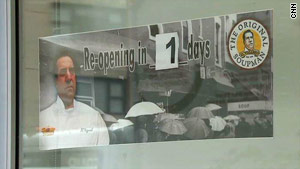
Real-life 'Soup Nazi' reopening famed shop

By Jessica Naziri,
From http://www.cnn.com/

Al Yeganeh's soup store in midtown Manhattan returns Tuesday after  a six-year absence.
Al Yeganeh's soup store in midtown Manhattan returns Tuesday after a six-year absence.

New York (CNN) -- Get in line, have your money ready and move to your extreme left -- Al Yeganeh, "the Original SoupMan," is back and re-opening his famed soup store Tuesday in midtown Manhattan.

Yeganeh and his Soup Kitchen International first rose to fame after he was caricatured in the long-running NBC TV show "Seinfeld" as the "Soup Nazi," a cranky and demanding soup-stand cook who bellowed "No soup for you!" to customers who didn't follow his strict rules for ordering.

Watch CNNMoney.com's report on the 'Soup Nazi' Video

Yeganeh, who first opened his shop in 1984, closed the store six years ago, but kept the lease to pursue franchise opportunities and a line of frozen soups with the Original SoupMan brand.

Chef Dan Rubano, who mentored with Yeganeh, was at the store a day before its re-opening, helping to set things up.

"We are keeping the original recipes and adding more to the menu," Rubano said.

Rubano didn't know whether Yeganeh would stop by for opening day, but said he's expected to make sporadic appearances.

According to the "Seinfeld" Web site, Yeganeh was at first unhappy with the publicity from the "Soup Nazi" episode and was quoted as saying he threatened to "smack" comedian Jerry Seinfeld's face.

Seinfeld, whose title character was banned during the "Soup Nazi" episode, declined to comment on the store's reopening.

NPR: Aged 9,000 Years, Ancient Beer Finally Hits Stores

See the original image at npr.org

npr.org — The Neolithic period, which began about 12,000 years ago, is thought to be about the time when humans started settling down, raising crops — and apparently getting a little tipsy.

click here for the full article and gallery: NPR: Aged 9,000 Years, Ancient Beer Finally Hits Stores

The Meteoric Rise and Catastrophic Fall of the PT Cruiser


2005 Chrysler PT Cruiser

2005 Chrysler PT Cruiser

Enlarge Photo
On Friday, the very last Chrysler PT Cruiser rolled off the assembly line in Mexico. To say that the last PT Cruiser marked the end of an icon would be a total understatement. The retro model’s life began a decade ago and was an instant hit, helping Chrysler rack up sales as high as 144,717 units in 2001 alone. A decade later, the PT Cruiser is very much a like a time capsule; having undergone only minor changes since its introduction, it has become a relic of everything that went wrong with Chrysler.

In the beginning…

Amid the bland Honda Civics and the conservative Toyota Camrys that dominated the compact and midsize sedan segments, Chrysler became a trendsetter with the launch of the PT Cruiser. The Cruiser’s flared fenders, sloping hood, and five-door body style mimicked the old sedans and panel trucks of the 1930s and 1940s. Its distinctive look even inspired a slew of other "retro" styled creations. But the eye-catching PT Cruiser and its immediate success didn’t just lead to imitators such as the Chevrolet HHR, instead it arguably spawned an entire movement of retro vehicles, like the latest generation Ford Mustang and Chevrolet Camaro.

Although the Chrysler PT Cruiser did appeal to an older demographic that remembered the vehicles from which the Cruiser’s styling was essentially borrowing from, its success was attributed to the fact that consumers of every demographic, young and old, seemed to be mesmerized by the car. Aside from its looks, the PT Cruiser was also roomy, versatile, and affordable, which helped make this car a great all-around value.

Then things went wrong

The initial success of the PT Cruiser was staggering, and many dealers were perpetually running out inventory. Over the years Chrysler decided to offer consumers more choices, eventually adding a convertible, with some new paint colors to choose from. Concepts of two-door and panel van versions were also built, but never reached production.

Unfortunately for the PT Cruiser, few other significant changes were introduced as the years went on. No major redesign or styling update was done, which caused the once trendsetting Cruiser to become dated and tired. Sales began to reflect that it was simply falling behind the times. From its high of 144,717 in 2001, the PT Cruiser sold just over 50,000 in 2008, and only 17,941 last year.

As the car withered away from abandonment, Chrysler was also struggling with larger problems. Resources began to dry up and product life-cycles lengthened. Eventually, the automaker’s troubled nine-year partnership with Daimler AG ended and in 2007 Chrysler was sold to private equity firm Cerberus Capital Management. With new ownership, the outlook at Chrysler didn’t improve much and the company fell into bankruptcy last year.

The chopping block

After Chrysler emerged from bankruptcy, Italian automaker Fiat Group SpA took the helm of the company and vowed to revamp Chrysler aging lineup; much of which had been criticized for dismal quality and poor efficiency.

It didn’t take long for Fiat to axe the PT Cruiser from the lineup, in part to make room for the U.S. launch of the Fiat 500. Slated to be built on the same assembly line as the PT Cruiser, the 500 is small, ultra fuel-efficient, and boasts fresh European styling. Despite being a very different car than the PT Cruiser, it’s also hoped that the 500 will make the same splash that the Cruiser did. Only this time, the automaker is no doubt hoping to sustain its popularity a little longer

Compounding problems

Because the PT Cruiser was so quintessentially American, it never stood a chance for substantial sales outside of the U.S. These days, due to economic constraints, automakers like Ford are building more global products, such as the Fiesta, which are designed to appeal to as many markets possible, and not just a select few.

With Chrysler producing so many PT Cruisers over the years - without any major redesign - the car became old just as quickly as it became a sensation. As it aged rather ungracefully sales steadily dwindled to a low of just 4,917 units this year through the end of June.

Despite the ill-fated position the PT Cruiser found itself in, it did prove to be a sales powerhouse for Chrysler - at least for a while. For those that still have an affinity for the beleaguered Detroit automaker, let’s hope that the meteoric rise and catastrophic fall of the PT Cruiser serves as a valuable lesson for Chrysler and for the upcoming 500.