Zazzle Shop

Screen printing
Showing posts with label Mayans. Show all posts

Tuesday, July 20, 2010

Maya Royal Tomb Found Beneath El Diablo Pyramid

Mayan Treasure from the burial  beneath the El Diablo pyramid, Guatamale - Image credit Arturo Godoy
The artefacts discovered in the tomb have been dated to between 350 and 400AD. - Image credit Arturo Godoy
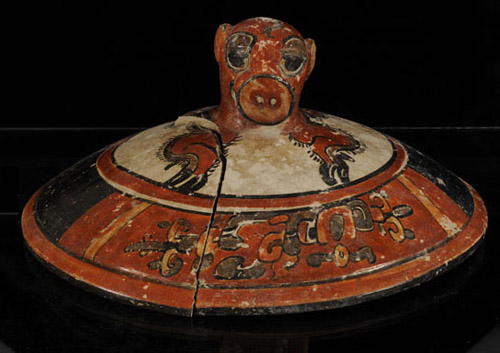
Archaeologists excavating in the Guatamalan jungle have discovered a royal tomb, filled with colourful 1,600-year-old Mayan artefacts, beneath the El Diablo pyramid. The well preserved tomb is packed with carvings, ceramics, textiles, and the bones of six children, possibly the remains of a human sacrifice.

The archaeological team, led by Stephen Houston, professor of anthropology at Brown University, uncovered the tomb beneath the El Diablo pyramid in the city of El Zots, Guatamala in May. Last week, the discovery of the tomb, dated to between 350 and 400AD, was made public.

Houston said the first pointer to the discovery was “something odd” in the deposit the team was digging, at a small temple built in front of a sprawling structure dedicated to the sun god, an emblem of Maya rulership.

“When we sunk a pit into the small chamber of the temple, we hit almost immediately a series of ‘caches’ - blood-red bowls containing human fingers and teeth, all wrapped in some kind of organic substance that left an impression in the plaster. We then dug through layer after layer of flat stones, alternating with mud, which probably is what kept the tomb so intact and airtight.”

The tomb itself is about 6 feet high, 12 feet long, and four feet wide. “I can lie down comfortably in it,” Houston said, “although I wouldn’t want to stay there.”

Then, on May 29th 2010, Houston was with a worker who came to a final earthen layer.

“I told him to remove it, and then, a flat stone. We’d been using a small stick to probe for cavities. And, on this try, the stick went in, and in, and in. After chipping away at the stone, I saw nothing but a small hole leading into darkness.”

They lowered a bare light bulb into the hole, and suddenly Houston saw “an explosion of color in all directions - reds, greens, yellows.” It was a royal tomb filled with organics Houston says he’d never seen before: pieces of wood, textiles, thin layers of painted stucco and cord.

“When we opened the tomb, I poked my head in and there was still, to my astonishment, a smell of putrification and a chill that went to my bones,” the dig's director said. “The chamber had been so well sealed, for over 1600 years, that no air and little water had entered.”

artefact from the discovery of mayan royal tomb at el  diablo pyramid, el zotz
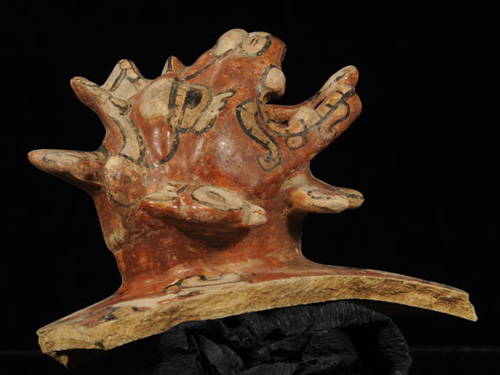
The chamber had been so well sealed, for over 1600 years, that no air and little water had entered. The colourful artefacts it contained are well preserved. - Image credit Arturo Godoy
The tomb itself is about 6 feet high, 12 feet long, and four feet wide. “I can lie down comfortably in it,” Houston said, “although I wouldn’t want to stay there.”

It appears the tomb held an adult male, who was between 50 and 60 he died from natural causes, but the team's bone analyst, Andrew Scherer, assistant professor of anthropology at Brown, has not yet confirmed the finding.

And who was this man buried with such a wealth? Though the findings are still very new, the group believes the tomb is likely from a ruler they only know about from hieroglyphic texts.

“These items are artistic riches, extraordinarily preserved from a key time in Maya history,” said Houston. “From the tomb’s position, time, richness, and repeated constructions atop the tomb, we believe this is very likely the founder of a dynasty.”

According to Houston, the tomb shows that the ruler is going into the tomb as a ritual dancer: “He has all the attributes of this role, including many small ‘bells’ of Spondylus shell with, probably, dog canines as clappers. There is a chance too, that his body, which rested on a raised bier that collapsed to the floor, had an elaborate headdress with small glyphs on them. One of his hands may have held a sacrificial blade.”

The blade was probably used for cutting and grinding through bone or some other hard material, and its surface seems to be covered with red organic residue. Though the substance still needs to be tested, “it doesn’t take too much imagination to think that this is blood,” Houston said.

So far, it seems likely that there are six children in the tomb, some with whole bodies and probably two solely with skulls. The children - ranging in age from 1 to 5 - were "probably sacrificed" in honour of the ruler.

“We still have a great deal of work to do,” Houston said. “Remember, we’ve only been out of the field for a few weeks and we’re still catching our breath after a very difficult, technical excavation. Royal tombs are hugely dense with information and require years of study to understand. No other deposits come close.”

The ancient Maya kingdom of El Zotz is located within a day's walk (about 20kms) from Tikal, the capital of one of the largest and most powerful kingdoms of the ancient Maya. Yet, El Zotz flourished in the midst of the 1st millennium AD - after Tikal was defeated by Caracol (Belize) and Calakmul (Mexico). It is likely that El Zotz allied with Tikal's enemies and that relations between the two cities were hostile. According to a text found at Tikal, in the 8th century AD, El Zotz was engaged in battle against Tikal, and the last known hieroglyphic inscription to refer to El Zotz describes the city as being the target of an attack by Tikal.

Thursday, January 28, 2010

Giant sculptured Mayan head found

January 27, 2010 by Lin Edwards Giant sculptured Mayan head found

Enlarge

Maya mask at the National Museum of Anthropology in Mexico City. Image: Wolfgang Sauber, via Wikipedia.


(PhysOrg.com) -- A decorated Mayan head measuring three meters (10 feet) at the base and sculptured out of stucco has been unearthed in northern Guatemala, near the border with Mexico. The sculpture had been buried for centuries under the thick jungle, and its presence may suggest the site could have been part of a Mayan city.

Archaeologists from the Polytechnic University of Valencia and the University of Valencia in recently found the in the Chilonché ruins in the jungle-covered Petén region. The team are experts in stuccoed artifacts and their restoration and conservation. They have dated the giant head to the early Classical period of 300-600 AD, which is considerably older than other artifacts found at the site, and means the site is older than thought previously. The find is in excellent condition and some of its original colors have been preserved.

One of the archaeology team, Professor Gaspar Muñoz Cosme, said the find was “spectacular” and the sculpture could be linked to Mayan mythology, and possibly represents an imaginary being such as a Mayan god, or an underworld figure. He said the discovery provides important scientific data that helps us understand the architecture of the Mayans of the time. The team hopes to find similar heads at the site, since the Mayans often built and arranged multiple items symmetrically.

The Petén region is close to well-known Mayan cities such as Tikal and Nakum. It contains dozens of Mayan ruins, but the site at Chilonché has not been excavated to a great extent, largely because the thick jungle region is home to poachers, looters looking for artifacts to sell on the black market, and drug smugglers carrying cocaine to nearby . The giant head was found inside one of the tunnels built by looters at the site. As soon as the find was located, the contacted Guatemalan authorities to ensure security around the site was tightened because of the significance of the find.

The giant figurehead sculpture is similar to other sculptured heads found at Uaxactun, where they decorated a solar observatory. In the Classical period from 300 to 900 AD the Mayans built vast cities and towering pyramids in an extensive area of Central America from Mexico through Honduras, El Salvador, Guatemala and Belize. The reasons for the collapse of the Mayan civilization in the last century or so of the Classical period remain a mystery, but may have been linked to deforestation and resulting climate change and extended droughts and crop failures.

© 2010 PhysOrg.com

Wednesday, July 22, 2009

Professional mover finds $16,500 in rare antiquities in the trash


Costanza for News

Art expert Howard Nowes (r.) examines artifacts found by Nick DiMola.

One man's trash turned into Nick DiMola's treasure.

Five years after the Queens rubbish remover took home a mysterious barrel from a SoHo apartment, he opened it to find dozens of ancient Mexican artifacts.

The mix of bowls, figurines and jugs were made between 300 B.C. and 500 A.D., some by Mayans.

They're worth an estimated $16,500 - and DiMola said he's not at all surprised.

"There's always something in the garbage worth money," he said.

DiMola, 39, came to own the booty when his Ridgewood company was hired to clear the cluttered space of abstract artist Clinton Hill, who died in 2003.

Hill left his possessions to his longtime partner, Allen Tran, who died just months later, said John Koegel, a lawyer for their estates.

The couple's property fell to friends, who formed a nonprofit foundation to take the valuables from the studio.

Hill's estate paid DiMola about $4,500 in October 2004 to clean out the artist's Prince St. apartment, studio and basement storage.

The scuffed cardboard barrel was mistakenly considered trash and DiMola stuck it in a warehouse, where it collected dust for years.

He recently decided to peek inside just to see what treasure might await.

Even though no one intended to toss out the artifacts, Koegel said the foundation has no legal claim to recoup them from DiMola.

"If he is given a contract by the owner of property to remove and dispose of certain things, if the owner makes the mistake, that's the way it is," Koegel said.

Still, the attorney declined to congratulate DiMola on his find.

"I'm not happy for him," Koegel said. "I'm sorry that [barrel] slipped through the cracks."

The most valuable object that DiMola brought to upper East Side art dealer Howard Nowes for appraisal was a $1,000 stone ax god - perhaps intended as a sacrifice - from the Mezcala region of Mexico.

As for the pieces' future, DiMola said he first planned to pack them back into the barrel. He doesn't collect ancient art, so he said he was open to selling the pieces.

"I don't see the beauty in this, to be honest with you," he said. "I like things about history, but this pottery doesn't grab me."