Tiny Flying Lizard Discovered in Indonesia
on February 16, 2010
By Michael Graham Richard
Original Post here: http://www.treehugger.com/
Adding Value To The World, one Post At A Time
Posted by gjblass at 4:57 PM 0 comments
Labels: 'Avatar', Amphibians, Avatar, Biology, Dragonfish, Lizard
By Ryan Wilson
Darrell Green retired from the Redskins after the 2002 season. He was the team's first-round pick in 1983, a seven-time Pro Bowler, and when it was all said and done, a first-ballot Hall of Famer.
In addition to being one of the all-time Redskins greats, he was also one of the fastest. And that still holds. According to his Twitter feed, Green celebrated his 50th birthday, like most folks who reach the milestone, by busting out a 4.43 forty.
A decade ago, shortly after signing a five-year deal (yep, that's right, Dan Snyder gave a 40-year-old a five-year contract), Green did this:
Posted by gjblass at 4:09 PM 0 comments
Labels: Football, Hall of Fame, NFL, NFL Rules, Track and Field
i.imgur.com — Over 22 years, the Great American Beer Festival has awarded 2,987 brewing medals. Here's where they all hail from.
CLICK TO ENLARGE
Posted by gjblass at 3:55 PM 0 comments
Labels: Beer, Beer Breweries, beer economy, Brewers, Sam Adams Brewery
By Jessica Ravitz, CNN
Atlanta, Georgia (CNN) -- No pizza maestro worth his sauce will reveal his secrets.
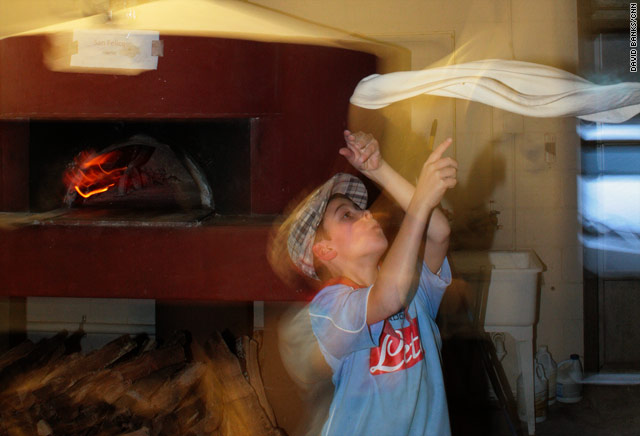
Not even if he's 9 and hoisting up his apron so he doesn't trip on it.
"I'm going to have to know you better," Johnny Di Palma says with a smile, as he sprinkles ingredients onto freshly tossed dough. "And if I tell you, I'll have to kill you."
It's a Wednesday evening and the third-grader is where he usually comes after school -- Antico Pizza, the dream-come-true business established by his father, Giovanni Di Palma. The father/son duo moved from New York two years ago to start a unique pizza place, one that would reflect their family's Italian roots. Four months ago, the restaurant on the west side of Atlanta, Georgia, opened its doors.
In the large open kitchen, where patrons crowd to eat over large metal worktables, Johnny is at home. He does his schoolwork -- math is his favorite subject -- in the restaurant office. But otherwise he's working the crowd in his signature newsboy-style hat, tossing and stretching dough (a skill he began developing at age 4) and making grown women swoon.

Gallery: Authentic Italian pizza in Atlanta "He wanted to know if this was my first time here," a 32-year-old woman gushes, her hand over her heart. "Oh, he's so cute."
Asked where he was born, Johnny, sporting a red kerchief around his neck, is quick to say Italy. But his father, standing within earshot, shakes his head and laughs.
"He thinks he was," Di Palma, 45, mutters. "Little Italy," in New York, "is more like it."
Along one wall are the imported mixers and sacks of San Felice flour from Naples, where Giovanni Di Palma's grandparents came from and where the family pizza-making tradition began. On the opposite side of the kitchen are three handcrafted ovens -- weighing in at 30,000 pounds -- that heat up to more than 1,000 degrees and bake a pizza to perfection in 60 seconds.
Combining ancient Santa Maria brick with beds of volcanic rock from Mount Vesuvio and Sorrento stone, only seven of these Acunto Napoli ovens exist in the United States, Di Palma says. He has three of them.
Propped atop each one is a patron saint, including above the center oven San Gennaro, the patron saint of Naples -- which is also the name of Di Palma's signature pizza, one that includes sweet and spicy peppers from a location he refuses to name -- or rather, confirm.
Johnny says they come from Sicily. His father counters with South Africa. Later, one of them says Morocco. The game of guarding a family recipe secret is one the boy knows how to play.
If he had his way, Johnny might be hanging out to the sound of Green Day. But the songs that fill the Antico Pizza kitchen include Dean Martin's "In Napoli," Frank Sinatra's "Isle of Capri" and Enrico Caruso's "O Sole Mio." The maestros at the ovens get especially worked up during Gigi D'Alessio's "Napule" -- the song, about a guy making pizza, that's used to pump up the Naples soccer team before games.
Wearing a team jersey emblazoned on the back with his nickname "Giggotto" (usually shortened to "Gigi" or "Gigo"), Johnny grabs a 12-foot-long wooden paddle and maneuvers one of his pizzas into an oven.
"Maestro, bravo! Gigo!" his father calls out, while standing beside the woman he recently asked to marry him.
Aleesha Hurd was studying to get her MBA at nearby Georgia Institute of Technology when she was introduced to this place. She walked into the under-construction kitchen for an interview, wanting to do some bookkeeping for Di Palma.
"I came in all Tahari-suited up," she says, laughing at the memory. "He asked me, 'You like pizza?' I said, 'No.'" With that, she says, the interview stopped. Di Palma got to work in front of the ovens, then placed one of his creations before her. "I ate the whole damn pizza myself," she says, shaking her head.
She was sold on the business, and even before the engagement she put school on hold to help make Di Palma's dream happen. Telling her father she was dropping out to work at a pizza place didn't go over well at first, she says, but one trip down from his Ohio home and her dad understood.
"I thought I made a pretty mean pizza," Albert Hurd said by phone. "Then I go and see the place. ... I'm watching these people come in. I just couldn't believe how they kept coming. They came until they ran out of dough."
On Saturday nights, Di Palma says, they usually have to lock the door to new customers at around 7:30 p.m.
It's not just any pizza, and Johnny knows this, too. He'd like to start a class to teach other kids how to make a proper pizza, and he grimaces and gives a thumbs-down at the mere mention of places like Domino's and Papa John's. But he also munches on prepackaged convenience store beef jerky while strolling past a bin of specialty dried aged beef fit for his father's pizzas, and says of Wendy's, "They rock!"
He absently grabs a handful of fresh basil and pops it in his mouth as he talks about his favorite movies, "a lot of blood and gore," he says, his eyes lighting up. Later, while making a mask out of dough for a 7-year-old boy who's in the restaurant to celebrate his birthday, Johnny blurts out, "You ever hear of Jeffrey Dahmer? That's one of the coolest serial killers."
He rattles off his other hobbies -- skateboarding, soccer and his Xbox 360 included -- and boasts of other skills. Tossing mints in the air, he pumps his fist when he catches three in a row.
"My second-best talent is jumping two chairs in a row, the long way," he says, minutes before grabbing hold of his flour gun.
Yes, Johnny is there in the family restaurant, charming the patrons. But he's also a boy who, frankly, can act like one. Taking -- and wearing -- handfuls of imported flour, he loads his weapon.
Bam! He blasts his uncle Giuseppe, visiting from out of town, in the back of the head.
Poof! He shoots a boy who's dining with his family point-blank in the face.
"Hey Gigo," his father calls out over the crowd and white cloud, "it might be time to put the gun away."
Leaving the laughing boy customer behind, Johnny saunters off -- maybe to chat up several women who are smiling his way or, if he's feeling it, to create the sort of pizza that would make his ancestors proud.
Posted by gjblass at 2:48 PM 0 comments
Labels: Child Prodigy, Pizza, Restaurant, Restaurant News, Restaurant Reviews
Did you read that right? The Canadian hockey team has a rap song? Kind of. Two Maple Leafs blogs -- Bloge Salming and Down Goes Brown -- have produced a hilarious Team Canada "Olympic Welcome" rap. Listen to (fake) Jerome Iginla use the Patrick Kane photos to diss Team USA.
"Can't believe you think you got a chance against the best/when your roster looks weaker than Patrick Kane's chest." So awesome.
h/t: Fourth Place Medal
Posted by gjblass at 2:30 PM 0 comments
Labels: Canada, Hockey, Olympics, United States, Vancouver
From: http://www.nytimes.com/
Suzanne DeChillo/The New York TimesON BOARD Alejandra, a 30-year-old waitress in Queens, is part of a government study of children’s health that will follow her and her daughter, Isabella, shown with her husband, José, for 21 years.
The woman sent by government scientists visited the Queens apartment repeatedly before finding anyone home. And the person who finally answered the door — a 30-year-old Colombian-born waitress named Alejandra — was wary.
![]()
EARLY START Alejandra agreed to be part of the study when she was pregnant. Isabella was born in August.
Although Alejandra was exactly what the scientists were looking for — a pregnant woman — she was “a bit scared,” she said, about giving herself and her unborn child to science for 21 years.
Researchers would collect and analyze her vaginal fluid, toenail clippings, breast milk and other things, and ask about everything from possible drug use to depression. At the birth, specimen collectors would scoop up her placenta and even her baby’s first feces for scientific posterity.
“Nowadays there are so many scams,” Alejandra said in Spanish, and her husband, José, “initially didn’t want me to do the study.” (Scientists said research confidentiality rules required that her last name be withheld.) But she ultimately decided that participating would “help the next generation.”
Chalk one up for the scientists, who for months have been dispatching door-to-door emissaries across the country to recruit women like Alejandra for an unprecedented undertaking: the largest, most comprehensive long-term study of the health of children, beginning even before they are born.
Authorized by Congress in 2000, the National Children’s Study began last January, its projected cost swelling to about $6.7 billion. With several hundred participants so far, it aims to enroll 100,000 pregnant women in 105 counties, then monitor their babies until they turn 21.
It will examine how environment, genes and other factors affect children’s health, tackling questions subject to heated debate and misinformation. Does pesticide exposure, for example, cause asthma? Do particular diets or genetic mutations lead to autism?
“This is a very important study for understanding the health of our nation’s children and for identifying factors that may play a role downstream in adult health,” said Dr. Francis S. Collins, the director of the National Institutes of Health, which is overseeing the study.
But while the idea is praised by many experts, the study has also stirred controversy over its cost and content.
In August, the Senate committee overseeing financing for the study accused it of “a serious breach of trust” for not disclosing that the initial price tag of $3.1 billion would more than double, and said the study needed to release more information if it wanted to get “any” financing in the next budget year.
And an independent panel of experts and some members of the study’s own advisory committee say it misses important opportunities to help people and communities — emphasizing narrower medical questions over concerns like racial and ethnic health differences, leaving unresolved crucial ethical questions concerning what to tell participants and communities about test results.
“This study is of the magnitude of the accelerator in CERN, or a trip to the moon — a really big science issue,” said Milton Kotelchuck, a professor at the Boston University School of Public Health and a member of the independent panel. “But if you have a flawed beginning, then you’ve got 20 years of working on a flawed study.”
Officials are making changes, putting all but the pilot phase, to involve 37 locations, on hold while conducting an inquiry into the cost and scientific underpinnings, Dr. Collins said. Some data may no longer be collected if “we can’t afford” it, he said, and every aspect will receive “the closest possible scrutiny.”
The study is far from its plan of recruiting 250 babies a year for four or five years in each community. By December, 510 women were enrolled and 83 babies were born in the first seven locations, including Orange County, Calif., and Salt Lake County, Utah.
That was after knocking on nearly 64,000 doors, screening 27,000 women and finding 1,000 who were pregnant and in their first trimester (and therefore eligible).
Dr. Collins said there were “unexpected difficulties in the number of houses that have to be visited to get enough babies” — 40 houses per enrolled woman, instead of the expected 14.
The time and information required from families could also make the study “too burdensome to be conducted the way it is,” said Dr. Susan Shurin, former acting director of the National Institute of Child Health and Human Development, part of the National Institutes of Health and the study’s supervising agency. The fear is women will “go ‘Oh no, you again,’ and slam the door in your face.”
Specimens include blood, urine, hair and saliva from pregnant women, babies and fathers; dust from women’s bedsheets; tap water; and particles on carpets and baseboards. They are sent to laboratories (placentas to Rochester, N.Y., for example), prepared for long-term storage, and analyzed for chemicals, metals, genes and infections.
Participants provide the names and phone numbers of relatives and friends, so researchers can find them if they move. As children grow, scientists, including outside experts, can cross-reference information about their medical conditions, behavioral development and school performance.
Clues could emerge if, for example, developmentally disabled children in both rural Alabama and suburban California show similar genetic patterns or chemical exposure.
“The task in selling this study is going to be to say we realize that this is audacious” and “seriously hard to do, but this is hugely important,” said Dr. Ellen Wright Clayton, director of the Center for Biomedical Ethics and Society at Vanderbilt University and part of the independent panel and the study’s advisory committee. “I’m hopeful some of the deficiencies can be addressed.”
Selling the study presents different challenges everywhere.
In affluent, highly educated Waukesha County, Wis., the study is advertised on movie screens, yard signs and parade banners.
But in the hog-farm-and-Butterball-turkey-plant territory of Duplin County, N.C., where scientists have to enroll nearly a third of the 800 babies born each year, some women are “concerned about questions they may be answering and how they may sound answering those questions,” said Dr. Roland Draughn, a local obstetrician.
Nancy Dole, a co-principal investigator in Duplin, said “we had to reassure” residents that “the purpose is not to make the county look bad.”
Organizers have visited child car-seat installation events, church groups, even Latino men’s soccer teams. Some women have volunteered, even ones who are not pregnant, bringing their children to the study’s Duplin headquarters, a former video store.
But others would hesitate if approached.
“Twenty-one years, that’s a long time,” said Wanda Johnson, 37, a nursing-home aide with four children. “I may say yes, and then tomorrow, I don’t want to be bothered.”
In Queens, with over 2 million people and 30,000 births a year, recruiting 250 might seem easy. And some pregnant women, like Amy Saez, 28, said that if asked to participate, “I would totally be down with that because I’d become a part of science and history.” But recruiters confront a jumble of languages and cultures, calling telephone translation lines to communicate in Urdu, Nepalese and Russian, for example.
And they have to “knock on each and every door in a building until they learn who lives there,” said Dr. Philip Landrigan, chairman of preventive medicine at Mount Sinai medical school and the principal investigator in Queens. They buzz random apartments to get into buildings, “buttonhole people coming out, talk to doormen, supers,” he said. For recruiters’ safety, door-knocking stops at 8 p.m.
Soon, said Dr. Steven Hirschfeld, appointed the study’s director when the original leader left under criticism, new recruiting methods will be tried, including having doctors encourage patients to enroll. That was previously rejected because investigators felt doctor-referred patients would exclude some women, like those not getting prenatal care.
Besides looking at widespread conditions, like diabetes, the study will consider regional differences. Maureen Durkin, principal investigator in Waukesha County, Wis., wonders if radium in the county’s water, and houses built on “farm fields that may be contaminated with nitrates and atrazine,” have different health consequences than pollution or industrial chemicals in Queens.
Health authorities in Duplin County, N.C., are concerned about “so many hog lagoons and poop everywhere,” said Shannon Brewer, a health department nurse, who also worries that many women there fail to breastfeed because “at the turkey factory, they just can’t step out of line to pump.”
In Flushing, Queens, Alejandra, who gave birth to Isabella in August, is breastfeeding. But she said she was “afraid of the baby getting too many vaccines.” She quit smoking after getting pregnant, but her husband, 34, a golf instructor, smokes in their bathroom.
Joseph Gilbert, a study employee who has been interviewing and collecting samples from Alejandra, said study protocol limited his ability to urge participants to change health habits.
But study officials are trying to determine what information to give participants and when. Some experts say people should get results of their chemical or genetic tests only if medical treatments exist because otherwise it only causes anxiety. Others agree with Patricia O’Campo, a member of the study’s advisory committee and the independent panel, who says the study should be “less ivory towerish” and disclose more information to families and communities.
In this and other aspects of the study, “changes have to be made, and maybe some very big changes,” Dr. O’Campo said. “I think it could be so much more.”
Dabrali Jimenez contributed reporting.
Posted by gjblass at 1:11 PM 0 comments
Labels: alternative health, Eating Healthy, Health, Health -Wellness, Health / Research, Pregnancy, pregnancy-and-childbirth
Posted by gjblass at 12:38 PM 0 comments
Labels: Celebrities, Celebrity Childhood Hairstyles, Celebrity Gossip, Movies
Posted by gjblass at 12:18 PM 0 comments
Labels: 3D Art, art, Environmental Graffiti, Graffiti, snow, Street Graffiti, Urban Art

Photo courtesy of Trends Updates (this is not a picture of the actual turbine)
In an attempt to make offshore wind farms more profitable, Norway plans to build the world's largest turbine standing 533 feet tall with a rotor diameter of 475 feet. It will also be the most powerful by generating 10-megawatts to power over 2,000 homes, making it three times more powerful than current turbines.
"We are aiming to install it in 2011," said Enova's head of new technology, Kjell Olav Skoelsvik. The prototype will cost $67.5 million to build and Enova's committed to $23 million of it.
The power gain comes from reducing the weight and number of moving parts in the turbine--it uses a gearless generator system.
It will be built by the Norwegian company Sway and tested first on land in Oeygarden, southwestern Norway. Unlike most offshore wind projects where turbines rest on the seafloor, Sway turbines float. This means further offshore development where winds are stronger and more consistent.
The floating tower is a pole filled with ballast beneath the water creating low center of gravity. Anchored to the seabed with a single pipe and a suction anchor, it can tilt 5-8°, and turn around with the wind.
The Scandinavian country is one of the world's top oil and gas producers but obtains most of its own energy through hydroelectric power. Hopefully this turbine can give offshore farms the revolution they deserve.
Like this article? Follow me on Twitter or friend me on Facebook.
Source: Grist
Posted by gjblass at 12:16 PM 0 comments
Labels: Oil Rig Wind Turbines, Renewable Energy, wind energy, wind power

The long-promised Meebo IM app for the iPhone and iPod touch [iTunes link] is now available in the App Store, and it’s both free and awesome.
Meebo (
) is a primarily web-based IM client — a place you can go in your browser to access almost every IM network you might want to use: Google Talk/Jabber, Yahoo!, AOL Instant Messenger, MySpace (
) IM, Facebook (
) — you name it.
Meebo demonstrated its app in the main presentation of the Apple event last March when iPhone (
) OS 3.0 was announced, which finally added push notification support to iPhone apps. Meebo’s app looked fantastic, and folks got really excited about it, but after a couple of weeks of hype it faded away from the public eye. Apart from a web-based version of Meebo for iPhone, nothing happened. But now the promised native app is finally here.
Meebo is arguably the best IM app for the iPhone because it’s lightweight and easy to use, and because it supports almost every network under the sun. Scroll to the bottom of this post for a complete list of supported networks; we’ll bet you didn’t even know that many of them existed.
Push notifications are unsurprisingly part of the feature set. But other cool things include syncing chat logs (and everything else, really) with the web app and the ability to move between active conversations by swiping from side to side with your fingers.
Mostly, though, we were impressed with the simplicity and speed of the app. Other solutions like BeejiveIM and IM+ seem bulky by comparison and their prices are comparatively bulky, too: $6.99 for the former and $4.99 for the latter for all the features. Meebo is totally free, and though it does lack a couple of the more advanced features that its competitors offer, most users won’t notice their absence.
Here are some pics of the app in action:


- AIM (
)
- Are You Interested
- aujourdhui.com
- BasilMarket
- Batanga
- CafeMom
- Chess.com
- DailyStrength
- DanceTrippin
- Decayenne
- Dhingana
- EliteCastingNetwork
- eBaum’s World
- Fabulously40 (
)
- Facebook
- Fanpop (
)
- Flirtbox
- Flixster (
)
- FooPets
- Footytube
- Fupa
- GGL
- GamerNook
- Gamevance
- GirlsAskGuys
- Google Talk
- ICQ
- imageChef
- Indianelement
- ibeatyou
- Jabber
- JacketFlap
- JamLegend (
)
- Justin.tv
- Klikot
- MSN
- MingleVille
- MixPod
- MuchGames
- MySpace
- MyWorkster
- myYearbook
- Operation Sports
- OrangeShark
- Outspark
- Packed
- PlayedOnline
- Playfire
- Playlist
- Quepasa
- SocialSplash
- Sonico
- SparkPeople
- Sparkteens
- Starpulse
- Tehkseven
- Threadsy
- Ultimate Guitar
- Wadja
- Wixi
- Yahoo!
- Yonja
- Zinch
- Zorpia
Posted by gjblass at 11:53 AM 0 comments
Labels: Apple iPhone 3G, iPhone chat, iPod Touch, Meebo
Are we looking outside this morning and thinking ..."Sure, the sun is shining, but b-r-r-r-r it's still very chilly out there."
Posted by gjblass at 10:51 AM 0 comments
Labels: Handicapp, New Medical Procedures, prosthetic limb, robotic limbs
BLACK GUY GET HIS ASS WHOOPED BY OLD WHITE GUY. SMH
Posted by gjblass at 10:16 AM 0 comments
It's astounding that until this moment, three years after the iPhone, the biggest software company in the world basically didn't compete in mobile. Windows Phone 7 Series is more than the Microsoft smartphone we've been waiting for. Everything's different now.
Today, at Mobile World Congress in Barcelona, Microsoft is publicly previewing Windows Phone 7 for the first time. The brand new, totally fresh operating system will appear in phones this year, but not until the holidays. All of the major wireless carriers and every likely hardware maker are backing it, and they'd be stupid not to. It's awesome. We've got a serious hands on for you to check out, but here is everything that you need to know:
The name—Windows Phone 7 Series—is a mouthful, and unfortunately, the epitome of Microsoft's worst naming instincts, belying the simple fact that it's the most groundbreaking phone since the iPhone. It's the phone Microsoft should've made three years ago. In the same way that the Windows 7 desktop OS was nearly everything people hoped it would be, Windows Phone 7 is almost everything anyone could've dreamed of in a phone, let alone a Microsoft phone. It changes everything. Why? Now that Microsoft has filled in its gaping chasm of suck with a meaningful phone effort, the three most significant companies in desktop computing—Apple, Google and Microsoft—now stand to occupy the same positions in mobile. Phones are officially computers that happen to fit in your pocket.
Windows Phone 7 is also something completely new for Microsoft: A total break from the past. Windows Mobile isn't just dead, the body's been dumped, buried and paved over by a rainbow brick road.

It's different. The face of Windows Phone 7 is not a rectangular grid of thumbnail-sized glossy-looking icons, arranged in a pattern of 4x4 or so, like basically every other phone. No, instead, an oversized set of bright, superflat squares fill the screen. The pop of the primary colors and exaggerated flatness produces a kind of cutting-edge crispness that feels both incredibly modern and playful. Text is big, and beautiful. The result is a feat no phone has performed before: Making the iPhone's interface feel staid.
If you want to know what it feels like, the Zune HD provides a taste: Interface elements that run off the screen; beautiful, oversized text and graphics; flipping, panning, scrolling, zooming from screen to screen; broken hearts. Some people might think it's gratuitous, but I think it feels natural and just…fun. There's an incredible sense of joie de vivre that's just not in any other phone. It makes you wish that this was aesthetic direction all of Microsoft was going in. Another, sorta similar interface, in terms of data presentation, is this Android Slidescreen app, which gives you a bunch of info up top.
Windows Phone 7 is connected in the same sense as Palm's webOS and Android, with live, real-time data seamlessly integrated, though it's even smoother and more natural. Live tiles on the Start screen, which you can totally customize, are updated dynamically with fresh content, like weather, or if you've pinned a person to your Start screen, their latest status updates and photos.
The meat of the phone is organized around a set of hubs: People, Pictures, Games, Music + Video, Marketplace, and Office. They're kind of like uber-applications, in a sense. Massive panoramas with multiple screens that are each kind of like individual apps. People, for instance, isn't just your contacts, but it's also where social networking happens, with a real-time stream of updates pulled in from like Facebook and Windows Live. (No Twitter support announced yet, it appears—a kind of serious deficiency, but one we're sure will be remedied by ship date.)
As another example, Music + Video is essentially the entirety of Zune HD's software, tucked inside of Windows Phone 7.
A piece of interface that's shockingly not there: A desktop syncing app. If anyone would be expected to tie their phone to a desktop, you'd think it'd be Microsoft, but they're actually moving forward here. All of your contacts and info sync over the air. The only thing you'll be syncing through your computer is music and videos, which is mercifully done via the Zune desktop client.
The People hub might be the best social networking implementation yet on a phone: It's a single place to see all of your friends' status updates from multiple services in a single stream, and to update your own Facebook and Windows Live status. Needs. Twitter support. Badly. But you have neat things going on, like the aforementioned Live tiles—if you really like someone or want to stalk them hardcore, you can make them a tile on your Start screen, which will update in realtime with whatever they're posting, and pull down their photos from whatever service. There's also your very own profile page, where you can scan your current social state and post updates to multiple services simultaneously.
All of your contacts are synced and backed up over-the-air, Android and webOS style, and can be pulled from multiple sources, like Windows Live, Exchange, etc. Makes certain other phones seem a little antiquated with their out-of-the-box Contacts situation.
Microsoft's vision of Zune is finally clear with Windows Phone 7. It's an app, just like iPod is on the iPhone, though the Zune Marketplace is integrated with it into the music + video hub, not separated into its own little application. It's just like the Zune HD, so you can check out our review of that to see what it's like. But you get third-party stuff like Pandora, too, built-in here. Oh, and worth mentioning, there will be an FM radio in every phone (more on that in a bit).
Pictures is a little different though, and gets its very own hub. That's because it's intensely connected—you can share photos and video with social networks straight from the hub, and via the cloud, they're kept in sync with your PC and web galleries. The latest photos your friends post also show up here. Of course, you get around with multitouch zoom and zip-zip scrolling stuff.
I'll admit, I very nearly needed to change my pants when I saw the Xbox tile on the phone for the first time. Obviously, you're not going to be playing Halo 3 on your smartphone (at least not this year), but yes, Xbox Live on a phone! It's tied to your Live profile, and there are achievements and gamer points for the games you can play on your phone, which will be tied to games back on your Xbox 360.
If Microsoft's got an ace-in-hole with Windows Phone 7, it's Xbox Live. Gamers have talked about a portable Xbox for years—this is the most logical way to do it. The N-Gage was ahead of its time. (Okay, and it sucked.) The DS and PSP are the past. The iPhone showed us that the future of mobile gaming was going to be on your phone, and now that just got a lot more interesting. The potential's there, and hopefully the games will be plentiful and awesome enough to meet it.
Yes, the browser is Internet Exploder. And yes, the rumor's true: It won't be as fast as Mobile Safari. Not to start. But it's not bad! Hey, least it's got multitouch powers right out of the box. Naturally, you've got multiple browser windows, and you can pin web pages to the Start screen, like any other decent mobile browser.
The Outlook email app makes me question how people read email on a BlackBerry. It is stunning. I never thought I'd call a mail app "stunning," but, well, it kind of is. It's the best looking mobile mail app around. Text is huge. Gorgeous. Ultrareadable. Of course, it's got Exchange support too.
Remember what I said earlier about Windows Mobile being dead? So are all the apps. They won't work on WP7. Sorry Windows Mobile developers, it's for the best. Deep down, we all knew a clean break was the only way Windows Phone wasn't going to suck total balls.
Apps will have some standardized interface elements, like the app bar on the bottom for common commands. But here's a question: Will they multitask? Um, that depends on your definition of multitasking! When we asked Joe Belfiore, the guy running Windows Phone, he alluded to live tiles and feeds as some ofthe ways that third-parties will be able to "bring value to the user, even when their apps aren't running." Which sounds to us like a big ol' "shnope," but we'll see more next month at Microsoft's developer event MIX.
The Marketplace is where you'll buy apps. Since we've got like 6 months 'til Windows Phone 7 launches and people should be excited to develop for it, hopefully there'll be plenty of stuff to buy there on day one.
Naturally, Bing and Bing Maps are built into the phone as the default search and maps services. They're nice, smartly contextual, and very location-oriented. Bing's also used for universal search on the phone, via a dedicated Bing button. (There is no search but Bing search, BTW.) Bing Maps is multitouchable, with pinch-to-zoom. It's rich, with built-in listings with reviews and clever ways of searching for stuff. And yeah, Office! It's connected to that cloud thing, for OTA syncing and such. Business people should be happy.
Another way the old Windows Mobile is dead is how Microsoft's handling partners and hardware situation. With Windows Mobile, a phonemaker handed Microsoft their monies, and Microsoft tossed them a software kit, and that was that. Which is why a lot of Windows Mobile phones felt and ran like crap. And why it took HTC like two years to produce the HD2, the most genuinely usable rendition of Windows Mobile ever.
Microsoft's not building their own phones, but they're going to be picky, to say the least, with Windows Phone 7. Ballmer phrases it as "taking more accountability" for people's experiences. There's a strict set of minimum hardware requirements: a capacitive, multitouchable screen with at least four points of touch; accelerometer; 5-megapixel camera; FM radio; and the like. There are serious benchmarks that have to be met. And only chosen OEMs get to build the phones now, not like before, when anybody with $20 could get a license. The OEMs that Microsoft's announcing they're working with at launch are: Qualcomm, LG, Samsung, Garmin Asus, HTC, HP, Dell, Sony Ericsson, and Toshiba. AT&T's their "premiere partner" in the US (dammit). (Take note people! Premiere does not mean exclusive!)
Every phone will have a Bing (search) button and a Start button. Custom skins, like the minor miracles HTC worked, are now banned. The message to hardware makers is clear: It's a Windows Phone, you're just putting it together. Basically, phonemakers get to decide the shape of the phone, and whether or not there's a keyboard.
One other word on hardware, in a manner of speaking. Hardware it won't work with? Macs. Which is kind of stupid to us—a lot of the people Microsoft wants to use Windows Phone 7, like college students, have been going Mac in droves. You wanna lure them back Microsoft? Let them use your phone with any OS.
Windows Phone 7 Series is, from what we've seen, exactly what Microsoft's phone should be. It's actually good. It brings together a bunch of different Microsoft services—Zune, Xbox, Bing—in a way that actually makes sense and just works. But there's a real, lingering question: Are they too late? The first Windows Phone 7 Series…phone—goddamn that is a stupid name—won't hit until the end of this year. That's more than three years after the iPhone, two years after Android, hell, even a year after Palm, the industry's sickly but persistent dwarf.
History is on Microsoft's side here—we know what happened the last time Apple had a massive head start. Microsoft is, if nothing else, incredibly patient. Remember the first Xbox? Back when it was crazy that Microsoft was getting into videogames? It's cost them about a billion dollars and taken nearly 10 years, but now, with Xbox Live, Project Natal and their massive software ecosystem, they arguably have the most impressive gaming console you can buy. That was a pet project. Now, mobile is the future of computing. What do you think Microsoft will sink into that?
The mobile picture is now officially a three-way dance: Apple, Google, and Microsoft. The same people who dominate desktop computing. Everybody else is screwed. Former Palm CEO Ed Colligan famously said a few years ago: "PC guys are not going to just figure this out. They're not going to just walk in." That's precisely what's just happened. Phones are the new PCs. PC guys are the new phone guys.
Posted by gjblass at 2:25 PM 0 comments
Labels: android, apple iphone, Cellphone, cellphones, Microsoft, Microsoft Windows 7, Windows 7