Zazzle Shop

Screen printing
Showing posts with label Baseball. Show all posts

Tuesday, September 6, 2011

Gallery: Empire Invades AT&T Park for San Francisco Giants’ Star Wars Day

Giants Bounty Hunters 7th Inning Stretch Giants Bounty Hunters Lou Seal Jedi Fear the Beard Little Darth Vader Chewbacca Darth Weezy and Princess Leia

Lou Seal on Field Stormtrooper Fans Stormtroopers on Field Darth Wilson Stormtroopers Brian Wilson in Carbonite

SAN FRANCISCO — A steady stream of Darth Vaders, Princess Leias, Boba Fetts and, of course, Stormtroopers descended on AT&T Park here Sunday as the world-champion San Francisco Giants played host to the Empire for Star Wars Day.

In a city known for its geek fascinations, seeing Jedi mix with hard-core baseball fans is not an uncommon occurrence, but the Giants' game against the Arizona Diamondbacks was the first-ever Star Wars Day for the franchise.

And the team went all-out. Fans got a pre-game costume contest, a post-game screening of Star Wars Episode V: The Empire Strikes Back in the stadium, Stormtroopers guarding the field during the "Star-Spangled Banner," giveaway statues of Giants closing pitcher Brian Wilson — frozen in carbonite, Han Solo-style — and the opportunity to generally geek out throughout the game.

"We don't even know what the score is," said 33-year-old Ryan Flores, above right, who came in a Giants bounty hunter uniform. Flores told Wired.com that he and his Boba-Fett-meets-Giants-costumed friend, Robin Lopez, 31 (above left), were distracted from the game's play-by-play due to fans wanting pictures with the pair.

Not that Flores minded. He noted that he and Lopez had been happy to take pictures, making them each a Star for the day.

"I'm a geek and if I can make a little kid smile, that makes my day," Flores said.

During the game, Giants players were shown in Jedi garb in their photos on the stadium's giant screen. Between innings, the park showed Star Wars clips, including one featuring the team's mascot, Lou Seal, inserted into key scenes from the film franchise — changes that went over better with fans than last week's addition of Darth Vader screaming "No!" in the upcoming Blu-ray version of Return of the Jedi.

In the end, though, the Force was stronger with Star Wars fans than with the Giants, who lost to the Diamondbacks 4-1 after an 8th-inning rally by the Arizona team.

Click through the gallery above to get a taste of San Francisco baseball's geekiest day, and, as one fan's sign said, "May the SForce be with you."

Thursday, July 28, 2011

The worst call in baseball history?

A marathon Atlanta Braves–Pittsburgh Pirates game ended controversially after 19 innings of play — and an umpire's seriously questionable call


Julio Lugo (left) of the Atlanta Braves scores the controversial game-winning run in the 19th inning against the Pittsburgh Pirates Tuesday night.
Julio Lugo (left) of the Atlanta Braves scores the controversial game-winning run in the 19th inning against the Pittsburgh Pirates Tuesday night. Photo: Scott Cunningham/Getty Images
SEE ALL 78 PHOTOS


Best Opinion:  Atlanta J-C, ESPN, Sporting News

The video: The Pittsburgh Pirates and Atlanta Braves were playing a grueling six-and-a-half hour, 19-inning baseball game Tuesday night, when, at 1:50 a.m., what's being called a blown call by homeplate umpire Jerry Meals brought the contest to an unceremonious end. With the game tied at 3-3, Braves pitcher Scott Proctor hit a ground ball to third base, causing his teammate Julio Lugo to take off for home. It appeared that Lugo had been thrown out before reaching home plate, even to Lugo himself, who slumped his shoulders dejectedly. (View the clip below.) But Meals called him safe, saying it looked like the tag by the Pirates' catcher "oléd him." Meals later backtracked after looking at replays, saying, "I'm guessing he might have got him." Last year, umpire Jim Joyce made headlines for robbing Detroit Tigers pitcher Armando Galarraga of a perfect game with his own bad call. Does Tuesday night's gaffe top even that?

The reaction: It's "the worst call by an official in the history of professional sports," says Jeff Schultz at The Atlanta Journal-Constitution. Indeed, with so much riding on the outcome of the game — both teams are vying for playoff spots — "the call made me sad," said David Schoenfield at ESPN. What a way to end a "wonderful" marathon of a baseball game. Actually, the call wasn't as "obvious" as Jim Joyce's mistake last year, says Ryan Fagan at Sporting News. If that egregious umpiring mistake wasn't enough to get commissioner Bud Selig to institute an instant-replay rule in the MLB, "this one isn't going to do the trick, either." See it for yourself:


Thursday, July 14, 2011

Baseball big screen kid does a smooth Thriller dance in front of thousands


Seeing himself on the big screen, this kid began to boogie, and suddenly everyone in the stadium was watching him. Watch this little tyke take the opportunity to show off his dancing skills. Could you do better?

Friday, June 10, 2011

12 Incredible Fan Catches At Baseball Games

From: http://clutch.mtv.com/

Sometimes it's the folks in the stands who make the greatest catches at a baseball game. And that's more impressive because many of the greatest fan grabs were made by people with a beer or a baby in the other hand. We'll be massively impressed, though concerned for the child, if we ever see a parent pull down a foul ball holding both at the same time.


As the dog days of summer get ready to seize professional ballplayers and turn them into overheated zombies, fans need to ready themselves too. A foul ball is not just a souvenir but a threat. Just ask the dude from the Astros game last year who dodged a ball and let it hit his girlfriend, who rightfully dumped him. Some fans have made incredible barehanded catches on line drives; others have snagged sharp grounders that reached the walls; and one fella who we truly admire scooped a ball while returning to his seat with a tray of food (above, left). Baseball really is America's pastime. Enjoy these videos.

1. Phillies fan catches one while returning to his seat with a tray of food (and doesn't spill anything)

2. Guy catches a homer with his hat

3. Nonchalant barehanded catch by a Giants fan

4. Supermom made this amazing grab with her baby in her arm

5. Young girl snags one over the rail

6. Great barehanded catch on a home-run ball

7. Another outstanding catch by a Phillies fan, with baby in hand

8. Woman at a Rays game gets drilled in the chin, then snags not one but two foul balls in the same inning

9. '80s dude nearly falls over the rail and incredibly catches himself from disaster below


10. Impressive home-run ball catch by a fan over the rail

11. Guy uses a bucket of popcorn

12. Fan nearly crushes woman at a spring training game in pursuit

And last, for illustrative purposes, we had to include:

Dodgers fan who dropped his kid to try for a ball but didn't even make the grab

Photos: YouTube; MLB.com; Photo: Mark Gormus / Times-Dispatch (Supermom)

Tuesday, April 26, 2011

In 'Bottom Of The 33rd,' A Look At Baseball's Longest Game


The cover of "Bottom Of The 33rd."
Harper

The cover of "Bottom Of The 33rd."

This Sunday on Weekend Edition, Liane Hansen talks to Dan Barry, author of the new book Bottom Of The 33rd: Hope, Redemption And Baseball's Longest Game. The book is all about a minor-league game that took place — or, rather, began — on April 18, 1981. It was suspended after 32 innings, tied at 2-2, at four in the morning on April 19, Easter Sunday. It resumed two months later, when the Pawtucket Red Sox finally beat the Rochester Red Wings 3-2 in the bottom of the 33rd inning.

Now, when you hear "minor league," you might assume this game involved a bunch of nobodies you've never heard of, but as Barry notes, not only was superstar-to-be Wade Boggs responsible for tying the game back up at 2:00 in the morning at the one point where it threatened to actually end, but among those who played all 33 innings was Cal Ripken, Jr., who went 2-for-13.

Barry talks in the interview about the fact that when the game was suspended, there were roughly 19 people still in the stands, who had spent eight hours in the cold. When it resumed for what became the final inning, it had become a well-known game and Major League Baseball was on strike besides. So it attracted a lot of attention, meaning that 6000 people showed up, all of whom could claim to have attended baseball's longest game, but few of whom had stuck it out on Easter morning, 1981, until just after four.

The game, he notes, is only more compelling as a story because minor league baseball doesn't carry the assumption that a major league game does that everyone involved has already, in a sense, "made it." Barry says that there's "an undercurrent of aspiration" and "a touch of the tragic" in a league in which many of the players will, in fact, never become the successes they dream of being. But because they won't, he says, "we learn at a minor league game that it is the journey to cherish, not necessarily the conclusion."

Monday, April 11, 2011

Best Beckett ever? Why Sunday's outing may have been pitcher's best with Red Sox

from http://www.weei.com/

Josh Beckett allowed as few as two hits in eight or more innings for the first time in his career on Sunday. (AP)

The question was obvious: When was the last time members of the Red Sox [2] had seen Josh Beckett [3] be this good?

The answer was meant to reflect the fact that, in eight overpowering innings of shutout baseball, the right-hander was better than he was at any point in a lost 2010 season, or in an unimpressive first start of the 2011 campaign last week against the Indians. But the answer was more far-reaching. On Sunday, in his 4-0 victory over the Yankees [4] (recap [5]), Beckett was quite simply as good as the Sox have ever seen him.

Ever. As in ever.

The claim seems like something between hyperbole and blasphemy. After all, Beckett was singularly dominant in his remarkable rampage through the 2007 postseason.

That October, he logged a complete-game four-hit shutout with eight strikeouts against the Angels, a one-run, 11-strikeout outing against the Indians and a one-run, nine-strikeout performance against the Rockies in the World Series [6].

In 2009, he enjoyed his longest sustained run of excellence with the Sox, producing six starts in which he did not allow an earned run, including his only two regular-season complete-game shutouts (one against the Royals, another against the Braves [7]) in Boston.

Even so, it is not unreasonable to say that Beckett was even more impressive on Sunday than in any of those starts. For validation of the thesis, one needed only to ask the man who has been on the receiving end of Beckett’s best games in Boston.

“Best I’ve seen him. As far as [being] complete, absolutely,” Varitek said. “[It was] eight strong, perfect innings.”

Beckett had total mastery over his full repertoire of pitches on Sunday night. Rarely one to get carried away when breaking down his outings, even he acknowledged that he featured a special pitch mix.

“I just felt like I never did get into like a pattern,” Beckett said. “I felt like I was throwing everything.”

He leaned primarily on a 93-95 mph four-seam fastball that he powered down in the strike zone, helping him to record 11 outs via ground ball. (The Yankees [4] managed to produce just three fly balls or line drives during Beckett's eight innings on the mound.) He also featured the biting two-seam fastball that sends left-handed hitters jolting backward and then dives back over the inside corner of the plate (Beckett punched out Mark Teixeira [8] looking at just such a pitch in the first inning).

To those, he added a hammer curveball that he could either drop into the strike zone or bury in the dirt for swings and misses. And, finally, he featured the changeup that he worked to refine for the 2011 season.

That was the pitch that Beckett used for the most pivotal play of the game, a double-play grounder by Yankees leadoff man Brett Gardner that ended a first-and-second, one-out threat in the third inning.

“Right from the very beginning he was commanding all his pitches,” Sox manager Terry Francona [9] said. “And especially, when he opens up the plate with that two-seamer to the lefties, it seems like it opens up the entire plate. He commanded his breaking ball. He threw it in all counts. He established it to where they couldn’t sit on a pitch, because he was changing speeds going back and forth.”

He got swings and misses on every one of his pitch types, using each to record at least one strikeout. As he blitzed through the Yankees [4], retiring the final 14 batters, New York’s hitters started heading to the plate with a blindfold and cigarette, resigned to their impending failure. Beckett needed just nine, eight and eight pitches to plow through the sixth, seventh and eighth innings (respectively).

Yankees first baseman Mark Teixeira [8] would acknowledge after the game that his team could do little more than tip its collective hat.

“They said he might have been hurt last year — he looks fine now,” Teixeira said. “[Beckett had] four pitches — fastball, cutter, curveball, changeup — throwing them all for strikes. Fastball was 94-95 again, which we hadn’t seen in a while. And his location was great.”

So were the results. Indeed, they attested to an outing that — especially given the depth and talent of the Yankees [4] lineup — was as good as, if not better than, anything he’d done with the Sox. It may well be the case that Beckett has never had such a diverse pitch mix working so perfectly for him. The line suggested as much.

This marked the first time that the Sox had held the Yankees to as few as two hits since Pedro Martinez [10]’ historic one-hit, 17-strikeout complete game at Yankee Stadium [11] in 1999. It was the first time since 2002 (again, a Pedro special, this time against the Rays) that a Sox pitcher tossed eight or more shutout innings, allowed two or fewer hits and struck out 10 or more batters.

In the 34 career outings in which Beckett had pitched eight or more innings, he had never before allowed as few as two hits. Until Sunday night, as a member of the Red Sox [2], he had never struck out as many as 10 batters in a game in which he did not permit a run.

The contest was a reminder of who Beckett can be. Varitek suggested that the right-hander remains capable of performing to the level that defined his 2007 and 2009 peaks.

“His stuff’s the same. Absolutely,” Varitek said. “He’s worked real hard to get back to where he was at. … He’s strong, he’s powerful and he’s good.”

Beckett offered a tantalizing glimpse on Sunday. The Sox need not be resigned to the idea that he is now just a back-of-the-rotation starter.

But ultimately, the dominant outing against the Yankees may mean little if Beckett cannot back it up. He was mindful of that fact when asked whether he had any game that would compare to Sunday’s outing against the Yankees in 2010.

“If I do, I can’t remember,” he said with a shrug. “That’s kind of me, moving forward to whatever is next and what I have to do tomorrow. I’m not really looking back.”

Where Sunday ranks among Beckett’s Red Sox [2] starts matters less than what it means going forward. It gave the Sox a much-needed victory, and also served as a reminder of what Beckett can be.

It was not so long ago that the 30-year-old was viewed as the anchor of the rotation. On Sunday, he offered a demonstration of how he achieved that status.

“That was the type of game that an ace throws,” Sox general manager Theo Epstein [12] said. “That was great to see. That’s an understatement. It was exactly what we needed.”

Monday, April 4, 2011

Field of dreams: Ballparks unveil tech upgrades

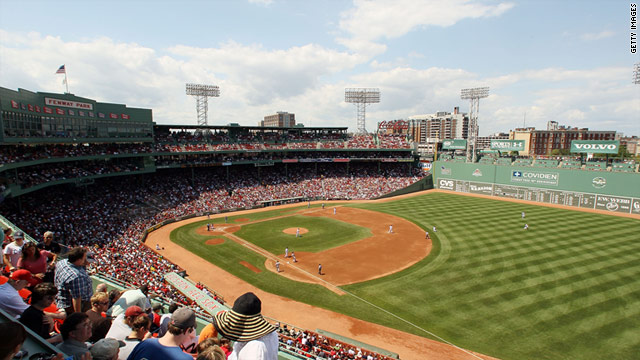
MLB clubs made tech-centric improvements to their ballparks, like Fenway Park, in advance of the 2011 season.

STORY HIGHLIGHTS
  • Fenway Park has rhree new scoreboards beyond right-center field for the 2011 season
  • Great American Ball Park has a new cell-tower system to access apps like MLB's At Bat

(WIRED) -- Professional sports teams are attempting at a furious rate to lure fans away from the comfort of their couches to live games. And sweet technological upgrades to their home venues become a bigger selling point every year.

Roughly a dozen Major League Baseball clubs followed that strategy by making tech-centric improvements to their ballparks in advance of the 2011 season, which kicks off Thursday. Notable upgrades include ballpark-wide Wi-Fi access (Chicago White Sox) and LED high-definition ribbon boards (Arizona Diamondbacks). Here's a deeper look at nine other teams that have made similar significant upgrades.

Houston Astros -- Minute Maid Park

The Astros join the Milwaukee Brewers and Minnesota Twins as the only MLB teams to feature a scoreboard with a 1080i display format. "Fans are watching games on high-definition [television], so when they come out to the ballpark we want things to be in high-definition, as well," Kirby Kander, the Astros' senior director of creative services, told Wired.com. Where once stood a 26-by-45-foot scoreboard in right field, there's now a 54-by-124-foot Daktronics behemoth that ranks as the fourth-largest scoreboard in the majors.

The 2.66-million pixel scoreboard was part of a $13 million project which included a 24-by-40-foot video board stationed in left field and 1,185 linear feet of ribbon boards spanning from one foul pole to the other. A state-of-the-art, two-level control room comprising 1,500 square feet was built at the suite level in left field to manage the new 'boards.

Apps, Gear and Beer: The Wired.com Guide to the Baseball Season

Boston Red Sox -- Fenway Park

A 10-year, $285 million plan to modify 99-year-old Fenway Park concluded this off-season with $40 million in construction upgrades, the most prominent of which are three new scoreboards beyond right-center field. ANC Sports Enterprises teamed with Mitsubishi Electric Diamond Vision Systems to install three video screens: a 38-by-100-foot scoreboard in right-center field that replaces a 23-by-30-foot structure installed in 1976 (but the famous John Hancock sign will still tower over the new 'board), a 17-by-100-foot video screen in center field, and a 16-by-30-foot video board in right field.

The primary scoreboard has the ability to display side graphics, as the old scoreboard did, or move to full-screen video to capture live action. The side 'boards will incorporate game info such as player stats, pitch speed and type, box scores, promotions, announcements and other types of messages

Philadelphia Phillies -- Citizens Bank Park

Phillies fans will get to watch live game action on a new 76-by-97-foot LED high-def scoreboard in left field. The old scoreboard, which was installed for Citizen Bank Park's 2004 debut, has been relocated to the Phils' spring training facility in Clearwater, Florida. The team partnered with Daktronics and Sony Electronics' System Solutions Group on the new 84,000-square-foot 'board, whose 2.9 million pixels dwarfs the former scoreboard's 459,000-pixel display.

Fans get to view one of the clearest scoreboards in the world. Its HD-15 display and 1,512 lines of resolution surpass that of the standard for 1080p HD video boards, and its LED technology allows it to show up to 144 quadrillion shades of color.

Citizens Bank Park's in-house video departments were also improved from standard to HD, including the video-coaching facility. Mark DiNardo, the Phillies' director of broadcasting and video services, told Wired.com the upgrade will most benefit the scouting and self-analysis performed by the team's coaches and players. "They voiced a concern to upgrade," DiNardo said, "and our management heard that concern."

Titanium Baseball Neckwear Big on Hype, Short on Science

Cincinnati Reds -- Great American Ball Park

The ability for fans to view information at high speed on their mobile devices headlines the pair of tech changes at the Reds' Great American Ball Park. The incorporation of a multi-tent cell-tower system with approximately 120 antennas will permit fans to access apps like MLB's latest At Bat rev on 3G or 4G networks through their iPhones, BlackBerries, iPads and Android devices. The app allows fans to view pitch-by-pitch tracking, real-time box scores and stats and searchable video highlights through a multitude of mobile service carriers, including ballpark sponsor AT&T. Reds IT director Brian Keys told Wired.com that roughly 1,500 to 3,000 fans demand high-speed mobile access at any given moment in the stadium, which seats more than 42,000 fans. "We're trying to get the fans more stats, videos, replays and information to their smart devices," Keys said.

Sixty luxury suites have also been outfitted with 46-inch Sony TVs and 25-inch Sony Vaio flat-panel PCs with Blu-ray functionality. Suite attendees can use the PCs to choose their preference of five camera angles on MLB.TV and view any league game, including typically blacked-out contests in Cincinnati, and reroute them to the high-def TVs.

Milwaukee Brewers -- Miller Park

The primary aspect of the Brewers' three-pronged tech upgrade for Miller Park is a 5,940-square foot scoreboard in center field. At 54 by 110 feet, the Daktronics 'board boasts true 1080i display containing more than 2.35 million pixels, compared to the 134,000 pixels produced by the dual 10-year-old scoreboards it replaces.

"The technology to support the [old scoreboards] was changing, and we were running out of spare parts for them," Brewers COO Rick Schlesinger told Wired.com. For example, the new scoreboard, unlike the ones it replaced, doesn't require air conditioning to cool it down. According to the Brewers, that will translate into a 50 percent to 65 percent reduction in energy consumption.

The Miller Park upgrades, which cost almost $11 million, also include a refashioned audio system that'll make it easier for the control room to manage the volume, bass and treble in different areas of the stadium.

Kinect Could Hold Key to Next-Gen Baseball Biomechanics

Seattle Mariners -- Safeco Field

A new LED scoreboard in right field and LED ribbon boards stretching from the the press box to the foul poles along the first- and third-base lines will enable the Mariners to present customized game and sponsor information to their patrons. All three Mitsubishi Electric Diamond Vision boards will have their video powered by ANC Sports' VisionSoft display. The system allows for a presentation of statistical and game information tailored strictly to Safeco Field. Sponsors can also customize their messages to appear on the boards on a game, series, homestand or season-long basis.

The 6-by-160-foot scoreboard above right field's Outfield Reserve seats will complement the ANC-installed out-of-town scoreboard in left field, implemented before last season. The 734 linear feet of ribbon boards permit the Mariners to show in-game information such as pitch count, type and speed; play-by-play from the prior three batters; animation and graphics; and messages from sponsors and the team's community relations department.

Minnesota Twins -- Target Field

Though Target Field only debuted last season, the team spent more than $5 million on improvements for the stadium's sophomore campaign. Leading the way is a Daktronics HD-15 LED scoreboard in right field, clocking in at 28 feet by 50 feet and providing 552 x 984 resolution. The new scoreboard mostly accommodates fans sitting in left field, who often complained of having to crank their heads to view live game video and statistical info on the scoreboard towering over them. This off-season, Twins owner Carl Pohlad made the move to address all the grumbling. "The Pohlad family said we'll just put up another [scoreboard], which is pretty cool," Twins VP of technology John Avenson told Wired.com.

A new 100-foot tall, LED-illuminated tower adjacent to the right field scoreboard will display situational graphic material and supplementary head-shot content, such as autographs, head-to-toe player pictures and player names and numbers. Also manufactured by Daktronics, each of the tower's four sides will incorporate more than 4,300 LED strips. An improved ballpark-wide Wi-Fi system with more than 200 access points will be operated by MLB Advanced Media, providing fans with information about the game, and ballpark, and even a concession-stand finder.

Tampa Bay Rays -- Tropicana Field

The Rays will play on a more durable and aesthetically pleasing surface at Tropicana Field, thanks to AstroTurf, the official synthetic turf of MLB. The company's GameDay Grass 3D60H model, installed during a three-week period this spring, contains a Horseshoe fiber which (literally) stands up to repeated use. The fiber's omega, or "C", dual-column design imparts mechanical memory to the fiber, so that it pops up even after repeated trampling by cleats and baseballs. Using 60 ounces of fiber per square yard ensures the surface's long-term durability.

The fiber's design also reflects light, which has a two-fold effect: It reduces surface temperatures by up to 18 percent and cuts down on the sheen produced by ballpark lights. The Rays' Andrew Heydt said the old artificial surface would produce a "glazing effect" when the dome's interior lights were turned on. That's no longer the case, as the improved look and performance of the Trop's turf almost mirrors the promise the future holds for Evan Longoria, David Price and the perennially upstart Rays.

Texas Rangers -- Rangers Ballpark in Arlington

New video boards in right and center field at Rangers Ballpark in Arlington use Daktronics' newest 15-millimeter LED technology. The 42-by-120-foot scoreboard above the Home Run Porch in right field and the 25-by-29-foot scoreboard in center field have the versatility to run as single displays or be separated into multiple windows to display various game info.

A newly installed IPTV system from Daktronics also allows all existing ribbon and field-level video boards and more than 800 Sony LCD monitors throughout the stadium to receive game information on up to 10 high-def channels. Real-time scores, statistics and even in-game menu pricing changes can be sent to any board or monitor on any IPTV channel. An upgraded control room and a revamped audio system round out the improvements made for last season's American League champs.

Subscribe to WIRED magazine for less than $1 an issue and get a FREE GIFT! Click here!

Copyright 2010 Wired.com.

Tuesday, September 28, 2010

Aroldis Chapman Throws Record-Breaking 105 m.p.h. Pitch


On Sept. 1, we told you about Cincinnati Reds reliever Aroldis Chapman's Major League debut, in which he pitched four 100+ m.p.h. pitches, including one that clocked in at 102.7 m.p.h. In a game this weekend between the Reds and the Padres, Chapman threw what is believed to be the fastest pitch ever recorder: a 105 m.p.h. fast ball inside to Tony Gwynn Jr. Chapman had been throwing in the 100s for his entire appearance, including a 104 m.p.h. fastball just before this record-breaker. Watch multiple videos of the pitch — from multiple angles — after the jump.

The TV broadcast from center field, including a funny "Bingo" reference by the announcer.


The view from the stands from behind the first-base dugout. The guy gets most of the preceding pitches, but only the scoreboard on the 105 m.p.h. pitch.

Thursday, August 5, 2010

Masato Akamatsu Makes The Greatest Home-Run-Saving Catch Ever (Video)

From: http://www.totalprosports.com/

Last season when Dewayne Wise climbed the center-field fence to rob Gabe Kapler of a home run, many considered it to be the greatest home-run-saving catch ever. While the grab was an impressive one, much of that label could be attributed to the timing of the catch, which took place in the ninth inning with Mark Buehrle's perfect game still intact. The catch would keep things that way and pave the way for Buehrle to enter the history books.

As for this outstanding over-the-fence catch by Masato Akamatsu of the Nippon Professional Baseball League's Hiroshima Carp, it may not have saved a perfect game, but just the sight of him scaling the entire wall is easily enough to make this the new front-runner for greatest home-run-saving catch ever.

Hat Tip - [NESN]

Thursday, July 15, 2010

Epic Ninja Ball Girl

Monday, July 12, 2010

Highest Paid Players in American Sports (Infographic)

mint.com In this infographic, mint.com compare the salaries of the top-paid baseball, basketball, football, soccer and hockey players, take a look at salary caps and give you the average compensation for a professional in each of these sports.


Budget Plannerfrom Mint.com

Friday, May 7, 2010

The 20 Most Awesome Fan Takedowns In Sports History


Cover_display_image

"Don't taze me bro!"

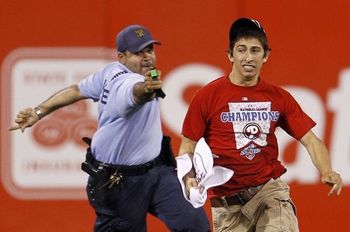
Before the Phillies fan who ran out onto the field the other night even had a chance to utter those words, he was taken down by an overzealous security guard who had watched The Hangover too many times.

Still, it serves the guy right. There's been a long and sordid history of fans running out onto the field and very rarely does it ever end well for them.

Here are The 20 Most Awesome Fan Takedowns In Sports.

Thursday, April 29, 2010

Best 3 Year Old Baseball Player


This is Beau. He likes the White Sox, Paul Konerko and mashing the ball out of the park.

Friday, April 23, 2010

Baseball Rain Delay Turns Into Talent Show Dance-Off

By: Ryan Wilson
From:  http://backporch.fanhouse.com/

There used to be a time when baseball rain delays meant one of two things: the teams involved would sit in the dugout or the locker room and wait for the weather to clear, or one enterprising soul would grace fans with a reenactment of a Babe Ruth home run, complete with waddling home run trot, and topped off with a tarp slide at the plate. Those were simpler times.

Last weekend, Western Kentucky and Florida Atlantic took advantage of the inclement weather and put on a talent show. There were dance-offs, wrestling matches, theatrical performances -- basically what you'd expect to find at a traveling carnival.


It was something right out of Glee just not as overproduced. Oh, and when the rain cleared, FAU beat WKU, 10-3. The talent show, however, was called a draw.


Friday, April 16, 2010

The Best 5 Year Old Baseball Player … EVER!

Ariel Antigua is The Best Five Year Old Baseball Player Ever!

April 12, 2010 – Matt Anaya

Wow, this kid is a stud.

Five year old Ariel Antigua from Lyndhurst, NJ is a do-it-all middle IF who is already hitting 85 MPH fastballs in the cage. A slick fielding potential shortstop, Antigua is on his way to something special and everyone around him knows it, just watch how people talk about him.

I do not know what I like most about him, yet. Perhaps his ability to go the other way so well as a five year old, or his slick fielding abilities. Either way, I love him.

Matt Anaya
Twitter.com/MatAnaya
Twitter.com/DugoutDoctors

Wednesday, April 7, 2010

Mark Buehrle Makes the Play of the Year ... on Opening Day

By Will Brinson
From http://backporch.fanhouse.com/


EDITOR'S NOTE: You may now see the video of Mark Buehrle's amazing play of the year at MLB.tv.

Hyperbole gets thrown around about "Play of the Year (!)" type stuff in every sport during the first week of the season. Usually it's just something incredible that reminds us said sport is here. But there's a pretty good chance you won't see a play more ridiculous than what Mark Buehrle pulled off on Opening Day.


Buehrle took a batted ball off his foot, sprinted to the first-base line after it, grabbed the ball with his glove, and managed to flip it between his legs to first baseman Paul Konerko who bare-handed it for the out. In case you don't believe me (totally understandable, by the way), there's video proof below.


Friday, April 2, 2010

Yankees Ambidextrous Pitcher

Pat Venditte Is The Newest Yankees Sensation

Yankees Pitcher Pat Venditte Can Throw From Both Sides! WTF?!

Have you guys seen this yet?

Pat Venditte, seen above pitching for his alma mater Creighton, is now a Yankee farmhand and he is ambidextrous. Yup, dude can throw left handed, and right handed, and is quite good at it. He has a career minor league ERA of 1.53, with a .95 WHIP and it seems like we might see him in the bigs shortly.

Tuesday, Venditte saw his first spring action and allowed one earned run, walked one, and gave up two hits in 1 1/3 innings against the Braves.

“People are going to have their doubts when they hear something like this, and I’ve got to prove that I can do it,” Venditte told MLB.com.

I promise I will be there for his big league debut, and the last MLB player to do the damn was Greg Harris in 1995 for Montreal. I think me and my brother called him “The Butt Shower” because his ass was so big.

Below are a few videos of my man throwing, including an ESPN video when Joba “The Hut” Chamberlain has nothing but good things to say about the multi talented Venditte.

Watch from the 1:00 mark as major confusion happens when both hitter and pitcher are capable of going from both sides. Pretty amazing stuff.

E:60 Piece

I wish this kid all the best and hope to see him in the bigs ASAP. He could pitch for the Cubs right now.

Matt Anaya
Twitter.com/MatAnaya
Twitter.com/DugoutDoctors

Monday, March 15, 2010

Japanese Girl May Be The First Female Pitcher To Make The Pros

Eri Yoshida wants to take her knuckleball proEri Yoshida an 18-year-old Japanese baseball player comes to America and tries to make the pros ... and she's a girl! It sounds like a magnificent sequel to "Mr. Baseball," but it's a-happenin'.

Yoshida is the first woman drafted by a Japanese professional baseball team, and she may be the first female pitcher to go pro. Her secret weapon is the old knuckleball, an elusive pitch that few have mastered, and the one thing that makes her attempt viable. Earlier this month, she hit the spring training circuit in Arizona, where she pitched under the tutelage of the Red Sox's Tim Wakefield. (Yoshida says she taught herself the pitch by watching videos of him.)

Although she isn't trying to make it to the majors -- she's only hoping for a spot in an independent league -- we would certainly love to watch an 18-year-old, 5-foot-1-inch lady strike out her juiced-up competitors.

Thursday, March 11, 2010

Nomar Garciaparra heads to TV studio after retiring -- as a Red Sox

From: http://content.usatoday.com/

Nomar Garciaparra, whose career tailed off because of injuries after leaving Boston, retired after 14 seasons today, signing a one-day contract with the Red Sox before heading for the TV studio.

By Jim Rogash, AP
"My tank's empty," Garciaparra said at a news conference in Fort Myers, Fla., shown on MLB.com. "It wouldn't have felt like a retirement if I couldn't have put this uniform on one more time."

The two-time American League batting champion will now don a jacket and tie as a member of ESPN's baseball crew, appearing mostly on Baseball Tonight.

Garciaparra, a six-time All-Star, says in recent years he's spent more time talking to younger players. Working on TV, he says, "is another way to pass on the knowledge. … I love talking about the game."

The infielder, who played 8 1/2 seasons in Boston before a 2004 trade to the Chicago Cubs, was a reserve for the Oakland Athletics last year, appearing in just 65 games, hitting .281 with three home runs and 16 RBI. He also played for the Los Angeles Dodgers.

"I hope to have a long career in broadcasting," Garciaparra said. "But it's not easy, and I've never thought it was." As potential role models on TV, he cites Harold Reynolds and Orel Herchiser as having done "a tremendous job" on-air.

Garciaparra, 36, exits with a .313 career batting average, with 229 homers, 936 RBI and six All-Star game selections, five as a shortstop for the Red Sox.

-- By Mike Dodd and Michael Hiestand

Monday, October 5, 2009

The Red Sox' swing doctor

Slumping sluggers could soon get help from MIT Media Lab researchers.

A player at the Boston Red Sox preseason training camp is wired with sensors developed by the MIT Media Lab, which gauge the forces he exerts when he swings the bat.
Photos: Joseph Paradiso and Alexander Reben

On Wednesday, the Boston Red Sox reached Major League Baseball's postseason playoffs for the sixth time in seven years. But whether or not they go on to win another World Series, when the Sox report to spring training next year, they could be spending some time in the trainer's room with members of the MIT Media Lab.

For three of the last four years, Professor Joseph Paradiso and other members of the lab's Responsive Environments Group have been strapping sensors on players at the Red Sox preseason camp to gauge the physical forces they exert when they swing a bat or throw a ball. So far, the researchers have been working mainly with minor-league players, trying to determine what kind of useful information they can extract from the sensors. But next spring, Paradiso hopes to gather more data on more players engaged in a wider range of activities.

If trainers could wire up a hitter when he's on a hot streak, and then again when he's in a slump, they might be able to determine how the mechanics of his swing have changed and how he can fix them. "There's many areas where this technique will have a meaningful influence on how things are perceived and how data is interpreted," says Eric Berkson, one of the Sox' team physicians. As a doctor, Berkson is particularly interested in how the technology could be used to identify behaviors that can lead to injury. "And then, using the same technology, we can try to find better ways to figure out when someone's able to come back from an injury and make sure they don't injure themselves in that process," he says.

The Responsive Environments Group's work with the Sox grew out of a project to allow dancers' movements to control the music accompanying them — "a very Media Lab thing," Paradiso says. While exploring the work's implications for gait analysis with collaborators at Massachusetts General Hospital, Paradiso met some physicians who worked with the Red Sox and were intrigued by the technology. Paradiso and his graduate student Michael Lapinski did the initial work on sensors customized for baseball players, and they've recently been joined by Clemens Satzger of the Technical University of Munich, who's at MIT until January.

Baseball teams had been trying to collect data on the biomechanics of players' swings and pitching motions for years, but they'd relied on optical systems that worked only in the lab and produced data that could be difficult to analyze. "Trying to measure pitching with just an accelerometer has never been done effectively before," says Berkson. "The idea that we can potentially do this biomechanics evaluation during real activities is a huge step."

In fact, the MIT team's sensors use more than just an accelerometer; they also use gyroscopes, and recent versions include a magnetometer that measures joint angles. But the biggest difficulty in developing the sensor, Paradiso says, is that no single accelerometer can handle the range of accelerations — measured as multiples of earth's gravity, or Gs — that a professional athlete can produce during a routine motion. The same goes for gyros and angular acceleration. "For dancers — even thought they're pretty kinetic, too — the 10-G range was okay," says Paradiso. "But for athletes — especially for pitchers — you have to go up to 120, 130 Gs to get that full range of motion, and for angular rate, you have to go up to about 10,000 degrees per second." The beginning of a pitcher's windup, however, though no less crucial to his delivery, is so slow that it won't register very clearly on a high-G accelerometer or high-rate gyro. So each Media Lab sensor includes two sets of three-axis accelerometers and gyros that span different ranges, to capture an athlete's full range of activity.

In the hope of further reducing the size of the sensors, Paradiso is talking with a Boston-area device manufacture about developing accelerometers and gyros that can handle a wide range of accelerations and angular rates, avoiding the need for dual sets of devices. But in the near term, a greater concern is developing ways to get the sensors on and off athletes more efficiently. "In spring training, even with a minor-league player, they're so tightly scheduled, that if you've got 20 minutes with this player, and you take a half-hour, that's going to throw their day off," Paradiso says. The lab is currently experimenting with a new method for mounting the sensors that should be more efficient but will also provide an attachment secure enough to withstand huge accelerations.

Ultimately, Paradiso believes, his group's work with the Sox will aid in the development of commercial devices for measuring biomechanics. Berkson finds that prospect exciting. "We can now look at what's causing injury in a shoulder through a pitcher's real activity, in real-world situations," he says, "and this will help us understand why kids get injured, and why Little League pitching is dangerous for some kids, and why there's an increased number of surgeries happening on these kids on a yearly basis." To some people outside New England, that could sound like an even more important application than helping the Sox to another World Series victory.