Zazzle Shop

Screen printing
Showing posts with label MLB. Show all posts

Tuesday, September 6, 2011

Gallery: Empire Invades AT&T Park for San Francisco Giants’ Star Wars Day

Giants Bounty Hunters 7th Inning Stretch Giants Bounty Hunters Lou Seal Jedi Fear the Beard Little Darth Vader Chewbacca Darth Weezy and Princess Leia

Lou Seal on Field Stormtrooper Fans Stormtroopers on Field Darth Wilson Stormtroopers Brian Wilson in Carbonite

SAN FRANCISCO — A steady stream of Darth Vaders, Princess Leias, Boba Fetts and, of course, Stormtroopers descended on AT&T Park here Sunday as the world-champion San Francisco Giants played host to the Empire for Star Wars Day.

In a city known for its geek fascinations, seeing Jedi mix with hard-core baseball fans is not an uncommon occurrence, but the Giants' game against the Arizona Diamondbacks was the first-ever Star Wars Day for the franchise.

And the team went all-out. Fans got a pre-game costume contest, a post-game screening of Star Wars Episode V: The Empire Strikes Back in the stadium, Stormtroopers guarding the field during the "Star-Spangled Banner," giveaway statues of Giants closing pitcher Brian Wilson — frozen in carbonite, Han Solo-style — and the opportunity to generally geek out throughout the game.

"We don't even know what the score is," said 33-year-old Ryan Flores, above right, who came in a Giants bounty hunter uniform. Flores told Wired.com that he and his Boba-Fett-meets-Giants-costumed friend, Robin Lopez, 31 (above left), were distracted from the game's play-by-play due to fans wanting pictures with the pair.

Not that Flores minded. He noted that he and Lopez had been happy to take pictures, making them each a Star for the day.

"I'm a geek and if I can make a little kid smile, that makes my day," Flores said.

During the game, Giants players were shown in Jedi garb in their photos on the stadium's giant screen. Between innings, the park showed Star Wars clips, including one featuring the team's mascot, Lou Seal, inserted into key scenes from the film franchise — changes that went over better with fans than last week's addition of Darth Vader screaming "No!" in the upcoming Blu-ray version of Return of the Jedi.

In the end, though, the Force was stronger with Star Wars fans than with the Giants, who lost to the Diamondbacks 4-1 after an 8th-inning rally by the Arizona team.

Click through the gallery above to get a taste of San Francisco baseball's geekiest day, and, as one fan's sign said, "May the SForce be with you."

Thursday, July 28, 2011

The worst call in baseball history?

A marathon Atlanta Braves–Pittsburgh Pirates game ended controversially after 19 innings of play — and an umpire's seriously questionable call


Julio Lugo (left) of the Atlanta Braves scores the controversial game-winning run in the 19th inning against the Pittsburgh Pirates Tuesday night.
Julio Lugo (left) of the Atlanta Braves scores the controversial game-winning run in the 19th inning against the Pittsburgh Pirates Tuesday night. Photo: Scott Cunningham/Getty Images
SEE ALL 78 PHOTOS


Best Opinion:  Atlanta J-C, ESPN, Sporting News

The video: The Pittsburgh Pirates and Atlanta Braves were playing a grueling six-and-a-half hour, 19-inning baseball game Tuesday night, when, at 1:50 a.m., what's being called a blown call by homeplate umpire Jerry Meals brought the contest to an unceremonious end. With the game tied at 3-3, Braves pitcher Scott Proctor hit a ground ball to third base, causing his teammate Julio Lugo to take off for home. It appeared that Lugo had been thrown out before reaching home plate, even to Lugo himself, who slumped his shoulders dejectedly. (View the clip below.) But Meals called him safe, saying it looked like the tag by the Pirates' catcher "oléd him." Meals later backtracked after looking at replays, saying, "I'm guessing he might have got him." Last year, umpire Jim Joyce made headlines for robbing Detroit Tigers pitcher Armando Galarraga of a perfect game with his own bad call. Does Tuesday night's gaffe top even that?

The reaction: It's "the worst call by an official in the history of professional sports," says Jeff Schultz at The Atlanta Journal-Constitution. Indeed, with so much riding on the outcome of the game — both teams are vying for playoff spots — "the call made me sad," said David Schoenfield at ESPN. What a way to end a "wonderful" marathon of a baseball game. Actually, the call wasn't as "obvious" as Jim Joyce's mistake last year, says Ryan Fagan at Sporting News. If that egregious umpiring mistake wasn't enough to get commissioner Bud Selig to institute an instant-replay rule in the MLB, "this one isn't going to do the trick, either." See it for yourself:


Friday, June 10, 2011

12 Incredible Fan Catches At Baseball Games

From: http://clutch.mtv.com/

Sometimes it's the folks in the stands who make the greatest catches at a baseball game. And that's more impressive because many of the greatest fan grabs were made by people with a beer or a baby in the other hand. We'll be massively impressed, though concerned for the child, if we ever see a parent pull down a foul ball holding both at the same time.


As the dog days of summer get ready to seize professional ballplayers and turn them into overheated zombies, fans need to ready themselves too. A foul ball is not just a souvenir but a threat. Just ask the dude from the Astros game last year who dodged a ball and let it hit his girlfriend, who rightfully dumped him. Some fans have made incredible barehanded catches on line drives; others have snagged sharp grounders that reached the walls; and one fella who we truly admire scooped a ball while returning to his seat with a tray of food (above, left). Baseball really is America's pastime. Enjoy these videos.

1. Phillies fan catches one while returning to his seat with a tray of food (and doesn't spill anything)

2. Guy catches a homer with his hat

3. Nonchalant barehanded catch by a Giants fan

4. Supermom made this amazing grab with her baby in her arm

5. Young girl snags one over the rail

6. Great barehanded catch on a home-run ball

7. Another outstanding catch by a Phillies fan, with baby in hand

8. Woman at a Rays game gets drilled in the chin, then snags not one but two foul balls in the same inning

9. '80s dude nearly falls over the rail and incredibly catches himself from disaster below


10. Impressive home-run ball catch by a fan over the rail

11. Guy uses a bucket of popcorn

12. Fan nearly crushes woman at a spring training game in pursuit

And last, for illustrative purposes, we had to include:

Dodgers fan who dropped his kid to try for a ball but didn't even make the grab

Photos: YouTube; MLB.com; Photo: Mark Gormus / Times-Dispatch (Supermom)

Monday, April 11, 2011

Best Beckett ever? Why Sunday's outing may have been pitcher's best with Red Sox

from http://www.weei.com/

Josh Beckett allowed as few as two hits in eight or more innings for the first time in his career on Sunday. (AP)

The question was obvious: When was the last time members of the Red Sox [2] had seen Josh Beckett [3] be this good?

The answer was meant to reflect the fact that, in eight overpowering innings of shutout baseball, the right-hander was better than he was at any point in a lost 2010 season, or in an unimpressive first start of the 2011 campaign last week against the Indians. But the answer was more far-reaching. On Sunday, in his 4-0 victory over the Yankees [4] (recap [5]), Beckett was quite simply as good as the Sox have ever seen him.

Ever. As in ever.

The claim seems like something between hyperbole and blasphemy. After all, Beckett was singularly dominant in his remarkable rampage through the 2007 postseason.

That October, he logged a complete-game four-hit shutout with eight strikeouts against the Angels, a one-run, 11-strikeout outing against the Indians and a one-run, nine-strikeout performance against the Rockies in the World Series [6].

In 2009, he enjoyed his longest sustained run of excellence with the Sox, producing six starts in which he did not allow an earned run, including his only two regular-season complete-game shutouts (one against the Royals, another against the Braves [7]) in Boston.

Even so, it is not unreasonable to say that Beckett was even more impressive on Sunday than in any of those starts. For validation of the thesis, one needed only to ask the man who has been on the receiving end of Beckett’s best games in Boston.

“Best I’ve seen him. As far as [being] complete, absolutely,” Varitek said. “[It was] eight strong, perfect innings.”

Beckett had total mastery over his full repertoire of pitches on Sunday night. Rarely one to get carried away when breaking down his outings, even he acknowledged that he featured a special pitch mix.

“I just felt like I never did get into like a pattern,” Beckett said. “I felt like I was throwing everything.”

He leaned primarily on a 93-95 mph four-seam fastball that he powered down in the strike zone, helping him to record 11 outs via ground ball. (The Yankees [4] managed to produce just three fly balls or line drives during Beckett's eight innings on the mound.) He also featured the biting two-seam fastball that sends left-handed hitters jolting backward and then dives back over the inside corner of the plate (Beckett punched out Mark Teixeira [8] looking at just such a pitch in the first inning).

To those, he added a hammer curveball that he could either drop into the strike zone or bury in the dirt for swings and misses. And, finally, he featured the changeup that he worked to refine for the 2011 season.

That was the pitch that Beckett used for the most pivotal play of the game, a double-play grounder by Yankees leadoff man Brett Gardner that ended a first-and-second, one-out threat in the third inning.

“Right from the very beginning he was commanding all his pitches,” Sox manager Terry Francona [9] said. “And especially, when he opens up the plate with that two-seamer to the lefties, it seems like it opens up the entire plate. He commanded his breaking ball. He threw it in all counts. He established it to where they couldn’t sit on a pitch, because he was changing speeds going back and forth.”

He got swings and misses on every one of his pitch types, using each to record at least one strikeout. As he blitzed through the Yankees [4], retiring the final 14 batters, New York’s hitters started heading to the plate with a blindfold and cigarette, resigned to their impending failure. Beckett needed just nine, eight and eight pitches to plow through the sixth, seventh and eighth innings (respectively).

Yankees first baseman Mark Teixeira [8] would acknowledge after the game that his team could do little more than tip its collective hat.

“They said he might have been hurt last year — he looks fine now,” Teixeira said. “[Beckett had] four pitches — fastball, cutter, curveball, changeup — throwing them all for strikes. Fastball was 94-95 again, which we hadn’t seen in a while. And his location was great.”

So were the results. Indeed, they attested to an outing that — especially given the depth and talent of the Yankees [4] lineup — was as good as, if not better than, anything he’d done with the Sox. It may well be the case that Beckett has never had such a diverse pitch mix working so perfectly for him. The line suggested as much.

This marked the first time that the Sox had held the Yankees to as few as two hits since Pedro Martinez [10]’ historic one-hit, 17-strikeout complete game at Yankee Stadium [11] in 1999. It was the first time since 2002 (again, a Pedro special, this time against the Rays) that a Sox pitcher tossed eight or more shutout innings, allowed two or fewer hits and struck out 10 or more batters.

In the 34 career outings in which Beckett had pitched eight or more innings, he had never before allowed as few as two hits. Until Sunday night, as a member of the Red Sox [2], he had never struck out as many as 10 batters in a game in which he did not permit a run.

The contest was a reminder of who Beckett can be. Varitek suggested that the right-hander remains capable of performing to the level that defined his 2007 and 2009 peaks.

“His stuff’s the same. Absolutely,” Varitek said. “He’s worked real hard to get back to where he was at. … He’s strong, he’s powerful and he’s good.”

Beckett offered a tantalizing glimpse on Sunday. The Sox need not be resigned to the idea that he is now just a back-of-the-rotation starter.

But ultimately, the dominant outing against the Yankees may mean little if Beckett cannot back it up. He was mindful of that fact when asked whether he had any game that would compare to Sunday’s outing against the Yankees in 2010.

“If I do, I can’t remember,” he said with a shrug. “That’s kind of me, moving forward to whatever is next and what I have to do tomorrow. I’m not really looking back.”

Where Sunday ranks among Beckett’s Red Sox [2] starts matters less than what it means going forward. It gave the Sox a much-needed victory, and also served as a reminder of what Beckett can be.

It was not so long ago that the 30-year-old was viewed as the anchor of the rotation. On Sunday, he offered a demonstration of how he achieved that status.

“That was the type of game that an ace throws,” Sox general manager Theo Epstein [12] said. “That was great to see. That’s an understatement. It was exactly what we needed.”

Monday, April 4, 2011

Field of dreams: Ballparks unveil tech upgrades

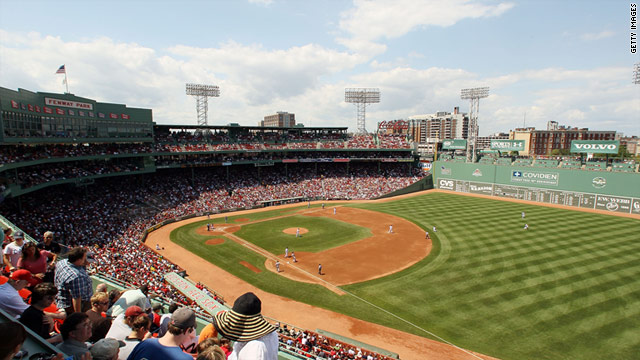
MLB clubs made tech-centric improvements to their ballparks, like Fenway Park, in advance of the 2011 season.

STORY HIGHLIGHTS
  • Fenway Park has rhree new scoreboards beyond right-center field for the 2011 season
  • Great American Ball Park has a new cell-tower system to access apps like MLB's At Bat

(WIRED) -- Professional sports teams are attempting at a furious rate to lure fans away from the comfort of their couches to live games. And sweet technological upgrades to their home venues become a bigger selling point every year.

Roughly a dozen Major League Baseball clubs followed that strategy by making tech-centric improvements to their ballparks in advance of the 2011 season, which kicks off Thursday. Notable upgrades include ballpark-wide Wi-Fi access (Chicago White Sox) and LED high-definition ribbon boards (Arizona Diamondbacks). Here's a deeper look at nine other teams that have made similar significant upgrades.

Houston Astros -- Minute Maid Park

The Astros join the Milwaukee Brewers and Minnesota Twins as the only MLB teams to feature a scoreboard with a 1080i display format. "Fans are watching games on high-definition [television], so when they come out to the ballpark we want things to be in high-definition, as well," Kirby Kander, the Astros' senior director of creative services, told Wired.com. Where once stood a 26-by-45-foot scoreboard in right field, there's now a 54-by-124-foot Daktronics behemoth that ranks as the fourth-largest scoreboard in the majors.

The 2.66-million pixel scoreboard was part of a $13 million project which included a 24-by-40-foot video board stationed in left field and 1,185 linear feet of ribbon boards spanning from one foul pole to the other. A state-of-the-art, two-level control room comprising 1,500 square feet was built at the suite level in left field to manage the new 'boards.

Apps, Gear and Beer: The Wired.com Guide to the Baseball Season

Boston Red Sox -- Fenway Park

A 10-year, $285 million plan to modify 99-year-old Fenway Park concluded this off-season with $40 million in construction upgrades, the most prominent of which are three new scoreboards beyond right-center field. ANC Sports Enterprises teamed with Mitsubishi Electric Diamond Vision Systems to install three video screens: a 38-by-100-foot scoreboard in right-center field that replaces a 23-by-30-foot structure installed in 1976 (but the famous John Hancock sign will still tower over the new 'board), a 17-by-100-foot video screen in center field, and a 16-by-30-foot video board in right field.

The primary scoreboard has the ability to display side graphics, as the old scoreboard did, or move to full-screen video to capture live action. The side 'boards will incorporate game info such as player stats, pitch speed and type, box scores, promotions, announcements and other types of messages

Philadelphia Phillies -- Citizens Bank Park

Phillies fans will get to watch live game action on a new 76-by-97-foot LED high-def scoreboard in left field. The old scoreboard, which was installed for Citizen Bank Park's 2004 debut, has been relocated to the Phils' spring training facility in Clearwater, Florida. The team partnered with Daktronics and Sony Electronics' System Solutions Group on the new 84,000-square-foot 'board, whose 2.9 million pixels dwarfs the former scoreboard's 459,000-pixel display.

Fans get to view one of the clearest scoreboards in the world. Its HD-15 display and 1,512 lines of resolution surpass that of the standard for 1080p HD video boards, and its LED technology allows it to show up to 144 quadrillion shades of color.

Citizens Bank Park's in-house video departments were also improved from standard to HD, including the video-coaching facility. Mark DiNardo, the Phillies' director of broadcasting and video services, told Wired.com the upgrade will most benefit the scouting and self-analysis performed by the team's coaches and players. "They voiced a concern to upgrade," DiNardo said, "and our management heard that concern."

Titanium Baseball Neckwear Big on Hype, Short on Science

Cincinnati Reds -- Great American Ball Park

The ability for fans to view information at high speed on their mobile devices headlines the pair of tech changes at the Reds' Great American Ball Park. The incorporation of a multi-tent cell-tower system with approximately 120 antennas will permit fans to access apps like MLB's latest At Bat rev on 3G or 4G networks through their iPhones, BlackBerries, iPads and Android devices. The app allows fans to view pitch-by-pitch tracking, real-time box scores and stats and searchable video highlights through a multitude of mobile service carriers, including ballpark sponsor AT&T. Reds IT director Brian Keys told Wired.com that roughly 1,500 to 3,000 fans demand high-speed mobile access at any given moment in the stadium, which seats more than 42,000 fans. "We're trying to get the fans more stats, videos, replays and information to their smart devices," Keys said.

Sixty luxury suites have also been outfitted with 46-inch Sony TVs and 25-inch Sony Vaio flat-panel PCs with Blu-ray functionality. Suite attendees can use the PCs to choose their preference of five camera angles on MLB.TV and view any league game, including typically blacked-out contests in Cincinnati, and reroute them to the high-def TVs.

Milwaukee Brewers -- Miller Park

The primary aspect of the Brewers' three-pronged tech upgrade for Miller Park is a 5,940-square foot scoreboard in center field. At 54 by 110 feet, the Daktronics 'board boasts true 1080i display containing more than 2.35 million pixels, compared to the 134,000 pixels produced by the dual 10-year-old scoreboards it replaces.

"The technology to support the [old scoreboards] was changing, and we were running out of spare parts for them," Brewers COO Rick Schlesinger told Wired.com. For example, the new scoreboard, unlike the ones it replaced, doesn't require air conditioning to cool it down. According to the Brewers, that will translate into a 50 percent to 65 percent reduction in energy consumption.

The Miller Park upgrades, which cost almost $11 million, also include a refashioned audio system that'll make it easier for the control room to manage the volume, bass and treble in different areas of the stadium.

Kinect Could Hold Key to Next-Gen Baseball Biomechanics

Seattle Mariners -- Safeco Field

A new LED scoreboard in right field and LED ribbon boards stretching from the the press box to the foul poles along the first- and third-base lines will enable the Mariners to present customized game and sponsor information to their patrons. All three Mitsubishi Electric Diamond Vision boards will have their video powered by ANC Sports' VisionSoft display. The system allows for a presentation of statistical and game information tailored strictly to Safeco Field. Sponsors can also customize their messages to appear on the boards on a game, series, homestand or season-long basis.

The 6-by-160-foot scoreboard above right field's Outfield Reserve seats will complement the ANC-installed out-of-town scoreboard in left field, implemented before last season. The 734 linear feet of ribbon boards permit the Mariners to show in-game information such as pitch count, type and speed; play-by-play from the prior three batters; animation and graphics; and messages from sponsors and the team's community relations department.

Minnesota Twins -- Target Field

Though Target Field only debuted last season, the team spent more than $5 million on improvements for the stadium's sophomore campaign. Leading the way is a Daktronics HD-15 LED scoreboard in right field, clocking in at 28 feet by 50 feet and providing 552 x 984 resolution. The new scoreboard mostly accommodates fans sitting in left field, who often complained of having to crank their heads to view live game video and statistical info on the scoreboard towering over them. This off-season, Twins owner Carl Pohlad made the move to address all the grumbling. "The Pohlad family said we'll just put up another [scoreboard], which is pretty cool," Twins VP of technology John Avenson told Wired.com.

A new 100-foot tall, LED-illuminated tower adjacent to the right field scoreboard will display situational graphic material and supplementary head-shot content, such as autographs, head-to-toe player pictures and player names and numbers. Also manufactured by Daktronics, each of the tower's four sides will incorporate more than 4,300 LED strips. An improved ballpark-wide Wi-Fi system with more than 200 access points will be operated by MLB Advanced Media, providing fans with information about the game, and ballpark, and even a concession-stand finder.

Tampa Bay Rays -- Tropicana Field

The Rays will play on a more durable and aesthetically pleasing surface at Tropicana Field, thanks to AstroTurf, the official synthetic turf of MLB. The company's GameDay Grass 3D60H model, installed during a three-week period this spring, contains a Horseshoe fiber which (literally) stands up to repeated use. The fiber's omega, or "C", dual-column design imparts mechanical memory to the fiber, so that it pops up even after repeated trampling by cleats and baseballs. Using 60 ounces of fiber per square yard ensures the surface's long-term durability.

The fiber's design also reflects light, which has a two-fold effect: It reduces surface temperatures by up to 18 percent and cuts down on the sheen produced by ballpark lights. The Rays' Andrew Heydt said the old artificial surface would produce a "glazing effect" when the dome's interior lights were turned on. That's no longer the case, as the improved look and performance of the Trop's turf almost mirrors the promise the future holds for Evan Longoria, David Price and the perennially upstart Rays.

Texas Rangers -- Rangers Ballpark in Arlington

New video boards in right and center field at Rangers Ballpark in Arlington use Daktronics' newest 15-millimeter LED technology. The 42-by-120-foot scoreboard above the Home Run Porch in right field and the 25-by-29-foot scoreboard in center field have the versatility to run as single displays or be separated into multiple windows to display various game info.

A newly installed IPTV system from Daktronics also allows all existing ribbon and field-level video boards and more than 800 Sony LCD monitors throughout the stadium to receive game information on up to 10 high-def channels. Real-time scores, statistics and even in-game menu pricing changes can be sent to any board or monitor on any IPTV channel. An upgraded control room and a revamped audio system round out the improvements made for last season's American League champs.

Subscribe to WIRED magazine for less than $1 an issue and get a FREE GIFT! Click here!

Copyright 2010 Wired.com.

Thursday, December 23, 2010

The Red Sox: The Team to Beat in 2011

Picture_1_large
Anthony Shea

If they can just get their lineup in order.

As long as the Boston Red Sox are going to have the highest payroll in MLB next season—pending a blockbuster move by the Yankees—they might as well keep the wallet open. General Manager Theo Epstein had made some key additions, but there are still holes to fill and problems in the lineup that need to be addressed. The pitching staff is short on lefties while batting order is riddled with them. Boston’s current 25-man roster is the obvious favorite in the AL East—on paper—but there’s still the possibility of implosion. Principal owner John Henry, ever mindful of his franchise’s revenue stream, can’t afford to have his $180 million club sink to the middle of the standings again this year.

The Red Sox feature a ferocious batting order. The problem is that most of those strong batters are left-handed, leaving the offense open to strikeouts from late inning lefty specialists and southpaw starters. One more right-handed power bat would balance out the lineup; for example, Josh Willingham was a perfect fit for Fenway Park before he was traded to the A’s last Thursday, and now his bat will wilt in the endless, dark dungeon that is the Oakland Coliseum. The Diamondbacks’ Justin Upton also seemed like a genuine fit, but apparently Epstein was against including star reliever Daniel Bard in any potential trade. (The addition of Bobby Jenks may have changed his tune.) If the Snakes were willing to accept a package consisting of Jacoby Ellsbury, Bard, Felix Doubrant and few other prospects, Epstein should have jumped on the offer. Upton is still a young athletic center fielder with enormous upside, and players of his caliber don’t come along very often. He would flourish at Fenway Park and benefit from the deadly lineup surrounding him. As a righty, Upton also fills the immediate hole in an otherwise stellar lineup.

Although the team didn’t make it to the playoffs last season, Sox fans had a lot to be happy about, including Clay Buchholz’s breakout. In 173.2 innings he pitched to a 2.33 ERA and 17 wins, but held a 1.20 WHIP and only struck out 120 batters. The reduction in strikeouts is easy to live with if it means that fewer runs are allowed, but the 67 walks he surrendered killed his overall innings pitched. So far, Buchholz has had an up and down career, but it appears Epstein has total faith in him. But would it be all that surprising to see him regress to a 3.50 ERA and average only five innings a game? The Brewers are constantly looking for pitching, and rumor has it that they’re still in the hunt, even after acquiring Shaun Marcum and Zack Greinke within the last couple of weeks.

At one time, Baseball America ranked Buchholz the best pitching prospect in the minors and now considers him one of the most promising starters in the majors. His skill-set isn’t in question: the general consensus is that he has the makeup of an ace, but does he have the mental ability to pitch adequately in Fenway Park? With five more years of team control left, his value is at an all time high, but he’s not always the most confident of pitchers. Milwaukee’s star outfielder Ryan Braun had a disappointing year—by his standards—and a change of scenery may suit him well. A Buchholz and Ellsbury trade for Braun matches up well for both teams. Boston gets a middle of the order right-handed masher with a team friendly contract and Milwaukee receives another young ace and a speedy and athletic, if injury-prone, center fielder. That said, the deal would lean towards the Red Sox side, so maybe a couple prospects would have to be added in, or maybe even Bard.

Epstein’s had a terrific off-season, dramatically improving the Red Sox, but with some more tinkering he can increase the possibility that the team goes wire-to-wire in 2011, leaving the Yankees in the dust.

Tuesday, November 30, 2010

Derek Jeter With The Red Sox? Imagine That!

From: http://www.totalprosports.com/

298diggsdigg
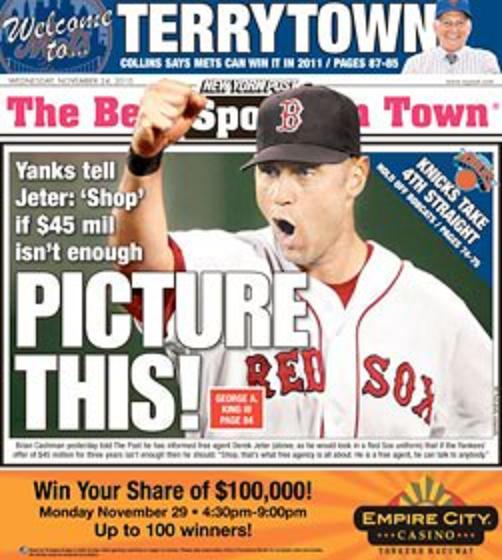
jeter as a red sox
Exactly one month ago our "Picture of the Day" featured Derek Jeter in a Red Sox uniform with the title "What if..."

It appears as though the New York Post has been thinking the same thing lately as the Yankees have told their 36-year-old free agent shortstop to feel free to shop around if the $45 million they offered him is not enough.  And anyone who follows baseball knows that if there is one team that may actually outbid the Yankees for an All-Star player, it is the Boston Red Sox.

So that once again leaves us all asking the question, "What if?"

Tuesday, September 28, 2010

Aroldis Chapman Throws Record-Breaking 105 m.p.h. Pitch


On Sept. 1, we told you about Cincinnati Reds reliever Aroldis Chapman's Major League debut, in which he pitched four 100+ m.p.h. pitches, including one that clocked in at 102.7 m.p.h. In a game this weekend between the Reds and the Padres, Chapman threw what is believed to be the fastest pitch ever recorder: a 105 m.p.h. fast ball inside to Tony Gwynn Jr. Chapman had been throwing in the 100s for his entire appearance, including a 104 m.p.h. fastball just before this record-breaker. Watch multiple videos of the pitch — from multiple angles — after the jump.

The TV broadcast from center field, including a funny "Bingo" reference by the announcer.


The view from the stands from behind the first-base dugout. The guy gets most of the preceding pitches, but only the scoreboard on the 105 m.p.h. pitch.

Wednesday, April 7, 2010

Mark Buehrle Makes the Play of the Year ... on Opening Day

By Will Brinson
From http://backporch.fanhouse.com/


EDITOR'S NOTE: You may now see the video of Mark Buehrle's amazing play of the year at MLB.tv.

Hyperbole gets thrown around about "Play of the Year (!)" type stuff in every sport during the first week of the season. Usually it's just something incredible that reminds us said sport is here. But there's a pretty good chance you won't see a play more ridiculous than what Mark Buehrle pulled off on Opening Day.


Buehrle took a batted ball off his foot, sprinted to the first-base line after it, grabbed the ball with his glove, and managed to flip it between his legs to first baseman Paul Konerko who bare-handed it for the out. In case you don't believe me (totally understandable, by the way), there's video proof below.


Monday, March 15, 2010

Japanese Girl May Be The First Female Pitcher To Make The Pros

Eri Yoshida wants to take her knuckleball proEri Yoshida an 18-year-old Japanese baseball player comes to America and tries to make the pros ... and she's a girl! It sounds like a magnificent sequel to "Mr. Baseball," but it's a-happenin'.

Yoshida is the first woman drafted by a Japanese professional baseball team, and she may be the first female pitcher to go pro. Her secret weapon is the old knuckleball, an elusive pitch that few have mastered, and the one thing that makes her attempt viable. Earlier this month, she hit the spring training circuit in Arizona, where she pitched under the tutelage of the Red Sox's Tim Wakefield. (Yoshida says she taught herself the pitch by watching videos of him.)

Although she isn't trying to make it to the majors -- she's only hoping for a spot in an independent league -- we would certainly love to watch an 18-year-old, 5-foot-1-inch lady strike out her juiced-up competitors.

Thursday, March 11, 2010

Nomar Garciaparra heads to TV studio after retiring -- as a Red Sox

From: http://content.usatoday.com/

Nomar Garciaparra, whose career tailed off because of injuries after leaving Boston, retired after 14 seasons today, signing a one-day contract with the Red Sox before heading for the TV studio.

By Jim Rogash, AP
"My tank's empty," Garciaparra said at a news conference in Fort Myers, Fla., shown on MLB.com. "It wouldn't have felt like a retirement if I couldn't have put this uniform on one more time."

The two-time American League batting champion will now don a jacket and tie as a member of ESPN's baseball crew, appearing mostly on Baseball Tonight.

Garciaparra, a six-time All-Star, says in recent years he's spent more time talking to younger players. Working on TV, he says, "is another way to pass on the knowledge. … I love talking about the game."

The infielder, who played 8 1/2 seasons in Boston before a 2004 trade to the Chicago Cubs, was a reserve for the Oakland Athletics last year, appearing in just 65 games, hitting .281 with three home runs and 16 RBI. He also played for the Los Angeles Dodgers.

"I hope to have a long career in broadcasting," Garciaparra said. "But it's not easy, and I've never thought it was." As potential role models on TV, he cites Harold Reynolds and Orel Herchiser as having done "a tremendous job" on-air.

Garciaparra, 36, exits with a .313 career batting average, with 229 homers, 936 RBI and six All-Star game selections, five as a shortstop for the Red Sox.

-- By Mike Dodd and Michael Hiestand

Monday, October 5, 2009

The Red Sox' swing doctor

Slumping sluggers could soon get help from MIT Media Lab researchers.

A player at the Boston Red Sox preseason training camp is wired with sensors developed by the MIT Media Lab, which gauge the forces he exerts when he swings the bat.
Photos: Joseph Paradiso and Alexander Reben

On Wednesday, the Boston Red Sox reached Major League Baseball's postseason playoffs for the sixth time in seven years. But whether or not they go on to win another World Series, when the Sox report to spring training next year, they could be spending some time in the trainer's room with members of the MIT Media Lab.

For three of the last four years, Professor Joseph Paradiso and other members of the lab's Responsive Environments Group have been strapping sensors on players at the Red Sox preseason camp to gauge the physical forces they exert when they swing a bat or throw a ball. So far, the researchers have been working mainly with minor-league players, trying to determine what kind of useful information they can extract from the sensors. But next spring, Paradiso hopes to gather more data on more players engaged in a wider range of activities.

If trainers could wire up a hitter when he's on a hot streak, and then again when he's in a slump, they might be able to determine how the mechanics of his swing have changed and how he can fix them. "There's many areas where this technique will have a meaningful influence on how things are perceived and how data is interpreted," says Eric Berkson, one of the Sox' team physicians. As a doctor, Berkson is particularly interested in how the technology could be used to identify behaviors that can lead to injury. "And then, using the same technology, we can try to find better ways to figure out when someone's able to come back from an injury and make sure they don't injure themselves in that process," he says.

The Responsive Environments Group's work with the Sox grew out of a project to allow dancers' movements to control the music accompanying them — "a very Media Lab thing," Paradiso says. While exploring the work's implications for gait analysis with collaborators at Massachusetts General Hospital, Paradiso met some physicians who worked with the Red Sox and were intrigued by the technology. Paradiso and his graduate student Michael Lapinski did the initial work on sensors customized for baseball players, and they've recently been joined by Clemens Satzger of the Technical University of Munich, who's at MIT until January.

Baseball teams had been trying to collect data on the biomechanics of players' swings and pitching motions for years, but they'd relied on optical systems that worked only in the lab and produced data that could be difficult to analyze. "Trying to measure pitching with just an accelerometer has never been done effectively before," says Berkson. "The idea that we can potentially do this biomechanics evaluation during real activities is a huge step."

In fact, the MIT team's sensors use more than just an accelerometer; they also use gyroscopes, and recent versions include a magnetometer that measures joint angles. But the biggest difficulty in developing the sensor, Paradiso says, is that no single accelerometer can handle the range of accelerations — measured as multiples of earth's gravity, or Gs — that a professional athlete can produce during a routine motion. The same goes for gyros and angular acceleration. "For dancers — even thought they're pretty kinetic, too — the 10-G range was okay," says Paradiso. "But for athletes — especially for pitchers — you have to go up to 120, 130 Gs to get that full range of motion, and for angular rate, you have to go up to about 10,000 degrees per second." The beginning of a pitcher's windup, however, though no less crucial to his delivery, is so slow that it won't register very clearly on a high-G accelerometer or high-rate gyro. So each Media Lab sensor includes two sets of three-axis accelerometers and gyros that span different ranges, to capture an athlete's full range of activity.

In the hope of further reducing the size of the sensors, Paradiso is talking with a Boston-area device manufacture about developing accelerometers and gyros that can handle a wide range of accelerations and angular rates, avoiding the need for dual sets of devices. But in the near term, a greater concern is developing ways to get the sensors on and off athletes more efficiently. "In spring training, even with a minor-league player, they're so tightly scheduled, that if you've got 20 minutes with this player, and you take a half-hour, that's going to throw their day off," Paradiso says. The lab is currently experimenting with a new method for mounting the sensors that should be more efficient but will also provide an attachment secure enough to withstand huge accelerations.

Ultimately, Paradiso believes, his group's work with the Sox will aid in the development of commercial devices for measuring biomechanics. Berkson finds that prospect exciting. "We can now look at what's causing injury in a shoulder through a pitcher's real activity, in real-world situations," he says, "and this will help us understand why kids get injured, and why Little League pitching is dangerous for some kids, and why there's an increased number of surgeries happening on these kids on a yearly basis." To some people outside New England, that could sound like an even more important application than helping the Sox to another World Series victory.

Thursday, October 1, 2009

The Best Multi-Sport Baseball Players

Bo Knew Baseball

September 30, 2009 – Peter Schiller

After the popularity of our story on Michael Jordan’s brief professional baseball career (yes, minor league baseball is considered professional level) in the MiLB with the Barons we were inspired to bring you this list.

Editor’s note: Every player on this list has played professional Baseball (MLB or MiLB) and another professional sport.

8 – Michael Jordan: Birmingham Baron (AA) at age 31 (for one year) after his first retirement (he retired three times) and NBA Hall of Famer. He hit only .202 with 3 HRs 51 RBIs and 18 SB. His fielding wasn’t much betterin theOF as his fielding percentage was .952

7 – Nathaniel Clifton – Minor League 1B in the Cleveland organization before moving onto the NBA for 8 seasons. As a 1B he hit .307 and 23 HRs

6 – Chuck Connors: Chicago Cubs 1B for 66 games, Brooklyn Dodgers 1B for one game and Boston Celtics as a F/C for 53 games before becoming an actor most famous for his role as “The Rifleman”. He hit only .238 with 2 HRs, 18 RBIs and 2 SBs

5 – Danny Ainge: Toronto Blue Jays and NBA player, coach and GM. While Ainge couldn’t hit his way out of a paper bag, he was playing in the major league. He played 211 games over three seasons in Toronto and hit 2 HRs, 37 RBIs, 12 SBs while hitting .220. He played mainly 2B and 3B, but also saw time at SS (6 games), LF (6 games), RF (2 games), DH (4 games) and CF (25 games).

4 – Jim Thorpe: NY Giants, Reds and Boston Braves OF from 1913 to 1919 and NFL All Decade RB/DB in the 1920’s. In those 6 seasons in the OF he hit .258 with 7 HRs, 82 RBIs and 29 SBs

3 – Deion Sanders: In 9 seasons in the OF for the Yankees, Braves, Reds and Giants he averaged .263 with 39 HRs, 168 RBIs, 43 triples (he led the NL with 14 in 1992) and 186 SBs. He was a CB for Falcons, 49ers, Cowboys, Redskins and Ravens.

2 – Bo Jackson: 8 seasons with the Royals, White Sox and Angels as an OF/DH. He hit for only a .250 BA, but had 141 HRs, 415 RBIs and 82 SBs. Bo Knew Baseball, but he also knew the NFL as a RB until his hip injury. He played both sports from age 25 to 28.

1 – Brian Jordan: 15 seasons mostly as an OF for the Cardinals, Braves, Dodgers and Rangers. His career BA was .282 with a .333 OBP and 184 HRs, 821 RBIs and 119 SBs. He was also a Safety with the Atlanta Falcons for 36 games.

Although Bo & Deion were the most famous of these former MLB baseball players, it’s hard to argue with Brian Jordan’s 15 years, .282 BA and other numbers. Although Bo would have surpassed him in HRs and possibly some other categories if he was able to play longer.

Both Danny Ainge & Chuck Connors beat out Jordan and Clifton only because they played on the Major League teams while Jordan and Clifton only played in the minors!

Wednesday, September 30, 2009

Michael Jordan and Baseball: Fulfilling A Fathers Dream

Michael Jordan in MiLB Action

September 29, 2009 – Jason DelSignore

Editor’s note: Yes, that is current Boston Red Sox manager Terry Francona. He was Jordan’s baseball manager with the Barons!

Michael Jordan’s recent induction into the NBA Hall of Fame was a no-brainer. There is no other basketball player on the face of the earth who deserves it more, with the exception of maybe Bill Russell, with all due respect. The idea that Jordan is anything but the greatest is as ridiculous as saying Manny Ramirez is a two-time NBA all-star. Of course, we do know that Ramirez never played professional basketball on any level, but the same cannot be said for Jordan, who played minor league baseball in the mid-90’s after the first of his three eventual basketball retirements.

Jordan’s story is sad and noble, but is it fair that he was able to walk into a baseball roster spot because he was a great…basketball player?

Let’s start with the sad part of the story. In July 1993, when Jordan was at the height of a tremendous career wave, the story broke that his father was murdered. The late James R. Jordan was gunned down as he slept in his car at a rest stop.

According to Jerry Reinsdorf, majority owner of the Chicago White Sox & the Chicago Bulls, said of Jordan- “The death of his father and all of the media attention and people saying it was because of his gambling, it had got to him. He was burned out.”

Jordan himself has said that it was his father’s dream to see him play baseball. That might be why he was set to play a few games for the Kannapolis Intimidators, a Class A affiliate for the Chicago White Sox, before his father’s passing.

“He said he wants to go to Kannapolis and just play a couple of games. He had taken batting practice a couple of years before,” said Reinsdorf. “Shortly thereafter, he found out his father was dead and that took care of the Kannapolis thing.”

It’s understandable that Jordan would be sick and tired of the media attention, and how ultimately this would affect his play on the court. It’s a noble and precious idea to take the words of a father who taught him so much, knowing that you’ll never be able to see or talk to him again. The only thing Jordan had was the dream of a father that his son play major league baseball.

And that’s what he set out to do. Jordan shocked the world by retiring from basketball at the age of 30.

In March 1994, he signed a contract to play professional baseball for the Birmingham Barons, a Class AA affiliate of the White Sox. The media coverage didn’t cease, nor did the idea that a publicity stunt was in the works. Even White Sox hitting coach Walt Hriniak had his doubts. “We don’t need this kind of publicity and what kind of gimmick is this?” remembers Reinsdorf of Hriniaks comments.

As it turns out Jordan was one of the hardest working guys on the field in the spring of that year. Of course trying to quell the doubts of many, and learning in a short time what the guys next to him have been learning since the early days of little league, will challenge anyone to work harder than most.

At the end of that baseball year stood Michael Jordan, an outfielder with a .202 batting average, 114 strikeouts in 436 at bats, three home runs, 51 RBI’s, and 30 stolen bases in 127 games. Let’s be honest, these numbers aren’t even good enough to keep a no-name orphan with a prosthetic leg and one blind eye in the game of baseball. They’d tell him maybe he should start looking for another line of work. That maybe this baseball thing isn’t going to work out after all. For a young player, the scouts would say this kid’s got potential. For a 31 year old Michael Jordan with mediocre skills, it’s too late for potential. The greatness he showed on the basketball court didn’t translate over to the diamond. He showed good instincts on the fastball, but couldn’t hit a curve with a 2×4.

There have never been many two-sport superstars in the professional ring. Bo Jackson was one, and Deion Sanders was another, playing both baseball and football. Both men displayed incredible skills to be able to achieve that goal. Is it fair that someone who has the want and desire to enter a professional sports setting, but has never demonstrated the ability to be able to perform such tasks, be allowed to take a spot away from those that do because he was great in another arena? Some may say yes, but there’s a 9-5er out there somewhere that might disagree.

If his name starts with Michael and ends with Jordan, then I guess that question is null and void.

In the end, Jordan retired from baseball in March 1995 and went back to the Chicago Bulls. For one year the sports writers had a story to write about, the White Sox organization took in unexpected publicity and profits, and Jordan got to partially fulfill his fathers dream of playing professional baseball, even if it wasn’t in a major league setting.

The quotes from Jerry Reinsdorf were taken from Scott Merkin’s piece “Jordan’s effort a marvel 15 years later on MLB.com.

Wednesday, July 29, 2009

MLB commissioner Bud Selig mulling pardon for hit king Pete Rose

McIsaac/Getty

Rickey Henderson (second from left) accepts his Cooperstown plaque with (from l.) Hall of Fame president Jeff Idelson, HOF chairperson Jane Forbes Clark and Bud Selig.

The tip-off that Selig may now be inclined to pardon baseball's all-time hit king was Hank Aaron's seemingly impromptu interview session with a small group of reporters in the lobby of the Otesaga Hotel on Saturday. In declaring for the first time that he would want an asterisk put on the achievements of any steroid cheats elected to the Hall of Fame, Aaron brought up Rose, who, in August of 1989, was given a lifetime ban for gambling on baseball, saying: "I would like to see Pete in. He belongs there."

It is no secret that Selig considers Aaron one of his closest friends and values his opinions over perhaps all others. It was also learned by the Daily News that in a meeting of the Hall of Fame's board of directors at the Otesaga later on Saturday, two of Rose's former teammates on the board, vice chairman Joe Morgan and Frank Robinson, also expressed their hope that Selig would see fit to reinstate Rose.

Said another Hall of Famer familiar with the situation: "I think a lot of the guys feel that it's been 20 years now for Pete, and would lean toward leniency and time served. If he had admitted it in the first place and apologized way back then, he'd probably be in the Hall by now."

According to another source, the behind-the-scenes lobbying process began five years ago, but stalled because Selig was still not satisfied that Rose was "reconfiguring" his life, as the late commissioner Bart Giamatti had instructed for him to do when he initially placed him on baseball's permanent ineligible list. In addition, the source said, Selig's conditions for any reinstatement would be stiff. Rose likely would need to make another public apology and he would be prohibited from managing.

If Selig does reinstate him, Rose then would become eligible for the Hall of Fame, but on the Veterans Committee ballot, as his 15 years on the Baseball Writers ballot expired during his time on the ineligible list. He would thus have to be elected by his peers, the 65 living members in the Hall of Fame, not all of whom agree with Aaron, Morgan and Robinson that Rose has done his time. It's hard to say if he would get the necessary 75% for election. "I know there are still guys who feel strongly against him," said one Hall of Famer, "and I don't know if that would change even if Selig clears him."

Nevertheless, it is beginning to look as if Rose will at least finally get Hall of Fame consideration, at the same time the Hall of Famers are taking an even harder stance on all the steroids cheats. "Believe me," said Reggie Jackson, to a couple of writers, "that little session Hank had with you guys was anything but impromptu. He wanted to get that out there. It was time."

RICKEY STORY OF INTEREST: Former Oakland A's general manager Sandy Alderson, who traded Rickey Henderson twice, was asked if had any particular favorite "Rickey story."

"Oh yeah," said Alderson, chuckling, "it would have to be the signing bonus check. At the end of the year, he still hadn't cashed it and when we called him about it, because we were getting our books in order, he said he was waiting for the interest rates to go up." ... The year after being inducted, Goose Gossage said it's such a pleasure to just relax and enjoy the Hall of Fame weekend. Gossage said the most unforgettable part of his induction weekend last year was the Sunday night Hall of Famers' private dinner. "Different Hall of Famers got up and gave little speeches and then Sandy Koufax got up there and asked me to come up," Gossage said. "I'm saying: 'What does he want me for?' And then he hands me my ring and says: 'Here Goose, welcome to the club.' Can you imagine what that was like?'"

TOM'S TERRIFIC MOMENT: At the Saturday night party in the Hall of Fame plaque room, Tom Seaver was standing in front of the inaugural 1936 class of plaques - Babe Ruth, Ty Cobb, Christy Mathewson, Walter Johnson and Honus Wagner. "In 1970," Seaver said, "I brought my wife Nancy up here and took her to the section where the first class was. I said to her: 'This is what all my sacrifice is for. This is what all that work, all that time away, all the stuff in the minor leagues is all about.' I make it a point to visit Mathewson's and Walter Johnson's plaques every year." ... In the introduction of the 50 returning Hall of Famers at the ceremonies, reclusive Carl Yastrzemski, who has been back to the inductions only three times since his own election in 1989 and recently had open-heart surgery, received the loudest ovation from the decidedly pro-Jim Rice Red Sox crowd.

Wednesday, June 10, 2009

The United Countries of Baseball

Thursday, June 4, 2009

David Ortiz Collapse: He Didn't Lie About PEDs but About Age

When great ones go, it might hurt us more than it does them.

by Bill Simmons

Stephen Dunn/Getty Images

In the academy award-winning classic Cocktail, Coughlin tells young Flanagan, "Everything ends badly, otherwise it wouldn't end." It's the single greatest yearbook quote ever. Hell, it may be the greatest movie quote ever. Either Coughlin was the Thoreau of bartending, or Thoreau the Coughlin of writing. One or the other.

We reached the "ending badly" point with David Ortiz five weeks ago. Remember in Superman II when Clark Kent gave up his superpowers so he could be with Lois Lane -- lesson No. 184 on how women ruin everything -- and then a bully beat the crap out of the suddenly mortal superhero in a diner? That's been Big Papi since Opening Day. What makes it stranger is that he still looks like Big Papi. Same bulky build. Same goofy beard. Same happy smile. Same batting stance. This isn't like the Ultimate Warrior returning after the then-WWF's first steroids scandal with a jarringly smaller physique. Everything looks the same with Ortiz, only Mario Mendoza has switched brains with him.

I've seen slumps. This was different. This was a collapse.

At first, we Sox fans thought we were just watching an early-season slump. Then three weeks passed and we started worrying. The guy couldn't hit the ball out of the infield. His bat was so slow he had to cheat on fastballs; even then, he couldn't catch up. One swing a night made him look like the drunkest batter in a beer league softball game. Look, I've seen slumps. This was different. This was the collapse of a career.

The steroid whispers started quickly. By late April, every conversation I had with a Sox fan seemed to include a "We need to mail Papi some HGH" joke. It was an easy leap for a couple of reasons: First, his power numbers leapt like Obama's Q rating from 2003 to 2007. Second, he's Dominican, and more than a few of his brethren -- Sammy Sosa, Miguel Tejada, Guillermo Mota -- have been in the center of PED controversies. Third, they sell steroids over the counter in the DR like they're Bubblicious. And fourth, baseball has reached a depressing point in which power hitters are presumed guilty until proven innocent.

When Manny Ramírez was suspended for trying to jump-start ovaries he didn't have, many Sox fans (including me) assumed we had our unhappy answer for Papi's demise. We braced for Ortiz to be linked to a bombshell headline that began with the words "Former Sox Clubhouse Attendant … " But one thing nagged at me: He wasn't belting bombs that were dying at the warning track like so many other former 'roiders. He just looked old. It reminded me of watching Jim Rice fall apart in the late '80s, when he lost bat speed overnight the way you and I lose a BlackBerry. That was painful too.

By mid-May, I was pondering another theory: Maybe Papi was older than he claimed. In Seth Mnookin's book Feeding the Monster, he recounts the story of how Boston nearly blew the chance to acquire Ortiz because they were concerned that he was much older than the media guide said. GM Theo Epstein asked Bill James to study Papi's numbers, and when James concluded the peaks and valleys were consistent with a man of Ortiz's stated age, they rolled the dice. The rest is history.

Well, what if James was wrong? How many Latin players have been exposed for lying about their ages in the past few years? Hell, one of Papi's best friends -- Tejada -- was found to have cut two years off his birth certificate when he was 17, er, 19 … you get the point. Watching Papi flounder now, I'd believe he's really 36 or 37 (not 33) before I'd believe PEDs are responsible. In a recent game in Minnesota, he couldn't catch up to an 89 mph fastball. Repeat: 89 mph!

That's what happens to beefy sluggers on their way out: Their knees go, they stiffen up, bat speed slows and, in the blink of an eye, they're done. Beefy sluggers are like porn stars, wrestlers, NBA centers and trophy wives: When it goes, it goes. You know right away.

So that's my theory. I think he's old(er). You may think something else. Whatever the case, it's clear that David Ortiz no longer excels at baseball. This has been banged home over and over again for two solid months. It's ruined the season for me thus far. The best way I can describe Fenway during any Papi at-bat is this: It's filled with 35,000 parents of the same worst kid in Little League who dread every pitch thrown in the kid's direction. There is constant fear and sadness and helplessness. Nobody knows what to do.

Beefy sluggers are like porn stars, nba centers and trophy wives.

It's been a sports experience unlike anything I can remember. Red Sox fans refuse to turn against Ortiz. They just can't. They owe him too much for 2004 and 2007. It's like turning on Santa Claus or happy hour. Every Ortiz appearance is greeted with supportive cheers, every Ortiz failure is greeted with awkward silence. The fans are suffering just like he is. Only when he left 12 men on base against Anaheim on May 14 did I receive a slew of angry e-mails from back home, but even those tirades centered more around Terry Francona's steadfast refusal to drop Ortiz in the order. I cannot remember another Boston athlete stinking this long, and this fragrantly, without getting dumped on.

Really, that's a tribute to what he means to his fans and how delightful it was to watch him play. His career might be over (notice I left the door open; I'm such a sap), but Ortiz has reached the highest level an athlete can reach: unequivocal devotion. Sox fans love him the same way you love an ailing family member. In the end, at his bleakest point, he's brought out the best of an entire fan base. He has inspired dignity and emotion and loyalty. The fans could have sped his demise (and saved a few games) by booing until Francona benched him. They didn't. How often does that happen?

We live in a world in which all entertainment is chewed up and spat out. We milk public figures like cows, and when they're out of milk, we tip them over and move on. Quickly. It's not just that we need to see everything "jump the shark" that bothers me. It's also that so many of us are gleeful about pointing out that something or someone we once loved has outlived his usefulness. The demise of Big Papi played out in an old-school way: real devotion, and in the end, people refusing to let go.

Including me. I still watch every Ortiz at-bat thinking, This is the one. When he belted his first bomb of the season, I clapped like everyone else and pumped my fist. Yes! He's back! The Fenway crowd cheered as if it were Game 7, demanded a curtain call and showered him with love. This was the single strangest sports moment I've ever seen: Fans going absolutely bonkers for something that once was a routine act. Turned out, it was Papi's only homer of the first eight weeks. So it really was a curtain call. By May's end, Francona had dropped him to sixth in the order. Barring a miraculous return of bat speed, he'll be benched or released soon. It'll hurt, and I'm going to feel bad. I already do. Coughlin was right.

Want more of the Sports Guy? Check out the Sports Guy's world.