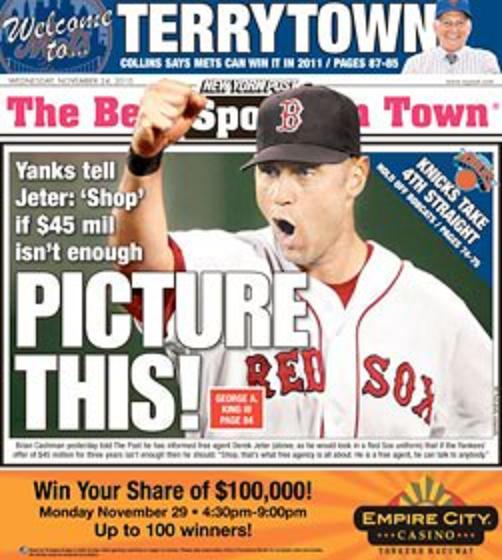
It appears as though the New York Post has been thinking the same thing lately as the Yankees have told their 36-year-old free agent shortstop to feel free to shop around if the $45 million they offered him is not enough. And anyone who follows baseball knows that if there is one team that may actually outbid the Yankees for an All-Star player, it is the Boston Red Sox.
So that once again leaves us all asking the question, "What if?"
George Steinbrenner, the controversial but beloved "Boss" who turned around the Yankees franchise in 37 years of ownership, died this morning in Tampa, Fla., after suffering a massive heart attack.
"He took a great but struggling franchise and turned it into a champion again," the family said in a statement released by spokesman Howard Rubenstein. "He was an incredible and charitable man. First and foremost he was devoted to his entire familygrandchildren."
Steinbrenner's micromanaging on the field and penchant for pursuing high-priced free agents -- and later taking a key role in escalating their salaries -- earned him a reputation as one of the most controversial figures in sports and made him beloved yet polarizing New York City legend.
Dramatic Photos: Yanks Celebrate World Series Return
LOOK
Dramatic Photos: Yanks Celebrate World Series Return
In Memoriam: Yankees Owner George Steinbrenner
LOOK
In Memoriam: Yankees Owner George Steinbrenner
A Look Back: George Steinbrenner Dies at 80
LOOK
A Look Back: George Steinbrenner Dies at 80
For more than 30 years, Steinbrenner lived up to his billing as "the Boss," a nickname he earned and clearly enjoyed as he ruled with an iron fist. During Steinbrenner's 37-year ownership of the club, the longest tenure in Bronx Bombers' history, the Yankees won 7 World Series titles and 11 penants.
He was known for feuds, clashing with Yankees great Yogi Berra, and firing manager Billy Martin twice. But as his health declined, Steinbrenner let sons Hal and Hank run more of the family business.
Steinbrenner was in fragile health for years, resulting in fewer public appearances and pronouncements. Yet dressed in his trademark navy blue blazer and white turtleneck, he was the model of success: The Yankees won seven World Series titles after his reign began in 1973.
Steinbrenner’s tenure of more than 37 years exceeded that of any other New York Yankees owner by 13 years (Colonel Jacob Ruppert purchased the Yankees with Tillinghast L’Hommedieu Huston in January 1915, bought out Huston in 1922, and maintained sole ownership in the club until his death in January 1939—a total of 24 years). Since Steinbrenner became principal owner, the other 29 Major League clubs had more than 100 owners or ownership groups while the Yankees had just one.
He appeared at the new Yankee Stadium just four times: for the opener in April 2009, for the first two games of last year's World Series and for this year's homer opener, when captain Derek Jeter and manager Joe Girardi went to his suite and personally delivered his seventh World Series ring.
"He was very emotional," said Hal Steinbrenner, his father's successor as managing general partner.
Until the end, he demanded championships. He criticized Joe Torre during the 2007 playoffs, then let the popular manager leave after another loss in the opening round. The team responded last year by winning another title.
In addition to the team’s on-field success, the Yankees have consistently shattered franchise and league attendance records at home and on the road. In 2009, they drew 3,719,358 fans in their first season of play in Yankee Stadium, topping the American League in attendance for the seventh straight season (2003-09). Currently, the Yankees remain the only franchise in baseball history to draw more than 4 million fans at home in four consecutive seasons (2005-08).
Yankees Pitcher Pat Venditte Can Throw From Both Sides! WTF?!
Have you guys seen this yet?
Pat Venditte, seen above pitching for his alma mater Creighton, is now a Yankee farmhand and he is ambidextrous. Yup, dude can throw left handed, and right handed, and is quite good at it. He has a career minor league ERA of 1.53, with a .95 WHIP and it seems like we might see him in the bigs shortly.
Tuesday, Venditte saw his first spring action and allowed one earned run, walked one, and gave up two hits in 1 1/3 innings against the Braves.
“People are going to have their doubts when they hear something like this, and I’ve got to prove that I can do it,” Venditte told MLB.com.
I promise I will be there for his big league debut, and the last MLB player to do the damn was Greg Harris in 1995 for Montreal. I think me and my brother called him “The Butt Shower” because his ass was so big.
Below are a few videos of my man throwing, including an ESPN video when Joba “The Hut” Chamberlain has nothing but good things to say about the multi talented Venditte.
Watch from the 1:00 mark as major confusion happens when both hitter and pitcher are capable of going from both sides. Pretty amazing stuff.
E:60 Piece
I wish this kid all the best and hope to see him in the bigs ASAP. He could pitch for the Cubs right now.
Matt Anaya Twitter.com/MatAnaya Twitter.com/DugoutDoctors
The amenities of the new Yankee Stadium were finally out for display yesterday, and perhaps nothing summed up the You Can’t Afford A Gaddamned Thing In This Place more than the $9 “Retro Beer” cooler, featuring 24 oz. Tall Boys of Pabst Blue Ribbon Horse Tinkle. Seriously? For nine bucks, they’d better send some Indonesian kid to my seat and pour it into my damn mouth. The beer , pervert. Pour the beer .
New Stadium Insider caught wind of this yesterday , but it’s still mind-blowing. Some people don’t understand that one of the drawbacks of having expensive beer is that it creates incentive for patrons to smuggle drinks of their own choosing into the stadium. And if 10 bucks can barely get you a can of PBR, it’s reasonable to believe that the new Yankee Stadium will see an uptick in smuggling compared to the old.
More on the Yanks’ new digs after the jump.
Keith Olbermann compares the new Yankee Stadium to the old, in a way that only a smug, self-satisfying prick can. From NBC New York :
BRIDGETON, N.J. — Just when it seemed that all the sports-licensing ideas had been exhausted — coffins with team logos, unveiled a few years ago, could have reasonably been the presumed end — along comes something that has been growing in plain sight all along.
A tuft for the windowsill? A pallet for the backyard? Officially licensed grass is about to be sold, in the form of sod or seeds, to fans who want a patch to call their own.
“It’s just capitalizing on what we have and what we’ve done,” said Rick DeLea, vice president of DeLea Sod Farms, which his grandfather founded in 1928 and has supplied turf for Yankee Stadium since the 1960s.
On a recent morning, Mr. DeLea swept his hand across a portion of the 80 acres of Yankees Sod on a vast hillside in South Jersey. Last fall, some of the secret blend of bluegrass was peeled in broad strips, hauled north on trucks and laid inside the new Yankee Stadium. But most of it was still here, greening under a late-winter sun.
“It’s going to be one of those ‘Why didn’t I think of that?’ stories,” said David Andres, the energetic and entrepreneurial man who came up with the idea of selling sod and grass to fans.
A former consultant with the company and now Mr. DeLea’s vice president for business development, Mr. Andres saw a field of bluegrass far bigger than the two and a half acres needed to cover the grassy portions of the new Yankee Stadium. The team had asked Mr. DeLea to reserve 10 acres for the stadium, apparently in case of some horrific horticultural incident in the Bronx, but that left a lot of leftover sod.
“I said: ‘Rick, you’re sitting on it. Why not do something with it?’ ” Mr. Andres said.
Actually, Mr. DeLea had been doing something with it. He sells the same three-variety blend of Kentucky bluegrass from this field to other clients. A high school in West Long Branch, N.J., had 16 acres installed last fall, when it was just called sod. Not Yankees Sod.
Mr. Andres, a self-described “sell ice to Eskimos kind of guy,” took the idea of licensing the product to the Yankees and Major League Baseball. He received the requisite stamps of approval and started a company called Stadium Associates to market Yankees Sod and Yankees Grass Seed.
It makes one wonder if other licensed permutations will follow — Cubs Ivy or Daytona Asphalt or Cameron Indoor Hardwood Floors, using the same vine, road mix or batch of trees as the sports arenas.
For now, Mr. Andres and three partners have visions of Cubs Sod and Red Sox Sod and other licensed sod. They have reached out to the farms that supply the other 27 major league teams with natural-grass fields.
But Major League Baseball is taking it one team at a time.
“We want to see how this goes,” Howard Smith, baseball’s vice president for licensing, said. “But we want all of our licensees to be wildly successful.”
Yankees Sod will be available at New York City-area Home Depot stores near the end of the month. A patch a little bigger than five square feet — 16 inches by 4 feet — will cost $7.50, Mr. Andres said. It may cost a few thousand dollars to cover a large backyard, but the sod comes with a certificate of authenticity from Major League Baseball, complete with the counterfeit-proof hologram, declaring it to be the official grass of the New York Yankees.
Yankees Grass Seed will also be available, in gift-friendly novelty sizes of three ounces and eight ounces, at Yankee Stadium and other places. Home Depot will carry bigger bags of seed.
Mr. Andres wants to sow grass seed in small planters, too, for fans who may want a little patch to water and cut, kind of like bonsai groundskeepers. He is even pondering miniature desktop replicas of the stadium filled with blades of Yankees Sod.
“It is something that is green,” Mr. Andres said, referring to the environmental benefit of the product, if not the awe-inspiring color that greets fans as they step through the stadium portals. “It is something that is connected to America’s pastime. It is something that is affordable. And it is something that every fan can appreciate.”
Mr. DeLea, an unassuming man who oversees a 13-farm sod empire with the help of a helicopter he pilots, supplies various varieties of turf, from bluegrass to bentgrass, to clients that include well-known golf courses and small municipalities.
He said that the bluegrass developed for the Yankees took about 14 months to mature. The DeLea sod laid in Yankee Stadium last fall, like the sod remaining on this hillside parcel, was planted in the spring of 2006. More is being planted at various sod farms for fans.
Mr. DeLea said that Yankee Sod was fine for a lawn that receives full sun, drains well and is reasonably maintained.
As the men turned to walk off the lush grass and into a van parked in the dirt, where sod once grew — the sod now in Yankee Stadium, perhaps, or maybe just at a high school in New Jersey — Mr. Andres mindlessly flicked the ashes of his cigar onto the turf.
Mr. DeLea scolded him and rubbed out the embers with his shoe. After all, this was not ordinary sod.
New stars in pinstripes Dec. 18: Sabathia says he has chills at the thought of being a Yankee.
NBC Sports
updated 9:00 p.m. ET,Thurs., Dec. 18, 2008
NEW YORK - Most teams triumphantly unveil a new ace. The New York Yankees presented a pair.
The sign board outside old Yankee Stadium beamed with an unusual message Thursday for a ballpark that already has seen its final game: “LET’S PLAY TWO,” read the top line. “CC & AJ 1 PM TODAY,” said the lower.
For $243.5 million, a lot in most places but a trifle in a city where a financier is accused of swindling billions, the Yankees signed two pitchers they hope will restore the franchise’s glory when it moves across the street to the new $1.3 billion Yankee Stadium next year.
There was a Christmas tree on the mound of the old ballpark, Yogi Berra was walking around and down in the cramped Stadium Club, 11 people were seated on chairs beside the podium. Manager Joe Girardi’s 9-year-old daughter, Serena, presented roses to the wives of CC Sabathia and A.J. Burnett.
Yankees president Randy Levine called the news conference “one last hurrah” for the 85-year-old stadium, scheduled for demolition starting next summer. Brian Cashman said the teddy bearish Sabathia “lights up a room when he walks in.”
“I hope he lights up a city,” the general manager said.
Disappointed, dismayed and dissed after their streak of 13 consecutive postseason appearances came to an end, the Yankees reversed course after a one-year experiment with young starters and exercised their economic might by finalizing huge contracts Thursday for the two highly pursued pitchers. Sabathia’s $161 million, seven-year deal is the highest for a pitcher. Burnett’s $82.5 million, five-year agreement would be the highest on many teams.
“We learned last year that injuries can happen across the board,” Yankees co-chairman Hal Steinbrenner said. “There’s no doubt pitching is a bit more worrisome, but you’ve got to live year by year and we’re focused on 2009.”
New York has used 51 starting pitchers since its last World Series title in 2000, according to the Elias Sports Bureau, tied for sixth in the majors and third in the AL. Kevin Brown, Javier Vazquez, Jeff Weaver, Randy Johnson and Carl Pavano have all come and gone. Many of them were introduced with similar hoopla.
“You can’t stop swinging for the fences,” Cashman said, proudly wearing a World Series ring. “We’ve been here. We’ve done this before. How many times, right? And I’ve got this on my finger from the times where things have worked out. And I’ve got tread on my back from where I’ve been hit by a bus when it didn’t work out.”
Sabathia, wearing two large diamond earrings and more bling on his arm, slipped a large jersey with No. 52 over his dress shirt and Burnett put a trimmer No. 34 top over his. At 6-foot-7, about 300 pounds and with size 15 shoes, Sabathia carries big expectations to go with his big body.
“I’m not the best physique-looking guy,” Sabathia said.
To reel him in, the Yankees dazzled the 28-year-old left-hander with fellow Californian Reggie Jackson, tales of how they had coveted him for more than a year and a provision that allows the 2007 AL Cy Young Award winner to terminate his contract after three years.
Derek Jeter made a recruiting call, and Cashman traveled to Sabathia’s home in Vallejo, Calif., last week during the winter meetings to assure him and wife Amber that New York was a great place to live and pitch. That clinched it.
“Ten minutes after he left my house,” Sabathia said, “I called him and I looked at my wife, I said, you know, ‘I’ll be a Yankee.’ Every time I say that I still get chills thinking about that.”
Sabathia said the addition of a seventh season to the original $138 million, six-year offer was important. His wife said Cashman’s decision to offer the opt-out provision was key.
“When he said that, I said, ‘We’re going to love it,”’ she recalled.
Already, they spent Wednesday looking at houses in Alpine, N.J. The Sabathias intend to permanently move to the area.
They said the one-month gap between the Yankees’ initial offer and Sabathia’s acceptance was partly because they have a new child and partly because he wanted to hear from every interested team. He was concerned New York would withdraw its offer and move on.
“I was worried about the public perception here,” Sabathia said. “I don’t want anybody to think that I didn’t want to come here.”
Burnett seemed to be the wilder personality. He has a Pisces tattoo on his left hand in honor of his two sons. When asked about his trips to the disabled list (10), he interrupted the questioner.
“You don’t have to say the number,” he said.
The 31-year-old right-hander even received a recruiting call from Alex Rodriguez. Last September, Burnett got an unexpected recommendation to sign with the Yankees: from Carl Pavano.
His former Florida teammate, maligned for multiple injuries during his four seasons in New York, spoke with him during batting practice at Yankee Stadium.
“It’s a great place to play. It’s a great place to live,” Burnett said Pavano told him. “I was expecting to hear, you know, different things.”
Playing near his home in Maryland was important to Burnett. So was the chance to win.
“Of course, money had something to do with it,” he added. “How often do you get the chance to put on pinstripes? I mean, whether you want to admit that you love them or hate them, everybody wants to be a Yankee.”
Burnett was looking forward to picking out his locker in the oval clubhouse of the new ballpark, where the pair went to pose for pictures after the news conference. Before heading over, he heard a loud noise from above as he spoke with reporters.
“Get over to the new place quick,” he said. “We’re supposed to get out first.”
Notes: The Yankees still hope to re-sign Andy Pettitte. “He’s still excited about coming back,” manager Joe Girardi said. ... Steinbrenner said it was possible Joba Chamberlain could wind up splitting time as a starter and reliever. Steinbrenner also wouldn’t rule out chances of signing OF Manny Ramirez. “I guess as realistic as any of the other free agents, because we’re looking at all of them,” he said. “We’re just going to have to see what each day brings.”
Here is the real news of the day. In a unanimous vote, MLB owners today approved Hal Steinbrenner to assume control of the Yankees at the request of his father.
“I realize it’s a great responsibility,” said Hal Steinbrenner, who turns 40 on Dec. 3. “My dad is, needless to say, a tough act to follow.”
Hal and Hank Steinbrenner have been listed as co-chairpersons. But it has been obvious for months that it is the younger brother who runs the club. Hal Steinbrenner has been in New York dozens of times to meet with Brian Cashman, Joe Girardi, Randy Levine and Lonn Trost. He also has ably represented the team at assorted events and made the majority of the decisions according to team officials.
It is uncertain whether there was any sort of power play between the brothers for this position. But within the team offices in Tampa and the Bronx, this will be welcome news.
UPDATE, 1:53 p.m.: This statement from family spokesman Howard Rubenstein:
“At the MLB meetings today, the clubs approved Hal Steinbrenner as the control person for the New York Yankees. This is consistent with George Steinbrenner’s desire and commitment to have his sons assume the day to day responsibility of operating the club. George Steinbrenner will remain as Chairman of the New York Yankees, Hal and Hank Steinbrenner will continue as Co-Chairmen.
“Hal was designated as the control person because he is responsible for the overall business and financial operations of the Yankees. Hank will continue to oversee the club’s Baseball Operations.”
Titles aside, it has been Hal Steinbrenner who comes to the Bronx and meets regularly with Cashman and Girardi and just last week said how he planned to start building relationships with agents. At the end of the day, one person has to be in charge and it’s him. —————— Mike Mussina will conduct a conference call at 4 p.m. Check back later for a report and hopefully the audio.
This entry was posted on Thursday, November 20th, 2008 at 1:49 pm by Peter Abraham.
The offer is expected to be six years in length and have a total value of slightly more than the record $137.5 million deal that pitcher Johan Santana signed with the Mets before last season.
Santana's deal had been the largest ever for a pitcher.
Yankees co-chairman Hank Steinbrenner confirmed Friday night at the team's spring training complex in Tampa, Fla., that an offer was made to Sabathia, and that proposals will be forthcoming for pitchers A.J. Burnett and Derek Lowe.
"Yes," Steinbrenner told The Associated Press when asked if an offer was made to Sabathia. "And we're prepared to make offers to Burnett and Lowe."
Steinbrenner declined to give details about the Sabathia offer.
Friday represented the first day that free agents can be signed. Burnett has a four-year, $54 million offer from Toronto, while Lowe is looking for a five-year contract.
The Milwaukee Brewers opened the bidding for Sabathia last week, when general manager Doug Melvin made a contract proposal to Sabathia. Melvin wasn't willing at the time to discuss terms of the offer or assess the team's chances of keeping its prize pitcher.
"It's in their hands," Melvin said in a telephone interview with The Associated Press. "He hasn't really had a chance to talk with other teams."
Sabathia, who went 11-2 with a 1.65 ERA for Milwaukee after he was traded from the Cleveland Indians on July 7, filed for free agency on Nov. 1.
Buster Olney is a senior writer for ESPN The Magazine. Information from The Associated Press was used in this report.
Two diligent, if hapless, would-be sports entrepreneurs couldn't resist the pecuniary opportunity at hand. It was April 18, 1923—opening day of the new Yankee Stadium. A $2.5 million marvel (the equal of $30 million now) built on a 10-acre parcel in the Bronx, it was reputedly the first ballpark to be heralded a "stadium." No other sports venue rivaled the size of the "House That Ruth Built," as the place was soon known. And it was worth every cent of Babe Ruth's annual $52,000 salary. Swinging mightily on that chilly inaugural day before a festive crowd of 74,200, Ruth hit a home run to bring the Yankees a 4-1 victory over the archrival Boston Red Sox. But the luckless entrepreneurs missed out on the electrifying action: one had tried to sell his ticket for $1.25, 15 cents more than the official $1.10 admission. The other guy was holding out for $1.50. Police arrested both for scalping.
Next April 16, history's most storied franchise and most lavishly compensated players (2008 payroll: $209 million) will begin playing in a 21st-century, state-of-the-art Yankee Stadium that is, at $1.3 billion, one of the world's costliest sports venues. When the gates open, fans may have a tough time distinguishing between bona fide scalpers and the Yankees' management. The pin-striped team is charging, for example, $2,500 per game for each of the stadium's choicest seats, up from $1,000 in this dismal final season in Ruth's now decrepit shack. But the Yankees are hardly alone in finding new ways to gouge fans; their premium seats are a bargain when compared with prices in Dallas just for the right to buy a season ticket: as much as $150,000. In the latest sign of hyperinflation in the sports business, a slew of ultraexpensive venues are rising, or have been built recently, across the country from Dallas to Washington to New York—where not only the Yankees, but also the Mets, Jets, Giants and New Jersey Nets will all be getting new digs (the New Jersey Devils got a new arena last year). The total price tag for the New York-area building boom alone: more than $5 billion.
Of course, with the nation's financial system teetering, all this construction couldn't be coming at a worse time. Many of the sports industry's most golden gooses, including financial-services giants and automakers—might have a tough time scrounging up thousands of dollars for a seat these days, and might have to slum it with the hard-pressed masses in the cheap seats (meaning under $100 each at Yankee Stadium). These new sports palaces were conceived in a more conspicuous era, and as such they're replete with luxury suites, upscale club seating, catered food and any number of high-tech distractions. Each stadium has an economically stratified seating scheme that will have fans scraping their pocket bottoms or, in a few cases, even mortgaging their homes (if anyone can get a loan these days).
Take, for example, the new Dallas Cowboys stadium, scheduled to open next year in suburban Arlington, Texas. Topped off with a retractable roof and featuring the world's largest high-definition scoreboard, spanning 60 yards, the $1.1 billion facility is an amalgam of steel from Luxembourg, glass from England and other pricey materials. To partially pay for it, owner Jerry Jones is employing a long-controversial financing tool of the sports business called the "personal seat license." For an upfront fee of up to $150,000 a seat, fans get an exclusive long-term license that allows them to buy season tickets each year—for thousands of dollars more. The license may be sold on the open market, if the owner is ever squeezed for cash or sours on the Cowboys. "I could have built this for a third less," Jones recently told reporters. "But this is what the Cowboys fans and the NFL deserve."
Once ensconced in their pricey seats, fans are captive to corporate sponsors, whose multimillion-dollar ad and promotional efforts in stadiums are essential elements of sports-franchise and league economics. These corporations and others are the primary occupants of the luxury suites (they'll go for up to $500,000 a year at the new home of the Cowboys) that take up an increasing percentage of stadium real estate these days.
Sports has a reputation for being recessionproof, but the nearly unprecedented economic travails of the past month may crush that chestnut. Leagues and team owners say they are cautiously monitoring the economy, but they insist that, so far, there is little evidence that fans are scaling back on their spending. Corporate sponsorships and luxury suites "for the most part are long-term arrangements … not one-year deals," says Thad Sheely, the New York Jets' top stadium-development and finance executive. "Economic cycles don't immediately impact our results." Indeed, even as fans bemoan that their favorite sports have become nothing more than moneyball (and in some cases even protest the trend, as Giants and Jets fans did recently), they continue lining up at the shiny new stadium gates and checking whether their names have ascended on the season-ticket waiting lists. "It's just more corporate greed," says Ronald Freeman, a Jets season-ticket holder from Orange, N.J.
Stadium development has come in waves, about every 30 years, beginning around the start of the second decade of the 20th century. Some 13 ballparks were built from 1909 to 1915, thanks to the advent of concrete construction, which was used to replace the rickety and unsafe wood-and-nail park, says Bill King, special projects editor with Street & Smith's SportsBusiness Journal. The 1990s saw a boom that ushered in the era of high-end stadiums. Often designed with a "retro" look of yesteryear's stadiums, they were crammed with suites and upscale seating, concierge services and in-seat food-ordering. Stadiums, King says, "were always a huge part of the business [of sports], the ticket sales and concessions."
As the sports economy has become more complex, the business of stadiums has come to rival sports television in financial significance. A new stadium can help keep a city from losing a team, and turbocharge the local fan base. Most critically, it can give a team a huge advantage in snaring top talent. All 32 NFL teams, from tiny Green Bay to the mighty Super Bowl champion New York Giants, share equally in national TV revenues. But their total incomes vary wildly based on attendance at the local ballpark, premium seating and corporate sponsorships, among other things. "You have teams that are grossing as much as $100 million more than other teams," says Pete Ward, senior executive vice president of the Indianapolis Colts, who opened a new stadium last month. That has implications beyond the owner's pocketbook. The league averages the gross revenues to calculate the salary cap, so the rising revenues of the rich teams drive up the cap, and the poorer teams have to play catch-up. "When you have such a wide range of revenues, the salary cap skews to the disadvantage of the low-revenue teams," Ward says.
Baseball's Minnesota Twins offer a stark before-and-after study of a stadium's financial impact on a franchise—and the greater demand a venue's economics can make on fans' budgets. Despite success on the field, the small-market team missed millions in potential revenues largely due to the shortcomings of its home field, the Hubert H. Humphrey Metrodome, the last multipurpose stadium for football and baseball. Fans seldom buy season tickets at the Metrodome, which is widely regarded as one of the worst venues for choice seats (the ballpark ranks near the bottom in baseball in that category). The Twins have captured virtually nothing from premium seating, while their co-tenant, the NFL's Vikings, has monopolized revenues from the 100 or so luxury suites. The local government has siphoned proceeds from parking, concessions and stadium ads. "And that's why we have been looking to control our own destiny, to control the revenue streams around our own games," says Dave St. Peter, the Twins' president.
It took 10 years, but in August 2007, the Twins broke ground on a 40,000-seat stadium in downtown Minneapolis. The team will pocket nearly all revenues, which include such sources as the naming rights (Target Field), premium seats and 55 to 60 luxury suites. Slated to open in 2010, Target Field will include 3,000 club seats averaging about $52 per game—on top of an upfront "membership fee" of $1,000 to $2,000. Most are already spoken for, says St. Peter, and the team has leased about 50 of the luxury boxes for up to 10 years for an unspecified sum.
Spectator sports ceased being about fun and games long ago. Now, in the age of the billion-dollar sports emporium, they're about financial life and death. Which probably explains why some teams have taken to scalping their fans.
.
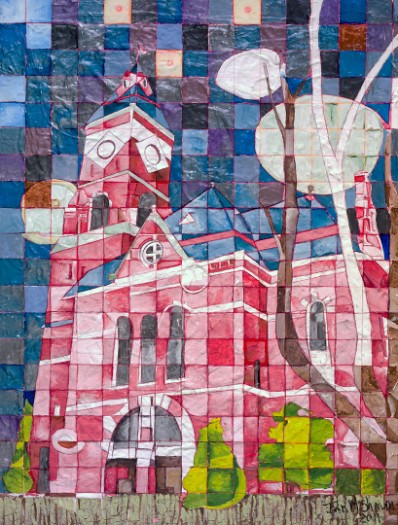
All you art collectors out there. Here is a chance to get a Giclee copy of some of Ian M Sherwin work. Ian is planning on doing a whole series of Marblehead, Massachusetts paintings. His work is amazing.




 .
.

 Posts
Posts

