Not to be outdone by David Letterman's EV love-fest, Jay Leno has posted his review of the Aptera 2e to JayLenosGarage.com. Clearly, now is the time for all late night hosts to come to the aid of electric cars. Next up: Jon Stewart invites Sarah Vowell to help him take on the RORMaxx Formula AE. (We hope.)
In the clip, Leno and Aptera's low-key front man, Greg Wilbur, discuss the finer points of the 2e--notably, its look. Leno seems pretty well smitten on that front, saying that it's "an exciting looking automobile". Also exciting (at least for the folks at Aptera): someone with the star status and car cred of Jay Leno endorsing such an outside-the-box vehicle.
Of course, as funky looking as the 2e is, no review would be complete without putting it through its paces, and Leno does just that. Hurtling down the freeway, he praises its "George Jetson feel" and insists that it's fun to drive. The three-wheeled Aptera's only shortcoming? Dodging road hazards: "If you see a pothole in the road, you're gonna hit it with something."
There are two other great moments in the clip--the first being Leno's market analysis. He bemoans the high cost of EVs like the Tesla Roadster and says that "if they can bring [the Aptera 2e] in for under forty [thousand], I think it'll be, uh,...very, very exciting." It's the "uh" that kills us--as in, "it'll be, uh...very exciting...for the people who buy one, but I will not be in that number."
The second moment: when Leno half-jokingly encourages Aptera owners to save all the money they would've spent on gas and buy a private jet. Which would be possible, perhaps, but isn't part of the point of the 2e to cut down on air pollution--you know, like the air pollution caused by jet planes? Fifteen minutes in the air, and hell, you might as well buy a Hummer. (Assuming Hummer's still around, of course.)
People use social networking website Facebook for different reasons – to post pics of their kids, boast that they’re sunning during a day off, or lamenting that Kris Allen won American Idol.
Actor Kirk Acevedo utilized FB in a different way; he let the online community know that he was fired from Fox drama Fringe, reports Entertainment Weekly.
“Well boys and girls, they done did yer boy wrong! They fired me off of Fringe, and I’ve never been fired in my life!!!” his FB status read.
This is a bummer on a couple of levels, as Acevedo’s character, FBI agent Charlie Francis, was a nice addition to the cast, injecting just the right amount of skepticism in contrast to the rest of Fringe’s characters.
Plus, Charlie only recently survived being injected with monster saliva, which morphed into nasty worms that were going to devour him from the inside.
He made it through that, only to be let go by producers.
The Live Journal website adds that a casting call has gone out, looking for a female FBI agent who is “attractive, brash, outspoken, quick-witted and capable.”
Even with a tough economy, is it possible to snag a deal in Palm Springs on Memorial Day weekend?
Kristen Bergevin, a 35-year old Los Angeles resident who works in a marketing communications agency, wasn't sure it would be possible to fulfill her vacation wishes, but with by taking some extra time to research possible vacation spots she found a great deal. The key: opting for a vacation rental with friends rather than staying in a hotel.
Photo by: Adam Chamness
For bigger savings, try destinations that are slightly off-the-beaten path such as Lake Martin, Ala.
"I would have to spend at least $300 a night in a hotel, and that’s just the room," she says. "By renting a house, it becomes $250 per person and we get our own rooms, a jacuzzi, and privacy."
With consumers uncertain about the economy, many are forgoing vacations, and leaving deals out there for those who are still traveling.
Renting a house or apartment can allow travelers to maximize their budget. Not only are some property owners cutting prices to attract guests, but more people who own second homes are renting them out in order to cope with the economic downturn. As a result, interest in rental properties is growing.
"Business is growing quite aggressively," says Brian Sharples, CEO of HomeAway.com. "People are still traveling and they are looking for more value."
"People are shopping around more," says Maya Offenbach, Manager of Villas of Distinction. "In the past, they weren't worrying about deals as much."
Sharples says that part of the reason for the increase is the fact that people are having a tough time selling their homes and they have started to see the value on vacation rentals.
"The supply for vacation rental homes has increased dramatically," says Stephen Ferrari, who has owned a five-bedroom vacation home in Duck, N.C., for the past 16 years. "You’ll find a place even if you wait until the last minute."
Still, Ferrari insists that even though there is more supply, the industry is not flourishing. "We have seen trouble," he says. "I used to rent my home 25 or 26 weeks in past years. Now I’ve renting only 15 or 16 weeks."
That may be good news for vactioners. As homeowners have started to be wary that the economic downturn might eventually hurt the business, real estate managers have started to act.
"Our rental manager dropped prices by 10 percent this year," says Shari Hindman, who rents a home in Lake Martin, Alabama. "The recession is on people’s minds."
"It’s a great time for the consumer," says Robert Haupt, a lawyer who represents vacation rental owners in the Midwest and in Florida. "Because of the recession we will start seeing prices drop this summer, and you’ll see lots of deals out there."
Photo by: Keith Bellvay
There are plenty of rental options available in North Carolina's Outer Banks.
For those who don't wish to gamble on snagging a deal at a popular resort area at the very last minute, try locations that are off the beaten path. Here are a few, lesser known destinations, where the deals are already available:
Duck, North Carolina
Located on North Carolina's Outer Banks, the "cottages"—as they are commonly known locally—can be as big as seven rooms. With balmy summer temperatures and the choice to enjoy the ocean or the bay, Duck is a popular destination.
The prices for a week’s stay range from $2000 to $9000 depending on the location and the size of the house.
Lake Martin, Alabama
This traditional Southern town in Alabama has been well regarded for fishing, swimming and boating.
"Anyone with wealth has come to build here," says local owner Aubrey Hornsvy. "But it’s still economically attractive to families."
Most homes in Lake Martin can be rented as low as $200 per night.
Photo by: Tony
Mt. Hood provides an option for those who want to leave the beach behind.
Mt. Hood, Oregon
Forty minutes away from Portland, Mt. Hood offers an interesting option for groups looking to leave the beach behind this summer.
"The summer is actually busier than the ski season," says Frank Groff, who owns a cabin in the area. "The topography looks like you’re in a fairy tale. The trees are huge and the mountain is amazing."
The peak summer season extends from May 23 through September 11, and cabins at Mount Hood can cost $250 a night per person.
Reader Christopher Cooper spotted a suspicious furry, blue-trenchcoated, yet friendly fellow lurking around the British Museum in London, confirming my suspicion that "England" really is an imaginary place found only in children's books. [Thanks, Chris!]
beautifullife.info —Intersting ecoprojects by Vincent Callebaut. It is anticipated that our children will live in such cities.
According to the less alarming forecasts of the GIEC (Intergovernmental group on the evolution of the climate), the ocean level should rise from 20 to 90 cm during the 21st Century with a status quo by 50 cm (versus 10 cm in the 20th Century). As a solution to this alarming problem architect Vincent Callebaut came up with this ecotectural marvel. He called this project “Lilypad“, but this ecotectural marvel is also called as “Floating Ecopolis for Climate Refugees”. The idea of Lilypad Project is to create a series of floating self-sufficient ocean-going eco-city islands. Each one would be able to house 50,000 residents and would support a great deal of biodiversity. Collecting pools located in their centers would gather and filter water for use on board. These would be places for adventurers and refugees alike as water levels rise around the world and threaten many, particularly island, habitats. Vincent Callebaut hopes that Lilypad will make the transition from design to reality around the year 2100.
The main deck with three marinas, the submarine performing arts center and the gardens of phytopurification.
The three mountains are ecological niches, aquaculture fields and biologic corridors.
The floating structure in “branches” of the Ecopolis inspired of the highly ribbed leave of the giant lilypad of Amazonia Victoria Regia.
Entirely autosufficient, Lilypad takes up the four main challenges launched by the OECD in March 2008 : climate. biodiversity, water and health.
Colorful Shibazakura (Moss Phlox) flowers cover a hill at Chausuyama Plateau in the Aichi Prefecture village of Toyone. The village and a local company plan to plant some 400,000 of the plants in a 22,000-square-meter field by fiscal 2011. Some 100,000 plants in six different colors, which were planted in autumn 2007, are now in full bloom. (Mainichi)
Aoyama Gakuin University is phasing out traditional methods of taking attendance at its School of Social Informatics, in favor of free GPS-enabled iPhones.
The faculty began providing Apple iPhone 3Gs to all 550 staff and students Friday, using the GPS function to determine whether they are in school or not. The university will initiate full operation of the system in the autumn. The school also has plans to expand their use to setting simple tests and questionnaires, submitting homework and reviewing class video materials.
The university is to pay the basic charges itself, ensuring no extra financial burdens will fall on students.
The same day, it also announced a tie-up with iPhone provider Softbank Mobile Corp., called "Mobile & Net Society Education and Training."
The Consumer Electronics Association, which hosts CES in Las Vegas every year, said Thursday that the trade show will expand its Apple section from 4,000 square feet to 25,000 square feet.
CES is devoting more floorspace to Apple this year. But will Apple attend?
(Credit: Tom Krazit/CNET)
It's called the iLounge Pavilion and will be an exhibition area for products related to the Mac, iPod, and iPhone. This year, for the first time, there will also be a section for applications for use on Apple products.
The original 4,000-square-foot space sold out within days of the announced availability to retailers, developers, and accessory makers looking to exhibit their wares and services, according to the CEA. That led to the decision to expand the floor space.
After Apple announced that the 2009 MacWorld Expo in January would be its last participation in the event, speculation arose that the company might choose to appear at CES--which is held around the same time--instead.
But despite the CEA's decision to create the Apple section, first announced in January, Apple has not yet commented on whether it would participate or not. The reason that the company bowed out of MacWorld--that it doesn't really need to participate anymore--would seem to preclude a similar type of presence at CES, where it would be one of thousands of companies on display.
For those who live in the Boston area, you will recognize some of the street scenes. I even saw the corner of my building in Lynn, where I live.
If you decide to skip the trailer, then you should at least go to the website mentioned at the end of the footage. By visiting ChooseYourSurrogate.com, you’re given the opportunity to design your very own cybernetic persona to send off into the real world. Designers have the option of building their surrogates from scratch or by uploading a photograph of their choice as a template.
It’s actually pretty fun once you get the hang of it. Now we’re looking forward to sending our surrogates out into the world, only to get blown to bits by some anonymous killer.
Do you feel like your cell phone's text message bill is getting higher every month? You're not alone. By some accounts, text messages cost more per megabyte to send than do messages from outer space to Earth. But you can email and Instant Message texts to phones for free. Here's how.
By Seth Porges
(Photograph by Tetra Images/Getty Images)
At roughly 20 cents a pop, text messages are expensive. But it takes a bit of perspective to realize just how pricey they really are.
Short-message-service messages (that’s the official name for text messages, often abbreviated to SMS) have a maximum of 160 bytes of data. Unless you purchase a bulk text-message package (which can cost as much as $20 per month), the 20 cents-per-message rate adds up to $1310.72 per megabyte. This is double the cost three years ago and, quite literally, astronomical: A space scientist at the University of Leicester in the U.K. did the math and discovered that this is several times as much as it costs to transmit data from the Hubble space telescope back to Earth. And most of this cost is pure profit for the phone companies, who are able to deliver text messages for nearly nothing by piggybacking them on other transmissions.
Thankfully, there are ways to bring your bill down to earth. The key is to use what are known as SMS gateways. These are backdoors that transform other (usually less expensive) types of communications, such as e-mail and instant messages, into text messages. The upshot: You can send all the texts you want without paying for the privilege.
All major mobile-phone carriers have e-mail addresses that feed into your SMS inbox (see our diagram for specific addresses). If you have a smartphone and an all-you-can-eat data plan, you can use your phone’s e-mail client to send as many texts as you want for no additional cost. Of course, this method has its limitations: In order to determine what address to send your message to, you first need to know what cellular provider your friends have. I suggest asking your most-texted contacts who their providers are. With that information, you can program the proper e-mail address next to their names in your phone’s address book.
Easier yet: Send your text message over AOL Instant Messenger (versions of which exist for most mobile phones). Instead of sending your message to a screen name, send it to “+1” followed by the area code and phone number. So if your friend’s number is 212-555-5555, sending an IM to “+12125555555” will ensure it pops up on his cellphone screen. If your phone has Web access, you can also send free texts through sites such as txtdrop.com.
Of course, you still have to pay to receive text messages from other people. If somebody replies to a text message that you sent as an IM or e-mail, his reply will come to you in the format you initially sent it in, and reading it won’t cost you a thing. You can cut your bill even further by asking your most-texted friends to program your e-mail address into their address books. Even if they insist on using SMS, sending a text message to your e-mail address will cause it to appear in your e-mail inbox. And as long as you have an e-mail program on your phone, it will be just as easy to retrieve.
Your target’s e-mail address depends on his mobile provider:
Stelios Arcadiou has an ear growing out of his arm. Rob Spence has a video camera hidden in his false eye. Jerry Jalava's finger is a detachable USB drive. Kevin Warwick – yes him – likes nothing better than sticking radio chips under his skin or connecting his central nervous system to robot arms.
Four very different men with four very different kinds of technology, but they all have one thing in common: they're cyborgs.
We've had cyborgs for a long time - the term was originally coined in 1960 to describe people whose bodily functions were aided or controlled by technology, so for example anyone with a pacemaker or hearing aid is a cyborg.
In recent years, however, we've gone beyond using tech to fix bits of us when they break. Increasingly, we're using technology to expand the possibilities of the human body and to blur the lines between (wo)man and machine.
But do we really need ears in our arms?
Ear we go
Stelios Arcadiou, aka Stelarc, probably isn't the template for Humans 2.0: his extra ear, grown in a lab from cells, is part of an ongoing performance art project designed to make us think. In interviews, he explains:
"I'm speculating on ways that individuals are not forced to, but may want to, redesign their bodies - given that the body has become profoundly obsolete in the intense information environment it has created…
"We shouldn't have a Frankensteinian fear of incorporating technology into the body, and we shouldn't consider our relationship to technology in a Faustian way - that we're somehow selling our soul because we're using these forbidden energies. My attitude is that technology is, and always has been, an appendage of the body."
Rob Spence is making a point, too. As the Toronto film maker explains: "I am a filmmaker who lost an eye so naturally I decided to modify my prosthetic eye into a video camera. I am not a lifecaster. I will use the eye-cam the same way I use a video camera now - or the same way any filmmaker would use a camera enabled cell phone."
Spence is working on a documentary "about how video and humanity intersect, especially with regards to surveillance."
ALL-SEEING EYE: Rob Spence's Eyeborg project uses a secret video camera implanted in his false eye
That doesn't mean artificial eyes and embedded cameras aren't coming. At MIT, researchers have developed a digital eye that enables the blind to see. At first, it was a giant machine costing $100,000. Then, a $4,000 desktop system. Now it's portable and costs around $500.
Elswhere at MIT you'll find Sixthsense, a wearable computer that uses a camera as an input device and nearby objects as display screens. The current prototype costs just $350 to build.
Rob Spence's eye uses a camera sensor developed by OmniVision, which specialises in high quality cameras for medical devices such as endoscopes. The firm is also working closely with Stanford University's Daniel Palanker on the Retinal Prosthesis project, a hugely complex and ambitious attempt to use sub-retinal implants to restore blind people's sight.
As an OmniVision spokesperson told us, the firm "agreed to participate in the project to jump-start and/or fuel research to provide vision for the blind."
Palanker has published a number of scientific papers detailing the project, and they make fascinating reading. In Design of a high-resolution optoelectronic retinal prosthesis [PDF] he explains how "an image from a video camera is projected by a goggle-mounted collimated infrared LED-LCD display onto the retina, activating an array of powered photodiodes in the retinal implant." Essentially the digital eye enables the blind to see again.
Hands-on technology
When Jerry Jalava was fitted with a prosthetic finger after a motorbike accident, he decided to make the finger more useful - by turning it into a USB drive containing Linux and some key applications.
"I'm planning to use the other prosthetic as a shell for the next version, which will have [a] removable fingertip and RFID tag," he writes.
Prosthetics have come a long way in recent years, with amputees being able to take advantage of myo-electric prosthetics that work just like real limbs. For example in May, Dawn O'Leary was fitted with a prosthetic arm that offers similar fine motor control to a real arm.
Sensors on her skin pick up nerve signals and operate the digits, enabling her to carry out complex tasks such as grasping the handle of a cup.
TOUCH AND FEEL: Jesse Sullivan operates a bionic arm via nerve signals [Image from RIC video]
Arms and the man
Sadly the "bionic arms race" owes much to a very real arms race. In 2005, the US military announced a multi-million dollar investment in prosthetic technology after a surge in the number of US soldiers losing limbs in Afghanistan and Iraq.
Improvements in body armour technology mean that attacks that just a few years ago would be fatal are now survivable - but the armour doesn't protect limbs.
Inevitably the military isn't just interested in rehabilitating injured soldiers. It's rather keen on enhancing soldiers' effectiveness in battle, too, which is why it's testing exoskeletons.
Earlier this year, Lockheed Martin inked a deal with Berkeley Bionics to develop the HULC - Human Universal Load Carrier - "to provide soldiers [with] a powerful advantage in ground operations." [PDF]
STRONGER SOLDIERS: The HULC exoskeleton isn't sci-fi: Lockheed Martin is working on it with the US Military [Image: Lockheed Martin]
The big problem with such technology is that it needs power. Military versions are powered by battery packs or small combustion engines, while civilian prosthetics tend to use batteries.
That might change. US and Canadian scientists have found a way for prosthetics to generate power. As Dr Douglas Weber of the University of Pittsburgh told the BBC, "All of the new developments in prosthetics require large power budgets. You need power to run your neural interface; you need it to run your powered joint; and so on."
The solution? A modified knee brace that uses regenerative braking technology to turn movement into electricity.
Tech on the brain
Professor Kevin Warwick - dubbed "Captain Cyborg" by The Register - is famous for headline-chasing ideas such as implanting RFID chips under his skin or attempting telepathy by connecting two people's brains to computers, but behind the headlines he's doing some useful and potentially far-reaching work.
Warwick is helping to develop a new generation of Deep Brain Stimulation equipment, which uses electrodes to make an amazing difference to the symptoms of Parkinson's Disease, and in 2008 he unveiled Gordon the robot.
Gordon is no ordinary robot: he's controlled by living brain tissue. As Warwick explains: "The purpose is to figure out how memories are actually stored in a biological brain… if we can understand some of the basics of what is going on in our little model brain, it could have enormous medical spin-offs".
While Warwick and his colleagues are trying to find out what makes us tick, other researchers are finding new ways of making us shriek.
In 1998, Dr Stuart Meloy was implanting electrodes in a patient's spine to make her feel better - but to say he exceeded his remit would probably be an understatement. "You'll have to teach my husband how to do that," the patient told him, moaning with pleasure.
Since then Meloy has been studying the effects of electrodes on the pleasure centres of our brains, and his device - inevitably dubbed the Orgasmatron - will be on sale within a few years.
As Meloy told the LA Times, unlike most medical devices the Orgasmatron won't be tested on animals: "I don't know how to ask animals 'where do you feel the tingling?' or 'do you want a cigarette?'"
SPINE TINGLING: The orgasmatron stimulates the nervous system to induce orgasm - but don't expect to see it in Ann Summers any time soon
So are USB fingers and extra ears part of our future? Probably not. They're impressive but not exactly essential or even particularly worthwhile, and while military exo-skeletons are interesting in an "eek! Terminator!" kind of way the real advances are medical.
From digital eyes that restore sight to prosthetic limbs that generate their own power, work like real limbs and even provide sensory feedback, technology can repair, replace and possibly even improve upon the human body.
Experiments such as Gordon the robot could shed light on the way our brains work, and in the (very) long term computers may even be able to detect and transmit our very thoughts, enabling us to communicate almost telepathically.
If you think Twitter is pretty tedious now, you ain't seen nothing yet.
The ’80’s were a magical decade for gadgets for kids. Computing power and display technology were evolving and cost effective enough to penetrate the toy market in a big way. Purely mechanical toys evolved into electromechanical toys and gave birth to the digital toy revolution. For example, LED games of the ’70’s were replaced by Tiger LCD games which were replaced by the Nintendo Gameboy and so on.
Companies also began to innovate on educational toys for kids, whether it was teaching them about electronics, programming, or offering educational games. As a child of the ’80’s, I had many of these toys and played with them much longer than a kid’s attention span would dictate. Below are five that I have the fondest memories of. And hoping to instill that same child-like wonder in my kids, I’ve also included what the modern equivalents are in the market today.
100-in-1 electronics kits
Photo Credit: Flickr User mightyohm
What is was: Arthur C. Clarke has said that any sufficiently advanced technology is indistinguishable from magic. As a kid in the midst of an increasing technological revolution, electronics were at the heart of that. Learning electronics was made easy through the Science Fair Electronic Project Kits found at Radioshack. Through the project guides, kids could construct various ‘experiments’ by attaching wires to terminal springs that make circuits. The terminal springs would wire in components such as LED segment lights, photo sensors, resistors, diodes, etc. While it was fun getting the projects to work, the manuals lacked in depth explanation as to what was happening in the circuit to produce the project’s result.
Why it was awesome: First, it was a simple buy for parents. Everything you needed to get your child interested in electronics was right in the kit. You didn’t need to breadboard or solder. I remember a distinct feeling of accomplishment making a high-water alarm or a light-sensor game with the realization that the bundles of wires springing up from the kit were actually doing something!
Modern equivalent: You can still pick up variations of the 100-in-1 kits, but their popular replacement seem to be Snap Circuits by Elenco. All of the components are mounted on a plastic base with a contact on either end which interconnect with each other and the plastic base that projects can be mounted to. Each component also has the electrical diagram symbol for that component drawn on it so it can help you read schematics. For that reason alone, I like these better.
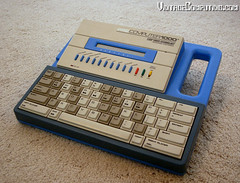
Pre-Computer 1000
Photo Credit: VintageComputing.com
What it was: One of many educational computers hitting the market during the mid-80’s, the VTech Precomputer 1000 wrapped learning in a quasi-game format that taught kids about science, history, geography, math and typing — or as much as quizzes can teach anyone about anything. But at least in two player mode you could school your friends by buzzing in your answer first.
Why it was awesome: The Precomputer 1000 featured a slimmed down version of BASIC called Pre-BASIC, and the wire-bound manual featured several programs and games which could be typed in to RAM. The programs were there to teach you the basics of programming computers and demystified many of the built-in games and quizzes by showing you how to make your own. However, programming was quite challenging as you could only view one line with 20 characters across the LCD display. Debugging was limited, and you lost your program if you replaced the battery.
Modern equivalent: VTech is still making educational laptops for kids that feature similar learning activities as the Precomputer 1000. These are packaged to look like mom and dad’s laptops enticing kids to play on their own. However, none of the current models in their catalog feature access to a programming language.
Also, The XO-1 from the One Laptop Per Child organization is much more advanced in capability but does not seem to have any educational learning software. However there are are plenty of learning tools such as an offline wikipedia, music composition software, and Pippy, a Python Programming Language/environment.
Etch-a-sketch Animator
What it was: Like a traditional Etch-a-Sketch, the Animator featured two knobs and a screen and allowed you to make drawings. But instead of a mechanical stylus removing aluminum powder from the screen, the Animator featured an LCD matrix and the knobs would move a cursor around the screen. Pressing a button would allow you to turn individual pixels on and off. Once a drawing was made, you could save it to memory and make another. Careful planning and ‘flipping’ back to previous drawings (not unlike traditional animation) allowed you to create a sequence of drawings. You could program the sequence to flip to any drawing in any order to create the illusion of animation.
Why it was awesome: It was kind of like a computer and more complex then making a flip book. You really weren’t programming, you couldn’t interact with it like a game, and the metallic sound effects were a really weird choice. But in the ’80’s, you felt like you were creating something amazing.
Modern equivalent: While there is plenty of software available that allow kids to make simple 2-D animation, the killer application for portable animating fun is an upcoming Nintendo DSiWare titled called Inchworm. Planned for a September 2009 release, Inchworm features a wide variety of features including a color pallet, various pen styles, basic shape drawing, layers and onionskin animation. Numerous tutorials are on the Inchworm website, including demonstrations on a web-uploading feature that will allow people to share their animations outside of the Nintendo DSi.
Casio VL-1 Keyboard
Image Source: wikipedia.com
What it was: A relatively inexpensive keyboard, sequencer, and calculator (!) that featured 5 built-in sounds, 10 rhythms, recording functionality, and the ability to create your own sound by modifying Attack, Decay, Sustain, and Release (ADSR) values. It was a fun toy to play around with as building your own sounds was the highlight of the toy. But it was monophonic (only one note at a time) and the built-in sounds were astonishingly bad. Plus the demo song teased you into thinking you could change sounds on the fly.
Why it was awesome: It was small, portable, and programmable. It didn’t matter that you couldn’t get faithful piano or violin sounds out of the thing. I wouldn’t say it’s a perfect toy for a budding musician, but it is perfect for a music geek. You could spend hours and hours adjusting the ADSR values creating crazy synth sounds. Plus, was your keyboard also a calculator?
Modern equivalent: The Korg microKorg modeling synthesizer is bigger, badder, and while more expensive than the VL-1, it is infinitely more usable, mostly due to the Korg being an actual instrument and not a child’s toy. Featuring multiple waveforms to model, multiple filters, two ADSR envelopes and a vocoder, it’s a great synthesizer for beginners. But is it kid friendly? Hard to say. The more features you throw at the thing, the more difficult it is to program and likely the less fun a younger kid might have, but older kids won’t be limited like we were with the VL-1. Consider this a call for the Casio’s of the world to bring back a programmable synth toy.
Erector Sets
Image Source: Meccano
What it was: The classic toy construction set that has been around since 1913, Meccano Erector sets were made of metal containing girders with holes that could be attached with nuts and bolts and other shaped elements. The pieces allowed you to build a variety of models including cars, planes, windmills, bridges, etc. Budding mechanical or civil engineers got a taste of constructing models or building toys in a much more grown-up way.
Why it was awesome: To a kid who mostly played with plastic toys, erector sets represented a graduation of sorts to a more advanced toy. The models were similar to some of the stuff you could build with Legos, but you got to use real tools to assemble your project.
Modern equivalent: Fortunately, Erector sets are still around. Meccano has smartly segmented their product line around age groups, having kits with all plastic parts for the 2-4 year olds, through advanced wifi-controlled robots. But the classic kits are where it’s at, with generic pieces that don’t limit the imagination. Lego’s may be the most popular construction toy, but it’s nice to see options still available.
A Hummer that gets 100 miles to the gallon is virtually unheard of, but Raser Technologies along with Sen. Hatch from Utah displayed a GM H3 that will hopefully push the development of plug-in hybrid technology towards the realm of consumer affordability.
Sen. Hatch showing off the candy apple red H3 to the media.
Given Barack Obama’s recent fuel efficiency standards, vehicle manufacturing companies are putting forth more of an outspoken effort to develop technologies that are cleaner, more efficient, but more importantly, affordable to the common consumer. Alongside the car companies themselves are a multitude of different, more independent groups finding ways to turn current market vehicles into some of the most fuel efficient machines on the road.
Normally when you think of fuel efficient vehicles, GM’s Hummer doesn’t exactly come to mind. But yesterday, Raser Technologies showcased its 100 mile per gallon Hummer with the help of Utah Senator Orrin Hatch. Capitol Hill was filled with cameras and journalists as Sen. Hatch test drove the candy apple red H3 plug-in hybrid; the vehicle boasted a little over a 400 mile range without either a charge or a fill-up. Hatch invited his fellow politicians to try out the technology for themselves; he noted how indispensable the development of plug-in hybrids are to weaning the Unites States off of oil while keeping the development of such important technology at home.
Hatch’s personal plea amongst his fellow politicians culminated into a direct appeal to Barack Obama that such technology needs to be fostered, both in the context of short and long term goals in our energy policy. Hatch, who’s been an outspoken advocate of hybrid technology, has high hopes that it’ll become more affordable so that the average hybrid vehicle sold won’t cost much more than its non-hybrid counterpart.
Currently, the GM restructuring plan involves seeing the Hummer brand sold off in China. Hatch urged Obama to prevent the selling of the well known gas-guzzling behemoths, especially since he believes “the US is on the cusp of integrating environmentally friendly and affordable hybrid technologies” into these normally environmentally disastrous vehicles.
Kraig Higginson, chairman of Raser, said that although the current trend is to turn smaller, more compact vehicles into hybrids, there is still little done to address the fact that it’s the utility of SUVs and trucks that some citizens could never live without. Offering a cleaner, more fuel efficient hybrid alternative to the vehicles some Americans need the most may be a key turnaround point within the whole scheme of the plug-in hybrid revolution.
People such as farmers, parents, and business owners aren’t driving gas guzzlers just cause, they’re holding onto them because hybrid technology has yet to make its debut in an affordable manner on the vehicles they need. Hopefully, companies like Raser and politicians like Sen. Hatch can open up some eyes in Washington, D.C. and make vehicles like this a market reality.
Already the recipient of Presidential iPods and box-set DVDs (non-PAL region), the world's most famous monarch can now claim her stake on yet another popular digital past-time- videogames. Specifically, a gold-plated Nintendo Wii, courtesy of publisher THQwhich hopes to lure Her Majesty and her own extended family into a few endless nights of waggle-induced fun.
Encased in gold and accompanied by a copy of the company's latest family-friend release, BIG Family Games, appropriately enough. So says THQ product manager Danielle Robinson of the royal present:
"But we thought that Her Majesty the Queen wouldn't want to play on any old console, so an extra-special gold one was commissioned. We hope that she and the rest of the Royal Family enjoy the game!"
The Queen can now claim to be the second-most popular world figure to house Nintendo's ubiquitous console, right after US President Barack Obama snatched one up for the White House soon after taking power. No word yet on whether the Queen and First Lady Michelle Obama will continue their burgeoning friendship via a few fast-paced games of Mario Kart Online, but we'll certainly keep you posted! Cheers!
David Traver, left, and Bob Gengler talk about the 2009 World Beard and Moustache Championships. (THE ASSOCIATED PRESS/Al Grillo)
ANCHORAGE, Alaska - The world's fanciest whiskers are coming to Alaska so their owners can strut their manly stuff in a land that has long appreciated furry faces.
On Friday, the 2009 World Beard and Moustache Championships will come to Anchorage, where more than 200 competitors from 12 countries will brandish facial hair ranging from delicate Salvador Dali-style mustaches to bushy full beards.
Seasoned competitors say Germans have the facial hair to beat.
"They take it very seriously. It is an age-old tradition there to have beards," said Bob Gengler, a 44-year-old physical therapist in Anchorage who sports a big bushy beard.
The Germans' 20-person contigent this year will not include Elmar Weisser, who is renowned for his ingenuity in the freestyle full beard category. In 2005 in Berlin, he styled his beard into the shape of the Brandenburg Gate. Two years later in Brighton, England, his beard formed London's Tower Bridge.
David Traver, 43, of Anchorage, has won three times in the world championships and hopes to capitalize on Weisser's absence. He's planning something special for the freestyle competition, he said, but he'll only reveal that is is "very Alaskan." Mount McKinley, perhaps? The Northern Lights?
"In freestyle, you can do anything except you can't use wires and pins. It is anything goes. The only drawback is your lack of imagination," Traver said.
At the world championships, contestants compete in three main categories: mustaches, full beards and partial beards. The competition is divided into 18 categories.
"We, the local guys, are in it for fun," said Robert Crawford, who grew a long, white full beard after 24 years in the Air Force where he was forced to have a military-style cut.
Will Merrill, 45, a marine equipment salesman in Anchorage, will be competing in his first world championships.
"In Alaska, I think I probably have the biggest goatee right now," he said. "It is right about to my belly button."
Merrill is shopping for some bright red pants to match his red goatee. He'll wear a white dress shirt to complete the "red, white, red" ensemble, he said.
There's a lot that goes into growing a competition-ready goatee, Merrill said. He has shampooed and conditioned his goatee every day in preparation for the competition, he said. He finishes off the preening with a blow-dry to keep his hair looking tidy.
The last time he was completely shaven was when he was 19 years old. He did it for a girl.
"I hated it," he said.
But since then, the bachelor said he's gotten lots of compliments on his facial hair.
"I've had women tell me that it is the best goatee that they have ever seen. I could tell they were very impressed," Merrill said.
George Haskins, a 53-year-old clerk in Fairbanks, said children will sometimes stare at him and his mustache as if he were a cartoon character. Haskins placed second in the English mustache category two years ago in his first international competition at the world championships.
The grocery store where Haskins works doesn't allow mustaches that droop past the corner of the mouth.
But his mustache gets to stay because it "doesn't go past the corner of the mouth," he said. "It just goes about a foot to each side."
Gengler has found that having a big bushy beard requires making some changes. When he goes to his favorite hangout for a beer, he asks for a straw.
"If you don't do that, you are covered in foam when you are done," he said.
But Phil Olsen, founder of Beard Team USA, said the competition is more fun than sacrifice.
Every two years, a contigency of hairy men get to come together and have a blast, he said as he boarded a ship in Vancouver, British Columbia, for a seven-day cruise to Anchorage.
"Here we have on board the ship about 80 people from many different countries who are all friends from this competition," he said. "It's all about friendship."
Bethany Hamilton became an international sensation when she lost her arm and nearly lost her life in a vicious shark attack while surfing off the coast of Hawaii almost six years ago. Despite the attack, Hamilton, 19, has proved she could still compete with the best of them, jumping right back in the water one month later.
This takes some ’splainin’! But fasten your seat belt; this one is a bit of a wild ride.
First off, in this picture from Cassini we’re looking down on the rings from about a 41° angle. The sunlight is coming from the left, in a direction from below the rings as seen here. The part of the planet itself we see here is actually in shadow! That’s obvious from the top half of Saturn’s disk, which is dark. However, the bottom part of the disk is being softly illuminated by reflected light from the rings (rather like moonlight can illuminate the Earth). In that case, sunlight came from the left, hit the underside of the rings (underside as seen from this angle that is), reflected off, hit the planet, which then reflected that light back to Cassini’s camera.
The top half isn’t completely dark, though. Light from the Sun is passing through the rings, too. It gets scattered and diffused, and some of it hits the dark part of Saturn at the top of the picture. So we can see that as a faint illumination.
There’s more! The rings look like they’ve been sliced clean; that’s the planet itself blocking sunlight from the rings, so think of that as the shadow of Saturn on the rings. But if you look to the right of that cut, you can see still the rings! They look dark and thin, and you can only see them against the planet’s disk. Some of the light reflected off the planet’s southern hemisphere (which itself was reflected from the rings as mentioned above) backlights the rings where they are in shadow, so you can see them silhouetted against Saturn’s disk.
Wow. What a tortuous way to light an image! But it’s very cool that we have Cassini-on-the-spot to send us lovely images like this. We can simply enjoy their beauty, of course, or we can unravel the pieces of the puzzle (to mix a metaphor) to see what’s really going on here. Both are fun, and both are worth spending time doing.
.
All you art collectors out there. Here is a chance to get a Giclee copy of some of Ian M Sherwin work. Ian is planning on doing a whole series of Marblehead, Massachusetts paintings. His work is amazing.


 Richard Read


 Reader Christopher Cooper spotted a suspicious furry, blue-trenchcoated, yet







 .
.

 Posts
Posts

