Zazzle Shop

Screen printing
Showing posts with label robotic. Show all posts

Thursday, July 28, 2011

Racing to the Bottom: Exploring the Deepest Point on Earth

 From: http://www.theatlantic.com
 
Teams led by Richard Branson, James Cameron, and some unknown guy from Florida are all hoping to make it to the Mariana Trench
TriesteWikiCommons-Post.jpg
At the southern end of the Mariana Trench, a deep scar that cuts into the bottom of the ocean floor, there is a point known as Challenger Deep. Here, just outside of the Marianas or Ladrones, a series of 15 islands made up of volcanic mountains that peak just above the water line, a small slot-shaped valley plunges nearly seven miles down. At 35,797 feet, Challenger Deep is the deepest known point in the oceans. It is so deep that, if you were able to place Mount Everest inside of the valley, there would still be 6,811 feet of water separating it from the surface.
At just 7,000 feet down, about where the tallest mountain in the world would peak, the pressure becomes so great that whales rely on unique evolutionary traits when hunting for giant squid. Whales have lungs that can collapse safely under pressure and ribs bound by soft cartilage that allows the cage to shift and settle in extreme environments rather than snap. Without similar anatomical gifts, we don't know much about what happens below that level. Imagine what creatures might live at depths five times greater than where whales and giant squid battle in the pitch-black ocean.
We've been there once before, to the bottom of Challenger Deep. But we didn't see or learn much. On January 23, 1960, Jacques Piccard suited up, plopped down inside of Trieste, and sank to the ocean floor. The Swiss-designed, Italian-built, U.S. Navy-owned Trieste is an inelegant machine. The observation gondola, a sphere welded to the bottom of the ship's main flotation system, has walls that measure five inches thick and a tiny, cone-shaped Plexiglas window.
Story continues after the gallery.


TRIESTE

Trieste
Historic Naval Ships
FULL SCREEN
  • Trieste
  • Trieste
  • Before the Dive
  • Main Features
  • Pressure Sphere
  • Walsh & Piccard
  • Jacques Piccard
  • Cross-Section of Mariana
  • Mariana Trench
After spending nearly five hours sinking to the bottom of the ocean, Piccard and Don Walsh, a Navy Lieutenant that accompanied him, were only able to peer through the Plexiglas while shivering in the 45-degree capsule and munching on chocolate bars for sustenance. Surrounded by a cloud of sediment that Trieste had kicked up when it smacked into the ocean floor, Piccard and Walsh couldn't see a whole lot from their window, which had cracked on the way down. What they did see, though -- a variety of sole and flounder, two types of flatfish -- proves that at least some vertebrate life can handle the extreme pressure in one of the Earth's most extreme places. Twenty minutes later, Trieste dumped tons of magnetic iron pellets and spent three hours rising back to the surface.
Now, more than 50 years later, humans are nearly ready to return to Challenger Deep. This time, though, they're planning to stay a while, collecting samples, videotaping whatever might be down there, sending out small remotely operated underwater vehicles (ROVs) and then bringing home $10 million. Earlier this year, the X Prize Foundation made that prize money available to the first privately funded submersible to make two visits to Challenger Deep. This money, though, is little more than proof that humans are fascinated with the extreme: climbing Mount Everest, walking on the Moon, searching the floor of the ocean. Ten million dollars will only cover a fraction of the race to the bottom. And it is indeed a race; one with at least three competitors, each close to claiming the prize.


RICHARD BRANSON'S VIRGIN OCEANIC

Billionaire Richard Branson is known for the hundreds of companies that fall under the Virgin Group umbrella, including Virgin Megastores, Virgin Atlantic Airways, Virgin Records and Virgin Galactic, his space tourism company that aims to bring passengers into sub-orbital space for $200,000 a head. As part of his team perfects SpaceShipTwo, the plane that will fly more than 60 miles above the Earth as those inside gleefully float about the cabin for six minutes of weightlessness, another crew is busy preparing a kind of ship meant to take humans in the opposite direction.

Branson's team, led by legendary submersible designer Graham Hawkes and chief pilot Chris Welsh, has been planning to take the Virgin Oceanic out for water tests as early as this summer, but, due to setbacks, no date has been confirmed. In early rounds of laboratory testing, the borosilicate viewing bubble through which the Oceanic's crew would peer out at the ocean floor cracked under just 2,200 pounds per square inch of pressure, about one-eighth of the 16,000 psi expected at Challenger Deep.
Story continues after the gallery.

VIRGIN OCEANIC

Virgin Oceanic
Virgin Oceanic
FULL SCREEN
  • Virgin Oceanic
  • Virgin Oceanic
  • Cheyenne Catamaran
  • Cheyenne Catamaran
  • Richard Branson
  • James Cameron
  • Triton 36,000
  • Triton 36,000
  • Triton 36,000
  • Triton 36,000
  • Triton 36,000
  • Triton 36,000
  • Triton 36,000
  • Triton 36,000
The 8,000-pound, 18-foot-long submersible that Hawkes has designed "represents a transformational technological advance in submarine economics and performance," according to Virgin Oceanic's official website. "The submarine provides the currently unequalled capability to take humans to any depth in the oceans and to truly explore." Taking some of the most elegant creatures of the sea as inspiration -- whales, dolphins and rays -- the Virgin Oceanic uses two sets of wings to fly through the water.

The Virgin Oceanic will be carried out to sea and launched by an enormous 125-foot racing catamaran that was once owned by adventurer, aviator and sailor Steve Fossett. Welsh, the pilot for the submersible who made his money in real estate and then decided to take to the seas, purchased the catamaran after Fossett disappeared in a single-engine airplane over the Nevada desert in 2007. He traveled to Fossett's estate to close the deal on the Cheyenne and was sold on the Challenger, the original name for what would become the Virgin Oceanic, as well.

JAMES CAMERON'S DEEP CHALLENGE TEAM

The Avatar and Terminator director is an explorer first and a filmmaker second. The box office-breaking Titanic wasn't on Cameron's radar as a Hollywood project because he knew it could earn huge dividends, rather, he has long been obsessed with the famous sinking of the ship. He has made several trips to the wreckage, shooting footage using 3-D cameras he designed himself to capture the 100-year-old ship as it has never been seen before. He plans on using some similar technology at the bottom of the Mariana Trench.

Admittedly, Cameron doesn't care if he's the first (well, the first of this group) to reach the bottom ... he just wants to be the best. Cameron's team is working on building what appears to be the most high-tech (and least reliant on a tourism-based model to fund future exploration) submersible. The as-yet-unnamed project will include a giant lighting array, several 3-D high-definition cameras, an arm that can grab samples from the ocean floor and a small ROV similar to that used to swim in and around the Titanic wreckage, according to an email that Cameron sent to Outside's Anna McCarthy.

Unlike Branson's Virgin Oceanic, Cameron's Challenger Deep project has passed pressure tests; at a Penn State University lab, the team turned the dials to 16,000 psi and waited. Nothing. But at what cost? Nobody knows how much time or money Cameron has put into this submersible, about which he has been pretty tight-lipped since kicking off the design stage with a couple of sketches in 2003. Now, more two dozen people are working around the clock to prepare the sub for sea trials next April.

BRUCE JONES' TRITON SUBMARINES

Bruce Jones is the odd man out in this triumvirate. And that's because you have no idea who Bruce Jones is -- and you're not alone. Building a vessel that can safely sink to the bottom of the ocean is no easy feat; it's one that requires big backers with deep pockets, something that Jones doesn't have. While the 55-year-old entrepreneur has drawn up plans and marketing materials -- they call this project the "race to inner space!" -- he has not yet secured the funds to construct a prototype. He's currently shopping around the idea. "We're talking to a number of first clients because, quite frankly, we don't have the money to build one of these on spec," Jones told Outside.

Jones' Florida-based company is hoping to build a number of Triton 36,000s -- named for its maximum depth, obviously -- and sell them for about $15 million each to individuals who can shuttle people down to the bottom of the ocean for even more than Branson plans to charge for a space ride: $250,000 each.

Image: Wikimedia Commons.

Tuesday, July 26, 2011

Wall-E meets his Canadian DJ maker, turns into a real robot toy (video)


What do you get when you cross a dj with a "Canadian roboticist?" An almost true-to-fiction Wall-E, that's what. In this rendition of garbage-bot gone cute, amateur robotics enthusiast DJ Sures (yes, he makes music) hollowed out a U-Command Wall-E toy and fixed him up with some servo guts. The voice-activated, semi-autonomous modjob has a built-in eye camera that recognizes motion, colors and faces, coming the closest we've seen to replicating the CG-romantic. The whole AA-battery powered affair runs on the EZ-B Robot Controller software shown off by Sures in the video below. And unlike other past re-creations, this little guy knows how to get down without the need for sped up video tricks. Clearly, the Pixar-bred bot's become the unofficial icon of the homebrew robotics community, so where's his official counterpart? You listening Disney? Get cracking.


Pancake-making robot is awesome, made out of LEGOs

By: Jennifer Bergen
From: http://www.geek.com/


Breakfast is a special meal for many of us. Sometimes we take the time to make a nice meal with eggs, bacon, French toast, or (and?) pancakes. But before we know it that Sunday morning meal is a lot of work. Problem solved! Inventor Miguel Valenzuela designed a robot that not only makes pancakes, but it makes them whatever shape you want.

As if the idea of a pancake-making robot wasn’t cool enough, the Pancake Bot (PB) is made of 99% LEGO and 1% ketchup bottle. Yes, the nerdiness factor just skyrocketed through the roof. Valenzuela goes into some pretty technical detail on his blog about how he made the robot. For example, he used a pneumatic pump and compressed air to dispense the batter. The manner in which the batter will be dispensed is pre-programmed with coordinates, so you can chose to make various shapes. The photo below shows some pretty good-looking Mickey Mouse flapjacks.


The PB is similar in some ways to the Solar Sinter, a 3D printer that we reported on earlier this month that creates objects out of sand. Both devices move smoothly on a track to produce a final product. In this particular case, the track leads a ketchup bottle full of batter down the length of the griddle, dispensing as it goes.

It’s slightly sluggish, so if you want to make some quick pancakes, you’re most likely better off just spooning the batter yourself. But a speedy breakfast is obviously not the point of the PB.

Valenzuela’s daughters Maia and Lily helped and are credited as “assistants” on the project. We’re not sure what part the young girls had in the making of the PB, but we have a feeling it may have something to do with the eating part. Judging by Valenzuela’s blog, being his kid seems pretty awesome. Not only does he create pancake-making LEGO machines, but he also builds awesome snow sculptures of Tauntauns, AT-ATs, and a humongous, awesome looking robot.

Make sure to check out how the Pancake Bot works, oggle over his awesome snow sculptures (scroll down), and watch the PB in action in the video below.


Via Waylou

Thursday, May 19, 2011

Amputee Patrick demonstrates his new bionic hand

Last year, Patrick, a 24-year-old Austrian, decided to have his dysfunctional hand amputated and replaced with a bionic hand. He lost the use of his left hand after being electrocuted at work.


Here he demonstrates the extra movement his new bionic hand has given him, opening a bottle and tying his shoelaces, and tests a prototype hand which will give him additional wrist movement.

Thursday, April 7, 2011

Robot Replicants Gather With Their Originals In World’s Creepiest Reunion (video)

by Aaron Saenz

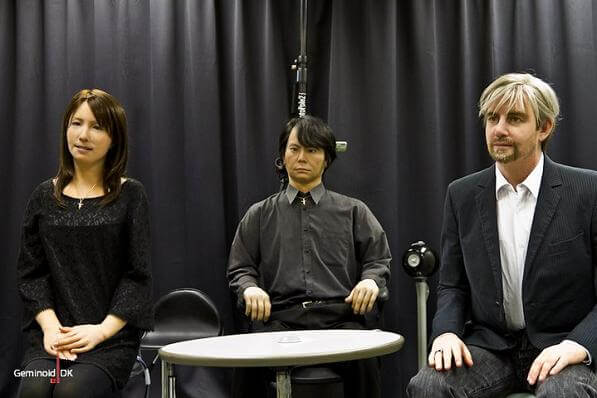
Geminoid Summit
Meet the Geminoids and their human counterparts. Can you tell which is which?

There are only a handful of people in the world who can say they have a robotic clone of themselves, and most of them just got together in Japan. ATR’s facilities in Nara hosted a bizarre reunion at the end of March as three Geminoid robot replicants and their originals met for a press conference and photo shoot. The first clone was modeled after its creator, Hiroshi Ishiguro of Osaka University, another bot is a copy of an unnamed Japanese woman, and the latest is a dead-ringer for Henrik Sharfe of Aalborg University in Denmark. Watch all six of these ‘people’ converse and interact in the video below, followed by some more great pics. Looking at the progression from the oldest (the Ishiguro-bot) to the newest (Sharfe-bot) it’s clear that the Geminoids are getting better…and relatively quickly too. It may only be a matter of a few years until these replicants look human enough to pass as one of us.

Ishiguro first demonstrated his robot clone (Geminoid HI-1) back in 2006, the female version (Geminoid F) arrived in early 2010, and Sharfe’s clone was ordered in 2010 but took six months to create (and reportedly cost $200k). Geminoid DK (as it is called) arrived early this year. While all have very similar pneumatically driven systems that are remote controlled by human users, Geminoid DK appears much more life-like. Perhaps it’s the facial hair covering some of the imperfections, but in any case it really comes close to bridging the Uncanny Valley…as long as it’s sitting still. Here is a video of Geminoid DK’s movements that was released after our previous coverage came out. This clip really showcases the life-like and creepy motions of the robot:

While Ishiguro continues to improve his Geminoid creations (in association with ATR and produced by Kokoro) Sharfe is aimed at studying how humans will accept/interact with them. This little Geminoid summit then represents the two halves of human-like robotics research: technical and social. Undoubtedly the next Geminoid that Ishiguro and his team creates will be even more realistic, perhaps able to show its teeth without causing my hackles to rise. In the meantime, Sharfe and colleagues may be able to explain to us what humanity really can expect from its upcoming future full of robotic clones. I suspect that no matter how human-like these bots will appear, we won’t fully accept them until they have human-like personalities as well.
Quick, someone make a Geminoid of a prominent AI researcher and bring them into the fold!

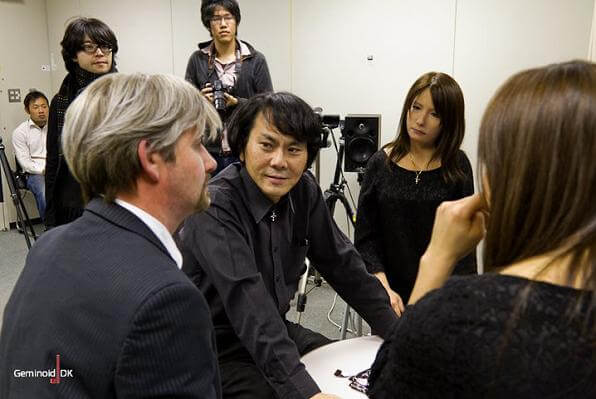
Geminoid Summit 02
Sometimes I really get the willies when I think Geminoid HI-1 is looking at me. To be fair, I get the same feeling when I think Ishiguro is looking at me, too.
Geminoid Summit 03
The improvements that ATR/Kokoro/Ishiguro have made since 2006 are so clear. Geminoid DK (right) wins the human look alike contest hands down.
Geminoid Summit 04
This is my favorite photo from the event because when you focus on Ishiguro, you forget that the two people on either side of him aren't really people at all.
[image and video credits: Geminoid DK]

[source: Geminoid DK (Facebook page)]

Friday, March 18, 2011

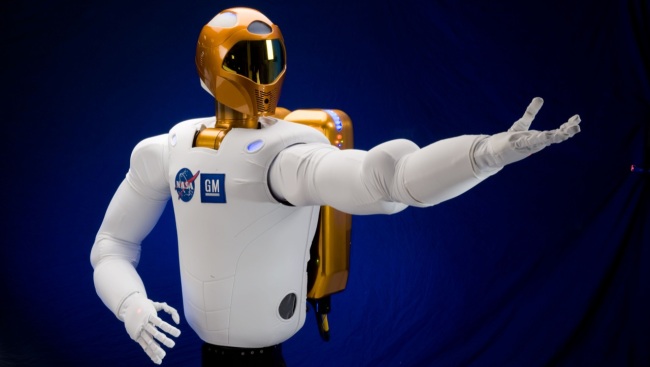
NASA's humanoid robot unveiled on space station

From: http://news.yahoo.com/

In this March 15, 2011 photo provided by NASA, astronaut Scott Kelly, Expedition 26 commander, right, poses with Robonaut 2, the dexterous humanoid as
AP – In this March 15, 2011 photo provided by NASA, astronaut Scott Kelly, Expedition 26 commander, right, …

CAPE CANAVERAL, Fla. – The first humanoid robot ever launched into space is finally free.

Astronauts at the International Space Station unpacked Robonaut on Tuesday, 2 1/2 weeks after its arrival via shuttle Discovery. NASA broadcast the humorous unveiling ceremony Wednesday.

American Catherine Coleman and Italian Paolo Nespoli pried off the lid of the robot's packing box, as though they were opening a coffin. TV cameras showed lots of foam inside, but no robot.

"It's like unearthing a mummy," radioed a payload controller at Marshall Space Flight Center in Huntsville, Ala.

"Well, at least the mummy would be here," Coleman replied. "We just have an empty box where Robonaut is supposed to be."

Robonaut — also known as R2 — was spotted a minute later in front of a work station.

"I'd like to introduce you to the newest member of our crew," Coleman said. "We're going to see what Robonaut can do."

The payload controller asked if R2 was related to HAL, the sinister computer with artificial intelligence from the 1968 film "2001: A Space Odyssey."

"Since we found him already controlling the space station, we're sure that he is related to HAL. But we'll see," Coleman said.

In a Twitter update, R2 announced: "Check me out. I'm in space!" A NASA employee on the ground posted the tweet.

Nespoli attached NASA's waist-high R2 to a fixed pedestal, where it will remain with its fists clenched and its arms folded against its chest until testing begins in May. The robotic team at Johnson Space Center in Houston wants to see how R2 performs in weightlessness. The robot is intended as an astronaut helper, inside the space station, in the decade ahead.

Legs should arrive next year.

R2's earthbound twin spent Wednesday at the Smithsonian Institution's National Air and Space Museum, performing demonstrations for children.

___

Online:

NASA: http://robonaut.jsc.nasa.gov/default.asp

Friday, March 11, 2011

Robotic Kit Lets You Control c**kroaches, WTF!

treehugger.com
by Jaymi Heimbuch, San Francisco, California

roboroach kit image
Image via YouTube video


Um, PETA? You might have a problem with this. It's a DIY kit that turns the average cockroach into a remote controlled toy. No kidding. Remember that whole flying cyborg beetle thing we told you about a couple years ago? Well, apparently the technology (er, sort of) is making its way into bug-infested living rooms.


roboroach kit image
I don't have anything against cockroaches -- I think they're amazing creatures. So to see one being remote controlled like this was actually a bit disturbing. So you can only imagine how the most serious animal activists among us might feel.


The kit comes from Backyard Brains, and it's a fairly simple set-up. The armor you put on the bug sends electrical pulses to the antennae nerves of the roach, which tells it to turn either left of right.
Apparently it only works on about 25% of roaches -- they must be smarter than we think. Once Backyard Brains get this kink worked out, they'll launch the device into beta mode. That is, unless PETA says something about it first.

Thursday, February 17, 2011

Robo-Rainbow

From: http://www.good.is/

robo-rainbow from mudlevel on Vimeo.

robo-rainbow from mudlevel on Vimeo.

Take a look at Adam Nilsson's "Robo-Rainbow," a fantastic short video depicting a "complicated technical solution to aide in simple acts of vandalism." It should appeal to fans of robotics, street art, and/or rainbows.

Monday, November 8, 2010

Robotic Limbs that Plug into the Brain

Scientists are testing whether brain signals can control sophisticated prosthetic arms.

Lifelike limbs: A brain-controlled prosthetic arm, under development at the Applied Physics Lab at Johns Hopkins University with funding from DARPA, may allow amputees to make much more sophisticated movements.
Credit: DARPA/JHUAPL/HDT Engineering Services

Most of the robotic arms now in use by some amputees are of limited practicality; they have only two to three degrees of freedom, allowing the user to make a single movement at a time. And they are controlled with conscious effort, meaning the user can do little else while moving the limb.

A new generation of much more sophisticated and lifelike prosthetic arms, sponsored by the Department of Defense's Defense Advanced Research Projects Agency (DARPA), may be available within the next five to 10 years. Two different prototypes that move with the dexterity of a natural limb and can theoretically be controlled just as intuitively--with electrical signals recorded directly from the brain--are now beginning human tests.

Initial results of one of these studies--the first tests of a paralyzed human controlling a robotic arm with multiple degrees of freedom--will be presented at the Society for Neuroscience conference in November.

The new designs have about 20 degrees of independent motion, a significant leap over existing prostheses, and they can be operated via a variety of interfaces. One device, developed by DEKA Research and Development, can be consciously controlled using a system of levers in a shoe.

In a more invasive but also more intuitive approach, amputees undergo surgery to have the remaining nerves from their lost limbs moved to the muscles of the chest. Thinking about moving the arm contracts the chest muscles, which in turn moves the prosthesis. But this approach only works in those with enough remaining nerve capacity, and it provides a limited level of control. To take full advantage of the dexterity of these prostheses, and make them function like a real arm, scientists want to control them with brain signals.

"When you pick up an object, your brain knows automatically to rotate the wrist and move the fingers," says Michael McLoughlin, who is overseeing the development of one of the prostheses at the Applied Physics Laboratory (APL) at Johns Hopkins University. "We want a dexterous limb and the ability to control it in a natural way, as well as some level of tactile feedback."

Limited testing of neural implants in severely paralyzed patients has been underway for the last five years. About five people have been implanted with chips to date, and they have been able to control cursors on a computer screen, drive a wheelchair, and even open and close a gripper on a very simple robotic arm. More extensive testing in monkeys implanted with a cortical chip shows the animals can learn to control a relatively simple prosthetic arm in a useful way, using it to grab and eat a piece of marshmallow.

"The next big step is asking, how many dimensions can you control?" says John Donoghue, a neuroscientist at Brown University who develops brain-computer interfaces. "Reaching out for water and bringing it to the mouth takes about seven degrees of freedom. The whole arm has on order of 25 degrees of freedom." Donoghue's group, which has overseen previous tests of cortical implants in patients, now has two paralyzed volunteers testing the DEKA arm. Researchers at APL have developed a second prosthetic arm with an even greater repertoire of possible movements and have applied for permission to begin human tests. They aim to begin implanting spinal cord injury patients in 2011, in collaboration with scientists at the University of Pittsburgh and Caltech.

Volunteers in this study will get two different cortical chips, each carrying 100 recording electrodes. Scientists hope that doubling the capacity to listen to the brain will provide enough independent signals to enable more complex movements on the sophisticated APL arm. "This is a highly dexterous and anthropomorphic arm," says Andrew Schwartz, one of the neuroscientists involved in the study. "The information bandwidth you need to control the device is a lot higher."

The Pittsburgh researchers will also test new chips combined with telemetry systems, which process some of the recorded information on the chip before sending it to a processor implanted in the chest. The processor then wirelessly controls the arm. Current versions in use in humans and monkeys send information via wires coming out of the skull, which increases risk of infection over the long term. While the new setup will be somewhat similar to that used in cardiac pacemakers and deep brain stimulation devices, a prosthetic arm carries out more complex functions than a pacemaker, and therefore more information is needed to control it. "No implantable device has a telemetry system capable of this bandwidth," says Schwartz. "This technology will be a big step."

The Pittsburgh researchers ultimately aim to add sensory capability to the arms as well, adding materials that can sense heat and other properties and convey that information to a third chip implanted into part of the brain that processes sensory stimuli.

It's not yet clear what the highest level of complexity will be in terms of controlling the arm. "We're hoping to do at least 11 degrees of freedom," says Schwartz. His team has developed algorithms that can derive seven degrees of freedom of movement in monkeys in real time. "How will we move up to 20 or 30? We don't know, maybe we'll need new algorithms, maybe more electrodes," says Schwartz.

Even if the tests are successful, researchers face a big challenge; they must show that the invasive cortical control system is significantly better than noninvasive approaches. Amputees using the shoe-controlled interface can pick up boxes, operate a drill, and even use chopsticks. "If you were an amputee, and you can do that with shoes, would you have a sensor put in your brain?" asks Donoghue. It may be a matter of personal preference and the level of risk and benefit each person is willing to tolerate. "You might, because it's more natural and you can walk and do other things."

Copyright Technology Review 2010.

Thursday, October 28, 2010

Robonaut 2 en route to International Space Station

nasa-robonaut-2-come-here-space-android-robot

NASA and GM have finished the Robonaut 2, a robot designed to assist astronauts on the International Space Station. It will launch Nov. 1.

Robonaut 2, or R2, is packed and ready to launch into space aboard the space shuttle Discovery on Nov. 1. The humanoid robot, or android, will assist astronauts aboard the International Space Station. It is not known precisely what tasks R2 will perform, but it is designed with “advanced control, sensor, and vision technologies.” Sounds useful enough.

The robot is a collaboration between NASA and General Motors, which began in 2007. Workers from NASA and GM spent the last few years at the Johnson Space Center in Houston building the robot.

“One of GM’s core goals is to lead in advanced technology and quality,” said Alan Taub, GM’s vice president of Global Research and Development. ”This partnership and the development of R2 are providing us with innovative technologies that will help us achieve these goals in both our future products and plants.”

GM believes that the advancements made in sensor capabilities will help the company improve safety in future vehicles. Already, several GM vehicles offer crash avoidance features that use sensors to warn of incoming danger and help drivers parallel park. In addition, some of the advancements in robotic hand dexterity could help GM design better manufacturing plants.

The original Robonaut was built by NASA and DARPA about ten years ago, and designed for space travel. NASA and GM have been working together since the 1960s, when the two collaborated on navigation systems for the original Apollo missions. GM helped develop the Lunar Rover.

Though strange looking, Robonaut 2 is undoubtedly a more constructive use of advanced technology than this pleasurable robot.

Wednesday, September 1, 2010

Wii Balance Board-controlled robot a hit with toddlers in Ithaca

Wii Balance Board-controlled robot a hit with toddlers in Ithaca (video)

How could we resist a story involving robot-powered babies? The Ithaca College Tots on Bots project aims to mobilize infants with physical disabilities by setting them atop a "mobile robot" equipped with a Wii Balance Board to let the young operator steer by leaning -- which, it turns out, works pretty well. Additionally, the vehicle uses sonar to avoid nasty crashes and a remote control that an adult can use to take control. Further study has to be made before any long term developmental benefits can be ascertained, but in the meantime it does look like a lot of fun. See it in action after the break.


Tuesday, August 10, 2010

Robot to explore mysterious tunnels in Great Pyramid

From: http://www.independent.co.uk/

For 4,500 years, no one has known what lies beyond two stone doors deep inside the monument

By Andrew Johnson

For 4,500 years, the Great Pyramid at Giza has enthralled, fascinated and ultimately frustrated everyone who has attempted to penetrate its secrets.

Now a robotics team from Leeds University, working with Egypt's Supreme Council of Antiquities, is preparing a machine which they hope will solve one of its enduring mysteries.

The pyramid, known as the Pyramid of Khufu after the king who built it around 2,560BC, is the only wonder of the ancient world still standing. At its heart are two rooms known as the King's Chamber and the Queen's Chamber. Two shafts rise from the King's Chamber at 45-degree angles and lead to the exterior of the monument. They are believed to be a passageway designed to fire the king's spirit into the firmament so that he can take his place among the stars.

In the Queen's Chamber, there are two further shafts, discovered in 1872. Unlike those in the King's Chamber, these do not lead to the outer face of the pyramid

No one knows what the shafts are for. In 1992, a camera sent up the shaft leading from the south wall of the Queen's Chamber discovered it was blocked after 60 metres by a limestone door with two copper handles. In 2002, a further expedition drilled through this door and revealed, 20 centimetres behind it, a second door.

"The second door is unlike the first. It looks as if it is screening or covering something," said Dr Zahi Hawass, the head of the Supreme Council who is in charge of the expedition. The north shaft bends by 45 degrees after 18 metres but, after 60 metres, is also blocked by a limestone door.

Now technicians at Leeds University are putting the finishing touches to a robot which, they hope, will follow the shaft to its end. Known as the Djedi project, after the magician whom Khufu consulted when planning the pyramid, the robot will be able to drill through the second set of doors to see what lies beyond.

The Pyramid of Khufu is the only wonder of the ancient world still standing

afp/getty images

The Pyramid of Khufu is the only wonder of the ancient world still standing

    Tuesday, August 3, 2010

    Hiroshi Ishiguro creates his creepiest robot yet, the Telenoid R1

    289diggsdigg Sure, creating freakish humanoid clones is Hiroshi Ishiguro's primary hobby, but his latest work takes a couple steps outside the Uncanny Valley. The Telenoid R1 telepresence robot trades extremities for an androgynous doll-like body, which researchers at Osaka University and ATR describe as "soft and pleasant" but strikes us as something we'd see crawling out of the depths of hell on stump-like arms. (Perhaps Ishiguro was going for Casper the Friendly Ghost.) The $35,000 prototype transmits both the voice and head motions of a remote operator, allowing dutiful Japanese individuals to visit their elders via internet-equipped PCs, and a final version will actually go on sale later this year for around $8,000 should said elders agree with the latest in puffy white design. Watch a sample visit after the break.


    sourceIEEE Spectrum

    Friday, November 20, 2009

    Robotic Surrogate Takes Your Place at Work


    Anybots "QA" at Work Anybots

    Having one of those days where even a hearty bowl of Fruit Loops and Jack Daniels can't get you out of bed? A telepresence robot can come into the office for you, elevating telecommuting to a decidedly new level. The somewhat humanoid 'bots, produced by Mountain View, California-based Anybots, are controlled via video-game-like controls from your laptop, allowing you to be "present" without actually being in the office.

    The robots are equipped with a screen displaying your smiling mug to your co-workers, as well as a camera that beams a feed straight to your computer screen. They're also mobile, so you can still drop by co-workers' offices unannounced, presumably to let them know that a robot will be filling in for you today. There are a few variations that Anybots is toying with, including one with long arms and hands, and another with a laser pointer that, while useful for pointing things out in a physical environment, will prove slightly less cool than Johnny 5's shoulder-mounted laser cannon.

    In all seriousness, Anybots plans to have a telepresence robot to market in the second half of next year. While it may seem to be little more than an expensive videoconferencing link (the product is expected to retail between $10,000 and $15,000), it could be a valuable tool in workplace environments where a more physical presence is handy, such as for U.S. businesses trying to keep an eye on manufacturing floors overseas. After all, you never know when a surrogate might come in handy.

    All right, all right. See QA operating from both sides of the link in the (real) videos below.

    [Anybots via Technology Review]