Zazzle Shop

Screen printing
Showing posts with label Fringe. Show all posts

Wednesday, September 21, 2011

Fringe Season 4 Premiere: Our Top 5 Favorite Things About Fringe’s Return

Author: Steve West
From: http://www.giantfreakinrobot.com/


Season 4 of Fringe starts up in just a few days, and we have questions galore. With one of the biggest WTF endings in recent memory last season it stands to reason that the premiere would be packed with answers. Well, you’ll get no spoilers here (I would never do that to my fellow Fringe fans) but the truth is that there’s more to do than have everyone sit around asking where Peter went. After all, none of the characters even know that a Peter Bishop existed.

I can’t wait to share thoughts and theories with everyone after season 4 premieres this Friday, but for now I wanted to share my top 5 favorite things about Fringe’s first episode back. Don’t worry about spoilers, I have no plot spoilers in this story, but if you want to know absolutely nothing about the episode you should turn back now.

Without further ado, here are my 5 favorite non-plot spoiling things from “Neither Here Nor There.”

Observers as Greek Chorus
It’s fantastic how in a modern sci-fi show such an old method of exposition is utilized. And not in a throwaway, we have no better idea, kind of way. The Observers are integral to the plot; we’ve figured that out. The season 4 premiere has them acting as the audience’s anchor to Peter Bishop, and it’s a genius way to solve the problem of an absent Peter. Fringe is also aware that they need to be getting new viewers, and the Observer Chorus in the premiere is used to explain how the universe now works with the original timeline erased from existence.

Walter Without Peter Is Untethered
Sure we all love quirky Walter, with his love of candy. But there’s a genuine depth of emotion when it comes to the connection between Walter and his son Peter. Without Peter the genius scientist who is the brains behind Fringe division isn’t the same. The interesting thing is that it has nothing to do with controlling or calming Walter, a task that Astrid and Olivia prove to be quite capable of handling. A world without Peter is incomplete for Walter.

Lincoln Lee Steps Up To The Plate
New Fringe division team member Lincoln Lee steps in without a problem. With his geek chic Cillian Murphy inspired look and demeanor, the man is perfect for this show. He’s so good that even if we lost Peter forever, I think the series would survive. Lee is a geek through and through, he just happens to be an FBI geek. It’s a fantastic idea to bring him further into the fold, and the character is a wonderful bridge between the crazy fringe science and investigation aspects of the show.

Is This A Wonderful Life
The audience experiences Peter’s absence, but the other characters really don’t. Fringe is doing something wonderful by not having the erasure of Peter mean that the whole universe is changed. Everyone is still working at the job they had, and you have to truly watch to see the changes. It’s so subtle that the Observer Chorus mentioned above is required for anyone new to the show. No one is learning a lesson about what they mean to the world.

It’s A Monster A Week
Probably the most divisive thing about the premiere is that it’s a tried and true monster of the week episode. I’ll go no further than that, but it was a surprising choice that took guts by the creators. Especially considering how rabid we sci-fi fans can be.

Season 4 of Fringe premieres Friday, September 23rd at 9 PM ET.

Tuesday, September 20, 2011

'Fringe' Season 4 Full Length Trailer

from: http://www.craveonline.com/

Welcome to the team, Lincoln Lee! Hope you survive the experience..


Last season on "Fringe," Lincoln Lee (Seth Gabel) proved to be a prominent figure in the alternate universe, first as an agent alongside a brainwashed Olivia Dunham (Anna Torv) and later as the replacement director of Fringe division following the disappearance and murder of the alternate Phillip Broyles (Lance Reddick).


The Lincoln Lee of our world was also introduced in a single episode last season, when he teamed up with Peter Bishop (Joshua Jackson) and Olivia while she was possessed by William Bell (don't ask). And while that case seemed to be a one-off appearance, Gabel's promotion to series regular means that we'll be seeing more of the alternate Lincoln Lee and his slightly geekier counterpart form our world in the coming season.


In the full length trailer for the new season of "Fringe," the Lincoln Lee of our world is brought on to the Fringe team by Olivia and he gets his first taste of the special brand of insanity that Dr. Walter Bishop (John Noble) cooks up in his lab, as well an introduction to Olivia's fellow field agent, Astrid Farnsworth (Jasika Nicole).


The brief synopsis for the episode has also been revealed:

The teams on the two worlds work together to solve the case of a shapeshifter, and Agent Lincoln Lee joins his world's team when no one remembers the existence of Peter Bishop.

If you want to get up to speed on every major storyline so far, check out our "Catching up on 'Fringe'" special feature. And don't miss the fourth season premiere of "Fringe," this Friday, September 23 on Fox!

Friday, August 12, 2011

What to Expect From Fringe Season 4: "The show has a meaning that we haven’t shared yet"

Fringe returns for a miraculous fourth season next month, and we'll finally get to discover just what kind of world(s) our characters are living in now.

When we got a chance to talk to the producers and stars, they promised huge surprises and twists. But the producers also promised that we'll start to discover just what Fringe really means, something that we haven't gotten to see yet.

Spoilers, including some pretty big hints for season four, ahead.

We were lucky enough to sit down with all of the Fringe stars, plus producers J.H. Wyman and Jeff Pinkner, for roundtable interviews at San Diego Comic-Con. And what they told us renewed our excitement and curiosity for the show's upcoming fourth season.

The big question hanging over Fringe, of course, is what happens if season four is the final season? The show already has a full-year commitment, and Fox has made it clear the show just has to hold its audience steady to be considered a success. But there's always the possibility that the producers won't get another few years to finish telling their story. Are we going to get the ending to Fringe that they've always said they had in mind?

Wyman says the studio and the network have been totally transparent with him and Pinkner. When the show moved from Tuesdays to Thursdays, and then from Thursdays to Fridays, the network always shared its goals with the producers. At the same time, "it's an expensive canvas," and if they don't get enough viewers, the network won't let them keep painting on it.

Adds Wyman:

The show itself has a meaning to us that we haven't shared yet. We feel confident that that meaning is going to get across. And that really is all we want, as success. To be able to ask questions but give answers, and have people feel satisfied. Because I would want that... If worst comes to worst, and we couldn't do anything, we always joked that we would do comic books, so people could do the story. We'll come up with something. Or a little hand-puppet show. [Laughs] But we feel confident that we're going to be able to tell enough story to make people satisfied.

Says Pinkner, "We know where the show ends. We're fans and we know what it's like to invest time in something and, all of a sudden it's like, 'Wait, that's it?' And that wasn't the creator's intention." And he stresses that they're telling a story about characters, rather than plot mechanics, and they've always known where they want the characters to end up.

"Science fiction is a really neat way to talk about the human condition," says Wyman. "We're always trying to investigate what it's like to be a human right now, in 2011." These questions are not really the same as, "What's going to happen to the Island" on Lost. It's more like, 'I care about these people. What does this show mean? How is it going to end?' It's scary because we do have a lot of seasons in us, you know. But it's okay. If it doesn't happen, then we'll try and finish, and make people satisfied."

And meanwhile, the producers promised huge reveals and twists this season. "We enjoy consequences, so we'll have many surprises along the way," says Pinkner.

I asked the producers whether the revelation in the season finale about the nature of the First People was going to stick. And they said, basically, yes. Pinkner explained:

We know that the First People were Walter. But we have a rule in that we never say we're done with anything. At one people thought we were "done" with Charlie, and we kept saying, 'No, no, no,' and nobody trusted us. And then Leonard retired, and then here he is back again. And we were getting cancelled — we're not done there either. But as far as the First People being a mystery? Yes. Mystery solved.

And when the show comes back, we'll see a new element introduced — one which will "dimensionalize the show," says Wyman. This new element, which they wouldn't reveal, will make the new status quo clear to the audience, and "You'll go, 'Oh.'" The producers are "always trying to recontextualize" with each new season, so that you're not viewing it the same way as you did before. And they hinted that relations between the two universes will not be without tension, now that they're linked together.

So what's the deal with Peter?

What on Earths is up with Peter Bishop? "We ended the season saying he doesn't exist and the characters don't remember him," says Pinkner. Obviously, Joshua Jackson is still on the show, say the producers. And the questions of what's happened to Peter, "will Peter return and how, and what will be the consequences of that," will dominate. "We like to set mysteries but then answer them quickly, and then play the 'And then what?', as opposed to hinging everything on an answer that we're then pushing down the line."

And when Pinkner was listing the mysteries about Peter, he seemed to be on the verge of including "Who Joshua Jackson is playing," but then he stopped himself.

We asked Jackson himself about this, and he said he wished Pinkner had finished that sentence — because Jackson himself doesn't know what's going on, even though they'd already filmed one episode at that point. "I wish they would have finished that sentence. I wish they would have told you, and then you could have let me in." (Watch the video at left, which was shot at another roundtable in the same room, to see Jackson discussing the possibility that Peter might be an Observer, as was hinted by the video at the show's panel.)

But Jackson does have one major clue to offer us: "Everything we knew at the end of season three is still valid, without Peter."

But without Peter in the picture, "everybody's life is quite different," said Blair Brown (Nina Sharp). "A lot of things in their lives are different, because the timeline is changed." And Brown says that for people who've never seen the show, this could be a great starting point, because it's like a fresh reboot. For people who've been watching all along, there'll be extra layers — but for new viewers, it'll all make sense. "It's really quite clever."

"I'm really excited to see how important Peter was to these people's lives, in all these small, tiny ways," adds Jasika Nicole (Astrid Farnsworth). "We take for granted how important it is to have someone in your life, all these years. And then suddenly they're not there any more, and in fact they were never there."

In particular, the backstory of Walter Bishop becomes very different. In the original timeline, Peter comes and gets Walter out of the mental institution in the show's pilot. But with no Peter, things played out very differently — instead, Olivia got Walter out. And Walter actor John Noble told us that "if Olivia took Walter from the hospital years ago, she would still be under a condition of approval. He needs her."

"[Olivia] and Walter have this arrangement that has been made," says Nicole. "Walter is so very different, because he did not transition out of the institution into real life, and so because of that, he's really, really weird this season — even more so than he has been before, which I thought wasn't possible. But it's really sad. It's funny, but it's really sad... It's like he's institutionalized himself, in a way."

And the fact that this crucial part of Walter's backstory — Peter getting Walter out of the institution — didn't happen means that there's a missing piece in these characters' past. "Particularly for Olivia and Walter, there's a chunk missing," says Brown. "And they don't know what it is."

Noble shared the theory he's been expounding in other places lately about what happened to Peter in this new timeline. It's not that he never existed, it's that he died of his illness as a child, instead of being cured.

Meanwhile, we were wondering if Joshua Jackson felt as though Peter Bishop had already achieved his destiny by stepping into the machine, and he felt like that was true:

Yeah. I feel like the character progression from the Peter we introduced at the beginning of the pilot is finished by the end of season three. So [we're] sketching either an aftermath, like a postscript, to that story, or we're having to draw an entirely new — not an entirely new character, but something new has to come out of it. You can chart this for each one of the characters, but their stories are still going. But for Peter — when we introduced him, the guy who cares about nothing, has no roots anywhere, and keeps no friends close to himself and lives this nihilistic life where it's all about him. To go forward three years, and to have that same guy decide first to get into the machine — which he really didn't want to do — but to decide this is my fate, my destiny, that's a major progress. And [second] to get to the future, and have that experience, and basically decide to conspire with his own father and make himself not exist, so that the people he loves will have a chance to live — that is a very noble sacrifice, and it is not anything that the guy three years ago would even have considered doing. So yeah, to me, that is a period, full-stop on Peter.

What else to expect

The new timeline means that Astrid is no longer Walter's caretaker — she's out in the field instead, with a gun and a briefcase! This is something that actor Jasika Nicole has been wanting for a long time, and "I'm really excited about that." And there's another really cool thing about Astrid, which Nicole didn't want to give away yet. "It's a great big step, and I'm hoping at some point she will be chasing after people in her heels, and pulling out her gun," she laughs. But she says it feels weird not to be in the lab with Walter.

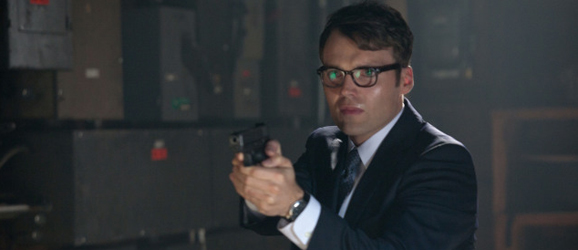
Meanwhile, Seth Gabel says the Lincoln Lee we see first in season four will be the one from "our" universe — the Lincoln with the glasses, who "does not know his own power, and does not know the Fringe team yet."

"When I imagine what this season would be about, I sort of imagine two universes being forced to face one another without fear," says Gabel, and try to make peace. And simultaneously, maybe we'll see Peter struggling to come back from wherever he's gone, in some "in-between" place outside of reality. But Gabel stresses he doesn't know anything, and this is just his imagining.

Says Lance Reddick: "I'd like to see Primary Broyles [and] see more of what's happened in his personal life," now that everybody's past is different. We know that Broyles still loves his ex-wife, but he's been forced to move on, but maybe things are different now. And he'd like to see more of Broyles' past with the government and the military. '

Reddick would also like to learn more about the Observers, and what dimension they live in, and where they come from. It appears that "they're outside the whole multiverse," so it could be fascinating to learn more about that.

"Maybe they have a connection to where Peter is, and our future selves," adds Gabel.

Also, Torv and Noble talked a lot about the challenge of playing alternate versions of their characters throughout season three. Noble felt very strongly that the alternate versions needed to be humanized:

We knew going in that because the audiences had come to like us, they would treat [our] enemies as bad people. That's kind of the nature of humanity…we kept asking the writers to humanize these people so the audience weren't sure who to root for.

Added Torv:

Never judge a character, because as an actor, you're taught to always fight their cause. The alternate Olivia isn't bad at all, and Walternate has a completely justifiable reason for doing what he does.

Torv said it was really interesting to play a different version of her character, after a couple of years, and get a different perspective on Olivia. And she worked extra hard during the whole "Fauxlivia/Olivia" switch — on the one hand, the audience needed to be able to tell that Fauxlivia was pretending to be Olivia, but on the other hand, it couldn't be so obvious that the audience would wonder why nobody saw through the charade.

Noble seemed excited at the idea of playing a whole new version of Walter this season: "Anything that doesn't freeze the characters in time" is a good move, he told reporters. If the show's characters don't keep growing and changing, "I think we would cease to be as enthusiastic about them as we are.

Tuesday, July 26, 2011

Comic-Con 2011: Who Else Auditioned to Play Peter on 'Fringe'? (VIDEO)


Fringe, Joshua JacksonDon't you just love hearing stories about the people who were almost cast for huge movie and TV roles? You know like Dana Delany was almost Carrie Bradshaw on 'Sex and the City,' and Matthew Broderick was nearly known as 'Family Ties'' Alex P. Keaton instead of Michael J. Fox.


Well, here's one I hadn't heard: There were about 12 other big names in line to play Peter Bishop on 'Fringe,' as Fox tried to "recast Peter" with Joshua Jackson M.I.A.


Don't believe me? Just take a look at this hysterical video they showed today at Comic-Con, featuring a few former 'Lost' stars (and the 'Lost' boss), a puppet-toting Paul Scheer, someone in our favorite 'Community' (nice stache, Pudi) and, of course, J.J. Abrams regular Greg Grunberg.


Also no spoof video about Jackson would be complete without some 'Dawson's Creek' jokes.


But be sure to watch until the very end to see a super 'Fringe' teaser with a very Observer-like Jackson robotically asking for direction. Spooky!


Friday, October 23, 2009

Trent Reznor Makes Fringe Even Creepier

the author of this post, at meredith@io9.com.

Nine Inch Nails frontman and all-around rock god Trent Reznor is remixing his own "Zero-Sum" for J.J. Abrams' Fringe. And in keeping with the show's nerd-overload, the whole thing is full of geeky Easter Eggs and hard core Fringe references.

According to Entertainment Weekly, Reznor will be mixing William Bell's on screen dialogue with his 07 track "Zero-Sum," voiced by Leonard Nimoy, naturally. Reznor became involved when Fringe used a clip of his song in a previous promo, and was reached out to, to see if he would be interesting in collaborating even more. But the real question here is, will Reznor make a cameo on Fringe? I'd like to see him as an observer or a before-the-title "freak of the week." Series exec producer Jeff Pinkner told EW:

"If he wants to come act on the show, that's not tit for tat — that's an open invitation, and we made that known to him," says Pinkner. Any ideas on what he may play? "Well, his head would probably end up exploding," deadpans Pinkner. "There'd be some uncomfortable biology in there one way or another."

Here's a sneak peek of Reznor's official promo and the entire thing will air Thursday during the American League Championship Series.


Friday, May 22, 2009

‘Fringe’ star fired!

By Greg David

Canned thespian reveals firing on Facebook


Fringe, Fox
Charlie has fallen off the 'Fringe'


People use social networking website Facebook for different reasons – to post pics of their kids, boast that they’re sunning during a day off, or lamenting that Kris Allen won American Idol.

Actor Kirk Acevedo utilized FB in a different way; he let the online community know that he was fired from Fox drama Fringe, reports Entertainment Weekly.

“Well boys and girls, they done did yer boy wrong! They fired me off of Fringe, and I’ve never been fired in my life!!!” his FB status read.

This is a bummer on a couple of levels, as Acevedo’s character, FBI agent Charlie Francis, was a nice addition to the cast, injecting just the right amount of skepticism in contrast to the rest of Fringe’s characters.

Plus, Charlie only recently survived being injected with monster saliva, which morphed into nasty worms that were going to devour him from the inside.

He made it through that, only to be let go by producers.

The Live Journal website adds that a casting call has gone out, looking for a female FBI agent who is “attractive, brash, outspoken, quick-witted and capable.”

Rest in peace, Charlie.

greg@tvguide.ca

Wednesday, April 22, 2009

J.J. Abrams on the Magic of Mystery

By J.J. Abrams Email 04.20.09

Photo: Mark Seliger
WARNING: SPOILERS AHEAD!!!

This essay ends with cheating. Specifically, my friend Greg and I, after playing a particular videogame for 11 hours straight, are stuck. We call a fellow gamer to learn what moves we need to make to get to the next level. With the new information in hand, we finally complete the game.

OK, there ya go. No need to read the rest of this piece—seriously, there's an annoying rant up ahead anyway. Skip to the next article. You certainly could—you could skip the whole magazine. Of course, I hope you don't. Some painstaking work went into this incredibly cool issue. (There are things occurring within these pages that are not apparent at first or second glance. That's the only hint I will give you.) I urge you to dig. Give in to the unknown for a while and ponder the mystery. It's worth it. Which, I suppose, is the topic of this very essay. The one that I've already suggested you skip.


J.J. Abrams, creative director Scott Dadich, deputy editor Thomas Goetz, and senior editor Chris Baker discuss the evolution of Wired's May issue.
For more, visit wired.com/video.

Mystery, obviously, is everywhere. Is there a God? Mystery. What about life after death? Mystery. Excuse me, what material is the ShamWow made of? Mystery. Stonehenge? Big Foot? Loch Ness? Mystery mystery mystery. McDonald's Special Sauce? I don't care how many bottles of Thousand Island Dressing you show me, it's Special Sauce. Mystery.

And yet: For all that mystery, why does it feel like the world has been ripped open, all parts exposed? Why does so much seem absolutely and thoroughly demystified? These days we can leap, all of us, from a casual curiosity about anything to a sense of satisfying understanding. Instantly. Want to fold origami? There are more than 200,000 Google results on that subject available to you, now. Need to know the capital of Mauritania? A recipe for sticky buns? How to pick a bicycle lock? You could answer all these questions in less time than it will take you to finish reading this article (which, for a second time, I suggest you skip. Remember: You know how it ends, so why are you still here?).

What I'm getting at is hardly news to anyone: We're smack dab in the middle of the Age of Immediacy.

True understanding (or skill or effort) has become bothersome—an unnecessary headache that impedes our ability to get on with our lives (and most likely skip to something else). Earning the endgame seems so yesterday, especially when we can know whatever we need to know whenever we need to know it.

People often ask me how Lost is going to end. I usually tell them to ask Damon Lindelof and Carlton Cuse, who run that series. But I always wonder, do they really want to know? And what if I did tell them? They might have an aha moment, but without context. Especially since the final episode is a year away. That is to say, the experience—the setup for a joke's punch line, the buildup to a magic trick's big flourish—is as much of a thrill as the result. There's discovery to be made and wonder to be had on the journey that not only enrich the ending but in many ways define it.

Think back, for example, to how we used to buy music. You would have to leave your apartment or house and actually move your ass to another location. You'd get to the store, where music would be playing on the stereo. Music you may not have heard before. Perhaps you'd ask the clerk what it was and she'd send you to a bin—those wooden containers holding actual albums or CDs—and you'd look through it, seeing other album covers that might catch your eye. You'd have a chance to discover something.

But wait, you say, iTunes gives you the chance to browse! To that I nod, concede the point, and say, "Bullshit." Those little icons you scroll past mean almost nothing to most of us. Why? Because we didn't get on the train, brave the weather, bump into strangers, and hear music we didn't choose. In other words, we didn't earn the right to casually scan those wooden bins. Lately I go to Amoeba Music in Hollywood just to watch people flip through albums. It's a lost art.

J.J., MAN OF MYSTERY

An Abrams production doesn't just mean a good story—it also means puzzles and Easter eggs. Here, we tap into our fave J.J. mysteries.


Meghan's Box in Felicity
In Abrams' college drama, there was one unanswered question that sustained throughout: What's in Meghan's wooden box?


The Number 47 in Alias
CIA agent Sydney Bristow's search for the elusive Milo Rambaldi's works frequently featured clues involving the number 47. They drove us mad.


The Rabbit's Foot in Mission: Impossible III
The plot focused on the struggle for the "rabbit's foot," but in the end even Ethan Hunt didn't find out what was really in that canister.


The "Observer" in Fringe
This enigmatic character writes in an unknown language, lacks eyebrows, and manages to be always around the corner. Stay tuned ...

Sure, in the days before recorded music, you'd need a live performance to hear music at all. So isn't technology actually enriching our lives? Well, of course. This is not meant to be an antitechnology diatribe—some clichè9d Luddite treatise (in an issue of Wired, no less). On the contrary, I'm a massive fan of most everything electronic. I use, appreciate, and drool over far too many high tech innovations. I'm an embarrassed whore for the stuff. But tech has made us thankless. Back in the day, it would've been unthinkable to go to the music store, actually purchase a record, and then get home and not listen to it. But today? How many of us have downloaded albums or songs that are still sitting, months or years later, unplayed in our iTunes library? My hand just slowly went up, too.

In my profession, this mentality is illustrated by the spoiler: that piece of information meant to be kept secret, like the end of a movie or TV show or novel. Spoilers give fans the answers they want, the resolution they crave. As an avid fan of movies and TV myself, I completely understand the desire to find out behind-the-scenes details in a nanosecond. Which, given technology, is often how long it takes—to the frustration of the storytellers. Efforts to gather this intel and the attempts to plug leaks create an ongoing battle between filmmakers and the very fans they are dying to entertain and impress. But the real damage isn't so much that the secret gets out. It's that the experience is destroyed. The illusion is diminished. Which may not matter to some. But then what's the point of actually seeing that movie or episode? How does knowing the twist before you walk into the theater—or what that island is really about before you watch the finale—make for a richer viewing experience? It's telling that the very term itself—spoiler—has become synonymous with "cool info you can get before the other guy." What no one remembers is that it literally means "to damage irreparably; to ruin." Spoilers make no bones about destroying the intended experience—and somehow that has become, for many, the preferred choice.

In some cases, spoilers don't just prevent the intended experience of something, they prevent the very existence of it. Case in point: I had spent close to two years working on a version of a Superman script for Warner Bros. Then an early draft was leaked, reviewed, and spectacularly decimated on a Web site that I still adore and read daily. It wasn't just that the review was bad. Which it was. I mean, like, kraptastically bad. And probably deserved (I'm the idiot who made Lex Luthor a Kryptonian). What was so depressing wasn't just that the thing being reviewed was an old version of a work in progress. What killed me was that the reviewer—and then readers of that reviewer—weren't just judging my writing. They were judging the movie. A movie that was barely in preproduction and many drafts away from final. A film that ultimately never got made—in small part because that review, and subsequent posts, made studio decisionmakers nervous. The fact is, that Superman film might have been awful. Or it could have been something else. We'll never know.

Recently my production company, Bad Robot, decided to be ultra-secretive about a movie called Cloverfield [guest ed. note: Apologies to anyone who got motion sick]. When the trailer hit the screens right before Transformers, people freaked out. Not necessarily because of the content of the trailer, but because it was a surprise—they knew nothing about it beforehand. That was the point: The intended effect was to make a teaser trailer that actually teased. It worked like gangbusters, all because we hadn't prepublicized the film on entertainment shows and in magazines. It was a small experiment that proved what most everyone knows: Having all the information isn't always better.

I guess the question is, who among us has the self-control to choose not to go for the easy answer? This time my hand stays down. In 1989, I was living with my best friend since kindergarten, Greg Grunberg. He's an actor—currently on NBC's Heroes. We had recently purchased a Nintendo videogame system and were playing Super Mario Bros. 2. Actually, playing is the wrong word. We were obsessed freaks. For us, getting to the end screen of that game was more important than anything in the history of time. And this particular game was lacking a certain feature I like to call The Ability To Fucking Save (or TATFS). This meant that playing Super Mario Bros. 2 was an all-or-nothing activity. Yeah, you could pause it, but then when you left your house the thing might catch fire and kill people. No, you had to play that damn thing in one hideous sitting.

Weeks into this pathetic example of two 23-year-old men not having a life, Greg and I decided to complete Super Mario Bros. 2. And because it lacked TATFS, this meant giving up any human activity until the job was done. So early one morning, we stockpiled some food and began playing. Around lunchtime, taking turns with the controller at every stage, we were at level 4-2. Which, for the uninitiated, is more than halfway through the game. We were feeling pretty cocky and had probably high-fived a few times.

Anyway, again for those not in the know, you start off with something like four Marios (meaning you can die three times and still play). But you can gain extra lives as you play. As it approached eight o'clock that night, the controller was in my hands, we were on level 7-1, and we had 22 Marios. That's right: 22. We were feeling pretty good about ourselves. 7-1 is so close to the end, you can almost smell having to get a life again. But to get past 7-1, you need to jump through a series of clouds—which sounds easy as hell but isn't: There was this one particular cloud I couldn't get past. Every time I tried, the little Mario would fall, spinning, to his demise. I can see it in my head now, and it still infuriates me. Our 22 Marios quickly dwindled to 15, and I was freaking out. When we were down to around a dozen Marios, I started getting pissed.

"This is bullshit!" I yelled.

"OK, OK," Greg said, picking up the phone. "I'm gonna call my cousin."

This was good news. As he dialed, I kept playing. And kept dying. Ten Marios left. I heard Greg on the phone, explaining our situation to his cousin. "Uh-huh. OK, thanks," Greg said and hung up. "Someone's gonna call us back."

"Good," I said, having paused the game to take a deep breath, only to resume and subsequently die again. "Damn it!"

A few minutes later, the phone rang. "Yeah, thanks for calling," Greg said in a grim voice, like there was a family emergency. He explained to the guy what was going on, and I heard Greg say, "Uh-huh. OK. OK, hold on." And then Greg told me, "Move to the right edge, then double-jump up and you should get to the next cloud."

"Double-jump?" I asked. Oh, good. This was information. This was new and helpful, and hope coursed through my veins. "Thanks—OK—" And I tried it. And died. "DAMN IT!!!"

Greg told the guy on the phone that it didn't work. Then he told me, "Yeah, he knows exactly where you are. Go to the edge of the cloud, then double-jump. He swears it works."

I tried it again and failed. Repeatedly. I now had five Marios left. FIVE MARIOS.

"Greg," I said, my heart sinking. "We're gonna die here."

"No," Greg insisted. "Try it again."

I did. Three more times—WE WERE DOWN TO TWO MARIOS AND I WAS GOING INSANE.

Greg reported this to the guy on the phone, then said to me, "Try it one more time."

Sweating, shaking my head, I tried again and lost my penultimate Mario, and I couldn't take it anymore, and I yelled out, "WILL YOU TELL THAT GUY HE DOESN'T KNOW WHAT THE FUCK HE'S TALKING ABOUT?!"

Greg quickly covered the mouthpiece and said to me, quietly, admonishingly, "Dude. He's 7."

And that was when I really felt it. Cheating is humiliating. No matter what form it takes. Skipping ahead—even without the help of someone in Underoos—lessens the experience. Diminishes the joy. Makes the accomplishment that much duller.

Perhaps that's why mystery, now more than ever, has special meaning. Because it's the anomaly, the glaring affirmation that the Age of Immediacy has a meaningful downside. Mystery demands that you stop and consider—or, at the very least, slow down and discover. It's a challenge to get there yourself, on its terms, not yours.

It turns out the 7-year-old was right. His tip finally worked, and Greg and I finished the game that day. But I'd traded any true satisfaction for a cheat. I can't even remember seeing that end screen.

The point is, we should never underestimate process. The experience of the doing really is everything. The ending should be the end of that experience, not the experience itself.

So, if you're still reading, I say please:

Dig.

J.J. Abrams is the creator of Alias, cocreator of Lost and Fringe, and director of the new Star Trek movie.


Wednesday, April 8, 2009

Ars cracks TV Fringe code

Ars go-to guy and cipher expert Julian Sanchez has cracked a code embedded into the TV series Fringe. Here are the details and what the codes mean.


Ars cracks TV Fringe code

Ars' own Julian Sanchez has deciphered a code embedded into the TV show Fringe. Bad Robot, the production company that created the Fox TV show, has been integrating puzzles and easter eggs into shows like Lost for years. Fringe, its freshman sci-fi/mystery which resumes Tuesday night on Fox, presented a particular challenge to viewers. It integrates a series of visual clues before commercial breaks. Sanchez determined that these images represented a simple cipher, building up to a single word per episode tying into the theme of that show.

Ars first wrote about the Fringe code last week. Building on that background, Sanchez was able to use a "dictionary attack" to create a correspondence between each unique image and a letter of the alphabet. Show clues translated to simple five, six, or eight-letter words like "Observer," "Child," "Bishop," and "Olivia."

On his personal blog, Sanchez writes that the actual solution ended up taking just a few minutes. "[I]t’s actually incredibly simple once you make one crucial assumption," Sanchez stated. That assumption was that the images from each show built up to that single word. "Alas, there’s no deep dark mysteries about the show’s arc concealed here," he added. "And the solution’s actually a bit anticlimactic..."

What Sanchez worked out was a simple monoalphabetic substitution cipher. Each picture shown was a combination of three things: one of eight images (including a butterfly, a seahorse, an apple, and so forth), its orientation (sometimes the image got flipped as if shown in a mirror) and the position of a small glowing yellow dot. Together these items defined one unique letter of the alphabet. Sanchez told Ars that the systematic organization of the reflections and dot positions simplified matters. "Once that's done, it solves itself when you get the wordbreaks right."

Sanchez relates that he had been personally challenged by a friend to see if he could work out the solution, being told that the cipher might not be crackable. "And I'm like, who are you talking to? I'll crack it before bed." Which he did. Referring to the previous Ars post on the subject, he thanked Ars for leaving a last step for him to tackle.

To date, Fringe has aired just 14 episodes. Sanchez's solution defines just 18 of the 26 letters of the alphabet. There's still some minor work to be done should the letters F, J, M, Q, W, X, Y or Z show up. Viewers will be able to continue working out the remaining secret phrases as each of the final six episodes of the season air.

And discovering those words may not be the end of the story. Sanchez suggests that the cipher may just be the first step of the solution. "Think, for instance, of those acrostic puzzles you sometimes see in the New York Times Magazine, where you fill in responses to a series of clues, then rearrange the letters into an adjacent grid to form a quotation," he writes. The words, when considered together, may offer a deeper game.

To aid amateur decoders who plan to watch the show's return to the air tonight, fan site FringeTelevision created a convenient key based on Sanchez's solution, included below.

GlyphCodeKey.jpg

Monday, April 6, 2009

Mad science and secret codes in the TV series Fringe


Ars obsesses over a variety of geek puzzles embedded into the new Fox TV series Fringe, in which Lost creator J.J. Abrams doubles down on weird.

read more | digg story