Zazzle Shop

Screen printing
Showing posts with label Denver. Show all posts

Wednesday, July 20, 2011

Billy Breathes Bud For A Job

Published by Rib
From:
dispensary 
Image via
Astronaut, Playboy photographer, editor at Vogue: whatever vocations are on your personal list of dream jobs, make room, because "pot critic" just became a real thing. Westword, an alt-weekly newspaper out in Denver, has hired one "William Breathes" to judge the quality of the city's medical cannabis and the dispensaries which sell it.

Breathes (it's not his real name, and is almost certainly a Phish reference) examines the grow quality of different bud he finds at dispensaries in the area, as well as the atmosphere and staff he encounters on his trips. He has been self-medicating for a stomach ailment for some time and seems to be young-ish, but many of the 100,000+ Colorado residents with medical marijuana cards are geriatric and may feel uncomfortable walking into a place in a bad neighborhood wallpapered with velvet posters and blasting the Disco Biscuits in its waiting room. The 300 dispensaries in Denver should offer something for everyone though, and Breathes describes the location, layout, pricing and of course the MM products from the ones he selects for review.

The weed reviews themselves are accompanied by photos of the buds, wax, etc. the author has purchased that week, along with pricing and info on how it looked, smelled, felt and smoked. It's a standardized system throughout his columns, and as clear and concise as any largely subjective review process can be.

Friday, July 30, 2010

Pot Reviewer Gets Paid To Get High

FROM: http://www.wbaltv.com/news/24422897/detail.html

Click here for Full VIDEO:

http://money.cnn.com/video/

A Denver man gets paid to
smoke pot and write about it as one of the first medical marijuana critics in the country.

A decade after medical marijuana was legalized in Colorado, it's estimated about 2 percent of residents -- or more than 100,000 people -- have applied for medical marijuana licenses.

According to one Harvard economist, roughly $18 billion is spent on pot every year in the U.S. Denver's Westword newspaper has capitalized on those numbers -- hiring the man known as "William Breathes" to review pot dispensaries and the quality of the medical marijuana they sell.

"He has his journalism degree," a Westword editor said. "He was a good writer, and he could also punctuate and he could spell, which was very different than a lot of people who applied for the job."

Breathes has been smoking marijuana for 15 years to ease chronic stomach pains. Now his medicine is paying his mortgage.

"Load up a little bit and taste it," he said as he tested a joint he bought at a local dispensary. "Try and taste the smoke as it comes out. It has a really woody finish, almost like a mesquite finish to it. After a few hits, try to see what kind of buzz it is.

"People who swear by pot's medical benefits are becoming so-called marijuana pharmacists.

Steve Horowitz makes edibles at his Ganja Gourmet Shop on a street nicknamed "Broadsterdam."

"It's like gold, this stuff," he said. "There's a big bubble going on, there's a big buzz, everyone wants to be in the medical marijuana business."

As for Breathes, he's not going to lie. His job can definitely be fun sometimes, and he still can't get over that he gets paid to take bong hits.

But Breathes also believes in the power of marijuana as medicine.

"When I'm battling throwing up, pot really helps me the most -- it's truly medical," he said.

Friday, May 7, 2010

Daily Show Profiles Competing Pot Dispensaries

Posted by: Matt Tobey

People like to demonize medicinal marijuana, but it's really no different from any other pharmaceutical. For example, on last night's Daily Show, Jason Jones visited a pair of feuding marijuana dispensaries in Denver. It's just like all those feuding Lipitor dispensaries from a few years ago.


The Daily Show airs Monday through Thursday at 11pm / 10c.

Tuesday, April 20, 2010

4/20 in Boulder preview: "An orgasm of cannabis consumption"

By Michael Roberts

420 2009 in boulder photo by leland  rucker.jpg
Photo by Leland Rucker
4/20 2009 in Boulder: Orgasm alert!

​In an interview last week, NORML executive director Allen St. Pierre confirmed that he'll be attending the politically oriented 4/20 rally at Denver's Civic Center Park this year.

It'll be his second straight 4/20 in Colorado. Last year, he was at the bash at the University of Colorado at Boulder, which he likened to "an orgasm of cannabis consumption."

NORML@CU executive director Alex Douglas, who recently decried the university's ban against medical marijuana patients smoking in dorms, laughs when he hears St. Pierre's description. However, he thinks a more apt description for what's going to happen at CU tomorrow at 4:20 p.m. is "an orgasm of cannabis consumption -- and students standing up for what they believe in."

According to Douglas, "We're expecting the largest gathering in the history of 4/20 at CU -- between fifteen and twenty-thousand people at the Norlin Quad," directly in front of Norlin Library, which he calls "one of the most academic buildings on campus."

The Denver event has a full schedule of live music and speakers such as St. Pierre, who will be delivering the bash's "invocation." Unfortunately, because of what Douglas calls "limitations from the school," that's not possible at CU.

Choosing another location in Boulder would add such options, but "that wouldn't be the attention-grabber it is at CU," Douglas feels. "It wouldn't make the same statement. These students aren't going to classes. They're protesting for what they believe in at their university, and that statement alone makes it so popular and newsworthy.

"We have so many top-rated programs here, and I believe a CU education is really amazing, and really carries students far after they graduate. So with all the recognition CU gets, it makes having 4/20 on campus that much more meaningful."

Douglas, who's currently a CU senior, is far too young to have experienced the genesis of 4/20 celebrations at the university. But by virtue of his role with NORML@CU, he's become something of a historian of the event.

"Back in the '80s and early '90s, there were people who would go onto Farrand Field, which is a recreational field in the middle of the residential dorms on campus," he says. "They were never large groups. Then, in 1997, the owner of a prominent store in Boulder put out a flier for people to meet on Farrand Field on 4/20. It was kind of rainy that year, but some people did show up -- and from that point on, it really seemed to gain interest. Like, in 1998, there were 75 to a hundred people -- and it just kept building and increasing."

Then, in the middle of the last decade, "CU-Boulder began getting a lot of attention because of the tactics they used to stop the students from participating in the 4/20 event," Douglas continues. "One year, they shut down the field and hired outsourced security to stand around. And they also turned the sprinklers on -- but that didn't really stop anybody. And then, the next year, they took video and put stills online and tried to get students to identify the people. It was absolutely ridiculous. There was a lot of mockery going on."

As April 20, 2007 approached, "the university did something very smart in their eyes: They destroyed the field to make a new one, thinking that was going to help 4/20 simmer down," Douglas says. "But it actually wound up making it more interesting, because that's when it moved to Norlin Quad -- and that's where we really got to see the increase in numbers." This was also the first year Douglas attended personally.

In 2009, CU administrators tried a different tack: The university sent an e-mail to students under the signatures of interim chancellor Phil DiStefano, vice chancellor of student affairs Julie Wong and dean of students Deb Coffin arguing that participating in the rally "debases the reputation of your University and degree" and creates safety risks. Read the e-mail here.

"I actually saw that e-mail a long time before they sent it out," Douglas notes. "I told them, 'What are you doing? This is just going to make more people go. If you're really, truly, honestly worried about the safety of students, why don't you tell them, 'Please don't bring barbecues and trampolines.' And two days after they sent out that first e-mail, they sent out another one that said, 'If you go to 4/20, be safe.' And I was happy about that."

He's also pleased that this year, CU supervisors seem resigned to the 4/20 festivities going forward whether they like it or not. Although he'd be even more upbeat if the university actually supported what was going on.

"They think it's a black eye to the school, but to me, I think it's something they should embrace," he says. "These students pay a lot of money to go to CU, and they're standing up for what they believe in. The university thinks that's debasing the degree -- but why would taking a stand for something do that?"

As for Douglas, he's got a simple message for the thousands upon thousands of people expected to light up tomorrow afternoon: "Make sure you're safe, you treat everyone with respect, and you stand up for what you believe in."

Those sound like the ingredients for quite an orgasm.

Friday, March 12, 2010

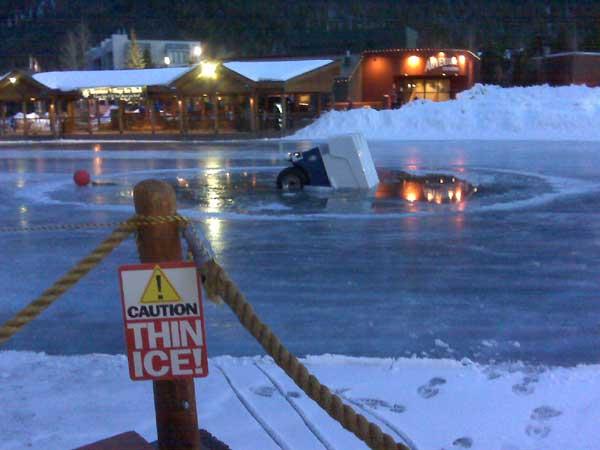
Zamboni Takes A Dip In The Lake

Zamboni Takes A Dip In The Lake

"Skating on thin ice" is most often used as an idiomatic expression, but at Keystone Resort in Colorado, that was literally the case for one unlucky zamboni.

Performing its regular maintenance to the largest groomed skating pond in North America on Tuesday night, the 7000-pound ice cleaner was too much for the ice to handle, causing the surface beneath it to crack. With the cameras rolling, some visitors captured some great footage of the zamboni falling through the sheet of ice.

Skaters were removed from the skating surface, and the ice was expected to be examined before reopening. As for the zamboni, staff had to wait until the following day to dig it out, however, it is believed that any damages will be reparable.

Oh, and we should probably mention the fact that no one was injured during the incident. Not even the zamboni driver. Another zamboni disaster averted!

Hat Tip - [Denver Post]

Friday, January 8, 2010

Marijuana Stores Trump Starbucks In Denver

If you want more proof that selling legal pot is a booming business, consider this statistic: Denver has more medical-marijuana shops than Starbucks Corp. locations.

Denver's City Treasurer Steve Ellington tells ABC New affiliate Channel 7 that at least 390 pot dispensaries applied for a sales-tax license recently. That compares to 208 Starbucks in the entire state of Colorado, the station reports. Denver's city council took a step toward regulating the marijuana stores last night, and the businesses are filing their tax applications.

The Denver statistic sheds light on a business that is becoming more institutionalized as local governments try to figure out ways to raise revenue. The Denver council will hold a public hearing and take a final vote Monday. Only a day later, on Tuesday, a California Assembly panel is expected to vote on a bill that would legalize pot across the state.

Denver is an example of how desperate politicians are to collect taxes on this burgeoning industry. The marijuana dispensaries are rushing to get their sales-tax applications filed to beat a deadline as part of a new law being considered. The change in law: No marijuana store can be within 1,000 feet of schools or child-care centers unless you get your tax application in before a deadline.

Monday, December 14, 2009

Colorado's Green Rush: Medical marijuana

By Jim Spellman, CNN

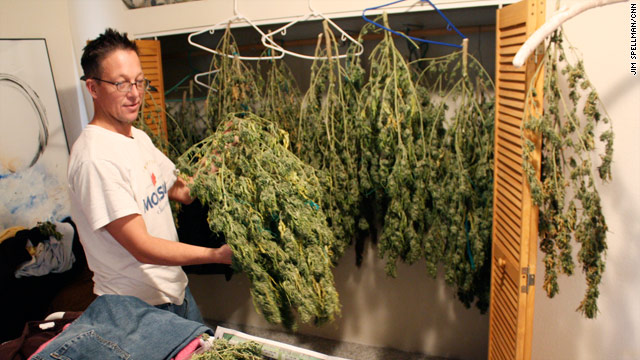
Zack Moore says he will make about $6,000 after six months of growing marijuana.
STORY HIGHLIGHTS
  • Denver strip of medical marijuana businesses nicknamed "Broadsterdam" by locals
  • State senator says it's easier to get a medical marijuana license than a liquor license
  • Boom in marijuana business likened to 49ers during the gold rush

Denver, Colorado (CNN) -- Driving down Broadway, it's easy to forget you are in the United States. Amid the antique stores, bars and fast-food joints occupying nearly every block are some of Denver's newest businesses: medical marijuana dispensaries.

The locals call this thoroughfare "Broadsterdam." As in Amsterdam, Netherlands, these businesses openly advertise their wares, often with signs depicting large green marijuana leaves.

"The American capitalist system is working," said attorney and medical marijuana advocate Rob Corry.

It's a matter of supply and demand.

"The demand has always been there," he said, "and the demand is growing daily because more doctors are willing to do this, and now businesses, entrepreneurs, mom-and-pop shops are cropping up to create a supply."

Colorado voters legalized medical marijuana in 2000. For years, patients could get small amounts from "caregivers," the term for growers and dispensers who could each supply only five patients. In 2007, a court lifted that limit and business boomed.

Between 2000 and 2008, the state issued about 2,000 medical marijuana cards to patients. That number has grown to more than 60,000 in the last year.

State Sen. Chris Romer, a Democrat whose south Denver district includes Broadsterdam, said the state receives more than 900 applications a day.

"It's growing so fast, it's like the old Wild West," Romer said. "This reminds me of 1899 in Cripple Creek, Colorado, when somebody struck gold. Every 49er in the country is making it for Denver to open a medical marijuana dispensary."

They're calling it the Green Rush.
Interactive: Taking your medicine
Video: Marijuana family business

Corry, who has represented defendants in medical marijuana cases for years, is taking a different role: He has formed the Colorado Wellness Association, a trade group representing medical marijuana growers and providers.

"We want to be the Better Business Bureau of marijuana," he said.

On the 28th floor of a downtown building with a great view of the Rocky Mountains, Corry's office is adorned with vintage posters. One reads "Marihuana: Assassin of Youth!"

In the corner sits a plastic 6-foot marijuana plant. It's a prop from the TV show "Weeds," about a suburbanite mother who begins selling marijuana to make extra cash, Corry said.

The lagging economy has created an opening for medical marijuana, Corry said. As governments struggle for new sources of revenue, the prospect of taxing medical marijuana can be enticing.

The dispensaries are "paying taxes, hiring employees, renting out space, purchasing supplies and moving this economy along," he said. "Local governments need to get on the bandwagon and start realizing this is a major source of revenue and it can help us cure our bankrupt governments."

The association aims to get a larger supply of marijuana into the dispensaries and make sure it is safe, Corry said.

See the different ways to use marijuana

"What we're looking at is quality control," he said. "We have the technology to make sure there's no harmful toxins, pesticides."

Bob Winnicki is a 35-year-old analyst and co-owner of Full Spectrum Laboratories, which the wellness association uses for testing.

"We're trying to get away from smelling, texture, color" as a measure of quality cannabis, he said, adding that he prefers "hard analytical data."

Wearing a dress shirt and tie under a white lab coat, Winnicki opens envelopes with samples of marijuana dropped off by growers and dispensers. He puts the marijuana into test tubes and mixes it with a solution to create a greenish liquid. The test tube goes into a machine that performs a chemical analysis.

The active ingredient in marijuana is tetrahydrocannabinol, or THC. But Winnicki said it's other, less understood components that may provide much of the claimed medicinal benefits.

Winnicki is not a marijuana user, he said. In July, he took a break from medical school to start the lab because he loves "the science" behind medical marijuana and thinks the market is wide open, he said.

"There's a lot of money to be had in it, and there's a lot of jobs and growth that can come out of it," he said.

Across the city, entrepreneurs are trying to get in on the Green Rush. In a northwest Denver neighborhood, Aaron Randle is tending to his new shop, Sunnyside Alternative Medicine.

He opened in September and said he has about 100 customers so far.

Read about a mother and son who grow marijuana

"I've been an electrician for eight years and before that I had a cable contracting company. It's always been a dream to work for myself," he said. "I'm very passionate about marijuana."

I personally haven't tried it yet, but I'm not saying someday before I'm done I won't.
--State Sen. Chris Romer on medical marijuana

Customers drop by his modest storefront operation and take a seat in a small waiting room. It's no different than a dentist's office except the magazine rack is stuffed with High Times, a publication for marijuana buffs, instead of Sports Illustrated and parenting magazines.

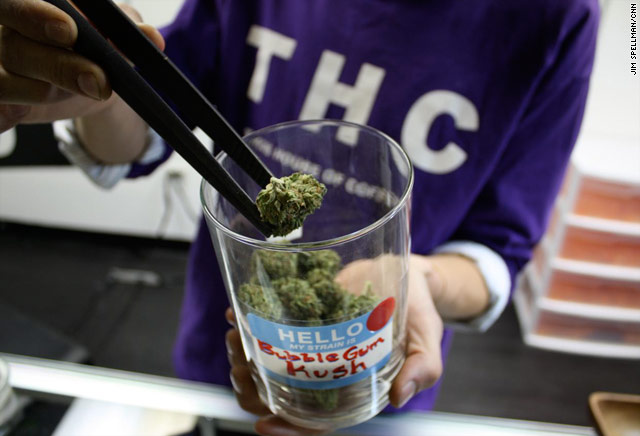
One at a time, customers survey a display case full of marijuana strains as well as marijuana-infused brownies, taffy and lollipops. Maui Waui and Purple Kush are popular strains. It costs $50 for an eighth of an ounce, $54 with tax. Purchases go into a plastic prescription bottle and then into a white bag that reads, "Prescriptions. Thank You!"

Randle proudly displays his business license on the wall.

"There's a lot of jobs created because of medical marijuana," he said. "You have employees that work at the dispensaries, then you have vendors that are getting paid. ... Real estate is booming right now. Warehouses are getting rented out for grow operations."

What Randle calls "vendors" are marijuana growers, a mix of people who operate "grow houses," where the plants are cultivated using elaborate lighting systems, or small-scale farmers who operate in rural areas.

Zack Moore is a grower with a small greenhouse operation in southern Colorado. He also is a medical marijuana patient. A snowboarding accident knocked out his two front teeth, and he smokes marijuana for relief from various aches and pains, he said.

He rolls a joint and lights up before having a seat in a rocking chair in the afternoon sun. With a basket of marijuana in front of him, he uses toenail scissors to trim the dried plants. When he's done, he will have made about $6,000 for six months work, he said.

Though he hopes to do better next season, he's happy to be working.

"I build houses for a living. There's not many houses to be built right now."

Not everyone is happy with the changes the legalization of medical marijuana has brought to the state.

Colorado Attorney General John Suthers said the amendment to the state constitution that allowed the new businesses is flawed.

"Colorado has seen a rapid proliferation of medical marijuana dispensaries and patients since the Justice Department earlier this year announced it would not actively prosecute medical marijuana businesses -- despite the fact that marijuana remains an illegal drug under federal law," he said in an October statement.

"Amendment 20, written by marijuana-legalization proponents, is very vague. Our state lawmakers must give clarification to Amendment 20 and create a regulatory scheme for the growing medical marijuana industry."

State Sen. Romer concurs. "Right now it's easier to get a medical marijuana license than it is to get a liquor license," he said.

Currently, patients need to see a doctor only one time to get a recommendation that enables them to buy medical marijuana. Patients can choose to pay $90 to file with the state and receive a card identifying them as medical marijuana patients. The cards do not expire.

To become a provider or grower of medical marijuana, entrepreneurs need to have a patient name them as a caregiver when they file for a medical marijuana card.

Romer said he doesn't want to limit legitimately sick people's access to medical marijuana, but he doesn't want to see the state law turned into de facto legalization of marijuana.

"Amendment 20 never dealt with where you got the medical marijuana," he said. "We're going to license the growers and we're going to license the caregivers."

Romer wants to keep marijuana out of the hands of teenagers and hopes to channel some of the revenues into programs to treat substance abuse.

One of the most difficult aspects for lawmakers is how to define true medical need. Romer is keeping an open mind.

"I think you're having a lot of baby boomers who, all of us, are feeling a lot of aches and pains [and] are going to decide to try medical marijuana," he said. "I personally haven't tried it yet, but I'm not saying someday before I'm done I won't."


Friday, December 11, 2009

First Gourmet Marijuana Restaurant Opens In Denver

DENVER (CBS4) ― A medical marijuana dispensary in Denver has decided to get creative and make the business into a full-service restaurant that caters to those who need to use medicinal marijuana to ease physical ailments.

The owner of Ganja Gourmet located at 1810 South Broadway Avenue said the restaurant will "aim to help distribute medicinal marijuana to those licensed to have it and provide an atmosphere where patients can visit with one another in a safe environment."

Ganja Gourmet plans to offer lasagna, gourmet pizza, jambalaya, paella, chocolate mousse and flavored cheesecakes, among other gourmet dishes.

"It's a different buzz too. It's a more alert, more awake buzz," Medical Marijuana Chef
Evan "Budman" said.

Budman believes it will put South Broadway on the state's budding medical marijuana map.

"It will bring people from all over Colorado here," he said.

The restaurant will be decorated in a 1960s retro feel, including tie-dye attire for the employees.

Steve Horowitz, an owner of Ganja Gourmet, says the restaurant will not promote a party-like atmosphere.

"With the new laws in Colorado, medicinal marijuana is a business like any other. Dozens of legal dispensaries are everywhere. We have to set ourselves apart as a business in order to survive," Horowitz said in a prepared statement. "Just like any other restaurant, we have to work on the quality of our food and our atmosphere to make sure our customers have an enjoyable experience that makes them want to come back."

Horowitz said the restaurant will offer courtesy rides home for customers who feel they can't drive.

"I hope the launch of Ganja Gourmet will set the standard for other Colorado distributers and distributers around the nation so that those suffering from illness get the best service possible," Horowitz said.

The marijuana-laced menu is actually prepared off-premises. Building inspectors won't allow an on-site kitchen because of a fire hazard.

Some neighboring businesses it's just the latest proof several blocks of South Broadway are going to pot.

"I don't think it's good for the neighborhood," an area business owner said. "I think it's a joke that they're using the guise that it's medicinal. It just shows it's not medicinal."

Former State Rep. Don Armstrong, injured in Vietnam, says the ganja gourmet is just what he needs instead of powerful painkillers.

"This is an alternative for me. It's a great alternative, when I do this," Armstrong said. "I can function with life in me and be able to live a normal life … I'm learning on the eating part. I'm just trying this out now."

Ganja Gourmet opened on Wednesday.

(© MMIX CBS Television Stations, Inc. All Rights Reserved. This material may not be published, broadcast, rewritten, or redistributed.)

Thursday, August 27, 2009

Fine for pot in Denver could go down to $1

DENVER - A city panel in charge of overseeing marijuana possession crimes in Denver recommended on Wednesday that the fine for possession be set at $1.

If Denver's presiding judge accepts the recommendation from the Denver Marijuana Policy Review Panel, the fine would be the lowest in the entire nation for marijuana possession.

The panel was created by Mayor John Hickenlooper in December 2007 after voters passed an ordinance that made it so adult marijuana possession is the city's "lowest lawn enforcement priority."

In May 2008, the city attorney's office made it so those cited for the crime can mail in their fines instead of having to appear in court. At that time, the city attorney's office assigned the value of the fine at $50.

"By setting the fine at just $1, we are sending a message to Denver officials that the era of citing adults for using a less harmful drug than alcohol is over. It's simply not worth the city's time or resources," said panel member and SAFER Executive Director Mason Tvert, who coordinated the successful Denver marijuana initiatives.

Lt. Ernest Martinez with the Denver Police Department is also part of the panel and voted against lowering the fine.

"There's no indication that there's a problem with the fine schedule," Martinez said. "The panel is going outside the bounds of the language of the ordinance."

Martinez thinks there should be more dialogue about the changes.