Zazzle Shop

Screen printing
Showing posts with label medical benefits of marijuana. Show all posts

Friday, August 19, 2011

Marblehead startup seeks to unlock secrets of cannabis

By Carolyn Y. Johnson
from: http://articles.boston.com/

It’s a plant more commonly associated with lava lamps and Pink Floyd than cutting-edge science. But today, a small Marblehead company plans to post online the hundreds of millions of letters of DNA that make up Cannabis sativa in a first step toward truly understanding and enhancing marijuana’s therapeutic potential.
For years, Kevin McKernan built genome sequencing technologies - powerful tools designed to provide insights into cancer and potential treatments.

But when desperate friends with cancer forwarded studies of medical marijuana’s use, he became intrigued. Earlier this summer, he founded Medicinal Genomics, a small firm that will partner with pharmaceutical companies to explore compounds made by the plant.

It’s not what most people would think - or what most stoners might hope. Medicinal Genomics might, for example, use insights from the plant’s genetic blueprint to create a plant that produces more of certain compounds, such as cannabidiol, which shows promise in early cancer studies - and even look at reducing the amount of THC, which gives the plant its psychoactive effects.

“The genetics were poorly understood,’’ McKernan said.

The company ultimately plans to sequence more than a dozen Cannabis species. This fall, Medicinal Genomics will launch an iPad app providing access to the data.

McKernan acknowledged that by making the information public, someone might try to use the genetic code to brew more potent pot. But not him, he swears. He’s only interested in marijuana for its medicinal value.

“Our goal is to help people,’’ he said.

Carolyn Y. Johnson

Monday, December 14, 2009

Colorado's Green Rush: Medical marijuana

By Jim Spellman, CNN

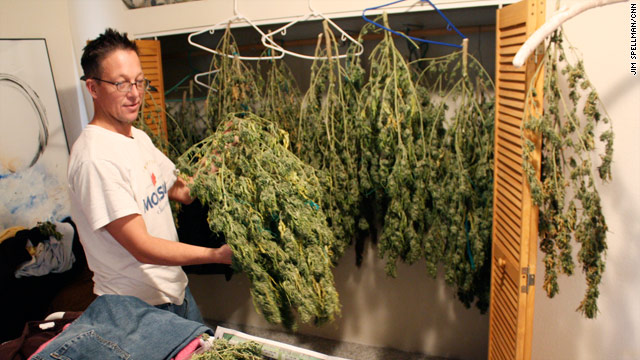
Zack Moore says he will make about $6,000 after six months of growing marijuana.
STORY HIGHLIGHTS
  • Denver strip of medical marijuana businesses nicknamed "Broadsterdam" by locals
  • State senator says it's easier to get a medical marijuana license than a liquor license
  • Boom in marijuana business likened to 49ers during the gold rush

Denver, Colorado (CNN) -- Driving down Broadway, it's easy to forget you are in the United States. Amid the antique stores, bars and fast-food joints occupying nearly every block are some of Denver's newest businesses: medical marijuana dispensaries.

The locals call this thoroughfare "Broadsterdam." As in Amsterdam, Netherlands, these businesses openly advertise their wares, often with signs depicting large green marijuana leaves.

"The American capitalist system is working," said attorney and medical marijuana advocate Rob Corry.

It's a matter of supply and demand.

"The demand has always been there," he said, "and the demand is growing daily because more doctors are willing to do this, and now businesses, entrepreneurs, mom-and-pop shops are cropping up to create a supply."

Colorado voters legalized medical marijuana in 2000. For years, patients could get small amounts from "caregivers," the term for growers and dispensers who could each supply only five patients. In 2007, a court lifted that limit and business boomed.

Between 2000 and 2008, the state issued about 2,000 medical marijuana cards to patients. That number has grown to more than 60,000 in the last year.

State Sen. Chris Romer, a Democrat whose south Denver district includes Broadsterdam, said the state receives more than 900 applications a day.

"It's growing so fast, it's like the old Wild West," Romer said. "This reminds me of 1899 in Cripple Creek, Colorado, when somebody struck gold. Every 49er in the country is making it for Denver to open a medical marijuana dispensary."

They're calling it the Green Rush.
Interactive: Taking your medicine
Video: Marijuana family business

Corry, who has represented defendants in medical marijuana cases for years, is taking a different role: He has formed the Colorado Wellness Association, a trade group representing medical marijuana growers and providers.

"We want to be the Better Business Bureau of marijuana," he said.

On the 28th floor of a downtown building with a great view of the Rocky Mountains, Corry's office is adorned with vintage posters. One reads "Marihuana: Assassin of Youth!"

In the corner sits a plastic 6-foot marijuana plant. It's a prop from the TV show "Weeds," about a suburbanite mother who begins selling marijuana to make extra cash, Corry said.

The lagging economy has created an opening for medical marijuana, Corry said. As governments struggle for new sources of revenue, the prospect of taxing medical marijuana can be enticing.

The dispensaries are "paying taxes, hiring employees, renting out space, purchasing supplies and moving this economy along," he said. "Local governments need to get on the bandwagon and start realizing this is a major source of revenue and it can help us cure our bankrupt governments."

The association aims to get a larger supply of marijuana into the dispensaries and make sure it is safe, Corry said.

See the different ways to use marijuana

"What we're looking at is quality control," he said. "We have the technology to make sure there's no harmful toxins, pesticides."

Bob Winnicki is a 35-year-old analyst and co-owner of Full Spectrum Laboratories, which the wellness association uses for testing.

"We're trying to get away from smelling, texture, color" as a measure of quality cannabis, he said, adding that he prefers "hard analytical data."

Wearing a dress shirt and tie under a white lab coat, Winnicki opens envelopes with samples of marijuana dropped off by growers and dispensers. He puts the marijuana into test tubes and mixes it with a solution to create a greenish liquid. The test tube goes into a machine that performs a chemical analysis.

The active ingredient in marijuana is tetrahydrocannabinol, or THC. But Winnicki said it's other, less understood components that may provide much of the claimed medicinal benefits.

Winnicki is not a marijuana user, he said. In July, he took a break from medical school to start the lab because he loves "the science" behind medical marijuana and thinks the market is wide open, he said.

"There's a lot of money to be had in it, and there's a lot of jobs and growth that can come out of it," he said.

Across the city, entrepreneurs are trying to get in on the Green Rush. In a northwest Denver neighborhood, Aaron Randle is tending to his new shop, Sunnyside Alternative Medicine.

He opened in September and said he has about 100 customers so far.

Read about a mother and son who grow marijuana

"I've been an electrician for eight years and before that I had a cable contracting company. It's always been a dream to work for myself," he said. "I'm very passionate about marijuana."

I personally haven't tried it yet, but I'm not saying someday before I'm done I won't.
--State Sen. Chris Romer on medical marijuana

Customers drop by his modest storefront operation and take a seat in a small waiting room. It's no different than a dentist's office except the magazine rack is stuffed with High Times, a publication for marijuana buffs, instead of Sports Illustrated and parenting magazines.

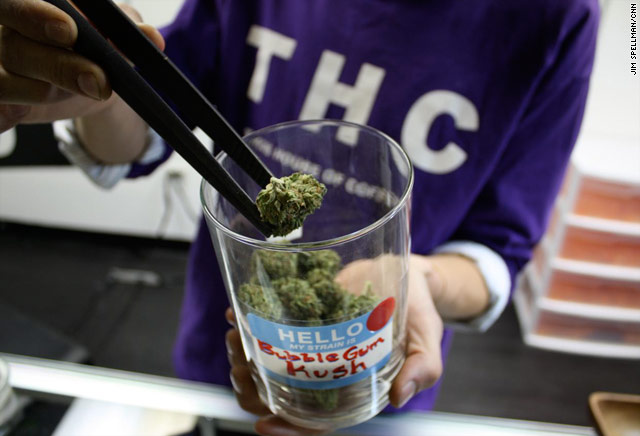
One at a time, customers survey a display case full of marijuana strains as well as marijuana-infused brownies, taffy and lollipops. Maui Waui and Purple Kush are popular strains. It costs $50 for an eighth of an ounce, $54 with tax. Purchases go into a plastic prescription bottle and then into a white bag that reads, "Prescriptions. Thank You!"

Randle proudly displays his business license on the wall.

"There's a lot of jobs created because of medical marijuana," he said. "You have employees that work at the dispensaries, then you have vendors that are getting paid. ... Real estate is booming right now. Warehouses are getting rented out for grow operations."

What Randle calls "vendors" are marijuana growers, a mix of people who operate "grow houses," where the plants are cultivated using elaborate lighting systems, or small-scale farmers who operate in rural areas.

Zack Moore is a grower with a small greenhouse operation in southern Colorado. He also is a medical marijuana patient. A snowboarding accident knocked out his two front teeth, and he smokes marijuana for relief from various aches and pains, he said.

He rolls a joint and lights up before having a seat in a rocking chair in the afternoon sun. With a basket of marijuana in front of him, he uses toenail scissors to trim the dried plants. When he's done, he will have made about $6,000 for six months work, he said.

Though he hopes to do better next season, he's happy to be working.

"I build houses for a living. There's not many houses to be built right now."

Not everyone is happy with the changes the legalization of medical marijuana has brought to the state.

Colorado Attorney General John Suthers said the amendment to the state constitution that allowed the new businesses is flawed.

"Colorado has seen a rapid proliferation of medical marijuana dispensaries and patients since the Justice Department earlier this year announced it would not actively prosecute medical marijuana businesses -- despite the fact that marijuana remains an illegal drug under federal law," he said in an October statement.

"Amendment 20, written by marijuana-legalization proponents, is very vague. Our state lawmakers must give clarification to Amendment 20 and create a regulatory scheme for the growing medical marijuana industry."

State Sen. Romer concurs. "Right now it's easier to get a medical marijuana license than it is to get a liquor license," he said.

Currently, patients need to see a doctor only one time to get a recommendation that enables them to buy medical marijuana. Patients can choose to pay $90 to file with the state and receive a card identifying them as medical marijuana patients. The cards do not expire.

To become a provider or grower of medical marijuana, entrepreneurs need to have a patient name them as a caregiver when they file for a medical marijuana card.

Romer said he doesn't want to limit legitimately sick people's access to medical marijuana, but he doesn't want to see the state law turned into de facto legalization of marijuana.

"Amendment 20 never dealt with where you got the medical marijuana," he said. "We're going to license the growers and we're going to license the caregivers."

Romer wants to keep marijuana out of the hands of teenagers and hopes to channel some of the revenues into programs to treat substance abuse.

One of the most difficult aspects for lawmakers is how to define true medical need. Romer is keeping an open mind.

"I think you're having a lot of baby boomers who, all of us, are feeling a lot of aches and pains [and] are going to decide to try medical marijuana," he said. "I personally haven't tried it yet, but I'm not saying someday before I'm done I won't."


Friday, September 11, 2009

Ganjapreneurs are cashing in on Colorado's booming medical pot business

By Joel Warner

I knock on the locked door of the nondescript one-story building not far from downtown, willing away my anxiety.

"Can I help you?" A security guard peers from behind the door, eyeing me suspiciously. He's an older guy, probably somebody's grandpa, but he gives me a look that says he doesn't have a problem tangling with a whippersnapper like me.

"I have an appointment," I stammer. I have Xeroxed medical records and $200 in cash to prove it. At that, the security guard is all smiles.

"Come on in," he offers, opening the door wide and beckoning me into one of Denver's most successful medical marijuana dispensaries.

I'm here to become a state-certified medical marijuana patient. If I succeed, I'll have access to one of the fastest-growing — and unusual — businesses around.

Colorado voters legalized marijuana for medicinal use in 2000 with the passage of Amendment 20, but until recently, the state's medical marijuana community was small and fairly inconspicuous. As of January, 5,000 people had applied to the state registry, and there were less than two dozen dispensaries selling pot.

But that's changed, thanks to the Obama administration's move in March to end most dispensary raids, as well as a Colorado Board of Health decision in July that did nothing to limit the number of patients that medical marijuana dispensaries can have. As of June 30, the Colorado medical marijuana registry had swelled to more than 10,000 applicants, with the state receiving more than 400 new applications each day. To meet that demand, at least seventy Colorado dispensaries have opened, forty in the metro area alone.

Many of these are operated by what insiders are calling a "second wave" of ganjapreneurs — savvy, experienced businesspeople and professionals. Some honed their chops running ventures that have nothing to do with marijuana; others are opportunists from the heady California dispensary scene who see a new market ripe for investment.

In the meantime, legal consultants, insurance companies and real-estate brokers are carving out their own niche, building industry-wide infrastructure for a form of commerce that never before existed.

Whether any of it is truly legal — and whether any of it will last — is anybody's guess, because marijuana, after all, is still illegal under federal law. And although Amendment 20 allows people in Colorado to use pot for medical reasons, the law says nothing about dispensaries or whether buying and selling marijuana at them is legal. ("Growth Industry," February 5.)

"I saw it coming," says Colorado Attorney General John Suthers about the growth of the dispensary industry, of which he disapproves. "Even when we looked at the amendment in 2000, it was very purposely designed, in my opinion, by the advocates so it was so broad you could drive a truck through it."

Cities and towns aren't waiting for Suthers and his colleagues to sort the laws out. To deal with the reality of a business model that isn't going away, one municipality after another is looking into their zoning or planning codes, and some have passed dispensary-specific rules, like where they can be located and what type of signage is allowed.

I'm not waiting, either. Past the security guard, I can see a brightly lit, professional-looking operation. People shuttle paperwork to and fro, chatting and laughing. It's a far cry from a drug-dealing operation — though a familiar smell lingers in the air. No time for second thoughts: I'm already late for my appointment.

I step inside, ready to get medicated.


For Craig Mardick, it's a great day for a grand opening.

The windows of his new business, Golden Alternative Care, are freshly polished, and a spread of complimentary fruit, veggies and dip greets customers just inside the door. Mardick's landlord and insurance agent stop by to congratulate him and his employees. His mom pops in, too, with a freshly framed art poster to hang on the wall.

Mardick has just launched Golden's first marijuana dispensary, and behind a discreet curtain, a glass display case offers marijuana strains with names like Bubble Berry, AK-47 and Pot of Gold, plus an assortment of cannabis-infused edibles.

"I have never seen an economic model like this," he says of his new undertaking. "It's unheard of. Economists don't know how to forecast the industry."

A former medical technician and environmental scientist by trade, Mardick had been laid off from a couple of jobs in the past few years when he got the idea to open a dispensary. A medical marijuana patient himself — he's been diagnosed with a large hiatal hernia, a serious gastrointestinal ailment — he'd been using his botany background to grow medicine for a half-dozen patients.

In February of this year, the Colorado Department of Public Health and Environment, which oversees the state medical marijuana registry, revealed that it was considering limiting marijuana caregivers to providing for a maximum of five patients — a move that would have put dispensaries out of business, since they need more than five customers to survive.

But at a heavily attended hearing on July 20, the Colorado Board of Health, the advisory board for CDPHE, voted against the proposed limitation. The decision was seen as a tacit endorsement of the dispensary model, and state registrar Ron Hyman says the state has received 6,000 medical marijuana patient applications since then.

Click here to continure the article Next Page »

Monday, August 10, 2009

Patrick Swayze smokes dope to ease pain, according to reports

Patrick Swayze

Source: Reuters

AFTER finding it hard to eat and feeling so weak, Patrick Swayze is using marijuana as he battles aggressive pancreatic cancer, it has been claimed.

According to the National Enquirer, the Dirty Dancing star, 56, has found that smoking pot helps ease his nausea, insomnia and anxiety.

Gallery - Swayze and his Dirty Dancing days

"He’s recently gained a little weight and feels more normal than he has in months," a source told the tabloid.

"Patrick was rapidly losing weight because he couldn’t keep food down.

"He was so weak, he needed help getting around."

Friends persuaded Patrick to try marijuana, disclosed the insider, and it seems to have helped.


"Patrick and his brother Donnie get together almost every day and smoke a joint," the source added. "They have been seen smoking weed on the roof of Cedars-Sinai Medical Center while Patrick was getting a treatment."

"Marijuana works extremely well" for many cancer patients, said Dr. Ron Kennedy, a physician in Santa Rosa, Calif., who provides medicinal marijuana. “It helps fight nausea from chemotherapy treatments and may alleviate anorexia or lack of appetite."

Wednesday, July 1, 2009

My Friend Bill, a Medical Marijuana Patient

mj plant.jpg

My friend, Bill is dying of cancer. He probably has two or three days left. He's not conscious and while the caretakers say that he can recognize my voice, I doubt it. He's being given a lot of drugs including morphine, but they don't seem to give him peace. His body struggles as if he is trying to free himself from unseen restraints. Perhaps he's pain-free, but he definitely does not seem comfortable. However, I was able to say goodbye to Bill with a smile on my face because of something his wife told me a few minutes earlier. She said, "Bill spent the last five days of his conscious life smoking pot." Now, if you knew Bill you'd know how utterly preposterous that statement sounds. Bill was a retired Pediatric Cardiologist. He voted Republican all his life until he voted for Obama. He did not waste money or words. And he definitely had never smoked marijuana.

Some weeks back, Bill's internist suggested that he consider medical marijuana as a way to restore his appetite which had been destroyed by chemotherapy. Later Bill decided to give it a try. Bill and his wife found a dispensary nearby after a brief internet search. They called the dispensary and were told they would need a referral letter and that a "doctor" would be on the premises that afternoon. At the time, Bill could only walk short distances and he was very weak, but they went over to the dispensary. They stood in a queue of seemingly able-bodied young men also seeking relief from something. The doctor relieved them of $140 and provided each with the referral letter. Bill's wife said that she was less than impressed with the certification process and ventured an opinion that "Bill was the only truly ill individual that doctor would see all week." The young dispensary clerks were very helpful. They suggested that Bill purchase two thumb sized buds "one of indica for pain and one of sativa for depression". Bill also picked out a nice psychedelic pipe. Once home, bill tried it. His wife said that once he felt the effects of the first puff a little smile brightened his face. He smoked some more and the smile broadened. His wife chuckled as she remembered his fondness for the stuff. She said, "I'd ask him if he'd like anything and he usually answered, "I believe I'll have some of that marijuana." It made Bill happy at the end of his journey. What a gift!

I agree with those that say that medical marijuana is mostly used by recreational pot smokers, but I know that there are other people like Bill who are truly ill and can't get anything from the medical community that works as well as marijuana to put a smile on their faces.