Stereoscopic 3D is one of the latest buzzwords in the tech and gaming industries. Sony has done their best to push it out the door with their line of 3DTVs and the now 3D-capable PlayStation 3 (thanks to a firmware update earlier this year). In addition, Nintendo will be releasing their glasses-free 3D handheld in March, the 3DS.
iPhone in 3D
Apple hasn't yet announced any plans to incorporate stereoscopic 3D into their devices. They probably don't need to at this point. That's not to say we don't want to see 3D content on our iOS devices. That's where Hasbro comes in. That's right, Hasbro--the toy maker. Right now, you may be wondering how the same company that makes Mr. Potato Head is going to give your iPhone a 3D screen.
Remember the View-Master?
The above photo looks like an old model, but the concept and design has remained nearly unchanged for several years
Most of us probably had a View-Master. The cool little toy you used to put paper discs in and watch a little slideshow through the lenses. The device gives viewers an illusion of 3D depth of field by pulling together two separate images in such a way that makes it appear as if certain objects "pop out" of the picture.
Meet My3D
My3D (above) uses a concept similar to the classic toy, reinventing it for a new generation by using an iPhone or iPod Touch for its slideshow rather than a little paper disc. According to Hasbro, the device will offer "three-dimensional content...a 360-degree experience in gaming, virtual travel experiences and entertainment content...[for] both children and adults."
The device will set users back about $30, and will be available Spring 2011 at stores where Apple's iPhones and iPod Touch devices are sold. Users can then purchase additional My3D content, which is said to range in price, some of it will be available for free.
According to Hasbro, Apple guided them in the development of the device, and they feel that nothing available that matches the quality and content users will get from My3D.
Excited Yet?
Yes and no. It's $30, so that's not entirely bad. We already own an iPhone, so we are set. However, those who want a device for viewing will have to fork over an additional lump of money for an iPhone or iPod Touch (iPod Touch ranges in price from $229 to $399 depending on the storage capacity).
It's also worth noting that Hasbro has teamed up with some big names like Dreamworks Animation, the movie studio responsible for the Shrek series and How to Train Your Dragon. They're definitely pulling out the big guns for this one.
Those without an iPhone can always pick up the classic View-Master for about $10 along with a few additional View-Master reels. We'll wait to see how it does.
brobible.com— Last year millions of people drank James Cameron's blue Kool-Aid about a so-called "3D entertainment revolution." Magazine publishers followed suit... to nice effect in many cases. —
The magazine's June edition hits newsstands Friday equipped with 3-D glasses. Now the toy that has kids dodging dragons, meatballs and tall blue aliens at the movies will help adults focus on what is, at first glance, a very blurry Playmate of the Year.
The Associated Press
Published: May 11, 2010
CHICAGO - Playboy readers who can only imagine what it would look like if a centerfold jumped right off the page are getting new specs to help them see into Hef's world.
The magazine's June edition hits newsstands Friday equipped with 3-D glasses. Now the toy that has kids dodging dragons, meatballs and tall blue aliens at the movies will help adults focus on what is, at first glance, a very blurry Playmate of the Year.
"What would people most like to see in 3-D?" asked Playboy founder Hugh Hefner. "Probably a naked lady."
Hefner makes no secret of hoping to capitalize on the popularity of 3-D movies such as "Avatar" and "How to Train Your Dragon," even as he makes no secret of not quite getting what all the fuss is about.
"I'm not a huge enthusiast of 3-D," he said in a telephone interview. "I leave real life to go to the movies and 2-D is fine with me."
If the thought of grown men sitting back in their recliners with a pair of 3-D glasses doesn't quite say "Playboy," it should be noted that a few months ago the magazine put Marge Simpson — yes, the blue-haired animated mother of Bart — on the cover and in a two-page centerfold.
"In today's print environment you have to create newsstand events," said the editorial director of the Chicago-based magazine, Jimmy Jellinek. "Marge Simpson was one of those."
Playboy certainly must do something to get more people, especially younger people, to buy a magazine that has seen circulation plummet from 3.5 million in 2006 to 1.5 million today.
Jellinek said he hopes the issue featuring centerfold Hope Dworaczyk in 3-D also reminds people that for all the infatuation with the Internet, there is nothing quite like having a magazine in your hands.
"People want things that last and have meaning," he said.
The thought hadn't occurred to Hefner. But, now that you mention it:
"This particular picture is one example of how books and magazines are different (than computer images)," he said. "You can hold it in your hands, save them, and as Dad used to, put them under the mattress."
Hefner notes there also are plenty of good old-fashioned 2-D pictures of Dworaczyk — the 51st Playmate of the Year, for those counting at home.
3-D may be all the rage, but Hefner said he first thought of using it when he launched his magazine in the 1950s.
"I actually signed a photographer to shoot two nude women in 3-D in Chicago," he said. But he scrapped the idea when he discovered how expensive it would be to include the glasses.
This time around, HBO is helping out. HBO wanted a creative way to promote its show "True Blood," and having Playboy include 3-D glasses with the show's name on them seemed a good way to do it, said Playboy spokeswoman Theresa Hennessey.
So, do the glasses work? Well, it does kind of look like Dworaczyk is handing you the wine glass she's holding. And she says the photograph makes everything a little, well, bigger.
"It's kind of like it says on the rearview mirror," Dworaczyk joked. "Things may appear larger."
(PhysOrg.com) -- Apple has filed a patent application for electronic video spectacles that will allow wearers to watch films in 3D on the inside of the glasses. Fans have already nicknamed the gadget iSpecs.
Users would attach their iPhone, iPod, or other device to the spectacles, which have a special lens that can split the image into two frames — one for each eye — and then project the image onto the spectacles. The two images would create a stereoscopic effect since they would appear to have been taken from slightly different angles, and this would simulate 3D.
According to the patent application (number 20100079356) the images would be equivalent to high definition in quality, and sensors inside the spectacles would detect the precise location of the wearer’s eyes to ensure the image is projected at exactly the right place and is comfortable to watch. The device could be controlled by the wearer’s head movements, such as nodding or head shaking, or by voice control. Sound would be provided by earphones fitted into the device. To enhance the viewing experience, the spectacles could even vibrate in response to content such as explosions.
The spectacles would also incorporate a small camera and infrared sensors embedded in the frames to stream video of the surroundings to a smaller screen in the glasses if anyone approached or tried to gain their attention while they were watching the film. The aim of this system is to make people feel more comfortable about wearing the glasses in public, such as during plane, train, or bus trips.
There are already a few video glasses that can be plugged into an iPod to allow viewers to watch films, but none offer 3-D viewing or high-quality images. Another drawback of the previous gadgets is that wearers are unable to see what is happening around them, which makes them reluctant to wear them in public.
Some have suspected the patent application is a hoax since news of it was published on the Web on April 1st, but the US Patent and Trademark Office is unlikely to be involved in a hoax and the application was filed in late 2008. Apple never comments on patent applications.
(AP) -- Sharp's latest 3-D displays deliver bright, clear imagery without the cumbersome glasses usually required for such technology. Now the bad news: They only work on a 3-inch (7.5-centimeter) screen held one foot (30 centimeters) from the viewer's face.
Sharp Corp. demonstrated liquid crystal screens Friday for mobile devices that showed 3-D animation, touch-panel screens that switched from one 3-D photo to another and a display connected to a 3-D video camera.
Movies and TVs in 3-D are no longer surprising. Sony Corp. and Pansonic Corp. of Japan, as well as South Korea's Samsung Electronics Co. and LG Electronics, already sell or are planning 3-D TVs.
The drawback until now has been the need for special glasses, which show different images to the right eye and the left eye. Sharp's 3-D technology doesn't require them because the displays are designed to shoot different images to each eye.
The technology may be applied to TVs in the future, said Executive Managing Officer Yoshisuke Hasegawa. But he acknowledged it now works better when the distance between the viewer and the screen is fixed.
The smaller displays, shown Friday, are intended for mobile devices such as cell phones, game machines and digital cameras.
The 3-D animation on the handheld screen looked like a miniature version of the 3-D animation we are used to seeing on larger TV screens, though images were less convincing than those seen in a darkened cinema.
Photos on the touch screen were less clear and even a bit blurry from certain angles, though Sharp said its latest technology does away with such "ghosting" effects.
Still, the system promises gaming and technology fans the potential for pop-up e-mail messages and taking 3-D photos of friends.
The technology is likely to show up in the next DSi portable game machine, which Nintendo Co. says will be 3-D. Sharp refused to confirm the names of companies it was supplying.
Sharp expects 3-D to replace two-dimensional displays the same way color replaced black-and-white in movies and television.
"The arrival of mobile 3-D is just around the corner," Hasegawa told reporters.
Sharp tried to sell 3-D products in the past but failed, largely because of poor image quality. This time, the Osaka-based company has made breakthroughs for displays that are twice as bright and clear as existing 3-D displays.
The displays can continue to show 3-D images when they are turned to the side, a key feature for smartphones, according to Sharp. Mass production of the 3-D LCDs is set to start in the first half of fiscal 2010, which began April 1, it said.
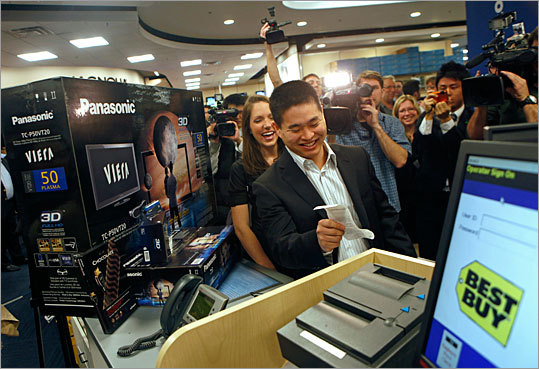
(David Goldman/AP Images for Best Buy)Brad Katsuyama, holding a receipt, and wife Ashley, become the world's first consumers to purchase a Panasonic Full HD 3D system at Best Buy in New York on Wednesday March 10, 2010.
NEW YORK—Panasonic Corp. on Wednesday revealed the price for its first 3-D TV set, confirming that $3,000 is about what it takes to be among the first to watch 3-D movies in the home.
The Japanese company put its first 3-D sets on sale at an event in New York on Wednesday. Panasonic's suggested retail price is $2,900 for a 50-inch plasma set, one pair of glasses and a 3-D Blu-ray player. An extra pair of glasses costs $150.
South Korean competitor Samsung Electronics Co. announced Tuesday that its 3-D sets would go on sale this week. For $3,000, buyers get a 46-inch set, two pairs of glasses, a 3-D Blu-ray player and a 3-D copy of "Monsters vs. Aliens." There's also a 55-inch set available -- it's $3,300 for the set alone.
Both manufacturers plan to expand their 3-D lines rapidly. Rivals are on their heels: LG Electronics Inc. plans to put its 3-D sets on sale in May and Sony Corp. is bringing out its 3-D sets this summer.
The sets can switch between 3-D and regular 2-D mode, which doesn't require glasses.
There's a dearth of movies on 3-D discs, but studios are rushing to put them out. On Wednesday, Twentieth Century Fox, the studio arm of News Corp., said it would make "Ice Age: Dawn of the Dinosaurs" its debut title in 3-D Blu-ray.
By Eric Fisher, Staff Writer SportsBusiness Journal
CBS Sports will show the semifinals and championship game of the NCAA men's basketball tournament in 3D, marking the network's first foray into 3D TV and the latest high-profile sports event to be shown in the enhanced format. The network has struck a deal with Cinedigm Digital Cinema Corp. to show the Final Four games in 100 movie theaters nationwide, with pricing yet to be established. CBS additionally selected Pace, whose 3D involvement includes work with the NBA and the record-setting Hollywood epic "Avatar," to aid with the production, with the choice based significantly on the firm's prior background with shooting basketball in 3D. "This is another experiment. We're looking to learn as much as we can," said CBS Sports Senior VP/Operations & Production Ken Aagaard. Aagaard added the 3D production is a likely forerunner for future such efforts by the network in football.
CBS, meanwhile, has signed Capital One as the third presenting sponsor of March Madness on Demand, adding to AT&T and Coca-Cola. Capital One also recently signed with the NCAA as the newest corporate champion sponsor, joining AT&T and Coca-Cola. The network continues to project that MMOD advertising sales will finish well north of last year's $30M, though executives declined to disclose specifics.
New Alice in Wonderland images of the Caterpillar, the March Hare and the Dormouse reveal more details about Tim Burton’s upcoming reboot of Lewis Carroll’s 19th-century tale.
Alice in Wonderland, opening March 5, features Alan Rickman as the voice of The Caterpillar, pictured above. See more fresh takes on the Alice universe as seen through the eyes of Burton below. (Super Bowl viewers will see even more of Burton’s 3-D animated film when Disney unveils a new Alice teaser spot during the Feb. 6 football broadcast.)
The March Hare is costumed by Oscar-winning designer Colleen Atwood.
Helena Bonham Carter's Red Queen rules a court staffed by frogs.
Michael Sheen, who previously played Tony Blair in The Queen, gives voice to The White Rabbit.
Lewis B. Carroll's creation The Dormouse is voiced by Barbara Windsor. Images courtesy Walt Disney Pictures
Grab your glasses, plop down on your couch, and watch the soccer ball fly out of your screen: ESPN is going 3-D. On Tuesday the popular sports network announced that it is launching the first-ever 3-D television channel. (Discovery Communications, Sony and IMAX also outlined plans to launch a 24/7 3-D television network in 2011.) For the channel's first year, ESPN, which is owned by Disney, has pledged to show at least 85 sporting events in 3-D, starting with the South Africa–Mexico World Cup match on June 11. The network also plans to broadcast additional World Cup matches, the Summer X Games and college basketball and football games in 3-D. At this point, ESPN is committing to the network for one year. "As we surveyed the landscape of the marketplace over the past four or five months, it became apparent to us that there was going to be this virtual tsunami of 3-D television sets hitting the marketplace," says Sean Bratches, ESPN's executive president for sales and marketing, who has played a major role in the network's 3-D initiative. "There's probably no better genre than sports for 3-D." (See the top 10 TV series of 2009.)
Over the past few years, when you asked any tech geek who works in sports about the future, you'd hear a familiar refrain: 3-D, 3-D, 3-D. Now, it appears the extra dimension is finally here. Analysts expect a slew of 3-D-related products to be released at the Consumer Electronics Show, which starts Jan. 7. ESPN has already experimented with 3-D production — the network showed the September USC–Ohio State football game in 3-D in select movie theaters.
What will the network look like? ESPN 3-D will have its designated space on the dial. However, when a live 3-D event is not playing, which will be most of the time for now, the channel will be dark. You'll need to buy a 3-D-capable television set, get a set-top box from your cable or satellite provider and, yes, grab a pair of glasses. "There will be varying degrees of glasses," says Bratches. "You can buy glasses for 50 cents that look like you're sitting next to Jake and Elwood Blues, or you can buy a very high-end designer pair. They all do very different things." Be careful: certain glasses only work with certain 3-D sets, so grill the guy at Best Buy. (Watch a video about how 3-D movies are made.)
According to Bratches, the in-home 3-D experience will take you dangerously close to the action. "When we did the USC–Ohio State game, one of the most interesting things we saw was when they ran a play to the side of the field where the 3-D cameras were," he says. "The people in the front row [of the theater] literally stood up. They thought they were going to get hit." Sports broadcasts in 3-D will require additional cameras at different angles from those in the 2-D production. "The camera at the center court line, 47 rows up, looking at the basketball game going back and forth doesn't provide a lot of value," Bratches says. For basketball games, you'll want to see a 3-D camera behind the basket: Duck, here comes Kobe flying at me. ESPN even plans to use different announcers for the 3-D broadcasts, so that they can emphasize the unique angles.
Though ESPN is still Disney's cash cow, the 3-D channel will carry significant risks. In addition to added production costs, there's a more crucial issue facing ESPN: whether people are ready to fork over big bucks to upgrade their television sets, just for a few good games. Yes, consumers can expect more 3-D content to be rolled out over the next few months. But will there be enough to justify what could be a $4,000 purchase, in a sticky economy, by the time ESPN 3-D launches? Plus, will the consumers who have already dropped a few thousand bucks on an HD set in recent years be ready to upgrade again so soon? (See questions and answers about retirement.)
Bratches says he heard the same skeptical questions when ESPN first entered the HD game. "If you look back at the HD experience, we had a similar amount of content that we're offering now in 3-D," he says. "But viewers saw the future, bought into the vision and invested, and now the deployment of HD sets is significant. We feel very good about where we are." And come June, ESPN will show sports fans where they are going. Look out for the flying soccer balls
You know 3D has a long way to go when even Jerry Jones can't manage to sell it for longer than seven minutes: the vaunted real-time 3D scoreboard display experiment at last night's Cowboys game was turned off to loud cheers after just six minutes and fifty seconds of being active. The problem, as usual, was glasses: most of the 80,000 people in attendance didn't bother to put on the headgear required to see the 3D effect, and instead saw a blurry anaglyph image -- which they then booed. What's more, some who wore the glasses complained that the 3D effect caused nausea, although probably not as badly as the Cowboys' 20-17 loss to the Chargers. HDlogix actually has the tech to do glasses-free 3D, but it simply doesn't work when scaled up for the world's largest HD monitor -- a problem they'll have plenty of time to solve when the Cowboys fail to make the playoffs with another couple December losses.
While FIFA made the unfortunate call yesterday to pass on TV replay capability for the upcoming World Cup, there will still be new broadcast technology unveiled this summer in South Africa. According to FIFA, up to 25 games from the competition will be filmed using Sony 3-D technology. There are no specific plans for broadcasting the 3-D games live, but it remains a possibility. And a compilation of footage will be turned into a feature-length film after the World Cup.
The announcement is the highest-profile appearance yet in what's been a steady trend towards 3-D technology for sports. From the live rugby battle between England and Scotland, to the NBA all-star game we reported on last year, to the announcement from SkyTV in England that it will launch a dedicated 3-D channel, get used to wearing goofy glasses (though some versions of the tech, sadly, won't require spectacles).
How Sony's 3-D Broadcast Works: Sony
So let us get this right: with thousands of hooligans gathered in South Africa, FIFA might now have 3-D footage of the next Ireland/France-Thierry Henry-handball-controversy, but will only use it for its highlight reel? Brilliant.
(PhysOrg.com) -- Sony and Panasonic have recently announced a new technology, called "active shutter" for producing the experience of 3D on high definition TVs. The first models are expected to be available in late 2009 or early 2010.
The original 3D experience of movies depended on the viewer wearing stereoscopic green and red glasses. The illusion of 3D in the image came from superimposed green and red images taken from slightly different angles. Each eye saw only one image, and the viewer's brain combined them to give the illusion of three dimensions. 3D movies using this technology, called anaglyph 3D, can be viewed on any TV, as long as the viewer wears the glasses.
Anaglyph 3D glasses. Image: Wikipedia.
The problem with anaglyph 3D is that it strains the eyes, and can cause headaches and nausea in some people. Others have a dominant eye, and find it difficult to see the image as three dimensional.
A newer process for 3D in the cinema uses a special screen and polarized glasses. In this system images for the left and right eye are rapidly alternated, and the glasses pick up the appropriate image for each eye. A similar technique has now been introduced for high definition LCD televisions by the South Korean company LG Electronics and Japanese firm Hyundai. The system, known as X-Pol, projects the different images in the even and odd horizontal lines of the video, and the polarized glasses sort it all out for the viewer.
Now Sony and Panasonic have introduced an "active shutter" technique for high definition plasma and LCD TVs. The viewer still has to wear polarized glasses, but in this system the glasses have LCD active shutters that are synchronized with signals from the TV. The shutters rapidly block the right and left eye views alternately so each eye receives the correct image.
The new system gives higher resolution than X-Pol because in active shutter technology each eye sees all the lines in the video, whereas in X-Pol each eye sees only half the lines.
Separate images for the left and right eyes are recorded with 1920 X 1080 full-HD quality and alternately played at high speed. By watching these images through special LCD glasses that are timed to open and close the right and left lenses in synchronization with the alternating images, the viewer is treated to exciting 3D realism. Image: Panasonic
Panasonic executive Peter Fannon said the new high definition 3D televisions will give viewers an experience just like being there, rather than watching it on TV.
Panasonic will be releasing some Full HD 3D models later this year, with Sony's version coming on the market later. Buyers of the new TVs will also need 3D-compatible Blu-ray disc players. The glasses will be supplied with the TV sets. There is no information yet on the prices of these televisions.
Relativity and Universal has bought the rights to James Cameron's "Sanctum".
(”You see, it’s like a flashlight… that you can f’ck,” Cameron explained.)
Relativity and Universal bought the distribution rights and are planning a wide theatrical release for Sanctum, an “underwater 3-D drama” produced by James Cameron. I wonder if this one will have cat people. REEER!Relativity was the first bidder after a screening last Thursday (of the new 3-D technology to be used in the pic) at Cameron’s offices in Santa Monica.
The picture, which has a budget of about $30 million, will lense later this year in Australia and has a late 2010 delivery date.
“Sanctum” was inspired by Wight’s near-death experience of leading a diving expedition miles into a system of underwater caves, then having to find a way out after a freak storm collapsed the entrance. [Variety]So basically, it’s The Descent, but watery and with less sluts. And don’t give me this “near-death” experience crap, they got lost, then found their way out. That’s not a near-death experience, that’s a dude-that-was-scary experience. I have those every time I get high.
On Tuesday, Fox said that it wasn't going to pay the $1-million-per-movie cost to supply theaters with 3-D glasses for the studio's upcoming in-your-face films like this summer's Ice Age: Dawn of the Dinosaurs. Instead, Fox wants the movie theaters to pay for them. Understandably, multiplex owners aren't too happy about the extra cost, and many are considering revolting by only showing Ice Age 3 in 2-D, which could massively cut into the film's box-office revenues.
Evidently, the glasses were part of a deal worked out long ago, when theater chains started installing the silver screens and digital projectors needed to view 3-D digital cinema, so to go back now and renegotiate after the equipment has been put in place is a difficult proposition.
"I'm already paying fees to RealD for the systems. I'm paying to put in the silver screens and I'm paying to train employees to run the product. To come in at this point and say they aren't going to pay for the glasses, yet they want all the upside of the revenue, is ridiculous."
Sadly, both the theaters and the studios are paying hefty sums to usher in this 3-D revolution, with the budget on Fox's upcoming live-action 3-D pic Avatar already reported to be north of $200 million. So, it's no surprise each side wants the other one to foot the bill. While we're not surprised that cost-centric Fox, still recovering from a rough year at the box office in 2008, doesn't want to put up the dough, if this is what it takes to get the additional revenues that 3-D movies provide, Fox may have to give in. After all, that Avatar budget won't be easy to recoup.
For its part, Fox, via distribution president Bruce Snyder, denied that there was any problem. "No exhibitor has said they don't want to play Ice Age in 3-D," Snyder told EW. "All we are doing is working out the issues."
Las Vegas (NV) - One of the most impressive product demos on the first day came from Mitsubishi. It showcased Nvidia 3D technology on one of its 3D-enabled TVs. You will be able to buy this stunning product for $200 next month (TV not included, of course).
Mitsubishi will be pitching a 3D product consisting of Nvidia driver software, 3D glasses with a receiver and a sender that is placed on top of a TV. If you own a home entertainment PC with a potent Nvidia graphics card, the driver software can create 3D imagery from regular video games, we are told. The sending unit reacts to the position of the 3D glasses to create a true 3D feeling.
We were able to testdrive the technology for a few minutes and were deeply impressed. Mitsubishi said that the product will be offered for $200 beginning next month - home entertainment PC and 3D-enabled LCD TV not included.
NBA 3D:How will the action look behind 3D glasses?Sean Captain; Inset: Courtesy NBA
Just a week after the NFL screened a live game in 3D to an invite-only audience, the NBA announced that it will broadcast its All Star Game to public theaters. The February 14 game will reach up to 160 screens in 80 locations around the US, including Atlanta, Chicago, Cincinnati, Detroit, LA, New York, San Francisco and Seattle.
Last week’s NFL screening had mixed results, with some viewers complaining that the broadcast was better for showing off the technology than showing fans the game. Basketball moves a lot faster than football, which could make it more challenging for camera operators to follow the action, but a basketball court is also a much smaller space to cover than an entire football stadium.
Joseph Piexoto, president of RealD, which has equipped most of the country’s 3-D capable theaters, had hinted at last week’s NFL game that a bigger, public event would soon follow. He also claimed that football was about the hardest event to cover in 3D. So perhaps the NBA coverage will come off with fewer of the satellite glitches, double images and confusing camera angles that plagued the NFL game.
Last week, CNN's attempt to display the future of TV news ended up making 3D look like the gimmick that it is. Yep, 3D is a gimmick, most associated (outside of CNN) with those stupid glasses designed to fit Blockheads from Venus. But as you know, there are many different scientific approaches dedicated to tricking you into thinking bullets—or other deadly projectiles such as children—are popping out of the screen and coming right at you. Here's a quick and dirty guide to 3D magic.
Most 3D operates on a single basic principle—tricking our dumb, binocular brain into interpreting a 2D image into one with depth. The most basic way to do this is stereoscopy, which is essentially showing a slightly different image to each eye which the brain mashes together into a 3D image. We've broken up the million different ways to do 3D in a few broad categories.
Stupid Glasses It's easiest to do stereoscopic images with glasses or other nerdtastic eyewear to change how you see stuff—hence there are a lot of variations in 3D glasses tech. • An anaglyph image is the old school 3D we all know and got headaches from: An image has two different color layers, one for each eye, with slightly different perspectives and when we look at them through those awesome plastic glasses (usually with red and blue lenses) that block one layer in each eye, our dumb brain takes the resulting separate image from each eye and mashes them together to make a 3D scene in our head.
• Polarized 3D glasses are the more modern choice for cheap 3D for the masses—you've worn them at IMAX if you've caught a 3D movie there, or at Disney World, since the big thing they allow over an anaglyph is full color. They work kind of the same way as the red/blue glasses though—two synced projectors throw images with slightly different perspectives up simultaneously, but at different polarizations. The polarized glasses only allow a single corresponding polarized image into each eye, and the brain does the hard work again, combining two separate images into a single 3D one.
•The Pulfrich effect is a brain bug where side-to-side motion is interpreted to have some depth when there's a slight sync lag between your eyes. A set of glasses with a dark lens over one eye will make this happen, so when something moves from left to right, it'll look like it's moving back or forward—you know, in 3D. It's been used for the Super Bowl and Married with Children, since the glasses are so cheap. [Thanks David!]
•ChromaDepth is perhaps the fanciest glasses tech using micro-prisms and whatnot (hello red and blue again), but all it essentially does is slightly shift the way colors are perceived in each eye, so they see different things and boom, 3D. The major limitation of the tech is that if you change the color of an object, you also change how its depth is perceived, since it's all based on color. (Check out the video above, done in ChromaDepth, to see what I mean.) [Thanks David!]
• LCD shutter glasses are excellent because they're so ridiculous. They actually block vision alternately in each eye in time with the refresh rate on the display by rapidly darkening each lens, while the display alternately shows images with a slightly different perspective (this is called alternate frame sequencing). It's essentially the "show different stuff to each eye" principle taken to its logically absurd conclusion—literally blocking the sight of the unwanted eye. Yes, these complicated puppies usually run over $100 (or way more, even), and can give you a headache on a monitor without a high enough refresh rate.
No Glasses Required Okay, so you don't wanna wear glasses. No problem—you just move the one-image-per-eye dance to the display itself. • A parallax barrier is one of the more popular ways for swinging 3D without glasses—you see it in Sharp TVs for instance. It actually works a lot like polarized glasses, it just moves where the obstruction magic happens to the front of the TV. Instead of having glasses filter the image for each eye, the screen's parallax barrier—think of it is a very finely grated fence with precisely angled holes—directs different light into each eye, and your brain turns the mixed signals into a 3D image. The bad part? With a normal parallax barrier, the screen is permanently in 3D mode and you don't have exactly have a wide viewing angle. Sharp's trick for 3D in LCD displays is fancier—there's a second LCD that creates the parallax barrier with a polarized grid of lines, which is nice because you can turn it off and go back to regular 3D viewing.
• Integral Imaging is a form of parallax actually. You've got a bunch of supertiny micro-images that you actually peep through an array of spherical convex lenses, one per micro-image. All these micro-images come together when you look at them to form a 3D image.
• Another form of parallax is continuous-motion parallax. Here, HoloVizio's system dumps pixels in favor of voxels, which can project multiple light beams in multiple directions simultaneously.
3D in 3D So far, we've just talked about 2D images on a flat screen, which your brain is fooled into thinking are three-dimensional. The other side is creating images in real 3D— you know, meatspace. Still, most of them make use of lighting and projection tricks too. • The Graphics Lab at the University of Southern California has come up with a cheap way to create images in 3D space (as opposed to planar space) by using a spinning mirror called a light-field display. Basically high speed video is projected onto a quickly spinning mirror, which then "reflects a different and accurate image to each potential viewer." The system uses an algorithm to figure out the correct shading and occlusion for the image.
• Japanese researchers' new plasma-laser hologrammy device takes advantage of the "plasma emission phenomenon near the focal point of focused laser light." By manipulating the laser's focal point, along the x, y and z axes, they can display real 3D images in mid-air.
• Heliodisplay actually creates a surface in mid-air to project an image onto, which allows you to do the "Help me Obi-wan Kenobi" type of floating holograms that look 3Dish, though they're actually planar (2D) images. Yep, it's expensive.
FAKE FAKE FAKE There are lots of suggested 3D images out there that aren't any kind of real 3D—videogames are of course the most obvious. But why pick on them when you can pick on CNN? • Sorry Wolf, but we gotta hit people with the truth: CNN's "holograms" are totally fake. We already explained this before, but no one was projected in front of Wolf Blitzer. He was looking at a wall. What we saw at home as computer-generated: A bunch of HD cameras filmed the hologramee from all sides, computers crunched that data and delivered whatever angle the studio camera needed at the time. As long as the source angle was synced to the studio angle, it looked, to viewers at least, like a 3D "hologram." Nice try, Wolfie. Call us when you score an R2 unit. –With Reporting by Seung Lee. Post updated with two additional 3D technologies.
.
All you art collectors out there. Here is a chance to get a Giclee copy of some of Ian M Sherwin work. Ian is planning on doing a whole series of Marblehead, Massachusetts paintings. His work is amazing.






 • An
• An  •
•  •
• • LCD shutter glasses are excellent because
  • A parallax barrier is one of the more popular ways for swinging 3D without glasses—you
  • Integral Imaging is a
  • The Graphics Lab at the University of Southern California has come up with a cheap way to create images in 3D space (as opposed to planar space) by using a spinning mirror
  •
•  .
.

 Posts
Posts


