Zazzle Shop

Screen printing

Monday, June 1, 2009

Sony Ericsson Unveils PS3-compatible Phone

As part of its Christmas line-up of products, Sony Ericsson introduced a new phone that will allow consumers to connect to their PS3 gaming consoles remotely. The new phone, known as Aino, will let users access media content such as music, videos, and photos from the PS3 while on the go. Sadly, Aino will not allow users to play games or access high-definition video from the phone.

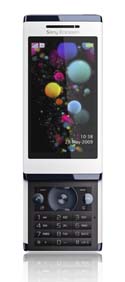
Aino can also synchronize with media files on your PC using Sony Ericsson’s Media Go multimedia manager. Sony Ericsson AinoAs for the phone itself, Aino features an 8.1-megapixel camera with geotagging capability; 3G, Bluetooth, and Wi-Fi connectivity; a physical keypad; and a three-inch touchscreen.
Sony Ericsson, the world’s fifth largest handset maker, has lost some of its market share as competition in the mid-market handset segment has increased. The company believes wireless operators are hungry for phones that can drive data usage without requiring huge subsidies. Given that interest in the company’s years-old Sony-branded Cybershot camera phones and Walkman music phones has faded, Sony Ericsson now must find new models to renew interest in its brand. The Aino is one of three new phones the company hopes will help it make a comeback.

In February, Sony Ericsson announced the Satio (previously known as the Idou) at the Mobile World Congress show. The Satio has a 12-Sony Ericsson Satio megapixel camera, a 3.5-inch widescreen touchscreen display, and runs on Symbian S60 5th edition. Satio users will also be able to play 3D and high-definition games on the handset as well as watch various types of media files.

Another new Sony Ericsson phone called the Yari contains accelerometers that can be used for motion controls with games similar to Nintendo’s Wii controllers. The Yari has a 5-megapixel camera, assisted-GPS, instant messaging, and Microsoft Exchange ActiveSync support.
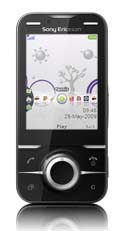
Sony Ericsson YariExpect the new phones to be available in select markets later this year, likely in the fourth quarter. No U.S. launch dates have been given, however, Jon Mulder, head of North American product marketing, did say “currently we do anticipate that these models will be unlocked in various channels in the U.S. We have yet to announce operator partnerships.”

Sony Ericsson also plans to launch a virtual software applications store. The company plans to announce additional details concerning the store at next week’s JavaOne Conference.


See the original image at dailymail.co.uk — Mother finds son on FB 27 YEARS after - kidnapped by father

By Daily Mail Reporter

A mother has been reunited with her son 27 years after he was 'kidnapped' by his Hungarian father - when her sister stumbled across his Facebook profile after Googling his name.

Gavin Paros was spirited out of Britain in 1982 at the age of three by his father, Joseph, after his marriage to Avril Grube broke down.

Ms Grube, now 62, had almost given up hope of ever seeing her son again. Then her younger sister, Beryl, decided to try Googling his name.

Lo and behold Mr Paros's Facebook profile popped up and the pair were put in touch for the first time.

Avril Grube is finally reunited with her son Gavin

Back together: Avril Grube is finally reunited with her son Gavin who was 'kidnapped' by his Hungarian father 27 years ago

Avril's treasured picture Avril of her son Gavin, aged three, with sister Debbie shortly before he was taken to Hungary by his father

Avril's treasured picture Avril of her son Gavin, aged three, with sister Debbie shortly before he was taken to Hungary by his father

E-mail contact followed and Mr Paros flew over to Britain this week.

Describing the moment she was reunited with her son, Mrs Grube said: 'Even though it has been nearly 30 years, when I first saw him I recognised him, he has my eyes.

'I was so overcome and just said "my beautiful son over and over again".

'He was very quiet and overwhelmed. We just hugged each other.'

However because of the language barrier they have to communicate through translation software.

The meeting took place yesterday at 4am after he flew in from Budapest.

Mrs Grube said she was living in Liverpool at the time Gavin was taken by her ex-husband Joseph Paros who had visiting rights. He died three years ago.

She said: 'Joseph took him to Blackpool for the weekend and never came back.

'Over the years we tried everything but couldn't find out what had happened to him.'

Beryl Wilson told BBC Radio Solent: '[Mr Paros' father] had visitation rights, he said he was going to the zoo or somewhere and when he didn't arrive back we found out he had taken him back to Hungary.

'My sister was devastated, her health suffered.

'I tried everything... but no-one wanted to know.'

Enlarge gavin paros meets his family

Meet the family: From left, Gavin is introduced to his cousin Raymond, his step-brother Tony, his mother Avril, step-father Jeff and his step-sister Debbie

Poole Harbou

Reunion: Avril Grube finally met her son at her home in Poole, Dorset, this week

Even after she first e-mailed Gavin she had to wait a few weeks before he replied as he didn't regularly check the page.

'As soon as I found him on Facebook I phoned Avril and said "I have some important news", and told her to sit down, and then I heard a merciful scream,' said Mrs Wilson.

'It was the happiest day of her life when she met her son. She said there were no words to describe it.'

Now Mrs Grube - who recently suffered a stroke and lives in sheltered housing - met her son at her Dorset home.

'It means so much to me,' she said. 'Of course I am delighted to have three grandchildren. I didn't know anything about them and can't wait to meet them.

Mr Paros, 30, had also been trying to find his family after the death of his father in 2006, but the father-of-three was hindered by the fact he speaks no English.

Now mother and son have to speak through translation software, so all the questions they want to ask each other after all these years takes time.

Mrs Wilson added: 'Gavin has got a family and three children and they are desperate to come to England and live but he needs help to find a house and job.'

'Die Hard' Nakatomi Plaza Color-Coded Casualty Map (PIC)

How Stem Cells Work

Introduction to How Stem Cells Work

­­Cloning Image Gallery

cells
This week, a group of London-based scientists requested official permission to begin a three-year study involving stem cells derived from human-cow hybrids. See more cloning pictures.

­Inside an ­embryo no bigger than the period at the end of this sentence are dozens of stem cells. Initially, these cells are blank slates, meaning that their fate is undecided. But they have great potential. Stem cells are pluripotent, which means that they can develop into every cell, every tissue and every organ in the human body. ­­ Their almost limitless potential has made stem cells a significant focus of medical research. Imagine having the ability to return memory to an Alzheimer's patient, replace skin that was lost during a terrible accident or enable a wheelchair-bound person to walk again. But before scientists can use stem cells for medical purposes, they must first learn how to harness their power. They can't treat disease until they learn how to manipulate stem cells to get them to develop into specific tissues or organs.

Up Next

­In this article, we will look at stem cells, find out how they work, discover their potential to treat disease and get inside the fierce debate surrounding their research and use.

Stem Cell Basics
A stem cell is essentially the building block of the human body. The stem cells inside an embryo will eventually give rise to every cell, organ and tissue in the fetus's body. Unlike a regular cell, which can only replicate to create more of its own kind of cell, a stem cell is pluripotent. When it divides, it can make any one of the 220 different cells in the human body. Stem cells also have the capability to self-renew -- they can reproduce themselves many times over.

There are two types of stem cells: embryonic stem cells and adult stem cells. Embryonic stem cells come from an embryo -- the mass of cells in the earliest stage of human development that, if implanted in a woman's womb, will eventually grow into a fetus. When the embryo is between three and five days old, it contains stem cells, which are busily working to create the various organs and tissues that will make up the fetus.

Adults also have stem cells in the heart, brain, bone marrow, lungs and other organs. They are our built-in repair kits, regenerating cells damaged by disease, injury and everyday wear and tear. Adult stem cells were once believed to be more limited than stem cells, only giving rise to the same type of tissue from which they originated. But new research suggests that adult stem cells may have the potential to generate other types of cells, as well. For example, liver cells may be coaxed to produce insulin, which is normally made by the pancreas. This capability is known as plasticity or transdifferentiation.

So where do scientists get the stem cells they use in their research? We'll look at two ways -- reproduction and cloning -- in the next section.

Full article How Stem Cells Work

How to shave your balls: A lesson from Gillette

testicles.jpg
photo by Charlie Brewer

This can't be for real. Can it? Can it? Gillette wants men to shave their balls?! Serious. This is their rationale: "When there is no underbrush... the tree looks taller?!" Did Doctor Evil infiltrate their company? WTF? Watch it for yourself.


See the original image at movieline.com — Will Ferrell's Uncredited Role in "The Goods" Will Be Huge

pivensready.JPGIt may not surprise you to know that The Goods was produced by Will Ferrell’s company Gary Sanchez, as the car salesman comedy bears all the hallmarks of the ex-SNLer’s work: a deluded egotist at its center (here played, in a stretch, by Jeremy Piven), a vaguely unflattering wardrobe that looks snatched from the disco era, and David Koechner in a supporting role. What may not be apparent, though, is that the movie boasts a secret star performance that’s glimpsed for nary a frame in the new trailer below.

That’d be from Ferrell, whose unbilled role is actually one of the largest in the movie, according to Piven himself. It’s not the first time Ferrell (who recently played a car dealer in Eastbound & Down) has gone without credit — there was also his third-act performance in Wedding Crashers, and his, uh, cameo as Artie Lange’s boyfriend in Boat Trip, according to the IMDb. There are no survivors of that movie who can confirm how that went.

So how does the Ferrell-less trailer play? Meh. Ironically, the missing Ferrell role really seems to be the one Piven’s playing; only Ferrell himself could tap into the outsized sense of the absurd it takes to truly sell Piven’s introductory monologue. Expect a second trailer with wall-to-wall Will as soon as the test scores come in.

VERDICT: Wouldn’t drive it off the lot.

The 8 Coolest Sets of Fast Food Premium Glasses

By Chris Cummins

Thumbnail image for Marvel glasses.jpg

From the mid-1970s to the mid-1990s, promotional glasses were huge merchandising tie-ins for films and TV shows. Sometime after Batman Forever brought cinematic misery to theaters (with corresponding etched mugs being hawked at McDonalds) the trend died. Wild stories about lead paint and tales of kids injuring themselves and others with the drinkware ensued. It's fun to envision middle school toughs manufacturing shivs out of shattered Papa Smurf glasses, but in reality the premiums were most likely discontinued because of high production costs. Thanks to Burger King's recent Star Trek offerings, the collectibles are back in vogue. Those of you drinking from 32-yeard-old chipped Darth Vader glasses will especially appreciate this news. In honor of a whole new era of nerdy drinking containers, let's take a look at the coolest fast food glasses ever released.


8) Pac-Man

Arbys1.jpg

Arby's is constantly getting shafted by popular culture. The roast beef-schilling fast food chain has been the target of ribbing from Fargo and The Simpsons. Even Adam West got in on the act with his recent Batman Garage Sale video. First off, this is terribly unfair as the restaurant's Big Montana sandwich is a carnivore's dream. Secondly, Arby's was somehow able to one-up McDonald's and Burger King to release glasses based on Pac-Man at the height of the game's popularity. An incredibly respectable feat from the purveyors of Horsey Sauce, wouldn't you say?

7) Star Trek III

The tired theory that the odd Star Trek movies are shitty and the even ones are great always overlooks the fact that Star Trek III: The Search for Spock is really quite awesome. The same can be said for the four glasses that Taco Bell released in conjunction with the film. Diners who made the run for the border could scarf down burritos while gazing at the destruction of the Enterprise and other key moments from the movie recreated on glass. (Admittedly they did miss a huge opportunity by not making a "David Is Dead" glass). Trek completists also may want to get their nerdy mitts on Dr. Pepper's 1976 promo glasses based on the series and the elusive three-glass set that was released in conjunction with 1979's Star Trek: The Motion Picture. They'll look cool in your cupboard--not that anyone but you will ever see them.

6) Mcdonaldland

In the glory days before Birdie the Early Bird interrupted McDonaldland's sausage party with her mentally handicapped antics, life underneath the Golden Arches was paradise. To allow customers to share in the burgertastic fun, Mickey D's began offering glasses of Ronald McDonald, Big Mac, Captain Crook, Grimace, Hamburglar and Mayor McCheese in 1977. The promotion was successful enough that McDonaldland plates went on sale shortly thereafter. The above clip features a look at the "McDonaldland Action Series" offerings from 1979 in which Ronald and Mayor McCheese both appear to be evacuating their bowels. Eating all those fries will catch up to you.

5) King Kong

Forget all that Bicentennial garbage, 1976 was all about King Kong. Rick Baker groupies will attest that the film is kind of a mess, but that ape something else. The movie's merchandising blitz gave the public everything from bop bags to crazy drinking straws--which were perfect to use with these glasses from Burger Chef. If you didn't have one of the restaurants in your neck of the woods, you were shit out of luck--just like Chuck Grodin at the end of the flick! Substandard paint jobs and collectors who have snatched up anything even remotely World Trade Center related have made tracking down complete sets in good condition fairly difficult. Check out the descriptions from the back of the four glasses:

"A Crazed King Kong Destroys the Skull Island Wall."

"King Kong Wreaks Havoc on a New York Subway Train."

"King Kong Straddling the World Twin Trade Towers."

"Mighty King Kong Battles a Giant Serpent for Control of Skull Island."

Yeah! As a proud owner of the subway train one I can tell you that these are worth every penny you might shell out. If you have don't care about paying excessive prices for merchandise based on goofy Jeff Bridges movies, grab yourselves some online and fill up your empty life with ape fun.

4) Indiana Jones and the Temple of Doom

Indiana Jones glasses.jpg

If thirst has a name, it must be Indiana Jones! The fucking up of Indiana Jones and the Temple of Doom merchandising wasn't just limited to LJN's action figure line. These jaw-droppingly cool glasses are amongst the best Indy swag ever released. So naturally they were only available at the regional food chain TacoTime in 1984. It's heartbreaking that a drinking glass emblazoned with the image of Mola Ram holding a still-beating heart exists and is so hard to come by. Between this and the scarcity of Hasbro's recent Temple of Doom assortment of figures, fans of the film have had to endure plenty of suffering. And that's not even mentioning Willie Scott.

3) Marvel Comics

Marvel glasses.jpg

Imagine spending an afternoon seeing Star Wars then heading to 7-11 to get a Slurpee in a commemorative Marvel Comics glass. In that magical geek year of 1977, you could have done just that. Having previously tested their feet in the waters of collectible cups with their DC and Marvel tumblers, 7-11 issued a variety of glasses that featured characters ranging from Spidey and Howard the Duck to Captain America and Falcon. With treasures like these available in '77, why would the folks on Lost ever want to get back to their own timeline?

2) The Great Muppet Caper

The second Charles Grodin property on this list, The Great Muppet Caper was immortalized in this 1981 series of McDonald's glasses. The underrated film suffers from the middle child syndrome as it was the second of the three Muppet movies that Jim Henson worked on during his life. Alas, fans of the flick could get their (red?) hands on four glasses that were designed by frequent Muppet illustrator Daryl Cagle. My personal favorite? The Happiness Hotel bus crammed with the film's puppet cast. Drinking with Beaker is bliss.

1) Star Wars Glasses

Along with Kenner's original action figures, the most iconic Star Wars collectibles from the original trilogy were the 12 glasses Burger King issued between 1977 and 1983. You owned them, you loved them, you probably still drink from them. We here at Topless Robot love you for that. So many of the sets were produced that you can still get the things dirt cheap on eBay. More than just your ordinary Star Wars collectibles, they remain the perfect pop culture tchotchkes.

Drug Czar's Pot-Potency Claims Go Up In Smoke

A newly released report about marijuana potency undermines previous claims by the Office of National Drug Control Policy (ONDCP) that the drug's potency has hit record highs.

In May, the media ran wild with stories of highly potent pot sweeping the nation, as the ONDCP announced that their testing showed average marijuana potency had topped 10 percent THC-level for the first time ever. THC is the active ingredient in marijuana.

"According to the latest data on marijuana samples analyzed to date, the average amount of THC in seized samples has reached a new high of 10.1 percent," reads the announcement by Gil Kerlikowske, the Drug Czar.

But the full report is now available and it shows that the 10-percent bar is only crossed by throwing hash into the equation. Without hash, the average potency was 8.52 percent. The average potency of hash was 20.76 percent.

The Marijuana Policy Project obtained the full report, which is produced by the Marijuana Potency Monitoring Project at the University of Mississippi.

Connoisseurs would enjoy reading the whole thing, which is available here, as it breaks seizures and potency-measurement into "Buds," "Kilobricks," "Loose leaf," "Loose other," "Thai Sticks" and other categories.

There is also debate over whether there is actually a problem with higher-potency marijuana, with advocates arguing that stronger pot means that users end up smoking less for the same effect, thus sparing their lungs.

If you find anything else noteworthy in the full report, let me know at ryan@huffingtonpost.com.

Read the report here (PDF).

Ryan Grim is the author of the forthcoming book This Is Your Country On Drugs: The Secret History of Getting High in America

Dr. Dre Debuts 'Detox' In Dr. Pepper Ad

Dr. Dre on the set of his new Dr. Pepper commercial.
May 28, 2009 07:24 PM ET
Mariel Concepcion, N.Y.
It may just be a few seconds of music, but Dr. Dre fans will remember the new Dr Pepper ad as the spot where they heard the first officially released beats from the much-delayed "Detox." The L.A.-based hip-hop producer appears in the latest installment of an ad campaign entitled "Trust Me, I'm A Doctor," and teases a song titled "Shit Popped Off," referenced by T.I., from the long-awaited album, currently slated for a late 2009 release on Aftermath/Interscope. The commercial will begin airing on Monday, June 1.


"Scientific tests prove when you drink Dr Pepper slow, the 23 flavors taste even better. For me, slow always produces a hit," Dr .Dre says in the commercial, before stepping behind a DJ booth, putting on a pair of his own signature "Beats" headphones and slowing down the sped-up techno song that's playing by placing a can of Dr Pepper over the record. The new track comes on, the party goes wild and Dre states "Slower is better - trust me, I'm a doctor."

Other spots in the campaign feature Dr. J, Dr. Frasier Crane and Gene Simmons (aka "Doctor Love").

As previously reported, guest appearances from Jay-Z, Lil Wayne, Nas, Eminem and 50 Cent, among others, are on tap for "Detox."

Dre's last album, 1999's "Dr. Dre 2001," has sold 7.23 million copies in the United States, according to Nielsen SoundScan.

The Sad State of Saddam’s Palaces

[Image: Ruined swimming pool at Uday's Palace, Jebel Makhoul, Iraq (2009); photo by Richard Mosse].

Photographer Richard Mosse first appeared on BLDGBLOG last year with his unforgettable visual tour through the air disaster simulations of the international transportation industry.
He and I have since kept in touch—so, when Mosse returned from a trip to Iraq this spring, he emailed again with an unexpectedly intense, and hugely impressive, new body of work.
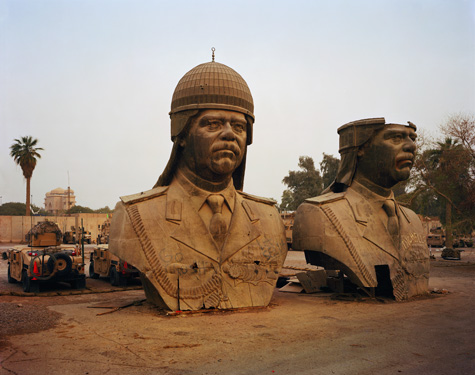
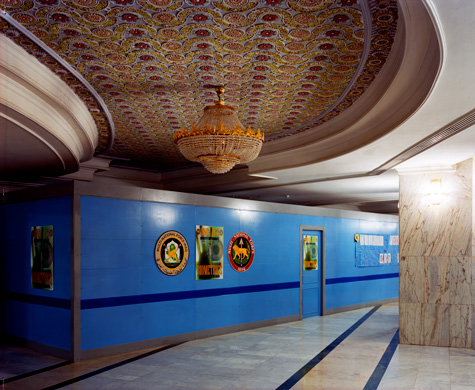
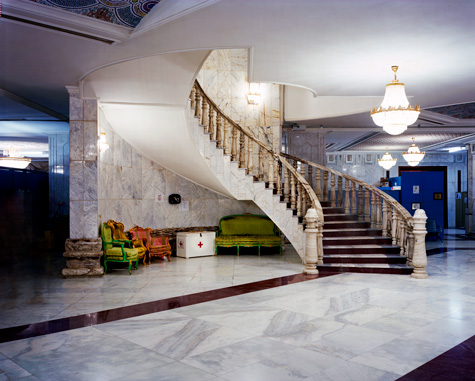
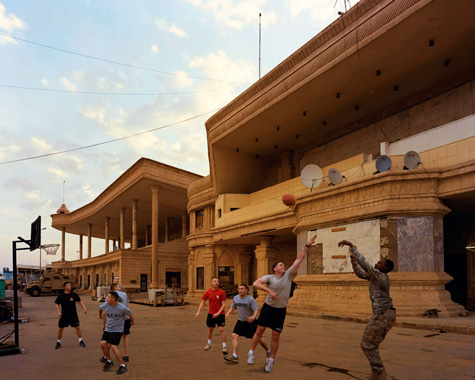
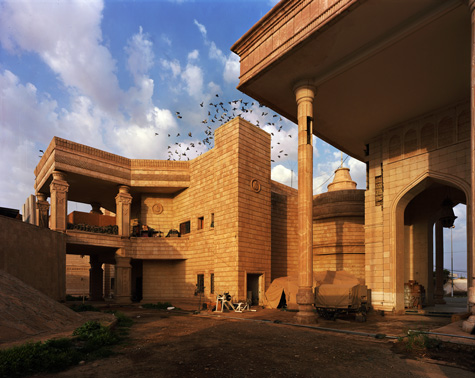
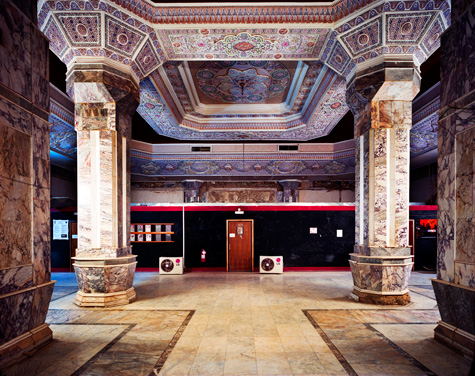
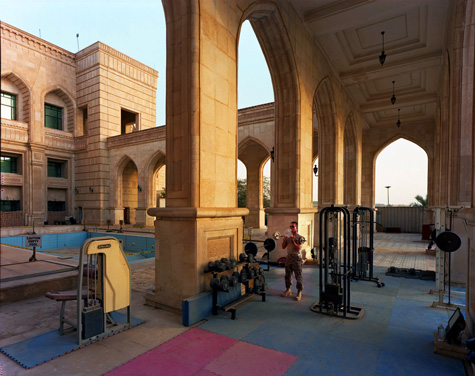
These extraordinary images—published here for the first time—show the imperial palaces of Saddam Hussein converted into temporary housing for the U.S military. Vast, self-indulgent halls of columned marble and extravagant chandeliers, surrounded by pools, walls, moats, and, beyond that, empty desert, suddenly look more like college dormitories. Weight sets, flags, partition walls, sofas, basketball hoops, and even posters of bikini'd women have been imported to fill Saddam's spatial residuum. The effect is oddly decorative, as if someone has simply moved in for a long weekend, unpacking an assortment of mundane possessions.
The effect is like an ironic form of camouflage, making the perilously foreign seem all the more familiar and habitable—a kind of military twist on postmodern interior design.
Of course, then you notice, in the corner of the image, a stray pair of combat boots or an abandoned barbecue or a machine gun leaned up against a marble wall partially shattered by recent bomb damage—amidst the dust of collapsed ceilings and ruined tiles—and this architecture, and the people who now go to sleep there every night, suddenly takes on a whole new, tragic narrative.
Fascinated by the dozens and dozens of incredible photos Mosse emailed—only a fraction of which appear here—I asked him to describe the experience of being a photographer in Iraq.
The ensuing dialogue appears below.

• • •

BLDGBLOG: What was the basic story behind your visit to Iraq? Was it self-funded or sponsored by a gallery?

Richard Mosse: The trip was backed by a Leonore Annenberg Fellowship in the Performing and Visual Arts, which I received after graduating from Yale last summer with an MFA in photography. The Fellowship provides enough to fund two full years of traveling to make new photographs, and I applied to shoot in a range of places, including Iraq. My proposal was to make work around the idea of the accidental monument. I'm interested in the idea that history is something in a constant state of being written and rewritten—and the way that we write history is often plain to see in how we affect the world around us, in the inscriptions we make on our landscape, and in what stays and what goes.

[Image: Saddam's heads, taken from the roof of the Republican Guard Palace, now located at Al-Salam Palace, Forward Operating Base Prosperity, Baghdad, Iraq (2009); photo by Richard Mosse].
I suppose it's an idea that captured me while traveling through Kosovo in 2004. I saw a building by the side of the road there that lay mined and shattered in a field of flowers. It was almost entirely collapsed—except for a church cupola which lay at a pendulous angle, though otherwise perfectly intact on a pile of rubble. It was a marvelously pictorial vision of the Kosovo Albanian desire to rewrite the history books. In other words, what I saw before me was not an act of mere vandalism, but a decisive act by the Kosovo Albanian community to disavow the fact of Serb Orthodox church heritage in the region. The removal of religious architecture is a terrible crime, and it constitutes an act of ethnic cleansing (remember Kristallnacht); yet I couldn't help but interpret this as an attempt to create a brave new Kosovo Albanian world.

I began to see architecture as something that can reveal the ways in which we alter the past in order to construct a new future, as a site in which past, present, and future come together to be reformed. And it's not the only one: language—our words and the way we use them—are another fine barometer of these things.

But architecture is something I felt I could research and portray using the dumb eye of my camera.

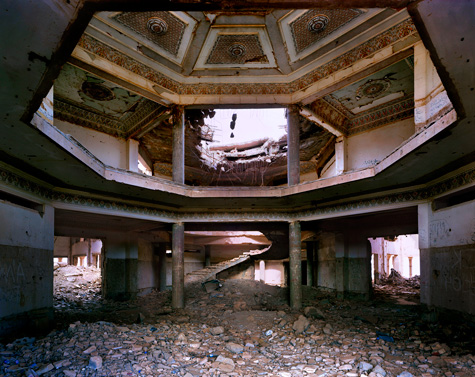
[Image: JDAM bomb damage within Saddam's Palace interior, Jebel Makhoul, Iraq (2009); photo by Richard Mosse].
BLDGBLOG: Beyond the most obvious reasons—for instance, there's a war going on—why did you go to Iraq? Was there something in particular that you were hoping to see?

Mosse: I had heard plenty about Saddam's palaces. They were the focus of the International Atomic Energy Association's tedious investigations in the years preceding the invasion, and the news was always full of delegations being turned away from this or that palace. Why were we so keen to get inside Saddam's palaces? Because he built so many—81 in total. Surely, we thought, he must be hiding something in those palace complexes. Surely he must be building subterranean particle accelerators. And, in the end, our curiosity got the better of us.

[Image: U.S.-built partition and air-conditioning units within Al-Salam Palace, Forward Operating Base Prosperity, Baghdad, Iraq (2009); photo by Richard Mosse].
In fact, Saddam was building palaces in every city as an expression of his authority. Palace architecture in Iraq served as a constant reminder of Saddam's immanence. A palace in your city simply fed the sense that Saddam was not just nearby—he was everywhere. Saddam was omnipresent.

I once heard a Westerner tell me that, prior to the invasion, Iraqis driving near one of Saddam's palaces would actually avert their eyes—they would refuse to look toward the palace. It was almost as if they were prisoners in a great outdoor version of Jeremy Bentham's Panopticon. Curiously, the sentry towers along the perimeter walls of Al-Salam Palace in Baghdad face only outward; they're screened from looking inward at the palace itself. People say it's so the guards could not witness Saddam's eldest son Uday's relations with underage girls, but I rather like to think that it created a sense of the unseen authoritarian staring blankly outwards. It was like those ominous black turrets that the British army constructed over the hills of Belfast, packed with listening devices and telescopic cameras.

[Image: Outdoor gym, Al-Faw Palace, Camp Victory, Baghdad, Iraq (2009); photo by Richard Mosse].
But the idea of Iraqis averting their eyes from Saddam's palace architecture also reminds me of something from W.G. Sebald's book On the Natural History of Destruction.

BLDGBLOG: That's an incredible book – I still can't forget his descriptions of tornadoes of fire whirling through bombed cities and melting asphalt.

Mosse: Sebald recounts how the German population, after the end of WWII, would ride the trains, staring into their laps or at the ceiling—anywhere but out the window at the terrible wreckage of their cities. It was as if they were somehow disavowing the war by willing it away, by refusing to perceive it.

It's interesting, then, that, in both instances—in both Iraq and in post-war Germany—it's the tourist, or the outsider, who observes this blindness. I suppose that's why I like to make photographs in foreign places: only the tourist notices the really dumb things that everyone else takes for granted.

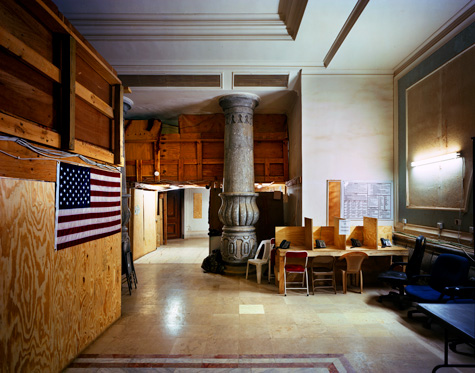
[Image: U.S. military telephone kiosks built within Birthday Palace interior, Tikrit, Iraq (2009); photo by Richard Mosse].
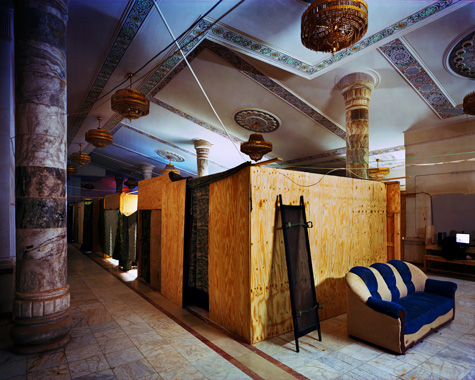
BLDGBLOG: The way these structures have been colonized is often amusing and sometimes shocking—the telephones, desks, and instant dormitories that turn an imperial palace into what looks like a suburban office or hospital waiting room. Can you describe some of the spatial details of these soldiers' lives that most struck you?

Mosse: It was extraordinary how some of the palace interiors had been transformed to accommodate the soldiers. Troops scurried beneath vaulted ceilings and glittering faux-crystal chandeliers. Lofty marble columns towered over rat runs between hastily constructed chipboard cubicles. Obama's face beamed out of televisions overlooking the freezers and microwaves of provisional canteen spaces.

Many of the palaces have already been handed back to the Iraqis—but where Americans troops do remain, they live in very cramped conditions, pissing into a hole in the ground and waiting days just to shower. Life is hard on the front line, and it seems more than a little surreal to be ticking off the days in a dictator's pleasure dome.

[Images: American dormitories built within Saddam's Birthday Palace, Tikrit, Iraq (2009); photos by Richard Mosse].

The most interesting thing about the whole endeavor for me was the very fact that the U.S. had chosen to occupy Saddam's palaces in the first place. If you're trying to convince a population that you have liberated them from a terrible dictator, why would you then sit in his throne? A savvier place to station the garrison would have been a place free from associations with Saddam, and the terror and injustices that the occupying forces were convinced they'd done away with. Instead, they made the mistake of repeating history.

This is why I've titled this body of work Breach. "Breach" is a military maneuver in which the walls of a fortification (or palace) are broken through. But breach also carries the sense of replacement—as in, stepping into the breach. The U.S. stepped into the breach that it had created, replacing the very thing that it sought to destroy.

There are other kinds of breach—such as a breach of faith, a breach of confidence, or the breach of a whale rising above water for air. All of these senses were important to me while working on these photographs.

[Image: Provisional office wall partitions within Al-Faw Palace, Camp Victory, Baghdad, Iraq (2009); photo by Richard Mosse].

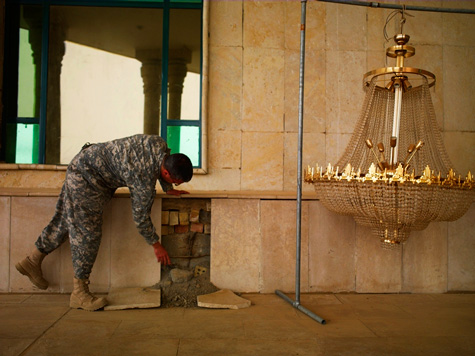
BLDGBLOG: In several of these photos, the soldiers are literally lifting tiles up from the floor as if the buildings had been left unfinished, or they're peering through cracks in the palace walls. From what you could see, were Saddam's palaces badly constructed or were they just heavily damaged during the war?

Mosse: Tiles simply fell from Al-Faw Palace because the cement used there had been poorly salinated. If that can happen to tiles, think what's happening when the entire palace has been built on similarly salinated foundations! It's just a matter of time before Al-Faw collapses in on itself.

You can already see arches cracking and walls beginning to sag.

[Image: Fallen tiles and chandeliers, Al Faw Palace, Camp Victory, Baghdad, Iraq (2009); photo by Richard Mosse].

But I'm reluctant to include images of U.S. soldiers pointing out problems with Saddam's architecture, because it's fairly evident that those could be a form of propaganda—and it's easy to forget that many of these palaces were built during times of terrible sanctions imposed by the West. It might not seem very clear why Saddam was busy building palaces in a time of sanctions, but remember how the WPA was set-up during the Great Depression? I don't want to risk being called an apologist for Saddam, but there are many ways to read a story.

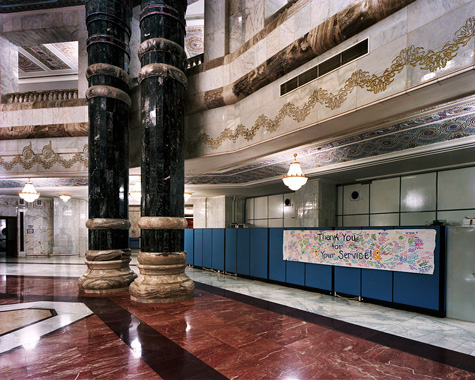
[Image: "Thank you for your service" banner, Al-Faw Palace interior, Camp Victory, Iraq (2009); photo by Richard Mosse].

That said, the palace is a fabulous monument to rushed construction, poor materials, and gaudy pomp. Saddam had apparently insisted that the palace be finished within two years, so many shortcuts were taken during construction. For example, the stairway banisters were made of crystallized gypsum—rather than carved marble—and where pieces didn't quite fit together, they were just sanded down rather than replaced. Marble that was used in the palace (such as in the great spacious bathrooms) was imported from Italy, in spite of the trade embargo. And the plaster cast frescoes in the ceilings were imported from Morocco.

[Image: Stairway, Al-Faw Palace, Camp Victory, Baghdad, Iraq (2009); photo by Richard Mosse].

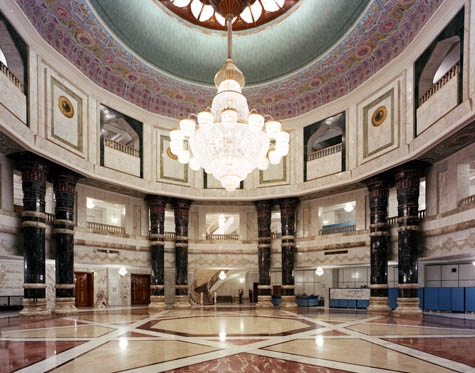
Al-Faw Palace later became the U.S, Army's Command HQ, located at the heart of Camp Victory, near Baghdad International Airport. The palace is now teeming with generals, including General Odierno, the commander of coalition forces in Iraq. It's a great, tiered wedding-cake structure, built around an inner hall with possibly the biggest and ugliest chandelier ever made. In fact, the chandelier is not made of crystal, but from a lattice of glass and plastic.

[Image: Chandelier, Al-Faw Palace, Camp Victory, Baghdad, Iraq (2009); photo by Richard Mosse].

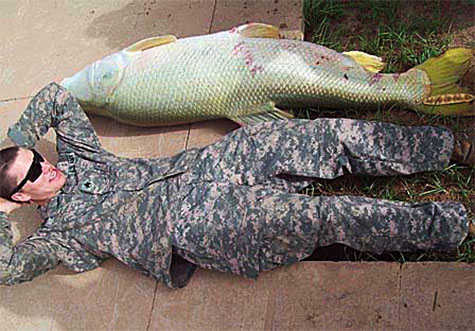
The palace itself is then surrounded by a lake, which seems a bit like a moat—and it would be tempting to take a swim there, but the moat has been turned into a standing pool for Camp Victory's sewage. In the summer, the place must be rather unpleasant: rank in all senses of the word, both military and sanitary. These artificial lakes surrounding the palace are also populated by the infamous "Saddam Bass." It's said that Saddam would feed the bodies of his political opponents to these monsters. In fact, they're not bass at all, but a breed of asp fish. U.S. troops stationed at Camp Victory love to fish on these lakes, and a 105-pound specimen was recently caught.

[Image: Tigris Salmon caught at Camp Victory Base, measuring 5 feet 10.5 inches and weighing 105 lbs. Image courtesy of the U.S. Army].

BLDGBLOG: How was your own presence received by those soldiers? Did you present yourself as a photojournalist or as an art photographer?

Mosse: The difference between art and journalism is, for me, of paramount importance—but twenty minutes in Iraq, and the dialectic recedes. I got a vague sense that Americans working there feel a little forgotten—unappreciated by people at home—so they're very grateful for a camera, any camera, coming through. Even a big 8"x10" bellows camera with an Irishman in a cape. There were a lot of rather obvious photographs that I chose not to make, and occasionally someone got offended by this.

[Image: A game of basketball, Birthday Palace, Tikrit, Iraq (2009); photo by Richard Mosse].

BLDGBLOG: What was the soldiers' opinion of these buildings? Did they ever just wander around and explore them, for instance, or was that a safety violation?

Mosse: I got the feeling that soldiers who occupied one of Saddam's palaces were pretty interested in its original function. They seemed a lot more together, and happier with their job, compared with the troops I met on the massive, sprawling, purpose-built military bases in the Iraqi desert. Constant reminders of hierarchy and protocol were everywhere on the bigger bases—but on the more cramped and less comfortable palace bases, soldiers of different ranks seemed much closer and more capable of shooting the shit with each other, to borrow an American turn of phrase.

Though a far tougher environment, there seemed to be real job satisfaction—a sense that they were taking part in a piece of history.

[Image: Detail of U.S. soldier's living quarters, Birthday Palace interior, Tikrit, Iraq (2009); photo by Richard Mosse].
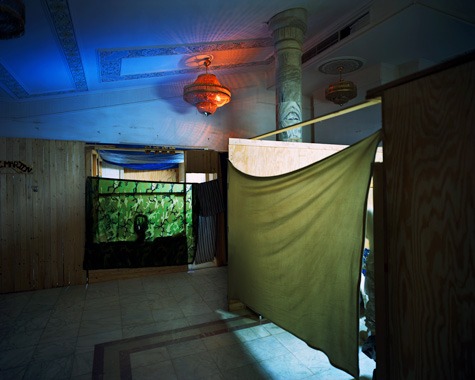
BLDGBLOG: Architect Jeffrey Inaba once joked, in an interview with BLDGBLOG, that Saddam's palaces look a bit like McMansions in the suburbs of New Jersey. He quipped that "the architecture of state power and the architecture of first world residences don’t seem that far apart. Saddam’s palaces, while they’re really supposed to be about state power, look not so different from houses in New Jersey." They're not intimidating, in other words; they're just tacky. They're kitsch. Now that you've actually been inside these palaces, though, what do you think of that comparison?

Mosse: Well, I've never been inside a New Jersey McMansion, so I can't pass judgment. However, "McMansion" is a term borrowed by us in Ireland, where I'm from. Ireland was hard-hit by English penal laws, from the 17th century onward. One of those laws was the Window Tax. This cruel levy was imposed as a kind of luxury tax, to take money from anyone who had it; the result was that Irish vernacular architecture became windowless. The Irish made good mileage on the half-door, for instance, a kind of door that can be closed halfway down to keep the cattle out but still let the light in.

Aside from this innovation, and from subtleties in the method of thatching, Irish architecture never fully recovered—to the point that, even today, almost everyone in my country chooses their house from a book called Plan-a-Home, which you can buy for 15 euros. And if you have extra cash to throw in, you can flick to the back of the book and choose one of the more spectacular McMansions. Those are truly Saddam-esque.

[Image: Birthday Palace, Tikrit, Iraq (2009); photo by Richard Mosse].
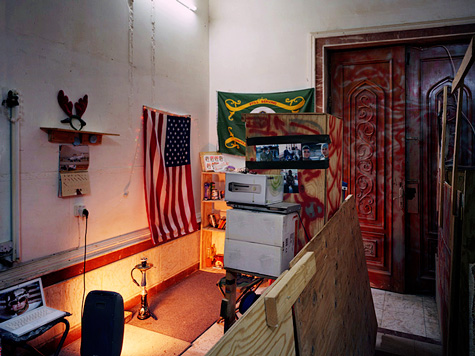
BLDGBLOG: Finally, the "Green Zone," as well as many of these palaces, are notoriously insular, cut-off behind security walls from the rest of Iraq. Did you actually feel like you were in Iraq at all—or in some strange architectural world, of walls and dormitories, surrounded by homesick Americans?

Mosse: Not all of Saddam's palaces are as isolated from reality as those situated in the green zone (or international zone, as it's now called). One I visited near Tikrit—Saddam's Birthday Palace—was even right at the heart of the city. Saddam was said to visit the palace each year on his birthday.

Wherever you go on the base, you're eminently shootable—a fantastic sniper target—and can hear the coming and going of Iraqis in the surrounding neighborhoods. It's a remarkable experience to go up to the roof with the pigeons at dusk and watch the changing light. You get a palpable impression of the great tragedy of the Iraq war, and you can see for yourself the fencing between neighborhoods, the rubbish strewn everywhere, the emptiness of the place, and you can hear the packs of dogs baying about. But you can also hear occasional shots fired in the distance, and you get the distinct feeling that you're being watched.

I spent a very slow month in Iraq trying to reach as many of these palaces as possible. I only managed to visit six out of eighty-one palaces. It is impossibly slow going over there, working within the war machine. These palaces are currently being handed back to the Iraqis, and many of them will be repurposed, sold to private developers or demolished. If I could get the interest of a publisher, for instance, I would return to Iraq to complete the project before Saddam’s heritage, and the traces of U.S. occupation, are entirely removed.

• • •

Thanks again to Richard Mosse for the incredible opportunity to talk to him about this trip, and for allowing BLDGBLOG to publish these images for the first time.
Be sure to see the rest of Mosse's work on his website. Hopefully the entirety of Breach will be coming soon to a book or gallery near you.

Do Horizontal Farms on Buildings Make More Sense than Vertical Farms? Paul de Ruiter Thinks So

by Lloyd Alter, Toronto

Zuidkas exterior perspective image
all images courtesy of Architectenbureau Paul de Ruiter

We do go gaga over vertical farms, but they might be just intellectual exercises rather than serious solutions. As Adam Stein noted, talking about New York: "Local food has its merits, but that’s what New Jersey is for.” But there is a middle ground between "fetishist temples of food production" and New Jersey- using the real estate on our roofs. As Sami noted in another post, greenhouses work very well.

That is why I like The Zuidkas, a proposal by Architectenbureau Paul de Ruiter commissioned by the Government Buildings Agency in the Netherlands. It integrates a greenhouse into the roof. And by integrating both office and residential functions into the same building, the greenhouse serves the additional function of being part of a system of air and water purification. Talk about local food- you just go upstairs.

Zuidkas aerial perspective image

In most cities it would be hard to find a spot where you get sun on the sides of your building all the time downtown, unless you happen to be on an island like Manhattan. Putting greenhouses on the roof make a lot of sense when you are surrounded by other buildings, which is your typical urban solution.

Zuidkas section image

It also makes sense to develop a mix of uses; their energy uses peak at different times. Paul de Ruiter explains:

The merging and advantageous stacking of offices, homes, a school and retail facilities results in a compact model. By including functions with a low-rise typology like stores and greenhouses in the model, the design makes optimum use of the available land. And thanks to the concentration of activities, there is less traffic than would be the case with a building with separate functions.

This compact model also creates an opportunity to develop a more balanced response to the demand for energy over time. In residential units, the energy demand spikes in the mornings and evenings. In the case of offices, the energy demand reaches its highest point at the middle of the day. A building’s energy supply often does not work efficiently, because capacity is regulated to meet the peak-hour demand any time of day, including off-peak hours.

Zuidkas details image
click on image to enlarge to almost readable size.

The design includes a glass shell that covers the configuration of the ground level and naves, creating a variety of climate buffers, that will work as an intermediate zone that naturally tempers the effects of the outside climate. The shell surrounding the building strongly reduces the surface area responsible for the loss of heat during the winter and cold during the summer. The buffer area facing south functions as a sun lounge for the homes. Thanks to the buffer effect, the loss of heat in the winter is reduced. In the summer, the sun lounge cools the adjacent areas thanks to the stack effect. In this process, fresh air is sucked in and constantly circulated. It will be possible to open the exterior shell, to prevent the area behind the shell from becoming too hot.

Zuidkas model image

Another reason to build the offices facing north is the extremely high production of internal heat by computers, lighting and appliances (and their users). This results in a fairly substantial cooling requirement in the summer period. By building the offices facing north, the heat of the sun in the summer has less of an impact on the building, with less energy required to cool the building as a result.

Zuidkas interior image


In homes, the production of internal heat is far lower, and the average temperature is often higher. By building the homes facing the south, and including a terrace, the design can actually make use of the heat of the sun, which in the winter makes a major contribution to the supply of heat.

dr-storage.jpg

The mix of uses creates waste that is used to produce heat and electricity.

Besides vegetable waste and biomass from the greenhouse, the building will also collect black water (toilet water) and lead it to the co-fermentation plant. In the co-fermentation plant, all biomass will be converted into biogas. This gas will serve as a sustainable fuel for the CHP power installation (bio-cogeneration). The heat that is released in this process will be used to heat tap water as well as the various building areas. Besides generating heat, the CHP power installation will also produce high-quality energy in the form of electricity.

The heat surplus in the summer and the cold surplus in the winter will be stored via a geothermal storage system in thermal masses below the surface. The stored heat will be used in the winter and the stored cold will be used during the summer. The supply and consumption of heat and cold will become even more interesting as an option if the whole surrounding area is involved in the geothermal storage system.
Rainwater will be collected on the roof. The quantity collected – some 4,130 m³ per year – is more than sufficient to supply the greenhouses and flush the toilets. The remainder of the collected water can be used for the washers and various household activities.

Zuidkas facade perspective image

I think there is a lot to be said for this concept, as a good compromise between the fantasy of vertical farms and the desire for local green in urban areas. It all works together symbiotically, producing food, cleaning air, generating power. The roof becomes a real productive part of the building, part of a system.


Thanks for the tip to Architectenbureau Paul de Ruiter

UPDATE: They have a website with more information on the project.

DATA

Client Government Buildings Agency
Design April-June 2008

Design Architectenbureau Paul de Ruiter
Design team Paul de Ruiter, Chris Collaris, Haik Hanemaayer, Noud Paes, Marieke Sijm

Advisor Arup Amsterdam: Jaap Wiedenhoff, Christa de Vaan