Zazzle Shop

Screen printing
Showing posts with label gardens. Show all posts

Tuesday, May 15, 2012

5 Gorgeous Climbing Vines to Plant for a Flowing, Bohemian-Chic Container Garden

By: Mairi Beautyman
From: http://www.treehugger.com/

There is something magical about a climbing vine in a garden. Vines seem to have a mind of their own and go completely wild with just a little bit of love. Something about this makes them symbolize a freestyle bohemia that is much more desireable to me than a few straight-laced plants properly lined up in a row, like a bunch of buttoned up soldiers.
And just because you are limited to a balcony or a small outdoor space doesn't mean you need to miss out.
The five vines here, from flowering to fruit baring, are all suitable for container gardens -- all you need is a big pot and something for it to climb up, generally a few sticks of bamboo will do. For more artful climbing, you can look into twining, netting or strings, or a trellis.

1. Black Eyed Susan Vine

The fast-growing Black Eyed Susan Vine (also called the Thunbergia or Clock Vine) adds a little drama with its solid black eye, framed by sunny yellow, white, or bold orange flowers.
They're easy to grow from seed, prefer full sun, and grow 6 to 8 feet tall. (870 Milligram PacketFerry-Morse 1779 Black-Eyed Susan Annual Flower Seeds, Vine (870 Milligram Packet), $.65 at productsmall.org)

2. Sweet Lace Grape Vine


As the enthusiastic Patti Moreno points out in this video, Sweet Lace Grapes orVitis Vinifera are a hearty addition to a container garden with the added bonus of a harvest -- which you can use for wine, jams, and jellies.
She says:
Sweet Lace Grapes are the perfect grape vine to grow in a container on a patio -- they're small, they're compact, even though they can grow to be between 20-40 feet. Keep it pruned if you don't want it to go that crazy or make sure you give it a vertical support, or plant it up against a lattice fence, or over an arbor.
($2 for 50 seeds on Amazon)

3. Heavenly Blue Morning Glory


Rowdy Rider/Flickr/CC BY 2.0
Best in full sun, the Heavenly Blue Morning Glory blooms all summer long -- up to 10 weeks -- and can grow an ambitious 12 feet high. (I once had a neighbor two floors down that missed out on most of his blooms...which climbed out of the shade to my apartment).
Morning Glories come in several color options, but the contrast of the blue and white here is particularly stunning.($4.92 for 150 seeds on Amazon)

4. Clematis Konigskind Climador


Alexandre Dulaunoy/Flickr/CC BY 2.0
Boasting clusters of lovely violet-blue blossoms, the Clematis Climador (also known as Konigskind )’ is a relatively new addition to the perennial container garden market, meaning it is bred to be in a pot, with a long blooming period.
Says garden.org:
One of the best new clematis to grow in containers is Clematis Konigskind ‘Climador’. This perennial has 5-inch-diameter, purple-blue, ruffled flowers that bloom for up to four months on vines that only grow 4 to 5 feet long. This clematis is hardy in USDA zones 3 to 9, although the container should be protected over the winter in cold areas.
($15 for the vine on Gardenvines.com)

5. Sweet Pea Vine


Wikipedia/CC BY 3.0
The small blossoms of the perennial Sweet Pea vine or Lathyrus latifolusactually look like dozens of tiny orchids (about 1 inch in diameter). But unlike orchids, they are ready to face the elements of your balcony or terrace.
Contrary to the Clematis, the sweet pea vine is no new kid on the block. Saysvintagegardengal.com, "It is an heirloom vine, which Thomas Jefferson grew, enjoyed, and called 'everlasting pea' in his day."
For more Sweet Pea tips, check out Success with Sweet Peas on finegardening.com. ($3 for one seed pack with three colors; minimum order three at reneesgarden.com)

Wednesday, September 21, 2011

Clever Tunnel System Makes Chickens Do The Gardening (Video)

by

from http://www.treehugger.com/

chicken tunnel gardening photo

Image credit: Ecofilms Australia

We've already seen how one farmer trains her chickens to eat slugs, and the internet is full of examples of chicken tractors—portable coops that can be moved to allow hens to till, fertilize, and weed a plot while providing pest control in the process. (see also this overview of chicken tractors at Planet Green.) But one Australian permaculturist has taken this idea to the next level—designing an intricate system of "chook tunnels" that let him funnel his ladies into any part of his garden. The amount of work that these creatures can do is actually quite amazing.

Of course many vegans will object to the idea of animals being used as "slave labor", but a system like this does go a large way toward answering the accusations of inefficiency so often leveled against animal husbandry. As soon as we stop thinking about chickens, or any other domesticated creature for that matter, as meat or egg production "machines", but rather as a productive, integrated member of a broader ecosystem, the efficiency equation starts to look a little different.

From processing weeds and food scraps into eggs and fertilizer, to replacing the need for human and/or mechanized labor in tilling, this really is yet another example of farming with animals the right way.

More on Chickens in the Garden

Friday, August 26, 2011

Four Amazing Green Greenhouses Built 40 Years Ago By Michael Jantzen

by
from http://www.treehugger.com/


michael jantzen greenhouses from 70s and 80s photo
All images credit Michael Jantzen
Artist and designer Michael Jantzen is best known for his visionary building ideas like his M-House, covered recently in Fast Company, but I was really excited by his older stuff like his Autonomous House, that I called a Thirty-year old green wonder. Trolling the older work on his site, I found some amazing looking greenhouse structures, and called him to find out more. What he built and what he said is really remarkable. In fact, it's amazing.
michael jantzen greenhouses from 70s and 80s photo
In 1980 he built this commercial greenhouse to raise seedlings prior to the beginning of the gardening season in Illinois. The structure is designed to conserve energy by moving the plants from the outside to the greenhouse to an insulated section,
michael jantzen greenhouses from 70s and 80s photo
There is a large mound of earth and it is connected to the greenhouse. There is a steel culvert under the mound of earth insulated with foam insulation. At night the plants roll into this underground space to keep them at the temperature they need so we wouldn't have to heat the greenhouse at night.
michael jantzen greenhouses from 70s and 80s photo
This is a commercial greenhouse for growing seedlings. There is a track where you can slided the plant outside into a 35' glazed section, during the day when it was too cold outside, so you could pull the plants from the underground section to the glazed section. When it was warmer outside and you want to harden the plants to the climate, you could move the plants outside.
michael jantzen greenhouses from 70s and 80s photo
It was a machine for growing plants, where they could go from a superinsulated cave environment where you didn't need any energy at all. There was an insulated lid that closed up after the plants were in. As the temperature moderates and in the daytime, they would stay inside the glazed section.
Experimental Greenhouse 1987
ePICT0001 copy.jpg
Experimental Greenhouse 1987 was built for the Missouri Botanical Gardens. It was a modular, transportable unit.
michael jantzen greenhouses from 70s and 80s photo
This was much more complex; the white section at the end is super-insulated with foam.
michael jantzen greenhouses from 70s and 80s photo
The whole thing was automated; there is a little computer that monitored the air temperature and light levels, and moved the plants in and out depending on the available of light and heat.
michael jantzen greenhouses from 70s and 80s photo

And then further, the drawers where plants are sitting on stainless steel benches, there were plastic tubes with phase change material in them. That was the thermal mass that would absorb the heat in the rods while it the material liquified, and that would provide the heat needed at night. It was also designed to self-water and inject CO2.
michael jantzen greenhouses from 70s and 80s photo
There is a cable that runs to the back of the insulated tube to the opposite end, and pulls the tray out into the sun.
michael jantzen greenhouses from 70s and 80s photo
Note that there is only one section in the middle that is tall enough for a person to step in, so idea was to design the shape of the structure is designed so that you don't have to heat a large volume that the plants don't need, you only need one small section where a person can tend to the plants as they were moving past. In the summer, all of the panels slid open so that it could ventilate naturally. A very complex little structure.
michael jantzen greenhouses from 70s and 80s photo
There is a lot more; the early greenhouses that he designed to minimize the interior area, with wings for the plants and a lane down the middle for the gardener, minimizing the air that has to be be warmed.
michael jantzen greenhouses from 70s and 80s photo
Just room for plants and people.
qPICT0001.jpg
The other greenhouses, like experimental greenhouse 1980, I was designing for the mass market. I was experimenting with growing plants in a cold climate. it was built with 2x4 and plywood and sprayed with foam on the outside to insulate. there were two layers of corrugated translucent plastic and in between was a blanket that rolled in between the airspace at night and rolled to the back in the daytime.
michael jantzen greenhouses from 70s and 80s photo
The corrugated section that you see you could close up like a roll-top desk. the side had a rock wall that would absorb heat during the day and you would blow air through it at night.
michael jantzen greenhouses from 70s and 80s photo
And there is still more material for yet another post to come. As I said, amazing stuff.

Friday, August 19, 2011

The World's Most Incredible Edible Gardens (Slideshow)

by
from http://www.treehugger.com/

villandry photo
Photo: Jose Fuste Raga/Corbis

Maybe you've only been looking at your vegetable garden as a means to an end: An easy way to get organic herbs, produce, and edible flowers without a grocery-store spending spree or a lineup of tasteless, non-local goods.

But as these photos show, your garden can be so much more than that: An eye-catching geometric layout of herbs, a home for sculptural shrubs, a masterpiece of shockingly colorful foods, and a peaceful place for getting in touch with your inner gardener.

Read on for more inspiration and ways to turn your plain plot into the centerpiece of your yard.

worlds most extraordinary ornamental gardens

Wednesday, August 17, 2011

Compost & Grow Food Indoors With "Parasite Farm" By Charlotte Dieckmann & Nils Ferber

by
from http://www.treehugger.com/
parasitefarm1.jpg
Photos: Alexander Giesemann

Indoor composting can seem like a daunting proposition if you're an apartment dweller who's short on space and time. Plus, with so many indoor systems out there, which one is the right one and how would it fit efficiently into your lifestyle and apartment layout?

Here's one stab at it: in envisioning a complete system of vermicomposting plus food-growing under the same roof, young German designers Charlotte Dieckmann and Nils Ferber offer an interesting integrated system that lets you compost under the kitchen counter and grow food plants by the way of illuminated planters that fit right into your bookshelf.

parasitefarm2.jpg

Seen over on Designboom, the "Parasite Farm" by Dieckmann & Ferber includes a vermicomposting bin with a nifty, integrated cutting board that can be hung right under the kitchen counter. Bonus: there's even a built-in fly trap to help get rid of those pesky fruit flies -- which, believe me, can be quite a nuisance when your vermicomposter is still not quite established (though it is preventable).

It's a vertical system that allows the user to produce humus over time, which can be harvested by shaking the grate and pulling out the bin underneath.

parasitefarm3.jpg

Water from your food scraps is also reused as it percolates to another bottom bin, where it's collected as nutrient-rich soup, similar to compost tea, which can be added to your water as liquid fertilizer.

parasitefarm4.jpg

The planters are designed to fit right into a typical bookshelf (like the IKEA-ish ones shown here), while light is supplied from above. Like windowfarms, this is definitely a boon for those who have precious little window space to actually grow food or herbs, and a thoughtful design solution for urban gardening in tight and light-poor spaces.

parasitefarm5.jpg

For more information, check out Designboom and the websites of Charlotte Dieckmann and Nils Ferber.

Inspired but not sure where to start? Or maybe you're already a pro at composting. But if you're in need of some encouragement or a refresher, our Green Basics on composting can help you get familiarized with terms and techniques, or check out the links below for more composting ideas.

Like this? Follow Kimberley on Twitter or subscribe via RSS

More on Composting
Buy Green: Indoor Composters
Easy Indoor Composting: Bokashi + Worm Bin
No Yard? Here's How You Can Still Make and Use Compost
Assemble Your Own Windowfarm: Edible Urban Garden In A Kit (Video)
Composting Basics: Build a Compost Spinner
Compost Conundrum: Backyard Box, Indoor Bin Or A Can-O-Worms?

Monday, August 8, 2011

Pocket Gardens Sprout on Paris's Anti-Parking Posts

by
from http://www.treehugger.com/

potogreen paris france pocket planters photo
A 'Potogreen' in Paris. Photo: Anne Mazauric via Paule Kingleur.

Necessary as they are to keep cars from blocking the sidewalk, anti-parking posts, or bollards, can be an ugly sight in a city. Parisian artist Paule Kingleur has commandeered some of the 335,000 posts in the French capital as sites for hanging micro-gardens -- what she calls a neighborhood "vegetable insurrection."

"Tomatoes, arugula, radishes, and flowers of all kinds" grow in these micro-gardens, according to the website Le Parisien. Kingleur worked with 600 children from Paris schools to plant the seeds and help keep them growing, she told Treehugger in an email this week about her "Potogreen" project.

Sewn Out Of Recycled Tents
"Children are adopting gardens. They are responsible for their care and are committed to leaving them in public spaces," Kingleur told Le Parisien.

The planters themselves are about as eco-friendly as you can get, made of discarded milk cartons collected from local businesses and wrapped in fabric pockets sewn out of recycled tents by Emmaus Maisons-Alfort, a rehabilitation association that works with homeless people.

Though each pocket garden can't grow much, the splashes of green are brightening up Paris neighborhoods. As one resident told Le Parisien: "When I left my house and I saw all these stakes with umbrellas of green, it was a piece of poetry in the street."

Tuesday, July 26, 2011

Real Live Vertical Farm Built In South Korea, Churning Out Lettuce

by Lloyd Alter
from http://www.treehugger.com/
suwon korea vertical farm photo
Image Credit Rural Development Administration
We have been showing conceptual vertical farms for years, but in Suwon, South Korea they have one working and producing vegetables. It is a little three storey demonstration project in a nondescript building (image here), operating much like Dickson Despommier has described in his book, The Vertical Farm, right down to the airlocks and sterility he suggests is required.
lettuce-inside.jpg
Image Credit Rural Development Administration
Fabian Kretschmer and Malte E. Kollenberg write in Spiegel Online:

Every person who steps foot in the Suwon vertical farm must first pass through an "air shower" to keep outside germs and bacteria from influencing the scientific experiment.....Heads of lettuce are lined up in stacked layers. At the very bottom, small seedlings are thriving while, further up, there are riper plants almost ready to be picked. Unlike in conventional greenhouses, the one in Suwon uses no pesticides between the sowing and harvest periods, and all water is recycled. This makes the facility completely organic. It is also far more productive than a conventional greenhouse.
The authors tour many of the vertical farms that we have shown on TreeHugger, and note what has traditionally been considered the major difficulty:
The main problem is light -- in particular, the fact that sunlight has to be replaced by LEDs. According to [agriculture researcher Stan] Cox's calculations, if you wanted to replace all of the wheat cultivation in the US for an entire year using vertical farming, you would need eight times the amount of electricity generated by all the power plants in the US over a single year -- and that's just for powering the lighting. It gets even more difficult if you intend to rely exclusively on renewable energies to supply this power, as Despommier hopes to do.
graff-system-ds.jpeg
But that is no longer necessarily true. Speigel Online has missed the recent work of vertical farm pioneer Gordon Graff, who's thesis at the University of Waterloo looked at the issue of energy and lighting, and has made a plausible solution for dealing with it. Here is what he proposed:
A vertical farm must be able to produce enough food to cover the cost of its day to day operations and, ultimately, the capital cost of the building's construction (or renovation). While this is clearly dependent on some factors outside the realm of architectonics, such as the market price of food and current state of grow-lighting technology, the physical arrangement of the building can have a profound impact.
gordon graff skyfarm vertical farm image
For the purposes of the thesis, Graff concentrates on one form of hydroponic system, a a drum system like the Omega Garden, seen on TreeHugger here and here. In terms of yield per kWh it is probably the most efficient system available. He packs it all into a 14,700 square meter building.
graff-drums.jpg
The drums are stacked three high,
gordon graff skyfarm vertical farm image
The drums are then are arranged on the production floor. An automated system extracts the drums and moves them to the ground floor via special dumb-waiters for harvesting.
graff-ground-floor.jpg
On the ground floor, the contents are harvested and shipped and the drums are then returned to the growing floors. While the drum system is the most efficient available in terms of electrical consumption, it still adds up to a huge number.
gordon graff skyfarm vertical farm image
But the lights aren't the only thing sucking up juice; plants transpire a huge amount of water, and the skyfarm has giant dehumidifiers to recapture it. Gordon writes:
Conventional greenhouses and other indoor agriculture facilities currently avoid reclaiming transpired water, electing to simply expel it to the outside world and consume more water to replenish irrigation levels....the incidence of water stress is widely projected to increase throughout much of the world in the coming decades. One study has calculated that if present trends continue, 1.8 billion people will be living in absolute water scarcity by 2025, while a full two thirds of the human population will face water stress.With agriculture currently accounting for some 72% of human water use it seems likely that such steps to reduce water consumption will become a desirable provision of vertical farming in the future.
In California, an acre of lettuce sucks up between 1800 and 3500 cubic meters of water; the Skyfarm consumes 14.4 cubic meters, 1/240th as much. That is a very compelling reason to sit up and notice vertical farming.
gordon graff skyfarm vertical farm image
That adds up to a lot of electricity. But fortunately, there is a readily available source being trucked all around Toronto: organic waste from the City's green bin composting program.
gordon graff skyfarm vertical farm image
97 tons of collected waste would be fed each day into anaerobic digesters that produce methane gas, which then runs General Electric Jenbacher gas-fired generators.
graff-basement.jpg
click image to enlarge.
The carbon dioxide rich exhaust is then purified and fed into the atmosphere of the skyfarm to increase food production and convert it back to oxygen through photosynthesis.
gordon graff skyfarm vertical farm image
Nothing is wasted; even the little bit of nutrition-depleted waste water is run through "Living Machines", a self-contained biological wastewater treatment system designed to purify water using microorganisms, algae, plants, snails, and fish.
graff-system.jpg
click image to enlarge
It is a sophisticated system where Toronto's green bin food waste is fed in one end and lettuce comes out the other end, along with digestate that is a rich fertilizer for conventional farms outside of the City.
capital-budget.jpg
I will not go into the pages of financial pro forma analysis, which is based on development costs of $110 million and the hypothetical sale of 25 million heads of lettuce per year into the local market; that is a lot of lettuce just to grow lettuce. But it does show that the economics can work, and as transport costs rise, our water supply gets worse and food costs increase, the economics will only get better.
opensystem.jpg
Gordon's vision of the role of vertical farms in the city is powerful and persuasive. He describes how wasteful and inefficient our current system is:
Urban citizens consume food, water, and other commodities, their buildings and appliances consume electricity, and their vehicles consume fuel - the latter two also involving the consumption of raw materials in their manufacture. Without the complimentary metabolic functions of producers or decomposers urban agents must obtain these resources from sources found outside the community, while also creating wastes of little use to the community, forming the traditional input and output externalities of urban life.
gordon graff skyfarm vertical farm image
Instead, the vertical farm is part of a closed system.
Vertical farming would increase a city's resilience to the more long- term, systemic alterations that human society is widely expected to experience in the coming decades. With vertical farming's maximally efficient resource use and functional segregation from the natural world, cities could achieve food security amidst the environmental transformations and resource shortages that would cripple a conventional urban food network.
graff-toronto.jpg
If I have one complaint about the project, and the role of vertical farms in cities, it would be that Gordon did not think big enough. The creative leap that Gordon makes is to tie the vertical farm into the city's organic waste system, but there is a really good reason to put this in the middle of a sea of condominiums: It could act as a giant purification system. Imagine if all of those buildings had vacuum waste systems delivering organic waste, urine separating toilets to deliver phosphorus, gray water systems to supply the plants, which then return pure water through the dehumidifiers. It feeds the city and processes its waste in a closed loop.
gordon graff skyfarm vertical farm image
Gordon Graff defending his thesis. Image Credit Lloyd Alter
Gordon Graff's thesis is not fully resolved. Architecturally it is not the eye candy that makes so many vertical farm proposals so delicious. But so far as I can tell (and I have looked at a lot of vertical farm proposals) it is the first time that anyone has made a plausible case for why one would want to put a vertical farm in the middle of a city, and shown how it might really work technically and economically. The vertical farm is no longer just pie in the sky.


Thursday, July 21, 2011

No Lawn, Just Food

Rip out your front lawn and replace it with fruits annd vegetables.

 
turning your lawn into a gardenFritz Haeg designs gardens that flip the traditional suburban landscape on its ear: He rips up front lawns and plants fruits and vegetables in their place. And once the owners—and their neighbors—get used to the sight of corn growing by the front door, they love it.
Haeg is an artist, architect, and author. His art project, Edible Estates, turns the grass in front of a house--that monotonous, conformist patch of green--into something that engages a neighborhood, changing how the residents think about their landscapes. Which is the point.

In his book, Edible Estates: Attack on the Front Lawn, Haeg chronicles the conversion of four urban and suburban American front yards and explains how the experience changed the owners and the neighborhoods. Haeg describes the traditional lawn as "a highly visible space that was mostly unoccupied, time-consuming, polluting, wasteful, and even socially divisive." He transforms the turf "with a little gardening and good will, into a productive space that feeds families with the healthiest local food while reconnecting them to their environment and neighbors."

One Garden
Clarence Ridgley's Baltimore garden illustrates this philosophy. Vegetables, fruit trees, and berry bushes reach toward the sun--an island of bounty amid a sea of grass. Ridgley's property was chosen through a program by Baltimore's Contemporary Museum. Like other Edible Estate gardens, Ridgley's front yard was all lawn.
Thirty kinds of organically grown fruits and vegetables later, there's a mini-orchard and a seating area surrounded by strawberries and tomatoes. Herbs are scattered among Swiss chard, cabbages, and a tiny "meadow" of edible flowers. Squash and watermelons bask in the sun, and beans climb a bamboo tripod.
Now in its third year, Ridgley's garden measures 33 by 51 feet. Neighbors haven't complained about the vegetable garden. On the contrary: Ridgley was anticipating the first tomato of the season, but a neighbor got to it before he did.

The Design
To create the garden, Haeg and Ridgley smothered the lawn with thick layers of newspaper and then topped it with a soil-compost mixture. Circular mounds of the mixture function as unframed raised beds. Wood chips define pathways. The plants make up the design of the garden; the lack of paving, structures, and other elements of hardscaping is a choice. Haeg calls it a deliberate move away from materialism and an obsession with things.


"It's not about super-fancy, aspirational, perfect garden designs," Haeg says. "I try to make the gardens real and modest, so people with modest means can do it."

As for what to grow, Haeg's palette is broad: any plant that grows in that climate. It's as diverse as possible, and takes into consideration the likes and dislikes of the family. The first year, the garden is mostly Haeg's vision. After that, it becomes the owners'.

The artist believes that growing food in front of the house is an opportunity to welcome and interact with other people. Ridgley says that neighbors he didn't know pre-garden stop to visit and comment on its progress. It's an experience to watch it transform from bare dirt to an attractive, productive garden. And it takes time. "It's not reality TV—instantly there," he says. "It's seeds. People watch it grow from nothing into something."
"People make their gardens more complicated and expensive than they need to be," states Haeg. "I keep it simple, cheap, and easy, so people think, 'I can do that, or better.' "

Tuesday, June 28, 2011

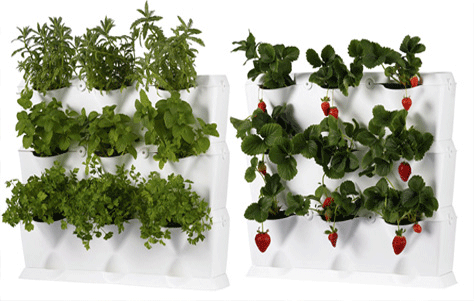
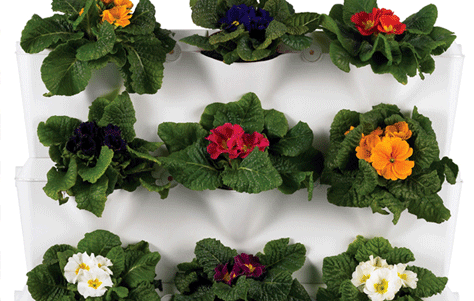
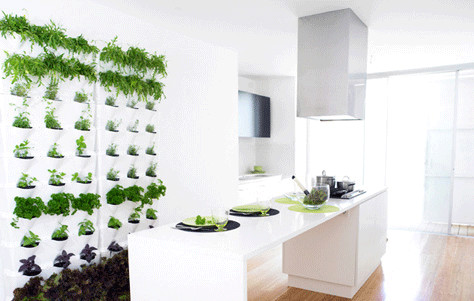
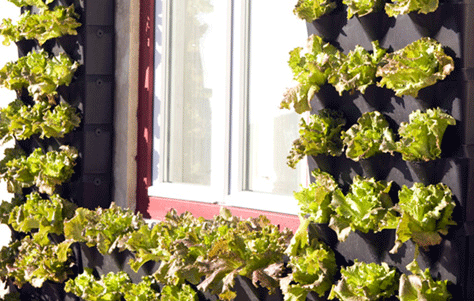
Space Saving Vertical Minigarden

edible wall, green building material, green wall, living wall, space saving, sustainable building material, vertical garden, vertical planting

Minigraden. Designed by Quizcamp.

Take a look into a courtyard of an apartment building or on the fire escapes and window ledges and you’re likely to see plants. People are desperate for greenery in their lives, and will use any space available to cultivate even the smallest garden. At my apartment, we have a planter on the fire escape and some herbs in small pots on the kitchen window sill that are constantly being knocked over by the wind. Efficiency of space is critical for all things city related, which makes the Minigarden all the more necessary and amazing.

Minigarden
Minigarden is a vertical gardening device that is modular to be easily adjustable for many circumstances. The modules can be stacked and connected to be single, back to back, and wall mounted. For the more ambitious gardener, Minigarden offers a irrigation system to make the process flow smoothly. The unique drainage system directs excess water through a series of plates and grills to keep the plants from being overwatered.
Minigarden
Minigarden offers environmental benefits in a number of ways. It is a primarily a source of fresh produce or herbs, but is also a great way to use compost and even promote thermal insulation. A well placed vertical garden on the exterior of a building can reduce the need to heat or cool a building. The black or white Mingarden modules are made from a tough durable copolymer polypropylene plastic, which, according to “The Green Guide” #77, The Green Guide Institute, are safe and do not leach chemicals.
Minigarden
About the Company: Minigarden is a brand within the Quizcamp Company, based out of Alentejo. Created in 2005; Quizcamp is a Portuguese agro-alimentary company which works to intervene in the entire agriculture to table process. They are involved in a series of parallel businesses such as beekeeping; mycoculture; tourism and the MiniGarden.

via Urban Gardens