Sunday, April 24, 2011
Monday, August 2, 2010
1988-89 Detroit Pistons are the most hated team in NBA history
By Trey Kerby
From: http://sports.yahoo.com/
The Germans call it schadenfreude, it means "pleasure derived from others' misfortunes" and outside of your favorite team or player winning something, it's one of the best things about being a fan. Sure, it's kind of silly to actively root against someone or something, but it's also irresistable. Hating other teams is a natural and occasionally fulfilling part of sports.
Some teams are hated more than others. Some teams just get so far under everyone's skin that they become the team everyone loves to hate, driving away casual fans in droves. Eventually, only the team's die-hards remain, leaving them to fight an us-against-the-world battle for respect. And according to Sports Illustrated, one NBA team in the 60 year history of the league stands head and shoulders above all other basketball teams — the 1988-89 Detroit Pistons.
Between the joy of Magic and the majesty of Michael was the dark and frightening rise of the Bad Boys. They threw hip checks like the Red Wings and were as mean as any boxer in Kronk Gym. Outside the state of Michigan, you wanted these guys in handcuffs. Never has an NBA team been so easy to detest, what with Rick Mahorn throwing forearms, Dennis Rodman elbows and Bill Laimbeer fits. (Somewhere, Laimbeer is probably still whining to the refs). Worst thing about them? They were a great basketball team. For all their roughhousing, the Pistons could light up the scoreboard with anyone -- Isiah Thomas flashing that sneaky grin as he beat you off the dribble, Joe Dumars locking up opponents and knocking down threes, Vinnie (Microwave) Johnson throwing in jumpers from everywhere. Fact is, the Pistons helped end two dynasties (Magic Johnson's Lakers and Larry Bird's Celtics) and delayed the start of a third (Michael Jordan's Bulls). They were bullies in basketball togs, but they could play.
Gross. Get out of here, Detroit Pistons, with your punching, kneeing and general jerkishness. Congratulations on your championship, but you are a very annoying team that people only like when they are trying to illustrate how soft today's NBA is. P.S. Your shorts are way too short and your star point guard eventually became a terrible general manager. Burn.
The Pistons finished second overall on SI's list, besting the 1993-94 New York Knicks who came in 7th. Also included are the 2000-01 Trailblazers (21) and this coming season's iteration of the Miami Heat (25), which might climb a few notches in the next year. The 2004 men's Olympic team also cracked the list (20), which isn't surprising considering that team featured both Allen Iverson(notes) and Stephon Marbury(notes).
All things considered, I'd say Sports Illustrated made a fine choice for the most hated team in NBA history. It's hard to argue against a team that everyone but Detroit fans hated. However, I'd dock them a few points since people look back fondly on their rugged defense and team attitude. Personally, I'd vote for those 93-94 Knicks who were wholly unpleasant. From their sweaty superstar to their black shoes and white socks look, everything about that team was no fun. Well, the fact that they had a guy named "Herb" was pretty cool for a 10-year-old, but other than that, nothing.
Posted by gjblass at 7:17 PM 0 comments
Labels: Basketball, detroit, NBA, Sports Illustrated
Friday, June 19, 2009
Got $100? Welcome to your new Detroit home
By Ashley Fantz
(CNN) -- If an e-mail popped up in your inbox promising a house for $100, you'd expect to see it sent from a guy in Nigeria asking you to wire him several thousand dollars first.
![]()
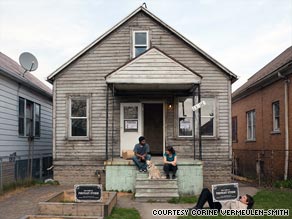
Zeb Smith lies on his front lawn and spends a quiet afternoon with his neighbors.
But this depressed housing market dream is real. And Detroit, Michigan, artist Jon Brumit and his wife, Sarah, are living it.
The couple never counted on owning a home.
"It's not that we have a little money," Jon Brumit said, laughing. "I'm saying we have no money."
But the couple began entertaining the idea of a permanent nest when their friends Mitch Cope and Gina Reichert, also artists, started taking advantage of foreclosures in the city, where the average home price dipped to $11,533 in April, according to the Detroit Association of Realtors.
Dragging down the average are homes that are long abandoned or foreclosed on that are selling for pennies on the dollar. Detroit already had the lowest market value houses in Michigan before the latest rounds of job losses at GM and other huge employers, market analysts say.
"Those artists are doing a good thing; they are at least helping to stabilize neighborhoods that would be all but lost," said Mike Shedlock, an investment adviser who blogs frequently about Detroit's economy.
![]()
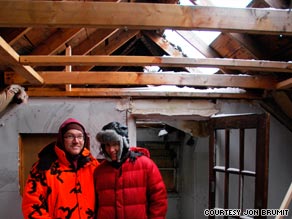
Jon Brumit and his wife, Sarah, in their new home shortly after buying it, under the huge hole in the roof.
For less than a few thousand dollars, Cope and Reichert snapped up a dilapidated bungalow in a north Detroit neighborhood called "BanglaTown," for its unexpected mix of Bangladeshis, African-Americans, Polish and Ukrainians and the occasional shady character.
Scrappers had cleaned the house to the bone. The copper had been stolen; the electrical wiring was stripped.
But no matter. Here was a chance for Cope and Reichert, who run a popular Detroit art store, to rehabilitate the 1920s brick house into a bastion of energy savings, with solar panels, LED lights, recycled wood and high-end insulated windows.
They're installing a security system that exemplifies elegant efficiency with hurricane-proof windows and steel doors replacing burglar bars. They are also experimenting with running their air-conditioning on a car battery.

![]()
Detroit artist Jon Brumit's $100 home last winter before any repairs.
The project became known as the Power House. Cope and Reichert wanted to create a central place to power homes nearby and, in turn, revive a neighborhood's sense of community.
The trick was getting their friends not only to cheer the concept but invest in it by moving next door.
"It was much easier than we thought it might be," Cope said. "We told everyone that Detroit is an interesting city to work in as an artist, and the neighborhood is diverse. But, really, it came down to money."
"I kept telling Mitch, 'Wow those are an awesome, ridiculously good deals but if you find anything that's less, let me know," Brumit said. "Like, if something comes along for next to nothing, cool."
A few weeks later, Cope e-mailed Brumit a photo of an abandoned home on his block. Its windows were boarded up and plywood was nailed across the front door. The huge hole in the roof was courtesy of the fire department. A neighbor said the house had been set on fire -- twice.
Pricetag: $100. Brumit called a real estate agent with the Department of Housing and Urban Development, who confirmed that bids on the foreclosed property started at $95 for the property, $5 for the house. There were no back taxes -- no one seemed to be sure who once owned the house, it had been empty for so long, Brumit said.
Cope, also a designer and builder, and an inspector did a walk-through.
"Inspection was fine and Mitch told me the foundation was good," Brumit said. "He just said, 'If you didn't mind scraping some peeling paint, doing some surface treatments, putting in new utilities, windows and repairing the roof ... this could be pretty interesting.'"
Now, when he's not hauling loads of rubble away or knocking out walls to create a single, open studio space, Brumit's searching Craigslist for a furnace. In exchange for designing the business Web site of a local barn recycler, he's getting materials to turn that hole in his roof into a skylight.
"I saw it as a project," the artist said. "I'm a builder. I've been building skateboards since I was 12."
Skateboards are one thing. Rebuilding homes where the plumbing has been ripped out or the cabinets destroyed in a fit by an upset foreclosed homeowner is another. Michigan housing authorities acknowledge that there's little incentive for people who aren't quite as handy as Brumit.
In two weeks, the state will begin offering $25,000 to anyone who buys a home, as long as they pay 1 percent of the total cost and live in it. Landlords or speculators aren't eligible.
Part of a $263 million grant given to Michigan and other states under 2008's Housing and Economic Recovery Act, the funds are intended to help buyers bring trashed properties up to code, according to Mary Townley, a director with the Michigan State Housing Development Authority.
She and other housing officials CNN spoke with said Michigan's economy has some extremely frustrating woes. A report from the nonprofit think tank Brookings Institution said Detroit had the lowest performing economy out of 100 U.S. cities it analyzed -- scoring the worst in unemployment and average wages, the highest foreclosure rates and the lowest market value homes.
The artists in BanglaTown are careful to say they are not looking to change a city. Their goal is simply to improve a neighborhood, one house at a time.
New neighbors, freelance photographer Corine Vermeulen-Smith and her husband Zeb Smith, a designer, are always checking out www.freecycle.com, where a stainless steel kitchen sink can be bought for $65.
The Smiths bought their 660-square-foot home for $549.99 from Cope and Reichert, who originally purchased the foreclosed home for $500. "We knew the property, we knew it had been sitting there empty for at least a year, and it had been trashed," Vermeulen-Smith said. "But we wanted to own a home."
All the copper in their "micro-home" had been ripped out, as well as every electrical outlet, Vermeulen-Smith said. Trash had to be hauled out in several loads.
"You have to get over that fear that the house had that history, that you're going to be a victim of a crime or something," she said. "Crime is everywhere. My husband and I have lived in the city for a long time; we know that people look out for each other here. We don't have that kind of fear."
Careful not to entice thieves again, the Smiths replaced the copper with plastic. They are considering taking the home completely off the grid by installing a mini-wind turbine, but for now they are happy to put in the basics.
A bathtub from Habitat for Humanity cost them $100. And Zeb Smith, who works at the Museum of Contemporary Art Detroit, brings home wood the museum would otherwise toss when installations close.
"This is, for us, very exciting to believe that we could totally reinvent a space," she said, "and prove that having a home isn't about having money."Posted by gjblass at 11:11 AM 0 comments
Labels: Cheap Real Estate, detroit, Real Estate
Wednesday, April 22, 2009
Hummer H3 Plugin Hybrid Gets 100 MPG, Kicks Prius Butt
While we wait to see if General Motors will go banko come June 1, Raser Technologies is hoping to change our minds about one of GM’s most iconic offerings: the Humvee.
During the upcoming 2009 SAE World Congress (Detroit, April 20 - 24) the company plans to unveil a Hummer H3 Range-Extended Electric Vehicle (ReEV) prototype. The vehicle is designed, first and foremost, as a purely electric vehicle with a drive train similar to the Voltec system in the Chevrolet Volt.
“We are resurrecting the Hummer,” David West, vice president of marketing for Raser Technologies said, adding that “It’s like a Volt on steroids.”
- » See also: Holy Honda Mod, Batman! Hawk 3-Wheeler looks like Batmobile Meets Rocket
- » Get Gas 2.0 by RSS or sign up by email.
So far, this zombie Hummer pretty sweet. The modded Hummer gets 268 hp, has a 40 mile all-electric range, and a fuel-efficiency of over 100 mpg.
“We’ve taken the worst environmental offender on the road and made it greener than a Prius,” West told Wired.com.
Seriously, can it really out-green the Toyota Prius?
“Yes,” explains West. “We took the challenge and here it is. The average driver starts off with a full charged battery with a 40 mile battery range. 75-percent of consumers live within that range and drive less than 40 a miles a day. So most people will never hear the gas engine come on.”
GM probably hopes so. GM was topdog for over 70 years until 2007 when they were surpassed by Toyota as the world’s No. 1 automaker.
“We are excited to be able to demonstrate an electric powertrain for larger vehicles such as trucks and SUVs,” said James Spellman, Vice President, of Transportation for Raser Technologies. “These are the best selling vehicles in America and can benefit the most from increased fuel economy and reduced emissions.” He went on to say, “Unlike the Prius, which is a mild hybrid vehicle, an eco-friendly SUV will get people’s attention.”
The vehicle is propelled by a 200 kW Symetron Enhanced AC induction motor hooked directly to the transmission, which is still connected to the all-wheel-drive system. According to Raser, it’s one of the most powerful passenger vehicle electric motors offered today and the whole system has near zero emissions. Also, the traction motor will support regenerative braking.
“If we put this powertrain in smaller vehicles down the road,” West said, “you could expect about 400 miles per gallon for the average (city) consumer.”
The V-8 combustion engine has been replaced by a small stand-alone 4 cylinder 2.0L engine which is only connected to the 100 kW Symetron PM Synchronous generator, and not the drive system. The engine is used only generate electricity and recharge the batteries when the vehicle drives beyond its 40 mile battery range and the lithium ion batteries are spent.
Three liquid cooled lithium ion battery packs are mounted between the frame rails and can be charged with a standard 110-volt household outlet. For a quicker charging 220-volt outlets are also supported. A full charge will take between 3 and 10 hours.
This plugin hybrid drive-system was designed by Raser Technologies, but developed by FEV, Inc. But is a 100 mpg Hummer enough to change the minds of the 30,000 industry specialists, engineers and business leaders who will be attending SAE?
No gas is used up to 40 miles. At 50 miles a day, the vehicle would still get 185 miles to the gallon. For 60 it’s 100 miles per gallon and over 200 miles the miles per gallon goes down to 33.
“Our goal in exhibiting this particular vehicle is to demonstrate that electric vehicle technology is a viable solution for a variety of vehicle platforms,” said Gary Rogers, FEV, Inc. president and CEO. “Needs of consumers will continue to vary, and the Hummer range-extended electric vehicle shows that fuel economy does not necessarily mean sacrificing power and utility.”
As of yet, there has been no talk of funding but I suspect that will come up during SAE. Raser hopes to have 2,000 of these things on the road by the end of 2010. Wired.com reports that Pacific Gas & Electric has already requested two of them.
Hey, only 1,998 more to go!
Posted by gjblass at 5:50 PM 0 comments
Labels: detroit, electric car, electric vehicle, electric vehicles, General Motors, GM, Hummer, Humvee, hybrid, hybrid electric vehicles, hybrid trucks, plug-in, plug-in hybrids, Toyota Prius
Monday, January 26, 2009
VW’s Diesel Roadster Gets 54 MPG, Offers Eco-Mode
At the North American International Auto Show in Detroit, Volkswagen showed off its latest roadster — the BlueSport Concept. The BlueSport features a 177 hp diesel engine with rail injection and a downstream NOx storage catalytic converter, all in a 6-speed DSG dual clutch transmission.
With a top speed of 140 mph, the 2.0-liter turbodiesel (TDI) delivers 258 lb-ft of torque. The Euro 6 compliant version gets 54.7 mpg where as the US version will get around 42 mpg. I am happy for the Tier II emission standards we have here in the US, and T2B5 standards are close to California’s stricter Level II standards, but do we really lose 12 mpg by those standards?
It’s VW’s eco mode that accounts for the boost in fuel economy: an automatic start-stop system and energy regeneration. Together they propel the Concept BlueSport to an additional fuel savings of up to 0.2 liter per 100 kilometers in city driving.
The roadster is barely over a ton. It’s lightweight construction includes a soft top that is the lightest in its class. It paid off. It will take less than 6-seconds to hit 60 mph. Of course, its weight also pays off in fuel consumption.
Editor’s note: this post was updated 1/24/2009 at 4:12 PST to change a reference to the vehicle hitting “top speed” in under 6 seconds. It should have said it will hit 60 mph in under 6 seconds.
Photos: VWvortex.com
Posted by gjblass at 12:46 PM 0 comments
Labels: auto show, concept car, detroit, Diesel, North American International Auto Show, Volkswagen, VW
Thursday, December 18, 2008
The Ruins of Detroit: 5 Abandoned Former Factories
By Ben Wojdyla
With the President mulling the use of TARP funds to help Detroit automakers weather the Carpocalypse, we thought it appropriate to show you these five Detroit industrial relics that didn't quite make it.
A few days ago, Time Magazine cashed in on the buzz around Detroit with a series of photos they called "The Remains of Detroit." While the images they portrayed were honest, they were not entirely fair. Painting a portrait of an entire city from a dozen pictures doesn't really do justice to either the rot of the city, or the renaissance. We're not here to preach about how Detroit as a city gets a bad rap or defend it from its warts, but if anyone wants to see what happens when an economy goes sour and competition shut plants down, we're happy to give you an honest look.
Over the years there have been myriad auto plants rising to power only to be wiped from the map when misfortune falls upon them. These hulking assemblages of glass and brick stand as a testament to the wills of men driven to greatness, and what happens when they, or their companies, are not continually vigilant of their profits or their contemporaries. What follows is only a slice of Detroit, so take it as it is.
Fisher Body Plant 21


The Fisher brothers started life as carriage makers and eventually became body suppliers for Buick and Cadillac. Their Fisher Body Plant 21 was in service between 1919 and 1974 and was closed shortly after the brothers died. It was used by other companies but never built another car part. The build stands now in a largely abandoned state, a single security guard watches over the back of the plant as it's slowly being taken apart.
Hudson Plant


The modestly-sized Hudson plant was originally home to the Aerocar company (no not that Aerocar) and was opened to produce Hudsons beginning in 1909. For the next three years Hudsons of the time were built there, but then in 1912 production was moved to a much bigger and more modern plant at Connor and Jefferson streets, which was demolished in 1961. The plant is currently a warehouse as far as we can tell and not vacant.
Ford Piquette Plant


The Piquette plant was the first home of the Ford Model T and can be considered the birth place of the Ford Motor Company as we know it today. Completef in 1904 and tiny by modern standards, the small plant measures only 400 by 56 feet with three floors, but was successful enough to outgrow its capacity in only nine years. The plant is today kept as something of a museum to itself by the Detroit Historical Society.
Ford Highland Park Plant


If Ford was born at the Piquette plant, it grew up at the Highland Park plant. When demand for the Model T exceeded the capacity of the old plant, Henry Ford and architect Albert Khan developed an all new type of plant built from reinforced concrete with many floors and large windows. This was also the site of the first moving assembly line in an automobile plant and could crank out a Model T every 24 seconds. Automobile production would move to the River Rouge Complex in 1917 where production continues to this day. The Highland Park plant was last used in the 70's for the production of Ford tractors and is largely vacant currently.
Packard Plant


Perhaps the most spectacular ruins in the entire city, the Packard Plant rests just off interstate 94 on the east side. Of the empty factories, it is perhaps the saddest, having once been a seat of innovation and produced the finest cars money could buy. The nearly mile long facility has long been quiet, serving as warehouse space for a while, and a destination for urban exploration, but recently security has been pulled, the once mighty facade was auctioned to the highest bidder, and the factory has been given up to the looters and the scrappers.
Posted by gjblass at 11:47 AM 0 comments
Labels: Abandonded Building, automakers, Big Three, Carpocalypse Now, detroit, Not-So-Big Three, Ruins Of Detroit