Zazzle Shop

Screen printing
Showing posts with label Vending Machines. Show all posts

Wednesday, November 3, 2010

Vending Machine Grows 20,000 Heads of Lettuce a Year Without Sunlight

by Brian Merchant
from: http://www.treehugger.com/


lettuce-vending-machine.jpg

Photos: Dentu

This is how we shall grow produce in the post-apocalyptic future

Finally -- a device that will guarantee we can still grow vegetables in the dark, after a nuclear holocaust has blocked out the sun or rampaging zombies have taken over our farmland. This Japanese lettuce-growing vending machine has been making the blog-rounds over the last few months, both because it doesn't require sunlight (it uses fluorescent bulbs) and because of the surprising yield it can churn out: 60 heads a day, or over 20,000 a year.

DVice explains:
The machine, called the Chef's Farm, was developed by Dentsu and can produce 60 heads of lettuce per day (or 20,000 heads per year) grown under 40 watt fluorescent lighting housed in a chrome housing that can be stored conveniently in any restaurant.
It can evidently grow other kinds of veggies as well.

lettuce-vending-machine-close.jpg

The portable fluorescent garden goes is on sale for $90,000, with the target market ostensibly being restaurants that want locally manufactured, sun-free vegetables on site.


Re-Nest has more:

Chef's Farm comes with five nutri-culture beds, which are each installed on long and thin metal frames. The lettuce seeds are planted in sponges in frames that have to be moved manually ... The lighting equipment, culture solution, and temperature can be controlled for each bed, and five different vegetables can be cultivated at the same time.

back-lettuce-vending.jpg

Obviously, shining twelve 40 watt bulbs on a shelf of seeds isn't the most efficient way to grow veggies, and there's no word on just how much water these 'nutri-culture' beds consume to pump out the lettuce at such a rapid clip -- and there's no word on the quality or nutritional value of the lettuce either. I suppose it would cut down on delivery emissions, but not much more than using locally-sourced produce.

lettuce-vending-machine-japan.jpg

But at least Soylent Green won't be the only menu item in the dystopic urban wastelands of the future.

Thursday, August 12, 2010

Vending Machines Of The Future


BY LUKE FUNK
FROM http://www.myfoxny.com/

MYFOXNY.COM - Your thumbprint might soon be the key to an afternoon candy bar. A Massachusetts based vending machine company is joinng the growing ranks of companies that are field-testing new technologies.

Next Generation Vending and Food Service is experimenting with biometric vending machines that would allow a user to tie a credit card to their thumbprint.

"For a certain demographic that is pretty cool," says company president John S. Ioannou.

Next Generation is currently testing about 60 of the biometric machines in various locations in the northeast.

The company is also testing other technologies. Ioannou says the key to the transforming the vending machine business is making the consumer feel more engaged.

The days might be numbered where a consumer watches a bag of chips roll through the machine and drop. Next Generation is also testing a machine that includes a 46" touch-screen display that acts similarly to an iPhone display. The user can click on an item, flip the image and even see the nutrional information on the back of the packaging.

Ioannou says initial results are good saying, "The feedback is extraordinary."

The machines include internally mounted cameras to monitor what is going on outside of the machine.

The tests are scheduled to run through the end of 2010. After that, Next Generation will decide if it is worth rolling out across its sales region in the northeast and Pennsylvania.

The company is also installing wireless or Ethernet connections on all of its current machines so there will be real-time reporting of the amount of goods in the machine for restocking purposes. Monitors will even be able to report when a coin is stuck in the machine. All of the current machines will be upgraded by the end of 2011.

There are other innovations that are being tested outside of the United States, including machines that use retinal scans to identify and charge consumers for their purchases.

Friday, July 16, 2010

Goodbye, Ice Cream; Hello, Cupcake Truck!


Curbsidecupcakes
1 of 9
A fantastic new trend is emerging on city streets across the country: The cupcake truck. Dispensing deliciousness to office workers, these trucks are a scrumptious new craze.

Curbside Cupcakes: Washington D.C.

Former lawyer Sam Whitfield and partner Kristi Cunningham took a chance and bought a big bright-pink Sprinter van, loaded up 300 cupcakes, and hit the streets of D.C. Today they sell over 1,300 cupcakes each day and enjoy a devoted following.

Signature Flavor: Red Velvet

curbsidecupcakes.com

Cupcakestop
2 of 9
A fantastic new trend is emerging on city streets across the country: The cupcake truck. Dispensing deliciousness to office workers, these trucks are a scrumptious new craze.

Cupcake Stop: New York, New York

Claiming to be the first-ever cupcake truck in Manhattan, the Cupcake Stop has reached an almost cult-like following in New York City.

Founder Lev Ekster started the company after graduating law school in 2009 when job prospects looked grim. Garnering over 13,000 followers on Twitter, the truck has over five locations across the city and two retail outlets.

Signature Flavor: Red Velvet with Sweet Cream-Cheese Frosting

cupcakestop.com

Cupkates
3 of 9
A fantastic new trend is emerging on city streets across the country: The cupcake truck. Dispensing deliciousness to office workers, these trucks are a scrumptious new craze.

Cupkates: Berkeley, California

Claiming the title of the Bay Area’s first cupcake truck, Kate McEachern can be found roaming around Oakland and Berkeley in her converted mail truck. Kate’s former lives as Managing Editor at Dwell Magazine and intern at Chez Panisse mean her cupcakes are gourmet creations sure to please Bay Area foodies.

Signature Flavor: Red Velvet (buttermilk chocolate cake with a bright-red hue, topped with cream cheese frosting)

cupkatesbakery.com

Flirtycupcakes
4 of 9
A fantastic new trend is emerging on city streets across the country: The cupcake truck. Dispensing deliciousness to office workers, these trucks are a scrumptious new craze.

Flirty Cupcakes: Chicago, Illinois

Tiffany Kurtz and Chris Sewall were sick of their corporate jobs and decided to convert an old mail truck into Flirty Cupcakes.

Serving Chicago residents with their elegant creations wasn’t easy. The city’s vast rules and regulations around food trucks required some serious modifications to their old truck, and to top it off the city insisted they had to pre-package each cupcake. To solve the problem, Tiffany had the idea of creating tiny gift boxes for each cake, which all her customers adore.

Signature Flavor: CBFF (Chocolate Best Friend Forever, Chocolate with Nutella Ganache)

flirtycupcakes.com

Buttercream
5 of 9
A fantastic new trend is emerging on city streets across the country: The cupcake truck. Dispensing deliciousness to office workers, these trucks are a scrumptious new craze.

Buttercream: Philadelphia, Pennsylvania

Former attorney Kate Carrara was surrounded by bitter and angry people all day, which prompted her to make a radical career change. Operating under the simple principle, “There’s nothing that a cupcake doesn’t make better,” she decided to buy an old mail truck and turn it into a rolling cupcake-happiness machine.

Signature Flavor: Yellow Cake with Vanilla Buttercream.

buttercreamphiladelphia.com

Karavan
6 of 9
A fantastic new trend is emerging on city streets across the country: The cupcake truck. Dispensing deliciousness to office workers, these trucks are a scrumptious new craze.

Kara's Cupcakes KaraVan: San Francisco, California

Established as one of the premiere cupcake makers in San Francisco, Kara Lind took her show on the road in her hip brown Sprinter van. Using local, seasonal, and sustainable ingredients, this truck is a treasure to find.

Signature Flavor: Sweet S’mores (Chocolate Cupcake with a Graham-Cracker Crust and a Toasted-Marshmallow Frosting)

karascupcakes.com

Perfectcupcakes
7 of 9
A fantastic new trend is emerging on city streets across the country: The cupcake truck. Dispensing deliciousness to office workers, these trucks are a scrumptious new craze.

Perfect Cupcakes: Baltimore, Maryland

Founder Catherine Hamilton might take her ingredients seriously, but her cupcakes are nothing but fun. Her truck is an imported mini-truck from India and according to Catherine, her recipes are “plain, simple, and sweet.”

Signature Flavor: Pink Velvet (Pink Cake, Pink Frosting)

perfectcupcakes.com

Thecupcaketruck
8 of 9
A fantastic new trend is emerging on city streets across the country: The cupcake truck. Dispensing deliciousness to office workers, these trucks are a scrumptious new craze.

The Cupcake Truck: New Haven, Connecticut

Taking an old-fashioned approach using locally sourced ingredients, Marsha and Todd Rowe started from scratch delivering their goodness to the folks of New Haven, Connecticut.

Signature Flavor: Chocolate Ruin (Deep Chocolate Buttermilk)

followthatcupcake.com


Tuesday, August 4, 2009

Vending Machines at Hotel Chain to Stock Swimsuits

Vending Machines at Hotel Chain to Stock Swimsuits
Courtesy of The Standard

Quiksilver has partnered with André Balazs’ The Standard Hotels to offer a new, cobranded line of swimsuits that will be sold both in the hotel boutiques and -- in an absolutely genius move -- poolside in special vending machines in New York, Los Angeles, and Miami in August.

As Joshua Katz, director of marketing and communications at Quiksilver, told WWD: “We decided to collaborate and make something cool as well as useful for Standard guests. Our core product is boardshorts, and The Standard hotels have pretty notorious pool scenes, so swimsuits made a lot of sense.”

Four different styles of men's board shorts were designed -- each representing the respective cities of the Standard's hotels: Hollywood is blue with white stars, for example, while New York's are (of course) black. Ladies seeking something to swim in at, oh, 4AM, can purchase a simple black string bikini.

In an even more brilliant move, each pair of shorts includes "Quik Tips" city guides -- spots of interest that bathing suit wearers might like to check out in the respective cities they're visiting. (We might take issue with the idea of folks in downtown L.A. featuring art spaces wearing old swimsuits, but we digress.)

The new collaboration can be purchased online today at shopthestandard.com, and the first vending machine will open in Los Angeles on August 8.

Tuesday, March 17, 2009

In Italy, a Vending Machine Even Makes the Pizza

Lucio Tonina/SITOS

The Let’s Pizza vending machine at a shopping mall in Trentino, Italy. It can turn flour, water, tomato sauce and fresh ingredients into hot pizza in a few minutes for a price as low as $4.50.


Published: March 13, 2009

ROVERETO, Italy — Is Europe bringing back the automat? Claudio Torghele hopes so.

Over the last decade, Mr. Torghele, 56, an entrepreneur in this northern Italian city who first made money selling pasta in California, has developed a vending machine that cooks pizza. The machine does not just slip a frozen pizza into a microwave. It actually whips up flour, water, tomato sauce and fresh ingredients to produce a piping hot pizza in about three minutes.

The machine, which Mr. Torghele calls Let’s Pizza, is only the spearhead of a trend. Restaurants reminiscent of the old Horn & Hardart chain in the United States, which are fully automatic, are also showing up around the Continent.

Unlike the old automats (the last Horn & Hardart closed in 1991), which were staffed with workers who refilled the machines with creamed spinach and baked beans as fast as customers pulled them out, these restaurants consist entirely of vending machines.

In Milan, a two-hour drive west of Rovereto, a franchise chain called Brekky has opened the first three of what is planned to be a large chain of restaurants in which customers can buy cold dishes like salads and sandwiches, and warm dishes like pasta, from vending machines.

North of the Alps, the automat never really died out. In the Netherlands, Febo, a chain started in 1941 by a Dutch baker, now has about 60 restaurants. In France, bright green and yellow Yatoo Partoo machines — the name loosely translates as “You can get everything, everywhere” — sell milk, juice, snacks and sandwiches 24 hours a day, seven days a week.

The European vending machine industry, which has grown significantly and now has annual sales of about 26 billion euros, or $33 billion, hopes the trend will catch on.

Much recent growth came with the placing of vending machines in factories and offices, where employees took coffee breaks or lunch from machines. But as recession bit into Europe and factories and offices closed, that market has contracted.

At the same time, Europeans are looking for less expensive ways to eat out, and the automat is far less expensive than a white-tablecloth restaurant.

“These are developments that we are watching,” said Luciano Iannuzzi, chief executive of Argenta in Carpi, Italy, a large vending operator with about 120,000 machines.

The idea for a pizza robot came to Mr. Torghele after he worked in California in the mid-1990s creating a fresh pasta manufacturer. “At food courts I saw a trend toward vending machines,” he said at his office in this mountain town. “In fast food, I saw pizza everywhere.”

With backing from a Dutch investment fund, his own capital and money from friends, he set to work. A plan to simply miniaturize industrial technology for producing frozen pizza failed, but by 2003 Mr. Torghele had produced a machine ready to be tested in Chicago and shown at a trade fair in Orlando, Fla.

That same year, with the help of Unilever, the British-Dutch food giant, he test-marketed 20 machines in Germany. “We had a bicycle,” he said. “Now we had to pedal.”

The machine Mr. Torghele and his engineers produced is outfitted with little windows so the customer can watch the pizza being made. As in the Charlie Chaplin film “Modern Times” (in miniature and without Chaplin) wheels turn and gears grind. The customer presses a button to choose one of four varieties — margherita (plain cheese and tomato sauce), bacon, ham or fresh greens. A plastic container dumps flour into a drum resembling a tiny washing machine; a squirt of water follows, and the drum goes into a spin cycle, forming a blob of dough that is then pressed flat to form a 12-inch disk.

Tomato paste is squirted onto the dough and cheese is added before it is lifted into a small infrared oven. The baked pizza then slips onto a cardboard tray and out into the customer’s waiting hands. Mr. Torghele says the pizza will cost as little $4.50, depending on the variety.

It is not surprising that the new drive to offer fresh-made food is coming from Italy. Italians may be legendary for long lunches of pasta and wine, but they also lead Europe in vending machines, with more than 614,000 installed, compared with 593,000 in France and 562,000 in Britain, according to the European Vending Association in Brussels.

Much of Italy’s strength in vending comes from coffee. An Italian coffee vending machine may offer up to 18 different varieties, including espresso, cappuccino, ristretto, lungo and macchiato.

But with coffee markets increasingly saturated, machine manufacturers are casting about for new products to push, like books, DVDs, scarves and handkerchiefs, even model cars and trains.

Operators are also increasingly offering fresh produce, like apples, and other healthy food at schools and fitness centers.

“Vending hasn’t arrived at the end of the road,” said Mr. Iannuzzi, 52, of Argenta. “It’s mature, but it’s growing.”

Argenta reflects the opportunities that vending offered to investors. In 2005, Argenta was snapped up by Advent International, a British equity fund, which turned around and sold it in late 2007 to an Italian fund, Cognetas. In that time, Argenta had doubled its annual revenue, to $260 million, partly through acquisitions and partly through growth.

Now, with the economic crisis spreading across Europe, the industry faces a different landscape. On the one hand, as factories close, potential vending machine sites disappear. On the other hand, as consumers find themselves with less cash, the lower-priced items in vending machines become attractive.

Where does this leave Mr. Torghele and his pizza machine? Initially, he thought the United States would be his primary market, but he learned that market would be hard to penetrate. Instead, when his machine goes into regular production this summer, he will be focusing on Italy and its neighbors. But vending machine prices there average about $2,600, and his machine will sell for $32,000.

Still, experts in the business are not discouraging. “You have to have a location; you have to understand where to go with that machine,” Mr. Iannuzzi said. “But there is a future for that.”


Monday, January 5, 2009

Airport Vending Machines Selling DS Systems and Games

Best Buy vending machine let's you buy a DS system and a couple of games before takeoff.

By Kris Pigna, 01/04/2009
Airport Vending Machine

Over the years, movies have shown a variety of insane inventions we could expect in the future -- flying cars, time machines, oppressive uniforms everyone in society would be forced to wear, etc. But how they failed to warn us about electronics-selling vending machines is beyond us: Like the U.K. vending machines that sell PlayStation 3 games we saw back in November, it looks like Best Buy is now distributing their own vending machines in airports that sell Nintendo DS systems and a variety of DS games (via Ars Technica). Surely, the future is now.

These "Best Buy Express" machines -- the one pictured above spotted at Atlanta International Airport -- offer such games as Mario Kart DS, Brain Age 2, and Guitar Hero: On Tour, just in case anyone is actually brave enough to be seen playing Guitar Hero: On Tour on a crowded flight. The games are priced the same as any other retailer, so there aren't even any steep markups you might expect for anything purchased inside of an airport.

It's worth noting that the machine apparently only sells DS systems and games (in addition to other electronics like digital cameras and headphones), and no PSP products. Might Nintendo have some sort of exclusive distribution deal with Best Buy... or did the retail chain decide on its own that PSP games weren't worth stocking? More than likely it's the former, but still, it's an interesting indication of how much more visible the DS is to the general public these days.

Tuesday, November 18, 2008

Vending Machines Craze in Japan

Instant Gratification to the Nth Degree

Welcome our contributing writer Michael I. Colwill of Kanteker's Craft. After living in Japan for some time, he became enchanted with the Japanese culture and technology, as this article clearly demonstrates.

Vending machines in Japan are as commonplace as temples, bicycles, and karaoke booths. It's not uncommon to see a street lined with a dozen or more machines selling products ranging from cold and hot drinks to flowers or rice. And almost none of these vending machines are vandalized or non-functional. According to the Vending Machine Manufacturers Association, Japan has one vending machine for every 23 people.


(image credit: Stefano)

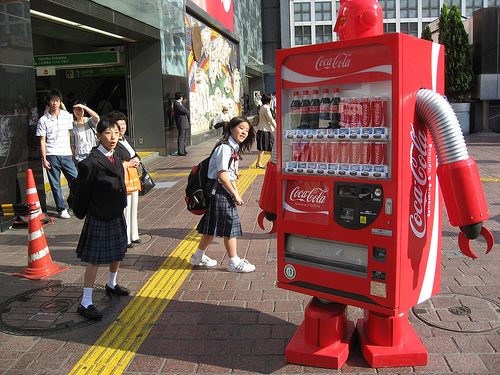
A Coke vending machine robot walks around Shibuya Station in Tokyo:


(image credit: Sanchome)

According to Tracy Jones in a web article titled "Jidoohanbaiki - Japanese Vending Machines, "the real surge in interest in jidoohanbaiki began during the Tokyo Olympics in 1964 with the need to supply large numbers of people with a number of goods and a severe lack of space and staff."

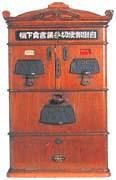
On the UCLA Asia Institute’s "Two Minute Japan" website you can find a picture of the first official vending machine in Japan. This wooden machine, built in 1904, sold postage stamps and postcards:


Here is a collection of interesting vending machines that you will find scattered throughout Japan’s cities, towns, and even countryside.

Get Your Drink, Coffee & Cigarettes Anytime, Anywhere

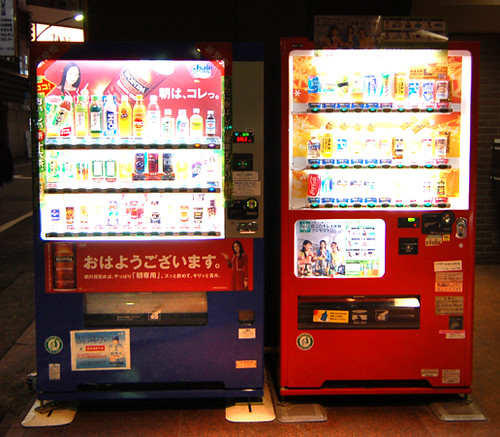
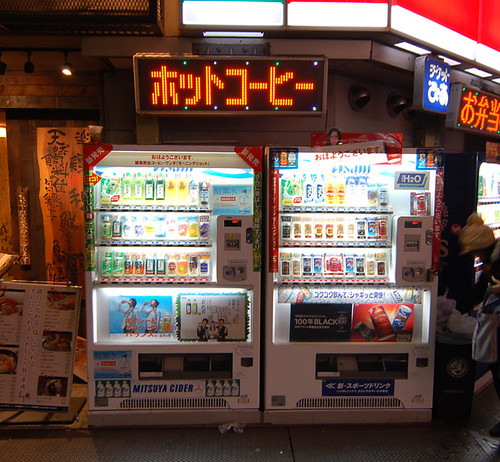
These are some of your standard drink vending machines. You’ll find them on practically every street corner. They usually sell a standard variety of sodas, complemented with all kinds of teas, hot and cold coffee, and energy drinks.


Photo by Mac Kane


Photo by Mac Kane

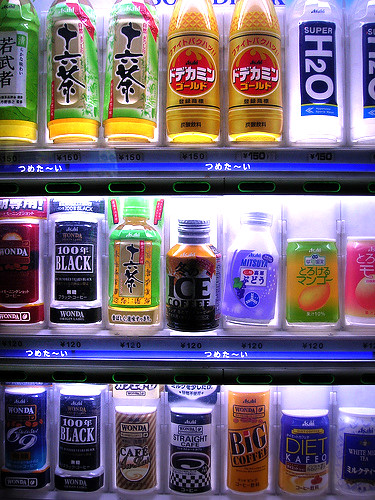
Most drinks around the size of a regular can of soda sell for around 120 yen. This is roughly around $1.05 in American currency. Smaller cans, usually of coffee, can sell for less than that.


Photo by Mac Kane

Notice the different color bands below the drink displays. This is standard on all drink machines and indicates the temperature of the drink, blue for cold and red for hot.


Photo by Ry Tweedie-Cullen


Photo by Mac Kane

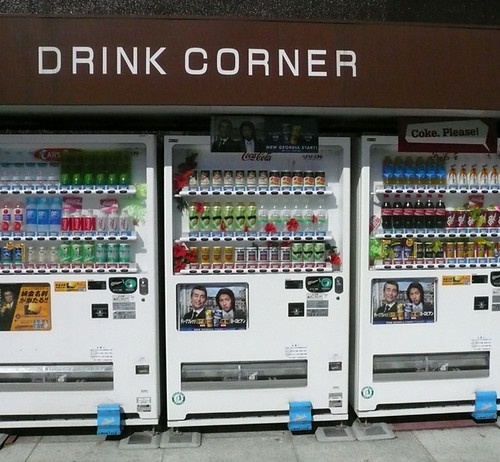
It’s actually more common to see several vending machines together, than an individual vending machine on its own. These random conglomerations of vending machines can be found anywhere from a Tokyo street corner to the side of a remote country road.


Photo by Mac Kane

Google offices in Japan have plenty of those:


(image credit: Loren Baker)

Most vending machines will have a recycling container nearby, or even built into the machine. This encourages people to obey the recycling laws, which are enforced in Japan.


Photo by Mac Kane

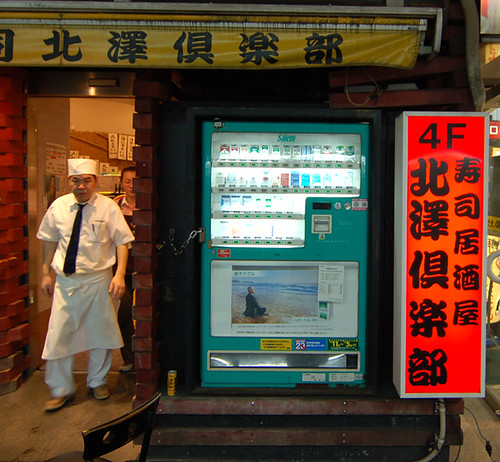
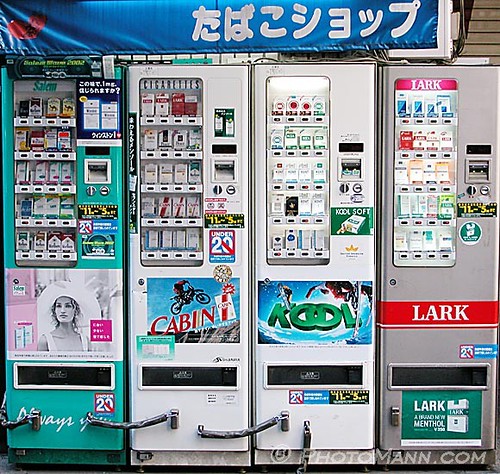
Here are some pictures of the cigarette vending machines. These machines will generally carry a wide variety of cigarettes, many of which are American brands, both popular and obscure. You will also come across some brands you probably never knew existed. This particular batch of cigarette vending machines has a girl outside promoting some of the products.


Photo by Paul Vlar

During my time in Japan I was amazed at the number of smokers. The World Health Organization has some great statistics on smoking in Japan and many other countries. According to their website, 51% of adult men smoke in Japan, which is down from the number of male smokers in the 1980s. Smoking among women was once considered taboo, but has now risen to nearly 10% in the last decade.


Photo by Mac Kane

A survey in the early 1990s indicated that 44% of Japanese physicians were smokers. And with 500,000 cigarette vending machines the young can easily purchase cigarettes. Smoking is legally prohibited until 20 years of age. The only method of prevention related to cigarette vending machines is that they are turned off between 11:00 P.M. and 6:00 A.M. Japan has some of the weakest anti-tobacco laws. There are very few public areas that are smoke-free.


Photo by Doug Mann


Better ask what they DON'T sell in these machines...

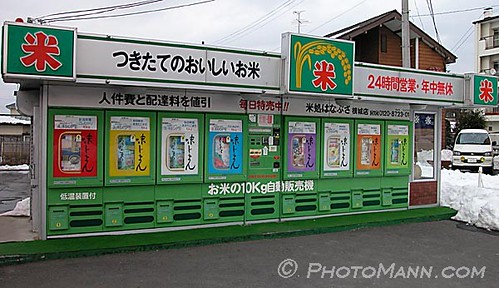
Soft drinks and cigarettes are only a fraction of vast multitude of goods sold from such machines. Rice being a major staple for the Japanese it is no surprise that large bags of rice can be purchased from vending machines. This particular set of machines sells rice in ten kilogram bags. There are some rice vending machines today that sell rice in the same plastic bottles that soda is sold in.


Photo by Doug Mann

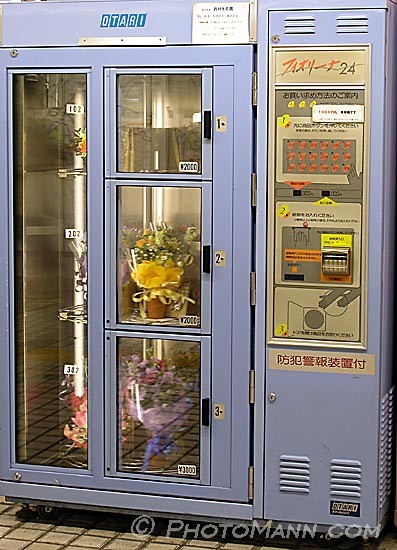
Though I've never encountered one of these, the flower machine seems to be a good idea, especially in Japan. Most businessmen are expected to work late, and then socialize with co-workers at a nearby bar; so the 24-hour availability of flowers seems to be promoted as a way for these men to "make it up" to their spouses. I wonder how well it works.


Photo by Doug Mann

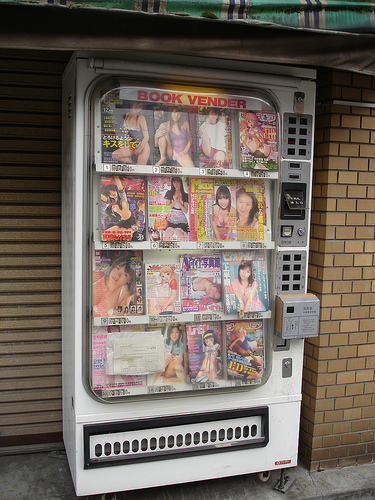
Porno vending machine:


(image credit: SweetThaiThai)

Lingerie vending machine (quite common in large cities, actually):


(image credit: François Rejeté)

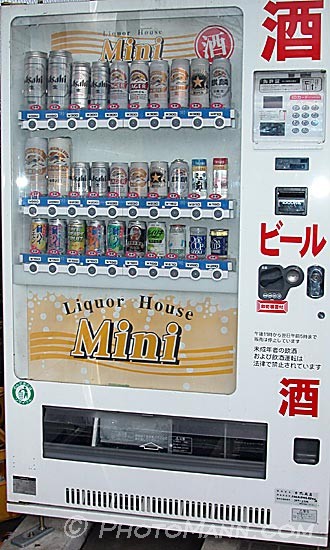
The number of alcohol vending machines probably matches the number of cigarette machines in Japan. Drinking, like smoking, is prohibited until age 20. And, like cigarette vending machines, the preventative method to keep youth from purchasing alcohol is to turn the machines off between the hours of 11 P.M. and 6 A.M.


Photo by Doug Mann

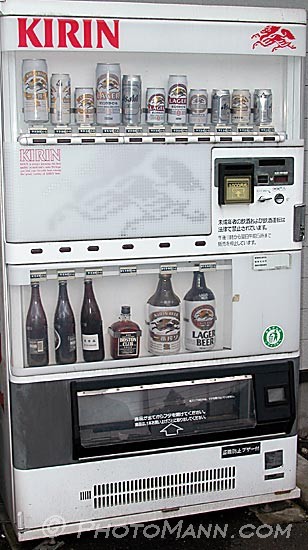
Many travelers to Japan wonder why most alcohol dispensing machines are located just outside the door of a liquor store. There may be a small convenience factor. But both store and machine would be closed during the night. Note the bottle of whiskey on the bottom shelf.


Photo by Doug Mann

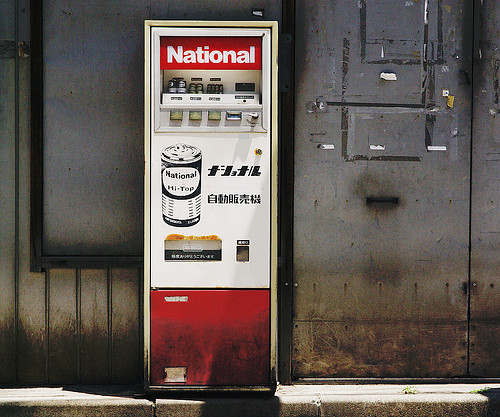
With all the electronics in stores everywhere, is it any wonder that battery vending machines would be available?


Photo by Doug Mann


(image credit: Isodacafe)

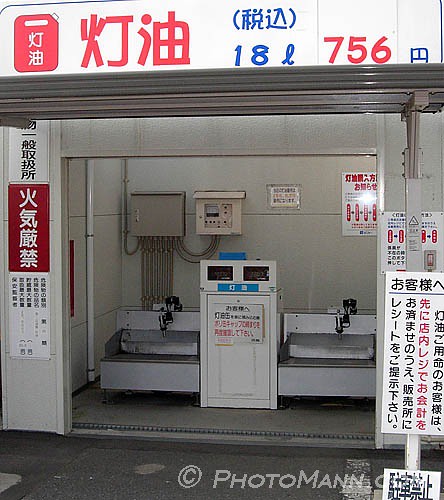
Most Japanese households use kerosene heaters to keep out the cold of winter. Because of this you will often hear vehicles driving around towns in the evenings or at night warning people over a loudspeaker to turn off their heaters before they go to sleep.


Photo by Doug Mann

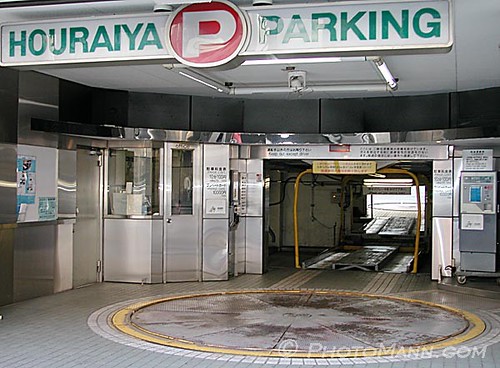
The various parking ingenuities in Japan would take another article to describe in detail. This one appears to be an automated parking elevator where you park your vehicle and receive a card or ticket. When you’re ready to depart you would insert your card, pay your fee, and the elevator would bring your vehicle down to the entry level, often times facing outward so you don’t have to back out. I never figured out how they did that part in some of these elevators.


Photo by Doug Mann

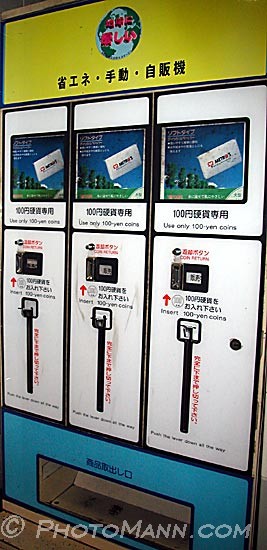
All your bare necessities can be purchased from a vending machine... not the least of them is toilet paper:


Photo by Doug Mann

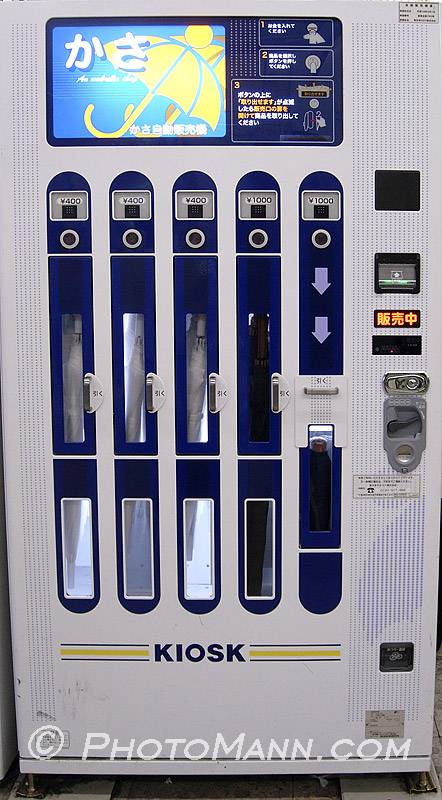
How many times have you left home only to be caught in a rainstorm later that day? How many times did you remember to carry an umbrella with you? Now it’s nothing to worry about, as long as an umbrella vending machine is nearby.


Photo by Doug Mann

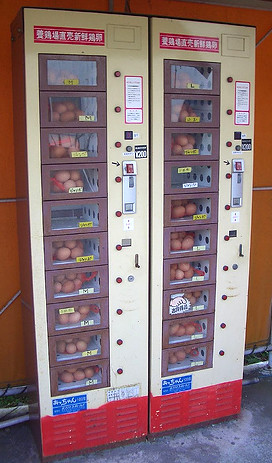
You can buy eggs in a vending machine? Don’t they break when they fall off the shelf? This particular machine seems to have a separate door for every product shelf. However, some vending machines (not necessarily egg-dispensing ones) will move the entire shelf down, until it's on one level with the dispensing window. Then your product will be carefully deposited onto takeout tray, safe and sound.


(image credit: Sally Kernick)

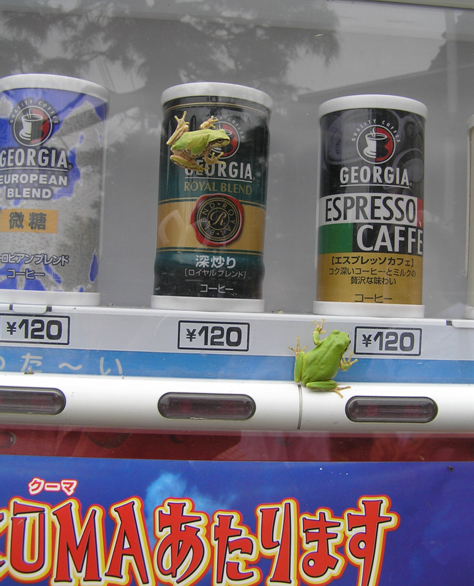
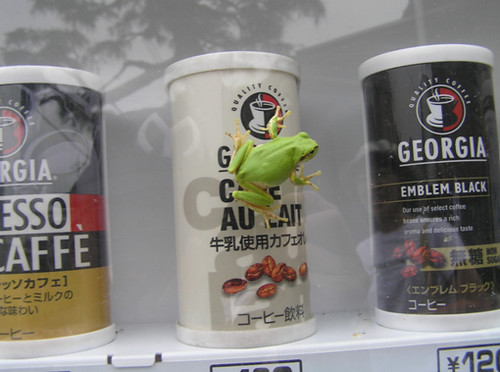
Frogs are perhaps the only thing these machines do not sell:


Photographer: Tetsuya Tanaka


The two photos above are taken by my father-in-law, Tetsuya Tanaka. He is an amateur photographer who has an eye for the beauty of Japan. You can find more pictures by him on my website.

For some other great collections of Japanese Vending Machine pictures please check out the websites of all the photographers included (by permission) in this article.
- Vending Machines of Japan, by PhotoMann
- Polar Interia, journal of nomadic and popular culture, by Mac Kane
- DutchAngle by Paul Vlar.
Also check out "Japanese Vending Machines" Pool, and this wonderful set on Flickr.


Article by Michael Colwill, Kanteker's Craft for Dark Roasted Blend.