Zazzle Shop

Screen printing
Showing posts with label Laser Light. Show all posts

Monday, June 13, 2011

Strung Out On A Lazer Harp: Q&A With Radium Audio

by Kevin Holmes
from http://www.thecreatorsproject.com/

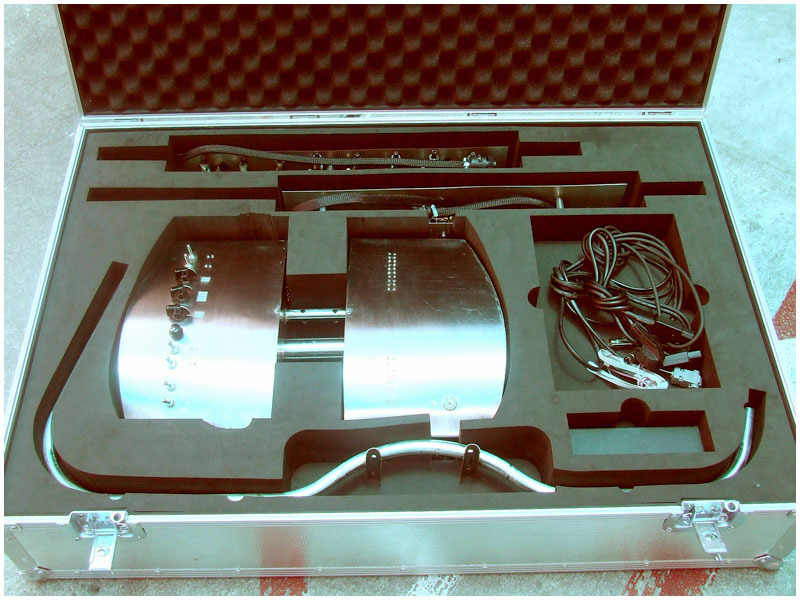
110520_moco_at-radium-studios_dsc5690_original_slide


Radium Audio are, an audio collective that plays around with sound. They create innovative sonic branding and audio design, always searching for that ever-elusive “sound that stirs emotion.” They have a sound lab in East London where they conduct their musical experiments, make instruments and create interactive designs. They recently notified us of their latest creation: a lazer harp that can control sound and stills. Seeing as how we’re big fans of lazers, the project naturally piqued our interest, so we emailed them to find out some more about this mystical new musical instrument.
The Creators Project: So, obvious question here… how come the lazer harp?

Radium Audio
: It’s been on the table for quite a long time. We had often talked about building something beautiful and magical using two of our favorite things: lazers and sound. When we were invited to represent sound at the F5 motiongraphics event in NYC, we decided the time was right to finally get on and build one!
How does your lazer harp differ from other lazer harps?

We did an audit on existing lazer harps, from the first ones built in the 1970s by Geoff Rose and Tim Walsh, via Jean-Michelle Jarre and his followers, up to the modern ones described on internet DIY sites, and we found that all of them were basically showpieces and not designed as a serious musical instrument. They were all monophonic—ours is polyphonic with selectable scales. They were not ergonomically designed for smooth and fast playing, rather for stage show effects. Our design is based on ergonomics and how a player can move his hands in a comfortable way over the beams—like a guitar neck, actually. Our harp is also velocity-sensitive to allow the same dynamics as a traditional piano keyboard.

Can you briefly explain how you built it?

First we made a wood mock-up with strings as beams, testing out sizes and angles to get it right. Then we made a thorough list of features we wanted to put inside it and then the design evolved from that. We passed through a number of prototypes before we got to the design we’ve used.

You’ve said the lazer harp controls video and stills, how does this work?

The lazer harp is basically a MIDI keyboard. We are using the MIDI control signals to control graphics as well as sound. This is a feature of the performance software we have developed for internal use.

Radium Audio Lazer Harp from Kevin Holmes on Vimeo.


What other instruments are you building?

We are currently building a series of hand gesture controllers, some using lazer beams and some using invisible sensors like IR [infrared] and similar. We have also developed middleware that turns “nonartistic” devices—such as bar code readers for example—into controllers for sound and visuals. And we have a number of other solutions up our sleeve that we cannot talk about openly just yet :) Just wait and see.

How dramatically do you see musical instruments evolving over the next 5-10 years?

Imagine the time when humans started to understand how to use—shape and control—wood and the revolution coming from that in terms of instrument making, all the possibilities: guitars, drums, violins and more. Now, consider the fact that it took quite a while from that point in time until we were able to build things like the Stradivarius violins, although it was built from the same material.

We are now at the end of a period in time when electronics and micro-processors have emerged as a major tool in musical instrument design—samplers, synthesizers and much more are all around us. However, we are still waiting for the Stradivariuses. Honestly, there’s quite a lot of bad design going around in the musical instrument world, especially in software-based devices. So, we are moving into the next phase: developing really good designs. It probably means that there will be few new basic technologies but, hopefully, a lot of improvements on designs. We are still waiting for the electronic instruments that you can buy at the age of 17 and live with for a lifetime, still evolving and finding out new things when you are 75. You can do that with a violin, why not with an electronic instrument ?

All images courtesy of Radium Audio

Wednesday, June 16, 2010

Deadly 'Star Wars lightsabre' sold in UK

From: http://www.metro.co.uk/

A deadly 'Star Wars lightsabre' is being sold to UK consumers for just £135. The 'Star Wars' style device produces a laser that can burn skin and cause instant blindness.
Alec Guinness as Obi-Wan Picture: Absolute Film ArchiveAlec Guinness as Obi-Wan (Picture: Absolute Film Archive)


But junior Jedis hoping to recreate the clash between Obi-Wan Kenobi and Darth Vader should think again, as the Spyder III Pro Arctic is not a toy and its force could prove deadly, according to the manufacturer.

The 1watt tool, said to be the world’s most powerful portable laser, features a blue ray that is 1,000 times stronger than sunlight on skin.

‘Extremely dangerous is an understatement to the power,’ says Hong Kong manufacturer Wicked Lasers.

‘It will blind permanently and instantly and set fire quickly to skin and other body parts – use with extreme caution and only when using the included eye protection.’

The powerful beam can be seen by aircraft pilots 72km (45miles) away and should not be pointed at vehicles, children or animals, Wicked adds.

But, even though it is a potentially lethal weapon, it seems anyone with a credit card can order one.

Britain is listed as one of 70 countries the laser will be shipped to and there do not appear to be age checks on buyers.

Customers must agree to a Class IV Laser Hazard acknowledgment form before ordering online and the document says ‘people have been arrested, fined and jailed for misuse’.

The Spyder III comes with safety goggles but even these cannot fully protect against the rays.

A post on a laser enthusiasts’ website reads: ‘I just ordered one. It will be stored in my gun safe because it is about as dangerous as a handgun.’

The $200 (£135) device was built by adapting blue lasers from home cinema projectors.

Friday, May 7, 2010

Janet Hansen: Giving Daft Punk, MIA and Kanye that Laser Look

Posted by Motherboard
From: http://www.motherboard.tv/


Janet Hansen lights artists for stage.

No, not like that. She actually lights the artists themselves. Their entire bodies.

The founder and Chief Fashion Engineer of Enlighted Designs, Inc, Janet’s sewn her lifelong passions for fashion, art, and technology together into spectacular lighted costumery that’s illuminated shows like Dancing with the Stars and laser-lined real-life Tron characters Daft Punk (like this and this). And yes, she gave Kanye his illuminated Kanye shades.

In this episode of Motherboard, Janet shows us her San Diego studio and explains her technique for coaxing the robot side out of some of the world’s biggest future-minded performers. After learning to sew at age 7, she began installing miniature lights in her own dollhouse, and as her costume-making hobby bloomed, she began to incorporate more electronics into her fashion. While developing her artistic skills — she’s also a multimedia painter and sculptor — Janet studied engineering, and picked up a PhD in biomechanics. Today, she is arguably the most prolific lighted clothing designer in the world.

Still, says Janet, lighted clothing won’t necessarily be the fashion statement of the future. It will, however, always be the best way to knock your socks off. Your plain, lame, non-LED-encrusted socks.

Learn more – and grab some of your own ready-to-wear or custom-made garments at Enlighted, and read a guide by Janet on how to make your own electroluminescent outfits at Instructables

Monday, March 8, 2010

Obscura Cuelight Pool Table


Obscura Digital Cuelight Interactive Pool Table. Featured at the Esquire Houses Ultimate Bachelor Pad in NYC, the limited Edition Obscura CueLight projection system turns a game of pool into an amazing interactive art display. Obscuras projection, sensor and tracking system reveals images and animations that follow the movements of the pool balls as players hit them around the table. You supply the pool table and we supply the system and customized content designed to create any type of experience you can imagine from relaxing to rockin

Wednesday, January 20, 2010

Make Your Own Star Trek Phaser

By: Laura Hudson
From: http://www.comicsalliance.com

Countless Star Trek fans have dreamed about owning their own phaser, and while Wikipedia lists it as a "fictional weapon," one enterprising (rim shot) gentleman decided not to let anyone else tell him what can and cannot be real, and transformed a 1994 Playmates replica of the phaser from the classic "Star Trek" series into a 320mA – 465mW laser device, complete with appropriate sound effect.


He's even got a tutorial to help you build your own, and while this may not be as dangerous as the "real" thing -- e.g. able to burrow tunnels through solid rock and disintegrate hostile aliens -- there's a video of the guy popping balloons with the beam, so it's not a joke, particularly if you shoot it into someone's eyes. Remember: Once you add actual lasers to a toy, it's not a toy anymore, so don't point it at any living things, ok?


Friday, November 6, 2009

Two years in jail for pointing a laser at a plane

The "sport" of pointing a laser pointer at a plane is not new - many people have been arrested for the stupid stunt.

Last week was a first though - someone caught pointing their laser at two planes was arrested, and sentenced to two and a half years in jail.

His first target was a United Airlines plane carrying 180 passengers. When the beam hit the cockpit window, the pilot caught it right in the eye, causing "flash blindness". The second target was an Alaska Airlines jet, this time the pilot was able to duck below a glare shield, but did have to abort a critical turn.

There appears to be no shortage of stupidity in the world, and shining a laser pointer at a jet just reinforces that. I'm not even sure what is going through the mind of someone who thinks this is a fun game.

These planes are carrying a lot of people, and in many cases they are on their final approach, one of the most critical parts of the entire flight. To me, two and a half year is on the short side - but hopefully it'll still send a message to anyone else who was thinking of messing around with their laser pointer.

Pilot drops his pants - asks checkpoint staff to Whoops - missed the airport by 150 milesHe almost got away with what he got away withWhen in doubt, blame the strong German beerDrunken flight attendant sex does not end wellPassengers spot drunk pilot - demand a sober one


Thursday, October 15, 2009

Kellogg's 'laser-etched' cornflakes

news.com.au


Laser etched cornflakes - Kellogg's / TwitPic
This is the image Kellogg's posted online as an example of laser-etched food. Picture: Kellogg's / TwitPic

IS this a marketing stunt, an elaborate hoax or a bizarre attempt by one of the world's biggest food producers to protect an iconic breakfast cereal from imitators?

The British PR office for Kellogg's claimed on its Twitter feed today that it has succeeded in etching its brand into individual corn flakes so they stand out against any copies.

Related story UPDATE: Kellogg's confirms laser-etched cornflakes are real - but not in Australia »

"Now you'll always be able to tell your Corn Flakes from your corn fakes!" Kellogg's UK announced on Twitter, with a link to an image of branded cereal.


Incredulous

Kellogg's claims the image, which looks like a badly doctored photograph, shows the result of a laser process that directs a concentrated beam of light onto the flake, using mirrors to control the burn.

The UK's Daily Telegraph today quoted a food technologist named as Helen Lyons as saying: "We want shoppers to be under absolutely no illusion that Kellogg's does not make cereal for anyone else.

"We've established that it is possible to apply a logo or image onto food, now we need to see if there is a way of repeating it on large quantities of our cereal," Ms Lyons said.

"We're constantly looking at new ways to reaffirm this and giving our golden flakes of corn an official stamp of approval could be the answer."

Laser-etching has been used to customise gadgets, create artworks and – in one dangerous experiment – tattoo a teenager's arm.

In 2005, Time magazine recognised Greg Drouillard for his invention of fruit tattoos, which was being tested at the time.

Mr Drouillard, a researcher for Sunkist Growers, says the laser essentially cauterises the burn on the food to stop it from spoiling.

Monday, June 1, 2009

Regular Light Bulbs Made Super-Efficient with Ultra-Fast Laser

May 29th, 2009 Regular light bulbs made super-efficient with ultra-fast laser

Enlarge

Chunlei Guo stands in front of his femtosecond laser, which can double the efficiency of a regular incandescent light bulb. Credit: University of Rochester

(PhysOrg.com) -- An ultra-powerful laser can turn regular incandescent light bulbs into power-sippers, say optics researchers at the University of Rochester. The process could make a light as bright as a 100-watt bulb consume less electricity than a 60-watt bulb while remaining far cheaper and radiating a more pleasant light than a fluorescent bulb can.

The laser process creates a unique array of nano- and micro-scale structures on the surface of a regular tungsten filament—the tiny wire inside a light bulb—and theses structures make the tungsten become far more effective at radiating light.

The findings will be published in an upcoming issue of the journal .

"We've been experimenting with the way ultra-fast lasers change metals, and we wondered what would happen if we trained the laser on a filament," says Chunlei Guo, associate professor of optics at the University of Rochester. "We fired the right through the glass of the bulb and altered a small area on the filament. When we lit the bulb, we could actually see this one patch was clearly brighter than the rest of the filament, but there was no change in the bulb's energy usage."

The key to creating the super-filament is an ultra-brief, ultra-intense beam of light called a femtosecond laser pulse. The laser burst lasts only a few quadrillionths of a second. To get a grasp of that kind of speed, consider that a femtosecond is to a second what a second is to about 32 million years. During its brief burst, Guo's laser unleashes as much power as the entire grid of North America onto a spot the size of a needle point. That intense blast forces the surface of the metal to form nanostructures and microstructures that dramatically alter how efficiently can radiate from the filament.

In 2006, Guo and his assistant, Anatoliy Vorobeyv, used a similar laser process to turn any metal pitch black. The surface structures created on the metal were incredibly effective at capturing incoming radiation, such as light.

"There is a very interesting 'take more, give more' law in nature governing the amount of light going in and coming out of a material," says Guo. Since the black metal was extremely good at absorbing light, he and Vorobyev set out to study the reverse process—that the blackened filament would radiate light more effectively as well.

"We knew it should work in theory," says Guo, "but we were still surprised when we turned up the power on this bulb and saw just how much brighter the processed spot was."

In addition to increasing the brightness of a bulb, Guo's process can be used to tune the color of the light as well. In 2008, his team used a similar process to change the color of nearly any metal to blue, golden, and gray, in addition to the black he'd already accomplished. Guo and Vorobeyv used that knowledge of how to control the size and shape of the nanostructures—and thus what colors of light those structures absorb and radiate—to change the amount of each wavelength of light the tungsten filament radiates. Though Guo cannot yet make a simple bulb shine pure blue, for instance, he can change the overall radiated spectrum so that the tungsten, which normally radiates a yellowish light, could radiate a more purely white light.

Guo's team has even been able to make a filament radiate partially polarized light, which until now has been impossible to do without special filters that reduce the bulb's efficiency. By creating nanostructures in tight, parallel rows, some light that emits from the filament becomes polarized.

The team is now working to discover what other aspects of a common light bulb they might be able to control. Fortunately, despite the incredible intensity involved, the femtosecond laser can be powered by a simple wall outlet, meaning that when the process is refined, implementing it to augment regular light bulbs should be relatively simple.

Guo is also announcing this month in Applied Physics Letters a technique using a similar femtosecond process to make a piece of metal automatically move liquid around its surface, even lifting a liquid up against gravity.

Source: University of Rochester (news : web)