Zazzle Shop

Screen printing
Showing posts with label Light. Show all posts

Monday, September 19, 2011

Light from a water bottle could brighten millions of poor homes (w/ video)

From: http://www.physorg.com/

Screenshot of a solar bottle bulb from the video below.
Image credit: Isang Litrong Liwanag

As simple as it sounds, a one-liter plastic bottle filled with purified water and some bleach could serve as a light bulb for some of the millions of people who live without electricity. Originally developed by MIT students, the "solar bottle bulb" is now being distributed by the MyShelter Foundation to homes throughout the Philippines. The foundation’s goal is to use this alternative source of daylight to brighten one million homes in the country by 2012.

In order to make the water bottles " up," holes are cut in the metal roofs of homes and a bottle is placed and sealed into each hole so that its lower half emerges from the ceiling. The clear disperses the light in all directions through refraction, which can provide a luminosity that is equivalent to a 55-watt electric , according to the MyShelter Foundation. The bleach prevents mold growth so that the bulbs can last for up to five years.

Although the solar bottle bulb only works during the day, it can meet the needs of many of the people in Manila, Philippines, and other cities, where the homes are so close together that very little sunlight can enter through the windows. As a result, the homes are dark even during the day.


Residents describe the difference that the solar bottle bulb has made. Video credit: Isang Litrong Liwanag


The solar bottle bulbs’ advantages include sustainability and safety; compared with candles or faulty electrical connections, they aren’t a fire hazard. The bulbs are also inexpensive to make and install, and of course have no operating costs while in use.

The MyShelter Foundation is promoting the solar bottle bulbs as the Isang Litrong Liwanag ("A Liter of Light") project. In Manila, the city government paid for the bulbs while the foundation is training residents on how to make and install them.

via: Treehugger
© 2011 PhysOrg.com

Wednesday, June 29, 2011

11,000 Lanterns Floating Over Poland


11,000 Lanterns Floating Over Poland - Watch more Funny Videos

Tuesday, February 15, 2011

I am Batman.................

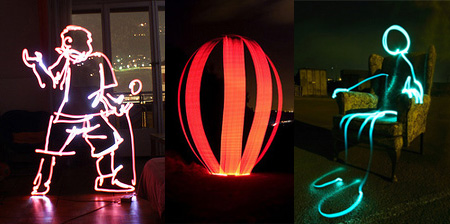
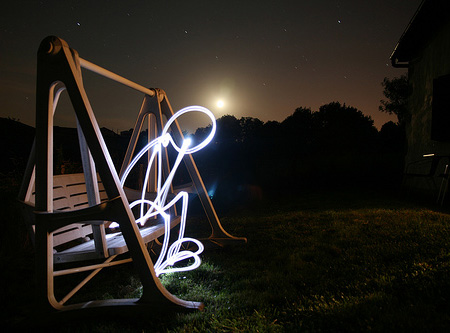
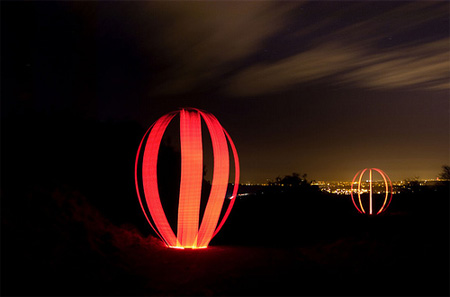
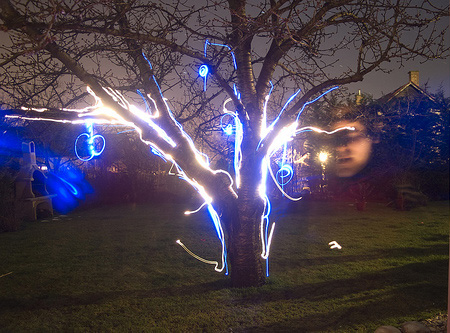
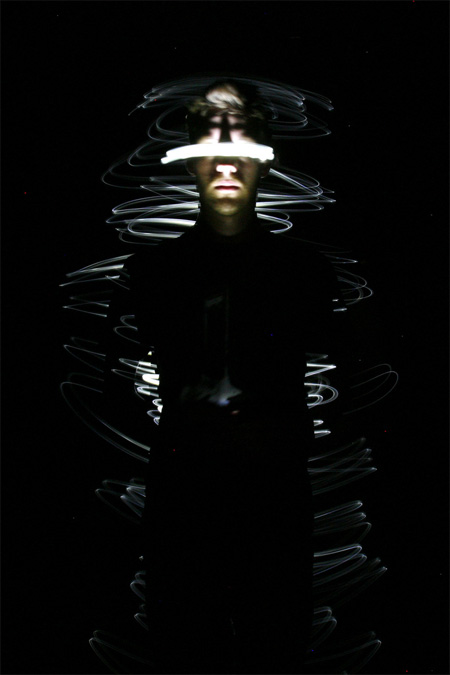
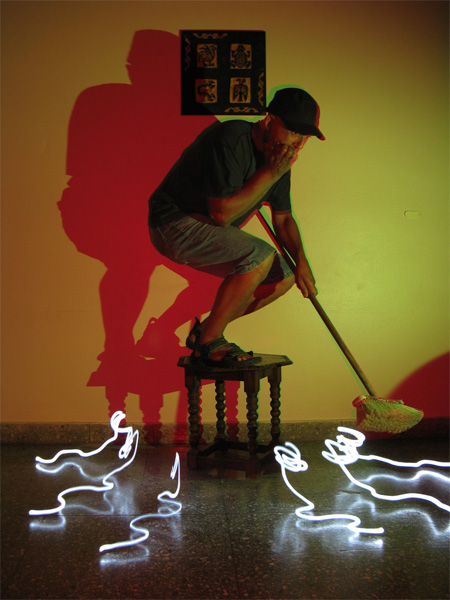
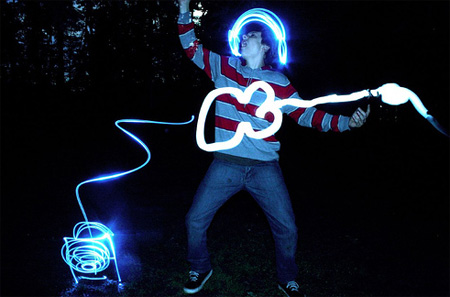
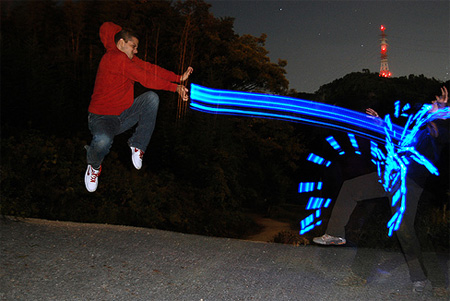
pretty cool light street graffiti

Friday, June 11, 2010

Control4 My Home for iPad

http://control4.com/ipad/


Control4 home automation solutions let you easily manage your security system, lights, home entertainment, thermostat and various other electronics…from your iPad!


If you already have a Control4 system in your home:

  1. Download the FREE Control4 My Home application at itunes.apple.com/us/app/control4-my-home-for-ipad
  2. Contact your Control4 Dealer to purchase a Control4 Mobile Navigator License to enable secure access to your Control4 system over your home Wi-Fi network.


If you do NOT have a Control4 system in your home:

  1. Download the Control4 My Home application at itunes.apple.com/us/app/control4-my-home-for-ipad
  2. Find a Control4 Dealer near you. Your Control4 Dealer can set-up and configure your Control4 system and can enable secure access to your Control4 system over your home Wi-Fi network.


Once you’re up and running, you can use your iPad as an interface to your Control4® system to create custom lighting scenes; to conveniently control entertainment systems; or to take advantage of energy savings with programmable thermostats and other ‘green’ settings. If you’ve already experienced mobile control using your iPhone or iPod Touch, you’ll be even more impressed by the iPad app which is specially designed to take advantage of the larger screen size making it even easier to manage your home.
Later in the year, you’ll be able to use Control4 My Home in conjunction with a Control4® 4Sight remote monitoring subscription to turn lights on and off, lock or unlock doors, or access IP video cameras and security systems from the Internet, providing increased home security and peace of mind.
Didn’t get your iPad yet? You can still manage your Control4 system from your iPhone or iPod Touch (Blackberry and Droid coming soon!). Ask your Control4 Dealer now!

Monday, March 22, 2010

Study: Daylight saving time a waste of energy

March 16, 2010 by Lin Edwards Daylight saving time

(PhysOrg.com) -- Daylight saving time is supposed to reduce energy use, but data gathered from a state in the US suggests it actually does the opposite.


The US state of has 92 counties, but until 2006 only 15 of them adjusted their clocks for daylight saving time, with the remainder keeping standard time all year, at least partly to appease farmers who did not want the change. Then in 2006 the Indiana Legislature decided the entire state should adopt daylight saving time, beginning that spring.

This unique situation enabled professor of economics Matthew Kotchen and his PhD student Laura E. Grant, both from the University of California at Santa Barbara, to study how the adoption of daylight saving affected . They studied over seven million electricity meter readings in southern Indiana every month for three years, and compared the before and after the change. The 15 counties that had adopted daylight saving time much earlier were the control group, which allowed them to adjust for the effects of weather extremes over the period.

The result of the study showed that electricity use went up in the counties adopting daylight saving time in 2006, costing $8.6 million more in household electricity bills. The conclusion reached by Kotchen and Grant was that while the lighting costs were reduced in the afternoons by daylight saving, the greater heating costs in the mornings, and more use of air-conditioners on hot afternoons more than offset these savings. Kotchen said the results were more “clear and unambiguous” than results in any other paper he had presented.

Kotchen and Grant's work reinforces the findings of an Australian study in 2007 by economists Ryan Kellogg and Hendrik Wolff, who studied the extension of daylight saving time for two months in New South Wales and Victoria for the 2000 Summer Olympics. They also found an increase in energy use.

Daylight saving was initially introduced, and has been extended, because it was believed to save energy, but the studies upon which this idea was based were conducted in the 1970s. A big difference between then and the present is the massive increase in the take-up of air conditioning. In hot periods means air conditioners tend to be run more when people arrive home from work, while in cooler periods more heating is used.

Professor Kotchen presented the paper at the March National Bureau of Economic Research conference.

More information: via WSJ

© 2010 PhysOrg.com

Tuesday, June 2, 2009

Phish Fenway -Tweezer /Light

a few more videos


Make sure you see the rest of them: http://www.pocketburgers.com/2009/06/phish-and-fans-come-back-together-for.html

Monday, June 1, 2009

Regular Light Bulbs Made Super-Efficient with Ultra-Fast Laser

May 29th, 2009 Regular light bulbs made super-efficient with ultra-fast laser

Enlarge

Chunlei Guo stands in front of his femtosecond laser, which can double the efficiency of a regular incandescent light bulb. Credit: University of Rochester

(PhysOrg.com) -- An ultra-powerful laser can turn regular incandescent light bulbs into power-sippers, say optics researchers at the University of Rochester. The process could make a light as bright as a 100-watt bulb consume less electricity than a 60-watt bulb while remaining far cheaper and radiating a more pleasant light than a fluorescent bulb can.

The laser process creates a unique array of nano- and micro-scale structures on the surface of a regular tungsten filament—the tiny wire inside a light bulb—and theses structures make the tungsten become far more effective at radiating light.

The findings will be published in an upcoming issue of the journal .

"We've been experimenting with the way ultra-fast lasers change metals, and we wondered what would happen if we trained the laser on a filament," says Chunlei Guo, associate professor of optics at the University of Rochester. "We fired the right through the glass of the bulb and altered a small area on the filament. When we lit the bulb, we could actually see this one patch was clearly brighter than the rest of the filament, but there was no change in the bulb's energy usage."

The key to creating the super-filament is an ultra-brief, ultra-intense beam of light called a femtosecond laser pulse. The laser burst lasts only a few quadrillionths of a second. To get a grasp of that kind of speed, consider that a femtosecond is to a second what a second is to about 32 million years. During its brief burst, Guo's laser unleashes as much power as the entire grid of North America onto a spot the size of a needle point. That intense blast forces the surface of the metal to form nanostructures and microstructures that dramatically alter how efficiently can radiate from the filament.

In 2006, Guo and his assistant, Anatoliy Vorobeyv, used a similar laser process to turn any metal pitch black. The surface structures created on the metal were incredibly effective at capturing incoming radiation, such as light.

"There is a very interesting 'take more, give more' law in nature governing the amount of light going in and coming out of a material," says Guo. Since the black metal was extremely good at absorbing light, he and Vorobyev set out to study the reverse process—that the blackened filament would radiate light more effectively as well.

"We knew it should work in theory," says Guo, "but we were still surprised when we turned up the power on this bulb and saw just how much brighter the processed spot was."

In addition to increasing the brightness of a bulb, Guo's process can be used to tune the color of the light as well. In 2008, his team used a similar process to change the color of nearly any metal to blue, golden, and gray, in addition to the black he'd already accomplished. Guo and Vorobeyv used that knowledge of how to control the size and shape of the nanostructures—and thus what colors of light those structures absorb and radiate—to change the amount of each wavelength of light the tungsten filament radiates. Though Guo cannot yet make a simple bulb shine pure blue, for instance, he can change the overall radiated spectrum so that the tungsten, which normally radiates a yellowish light, could radiate a more purely white light.

Guo's team has even been able to make a filament radiate partially polarized light, which until now has been impossible to do without special filters that reduce the bulb's efficiency. By creating nanostructures in tight, parallel rows, some light that emits from the filament becomes polarized.

The team is now working to discover what other aspects of a common light bulb they might be able to control. Fortunately, despite the incredible intensity involved, the femtosecond laser can be powered by a simple wall outlet, meaning that when the process is refined, implementing it to augment regular light bulbs should be relatively simple.

Guo is also announcing this month in Applied Physics Letters a technique using a similar femtosecond process to make a piece of metal automatically move liquid around its surface, even lifting a liquid up against gravity.

Source: University of Rochester (news : web)

Sunday, January 11, 2009

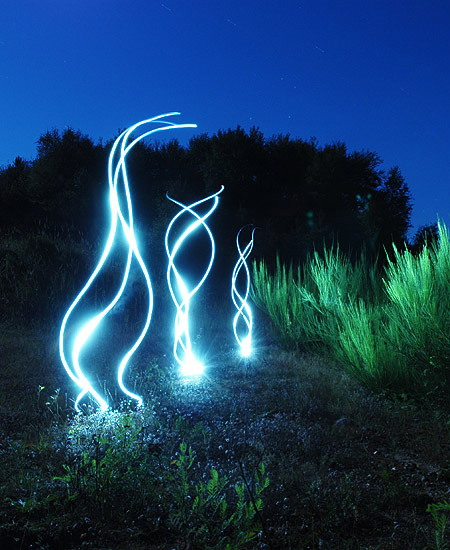
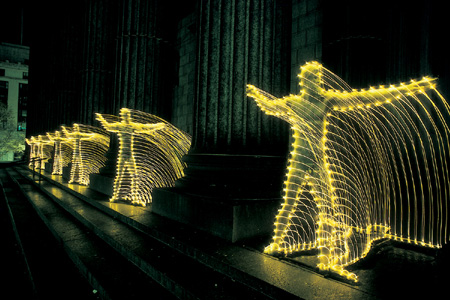
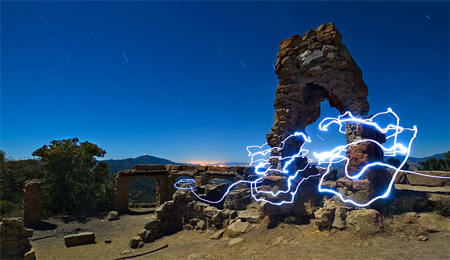
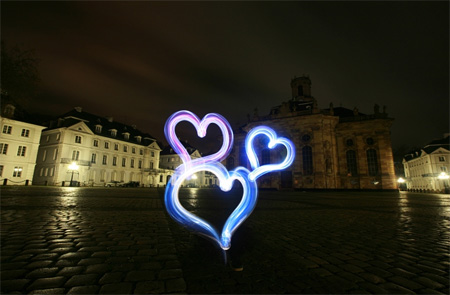
20 Beautiful Examples of Light Graffiti

20 Beautiful Examples of Light Graffiti

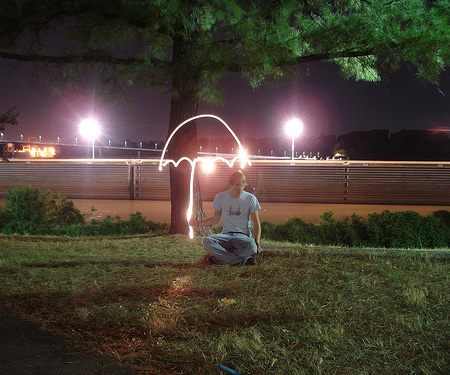
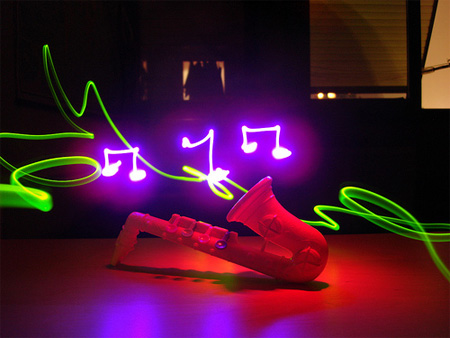
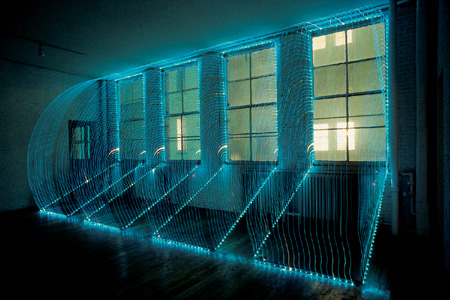
Light graffiti, also known as light painting is a photographic technique in which exposures are made usually at night or in a darkened room by moving a hand-held light source or by moving the camera.

This post features examples of beautiful and creative light graffiti.

Light Painting by rafoto [link]

Light Painting by rafoto

Orbing by Marc B.B [link]

Orbing by Marc B.B

Play with Light by ddqhu [link]

Play with Light by ddqhu

Light Graffiti by Lightmark [link]

Light Graffiti by Lightmark

Poseidon by Eric Staller [link]

Poseidon by Eric Staller

Singer by versi16 [link]

Singer by versi16

Light Painting by Toby Keller [link]

Light Painting by Toby Keller

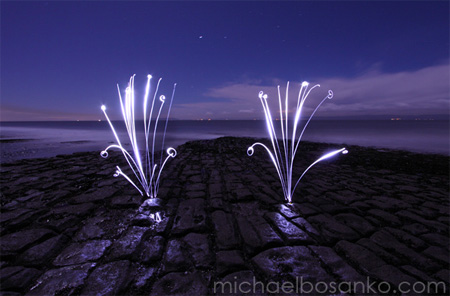
Botanical by Michael Bosanko [link]

Botanical by Michael Bosanko

Max Ophuels Preis by Lichtfaktor [link]

Max Ophuels Preis by Lichtfaktor

Under My Umbrella by Jacob Carter [link]

Under My Umbrella by Jacob Carter

Sax A Phone by Eran Hakim [link]

Sax A Phone by Eran Hakim

Window Dressing by Eric Staller [link]

Window Dressing by Eric Staller

Blinder by M R I [link]

Blinder by M R I

Snakes on a Pain by El Endemoniau [link]

Snakes on a Pain by El Endemoniau

Rockstar by Simon Dehn [link]

Rockstar by Simon Dehn

Air Fireball by Ben [link]

Air Fireball by Ben

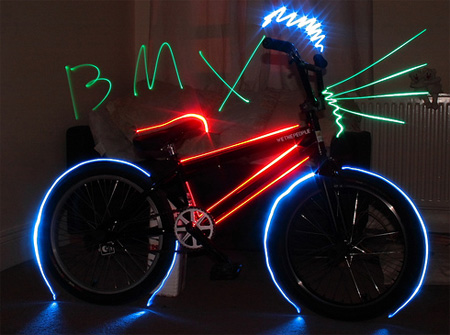
Neon BMX by Sumthin’ Luv [link]

Neon BMX by Sumthin Luv

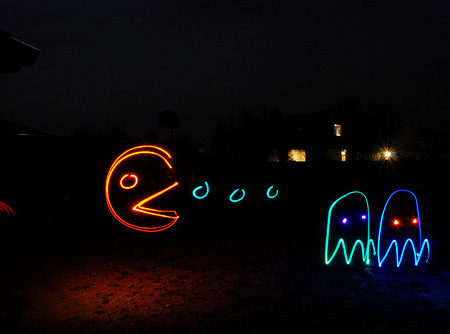
Pac-Man Light Graffiti by robokon_gt [link]

Pac-Man Light Graffiti by robokon_gt

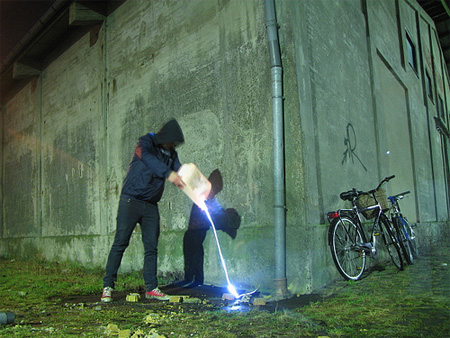
Waste Removal by The Path of Light [link]

Waste Removal by The Path of Light

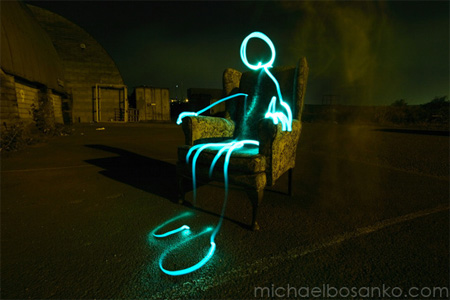
Armchair Alien by Michael Bosanko [link]

Armchair Alien by Michael Bosanko