Zazzle Shop

Screen printing
Showing posts with label Military Laser. Show all posts

Wednesday, January 20, 2010

Make Your Own Star Trek Phaser

By: Laura Hudson
From: http://www.comicsalliance.com

Countless Star Trek fans have dreamed about owning their own phaser, and while Wikipedia lists it as a "fictional weapon," one enterprising (rim shot) gentleman decided not to let anyone else tell him what can and cannot be real, and transformed a 1994 Playmates replica of the phaser from the classic "Star Trek" series into a 320mA – 465mW laser device, complete with appropriate sound effect.


He's even got a tutorial to help you build your own, and while this may not be as dangerous as the "real" thing -- e.g. able to burrow tunnels through solid rock and disintegrate hostile aliens -- there's a video of the guy popping balloons with the beam, so it's not a joke, particularly if you shoot it into someone's eyes. Remember: Once you add actual lasers to a toy, it's not a toy anymore, so don't point it at any living things, ok?


Tuesday, March 31, 2009

World’s Most Powerful Laser has the Energy of a Hydrogen Bomb

Posted by Samuel R. Avro
The National Ignition Facility (NIF) laser bay at Lawrence Livermore National Laboratory in California.

The National Ignition Facility (NIF) laser bay at Lawrence Livermore National Laboratory in California.

At a cost of $3.5 billion and more than a decade of work, the 192 laser beams are billed as the most powerful in the world.

Scientists working at the National Ignition Facility of the Lawrence Livermore National Laboratory in California, have built the most powerful laser in the world, capable of simulating the energy force of a hydrogen bomb and the sun itself.

“The system already has produced 25 times more energy than any other laser system,” said NIF Director Ed Moses.

The Energy Department is expected to announce Tuesday that it has officially certified the National Ignition Facility, which would clear the way for a series of experiments which scientists hope will eventually will mimic the heat and pressure found at the center of the sun.

The successful completion of the laser is the culmination of more than a decade of work at a cost of $3.5 billion.

“NIF is well on its way to achieving breakthroughs in science never imagined. Through our readiness testing we will see glimpses of what that future will bring,” said Moses.
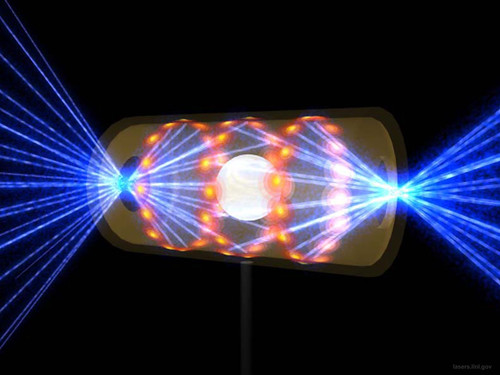
This artists rendering shows a NIF target pellet inside a hohlraum capsule with laser beams entering through openings on either end. The beams compress and heat the target to the necessary conditions for nuclear fusion to occur. Ignition experiments on NIF will be the culmination of more than 30 years of inertial confinement fusion research and development, opening the door to exploration of previously inaccessible physical regimes.

This artist's rendering shows a NIF target pellet inside a hohlraum capsule with laser beams entering through openings on either end. The beams compress and heat the target to the necessary conditions for nuclear fusion to occur. Ignition experiments on NIF will be the culmination of more than 30 years of inertial confinement fusion research and development, opening the door to exploration of previously inaccessible physical regimes.

NIF’s 192 laser beams, housed in a ten-story building the size of three football fields, travel a long path, about 1,000 feet, from their birth at one of the two master oscillators to the center of the target chamber. As the beams move through NIF’s amplifiers, their energy increases exponentially. From beginning to end, the beams’ total energy grows from one-billionth of a joule (a joule is the energy needed to lift a small apple one meter against the Earth’s gravity) to four million joules, a factor of more than a quadrillion - and it all happens in less than 25 billionths of a second.

Each master oscillator generates a very small, low-energy laser pulse. The pulse may range from 100 trillionths to 25 billionths of a second long, and has a specific temporal shape as requested by NIF experimenters.

The laser is expected to be used for a wide range of high-energy and high-density physics experiments, but its primary purpose is to assist government physicists in ensuring the reliability of the nation’s nuclear weapons as they become older.

The Lawrence Livermore lab will be taking order of the world’s most powerful supercomputer –capable of performing at 20 petaflops (1 petaflop equals 1 thousand trillion floating-point operations per second), twenty times faster than the current record holder, and more powerful than all of the systems on the top 500 supercomputer list combined– currently being constructed by IBM under contract by the U.S. government, which will also be utilized to ensure the safety of the country’s nuclear weapons.

“We are well on our way to achieving what we set out to do – controlled, sustained nuclear fusion and energy gain for the first time ever in a laboratory setting,” said Director Moses.
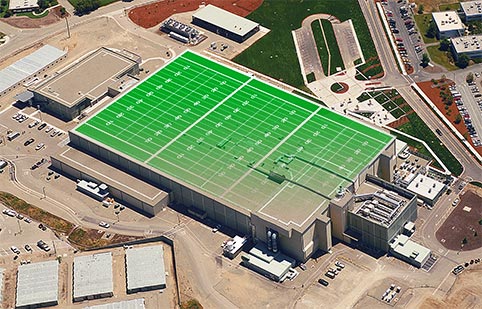
The Laser and Target Area Building is the size of three football fields.

The Laser and Target Area Building is the size of three football fields.

“This laser technology has the potential to revolutionize our energy future,” California Gov. Arnold Schwarzenegger said during a tour last year of the stadium-sized NIF facility. “If successful, this new endeavor could generate thousands of megawatts of carbon-free nuclear power but without the drawbacks of conventional nuclear plants. This type of innovation is why we are a world leader in science, technology and clean energy, and I could not be prouder that this work is happening right here in California.”

The project is a national collaboration among government, industry and academia and many industrial partners throughout the nation.

The NIF’s 192 laser beams are 60 to 70 times more powerful than the world’s second strongest - a 60-beam system located at the University of Rochester.

Click here to take a complete 360° panoramic virtual tour of the entire NIF facility and their laser system.


Thursday, March 19, 2009

Military Laser Hits Battlefield Strength

By Noah Shachtman Email

Des1_rendering_hr Huge news for real-life ray guns: Electric lasers have hit battlefield strength for the first time -- paving the way for energy weapons to go to war.

In recent test-blasts, Pentagon-researchers at Northrop Grumman managed to get its 105 kilowatts of power out of their laser -- past the "100kW threshold [that] has been viewed traditionally as a proof of principle for 'weapons grade' power levels for high-energy lasers," Northrop's vice president of directed energy systems, Dan Wildt, said in a statement.

That much power won't get you a Star Wars-style blaster. But it should be more than enough to zap the mortars and rockets that insurgents have used to pound American bases in Iraq and Afghanistan.

The battlefield-strength breakthrough is just one part in a larger military push to finally make laser weapons a reality, after decades of unfulfilled promises. The Army recently gave Boeing a $36 million contract to build a laser-equipped truck. Raytheon is set to start test-firing a mortar-zapper of its own. Darpa is funding a 150 kilowatt laser project that is meant to be fitted onto "tactical aircraft."

Does that mean energy weapons are a done deal? Hardly. There are still all sorts of technical issues -- thermal management and miniaturization, to name two -- that have to be handled first. Then, the ray gunners have to find the money. The National Academies figure it'll take another $100 million to get battlefield lasers right.

Still, clearing the 100 kilowatt hurdle is a big deal. For the longest time, the military research community concentrated on developing chemical-powered lasers. The ray guns produced massively powerful laser blasts. But the noxious stuff needed to produce all that power makes the weapons all-but-impractical in a war zone. (One ray gun took as many as eight shipping containers' worth of chemicals and electronics to power a single blaster.) So the Defense Department shifted gears, and poured money into electric lasers. They're much less hassle to operate. And, given a steady supply of power, they should be able to fire away, almost indefinitely.

At first, these electric lasers were weak. When the military started its Joint High Power Solid State Laser (JHPSSL) program in 2003, these easy-to-maintain lasters could barely produce more than 10 kilowatts of coherent light. Now, Northrop believes, going way past 100 kilowatts should be pretty simple.

In its lab, south of Los Angeles, Northrop combines 32 garnet crystal "modules" into a "laser amplifier chains." Shine light-emitting diodes into 'em, and they start the laser chain-reaction, shooting out as much as 15 kilowatts of focused light. Combine all those beams into one, and you've got yourself a battlefield-strength ray. Northrop's JHPSSL lasers used seven chains to get to 105 kilowatts. But there's room, at least, for an eighth. Which means an even stronger blaster.

The next step is to start trying out the ray gun, outside of the lab. The Army is planning to move the device to its High Energy Laser Systems Test Facility at White Sands Missile Range. Testing is supposed to begin by this time, next year.

[Photo: Northrop Grumman]