This year’s Consumer Electronics Show was a little muted (largely thanks to Google, who announced its Nexus One aka iPhone clone right before the convention) but there were diamonds in the rough. In this edition of the Wired video podcast, senior editor Dylan Tweney sums up the highlights — as well as the lowlights — of CES 2010.
3-D TVs dominated the show floor, with fancy sets showcased by almost every major video manufacturer including Sony, LG, Toshiba and Panasonic. Our favorite was the Cell TV from Toshiba — a set packed with multiple eight-core processors to convert standard 2-D video into 3-D. Wowzers.
E-book readers of many flavors also flooded the show floor. Plastic Logic’s Que was a noteworthy item with its especially large 8.5-inch screen — like a sheet of letter-sized paper.
We ooh-ed and ahh-ed at a particular Samsung notebook. What’s so great about it? Its 14-inch screen is a 40-percent transparent OLED display, so you can see right through it — kind of like that awesome tablet in Avatar.
Another notebook that caught our eye was Lenovo’s Skylight “smartbook” — a netbook with a smartphone processor promising 8-hour battery life — mostly because it was the freshest looking mini note on the block.
As for lowlights, we dissed on long-winded keynotes put on by Microsoft and Sony, companies that could both use some lessons in showmanship. We also rolled our eyes at custom celebrity gadgets from Lady Gaga, P Diddy and even Ed Hardy.
For full coverage of the convention, visit Wired.com’s CES 2010 page. This episode of the Wired video podcast was produced by Annaliza Savage with editing by Michael Lennon, audiowork by Fernando Cardoso, camerawork by John Ross and still photos by Jonathan Snyder.
An attendee examines the new E6 e-book reader by Samsung during a press event at the 2010 International Consumer Electronics Show at the Venetian in Las Vegas, Nevada. The 6-inch device will be available this year for $399. A 10-inch version, the E101, will sell for $699.
South Korean electronics giant Samsung jumped into the increasingly crowded electronic book reader market Wednesday, unveiling its first devices and a partnership with Google Books.
Samsung took the wraps off two wireless e-readers at the annual Consumer Electronics Show (CES) in Las Vegas, the "E6" with a six-inch (15.2-centimeter) screen and the "E101" with a 10-inch (25.4-centimeter) display.
Samsung touted its new black-and-white display e-readers for their ability to allow users to write directly on the screen, making annotations with an electromagnetic resonance stylus pen.
"It's not just a reading device," said Doug Albregts, vice president of Samsung's information technology division. "It's more like paper with a handwriting feature in that it allows you to write directly on the display."
Users of the Samsung devices can "write and share wirelessly and truly collaborate," Albregts said.
Google global director of communications Gabriel Stricker made a video appearance at the Samsung event to announce that the Web giant, which is compiling a vast online library of books, would be a partner with Samsung.
"We want people to find these books anywhere, anytime," Stricker said, calling Samsung a "great match for us at Google."
"We're so excited to make our million-plus public domain books available," he said.
Samsung said the E6 will cost 399 dollars while the E101 will cost 699 dollars and will be available in early 2010.
The new Samsung devices will go up against Amazon's popular Kindle and a host of other new devices already on the market, including the Sony Reader, the "Nook" from Barnes & Noble and the Cool-er from Britain's Interead.
Samsung is one of a number of a companies unveiling e-readers at CES but the category has been overshadowed lately by reports that consumer electronics star Apple may shortly unveil a tablet computer that may double as an e-book reader. (c) 2010 AFP
The Parrot AR.Drone: 'Easy to control and flies like a dragonfly.' Photograph: Andrew Gombert/EPA
Unmanned drones have become synonymous with controversial military action in some of the most dangerous warzones. But now a child's toy has been created using the same technology.
The AR.Drone, an iPhone-controlled helicopter powered by four separate blades, has been unveiled at the agenda-setting Consumer Electronics Show in Las Vegas.
Boasting built-in military grade systems such as wind compensation and autopilot functions, the drone is able to hover for hours over a single spot – or fly under the command of a pilot using a wireless controller such as an iPhone.
The toy also boasts a number of other hi-tech embellishments, including a pair of on-board cameras and a computerised internal guidance system that allow it to track objects and react to the environment automatically.
"With video cameras and a powerful computer, we have developed a very stable drone that is easy to control and flies like a dragonfly," said Henri Seydoux, the founder and chief executive of the Paris-based company behind the toy, Parrot.
A spokesman for the company, which is better known for making Bluetooth headsets and in-car systems, would not say how much the AR Drone will cost – but confirmed that it would be available to buy later this year.
"Our first project was a Bluetooth race car. We've developed it, but I was not satisfied," said Seydoux. "So I started with the idea of a quadricopter."
The company was demonstrating the device at the annual Consumer Electronics Show in Las Vegas, one of the world's biggest technology industry showcases.
Thousands of computer buffs and hi-tech entrepreneurs are expected in the city this week as the world's most powerful electronics brands fight it out for top billing. Among the 2,500 companies in attendance are Microsoft, Sony, Samsung and Nokia – who are all launching major new products at the event.
The show's organisers expect more than 100,000 enthusiasts to turn up over the next four days to get their hands on new products such as touchscreen tablet computers, record-breaking television screens and electronic books.
Despite the focus on expensive gadgets and gizmos, however, toys are an increasingly significant part of the show – with a manufacturers showing off robots and hi-tech contraptions aimed at youngsters.
The high levels of interest and excitement come despite a difficult period for the event, which is entering its 42nd year. In 2009 many exhibitors were left reeling by the global economic crisis, and many have scaled down their plans for this year's show.
Organisers say that visitor numbers could be even lower this week than they were this time last year, although more new companies have signed up to exhibit than ever - a signal that the excitement that was absent last year has returned.
"There's a great deal of enthusiasm leading into 2010 that just wasn't there in the 2009 show," said Jason Oxman, a senior vice-president of the Consumer Electronics Association, which organises the event.
It's CES time and that means a flurry new products will be hitting the streets soon. Today, we attended the Asus 2010 CES Event at the Venetian Hotel in Las Vegas where company chairman Jonney Shih revealed the company's latest products and technology. Here's a quick preview of what was on display...
Asus NX90 Bang & Olufsen Notebook
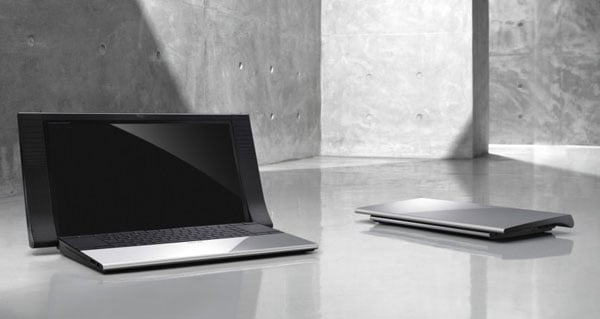
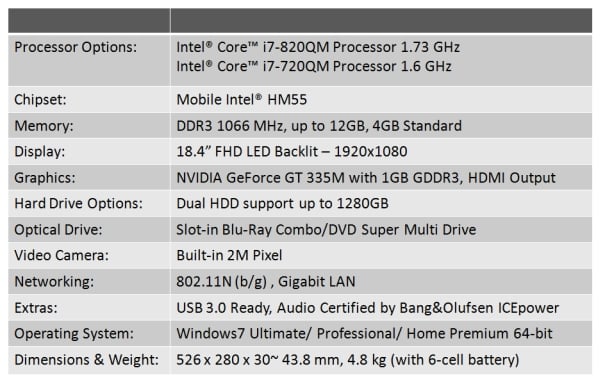
Let's get right to the good stuff. The NX90 is a multimedia notebook that combines modern design and cutting-edge technology. Designed by Bang & Olufsen Chief Designer David Lewis, the NX90 features a polished aluminum exterior and palm rest that contrast the matte-black keyboard and dual touchpads. Two speakers featuring ICEpower technology flank a large display. Exclusive Sonic Focus technology helps to ensure that all audio is reproduced as flawlessly as possible, according to Asus. The NX90 also offers a unique way to interact with the system, in the form of dual touch pads. These work in concert with the Rotation Desktop software to provide users with an intuitive DJ-like control. Specific hardware options consist of Intel's Core i7 820QM or 720QM processor, up to 12GB DDR3 1066, 18.4" LED display, NVIDIA GT 335M, dual HDD support, Blu-Ray, and USB 3.0. Expect to drop well over $2K for this beast.
Republic of Gamers G73Jh Notebook
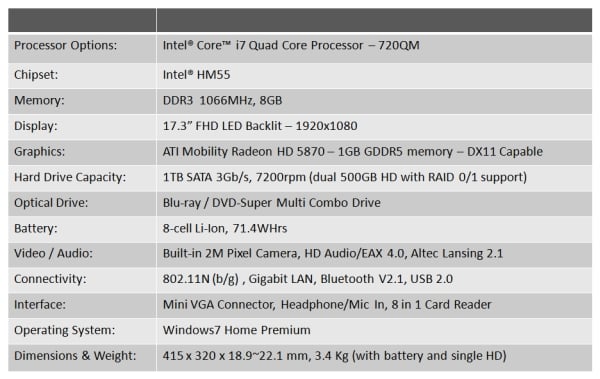
You knew a high performance gaming laptop was coming and here it is. The Republic of Gamers G73Jh was inspired by the angular lines of stealth fighter jets, much like some desktop enclosures released last year. High end components will be readily available to match the cutting edge exterior as consumers will be able to configure the G73Jh with Intel's Core i5 / i7 processors, up to 8GB of DDR3 memory, a 17.3" display, and ATI's Mobility Radeon HD 5870 graphics. We plan to take this baby out for a spin as soon as samples are available, so stay tuned.
Eee PC Seashell Karim Rashid Collection
Karim Rashid is a renowned designer based in New York. Don't worry if you've never heard of him, we hadn't either. The goal of the Eee PC Seashell Karim Rashid Collection is to marry high tech with high fasion and realize Karim's vision of hip computing. The high gloss case you see is soft to the touch and available in two colors - hot pink and brown gold.
U53 Notebook - U Series Bamboo Collection
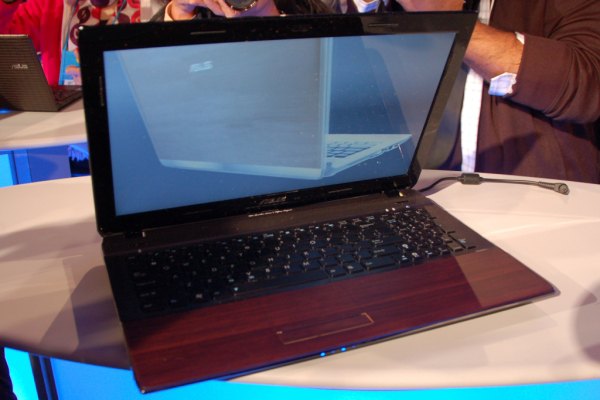
In an effort to protect the environment and be more green, Asus reveals the latest model in the environmentally friendly Bamboo Collection. The U53 Series laptop is thin, light, and clad in bamboo that is warm to the touch. It features a unique design thanks to the subtle variations in its manufacturing material and will sport USB 3.0 and Intel's Core i5 processor.
For more information on the NX90 and G73Jh notebooks, check out these videos:
In case plans by AMD and a slew of other tech vendors planning to showcase 3D Blu-ray compatible products at CES wasn't a tip-off, the updated specifications are done. The key details? First, that the Blu-ray Disc Association has chosen the Multiview Video Coding (MVC) codec to store 3D, so that even though it is now providing a full 1080p frame for each eye, it will only require about 50% more storage space compared to the 2D version, and all discs will be fully backwards compatible, in 2D, on existing players. Better than backwards compatibility, the PlayStation 3 will be forwards compatible with the new discs -- a new HDTV setup (the spec promises to work with plasmas, LCDs or projectors equally well) with IR emitters and glasses will still be necessary. According to the PR (after the break) we can expect Blu-ray 3D-stickered products in 2010, our only advice is to keep those responsible for the Cowboys Stadium abomination far, far away from it.
Show full PR text
Blu-ray Disc Association Announces Final 3D Specification "Blu-ray 3DTM" Expected to Reach Consumers in 2010 LOS ANGELES --(Business Wire)-- Dec 17, 2009
The Blu-ray Disc Association (BDA) today announced the finalization and release of the "Blu-ray 3DTM" specification. The specification, which represents the work of the leading Hollywood studios and consumer electronic and computer manufacturers, will enable the home entertainment industry to bring the 3D experience into consumers' living rooms on Blu-ray Disc, the most capable high definition home entertainment platform.
"Throughout this year, movie goers have shown an overwhelming preference for 3D when presented with the option to see a theatrical release in either 3D or 2D," said Victor Matsuda, chairman, BDA Global Promotions Committee. "We believe this demand for 3D content will carry over into the home now that we have, in Blu-ray Disc, a medium that can deliver a quality Full HD 3D experience to the living room."
The "Blu-ray 3D" specification fully leverages the technical advantages of the Blu-ray Disc format to deliver unmatched picture quality as well as uniformity and compatibility across the full range of Blu-ray 3D products, both hardware and software. Notably, the specification allows every Blu-ray 3D player and movie to deliver Full HD 1080p resolution to each eye, thereby maintaining the industry leading image quality to which Blu-ray Disc viewers are accustomed. Moreover, the specification is display agnostic, meaning that Blu-ray 3D products will deliver the 3D image to any compatible 3D display, regardless of whether that display uses LCD, Plasma or other technology and regardless of what 3D technology the display uses to deliver the image to the viewer's eyes.
"From a technological perspective, it is simply the best available platform for bringing 3D into the home," said Benn Carr, chairman, BDA 3D Task Force. "The disc capacity and bit rates Blu-ray Disc provides enable us to deliver 3D in Full HD 1080p high definition resolution." The Blu-ray 3D specification is also designed to allow PS3 game consoles to play back Blu-ray 3D content in 3D. Additionally, the specification supports playback of 2D discs in forthcoming 3D players and can enable 2D playback of Blu-ray 3D discs on the large installed base of Blu-ray Disc players currently in homes around the world.
"In 2009 we saw Blu-ray firmly establish itself as the most rapidly adopted packaged media format ever introduced," said Matsuda. "We think the broad and rapid acceptance Blu-ray Disc already enjoys with consumers will be a factor in accelerating the uptake of 3D in the home. In the meantime, existing players and libraries can continue to be fully enjoyed as consumers consider extending into 3D home entertainment."
The Blu-ray 3D specification calls for encoding 3D video using the Multiview Video Coding (MVC) codec, an extension to the ITU-T H.264 Advanced Video Coding (AVC) codec currently supported by all Blu-ray Disc players. MPEG4-MVC compresses both left and right eye views with a typical 50% overhead compared to equivalent 2D content, and can provide full 1080p resolution backward compatibility with current 2D Blu-ray Disc players. The specification also incorporates enhanced graphic features for 3D. These features provide a new experience for users, enabling navigation using 3D graphic menus and displaying 3D subtitles positioned in 3D video.
The completed specification will be available shortly and provides individual manufacturers and content providers with the technical information and guidelines necessary to develop, announce and bring products to market pursuant to their own internal planning cycles and timetables.
CES 2010 will have several Apple-related booths to visit, but are Apple and CEO Steve Jobs really planning to attend?
(Credit: James Martin/CNET News)
The Consumer Electronics Association has confirmed plans to host a Mac-centric area at CES 2010, but Apple has still not commented on whether it plans to participate.
Jason Oxman of the CEA confirmed Saturday that the group "dedicated a special area at the 2010 CES to Apple-related CE manufacturers." That immediately sets up an alternative for companies thinking about exhibiting at Macworld 2010, which will not have Apple present for the first time in 12 years.
"We decided to create this special area based on discussions we've had with companies regarding 2010 show participation. We are pleased with the feedback we've received regarding this space," Oxman said in an e-mail.
Oxman, however, deferred all questions regarding whether Apple would participate to the company itself, which did not return calls Friday and Saturday seeking comment on reports that it will be involved. "(Apple) is a member of the Consumer Electronics Association (CEA) and we are delighted to have a longstanding relationship with them," he said.
Cult of Mac and AppleInsider reported Friday that Apple would indeed be present at next year's CES, calling it a "done deal." Such a move would be quite surprising given Apple's December statement that it was pulling out of Macworld 2010 because it no longer felt trade shows were an effective means of reaching its customers.
.
All you art collectors out there. Here is a chance to get a Giclee copy of some of Ian M Sherwin work. Ian is planning on doing a whole series of Marblehead, Massachusetts paintings. His work is amazing.






;)
;)
;)
;)
;)


 .
.

 Posts
Posts


