Zazzle Shop

Screen printing
Showing posts with label Africa. Show all posts

Friday, September 2, 2011

Gorillaz Frontman Streams Quirky New Songs From Congo

From: http://mashable.com/2011/08/30/drc-music-songs-congo/


Last month we told you about how Damon Albarn, the frontman for Gorillaz and Blur, packed up his music gear and a bunch of his producer friends to make a charity album in the Congo.

The project, called DRC Music, has released three songs and an album teaser video. The site has been providing constant video and audio updates including clips of Albarn working with local musicians and explaining the crisis in the Democratic Republic of Congo (DRC).

Albarn and his team created the album in partnership with Oxfam. All proceeds from the album’s sale will go towards supporting Oxfam‘s work in the DRC.

One of the best parts of this project is the obvious care and respect the Western producers paid to local musicians and traditions. The three tracks below not only feature local musicians, but play on musical characteristics and patterns from the DRC. It’s not just a way to turn a buck, but also shine a spotlight on the rich musical history of the region.

Take a listen to the tracks below from the album, “Kinshasa One Two,” and the video above and let us know in the comments what you make of the DRC Music project.
Hallo (featuring Tout Puissant Mukalo and Nelly Liyemge) by DRC Music

Ah Congo (featuring Jupiter Bokondji and Bokatola System) by DRC Music
Lingala (featuring Bokatola System and Evala Litongo) by DRC Music
You can find more at DRC Music’s Soundcloud page.

Wednesday, January 26, 2011

Liberia has Lost 95 Percent of its Elephants to Poachers

by David DeFranza
from  http://www.treehugger.com/
forest elephant photo
Liberia is home to African forest elephants, like those seen here. Photo credit: Wikimedia Commons

Since civil war broke out in Liberia in the 1980s, 19,000 elephants have been killed by poachers. Today, only 1,000 elephants remain, meaning the country has lost 95 percent of its elephants in only a few decades.
Across Africa, elephant populations have dropped precipitously since the end of the 20th century, when it was estimated that elephants numbered between 5 and 10 million. Today, only an estimated 400,000 remain.
Patrick Omondi of the Kenya Wildlife Service commented that:
Though, Liberia opposes trade in ivory, but, the trade is still being illegally practiced in the country. This trade is having negative impact on your resources, therefore, we all need to join efforts to conserve your wildlife resources
Established by free American slaves in the early 1820s, the small country in West Africa is known for its biological diversity. Unfortunately, a series of civil wars—from 1980 to 2003—left much of these rich natural resources unprotected. Timber harvesting—which was used to fund armies in the conflict—went completely unchecked, leading to massive habitat loss and degradation across Liberia.

Currently, Liberia is in the process of reactivating its membership in the Convention on International Trade in Endangered Species (CITES)—an essential step towards joining the international campaign against poaching.

Monday, August 23, 2010

Albino girl, 11, killed and beheaded in Swaziland ’for witchcraft’

An 11-year-old albino girl from Swaziland was shot dead in front of her friends and then beheaded in what police believe was a ritual murder.

Police believe children are targeted because of a belief by witch doctors that the blood and body parts of albinos can bring good luck and fortune when used in potions
Police believe children are targeted because of a belief by witch doctors that the blood and body parts of albinos can bring good luck and fortune when used in potions Photo: AFP/GETTY

The child had been washing clothes and bathing at a river with friends and was returning home when she was grabbed by a man wearing a balaclava.

As her friends looked on, the man shot her in the back before dragging her away. Her headless body was found upriver a short time later.

The murder is the latest in a series of albino killings in Sub-Saharan Africa, where sufferers of the rare skin pigmentation condition are concentrated.

Earlier this year, another 11-year-old albino child was killed close to the same spot in Swaziland and her hand was removed.

Police believe both children may have been targeted because of a belief by witch doctors that the blood and body parts of albinos - who lack pigment in their eyes, hair and skin - can bring good luck and fortune when used in potions.

Their value for black magic practitioners sees them often fall prey to human traffickers, one of whom was jailed for 17 years in Tanzania this week for abducting and attempting to sell a live albino man.

The girl murdered in Swaziland was named locally as Banele Nxumalo. A man identified as her father, Luke Nxumalo, told The Times of Swaziland that his late uncle had also been an albino.

“What happened to my child is very painful. I wonder why albinos are targeted because they are just humans like us and a gift from God,” he said.

Thursday, April 15, 2010

'Among the Righteous:' Arabs Saving Jews in the Holocaust

Posted By Robert Satloff

From: http://mideast.foreignpolicy.com/

"Among the Righteous: Lost Stories from the Holocaust in Arab lands," is a new documentary I made in partnership with MacNeil-Lehrer Productions, airing tonight on PBS. It retells largely forgotten stories from World War II in North Africa of Arabs who saved their Jewish neighbors from the Holocaust -- a story which Holocaust historiography has largely left untouched. The documentary digs into history to uncover not only cases of Jewish persecution in North Africa similar to the Jewish experience in Europe, but also stories of the "righteous" Arabs that protected Jews. Filmed in eight different countries stretching from Morocco to Israel, the documentary reveals surprising discoveries about the past that can help challenge how Arabs and Jews alike view this part of Holocaust history.

The documentary airs tonight on PBS at 10 p.m. eastern time.

Robert Satloff is executive director of the Washington Institute for Near East Policy.

Monday, January 4, 2010

Being Obama’s Brother

Stephen Morrison / Corbis
George Obama sits in front of his home in a slum in Nairobi, Kenya


In November 2008, I stood in a bar in Kenya watching Barack Obama give his victory speech. From the wild cheering of the crowd on TV, and his repeated appeals to them personally—"You said," "You heard," "You called"—I felt as if the people of America knew this man far better than I, even though we shared the same father. If there was a leading light in the Obama clan, he was it; and if there was a shadowed place that no one liked to talk about, then that, I guess, was me.

After a relatively privileged childhood, I crashed and burned in my teenage years. I had migrated from the plush suburbs of Nairobi, Kenya, to the wild chaos of the ghetto. I lost myself in drink and drugs and became a gun-toting gangster. In my early 20s, I spent a year in a Nairobi prison on robbery charges. My imprisonment included a starvation diet and 24/7 lockdowns in overcrowded, airless cells. But I came out a different man, resolved to turn my life around and find a different path.

Along with some fellow slum dwellers, I set up a youth group for ghetto kids. My passion was football (soccer), which is followed religiously throughout Africa. When we first established the Huruma Centre Football Club, none of our kids had so much as a pair of football boots, let alone any uniform. Some were so hungry when they turned up that they had no energy to play. At other times, the team had to trek for miles to matches because we couldn't afford any transportation. In spite of all that, our players were passionate, and we started winning. Then, as my brother's profile grew in America and around the world, the media came looking for his African relatives.

Eventually the press found me in my slum. My new notoriety was a blessing and a curse. Many people presume I have a direct line to the White House, but I don't. I've only met my big brother twice and have spoken to him just once since the election, to say congratulations. Still, because of our connection, I managed to pull in funds from philanthropists to support the work of the youth group. I raised enough money to buy the team gold and green uniforms—with their own numbers on the back. Last fall, Obama's Champs won the Nairobi Super League—a feat that, just a couple of years back, would have been unthinkable for a team from the slums. With the sponsorship I've attracted because of my last name, we can now afford to take buses all across Kenya for matches.

I still live in one of Africa's biggest slums, along with some 4.5 million others. We have little or no access to health care, no welfare, and no free schooling. The average income is less than $5 a day—and that's for those who find work as servants, taxi drivers, or garbage collectors. For the rest, there is nothing. My brother has risen to be the leader of the most powerful country in the world. In Kenya I hope to be a leader among the poorest, most powerless people on earth—the people of the ghetto.

Hope—it's an idea my brother talked about a lot. But it was only recently that I learned again what it means to feel the true spirit of that word. Here, a little goes a long way.

Obama's memoir, Homeland, was co-written with Damien Lewis.

© 2010

Wednesday, December 30, 2009

Human Development Indicators


A new report from the UN has shown where in the world is the most desirable, and least desirable place to live. The 182 countries featured in the report, were ranked according to the quality of life their citizens experienced.

The results of the report, showed that the most desirable place in the world to live, is Norway, while the least desirable is Niger.

Criteria examined in the report, included life expectancy, literacy rates, school enrolment and country economies.

The UN Development Programme said the index highlighted the grave disparities between rich and poor countries.

Looking at Norway, the reason for its consistently high rating for desirable living standards, is, in a large part, thanks to the discovery of offshore oil and gas deposits in the late 1960s.

Whereas looking at Niger, it is a drought-prone country which has sometimes struggled to feed its people.

A major difference between the two countries was life expectancy. In Niger, the life expectancy was 50 years, approximately 30 years shorter than it is for those living in Norway.

Another huge difference, is that for every dollar earned per person in Niger, US$85 was earned in Norway.

The below infographic has looked at the Human Development report, and shows the differences between the two countries in terms of factors such as estimated yearly income, female to male income, and government education expenditure per pupil.

Thursday, July 2, 2009

Gardener tames his wild garden by turning his 12ft hedge into a herd of elephants

By Daily Mail Reporter

A homeowner concerned that his garden was becoming a jungle - has transformed it into a herd of elephants.

Green-fingered Gavin Hogg fell in love with the wildlife during a safari in Kenya.

So much so, that when he returned to Britain, he found an inspired way to recreate a little bit of Africa in his back garden.

Enlarge Gardener creates herd of elephants from topiary hedge

Herd the one about the elephants? Gavin Hogg lovingly crafts his hedge

Enlarge hedge elephants

Hedge herd: The topiary family of elephants has been fashioned out of an unruly hedge

The 49-year-old painstakingly carved out a herd of elephants from an overgrown hedgerow.

He spent two days crafting the seven adults and three babies with a trimmer, shears - and a pair of scissors for the fiddly bits.

The result is a striking 100ft-long trail of green elephants that stretches around the corner of his family home outside Brecon in Mid Wales.

Mr Hogg said: 'It was just a normal, fairly boring box hedge when I started. I found a picture of a group of elephants and set about shaping it. Time seemed to disappear while I was working on it.

Enlarge  Gardener Gavin Hogg trims a topiary hedge in the shape of a herd of elephants

Mind the ears: Gavin Hogg puts the finishing touches to his topiary elephants

'I was able to create the appearance of folds in the skin and shadow lines for shoulder blades and hips.

'I also clipped an eye in some of the adult elephants to give it greater authenticity. It was a lot of work and the ears and trunks were a bit tricky but I am pleased with the end result.'

Father-of-two Mr Hogg and his wife Vina, who visited the Masai Mara game reserve in Kenya, farm organic vegetables at their 17th century home.

He added: 'It's great to see our own herd of elephants every time we look out of the window, even if they are green. They will need a haircut twice a year to smarten them up. But they will be a permanent feature.'

The topiary elephants are cut out of a hedge of common box (Buxus sempervirens) which was planted about 200 years ago.

Thursday, March 19, 2009

On Africa trip, pope says condoms won't solve AIDS

Pope says condoms won't solve AIDS

Play Video AP – Pope says condoms won't solve AIDS

YAOUNDE, Cameroon – Pope Benedict XVI said condoms are not the answer to the AIDS epidemic in Africa and can make the problem worse, setting off criticism Tuesday as he began a weeklong trip to the continent where some 22 million people are living with HIV.

Benedict's first statement on an issue that has divided even Catholic clergy working with AIDS patients came hours before he arrived in Cameroon's capital — greeted by thousands of flag-waving faithful who stood shoulder-to-shoulder in red dirt fields and jammed downtown streets for a glimpse of the pontiff's motorcade.

In his four years as pope, Benedict had never directly addressed condom use, although his position is not new. His predecessor, Pope John Paul II, often said that sexual abstinence — not condoms — was the best way to prevent the spread of the disease.

Benedict also said the Roman Catholic Church was at the forefront of the battle against AIDS.

"You can't resolve it with the distribution of condoms," the pope told reporters aboard the Alitalia plane heading to Yaounde. "On the contrary, it increases the problem."

The pope said a responsible and moral attitude toward sex would help fight the disease, as he answered questions submitted in advance by reporters traveling on the plane. His response was presumably also prepared in advance.

The Catholic Church rejects the use of condoms as part of its overall teaching against artificial contraception. Senior Vatican officials have advocated fidelity in marriage and abstinence from premarital sex as key weapons in the fight against AIDS.


Pope Benedict XVI waves to a cheering crowd as he leaves the airport in Yaounde, AP – Pope Benedict XVI waves to a cheering crowd as he leaves the airport in Yaounde, Cameroon Tuesday, March …

The late Cardinal Alfonso Lopez Trujillo made headlines in 2003 for saying that condoms may help spread AIDS through a false sense of security, claiming they weren't effective in blocking transmission of the virus. The cardinal, who died last year, headed the Vatican's Pontifical Council for the Family.

Three-quarters of all AIDS deaths worldwide in 2007 were in sub-Saharan Africa, where some 22 million people are infected with HIV — accounting for two-thirds of the world's infections, according to UNAIDS.

Rebecca Hodes with the Treatment Action Campaign in South Africa said if the pope is serious about preventing HIV infections, he should focus on promoting wide access to condoms and spreading information on how to use them.

"Instead, his opposition to condoms conveys that religious dogma is more important to him than the lives of Africans," said Hodes, head of policy, communication and research for the group.

Hodes said the pope was right that condoms are not the sole solution to Africa's AIDS epidemic, but added they are one of the very few proven measures to prevent HIV infections.

Even some priests and nuns working with those infected with the AIDS virus question the church's opposition to condoms amid the pandemic ravaging Africa. Ordinary Africans do as well.

"Talking about the nonuse of condoms is out of place. We need condoms to protect ourselves against diseases and AIDS," teacher Narcisse Takou said in Yaounde.

Stanley Obale Okpu, a civil servant working in the ministry of urban development in Cameroon, said: "What the pope says is an ideal for the Catholic church. But he needs to look at the realities on the ground. One should be aware of these realities. In the case of Cameroon — and Africa as a whole — condoms are very necessary ... You need condoms to prevent AIDS and birth control."

A crowd of photographers and cameras flashed as the 81-year-old pontiff stepped off the plane into the steaming 88-degree heat, with humidity levels measuring a wilting 90 percent.

It was the first stop on a weeklong pilgrimage that will also take Benedict to Angola as he seeks to draw international attention to Africa's problems of famine, poverty and armed conflict.

The pope was greeted by Cameroon's President Paul Biya, who has ruled since 1982 and whose government has been accused by Amnesty International of abuses in crushing political opponents.

The pope made no specific reference to the situation in Cameroon, but he did say in general remarks on Africa that "a Christian can never remain silent" in the face of violence, poverty, hunger, corruption or abuse of power.

"The saving message of the Gospel needs to be proclaimed loud and clear so that the light of Christ can shine into the darkness of people's lives," Benedict said as the president and other political leaders looked on.

Africa is the fastest-growing region for the Catholic church, though it competes with Islam and evangelical churches.

The pope said Tuesday he intends to make an appeal for "international solidarity" for Africa in the face of the global economic downturn. He said while the church does not propose specific economic solutions, it can give "spiritual and moral" suggestions.

He described the current crisis as the result of "a deficit of ethics in economic structures."

"It is here that the church can make a contribution," he said.

On the plane, Benedict also dismissed the notion that he was facing increasing opposition and isolation within the church, particularly after an outreach to ultraconservatives that led to his lifting the excommunication of a Holocaust-denying bishop.

"The myth of my solitude makes me laugh," the pope said, adding that he has a network of friends and aides whom he sees every day.

___

Associated Press writers Krista Larson in Johannesburg and Emmanuel Tumanjong in Yaounde contributed to this report.

Wednesday, March 4, 2009

10 Most Diabolical Fish On Earth

Image via: wolaver

viperfish

On the one hand, fish are inoffensive creatures, the majority not much to worry about unless they’re getting overcooked on the barbecue. Yet there are a few species that are more loathsome to our tastes. These are creatures straight out of nightmares – some more fangs than fish; others that look like they’ve barely swum out of the primeval sludge. But though we’d like to think we’re no relation to these demons of the deep, in the evolutionary scheme of things all us land vertebrates are derived from our fishy cousins.

Note: Sharks were omitted as we thought it unfair on the littler guys; the dorsal-finned ones deserve their own top ten. Otherwise, points were awarded for appearance, attitude, and aggression – with a partiality for nasty teeth and equally nasty names. Brace yourself.

1. Piranha Fish (up to 18 inches)

newpiranha2
Image: Laura Travels

While the threat this little teeth-with-gills poses to humans has been rather blown up in films – including its own self-titled horror B movie – the Piranha has a set of jaws to make any dentist nod with nervous approval. Its rows of razor-sharp gnashers are tightly packed and interlock with each other, teeth perfectly designed for the rapid piercing and shearing of meat – for which the Piranha has a rapacious appetite, as if you needed to know. The Piranha is also aggressive to its own kind and can become cannibalistic if underfed.

Dentist’s bad dream: Piranha Fish
piranha1
Image: Lee Nachtigal

Although the Piranha hunts in a lethal, highly organised fashion, in its defence it also eats vegetable matter such as seeds. Research also suggests its habit of forming into large groups is as much a defence against predators like caimans and river dolphins as it is a killing strategy. But despite its overblown menace – with the piranha more likely to end up as part of your dinner than vice versa – you wouldn’t want to spend too long in Amazonian waters with an open cut to whet this fish’s appetite. Feeding frenzies against larger animals do happen, and this fiend will bite and maim without a second invitation.

Red-bellied Piranha
newpiranha1
Image: photochild

2. Anglerfish (up to 2 feet)

newangler2
Image: tgerard2001

Fish don’t come much more monstrous looking than the deep sea Anglerfish. Lurking far below the surface of the ocean, this bony beast of a fish is so called because of its distinctive method of catching prey using a fleshy lump that protrudes from its head like a fisherman’s lure. The Anglerfish is able to cheekily wiggle its growth so it appears as prey to other predators, the bait made even more alluring by the fact that it emits bright bioluminescent light. When the unsuspecting victim stays close enough, the anglerfish devours it whole, jaws triggered automatically by contact with the decoy.

Gone fishing and gulping it down: Anglerfish
newangler1
Image: thiiissideup

That cavernous mouth extends right around the Anglerfish’s head, its jaws armed with long, pointed, inward-folding teeth that allow easy access to the stomach but no escape from the mouth. This machine-like predator can expand its jaw and stomach to a huge size, enabling it to gulp down prey even bigger than itself. It’s probably a good thing for us that this fiend, also known as the sea devil, is found at depths of 3,300-6,600 ft. As far as we’re concerned, it can stay there.

Tiny deep-sea Anglerfish, stomach in mouth
newangler3
Image: neilcreek

3. Moray Eel (up to 13 feet)

moray1
Image: bwraf

Found all over the world skulking in reef crevices – where it waits for prey to pass by near enough for it to lunge at and seize in its powerful jaws – the Moray Eel is a fish best steered clear of. This fearsome carnivore feeds on sea-dwelling creatures, but can also inflict severe injuries on people that get too close for comfort. Apparently the Moray is more often aloof than ill tempered, and will only attack humans in self-defence or bite hands by mistake if fed. When disturbed, however, it is vicious; and the bacteria coating its sharp backward-pointing teeth can infect wounds, making for an extra beastly bite. The toxic potential doesn’t stop there either, with the mucus secreted over the skin containing a toxin in some species.

Extra dentures and nasty mouthwash: Moray Eel
moray2
Image: vanveelen

Another feature that makes the Moray unique is the second set of jaws in its throat that are also equipped with teeth. When hunting and capturing victims, this nighttime marauder launches these jaws into its mouth, snatching the struggling prey and pulling it down into the Moray’s digestive system. Ridley Scott’s Alien eat your heart out.

Green Moray, apparently blind
newmoray
Image: jormungund

4. Tigerfish (up to 6 feet)

tiger
Image: fotographyfun

No prizes for guessing some of the reasons the Tigerfish got its name. With a gaping maw made up of an extremely well developed mouth with protruding teeth, this definitely isn’t the kind of fish you’d like to meet in a dark corner of the river. The Tigerfish is just as ferocious as it looks – fiercely territorial and known for being a voracious predator.

Orthodontist’s nightmare: Tigerfish
kingduck
Image: kingduck

The body of this fish is built for speed and power; and with its scaly armour, pointed fins, and conspicuous need for a brace even when its mouth is shut, the Tigerfiish is highly prized as a game fish. Found in freshwater across Africa, the Tigerfish will chomp on practically any fish that strays into its path using strong jaw muscles and dagger-like teeth that mesh together like the Piranha’s. It’s even reputed to take on prey as big or much bigger than itself; added reason to stay out of the water. Fishermen have a healthy respect for the Goliath Tigerfish, a monster uniquely adapted to the Congo River that the National Geographic recently described as an example of “evolution on steroids”. Make that evil-lution on steroids.

Fisherman’s fiend: Tigerfish
newtiger
Image: B00M3R

5. Snakehead Fish (up to 3 feet)

snakehead
Image via: environmentalgraffiti

Previously introduced in these columns when it was reported to have invaded Britain, the Snakehead fish can be one mean mother – quite literally as it’s thought to have attacked humans who have gone too close to its young. Widely distributed across South East Asia, parts of India and Africa, the giant tropical specimen boasts a fat mouth and sharp pointed teeth, and will eat just about everything in or on a body of water, be it fish, bird, amphibian or mammal.

Overrun by old iron lung: Snakehead Fish
driedsnakehead
Image via: popfi

If the Tigerfish is evolution gone berserk, then this is evolution that’s remained raw but no less brutal, the Snakehead having originated at least 50 million years ago. Yet the Snakehead is also like a living example of evolutionary adaptation; incredibly it uses a primitive lung and breathes atmospheric air. Yes, this sucker can survive on wet land for prolonged spells, crawling to the next pond or lake to resume feeding by wriggling its body and fins. It’s perhaps no surprise that this apex predator is a prime example of a dangerously invasive species that can wreak ecological havoc, spawning like wildfire and wiping out anything in its environment. You’ve been warned.

Northern Snakehead
newsnakehead
Image: EdBrown05

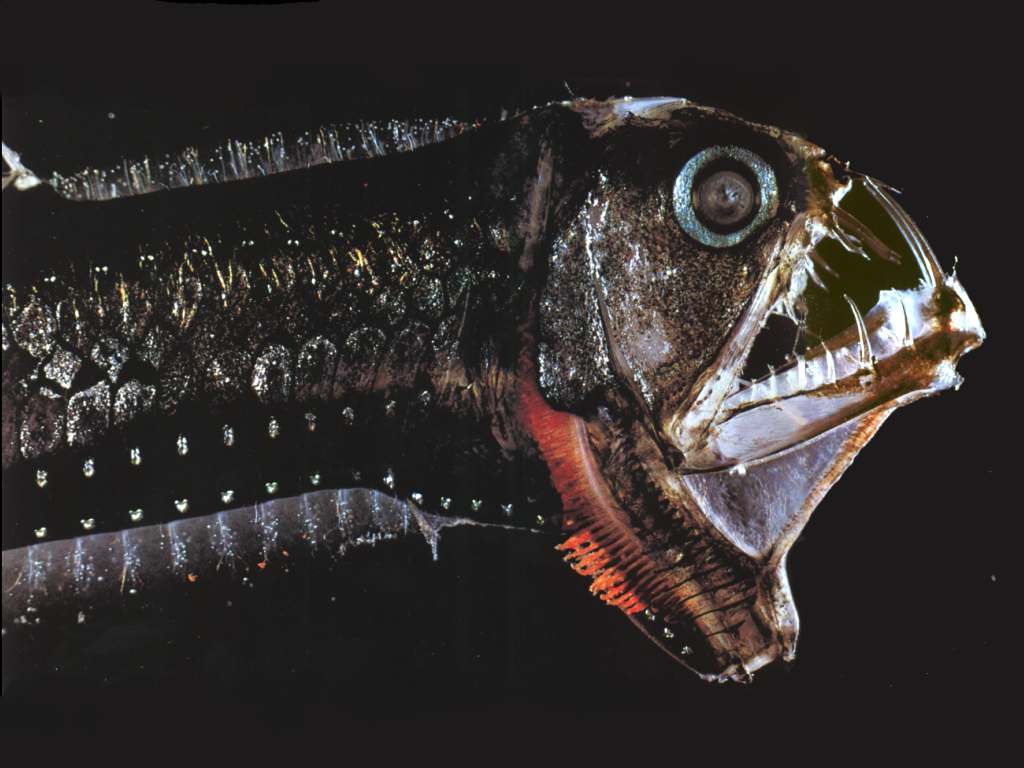
6. Viperfish (up to 6 feet)

viperfish
Image via: wolaver

Moving to the bottom five of our top ten, we come to the Viperfish, another predatory nasty with a snaky moniker. Rather like its bioluminescent buddy the Anglerfish, the Viperfish keeps to the ocean’s lower reaches. At night, though, this gruesome looking member the bottom feeding brotherhood swims to shallower depths of less than 700 feet where food is more available. Mercifully we wouldn’t fall into the F-word category were we ever to come face to face with the Pacific Viperfish – an extra large specimen that that may demonstrate deep-sea gigantism, reaching as long as 2 m. A relief to be sure, as the teeth protruding from that grim underbite look less than friendly – prey or not.

Grandma what big teeth you have: Viperfish
newviperfish
Image: Crappy Wildlife Photography

7. Fangtooth Fish (up to 6 inches)

fangtooth
Image: Diwan2000sa

Another cruel-faced deep-dwelling assassin, and one of the deepest-dwelling at that, the Fangtooth fish is found at murky depths as far as 5 km below the surface. Endowed with oversized fang-like teeth and a hefty jaw, the Fangtooth’s two largest lower fangs are so long the fish has a pair of sockets on either side of its tiny brain for the teeth to slot into when it shuts its mouth. The Fangtooth is actually thought to have the largest teeth of any ocean fish relative to its body size, though it needs to be able to grab any meal it can, even if larger than itself. Though haggard and scary in appearance, this fish is too small to be harmful to humans – unless it swims into your dreams.

Fangtooth preserved
fangtooth2
Image of Fangtooth Fish: miss ruta

8. Dragonfish (up to 16 inches)

blackdragonfish
Image: clifftrobot

The deep-sea horrors continue, and the Dragonfish has the by know familiar outsized mouth and fang-like teeth that are hallmarks of the abyssal beasts we’ve seen – but, hey, they’ve got to eat, and anything encountered will do. The Dragonfish’s head seems to be all jaw and eyes, but unlike its relative the Viperfish, it has a barbel that dangles from its chin and emits light to attract unwary prey, rather like the lure of the Anglerfish. The Dragonfish might have swum further up our list if it weren’t for its bold bioluminescent beauty. Still, it leaves us in no doubt that it can be a ferocious predator that you definitely wouldn’t want getting primeval on you.

Shining light: Scaly Dragonfish
scalydragonfish
Image: MichaelStPatrick

9. Gulper Eel (up to 6 feet)

newgulper
Image: Alexander Yean

With a mouth much larger than its body – a mouth that makes the word enormous seem too tiny – the Gulper Eel swims into our midst, whip-like tail in tow. This bizarre and terrifying looking creature also goes by the name of Pelican Eel, and that massive pouch of a lower jaw makes it easy to see why. The mouth is slack-hinged, and can be opened wide enough for the Gulper to swallow creatures much larger than itself, while the gut of this freaky fish also stretches so it can stomach large meals. But despite the size of the Gulper’s jaws, it has rather small teeth, suggesting a preferred diet of smaller fish. This monster inhabits depths thousands of feet down. A good job too, else we’d be the ones gulping – with fear.

Hard to swallow? Gulper Eel
newgulper2
Image: tobymiller

10. Conger Eel (up to 10 feet)

newconger
Image: Benthichi

Finally, moving to slightly less bottomless depths, its time to get up close and personal with the Conger Eel. It may not have as many fancy tricks up its crevice as its cousin the Moray, but with its great size and none too pretty chops, the carnivorous Conger Eel busts its way into the top ten. The American Conger, or sea eel, is known for being a particularly fierce game fish. Fronting up to you with a chunky head, wide mouth and strong teeth that could really do some damage, we definitely wouldn’t want to be fooling around with one of these bad boys – unless it was safely on our dinner plate.

Dare you do the conger? Conger Eel
conger
Image: why I love life

Thursday, December 11, 2008

South African Teenagers Smoke HIV Drugs to Get High

drugsIn the U.S., the kids are snorting Ritalin to get high. But in South Africa, the newest abused prescription drugs of choice are HIV drugs. Teenage schoolchildren in South Africa have been seen grinding up anti-retroviral pills and smoking them, sometimes mixed with painkillers or marijuana. The children say they are buying or stealing the drugs from HIV patients and healthcare workers.

Tooli Nhlapo, a documentary filmmaker for the South African Broadcasting Corporation, was shocked when she first observed the children smoking the pills. Meant to boost the immune system and help the body fight off HIV, the drugs apparently produce a hallucinogenic effect when smoked.

“When I asked them why they like doing it, they said it helps them relax and forget about their problems,” she said. What Nhlapo first thought was an isolated incident may turn out to be a nationwide problem: Many people in the areas she visited were aware of the new way to get high.

Doctors say the abuse of HIV drugs is particularly worrisome if the drugs are coming from HIV patients, because these pills need to be taken as part of a cocktail of several drugs to have optimal effect.

To make matters even worse, South Africa has one of the worst HIV/AIDS epidemics in the world, with an estimated one-fifth of the population infected. The government-supported treatment program, which distributes anti-retroviral drugs, has only been in effect since 2004.

Wednesday, November 19, 2008

Africa ivory trade bust is the 'biggest ever'

Tusk haul (AP)
Smuggled ivory finds its way all over the globe

More than one tonne of ivory products has been seized in Africa's largest-ever international crackdown on wildlife crime.

The operation, co-ordinated by Interpol and the Kenya Wildlife Service, led to the arrest of 57 illegal traders across five African nations.

The haul also included animal skins and hippopotamus teeth.

Interpol said that similar trans-national operations will be carried out worldwide to combat wildlife crime.

Planning for the bust, dubbed Operation Baba, started in June in response to a plea to Interpol from African nations dealing with illegal elephant killings.

Over the past weekend, undercover agents intercepted local dealers and brokers at ivory markets, border crossings and airports in the nations of Kenya, Democratic Republic of Congo, Ghana, Uganda and Zambia.

More than one tonne of ivory products - including powdered ivory and carved items - was recovered, as well as leopard, cheetah and serval cat skins.

"Co-operation among countries in East, West and Southern Africa against wildlife crime has set an inspired example," said Giuliano Zaccardelli, director of Interpol's Oasis programme that supports African law enforcement.

"Similar operations could also be conducted in Asia, the Americas and in any other region where criminal interests, including trafficking in illegal wildlife products, are common," he added.