Zazzle Shop

Screen printing

Tuesday, January 20, 2009

Flying the Coal Fired Skies

The Air Force has an ambitious plan to wean American aviation off oil. But will the cure be worse than the disease?

Off Oil, On Coal: The Air Force uses more fuel than any other branch of the military—2.5 billion gallons in 2007 alone. John MacNeill
In the not-so-distant future, cars could run on electricity, power plants on wind and solar energy, and city buses on zero-emission hydrogen fuel cells. But airplanes? Those just might run on coal.

Yes, coal. The U.S. Air Force wants to create a synthetic-fuel industry that, unless something better comes along, will mine America’s massive coal supply (we have more than a quarter of the world’s known reserves) and turn it into enough jet fuel for half its domestic operations to run on a 50/50 blend of synthetic and regular fuel by 2016. By the Air Force’s logic, it has no choice. It uses more fuel than all the other branches of the military combined, burning through 2.5 billion gallons of the stuff in 2007 alone—10 percent of the total used by the entire domestic-aviation fuel market—at a cost of $5.6 billion. And although oil prices have dropped in recent months, no one expects the relief to last indefinitely.

Yet alternative fuels for aviation are hard to come by. The Air Force says it’s open to all sources of power for its fleet, but according to former assistant secretary of the Air Force William Anderson, petroleum, natural gas and coal are our only current options—and when you look at the U.S.’s resources, the choice is clear. “We’re not the largest holder of oil reserves, so that’s not a good option,” he says. “We’re not the biggest holder of natural gas. But we are the Saudi Arabia of coal.” So the Air Force is doing its best to spark a domestic fuel industry that would be devoted, most likely, to digging new coal mines and building the country’s first major coal-to-liquids (CTL) plants. To make the market bigger, it wants to convince the other branches of the military and even domestic airlines to run their fleets on liquefied coal, too.

From a purely martial perspective, the strategic benefits of this plan are obvious: The U.S. would use far less oil imported from countries it doesn’t get along with. But there are problems, like the fact that the plan could generate twice the carbon dioxide emissions of current fuels—making it, thanks to a special clause in the 2007 energy bill, illegal.

GAS-GUZZLERS OF THE SKY : The Air Force flies some 51,000 aerial refueling missions a year in support of aircraft like the F-16 Falcon [right] and the B-2 Spirit stealth bomber. Richard VanderMeulen/Getty Images

One good thing about transforming coal into jet fuel is that we know how to do it. In the 1920s, German scientists figured out a method for turning raw materials such as coal and natural gas into liquid fuel. It essentially involves steaming the coal to produce a hydrogen-and-carbon-monoxide gas, and then, through something called the Fischer-Tropsch process, exposing that gas to a series of catalysts to convert it to a liquid fuel. Hitler used the technique to power Germany in World War II, and during apartheid, when South Africa was facing embargoes, its government tweaked the process so that it could produce jet fuel as well. Once you’ve got the fuel, it’s just a matter of proving that your planes can run safely on it. The Air Force has certified the B-52 and C-17 for unlimited use of a 50/50 synthetic fuel blend; has tested its B-1 Bomber, F-15, F-22 and KC-135; and aims to certify its entire fleet by 2011.

CTL proponents, aware that coal has an image problem, fend off criticism by saying that the fuel is actually “greener” than jet fuel made from petroleum. What they mean is that during the gasification process, jet fuel from coal is scrubbed clean of particulate emissions as well as sulfur dioxide and nitrogen oxide—the stuff that causes acid rain—so it is in one sense cleaner to burn. But that leaves out a crucial bit of information: Between mining the coal and burning the resulting jet fuel, coal-to-liquids fuel produces twice as much CO2 as the existing petroleum-derived fuel. The potential effect of creating a market for CTL fuels is frightening enough to environmentalists that last year Representative Henry Waxman, who now heads the House Committee on Energy and Commerce, added a clause to the 2007 energy bill—Section 526—forbidding the U.S. government from spending taxpayer money on fuels that emit more greenhouse gases than the fuels we’re already using.

That hasn’t stopped the Air Force from moving ahead with its plan—it simply says that the companies that produce the fuel will have to figure out a way to comply with Section 526. So while lobbyists for both the coal and petroleum industries work aggressively to get Section 526 repealed, potential CTL suppliers are l

There are a few ways to get there, none of them easy, including recycling CO2 by running it back through the Fischer-Tropsch process to produce more fuel (after all, carbon dioxide has carbon in it, the same energy source as fossil fuel), using the CO2 to grow oil-producing algae, or turning the carbon into usable industrial gases. The Air Force estimates that it will be at least a decade, however, before any of those technologies can be used at anywhere near a broad scale. More feasible is using CO2 for something called enhanced oil recovery—liquefying and pumping the CO2 into dying oil wells to push remaining oil to the surface. But the danger in that process is that it might contribute to the very problem it’s trying solve, because the energy required for liquefication will almost certainly come from carbon-emitting fossil fuels. Then there are long-term consequences to consider. Will the carbon dioxide leak out of the oil well? No one knows.

How to Fly on Coal: 1. Take coal. . . 2. Steam it to form “syngas”. . . 3. Expose that to catalysts. . .4. And voilà: jet fuel John MacNeill

The same long-term concerns vex another oft-discussed solution: carbon capture and storage. Currently being done at several small demonstration plants outside the U.S., this process involves capturing the CO2 as it’s released from the Fischer-Tropsch reactor (the part where the synthetic gas turns into a liquid fuel) and pumping it into formations underground—essentially sweeping it under the rug, where it may or may not stay. But according to Lowell Miller, director of the U.S. Department of Energy’s Office of Sequestration, Hydrogen, and Clean Coal Fuels, the real challenge of carbon sequestration is the vast amounts of money it will take to make it work. University of Manitoba professor Vaclav Smil has estimated that sequestering just 10 percent of the world’s 2005 CO2 emissions would require more plants and pipelines than are used in the entire worldwide business of crude-oil extraction. And there are other setbacks. Last year the Department of Energy canceled the main feature of its FutureGen project—the creation of the country’s first commercial-size coal-fired plant that would capture all of its carbon emissions—because it was so far over budget.

Ultimately, the question is this: Is it better to send American aviation down the road toward coal-based fuel without a clear idea of what to do about the extra carbon emissions, or to keep on burning billions of gallons of imported oil every year? The lack of alternatives makes this debate tricky. Finding renewable sources of jet fuel is “going to be tough, there’s no doubt about it,” says Tyson Slocum, director of the public-interest group Public Citizen’s Energy Program. “You can’t put solar panels on a jet airplane.”

The problem can even make committed environmentalists soften a bit toward oil. Henry Henderson and Shannon Fisk of the Natural Resources Defense Council suggest that we scrap liquid coal entirely and invest in oil-saving technologies that we already have, like hybrid and electric cars and trucks. That could free up more oil for jet fuel, lowering its cost and buying time to search for sustainable alternatives.

Fueled-UP: The B-2 can fly across the world in a single run as long as it’s fortified with several hits from an airborne fuel tanker along the way. Kristen Rohrer/60th Air Mobility Wing Public Affairs
Eventually, new biofuels that cut carbon without raising food prices could be the answer. Some companies are already working on them. Virgin Atlantic flew a jumbo jet from London to Amsterdam last year using a fuel partially derived from Brazilian babassu nuts and coconuts. Last September saw the launch of the Sustainable Aviation Fuels Users Group, a coalition of Boeing, the NRDC, and several other airlines and environmental groups that aims to encourage the development of low-carbon fuels. In the meantime, the American military might very well start powering its future using the hydrocarbon fuel of the past.

Catherine Price’s most recent article for Popular Science was “The Anonymity Experiment,” last March.

ooking into technology that could, theoretically, clean coal-based jet fuel enough that it’s the greenhouse-gas equivalent of petroleum

What if None Of This is Real?

A simulated black hole of ten solar masses: Ute Kraus

Also in today's links: an endangered species is said to no longer be endangered, an extinct species is no longer extinct, and more.

See the original image at telegraph.co.uk — Bionic hand gives student new life & best Star Wars costume

A student who lost his left hand in a car accident has been fitted with the world's most advanced prosthetic limb.

20 Jan 09: Evan Reynolds who lost his left hand in a car accident has been fitted with the world's most advanced prosthetic limb. ; http://link.brightcove.com/services/link/bcpid1488655367/bctid8581227001 http://www.brightcove.com/channel.jsp?channel=1139053637

Evan Reynolds has been given a new lease of life by the fully functional artificial replacement.

The sports biology student at University of the West of England (UWE), in Bristol, was the second person in Britain to be fitted with the advanced i-LIMB hand.

Mr Reynolds, 19, from Haslemere, Surrey, said it took him only minutes to adapt to the product, which is controlled by electronic muscle signals from the remaining part of the limb.

The innovation has five independently powered digits which operate like a human hand when closing around an object.

The rugby-playing student, who had dreamed of joining the Army and going to Sandhurst, had his left hand ripped off as a friend drove him home following a day out.

He was sitting in the passenger seat with his hand resting on the wound-down window ledge when the car scraped a wooden post at the exit to the car park. Mr Reynolds' hand was taken off instantly.

His friends saved his life by applying a tourniquet to stop the bleeding.

He said: "It was very nasty. It was amputated in a second.

"Obviously I couldn't join the Army any more"

The i-Limb was developed by a Scottish company, Touch Bionics, and has won awards for its innovative technology. The total cost including the hand itself and the fitting is about £30,000.

Mr Reynolds's older brother Richard saw a television report about the i-LIMB and contacted the manufacturer.

The firm was still working on a prototype at the time, but after a number of tests and meetings with prosthetic specialists, Mr Reynolds had the i-LIMB fitted in February last year.

He said: "The most amazing thing about it was how quickly I adapted to it. People always ask how it's changed my life, but there's no specific thing.

"It's the hundreds of everyday things you take for granted, which I can do again, like peeling a potato, catching a ball, holding a bottle of water.

"I'm incredibly grateful."

He added: "It's so sensitive I can grip a bottle of water or a paper cup without crushing it, and even swing a racket. All I have to so is imagine picking something up or gripping it and the fingers and thumb move automatically."

Mr Reynolds said his disability has not stopped him playing sport, his greatest passion, nor has it crushed his spirit.

He still plays rugby, but makes sure he removes the expensive appendage first.

He said: "I love sport, I still play rugby, I still play squash, but I take the i-LIMB off first."

Time Magazine named the i-LIMB as one of the Top 50 inventions of 2008 and Touch Bionics won the Limbless Association's Prosthetic Product Innovation Award for 2008 for the product. American soldiers injured in action are among those who have been given it.

Steve Jobs to stand for re-election to Disney's board

By Slash Lane

Although complicated health issues have forced Steve Jobs into a 6 month leave from Apple, he's seemingly confident in his ability to serve on Disney's Board of Directors, where he'll be standing for reelection come March.

Jobs has been a member of Disney's board ever since the entertainment conglomerate purchased Pixar back in the spring of 2006. At the time, his 50.6 percent controlling stake in the animation studio netted him more than $4 billion in Disney shares, making him the company's largest shareholder.

The Apple co-founder receives no compensate for his role at Disney, where he's also believed to serve as a special advisor to chief executive and close personal friend Bob Iger on technology-related matters.

However, Jobs’ decision to stand for re-election to the Disney board just days after stepping aside at Apple is drawing some concern from corporate governance experts, according to the Financial Times.

"A directorship is not an honorary position,” Charles Elson, professor of corporate governance at the University of Delaware, told the paper. "If he’s said he can’t run Apple, how on earth can he [stand for the Disney board again]?”

Elson added that non-executive directors of large public companies need to be able to devote at least 250 hours a year to the position.

Disney, which reportedly declined to comment on Jobs' decision to seek another term as a board member, has been one of Apple's stalwart allies in its efforts to push video content into the digital age.

Prior to purchasing Pixar, Disney inked a landmark deal to sell its hit ABC television shows over iTunes and later followed up as the first major Hollywood studio to commit its movie library to the digital download service. Since then, Disney has gone on to sell millions of movies and tens of millions of TV shows through iTunes.

In related news, Bloomberg on Friday cited "people who are monitoring [Jobs'] illness" as saying he is considering a liver transplant as a result of complications that followed his pancreatic cancer treatment in 2004.

When reached by phone, Jobs refused to comment further on his health and pleaded for some privacy.

"Why don’t you guys leave me alone -- why is this important?," he told Bloomberg.

Methane May Point to Life on Mars

Discovery of the gas raises the specter of Martian life

Methane Deposits on Mars: NASA

If you roll out of bed and see the headline "Life on Mars," is it because: a) it's a hoax, b) NASA got lucky, c) scientific genius won out, or d) it is written in a British tabloid?

The British Sun received a slap on the wrist from the journal Science, but news sites buzzed cautiously over a new NASA study about methane gas detected on Mars in 2003. Methane plumes traced to three specific regions could signal active geological processes—or possibly even gas-emitting microbes, said scientists during yesterday's press conference.

The methane puffs appears linked to heating that occurred during the northern Martian hemisphere's summer, SPACE.com explained. Such methane must have marked a recent release, because the gas molecules rapidly fall apart when struck by sunlight's ultraviolet rays in the Martian atmosphere.

Even methane produced by active geology could prove intriguing, because scientists generally view Mars as a dormant planet. Sushil Atreya, a space scientist from the University of Michigan at Ann Arbor, examined this methane mystery for Scientific American in 2007.

Wired noted the possible impact of these findings on future Mars missions, such as the Mars Science Laboratory (MSL) that has been delayed by two years. One methane hot spot appeared near the Nili Fossae region, which may now get a second look on the list of MSL landing sites.

MSL has the equipment to sniff out traces of methane after landing, if the SUV-size rover does end up near a methane-emitting region. Such close study could prove as scientifically intriguing as the discovery of water ice on Mars by NASA's Phoenix Mars Lander last summer.

But regardless of any offbeat proposals or serious long-term planning, no humans will likely set foot on the Red Planet until travelers can avoid the problem of deep space radiation. In the meantime, geologists hankering for an up-close-and-personal look will have to bide their time.


Whitehouse: How to move two presidents in six hours

(CNN) -- Comedian Mark Russell was at a recent event in Chicago, Illinois, when he found himself sitting next to Valerie Jarrett, an adviser to President-elect Barack Obama.

Moving the Obamas into the White House will take about six hours.

Moving the Obamas into the White House will take about six hours.

Russell asked her whether President Bush's staff members were going to remove all the Os from their computer keyboards, alluding to the 2001 incident in which President Clinton's departing staff removed Ws from some White House computers.

Jarrett said no, but that didn't stop Russell from speculating what really happened when President Bush's daughters, Barbara and Jenna, gave Obama's two daughters a tour of the White House recently.

"The Bush daughters showed Sasha and Malia Obama around," Russell joked. "Barbara showed them where all the bedrooms were, and Jenna showed them how to make a fake ID."

Russell sees humor in the presidential transition, but the actual operation to move both families in and out of the White House is serious business.

The clearing out of the Bushes' belongings began over the summer, when many items were packed and taken to Crawford, Texas, says Anita McBride, chief of staff to first lady Laura Bush. Then, during the Christmas holiday, the Bushes moved their personal things out of Camp David, the presidential retreat in Maryland, according to McBride.

On January 20, the Obamas move in -- a side of Inauguration Day that most people never see: a grueling, precisely timed workday involving scores of staffers that follows six months of careful planning.

The Bushes welcome the Obamas to the White House in November.

The Bushes welcome the Obamas to the White House in November.

Gary Walters worked at the executive mansion from 1986 until 2006 as chief usher in charge of moving presidential families in and out of the White House. From his Virginia home, Walters described how the complicated Obama move in to the White House is completed in only a few hours.

In the morning, after the Bushes and Obamas depart the executive mansion for the Capitol Hill swearing-in ceremony, moving trucks will roll up to the south side of the White House, Walters said.

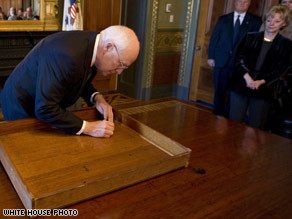
Vice President Cheney signs his office desk, following a tradition started by Teddy Roosevelt.

Vice President Cheney signs his office desk, following a tradition started by Teddy Roosevelt

The drivers put down their tailgates, allowing most of the White House's 93 staff members to begin unloading Obama family items, he said.

"Staff members all have been given very specific jobs on that day, almost down to the minute as to what their responsibilities are," Walters said.

The move is designed to be seamless, painless and invisible while millions of Washington visitors -- and millions more watching on TV -- follow the inauguration ceremonies and the parade that follows.

By about 5 p.m., before the Obamas move from the parade viewing stand to their new home, the presidential move must be complete.

"Their clothes will be in their closets; everything will be put away," Walters said. "There should be no full or half-empty boxes will in view. Furniture will be set in proper places. Their favorite foods will be in the kitchen or the pantry. The chief usher will welcome them into their home and ask them what they would like to do before going out to enjoy the inaugural balls."

Incoming first lady Michelle Obama's mother, Marian Robinson, will also be moving into the White House residence, which has 24 rooms on the second and third floors. The Obamas have hired California decorator Michael Smith to use an allocated $100,000 to redecorate the space. Video Watch what decorator may do with the White House »

"I think they're going to find that this is really conducive to family life," President Bush told CNN's Larry King. "President-elect Obama has got a 45-second commute to see his girls."

In the West Wing of the White House, the political jostling has begun among new staffers to grab workspaces near the center of power: the Oval Office.

White House move

  • The move is performed by most of residence staff, which numbers 93.
  • It takes place from 11 a.m. to 5 p.m. on the south side of the White House.
  • At least two or three trucks will take part.
  • Tents, chemicals on hand in case of ice, snow or rain.

Source: Former White House Chief Usher Gary Walters

There, the carpet is changed with each new administration to suit the incoming president, Walters said. Possibly, the office desk will be changed, as will paintings that will be hung on the wall.

Books on the Oval Office shelves will be changed per the new commander in chief, as will accessories to be placed around the room, Walters said. Staffers may tote in a new sofa and chairs -- or busts of past presidents.

Following tradition, Bush is expected to leave a personal letter written to Obama. Past letters have offered the new president private words of advice and reflection.

Several Democratic presidents have chosen to hang a Thomas Sully painting of President Andrew Jackson in the Oval Office, said political scientist and historian Martha Joynt Kumar, an expert on the White House. "In the residence, many presidents have brought their personal paintings to decorate their living space."

After movers tote out boxes of office materials from Bush staffers, the West Wing will become a dusty workspace, with empty bookshelves and the odd three-ring binder left behind, say veterans of the White House press corps.

As in previous moving periods, contractors may come to slap on a coat of paint or lay carpet as the new crop of staffers finds their workspaces.

"It was incredible," former Clinton staffer David Seldin said, recalling his experience on Inauguration Day 1993. "I think people were overwhelmed with the sense that it was real and the sense that something that you had been working on as a political campaign is actually becoming part of the government."

On Tuesday, once the whirlwind moving operation is finally done, Chief Usher Stephen Rochon will probably greet Obama the same way Walters did Bush in 2001.

Standing near the doorway to the White House North Portico, Walters recalls, he said, "Hello, Mr. President, welcome to your home."

Oh, and about those Os on White House keyboards -- two Bush officials told CNN on Sunday that outgoing aides won't be getting payback on the incoming Democratic administration.

There is an understanding that Bush will be furious if there are any pranks, especially after cordial transition between the two administrations, the officials said.

Windows 7 - what it means for gamers

Will Windows 7 achieve the respect that Vista failed to win?

windows-7-games-explorer

A slightly tweaked Games Explorer brings support for auto-checking for game patches


The Windows Experience Index has increased its maximum rating from 5.9 to 7.9, to account for upcoming beefier components

It's telling that one element of Windows 7 Microsoft isn't especially trumpeting (amidst the cloud of self-congratulation about how the new OS is slicker, faster and essentially the Barack Obama of networking) is its gaming clout.

There's one simple reason for that - it's built on Vista, an operating system that gamers at large have spurned after all its outrageous performance promises turned out to be performance penalties instead.

Sure, SP1 helped a lot. And yes, there's been a ton of exaggeration from the operating system's counter-propagandists to contend with. But the truth is that three years on DirectX 10 remains a niche option of debatable usefulness, while the back of most game boxes coldly state you'll need an extra half-gig (or more) of RAM to run 'em on Vista instead of XP. Even the notoriously hyperbolic Microsoft is unlikely to attempt a similar massaging of the facts this time around.

So we can largely expect 7's gaming performance to be pretty much on a par with Vista's, and the recently released beta bears that out: give or take a few frames per second, benchmarks match those on the same system running Vista SP1.

More RAM available

It's the RAM issue that's likely to be 7's biggest boon to gamers, however. While the new OS is fundamentally an optimised version of Vista rather than a brand new platform, it's significantly more efficient, especially in terms of memory usage.

This means there'll be that much more RAM optionally available to gamers, as less of it is sacrificed to the OS's bottomless stomach. It also means there's the potential for smoother-running, faster-loading games for those with ample RAM, and for more games to run in the first place for those toting just a Gigabyte or so.

Unlike fat old man Vista, 7's even happy on a netbook, so there's more scope for Eees, Winds et al to be decent mini-gaming platforms.

In the long-term, we hope Windows 7 will achieve the success that Vista didn't quite manage and, more importantly, the respect that it definitely failed to win. If most gamers decide they trust 7 enough to finally step away from their faithful XP, that means DirectX 10 (although Win 7 introduces DX11, it won't be the major shift that 10 was from 9 and, importantly, it'll also be available for Vista) will be that much more established. That, in turn, means more games will support it, so we get better-looking titles all round.

It's likely, too, that the fairly insulting Vista-only tag carried by the few games unfortunate enough to get caught up in Microsoft's marketing misfires will seem less offensive when it now means the game will run on two operating systems.

Solid 3D stability from day one

Speaking of which, the early days of 7 shouldn't suffer from the really severe performance hits that blighted Vista's first months. While Vista's launch saw 3D card makers scrabbling to write drivers for a whole new architecture, we're told that this time around what works on Vista will work on 7.

While there's bound to be a few casualties, the current beta version certainly installs the latest Vista Nvidia and ATI drivers without complaint, which should mean rock-solid 3D stability from day one. Outside of drivers, however, the beta's not quite proving the plain sailing Microsoft is promising 7 will be - there's a few weird-beardy errors such as Mirror's Edge not playing sound during its cutscenes.

While most current games run solidly and developers working on upcoming titles have most of 2009 in which to ensure maximum 7 friendliness before the OS's retail launch, there's a worrying chance some older titles will remain unpatched and only partially functional.

In the end, though, Windows 7's main appeal to dedicated gamers is that it's simply a more pleasant place to be than Vista ever was. It looks better, it loads quicker, it's more responsive and it gets in your face a whole lot less. It may not offer gamers much that's new, and it's certainly not going to revolutionise performance, but as a nippy, cheerful background platform to launch games from, it's probably Microsoft's strongest-ever hand.

Fighting for Recognition: ‘Tyson’ at Sundance

James Toback

Mike Tyson in the documentary "Tyson," which is being shown at the Sundance Film Festival. More Photos >

Published: January 18, 2009

PARK CITY, Utah — The Sundance Film Festival always has much on its plate. And one of the jobs served up this year involves feeding Mike Tyson.

Shea Walsh/Associated Press

Mike Tyson on Main Street in Park City, Utah, for Sundance. More Photos »

On Saturday night, John Besh, the New Orleans restaurateur, was preparing to do exactly that at Bon Appétit’s temporary supper club, which is perched on a slight rise above the party tents on Main Street here.

The menu was built around Kobe beef short ribs stripped from the bone and cooked for 26 hours at precisely 141 degrees. “Since we’re cooking for Mike Tyson, I wanted big blows for the palate but also some food for the soul,” Mr. Besh said, shortly before pouring the soupe de poisson with blue crab and tapioca.

The idea is not so much to sate the appetite of Mr. Tyson, a 42-year-old former boxer who has been in and out of jail, as to create a bit of theater around a documentary film about him.

The movie, “Tyson,” directed by James Toback, screened earlier on Saturday to a packed house of about 450 at a the town library, where the film was screened. Mr. Tyson spoke briefly afterward, but the real event was simply his presence.

“Mike Tyson’s coming in!” Pierce Brosnan said as he left the supper club from an earlier dinner honoring his own movie, “The Greatest,” shortly before Mr. Tyson walked in through a crowd of gawkers.

The new film tries mightily to find a redemption story in Mr. Tyson’s rise, fall and reconciliation with his demons. “The regeneration, reconstruction and rehabilitation of a great spirit is always possible,” Mr. Toback said, summing up his movie’s moral during cocktail hour at the supper club.

Still, Mr. Tyson appears to remain more spectacle than morality tale, which is not altogether a bad thing as far as Sundance is concerned.

One of the festival’s jobs, bluntly put, is to sell documentaries. In one of the “Storytime” memory reels attached to the beginning of each screening here, Robert Redford, the festival’s patriarch, muses of documentaries: “What if we use the festival to promote them on an equal footing with theatrical films?”

The key word is promote, and it is not necessarily a dirty one. Despite a supposed marketplace surge that came with the runaway success of Michael Moore’s “Fahrenheit 9/11” in 2004, documentaries generally remain a poor relation at the box office.

Many of the art form’s bigger box-office hits have been political. Those include Mr. Moore’s “Sicko” and “Bowling for Columbine,” as well as Davis Guggenheim’s “Inconvenient Truth,” the global warming film with Al Gore.

Every once in a while a nonpolitical specimen breaks the rules by doing as well as any other kind of feature film. The last such example was “March of the Penguins,” which took in $77 million at the domestic box office after Warner Independent Pictures released it in 2005.

But the record has been much spottier for most documentaries. Sony Pictures Classics, which only days ago acquired rights to distribute “Tyson,” in the last couple of years released “Waltz With Bashir,” “Jimmy Carter, Man From Plains” and “My Kid Could Paint That,” none of which has topped $1 million at the box office, although “Waltz With Bashir,” which won a Golden Globe award, is still playing.

“Nine months ago we were thinking we weren’t going to do any more documentaries,” said Michael Barker, co-president of Sony Pictures Classics, speaking at the same reception. “Then you see a film like this.”

Where “Tyson” is concerned, Sundance has some work to do. The festival is supposed to reignite interest in a movie that’s been around for a while: It has screened at a number of festivals, including Cannes, where Mr. Tyson and Mr. Toback did some heavy selling last May.

On a large scale, Sundance is supposed to use its promotional tricks — among them, feeding the 90 movie and media types at this dinner — to convince people that there really is something appetizing about real-life stories told, on the whole, with fidelity to the facts.

For Mr. Barker, the next step is to begin releasing “Tyson” in theaters on April 24. The plan, he said, is to cultivate both the art-house crowd and African-American viewers, aiming for a crossover hit like “Hoop Dreams,” a 1994 basketball documentary that took in $7.8 million.

If Mr. Tyson caused excitement on Saturday night, the same sort of sizzle was in the air that morning, when several hundred festival-goers started lining up four hours early at the Har Shalom Temple’s theater for a look at “The September Issue,” another documentary. That one follows the fashion editor Anna Wintour as she assembles the September 2007 issue of Vogue magazine.

Theatrical rights to “The September Issue” are for sale here by the Creative Artists Agency, so even Ms. Wintour, whose legendary lack of warmth is a theme in the film, had some promoting to do.

Tucked inside a jacket edged with a big fur collar, she took questions from John Cooper, the festival’s director of programming, on Saturday.

Mr. Cooper asked Ms. Wintour about the experience of watching underlings dissect her vision and decisions on screen, not always in flattering ways. “There wasn’t much in there I didn’t know before,” she said.

“Do you like it?” Mr. Cooper persisted, referring to the film, which was directed by R. J. Cutler, a producer of “The War Room,” about Bill Clinton’s 1992 presidential campaign.

“It’s quite hard to look at oneself in such an intense way,” Ms. Wintour said. But, she added, “I’m very glad to have a record of what we do.”

Obama Inauguration Excitement Builds -- PHOTOS

Obama inauguration excitement builds

Filling the National Mall

(Tribune photo by Nancy Stone / January 20, 2009) People fill the National Mall all the way back to the Washington Monument in the early morning hours before the inauguration of Barack Obama as the 44th President of the United States


clcik here for more pics...

How Obama Found His Voice--Through Books

Doug Mills/The New York Times

Barack Obama arrived in Bozeman, Mont., for a campaign rally in May 2008 carrying Fareed Zakaria’s “The Post-American World.”

Published: January 18, 2009

WASHINGTON — In college, as he was getting involved in protests against the apartheid government in South Africa, Barack Obama noticed, he has written, “that people had begun to listen to my opinions.” Words, the young Mr. Obama realized, had the power “to transform”: “with the right words everything could change -— South Africa, the lives of ghetto kids just a few miles away, my own tenuous place in the world.”

A Reading List That Shaped a President

Some of President-elect Barack Obama’s favored reading matter as mentioned in this article:

  • The Bible
  • “Parting the Waters,” Taylor Branch
  • “Self-Reliance,” Ralph Waldo Emerson
  • Gandhi’s autobiography
  • “Team of Rivals,” Doris Kearns Goodwin
  • “The Golden Notebook,” Doris Lessing
  • Lincoln’s collected writings
  • “Moby-Dick,” Herman Melville
  • “Song of Solomon,” Toni Morrison
  • Works of Reinhold Niebuhr
  • “Gilead,” Marilynne Robinson
  • Shakespeare’s tragedies

Much has been made of Mr. Obama’s eloquence — his ability to use words in his speeches to persuade and uplift and inspire. But his appreciation of the magic of language and his ardent love of reading have not only endowed him with a rare ability to communicate his ideas to millions of Americans while contextualizing complex ideas about race and religion, they have also shaped his sense of who he is and his apprehension of the world.

Mr. Obama’s first book, “Dreams From My Father” (which surely stands as the most evocative, lyrical and candid autobiography written by a future president), suggests that throughout his life he has turned to books as a way of acquiring insights and information from others — as a means of breaking out of the bubble of self-hood and, more recently, the bubble of power and fame. He recalls that he read James Baldwin, Ralph Ellison, Langston Hughes, Richard Wright and W. E. B. Du Bois when he was an adolescent in an effort to come to terms with his racial identity and that later, during an ascetic phase in college, he immersed himself in the works of thinkers like Nietzsche and St. Augustine in a spiritual-intellectual search to figure out what he truly believed.

As a boy growing up in Indonesia, Mr. Obama learned about the American civil rights movement through books his mother gave him. Later, as a fledgling community organizer in Chicago, he found inspiration in “Parting the Waters,” the first installment of Taylor Branch’s multivolume biography of the Rev. Dr. Martin Luther King Jr.

More recently, books have supplied Mr. Obama with some concrete ideas about governance: it’s been widely reported that “Team of Rivals,” Doris Kearns Goodwin’s book about Abraham Lincoln’s decision to include former opponents in his cabinet, informed Mr. Obama’s decision to name his chief Democratic rival, Hillary Rodham Clinton, as Secretary of State. In other cases, books about F. D. R.’s first hundred days in office and Steve Coll’s “Ghost Wars,“ about Afghanistan and the C.I.A., have provided useful background material on some of the myriad challenges Mr. Obama will face upon taking office.

Mr. Obama tends to take a magpie approach to reading — ruminating upon writers’ ideas and picking and choosing those that flesh out his vision of the world or open promising new avenues of inquiry.

His predecessor, George W. Bush, in contrast, tended to race through books in competitions with Karl Rove (who recently boasted that he beat the president by reading 110 books to Mr. Bush’s 95 in 2006), or passionately embrace an author’s thesis as an idée fixe. Mr. Bush and many of his aides favored prescriptive books — Natan Sharansky’s “Case for Democracy,” which pressed the case for promoting democracy around the world, say, or Eliot A. Cohen’s “Supreme Command,” which argued that political strategy should drive military strategy. Mr. Obama, on the other hand, has tended to look to non-ideological histories and philosophical works that address complex problems without any easy solutions, like Reinhold Niebuhr’s writings, which emphasize the ambivalent nature of human beings and the dangers of willful innocence and infallibility.

What’s more, Mr. Obama’s love of fiction and poetry — Shakespeare’s plays, Herman Melville’s “Moby-Dick” and Marilynne Robinson‘s “Gilead” are mentioned on his Facebook page, along with the Bible, Lincoln’s collected writings and Emerson’s “Self Reliance“ — has not only given him a heightened awareness of language. It has also imbued him with a tragic sense of history and a sense of the ambiguities of the human condition quite unlike the Manichean view of the world so often invoked by Mr. Bush.

Mr. Obama has said that he wrote “very bad poetry” in college and his biographer David Mendell suggests that he once “harbored some thoughts of writing fiction as an avocation.” For that matter, “Dreams From My Father” evinces an instinctive storytelling talent (which would later serve the author well on the campaign trail) and that odd combination of empathy and detachment gifted novelists possess. In that memoir, Mr. Obama seamlessly managed to convey points of view different from his own (a harbinger, perhaps, of his promises to bridge partisan divides and his ability to channel voters’ hopes and dreams) while conjuring the many places he lived during his peripatetic childhood. He is at once the solitary outsider who learns to stop pressing his nose to the glass and the coolly omniscient observer providing us with a choral view of his past.

As Baldwin once observed, language is both “a political instrument, means, and proof of power,” and “the most vivid and crucial key to identity: it reveals the private identity, and connects one with, or divorces one from, the larger, public, or communal identity.”

For Mr. Obama, whose improbable life story many voters regard as the embodiment of the American Dream, identity and the relationship between the personal and the public remain crucial issues. Indeed, “Dreams From My Father,” written before he entered politics, was both a searching bildungsroman and an autobiographical quest to understand his roots — a quest in which he cast himself as both a Telemachus in search of his father and an Odysseus in search of a home.

Like “Dreams From My Father,” many of the novels Mr. Obama reportedly admires deal with the question of identity: Toni Morrison’s “Song of Solomon” concerns a man’s efforts to discover his origins and come to terms with his roots; Doris Lessing’s “Golden Notebook” recounts a woman’s struggles to articulate her own sense of self; and Ellison’s “Invisible Man” grapples with the difficulty of self-definition in a race-conscious America and the possibility of transcendence. The poems of Elizabeth Alexander, whom Mr. Obama chose as his inaugural poet, probe the intersection between the private and the political, time present and time past, while the verse of Derek Walcott (a copy of whose collected poems was recently glimpsed in Mr. Obama’s hands) explores what it means to be a “divided child,” caught on the margins of different cultures, dislocated and rootless perhaps, but free to invent a new self.

This notion of self-creation is a deeply American one — a founding principle of this country, and a trope addressed by such classic works as “The Great Gatsby” — and it seems to exert a strong hold on Mr. Obama’s imagination.

In a 2005 essay in Time magazine, he wrote of the humble beginnings that he and Lincoln shared, adding that the 16th president reminded him of “a larger, fundamental element of American life — the enduring belief that we can constantly remake ourselves to fit our larger dreams.”

Though some critics have taken Mr. Obama to task for self-consciously italicizing parallels between himself and Lincoln, there are in fact a host of uncanny correspondences between these two former Illinois state legislators who had short stints in Congress under their belts before coming to national prominence with speeches showcasing their eloquence: two cool, self-contained men, who managed to stay calm and graceful under pressure; two stoics embracing the virtues of moderation and balance; two relatively new politicians who were initially criticized for their lack of experience and for questioning an invasion of a country that, in Lincoln’s words, was “in no way molesting, or menacing the U.S.”

As Fred Kaplan’s illuminating new biography (“Lincoln: The Biography of a Writer”) makes clear, Lincoln, like Mr. Obama, was a lifelong lover of books, indelibly shaped by his reading — most notably, in his case, the Bible and Shakespeare — which honed his poetic sense of language and his philosophical view of the world. Both men employ a densely allusive prose, richly embedded with the fruit of their reading, and both use language as a tool by which to explore and define themselves. Eventually in Lincoln’s case, Mr. Kaplan notes, “the tool, the toolmaker, and the tool user became inseparably one. He became what his language made him.”

The incandescent power of Lincoln’s language, its resonance and rhythmic cadences, as well as his ability to shift gears between the magisterial and the down-to-earth, has been a model for Mr. Obama — who has said he frequently rereads Lincoln for inspiration — and so, too, have been the uses to which Lincoln put his superior language skills: to goad Americans to complete the unfinished work of the founders, and to galvanize a nation reeling from hard times with a new vision of reconciliation and hope.

See the original image at news.aol.com — Why Will Obama's Inauguration Cost so Much?


In these dour economic times, one complaint made by the people who didn't vote for Barack Obama is: why is the federal government spending so much money on his inauguration? As Tom "Hammer" Delay told Politico:

If Obama were "serious" about changing Washington, DeLay said, "He would announce to the world: 'We are in crisis, we are at war, people are losing jobs; we are not going to have this party. Instead, I'm going to get sworn in at the White House. I'm going to have a nice little chicken dinner, and we'll save $125 million."

Oh, Mr. Delay. This whole inauguration thing must really be painful for you to have to watch. Forced from your position of power due to an indictment charging that you violated campaign finance laws, you're a fine one to lecture Obama on how to be serious about change. But what about the price tag? Is Delay in the right ballpark?

ABC News crunches the numbers and finds that:

The federal government estimates that it will spend roughly $49 million on the inaugural weekend. Washington, D.C., Virginia and Maryland have requested another $75 million from the federal government to help pay for their share of police, fire and medical services.

And then there is the party bill.

We have a budget of roughly $45 million, maybe a little bit more," said Linda Douglas, spokeswoman for the inaugural committee. That's more than the $42.3 million in private funds spent by President Bush's committee in 2005, or the $33 million spent for Bill Clinton's first inaugural in 1993.

So, while Delay may not be far off in terms of the total cost of the event, a good bit of that will be paid via private donations, just as in inaugurations past. Media Matters has more on the apples-to-apples comparison.

We also must consider crowd size. When Lyndon B. Johnson took his oath of office in 1965, roughly 1.2 million people turned up. Until Obama, that record turnout would not be surpassed. Bill Clinton drew 800,000 for his first term, and a mere 250,000 for his second. George W. Bush packed in 400,000 for his first solemn swearing, and about 100,000 fewer than that for his second.

Estimates for Obama's crowd range anywhere from 2-4 million. That's a whole lot more porta-potties to rent. And here is the fundamental difference with those who bemoan another lavish inauguration at a time of economic turmoil and those who want to dance and sing in the frigid cold on the Washington Mall: the former group isn't happy Obama won, and the latter group is. The latter group is larger than the former, judging from most polls, and they are hungry to have something to celebrate.

So, while Tom Delay sits at home with his darkened television, eating his chicken (don't forget the collard greens!) and cursing history, a great many Americans will be having a grand old time, if but for a day or two.

Barack Obama and a plunger: He might not want to remember this photo

Obama and the Arcola Lawn Rangers

Before he was even a senator, let alone president-elect, then-unknown Barack Obama was, at a 2003 St. Patrick's Day parade, a plunger wrangler. (Photo courtesy Mats Selen)


Take that, Joe the Plumber: Here's evidence that the soon-to-be leader of the free world knows his way around a plunger.

This very unpresidential photo of Barack Obama, blown up to poster size, will be rolling down Pennsylvania Avenue on Tuesday along with the most unorthodox participants of the inaugural parade: the World Famous Lawn Rangers, a 28-year-old Central Illinois-based precision lawn mower drill team.

"We are the whoopee cushion of the parade," declared Ranger veteran Tom Bruno, a member of the Champaign City Council.

Obama met the Rangers in 2003 at Chicago's St. Patrick's Day Parade when he was just launching his bid for the U.S. Senate. As they joked around, the little-known candidate grabbed one of the plungers that Ranger leaders use in lieu of batons. Ranger Mats Selen, a University of Illinois physics professor, snapped a picture, which everybody promptly forgot about until Obama was elected plunger-carrier-in-chief.

Then, on a lark, Ranger founder Pat Monahan of Arcola applied to march in the inaugural parade, and somebody on the parade committee apparently had a sense of whimsy.

The 48-mower contingent will include one topped with a 5-foot replica of the Washington Monument, another with a well-endowed mannequin wearing a T-shirt declaring "D.C. or bust," and another called "Obama the self-starter." It features two hands emerging from the mower and grabbing the starter rope.

The group, which calls the new president "Mow-Bama," is selling the photo on T-shirts, aprons and the like at www.zazzle.com

/tombruno. Also available is kitsch with the Ranger inaugural credo: "Bringing dignity back to Washington."

—Bob Secter

Obama's inaugural speech to be most watched in history


(01-18) 20:34 PST --

It will probably be the most widely watched address ever delivered, one that will draw millions of Americans and billions around the globe together - to savor the moment and the message of one man at one memorable turning point in American history.

And that makes the inaugural address of Barack Obama, to be delivered Tuesday, more than merely a ceremonial occasion of state. It represents the biggest challenge yet for a political leader whose eloquence has been essential in his unlikely rise to become leader of the free world.

The test: to not only master the present, but to meet the standards of those who have stood before him in the same place, to deliver a soaring sermon for the ages and at the same time to address the precise set of daunting circumstances now facing the nation.

"He's going to have to hit the rhetorical sweet spot between high-flying, speaking-to-history rhetoric and specific policy notions designed to address the day's crises," wrote Robert Schlesinger of U.S. News & World Report.

In an interview aired Sunday on ABC's "This Week," David Axelrod, Obama's senior adviser, said the speech would be consistent with the themes that Obama has emphasized throughout the campaign.

"I don't think you're going to be surprised by what you hear," he said. "I think he's going to talk about where we are as a country but also who we are as a people and what responsibilities accrue to us as a result of that, and what we have to do to move forward."

Presidents who delivered memorable inaugural speeches all crafted messages that resonated with the particular challenges of their political era.

John F. Kennedy's "ask not what your country can do for you" was a clarion call to a younger generation regarding service to country. Franklin Delano Roosevelt's "the only thing we have to fear is fear itself" was an assurance that Americans could - and would - emerge from the economic depths of the Depression. Thomas Jefferson's "we are all Republicans; we are all Federalists" was his appeal to end political rivalry. Even Bill Clinton strengthened a country emerging from a harsh recession when he declared, "There is nothing wrong with America that cannot be cured by what is right with America."

Six to 20 words

Obama's inaugural address comes at "a moment of extreme crisis for the country, with a virtual depression and two wars," said Democratic strategist and speechwriter Phil Trounstine. "He's taking charge of the ship of state in the middle of the perfect storm.

"So his task is to demonstrate great command and inspire great confidence and give people hope," Trounstine said. "And that's no easy challenge."

History shows that "what's remembered from great inaugural speeches is one or two lines, six to 20 words really," Trounstine said. The "tone and atmospherics are important, and you come at it with the idea ... of crafting words that give voice to what is a staggering historical moment."

University of Southern California communications Professor Thomas Hollihan agrees that while the traditional address is epideictic - or ceremonial - it "comes with a lot of attached expectations."

"An inaugural speech is very different from the annual State of the Union address," he said. "By its very nature, it's a speech that celebrates the continuity of the compact between people and the democratic process."

But it marks another departure, too, said Professor James Taylor, who teaches African American history and politics at the University of San Francisco.

"This is likely, with the exception of a re-election campaign, the last rhetorical speech the American public will hear from Barack Obama," Taylor said.

Last chance to inspire

"From here on out, it's specific policy positions and crises he faces, Israel and Palestine, the economy and the housing issues," he said. "We can expect to feel really good on Jan. 20, but ... that may be the end of the inspirational Barack Obama. (Now), what we will see unfold is much more deliberate Barack Obama," no longer a candidate or a political figure, but the president of the United States.

And though it will last just minutes, Obama's address must also meet a multitude of objectives, experts say.

"Because of the dire straits the country is in, his job is really to lift people up," said communications and speech expert Ruth Sherman. "I don't think the American people are the only people looking for that. The whole world is expecting that."

She said Obama, whose political mantra has been "change," must begin to "clarify what the changes are that he's going to make. ... This is his chance for inspiration, a call to action, asking for help, and demonstrating his humility."

Morley Winograd, a fellow at NDN, a Democratic advocacy group, and co-author of "Millennial Makeover: MySpace, YouTube, & the Future of American Politics," said that the speech will probably include at least one reference to a theme that Americans on both sides of the aisle will welcome: "rebuilding America's civic spirit."

"The way to solve that is through a unified effort, a perfect millennial theme, the 'Joshua generation' - that we hold hands and blow down the walls together," he said. "I don't think it will have a single digit of partisan tinge. ... It will be 'everybody is in this together.' "

But, said USF's Taylor, "I suspect Barack Obama really needs to speak to the lack of confidence that Americans have had in the government, especially with regard to the war and the economic collapse.

"He can combine an inspirational speech, something that aims high and is full of the American destiny, to talk about navigating this new century, this new era," Taylor said.

The promised land

Obama must also mark another new era, as the first African American president, which for many Americans may mean Obama's inaugural speech will be viewed as a kind of passing of the torch from slain civil right leader Martin Luther King Jr., an orator whose speeches still resonate deeply in the American consciousness.

"King said the night before he died ... that we will 'get to the promised land,' " Taylor said. "Obama reaches across 40 years of history that promises that we, as a people, will get there. King put down the mantle in '68, and Obama has picked it up in 2008, 40 years later."

Even one of Obama's daughters made reference to the symbolism, the president-elect told CNN.

When the family visited the Lincoln Memorial last week, Obama told CNN's John King that his daughter Malia noted Lincoln's inaugural address engraved on the wall.

"Do you have to give one of these?" she asked her father.

When he said yes, Obama recalled, "she turns to me and says, 'First African American president. Better be good.' "

Obama's Address

Thomas Hollihan, a professor at the University of Southern California's Annenberg School for Communication, offers tips on what to expect in the Obama inaugural address, scheduled for approximately 9 a.m. PST Tuesday:

DO EXPECT REFERENCES TO

-- Abraham Lincoln - overcoming racial and civic divisions, wartime challenges

-- John F. Kennedy - a new era with a young, vibrant leader

-- Franklin D. Roosevelt - using the power of the state to confront a depression, wartime challenges

-- Martin Luther King Jr. - societal change, overcoming racial and civic divisions

-- George W. Bush - acknowledging the service of the outgoing president as power is

transferred

DON'T EXPECT

-- Specific policy proposals

-- Joe the Plumber shout-outs

-- Introductory jokes

The test of time

MEMORABLE RHETORIC

-- "With malice toward none, with charity for all." - Abraham Lincoln, 1865

-- "We wish peace, but we wish the peace of justice, the peace of righteousness. We wish it because we think it is right and not because we are afraid. No weak nation that acts manfully and justly should ever have cause to fear us, and no strong power should ever be able to single us out as a subject for insolent aggression." - Theodore Roosevelt, 1905

-- "The only thing we have to fear is fear itself." - Franklin D. Roosevelt, 1933

-- "Ask not what your country can do for you. Ask what you can do for your country." - John F. Kennedy, 1961

-- "It is time for us to realize that we're too great a nation to limit ourselves to small dreams. We're not, as some would have us believe, doomed to an inevitable decline." - Ronald Reagan, 1981

-- "Our democracy must be not only the envy of the world but the engine of our own renewal. There is nothing wrong with America that cannot be cured by what is right with America." - Bill Clinton, 1993

DUBIOUS DECLARATIONS

-- "The election has again confirmed the determination of the American people that regulation of private enterprise and not government ownership or operation is the course rightly to be pursued in our relation to business." - Herbert Hoover, 1929

-- "In trusting too much in government, we have asked of it more than it can deliver. This leads only to inflated expectations, to reduced individual effort, and to a disappointment and frustration that erode confidence both in what government can do and in what people can do." - Richard Nixon, 1973

-- "We will reduce taxes, to recover the momentum of our economy and reward the effort and enterprise of working Americans. We will build our defenses beyond challenge, lest weakness invite challenge. We will confront weapons of mass destruction, so that a new century is spared new horrors." - George W. Bush, 2001

E-mail Carla Marinucci at cmarinucci@sfchronicle.com.

Happy Inauguration: Krispy Kreme to give out free doughnuts

http://countryporchllc.com/yahoo_site_admin/assets/images/KrispyKremeLogo350.170131327_std.jpg

Krispy Kreme says it will celebrate the inauguration of the USA's 44th president by giving out free doughnuts:

Krispy Kreme Doughnuts’ Inauguration Day promotion on Tuesday, January 20, 2009, is offering one, free doughnut of a customer’s choice at participating Krispy Kreme locations nationwide. No purchase is necessary. The promotion allows customers to commemorate Inauguration Day by selecting one free doughnut of any variety at local participating stores. On Election Day, November 4, 2008, Krispy Kreme ran a promotion that provided customers with one free star-shaped doughnut at stores nationwide. The Inauguration Day promotion is not about any social or political issue.

Lego master craftsmen create Barack Obama's inauguration

Barack Obama-mania has spread to the world of Lego, with a model of the President Elect's highly anticipated inauguration now the main attraction at Legoland in California.

Barack Obama, Michelle Obama: Lego 56th Presidential Inauguration
LEGO 56th Presidential Inauguration - Barack and Michelle Obama in motorcade Photo: GRAHAM WHITBY BOOT/ALLSTAR

Lego master craftsmen have been putting the finishing touches to a model White House, motorcade, and even queues to the porta-loos, as excitement surrounding the upcoming 56th inauguration of a US president reaches fever pitch.

Obama will be sworn in as the 44th American president and first African-American president in Washington on Tuesday. But those who simply cannot wait can already see what the theme park describes as a "pre-enactment".

Barack Obama: Lego 56th Presidential Inauguration

Visitors to the California attraction can see Mr Obama and his whole family constructed out of the multi-coloured Danish bricks.

Crowds of mini Lego people surround the construction, with onlookers including outgoing George W. Bush and Hillary and Bill Clinton.

Obama's daughters Sasha and Malia are also depicted, standing proudly behind the president-elect as he takes the presidential oath of office on the steps of the Capitol.

Lego 56th Presidential Inauguration:  Gary McIntire

More than one thousand mini figures have been created out of thousands of Lego bricks. Other mini-figures depicting ceremony participants include Oprah Winfrey and Aretha Franklin.

Legoland is the latest attraction trying to capitalise on the enthusiasm surrounding the event.

Michelle Obama, Malia Ann Obama, Sasha Obama, Barack Obama, Laura Bush, George W. Bush: Lego 56th Presidential Inauguration

Madame Tussauds in London have also unveiled their recreation of Obama. The waxwork of the president-elect is seen smiling with his arms folded as he stands behind a desk in the Oval Office.

Lego Obama is inaugurated