Zazzle Shop

Screen printing
Showing posts with label Sundance Film Festival. Show all posts

Monday, January 24, 2011

Sundance: Kevin Smith debuts bloody 'Red State' and severs relations with Hollywood

from: http://insidemovies.ew.com/
Red-State-Kevin-Smith 
Image Credit: Danny Moloshok/AP Images

Seventeen years ago at Sundance, a chubby New Jersey convenience store worker broke into Hollywood.
Sunday night, he broke out of it.

Kevin Smith, who became a hero to aspiring filmmakers everywhere by selling his comic book collection and maxing out credit cards to create 1994′s Clerks, premiered that film at Sundance and sold it to Harvey Weinstein’s Miramax, which turned it into a cult-hit that spoke to a generation.

“Cult” was the operative word Sunday as Smith premiered his latest movie, the bizzaro horror thriller Red State, about a gay-hating minister (Michael Parks) who goes on a blood-drenched rampage against an equally murderous squad of federal agents, with some sex-crazed teens stuck in the middle. In addition to Red State being a film about a cult, Smith also announced plans to leverage his own cult-fanbase to break out of the studio distribution system and put the film out there for audiences on his own.

Though Smith had promised via Twitter he would auction the film to a distributor live from the stage after the premiere, it turned out to be a joke. When the auction started, he immediately “bought” the $4 million movie himself for $20, and announced he would use Twitter (where he has 1.7 million followers), his popular comedy podcast, a 15-city roadshow tour, and word-of-mouth from fans to release the picture himself.
“What we want to do is, like, ‘Yes, anybody can make a movie,’” Smith said – at the tail end of a nearly half-hour long speech. ”We know that now. We know that because I’ve made ten, you know what I’m saying? That means anybody can make a f—ing movie. What we aim to prove is that anybody can release a movie now as well. It’s not enough to make it and sell it now, I’m sorry.”

He compared laboring to make a truly independent film and selling it to a studio distributor to having a child and giving it to someone else to raise.

Smith said the one thing he can’t do in-house is get the movie onto screens. So he put out the invitation for theater owners to cut a special deal with him, which he pledged would be better terms than what they get from studios. “We want to partner up, man,” he said, taking a shot at his last movie, the critically slammed Warner Bros. comedy Cop Out: “We won’t screw you over. We won’t be like, ‘You gotta f—ing take this piece of s—. If you want The Dark Knight, you better take this piece of s— Cop Out.”

His plan is to have the movie in theaters nationwide Oct. 19, the anniversary of the Clerks release. He didn’t make the project sound especially inviting to potential exhibitors, however, saying he would not do any advertising or interviews to promote the film, instead relying on his fanbase to spread the word. The ecclesiastical irony was not lost on many in the audience. “Kevin Smith intends to market Red State, a film about a church-cult, directly to his fans.The irony of ‘preaching to the choir’ is piquant,” tweeted James Rocchi of MSN Movies.

Smith apologized to studio scouts in the audience who may have thought he was sincere about selling the film. Then he joked: “I’m not that sorry. It’s a film festival — come see a movie…. I will say this in my own defense, a lot of you work for studios and s—. Studios make movies. Movies have trailers. So you guys make a lot of trailers; you’ve lied to me many times.”

His next project is the hockey film Hit Somebody, which he announced would be his last film as a director. After that, he said he wanted to focus on his fledgling distribution company, helping other indie filmmakers get their films to an audience without going through Hollywood.

Or would his becoming a successful distributor actually make him just another part of Hollywood?
To put it in one of Smith’s beloved geek-friendly Star Wars metaphors, is he defying the Darth Vader of studios — or simply joining them to help rule the indie movie galaxy?

Footnote: About six members of an anti-gay extremist church used as the model for the religious group in Red State showed up outside the theater to protest, but few festival-goers paid attention to them besides a few dozen counter-protesters carrying goofy signs. Smith marched over himself with one that read: “God Hates Fat.”
Wednesday, November 17, 2010

Sundance: Gaspar Noe On Enter the Void, Avatar, and Magic Mushrooms

From: http://nymag.com/

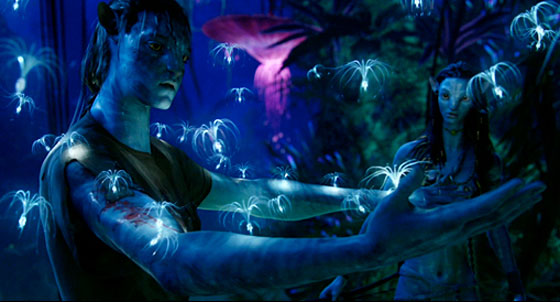
Avatar: James Cameron straight tripping?

Avatar: James Cameron straight tripping?Photo: 20th Century Fox

Even here in Park City, it’s hard to escape Avatar’s long shadow. And it’s not just because everybody’s talking about the sci-fi epic’s record-breaking box office. Comparisons to James Cameron’s film came swiftly among both critics and moviegoers after the premiere of French director Gaspar Noe’s stunning Enter the Void, a borderline experimental techno epic about a junkie whose spirit floats above the streets of nighttime Tokyo after he’s killed during a drug bust. Sort of an art-film counterpart to Cameron’s film, Void is a fever dream that blends elements of 2001, The Tibetan Book of the Dead, and dozens of other films, books, and videogames to craft a journey into an alternate reality, one that seems to have emerged from the deepest recesses of one passionately twisted auteur’s mind. (Though, unlike Avatar, it’s also got acres and acres of explicit sex and nudity.) And for all his arthouse cred, Noe doesn’t seem bothered by the comparisons: He freely cops to loving Avatar, and the fact that he and Cameron share a Stanley Kubrick obsession.

He’s also convinced they have something else in common: “I’m sure Cameron did some mushrooms,” Noe told us during a chat here. “Those scenes in the forest with the glowing plants — if you’ve ever done mushrooms any time in your life, you know those are exactly the kind of visions you have. I’m sure he must have done some ‘mental research’ before he made that movie.” Cameron, of course, has denied ever having done drugs (except inadvertently, when someone infamously spiked the catering for Titanic). Noe shrugs: “Michel Gondry also does very trippy images, and I know for a fact that he’s clean as water. So maybe it’s true.”

For his part, Noe has been fairly open about how drug use played a part in the conception of Enter the Void, which the director has been working on for over a decade. (Along the way, to test out some of his techniques, he made the super-controversial Irreversible, which told a rape-revenge story in reverse, opening with a man being bludgeoned to death on-camera and then progressing backwards to the 10-minute Monica Bellucci rape scene which triggered the act.) “One day, in my 20s, I was with friends, and had done too many mushrooms,” he recalls. “I turned on the TV as I was coming down, and it was showing Lady in the Lake, the Robert Montgomery film noir that’s filmed entirely through the character’s eyes. I wasn’t so much hallucinating at that point, but I thought it would be great to make a movie like this and add all the experiences I had today on mushrooms — telepathic perception, strange colors around people, the sense of floating.”

So, will Enter the Void, which has been picked up by IFC Films and is set to be released later this year, now generate armies of imitators, as Avatar surely will? Noe isn’t so sure. “This is mainly a big budget underground movie, and it could only have been made in Europe. If it wasn’t me, then maybe it would be Lars von Trier or somebody making it. But I don’t know how many people will try to do what we did. It was pretty exhausting.”


Wednesday, September 9, 2009

Interview with Bobcat Goldthwait, Writer/Director of World's Greatest Dad

Posted by Turk182

Bobcat Goldthwait doesn't make movies for the masses. Love them or hate them, you have to respect that his films are not prepackaged creations designed to fit some concept of the popular aesthetic. Like any filmmaker, he wants to connect with an audience, but he is first and foremost interested in making films that he would want to see. Most great filmmakers are. Goldthwait’s World's Greatest Dad is easily his best film to date and one that displays a confidence and awareness that comes with decades of moviemaking experience. He sat down for a spirited and incredibly enjoyable conversation in Chicago this week.


**********


MovieRetriever: When you took World’s Greatest Dad to Sundance and the response was so overwhelmingly positive, were you surprised?

BOBCAT GOLDTHWAIT: Yeah because the last movie I had there, during the press screening, the projector broke down. (Laughs.) I'm just glad that it's been getting a favorable response. I'm fully aware that this movie has a lot of hurdles. If you heard what it was about, you would think that it was a slob comedy and my involvement and Robin. We both come with a lot of baggage. And then the name too. I don't think the name helps us much.

Bobcat Goldthwait on the set of World's Greatest Dad.
Photo courtesy of Magnolia Pictures.


MovieRetriever: Then why choose the name?

GOLDTHWAIT: I thought it was funny when I wrote it. (Laughs.) I thought it was funny, I just think people's perception of, once again, Robin and myself, they think it's going to be a "wacky comedy."

MovieRetriever: There's an interesting line at the beginning where Lance expresses more interest in fame than creative fulfillment.

GOLDTHWAIT: He's saying that he wants success, but in a very cartoony way we see into his psyche what he's really imagining, which is that he'd be popular and have women and money. In my mind, Lance is writing for the wrong reasons. He's trying to ... to try and make stuff artistically and you're thinking of how it's going to affect other people and the repercussions is ... well, I shouldn't say that ... trying to make art for fame and money and all that is really silly. Trying to make stuff to connect with other people is a valid way to make stuff.

MovieRetriever: And the first line of your director's statement is "When I make a movie my only goal is to get to see it projected in front of an audience." But that's more of a connection standpoint than a fame standpoint.

GOLDTHWAIT: Oh, definitely. When it works for people, it's really exciting. I think people find it hard to believe that when I'm writing, I'm not saying "Oh, this will make a lot of money. Oh, this will make me really successful." Those are the furthest things from my mind. I think if I was really trying to make a lot of money, I would try and write a Judd Apatow movie .... or worse ... I'm not really interested in that.

MovieRetriever: But it raises an interesting idea about writing for yourself versus trying to appeal to an audience and how you balance the two. What's more important – if you like it or if the audience likes it?

GOLDTHWAIT: It's definitely ... I'm trying to make movies that I would go to.

MovieRetriever:
You have to satisfy yourself first.

GOLDTHWAIT: Yeah. If it works for other people, that's awesome, but I spent most of my career just reacting to whatever was offered me or trying to pursue the things that Lance is trying to pursue – meet women and get rich. (Laughs.) It doesn't work and it's not very fulfilling.

Robin Williams in World's Greatest Dad.
Photo courtesy of Magnolia Pictures.


MovieRetriever: When and how did you realize that?

GOLDTHWAIT: I realized that when I had all those things that Lance wants. I had the cute girl that's half-in and half-out of the relationship with me. I did have fame and all of that. It never felt right. It never felt right. It always felt really strange. I'm glad I had a persona to hide from ... wait, Freudian slip ... hide BEHIND all those years because it doesn't feel right or good.

MovieRetriever: But now that you've ditched that persona, don't you feel more comfortable?

GOLDTHWAIT: I'm much happier. It's funny. The cynical person who blogs or comments is going to say, "Well, he says he's happier now but...." I read a comment that was like, "That's what someone says when they've made mistakes and burned bridges and they're not happy." It's like, "No, I'm happier now pursuing the things that make me happy." If you've convinced yourself that making money makes you happy, it doesn't. In our culture, people aren't really encouraged to be fulfilled.

MovieRetriever: Especially in celebrity.

GOLDTHWAIT: Yeah. Look, as soon as Howie Mandel hit with that game show, I was offered three pilots and they would have all been for a lot of money. I turned those down not because I'm above it but because I knew that it wasn't going to make me happy. It's not very fulfilling. To have strangers come up and say, "I saw ‘Who's Your Daddy?’ last night and the other guy should have won." I would have put a gun in my mouth. I do stand-up to pay the bills and I've been offered reality shows. I make these tiny, personal movies. I think the mentality that every movie you make is trying to reach the broadest audience [is wrong]. I don't really want to talk to anybody that goes and sees studio comedies. If you write a review of studio comedies, I have nothing in common with you. I couldn't imagine going to any of those movies. I was reading one of those movies and someone was like "This is my pet peeve – that they used something that was in Bring It On and Mean Girls." It's like, "I would rather have someone shoot me in the face than see Bring It On and Mean Girls. I don't even know what the f**k you're talkng about. You're an adult. You went and saw Mean Girls and now you're going to write about it. Seriously?"

MovieRetriever: Well, we do it so we can...

GOLDTHWAIT: Well, if you're FORCED to see them. I understand if it's your job. Look, there's a lot of comedy clubs I don't like playing and that's what I do for a living. I understand that, but to weigh in on those movies as if there's good ones, that's crazy.

MovieRetriever: My theory is that you have to see the sh*t to know what's good.

GOLDTHWAIT: Right. And you're going to stumble across ones that surprise. I remember seeing the first Tremors and loving that movie unexpectedly.

Poster art for World's Greatest Dad.


MovieRetriever: And, to be honest, to tell people about little films like yours, you have to cover the big ones.

GOLDTHWAIT: It's not like I'm back-peddling but there's so many movies made solely with absolutely no voice in the movie. It's nobody's idea. It's just solely to get made to make money to perpetuate fame and they're not about anything.

MovieRetriever: I completely agree and would like to think that I can help people avoid them.

GOLDTHWAIT: (Laughs.) Look, I've been IN plenty of them. But, you know, it's only as a middle-aged man that I looked around and said, "What the f**k am I doing?" You know what's kind of funny now? Now that I've made a couple comedies that worked for some people, Hollywood reaches out a bit because they think "We could get Bob and we could FIX him." The guy who runs some company that made some new movie – He owns a company that wanted to acquire this movie and re-edit it. That's retarded. You would think that a fellow filmmaker would realize that it's all subjective. It's like, "Dude, give me an AVID and a couple days with your film and I'll see what I could do with it." What a knucklehead.

MovieRetriever: I read in another interview that you thought of the ending of this film first. Can you let our readers know the origin of the project?

GOLDTHWAIT: I wanted it to be about a guy who grows up and doesn't do what's expected of him because he's convinced himself that it would make him happy. The only reason that Lance is rewarded by the end is that he's willing to be alone. That's really scary to most people – the idea of being alone. And then the reward is that he ends up with people in his life who like him and are supportive.

MovieRetriever: Whenever a writer makes a film about a writer, one has to wonder how much of the creator is in the character. How much of you is in Lance?

GOLDTHWAIT: About a day in, Robin just goes, "I'm playing you." And I was like, "Yeah." There's a ton of Lance in me. I just spent a good portion of my adult life thinking "Oh, poor me. I'm not getting a break." I realized that none of these things that I was pursuing were going to ever really make me happy – relationships or work.

Bobcat Goldthwait (left) and Robin Williams in World's Greatest Dad.
Photo courtesy of Magnolia Pictures.


MovieRetriever: If it's you, would you ever consider directing yourself in a movie?

GOLDTHWAIT: No. I really, really, really take making movies seriously and I want to put all of my energy into being the best writer and director I can be and I think it would be distracting. I make a cameo and it wasn't even really to be cute. Guillermo from the Kimmel show was supposed to play that part and he couldn't get the day off. He was doing a remote in Florida and I was in Seattle. I scrambled and held auditions that didn't go very well. I put myself in and I think it's funny how much I choked when the door opened up and it was Robin. (Laughs.) It was like The Chris Farley Show.

MovieRetriever: Did you write the part for Robin?

GOLDTHWAIT: No, no. I really would have stayed away from "poetry teacher who faces tragedy." (Laughs.) He really is one of the greatest actors in the world. I can't explain what really makes him good. It isn't just the empathy that people feel. It's so tiny and so natural. That's really the genius. It's the tiny moments that really....

MovieRetriever: Did you allow Robin input into his character?

GOLDTHWAIT: The reality is that there's a lot of ad-libbing but it's much more collaborative. You sit there and say, "What about this and that?" It's not just Robin. The kids asking questions about Kyle – I had written stuff but it just didn't work. So, I got all the kids together and let them come up with what they would ask. You trust the people you work with. Especially actors. I never hire anyone who doesn't get what they're doing. You need to get what the whole thing is about or I wouldn't have you on-board. I try not to hire people who just "do what they do" and don't get it.

MovieRetriever: Did Bruce Hornsby (who makes a great cameo) get it?

GOLDTHWAIT: Totally. And if he didn't, it would have come off as snarky. I needed someone that Lance would be a fan of. One of the nice byproducts of this movie is that people have a perception of me that I'm doing my best to change but people also have a perception of Daryl, Robin, Bruce Hornsby ... it's fun to say, "You know, it ain't over."

MovieRetriever: Do you prefer acting or directing?

GOLDTHWAIT: I prefer directing. If I never acted again, I would be really happy. Now that I take directing seriously, I have this whole new respect for actors.

MovieRetriever: What about your acting experience makes you a better director?

GOLDTHWAIT: I really stress that it's comfortable for the actors. On a set, there can be too much calamity. Actors can not feel safe and not feel like they're allowed to try different things or suggest different things. The bond company may want to shut me down, but I'll do another one because it's really terrible to be on a set making a comedy and everything is really stressful.

Alexie Gilmore (from left), Robin Williams, and Zach Sanchez
in World's Greatest Dad. Photo Courtesy of Magnolia Pictures.


MovieRetriever: Did you have too many uncomfortable set experiences or is there something about it you just don't enjoy?

GOLDTHWAIT: I don't enjoy it but I also feel that I don't think that it's what I'm strong at. I think there's a lot of people that are talented. It's funny. If you really boil Robin down, he thinks of himself as an actor first.

MovieRetriever: And you now think of yourself as a director first?

GOLDTHWAIT:
TRYING to be a director. Trying to be a writer. And that's how I know that it's what I really want to do. I'm really trying.

MovieRetriever: You have so much creative control over your films now. Would you take an assignment or someone else's script ... $80 million budget, Ryan Reynolds, Sandra Bullock, back-end ... do you do it?

GOLDTHWAIT: (Laughs.) Sandy and Ry. No. No.

MovieRetriever: $10 million paycheck. Proposal, Part II.

GOLDTHWAIT:
No, no, no.

MovieRetriever: What if it's the opposite? A GREAT script, but you didn't write it?

GOLDTHWAIT:
Yeah. If it was a great script, but the problem would be the interference from ... getting notes and stuff. These last two movies were so small that I didn't get producer notes. Or from anybody. I want to keep doing that. I'll take jobs working for other people but the movies I'm making, I don't want to do that. I'm trying to build a trust with people.

MovieRetriever: Who has built a trust with you?

GOLDTHWAIT:
There's so many people. Wes Anderson. There's so many folks. I like Quentin Tarantino, the Coen brothers, it's pretty basic stuff. I like going to see what P.T. Anderson does.

MovieRetriever: All writer/directors.

GOLDTHWAIT:
All people who have a voice. I admire them. I get excited to watch their new stuff.

Bobcat Goldthwait's 2003 release I Don't Mean to Insult You,
But You Look Like Bobcat Goldthwait.


MovieRetriever: Do you still do stand-up?

GOLDTHWAIT: I do it to pay bills.

MovieRetriever: Do you enjoy it still?

GOLDTHWAIT: I didn't for the longest time and then recently I killed the character. And, by the way, if you're in the heartland and people come to see you do that? It's like being at a Poison reunion tour and not hearing "Every Rose Has Its Thorn." There's gonna be disgruntled audience members.

MovieRetriever: You must get asked to do it in airports.

GOLDTHWAIT: Sure. And morning radio shows. "The Taint and Teabag Show." Whatever. It's my own fault. I remember once seeing Spinal Tap performing live and Rob Reiner is there and the crowd starts going "Meathead! Meathead!"

MovieRetriever:
Even he can't avoid his past.

GOLDTHWAIT: Yeah. And Ron Howard.

MovieRetriever:
What's your airport question?

GOLDTHWAIT:
I named a CD this because it was true. I did have a woman say, "I don't mean to insult you, but you look like Bobcat Goldthwait." A lot of people when they come up to me in an airport, they're unsure that it's me. And I do often hear, second hand, that people think I'm dead.

**********


**********

Bobcat Goldthwait is definitely alive and kicking.
His film, World's Greatest Dad, opened in Chicago on Sept. 4, 2009.

Monday, January 26, 2009

List of 2009 Sundance Film Festival awards winners


By The Associated Press

-- The Sundance Film Festival's 2009 audience and jury awards, presented Saturday in Park City, Utah:

_ Grand jury, U.S. drama: "Push: Based on the novel by Sapphire"

_ Audience, U.S. drama: "Push: Based on the novel by Sapphire"

_ Grand jury, U.S. documentary: "We Live in Public"

_ Audience, U.S. documentary: "The Cove"

_ Grand jury, world cinema drama: "The Maid (La Nana)"

_ Audience, world cinema drama: "An Education"

_ Grand jury, world cinema documentary: "Rough Aunties"

_ Audience, world cinema documentary: "Afghan Star"

_ Waldo Salt screenwriting award: Nicholas Jasenovec and Charlyne Yi, "Paper Heart"

_ Directing, U.S. drama: Cary Joji Fukunaga, "Sin Nombre"

_ Directing, U.S. documentary: Natalia Almada, "El General"

_ Directing, world cinema drama: Oliver Hirschbiegel, "Five Minutes of Heaven"

_ Directing, world cinema documentary: Havana Marking, "Afghan Star"

_ Screenwriting, world cinema drama: Guy Hibbert, "Five Minutes of Heaven"

_ Editing, U.S. documentary: Karen Schmeer, "Sergio"

_ Editing, world cinema documentary: Janus Billeskov Jansen and Thomas Papapetros, "Burma VJ"

_ Cinematography, U.S. drama: Adriano Goldman, "Sin Nombre"

_ Cinematography, U.S. documentary: Bob Richman, "The September Issue"

_ Cinematography, world cinema drama: John De Borman, "An Education"

_ Cinematography, world cinema documentary: John Maringouin, "Big River Man"

_ Special jury prize for originality, world cinema drama: "Louise-Michel," directed by Benoit Delepine and Gustave de Kervern

_ Special jury prize, world cinema documentary: "Tibet in Song," Ngawang Choephel, director

_ Special jury prize for acting, world cinema: Catalina Saavedra, "The Maid (La Nana)"

_ Special jury prize, U.S. documentary: "Good Hair," Jeff Stilson, director

_ Special jury prize for spirit of independence: "Humpday"

_ Special jury prize for acting: Mo'Nique, "Push: Based on the novel by Sapphire"

_ Jury prize, U.S. short filmmaking: "Short Term 12," Destin Daniel Cretton, director

_ Jury prize, international short filmmaking: "Lies," Jonas Odell, director

_ Alfred P. Sloan prize: "Adam," Max Mayer, director

Tuesday, January 20, 2009

Fighting for Recognition: ‘Tyson’ at Sundance

James Toback

Mike Tyson in the documentary "Tyson," which is being shown at the Sundance Film Festival. More Photos >

Published: January 18, 2009

PARK CITY, Utah — The Sundance Film Festival always has much on its plate. And one of the jobs served up this year involves feeding Mike Tyson.

Shea Walsh/Associated Press

Mike Tyson on Main Street in Park City, Utah, for Sundance. More Photos »

On Saturday night, John Besh, the New Orleans restaurateur, was preparing to do exactly that at Bon Appétit’s temporary supper club, which is perched on a slight rise above the party tents on Main Street here.

The menu was built around Kobe beef short ribs stripped from the bone and cooked for 26 hours at precisely 141 degrees. “Since we’re cooking for Mike Tyson, I wanted big blows for the palate but also some food for the soul,” Mr. Besh said, shortly before pouring the soupe de poisson with blue crab and tapioca.

The idea is not so much to sate the appetite of Mr. Tyson, a 42-year-old former boxer who has been in and out of jail, as to create a bit of theater around a documentary film about him.

The movie, “Tyson,” directed by James Toback, screened earlier on Saturday to a packed house of about 450 at a the town library, where the film was screened. Mr. Tyson spoke briefly afterward, but the real event was simply his presence.

“Mike Tyson’s coming in!” Pierce Brosnan said as he left the supper club from an earlier dinner honoring his own movie, “The Greatest,” shortly before Mr. Tyson walked in through a crowd of gawkers.

The new film tries mightily to find a redemption story in Mr. Tyson’s rise, fall and reconciliation with his demons. “The regeneration, reconstruction and rehabilitation of a great spirit is always possible,” Mr. Toback said, summing up his movie’s moral during cocktail hour at the supper club.

Still, Mr. Tyson appears to remain more spectacle than morality tale, which is not altogether a bad thing as far as Sundance is concerned.

One of the festival’s jobs, bluntly put, is to sell documentaries. In one of the “Storytime” memory reels attached to the beginning of each screening here, Robert Redford, the festival’s patriarch, muses of documentaries: “What if we use the festival to promote them on an equal footing with theatrical films?”

The key word is promote, and it is not necessarily a dirty one. Despite a supposed marketplace surge that came with the runaway success of Michael Moore’s “Fahrenheit 9/11” in 2004, documentaries generally remain a poor relation at the box office.

Many of the art form’s bigger box-office hits have been political. Those include Mr. Moore’s “Sicko” and “Bowling for Columbine,” as well as Davis Guggenheim’s “Inconvenient Truth,” the global warming film with Al Gore.

Every once in a while a nonpolitical specimen breaks the rules by doing as well as any other kind of feature film. The last such example was “March of the Penguins,” which took in $77 million at the domestic box office after Warner Independent Pictures released it in 2005.

But the record has been much spottier for most documentaries. Sony Pictures Classics, which only days ago acquired rights to distribute “Tyson,” in the last couple of years released “Waltz With Bashir,” “Jimmy Carter, Man From Plains” and “My Kid Could Paint That,” none of which has topped $1 million at the box office, although “Waltz With Bashir,” which won a Golden Globe award, is still playing.

“Nine months ago we were thinking we weren’t going to do any more documentaries,” said Michael Barker, co-president of Sony Pictures Classics, speaking at the same reception. “Then you see a film like this.”

Where “Tyson” is concerned, Sundance has some work to do. The festival is supposed to reignite interest in a movie that’s been around for a while: It has screened at a number of festivals, including Cannes, where Mr. Tyson and Mr. Toback did some heavy selling last May.

On a large scale, Sundance is supposed to use its promotional tricks — among them, feeding the 90 movie and media types at this dinner — to convince people that there really is something appetizing about real-life stories told, on the whole, with fidelity to the facts.

For Mr. Barker, the next step is to begin releasing “Tyson” in theaters on April 24. The plan, he said, is to cultivate both the art-house crowd and African-American viewers, aiming for a crossover hit like “Hoop Dreams,” a 1994 basketball documentary that took in $7.8 million.

If Mr. Tyson caused excitement on Saturday night, the same sort of sizzle was in the air that morning, when several hundred festival-goers started lining up four hours early at the Har Shalom Temple’s theater for a look at “The September Issue,” another documentary. That one follows the fashion editor Anna Wintour as she assembles the September 2007 issue of Vogue magazine.

Theatrical rights to “The September Issue” are for sale here by the Creative Artists Agency, so even Ms. Wintour, whose legendary lack of warmth is a theme in the film, had some promoting to do.

Tucked inside a jacket edged with a big fur collar, she took questions from John Cooper, the festival’s director of programming, on Saturday.

Mr. Cooper asked Ms. Wintour about the experience of watching underlings dissect her vision and decisions on screen, not always in flattering ways. “There wasn’t much in there I didn’t know before,” she said.

“Do you like it?” Mr. Cooper persisted, referring to the film, which was directed by R. J. Cutler, a producer of “The War Room,” about Bill Clinton’s 1992 presidential campaign.

“It’s quite hard to look at oneself in such an intense way,” Ms. Wintour said. But, she added, “I’m very glad to have a record of what we do.”