Zazzle Shop

Screen printing
Showing posts with label President Bush. Show all posts

Monday, November 22, 2010

Barbara Bush: I Wish Sarah Palin Would Stay In Alaska

George Bush was asked by Larry King what he thinks of the Tea Party. The former President answered, “I don’t know what it really is Larry.” “I’m confused by it frankly.” King asks Barbara Bush how she feels about Sarah Palin.

Like me, she wants her to stay in Alaska. No, really.

You just know that’s what they’re all thinking, really. This should confuse the hell out of Sarah Palin’s apologists.

Thursday, January 22, 2009

George Bush's Obama Speech Doodles

http://cdn.holytaco.com/www/sites/default/files/images/Bush-Notes.jpg

As George W. Bush leaves, so does pardon shot for Roger Clemens

There was no last-minute pardon for Roger Clemens before President Bush left the White House Tuesday, and the federal grand jury that has been examining evidence that the former Yankee star committed perjury will continue its work.

Brian McNamee's attorney Richard Emery raised the possibility of a Bush pardon after Clemens testified at the Feb. 13, 2008, congressional hearing on the Mitchell Report.

"We're glad neither Clemens nor Bush stooped to conquer," Emery said. "We hope by raising the issue we inoculated it and helped avoid it."

Emery said he raised the pardon issue because Republican members of the House Committee on Oversight and Government Reform seemed eager to protect Clemens and attack McNamee during last year's hearing.

Clemens also brought up his friendship with former President George H.W. Bush during the hearing. Clemens testified that he was never contacted by former Senate Majority Leader George Mitchell or his investigators, but Bush Sr. tracked him down on a duck hunt to wish him well after the release of the explosive report on steroids and baseball.

Clemens' attorney Rusty Hardin has said he would not seek a pardon on behalf of the seven-time Cy Young Award winner. Hardin has steadfastly denied his client ever used performance-enhancing drugs, and has said innocent people don't ask for pardons.

"Richard Emery just has to quit smoking his own dope," Hardin said after Emery first raised the pardon issue.

Despite Clemens' ties to the Bush family, Washington insiders said in recent weeks that a pardon was unlikely.

One reason revolved around race. Barry Bonds' perjury trial is scheduled to begin in March in San Francisco. Olympic track star Marion Jones, who served a six-month prison sentence for lying to federal investigators and check fraud, unsuccessfully sought a pardon. Bush would have ignited angry protests if he intervened for Clemens but not for two prominent African-American athletes.

Bush made headlines when he commuted Scooter Libby's 30-month prison sentence in 2007, but the 43rd President was apparently not a fan of pardons. Bush may still be smarting from his Dec. 23 pardon of Isaac Toussie, who pleaded guilty in 2001 to lying to the feds to obtain mortgages for unqualified home buyers. Bush later revoked the pardon after the Daily News reported that Toussie's father had donated $28,500 to the Republican National Committee.

If Bush did get involved in the Clemens investigation, he would have raised questions about his own, albeit indirect, role in Major League Baseball's steroid scandal. Bush was the the managing general partner of the Texas Rangers when Jose Canseco claims he taught his teammates about performance-enhancing drugs.

Bush raised the steroid issue in his 2004 State of the Union address, when he called on sports leagues to crack down on drugs.

"The use of performance-enhancing drugs like steroids in baseball, football and other sports is dangerous, and it sends the wrong message - that there are shortcuts to accomplishment and that performance is more important than character," Bush said.

Tuesday, January 20, 2009

A Look Back at Bush's Economic Missteps

Brooks Kraft / Corbis for TIME

INTRODUCTION

George Bush is leaving the White House with a dismal economic record. By almost every measure — GDP growth, jobs, median incomes, financial-market performance — he stacks up as probably the least-successful President on the economic front since Herbert Hoover.

It's not all Bush's fault. He inherited an inevitable recession in 2001, and even last year's financial collapse was to some extent the result of unsustainable trends in place long before he moved to Washington. Also, we generally give Presidents both more credit and more blame for economic outcomes than they probably deserve. As Bush mock-moaned in his final White House press conference, "Why did the financial collapse have to happen on my watch?"

His next words, though, were, "It's just pathetic, isn't it, self-pity?" So let's spare him the pity. As the decider in the White House for the past eight years, George Bush made some economic calls that don't look smart today. Here are eight of them.


1. The Return to Deficits

Jim Young / Reuters

When President Bush took office in 2001, Republicans and Democrats in Washington had built a strong consensus on the need for fiscal responsibility. Bush blew that apart within a few months. With the country in a recession, a temporary return to deficits was inevitable. But Bush's tax cuts and spending increases — and clear disdain for the pay-as-you-go approach that had brought deficits down in the 1990s — brought a return to permanent deficits. These actions almost certainly didn't cause the current crisis, but they have left the Federal Government in a much weaker position to combat it.


2. Iraq

Spencer Platt / Getty

Doing a cost-benefit analysis on a war is awfully hard. There are just too many what-ifs. But the cost of invading and occupying Iraq has been staggeringly high — whether you believe the $3 trillion figure of economists Linda Bilmes and Joseph Stiglitz or side with the Congressional Budget Office estimate of a mere trillion or two. It's the biggest part of the explanation for the yawning Bush-era budget deficits. So even if you think the war did bring benefits to the U.S., they would have to be pretty gigantic to justify the cost.

See pictures of Bush's friendship with Tony Blair.


3. Tax Cuts for the Rich

Rhona Wise / AFP / Getty

When Ronald Reagan slashed taxes on capital gains and high earners in the early 1980s, inflation was pushing the middle class into top tax brackets, financial markets had been stuck in a funk for 15 years and income inequality had been declining for almost five decades. Like him or not, the man's actions fit the times — and the U.S. economy boomed for most of his two terms in office. Bush came to Washington facing almost diametrically opposing economic conditions, yet he offered up the same solutions as Reagan. Guess what: they weren't what the economy needed.

See TIME's gallery of politicians outed in scandals.


4. Financial Regulation

The only major piece of regulatory legislation enacted during the Bush years was the Sarbanes-Oxley Act, which dramatically increased regulation of corporate financial disclosures. The really big regulatory changes being pointed to now as possible culprits for the crisis date back to Bush's predecessors: Bill Clinton, Ronald Reagan, even Jimmy Carter and Gerald Ford. So the popular Democratic refrain that "Bush-era deregulation" is to blame for our troubles is a little hard to square with the evidence. What is true is that most Bush-era financial regulators were less than enthusiastic about the very act of regulating, and that Bush's "ownership society" push glossed over a lot of potential dangers. Bush didn't cause the financial regulatory breakdown, but he didn't jump in to fix it either.

See pictures of the top 10 scared traders.


5. Telling Us to Go Shopping

Mario Tama / Getty

After the 9/11 terrorist attacks, President Bush didn't call for sacrifice. He called for shopping. "Get down to Disney World in Florida," he said. "Take your families and enjoy life, the way we want it to be enjoyed." Taken on its own, this wasn't such a horrible sentiment. But Boston University historian Andrew Bacevich has made a convincing case that it was part of a broader pattern of encouraging financial irresponsibility. "Bush seems to have calculated — cynically but correctly — that prolonging the credit-fueled consumer binge could help keep complaints about his performance as Commander in Chief from becoming more than a nuisance," Bacevich wrote in the Washington Post in October. Now we're paying the bill.

See pictures of expensive things that money can buy.


6. Energy Policy

Justin Sullivan / Getty

Not much to say here, except that there wasn't an energy policy. Again, this wasn't new to the Bush era. But with a years-long oil-price slide finally coming to an end not long before he took office, the President's (and Vice President's) unwillingness to take serious steps to reduce the country's dependence on fossil fuels left the country vulnerable and way behind the rest of the developed world in preparing for a post-oil future.


7. A State of Denial

Stephen Jaffe / AFP / Getty

Every Administration spins and sugarcoats the economic truth. But the Bush White House took this disingenuousness to new levels. The surest way to get yourself fired as a Bush economic adviser was to say something that was true. Paul O'Neill was ousted from Treasury for warning about deficits. Larry Lindsey was kicked out of the top White House economic job for predicting in 2002 that the Iraq war would cost $100 billion to $200 billion — far below the actual cost but much more than what the White House was officially projecting. This disdain for reality, and for expertise, pervaded the Bush economic approach, and made it impossible for the Administration to react intelligently to real-world economic problems like the housing bubble.

Read "Four Steps to Ending the Foreclosure Crisis."


8. The Muddled Bailout

Gerald Herbert / AP

It could have been much, much worse. For the first time, Bush gave someone with more expertise than political bona fides — Treasury Secretary Henry Paulson — control over economic policy and didn't let the hacks in the White House undercut him. Paulson's financial rescue has been awfully messy and expensive, but one shudders to think what might have happened if his much weaker predecessor, John Snow, had still been in charge at Treasury when trouble struck. The main problem has been the ambivalence with which both Paulson and the White House have approached the financial rescue. They backed into it, never articulating clear principles for how it should work. That's yet another thing the new Administration is going have to rectify.

See pictures of TIME's Wall Street covers.

Whitehouse: How to move two presidents in six hours

(CNN) -- Comedian Mark Russell was at a recent event in Chicago, Illinois, when he found himself sitting next to Valerie Jarrett, an adviser to President-elect Barack Obama.

Moving the Obamas into the White House will take about six hours.

Moving the Obamas into the White House will take about six hours.

Russell asked her whether President Bush's staff members were going to remove all the Os from their computer keyboards, alluding to the 2001 incident in which President Clinton's departing staff removed Ws from some White House computers.

Jarrett said no, but that didn't stop Russell from speculating what really happened when President Bush's daughters, Barbara and Jenna, gave Obama's two daughters a tour of the White House recently.

"The Bush daughters showed Sasha and Malia Obama around," Russell joked. "Barbara showed them where all the bedrooms were, and Jenna showed them how to make a fake ID."

Russell sees humor in the presidential transition, but the actual operation to move both families in and out of the White House is serious business.

The clearing out of the Bushes' belongings began over the summer, when many items were packed and taken to Crawford, Texas, says Anita McBride, chief of staff to first lady Laura Bush. Then, during the Christmas holiday, the Bushes moved their personal things out of Camp David, the presidential retreat in Maryland, according to McBride.

On January 20, the Obamas move in -- a side of Inauguration Day that most people never see: a grueling, precisely timed workday involving scores of staffers that follows six months of careful planning.

The Bushes welcome the Obamas to the White House in November.

The Bushes welcome the Obamas to the White House in November.

Gary Walters worked at the executive mansion from 1986 until 2006 as chief usher in charge of moving presidential families in and out of the White House. From his Virginia home, Walters described how the complicated Obama move in to the White House is completed in only a few hours.

In the morning, after the Bushes and Obamas depart the executive mansion for the Capitol Hill swearing-in ceremony, moving trucks will roll up to the south side of the White House, Walters said.
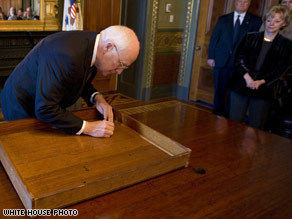
Vice President Cheney signs his office desk, following a tradition started by Teddy Roosevelt.

Vice President Cheney signs his office desk, following a tradition started by Teddy Roosevelt

The drivers put down their tailgates, allowing most of the White House's 93 staff members to begin unloading Obama family items, he said.

"Staff members all have been given very specific jobs on that day, almost down to the minute as to what their responsibilities are," Walters said.

The move is designed to be seamless, painless and invisible while millions of Washington visitors -- and millions more watching on TV -- follow the inauguration ceremonies and the parade that follows.

By about 5 p.m., before the Obamas move from the parade viewing stand to their new home, the presidential move must be complete.

"Their clothes will be in their closets; everything will be put away," Walters said. "There should be no full or half-empty boxes will in view. Furniture will be set in proper places. Their favorite foods will be in the kitchen or the pantry. The chief usher will welcome them into their home and ask them what they would like to do before going out to enjoy the inaugural balls."

Incoming first lady Michelle Obama's mother, Marian Robinson, will also be moving into the White House residence, which has 24 rooms on the second and third floors. The Obamas have hired California decorator Michael Smith to use an allocated $100,000 to redecorate the space. Video Watch what decorator may do with the White House »

"I think they're going to find that this is really conducive to family life," President Bush told CNN's Larry King. "President-elect Obama has got a 45-second commute to see his girls."

In the West Wing of the White House, the political jostling has begun among new staffers to grab workspaces near the center of power: the Oval Office.

White House move

  • The move is performed by most of residence staff, which numbers 93.
  • It takes place from 11 a.m. to 5 p.m. on the south side of the White House.
  • At least two or three trucks will take part.
  • Tents, chemicals on hand in case of ice, snow or rain.

Source: Former White House Chief Usher Gary Walters

There, the carpet is changed with each new administration to suit the incoming president, Walters said. Possibly, the office desk will be changed, as will paintings that will be hung on the wall.

Books on the Oval Office shelves will be changed per the new commander in chief, as will accessories to be placed around the room, Walters said. Staffers may tote in a new sofa and chairs -- or busts of past presidents.

Following tradition, Bush is expected to leave a personal letter written to Obama. Past letters have offered the new president private words of advice and reflection.

Several Democratic presidents have chosen to hang a Thomas Sully painting of President Andrew Jackson in the Oval Office, said political scientist and historian Martha Joynt Kumar, an expert on the White House. "In the residence, many presidents have brought their personal paintings to decorate their living space."

After movers tote out boxes of office materials from Bush staffers, the West Wing will become a dusty workspace, with empty bookshelves and the odd three-ring binder left behind, say veterans of the White House press corps.

As in previous moving periods, contractors may come to slap on a coat of paint or lay carpet as the new crop of staffers finds their workspaces.

"It was incredible," former Clinton staffer David Seldin said, recalling his experience on Inauguration Day 1993. "I think people were overwhelmed with the sense that it was real and the sense that something that you had been working on as a political campaign is actually becoming part of the government."

On Tuesday, once the whirlwind moving operation is finally done, Chief Usher Stephen Rochon will probably greet Obama the same way Walters did Bush in 2001.

Standing near the doorway to the White House North Portico, Walters recalls, he said, "Hello, Mr. President, welcome to your home."

Oh, and about those Os on White House keyboards -- two Bush officials told CNN on Sunday that outgoing aides won't be getting payback on the incoming Democratic administration.

There is an understanding that Bush will be furious if there are any pranks, especially after cordial transition between the two administrations, the officials said.


Friday, November 14, 2008

Presidential Shocker.............WTF


President George W. Bush poses with members of the Arizona State University Men's and Women's Track Team Wednesday, Nov. 12, 2008, during a photo opportunity with 2008 NCAA Sports Champions at the White House. White House photo by Eric Draper
President George W. Bush poses with members of the Arizona State University Men's and Women's Track Team Wednesday, Nov. 12, 2008, during a photo opportunity with 2008 NCAA Sports Champions at the White House. White House photo by Eric Draper Full Story


Different names for the shocker

Wiki on the Shocker