Zazzle Shop

Screen printing

Friday, January 9, 2009

Cigar Aficianado's Top 25 Cigars of 2008 (1-5)

The Fuente family has been making Arturo Fuente Don Carlos cigars since 1976, longer (by four years) than they have been making cigars in the Dominican Republic. The blend is the creation of Carlos Fuente Sr., patriarch of the family. In 2006, his son, Carlos Fuente Jr., made the Don Carlos Edición de Aniversario to celebrate the 30 years of Don Carlos cigars. He swapped out the Cameroon wrapper for the Dominican shade-grown leaf he uses on Fuente Fuente OpusX. He also boosted the cigar’s power considerably.

The result is a tremendously intense and complex blend, especially in the Double Robusto size. The cigars are wonderful, but especially hard to find due to their extremely limited production—only 9,000 cigars were released in 2008.


MADE BY: Tabacalera A. Fuente y Cia.
FACTORY LOCATION: Dom. Rep.
WRAPPER: Dom. Rep.
BINDER: Dom. Rep.
FILLER: Dom. Rep.
PRICE: $32.00
RING GAUGE: 52
LENGTH: 5 3/4"
RATING: 94

La Aroma de Cuba is an old Cuban brand name, believed to have been a favorite of Sir Winston Churchill. Ashton Distributors created a Honduran version of the brand in 2003, made by La Flor de Copan, and last summer it added the Edición Especial variation, which it contracted out to the hottest name in the cigar business, Jose “Pepin” Garcia. Pepin’s La Aroma de Cuba is the best yet, made with his trademark Nicaraguan filler and binder tobaccos, and covered in something relatively new for him, Ecuadoran leaf.

The belicoso-shaped No. 5 is a wonderful smoke, brimming with spice, coffee and cocoa notes. Ashton is becoming a major client for Garcia. This is the second major cigar brand he has made for the Philadelphia-based company, a follow-up to his San Cristobal—one size of which took the No. 12 slot in our 2007 ranking.


MADE BY: Tabacalera Cubana S.A.
FACTORY LOCATION: Nicaragua
WRAPPER: Ecuador
BINDER: Nicaragua
FILLER: Nicaragua
PRICE: $7.80
RING GAUGE: 52
LENGTH: 5 1/2"
RATING: 93

Litto Gomez has, arguably, the most innovative mind in the cigar business. The proof is evident in his Chisel-shaped cigar, which first appeared in his La Flor Dominicana Double Ligero line. With its wedge-like head, the Chisel is Gomez’s unique spin on a figurado: he was inspired to create the size after chewing on a torpedo. The Diez line was Gomez’s coming-out party for his wrapper tobacco, which he grows on a farm in La Canela, Dominican Republic.

Gomez, known for his distinctive Montecristi Panama hat, launched the Diez line in 2004 to commemorate his 10th year in the cigar business. He made a change to the cigar last year, adding a vintage date to showcase the year of release—2008 is the first. While he also says he tempered the blend a bit, the Chisel remains a favorite of seasoned smokers, full of prominent leather and black pepper notes, and just enough balancing sweetness. The cigar is a work of art, and the flavor unmistakable.


MADE BY: Tabacalera La Flor S.A.
FACTORY LOCATION: Dom. Rep.
WRAPPER: Dom. Rep.
BINDER: Dom. Rep.
FILLER: Dom. Rep.
PRICE: $11.00
RING GAUGE: 54
LENGTH: 5 1/2"
RATING: 93

Eighty-three years ago this coming June, José Orlando Padrón was born in Pinar del Río, Cuba. He emigrated to the United States, and in 1964 he founded Padrón Cigars Inc. in an attempt to re-create the beloved Cuban cigars of his youth. The first Padróns were humble, 30 cent fumas sold exclusively in Miami. The cigars were later taken nationwide, largely due to Padrón’s son Jorge, now president of the company. Numbers are important to the Padróns: the 1964 Anniversary Series marks the year the company was founded, and the Serie 1926 line commemorates the birth year of the company patriarch.

This year’s No. 2 cigar celebrates his 80th birthday. It is undeniably an amazing cigar, teeming with complexity and depth that can only be achieved through inventories of well-aged tobacco. The cigar has the signature Padrón flavor: cocoa, coffee, nuts and toast; it also has orange peel, leather and some spice on the finish. It is made with some of the company’s oldest leaves by only one buncher and one roller, who create but 300 cigars per day. It’s a rare find. The Padróns, two-time winners of our Cigar of the Year contest, have never finished lower than third in this ranking. Their long-standing philosophy is that they make cigars to suit their own taste, and sell what they don’t smoke.


MADE BY: Padrón Cigars Inc.
FACTORY LOCATION: Nicaragua
WRAPPER: Nicaragua
BINDER: Nicaragua
FILLER: Nicaragua
PRICE: $30.00
RING GAUGE: 54
LENGTH: 6 3/4"
RATING: 96

Manuel Quesada has been making cigars since 1974. His original cigars were mild bodied, most of them a blend of Dominican filler and binder tobaccos cloaked with light Connecticut-seed wrappers. His latest endeavors are bolder, more vibrant smokes. The Casa Magna is his greatest innovation. He joined forces with Nicaragua’s largest grower of cigar tobacco, Nestor Plasencia, and created this blend in Plasencia’s Segovia Cigar factory. The line of five cigars saw first light in the summer at an industry trade show and the entire brand was initially reviewed in the August 26 Cigar Insider. Standing above the other sizes was the robusto, a stubby cigar with a bold heart of Cuban-seed tobacco, all of it grown in two very different regions of Nicaragua: tobacco from Estelí (the area where most Nicaraguan cigars are produced) tends to be strong, while that grown in Jalapa, to the north, is typically more balanced and elegant. Together they combine to create a full-flavored cigar, full of rich coffee notes and balanced by a cedary sweetness with a hint of raisins.

Best of all is the price: at only $5.25, this superb smoke is less expensive than all but one cigar on this list (No. 23, which is a nickel cheaper.) The word “Colorado” in the brand name refers to the dark, slightly reddish hue of the wrapper, and is a hint that Quesada will expand this line to more styles. It will be hard to improve upon this.


MADE BY: Segovia Cigars (Nestor Plasencia)
FACTORY LOCATION: Nicaragua
WRAPPER: Nicaragua
BINDER: Nicaragua
FILLER: Nicaragua
PRICE: $5.25
RING GAUGE: 52
LENGTH: 5 1/2"
RATING: 93

Bringing 3D Home


Credit: Technology Review

According to industry estimates, there are already some two million television sets in homes that are ready to show 3-D video. The only problem is that there aren't a lot of 3-D broadcasts ready to roll. At this year's Consumer Electronics Show (CES) in Las Vegas, however, electronics and 3-D production companies are showing off the potential of 3-D content with the hope that in-home 3-D television will be mainstream within a couple of years.

The experience of watching a movie in 3-D has changed significantly over the past few decades. Gone are the red and blue cardboard glasses that meld two different images together and often distort on-screen colors. Directors and cinematographers have also learned to avoid gimmicks, like a pie in the audience's face, and are trying to use the extra dimension to tell the story better. Many new televisions are already shipping with software and hardware that supports 3-D, and some early adopters are taking advantage of the technology with video games.

Mitsubishi, Samsung, Panasonic, Sony, and JVC will all be showing off 3-D products at CES. Companies including RealD and Dolby have developed technology that provides the correct visual information to the left and right eye using polarizing lenses that filter two differently polarized versions of video footage to their respective eyes. By contrast, old 3-D movies used a method called anaglyph in which the film for one eye is dyed red and the other blue, while red-and-blue-tinted lenses filtered the appropriate version for each eye.

Mitsubishi and Samsung, for instance, have developed televisions that synchronize with another type of glasses that use shutters synchronized with the timing of the film's frames and an infrared cue from the display source. For this to work, television must operate at a frequency of at least 120 hertz so that the left-eye and right-eye information can each receive 60-hertz signals.

Philips has offered a display that bypassing the glasses altogether. Its 3-D television plays specially created videos that contain two frames for each scene, one with color information, and the other with grayscale depth information. Lenses on the screen itself project these slightly different images to the left and right eyes, creating the illusion of depth.

"3-D has picked up steam, in large part driven by the amount of movie-theater content out there," says Mark Hartney, managing director of the 3D@home consortium, an organization created in 2008 to speed up adoption of the technology. Hannah Montana and Journey to the Center of the Earth were both released in 3-D in 2008, and Hollywood is responding with more: three times as many 3-D movies are planned for 2009 than showed in 2008.

The movie industry has already tackled some of the biggest production and postproduction challenges by building effective 3-D camera rigs and software for cleaning up the artifacts that arise when a movie is shot with two separate cameras. (See "Making a Modern 3-D Movie.") People are becoming more accustomed to seeing movies in 3-D, Hartney says. "Now the question is, how do we translate that into home?"

One way may be to simply broaden the variety of 3-D content available. Yesterday at CES, Sony and production company 3ality presented a 3-D version of the FedEx BCS Championship game between the University of Florida and the University of Oklahoma at a Las Vegas theater. The game was also broadcast live in 3-D to more than 80 theaters around the country.

But in-home 3-D also faces a significant technical challenge: twice as much information is needed (one video image for each eye), so footage has to be compressed before broadcast. This means developing standards to ensure a uniform viewing experience across types of displays. "There are a handful of companies working on [compression] formats," says Hartney, including Sensio and TDV. "They're trying to be compatible with existing televisions . . . to convert 2-D to 3-D for broadcast."

Chris Chinook, president of Insight Media, a display consultancy, predicts that 3-D in-the-home technology will gain traction in 2009, but won't break out into the mainstream for another couple of years. "A lot of it's evolutionary and stuff we've been expecting," Chinook says of CES. "But seeing stuff supported and demoed by major companies is a milestone." In 2009, 3-D momentum will build, he adds. "But most of the stuff at the show is going to be demos of products that will hit the market in late 2009 or in 2010."

NanoTube Super Batteries


Pure power: Pure thin films of carbon nanotubes can store and carry large amounts of electrical charge, making them promising electrode materials. This scanning-electron-microscope image shows a film made up of 30 layers of the nanotubes on a silicone substrate.
Credit: Journal of the American Chemical Society

Researchers at MIT have made pure, dense, thin films of carbon nanotubes that show promise as electrodes for higher-capacity batteries and supercapacitors. Dispensing with the additives previously used to hold such films together improved their electrical properties, including the ability to carry and store a large amount of charge.

Carbon nanotubes can carry and store more charge than other forms of carbon, in part because their nanoscale structure gives them a very large surface area. But conventional methods for making them into films leave significant gaps between individual nanotubes or require binding materials to hold them together. Both approaches reduce the films' conductivity--the ability to convey charge--and capacitance--the ability to store it.

The MIT group, led by chemical-engineering professor Paula Hammond and mechanical-engineering professor Yang Shao-Horn, made the new nanotube films using a technique called layer-by-layer assembly. First, the group creates water solutions of two kinds of nanotubes: one type has positively charged molecules bound to them, and the other has negatively charged molecules. The researchers then alternately dip a very thin substrate, such as a silicon wafer, into the two solutions. Because of the differences in their charge, the nanotubes are attracted to each other and hold together without the help of any glues. And nanotubes of similar charge repel each other while in solution, so they form thin, uniform layers with no clumping.

The resulting films can then be detached from the substrate and baked in a cloud of hydrogen to burn off the charged molecules, leaving behind a pure mat of carbon nanotubes. The films are about 70 percent nanotubes; the rest is empty space, pores that could be used to store lithium or liquid electrolytes in future battery electrodes. The films "can store a lot of energy and discharge it rapidly," says Hammond. The capacitance of the MIT films--that is, their ability to store electrical charge--is one of the highest ever measured for carbon-nanotube films, says Shao-Horn. This means that they could serve as electrodes for batteries and supercapacitors that charge quickly, have a high power output, and have a long life.

The MIT group is not the first to use the layering technique to create nanotube films. But previously, researchers using the method layered a positively charged polymer with negatively charged nanotubes, resulting in films that were only half nanotubes. No polymer can equal the electrical conductivity of carbon nanotubes, so these films' electrical properties weren't as impressive as those of Hammond and Shao-Horn. Others have made films by growing the nanotubes from the substrate up, but the resulting forest of vertically aligned nanotubes is insufficiently dense.

"I see particular importance of these findings for supercapacitors, because all-nanotube materials can potentially store a greater amount of charge," says Nicholas Kotov, a professor of chemical engineering and materials science at the University of Michigan.

In addition to their high capacitance, the nanotube films have other advantages as electrode materials, says Shao-Horn. Conventional high-energy-density electrodes are made of carbon powder held together with a binder. But particles of the binder in the surface of the electrode reduce its active area and make it difficult to modify. With carbon nanotubes, says Shao-Horn, "you have systematic control of surface chemistry." Adding charged molecules to the electrodes' surface, for example, could increase their capacitance and energy density.

"Many researchers are pursuing thin films of carbon nanotubes for diverse applications in electronics, energy storage, and other areas," says John Rogers, a professor of materials science and engineering at the University of Illinois at Champaign-Urbana. The MIT group is primarily focused on developing the films for electrochemical applications like batteries, but the layering technique is versatile. By varying the pH of the nanotube solutions and the number of layers in the films, it's possible to tailor the films' electrical properties. This is "an attractive feature of this approach," says Rogers. The technique could be used to make nanotube films for flexible electronics, for example. Kotov also sees other potential uses of the nanotube films. When immersed in liquid, the films swell. "This will be useful, because it changes both the conductivity and capacity of the material, which opens up a lot of prospects for sensing applications and smart coatings," says Kotov.

The layer-by-layer method is time consuming, however. Typical electrodes are 10 to 100 micrometers thick; those that the MIT group has made so far are only about 1 micrometer thick. But Hammond, a pioneer in layer-by-layer assembly of polymers, has developed a layer-by-layer spraying technique that should be adaptable to nanotubes. "This reduces the time it takes by an order of magnitude, which will be necessary for commercial development," says Shao-Horn.

E Paper Technology Speeds Up


Pick a color: A new material made from photonic crystals changes color when different voltages are applied to it.
Credit: Daniel Puzzo, University of Toronto
Multimedia
video Watch a prototype device change color.

Researchers at the University of Toronto, in Ontario, have increased the speed of their new color-changing material tenfold. The material, which uses photonic crystals, reflects bright, intense light of any color from red to blue, switching color based on the voltage applied to it. The technology could enable brighter, flexible color displays for electronic readers and billboards.

"To get color changes that go across from UV all the way to near infrared--it's the only material on the planet that can do it," says chemistry professor Geoffrey Ozin, who led the new work. "All I'm doing here is with one material tuning the voltage."

Reading devices such as the Amazon Kindle, the Sony Reader, and Plastic Logic's new reader use a black-and-white e-paper from Boston's E Ink. E-paper reflects light instead of emitting it, which makes it less power hungry and easier to read in bright sunlight. Displays using a color version of E Ink's technology are expected to reach the market in the next few years, but their pixels will be divided into three subpixels, with red, green, and blue filters. Light from the subpixels is mixed in varying intensities to produce different colors. "That means you just have one-third of the [pixel] area that displays red," says Jacques Angele, cofounder of the French e-paper company Nemoptic. "So you reduce brightness by a factor not far from three."

The key advantage of the new technology is that the photonic crystal making each pixel can be tuned to emit different colors. "In principle, they should be able to get good brightness more similar to printed paper, compared to current e-paper technology," Angele says. Increasing the speed with which the material changes color moves it one step closer to practical applications.

The Toronto researchers reported the new version of the material in an online Angewandte Chemie paper. In addition to changing colors more rapidly, the material also covers a much wider color spectrum.

Opalux, the Toronto-based startup commercializing the technology, is already using the new material to make color-changing displays. The display is currently made on glass but could easily be made on flexible substrates, says Andre Arsenault, coauthor of the paper and cofounder of Opalux.

A photonic crystal is any nanostructure with a regular pattern that influences the motion of photons. By changing the structure slightly, you can change the color of light that the crystal reflects. Previously, the Canadian researchers made photonic crystals using stacks of hundreds of silica nanospheres embedded in a polymer. They sandwiched these stacks along with an electrolyte--a material that conducts ions--between two transparent electrodes coated on glass. When different voltages are applied, the electrolyte goes in and out of the polymer, which swells and shrinks, altering the distance between the nanospheres. This changes the wavelength of the reflected light.


The crucial change in the new material is that it does not contain silica. The researchers dissolve the silica nanospheres using an acid solution. This leaves behind a porous, weblike polymer structure, which now acts as the photonic crystal. The researchers fill the pores with electrolyte and sandwich the material between electrodes.

The electrolyte is now in direct contact with a much larger portion of the polymer's surface area, so it goes in and out of the polymer faster and more evenly, speeding up the color change and increasing the range of colors possible. "When the active polymer is filled with silica spheres, there's no void space available for [electrolyte] to go in and out," Arsenault says. "So to get to the bottom of the structure, [it has] to diffuse from the top all the way down, which can be a long way to go."

The new material has caught up with the speed of E Ink's display. The photonic-crystal pixels can switch color in about a tenth of a second, according to Arsenault. By contrast, says Angele, E Ink's pixels take about a fifth of a second. (But Angele adds that Nemoptic's displays--which use a material called nematic liquid crystals--switch color in a hundredth of a second.)

Angele says that one drawback of the photonic-crystal approach could be that it depends on the flow of electrolyte in response to electricity. This electrochemical cycle is similar to that used in rechargeable batteries. "So it might face the same issues of rechargeable batteries, where efficiency decreases after enough cycles," Angele says. To create a practical display, the Toronto researchers will have to make sure that the device can endure thousands of cycles. Precisely controlling the amount of electrolyte that infuses the polymer to get a specific color might also be a challenge, Angele adds.

There are other hurdles to overcome. The pixels change easily from shorter-wavelength colors to longer ones--from blue to green to red--but switching color in the reverse direction is slower. The pixels also need to have more color contrast. The researchers hope to make the material better by adding nanoparticles to the polymer.

AT&T moves closer to offering in-home cell base stations

By Glenn Fleishman

AT&T is contacting some of its customers asking if they'd like to test an in-home extension to its cellular networks powered by a subscriber's own broadband—a femtocell. Femtocells use frequencies licensed by the carrier for data and voice, while handling backhaul through a customer-provided service.

An Ars Technica reader forwarded a customer survey question he'd seen after being solicited by AT&T for his opinion: "AT&T's new product is a small, security-enabled cellular base station that easily connects to your home DSL or Cable Internet, providing a reliable wireless signal for any 3G phone in every room of your house. The device allows you to have unlimited, nationwide Anytime Minutes for incoming or outgoing calls."

Sprint Nextel has been offering femtocells since last year; the advantage to the carrier is providing fill-in service in the home without deploying more base stations in an area. (See "Sprint's new femtocells offer cell coverage, backhaul costs," July 30, 2008.) AT&T has apparently been testing femtocells with its own employees since last year as well.

Femtocells differ from T-Mobile's UMA (unlicensed mobile access) approach, which also puts a specialized device in the home. With UMA, specialized handsets must have both cell and WiFi radios, and the firmware to handle seamless handoffs between the two network types. With a femtocells, the radio side is effectively identical with only the backhaul varying. T-Mobile also offers WiFi routers that feature two increasingly common VoIP-oriented protocols (one for power conservation, the other for packet prioritization).

Carriers pay enormously less to transit and account for voice and data over a customer's own broadband, and thus can offer so-called unlimited voice plans (which have some very high monthly limits). T-Mobile's HotSpot@Home service costs $10 (1 or more lines) per month adding to a minimum $40-per-month voice plan; Sprint charges $15 to $25 per month for the same thing.

Femtocells have few disadvantages for home users because the dedicated frequencies means that any WiFi network they may already have in place isn't degraded by cellular use, and vice versa.

Translucent Concrete: 30% Lighter, Lets 80% of Light Through

Victor Bridge

Translucent concrete

Two Mexican college students have invented a concrete that are a 30% lighter than the traditional one, allows the passage of until 80% of the light and presents/displays the same conditions of hardness and resistance to earthquakes that the traditional one. The manufacturers calculate that she will begin to be sold anywhere in the world in less than two years.

Their special characteristics must to a secret ingredient that are added to the mixture of gravel, cement and sand with which the traditional concrete makes, without needing no special machinery. The concrete, known as concrete in Latin America, is a material that comprises of the structure of almost all the buildings.


Video is in Spanish

The translucent concrete is sold in Mexico from year 2005, when two students of civil engineering of the Metropolitan Independent University (UAM), developed its formula and founded a company to make it.

At the moment the sales have been very slow, had, according to their inventors, to that they spend all their time to patent the formula in several countries and to realise new tests.

Although the characteristics of this concrete would allow to use it to construct buildings, its high price (3 times greater than the one of the traditional one), causes that the company makes that it supplies especially concrete plates with gravel of colors showy, easy to transport, to place in ceilings and walls.

In fact, already they have made a piece for a heliport, the facade of a building in the state of Querétaro and have in march a project for the University Museum of Contemporary Art in City of Mexico.

Via | Terra
In Genciencia | Translucent concrete

4 dogs vs. 1 desperate coyote (intense photos)


Click here for the whole collection of pics

Pacman out as 2007 shooting surfaces


Latest On Adam Jones Allegations
Adam Jones allegedly arranged 2007 Atlanta shooting while under NFL suspension

IRVING, Texas -- The Cowboys have released Adam "Pacman" Jones, and a team source told ESPN's Ed Werder that the move was made after the team learned of new allegations against the troubled cornerback from his time with the Titans.

Pacman Jones

Jones

Jones' release came after "Outside the Lines" reporter John Barr contacted the NFL, the Cowboys and Jones' attorneys about a piece scheduled to air Sunday in which three Atlanta-area men allege that Jones arranged for someone to shoot at them two months after the football player was suspended by NFL commissioner Roger Goodell in 2007.

The June 2007 shooting occurred outside a suburban Atlanta strip club. One of the shooting victims told "Outside the Lines" that he had a dispute with Jones inside the strip club and that not long after he and the two others left the club, a hail of bullets struck their car. The NFL knew about that incident, but charges were never brought against anyone because the victims did not see the shooter.

Mosley: Bad risk

With a two-line press release Wednesday, the Dallas Cowboys ended their relationship with cornerback Adam "Pacman" Jones. The laughter you're hearing is coming from the Tennessee Titans' practice facility, Matt Mosley writes. Blog

Atlanta incident

"Outside the Lines" obtained information that police, investigating a separate Atlanta-area case, had been told by an informant that Jones ordered the June 2007 shooting following his dispute with one of the men. Police have said that while the case remains open, they are not actively investigating.

Jones denied the report and told the Dallas Morning News: "It will be a lawsuit in a week against ESPN. That's stupid. It's so stupid I have no more comments."

The Cowboys traded for Jones before the season even though he had been suspended in 2007 because of a series of off-field incidents. Jones, expected to give the Cowboys a boost on defense and special teams, had no interceptions and averaged just 4.6 yards per punt return.

"Surprised? Yeah, I was surprised," Jones said of the release, according to the Dallas Morning News. "All I can do is keep working hard, keep my nose clean and hope for the best."

Jones missed six games this season for violating the league's player conduct policy after an Oct. 7 scuffle with a team bodyguard at a Dallas hotel. He missed a seventh game with an injury.

The 25-year-old Jones spent part of his time away from football taking part in an alcohol rehabilitation program.

"He was surprised, and I think he was obviously somewhat hurt," Worrick Robinson, Jones' agent, said of the decision. "At the same time, he understands the business behind what is happening here."

Robinson said he did not think Jones' suspension was a factor in the Cowboys' decision to release the cornerback.

"We don't have any reason to believe at this point that that off-the-field incident had anything to do with the team's decision today," Robinson said. "I know there was certainly a lot of bad that came out of that situation, but there was some good that came out of that situation as well."

Jones' attorney added he expects the cornerback will be back with some team in 2009.

"He is young. He has a lot of ability and he is eager to get back on the field," Robinson said.

Cowboys spokesman Rich Dalrymple declined to comment on the team's decision and said owner Jerry Jones was unavailable. Coach Wade Phillips and linebacker Greg Ellis, who is the team's representative to the players' union, did not immediately return messages left by The Associated Press.

NFL spokesman Greg Aiello said the league would not comment on the ESPN report or the Cowboys' release of Jones.

"We do not comment on player transactions by our teams. And we have no other comment to offer on this matter," Aiello said Thursday.

The Cowboys traded for Jones despite the cornerback's suspension for the 2007 season after multiple off-field incidents while with the Titans. He was given another chance and cleared to play in 2008 by commissioner Roger Goodell.

When Jones was traded to Dallas in April, Tennessee received a fourth-round draft pick. The Titans were also supposed to get a sixth-rounder next year, but because Jones was suspended again, Dallas will instead receive a fifth-round pick in 2009.

Before coming to Dallas, Jones was arrested six times and involved in 12 instances requiring police intervention after Tennessee drafted him in the first round in 2005.

According to the Dallas Morning News, Jones said he plans to remain in the area and workout at friend Deion Sanders' Prime U camp next week.

"If I beat myself up, who will take care of me?" Jones said, according to the report. "Football means a lot to me, but it's not everything. It's not like I'm taking it pretty good. I love me some me."

The Associated Press contributed to this report.

17 Mind-Blowing Digital Painting Tutorials Of Beautiful Girls

Almost every one of you already know about the power of Photoshop and probably have seen lots of different creative graphics tutorials on Photoshop. But this collection is surely spark your mind because these are the tutorials about digital painting. There are too many collection that covered visual effects, patterns, brushes, grunge style, artwork etc. But for this tutorial list, we assure you that you will find this very unusual and inspirational with learning opportunity. This is a wonderful list of 17 Mind-Blowing Digital Painting Tutorials Of Beautiful Girls.

Making of Spanish Girl

Making of Spanish Girl

Jim Zubkavich’s digital painting tutorial

Jim Zubkavich’s digital painting tutorial

Click here for the rest of these Fantastic Tutorials

Spidey musical Edges closer

Spidey's Edgy new role ... Spiderman musical is on the way

Spidey's Edgy new role ... Spiderman musical is on the way

JUST call him BONO LLOYD WEBBER. Rock superstars U2 have revealed their Spiderman musical will be ready to hit Broadway this year.

Bono and EDGE have been working with director JULIE TAYMOR — who won a Tony for her work on The Lion King — and scriptwriter GLENN BERGER.

Speaking for the first time about the project, guitar lord The Edge has revealed: “It is happening. We’ve written a lot of the songs at this point.

“It’s in a pretty good state, and I hope it’ll open this year. We’re not sure where in the world, but most likely it will be in New York.”

He told Q Magazine he and pal Bono have always hoped to write a musical and have also been involved in the show’s plot and dialogue.

He said: “The overall story was really Julie working with Glenn, and Bono and myself riding shotgun with the odd idea here and there — as they do for the songs.”

The Axeman also revealed the show won’t have a full orchestra, just up to 20 musicians — string players, brass, some woodwind. He added: “The core will be a rock ’n’ roll band.”

Musicals are not normally my thing. But a rock ’n’ roll Spiderman? That might just catch me in its web.

The Secret

The 25 Most Anticipated Movies of 2009

Posted by FSR Staff (editors@filmschoolrejects.com) on January 7, 2009

2009preview-header

Over the past few weeks we’ve beaten you to a pulp with lists. We laid down list after list in our 2008 Year in Review and even gave you Ten People to Watch in 2009. And while you might think that’s enough. That you never want to read another list from the staff of FSR again, we must disagree. Because if you ask anyone in the film industry, the year doesn’t begin until we’ve properly dictated to you our most anticipated movies of the next 12 months. Seriously, ask anyone. They will tell you that anticipation cannot exist without a road map. And said map must be provided by the staff here at FSR. It’s science. With that in mind, please feel free to read, enjoy and comment on our list of The 25 Most Anticipated Movies of 2009, in chronological order.

Bitch Slap (January 15)

The 25 Most Anticipated Movies of 2009

Talent: Julia Voth, Erin Cummings, America Olivo

Do yourself (and me) a quick favor by checking out the trailer for this red hot mess of a movie. If you do, I won’t even have to write any more. Three gorgeous, busty women spitting out pithy one-liners and kicking ass, shooting off cartoonishly large weapons, and a $200 million revenge plot. You might not recognize any of the talent involved, but from what I’ve seen so far it looks like it could be a fantastic, campy love letter to the Faster, Pussy Cat! Kill! Kill! School of Filmmaking. A film school I wouldn’t mind actually enrolling in. Be warned though - Bitch Slap is rated PG-DD, making it unsuitable for children under 17 and Gloria Steinum. - Cole Abaius

My Bloody Valentine 3D (January 16)

The 25 Most Anticipated Movies of 2009

Talent: Patrick Lussier (Director), Tom Atkins

An R-rated slasher film in 3-D? Hell yeah! This remake of the 1981 classic features a sadistic miner on the rampage mowing down twenty-somethings like blades of sexually active grass. Advance word from early screenings is that this is a bloody and awesome experience. 3-D is the new Smell-o-vision, and this is the first film (in a very long time) to take advantage of it for adult audiences. Only about 1/3 of the theater screens will actually be showing this in 3-D though, so check before you go. Be sure to duck if you see vomit heading your way… that may actually be real. - Rob Hunter

Click here for the rest.....

A Low Energy Water Purifier


Pressure drop: The pilot plant shown above uses osmotic pressure to produce clean water from brackish and salt water.
Credit: Oasys

Access to clean water is severely limited in many parts of the world, and while desalination plants can separate freshwater from sea and brackish water, they typically require large amounts of electricity or heat to do so. This has prevented desalination from being economically viable in many poorer cities and countries.

A Yale University spinoff called Oasys is driving one effort to change all this. Professor Menachem Elimelech and graduate students Robert McGinnis and Jeffrey McCutcheon have developed a novel desalination device that reduces the energy needed to purify water to one-tenth of that required by conventional systems.

In many parts of the world, freshwater supplies are strained due to population growth and increasing agricultural, industrial, commercial, and domestic demand. Goldman Sachs estimates that global water consumption is doubling every 20 years, and in 2008, the total worldwide water market was worth $522 billion, according to the analyst firm Lux Research.

The most common approach to desalination is currently reverse osmosis, and the market for this technology is expected to grow at a rate of 10 percent per year. Reverse osmosis involves forcing a solution through a semipermeable membrane using hydraulic pressure or thermal evaporation. The energy required to do this has spawned new thinking and innovation on lower-energy purification technologies. "The primary driver behind this technology is to get at the heart of the problem of energy cost," says Aaron Mandell, CEO of Oasys.

The company is using what it calls engineered osmosis. Unlike conventional desalination systems, the Oasys system establishes an osmotic pressure gradient instead of using pressure or heat to force water through a purifying membrane. The approach exploits the fact that water naturally flows from a dilute region to one that's more concentrated when the two solutions are separated by a semipermeable material, thereby saving the energy normally needed to drive the process.

In Oasys's system, a "draw solution" is added on one side of the membrane to extract clean water from dirty water. The solution used by Oasys is designed to have a high osmotic pressure and be easy to remove through heating.

"Forward osmosis is not a new technology, but trying to find the optimal draw solution to make it efficient and create the proper balance of ammonia and chlorine is critical," says Michael LoCascio, senior analyst with Lux Research.

The biggest challenge, according to Mandell, was identifying a concentrated solution that could be removed efficiently and entirely. Details of Oasys's draw solution are a company secret, but it uses ammonia and carbon-dioxide gases dissolved in water in specific proportions. Crucially, the solution can be reused after being removed from clean water, and the membrane required is also nearly identical to those already used in reverse osmosis. While other companies are doing forward osmosis, Oasys claims that its draw solution makes its technology much more efficient.

Reverse osmosis currently produces water at a cost of about $0.68 to $0.90 per cubic meter. Oasys estimates that engineered osmosis will cost just $0.37 to $0.44 per cubic meter once fully scaled up. The startup has so far established a pilot-scale plant to test the technology by producing one cubic meter of water per day. Mandell says that it is raising venture financing that will be put toward scaling to around 1,000 to 10,000 cubic meters of water per day. However, this is still well below the scale of many commercial desalination plants.

Oasys says that the first market it will focus on will be wastewater reuse. The second will be reprocessing wastewater produced by the oil and gas industries. Instead of having to pay to haul this water away, companies would treat it on-site using the Oasys system.


Official Inauguration Poster Released By Obama Team: Exclusive

Sam Stein

The Barack Obama Inaugural Committee is releasing an official inauguration poster playing off past themes and marking the history of January 20th in a uniquely Obama fashion.

Designed by famed street artist Shepard Fairey, the print, created especially for the 2009 Inauguration, boldly declares "BE THE CHANGE."

2009-01-07-shepardobamaposter.jpg

It is the next step in the branding of the presidency -- a development that is not unique to Obama but one that he has used better than any other politician in recent memory.

Fairey's initial design -- a guerrilla style, dark-colored portrait of the then-candidate -- proved to be a political and cultural phenomenon during the campaign. The current edition plays heavily off those themes and it seems likely to be a major symbol during the inauguration festivities. The image will be available on buttons, lapel pins, stickers and t-shirts.

The poster will officially be released tomorrow on the Inaugural Committee's online store.

Fuel From Coal Eating Microbes

Gas bugs: Methane-generating bacteria on a coal sample from Wyoming's Powder River Basin, viewed by scanning electron microscopy.
Credit: Luca Technologies

Luca Technologies, a startup based in Golden, CO, has raised $76 million to scale up a process that uses coal-digesting microorganisms to convert coal into methane. The process is designed to operate underground, inside coal beds. Methane, the key component of natural gas, can then be pumped out and used to generate electricity or power vehicles.

If the process proves economical, it could help reduce carbon-dioxide emissions, since burning natural gas releases half as much carbon dioxide as does burning coal. It could also reduce or eliminate the anticipated need to import natural gas in the future, says Gary Stiegel, the technology manager for gasification at the National Energy Technology Laboratory, in Philadelphia. As little as one-hundredth of 1 percent of the coal in the United States converted into methane by microbes would supply the country's current annual natural-gas demands, says Andrew Scott, a former professor of economic geology at the University of Texas at Austin. Scott is the founder of Altuda Energy Corporation, based in San Antonio, TX, which is developing a similar process.

Most natural gas is the product of heat and pressure over millions of years. But Scott, working at the University of Texas in the mid-1990s, helped show that a significant fraction of natural gas is constantly being produced by microorganisms that feed on coal. First, one type of microbe breaks the long hydrocarbon molecules found in coal into shorter molecules. Other microbes convert these molecules into organic acids and alcohols. Finally, microbes called methanogens feed on these and produce methane.

The researchers at Luca have learned to increase the amount of methane that these microorganisms produce, both in laboratory experiments and inside coal beds, by adding various nutrients and otherwise changing the chemistry of the microbes' living environment. The task was made difficult by the fact that some coal beds host as many as a thousand different microbes, some of which can interfere with methane production. What's more, the combination of microbes varies from location to location. The company developed combinations of nutrients that favored the methane-producing organisms.

Mark Finkelstein, Luca's vice president of bioscience, says that the company has tested its methods in coal beds where wells had been drilled to collect natural gas (about 10 percent of the natural gas mined in the United States comes from coal beds). Many of these wells had stopped producing natural gas, or produced too little to be profitable. After treatment, production increased, and the wells became profitable again, Finkelstein says. The new funding will allow Luca to apply its techniques to more wells and continue research to understand the microorganisms involved, with the goal of further increasing methane production.

Finkelstein says that based on initial results, the company's process could extend the lifetime of natural-gas wells. Conventional techniques for extracting natural gas from coal kill the gas-producing organisms found naturally in these coal beds, first, by removing the water that they need, and second, by exposing them to oxygen, which is deadly to them. By carefully maintaining conditions favorable to the microorganisms, the company allows them to continue digesting the coal and producing methane. The company could also employ its techniques to collect useful fuel from coal that's inaccessible to conventional mining, Finkelstein says.

Scott says that it's still unclear how much of the coal reserves in the United States can be converted into methane. Much depends on the nature of the coal bed, including factors such as the surface area of the coal that the microbes feed on. Eventually, for example, waste produced by the microbes could cause them to die off. Scott is also concerned about public reaction to the use of microbes, even though they occur naturally in coal beds, especially in areas where the coal beds are the source of drinking water. (However, he says, the microbes aren't harmful to humans.)

Ultimately, Stiegel says, the success of the company will depend on the costs of Luca's process and the price of natural gas. But he says that as a way to reduce carbon emissions and develop more sources of domestic energy, "it's an intriguing approach."

Rourke, Rockwell To Play Villains in Iron Man 2

By Borys Kit

Jan 7, 2009, 06:10 PM ET

Mickey Rourke and Sam Rockwell are in talks to star as the villains in "Iron Man 2," being directed by Jon Favreau.

Marvel has been keeping a very tight lid on the script for the sequel, being written by Justin Theroux, but it is known that Rourke would play a tattooed Russian heavy named Ivan who becomes Whiplash, a man with deadly, technologically enhanced coils.

Rockwell would play Justin Hammer, a multibillionaire businessman and a rival of industrialist Anthony Stark, AKA Iron Man, being played by a returning Robert Downey Jr.

Rourke and Rockwell would be joining a cast that also includes the returning Gwyneth Paltrow and Don Cheadle, who is replacing Terrence Howard, making for one eclectically cast summer blockbuster.

Another part -- one for Stark's assistant Natasha -- is still open.

The project is eyeing a spring start in Manhattan Beach. Paramount will release the movie May 7, 2010.

Rourke, repped by ICM, is making the best of the accolades he is receiving for his heart-wrenching turn in "The Wrestler." On top of this big-budget movie, the actor, who will next be seen in "The Informers," just joined the cast of "The Expendables," an action movie starring Sylvester Stallone, Jet Li, Jason Statham and Dolph Lundgren.

If Rockwell's deal makes, it would mark a rare studio appearance for the actor, who is best known for his indie dramas. Gersh-repped Rockwell recently starred as a sex-addicted con man in "Choke" and an estranged husband in "Snow Angels." He can currently be seen in the political drama "Frost/Nixon."

Aérotrain: A Rocket Powered Railways Experiment from the 60s

Posted by Michael Pinto on Jan 8, 2009 in Tech |

Aérotrain

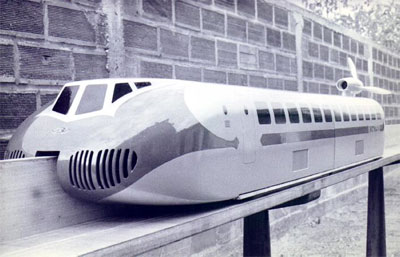
The Aérotrain sounds like a plot device from a steampunk novel — a rocket powered railroad car designed to travel on a monorail. This amazing retro tech project was lead by engineer Jean Bertin in France from 1965 until 1977. Sadly Bertin passed away in 1975, and his technology was passed over in favor of high speed trains that used high-powered electrical motors. Shown above is a working prototype from 1967 that was powered by Pratt & Whitney JT12 engine. Below is an early concept model which was created in 1962 which used compressed air:

Concept model of the Aérotrain created from 1962 - 1963.

While the Aérotrain looks like a bit of a historical curiosity today, it does show that France was very focused on spending serious research and development funds in the 60s which has give them a very useful high speed railway system today. This never happened in the United states because 20th Century America had a deep love affair with the automobile — starting with Robert Moses with the New York parkway system in the 30s and reaching a high point with Eisenhower’s Interstate Highway System of the 50s. However I wonder with the current green movement if we’ll see a return to high speed rail over here.

If you think about it an American high speed railway system could eliminate a great deal of domestic airplane travel which consumes a great deal of fuel and is hub based anyway. Such a project could also be a very positive job creation program from the federal government. Also if we look back to France in the 60s we should be inspired to see that it might be a good idea to not just take what already exists — but put some real effort into innovation.

Maybe this might mean creating single user (or family sized) railway vehicles? Or perhaps we might see a return to something like trolley cars inside of urban settings which could replace buses. When you look at the video footage below of Mr. Bertin’s handy work from 1969 you start to realize that even though we may hit some dead ends, that it’s never too late to rethink a basic mode of transportation:


Boy, 6, Misses Bus, Takes Mom's Car Instead


10-Mile Trip to Va. School Ends With Crash but Without Injury

By Tom Jackman
Washington Post Staff Writer

The word "miracle" can be overused. But when a 6-year-old boy drives a Ford Taurus for more than 10 miles, weaving in and out of oncoming traffic, slams into a utility pole and no one gets hurt, well, maybe miracle is appropriate.

That's what happened on Virginia's Northern Neck on Monday morning, when the first-grader missed his school bus and decided to drive his mom's car to elementary school so he wouldn't miss breakfast and PE, authorities said yesterday.

"It's a miracle that somebody didn't get killed," said Northumberland County Sheriff Chuck Wilkins of the boy's drive along Northumberland Highway. "We're a rural area, but if we do have a rush hour, that's it."

The boy's parents were arrested and charged with felony child endangerment. Wilkins said the father, David E. Dodson, 40, was under a court order not to leave the 6-year-old and his 4-year-old brother alone with their mother, Jacqulyn D. Waltman, 26, at their home in the town of Wicomico Church. But Dodson left for work at 6:30 a.m., and Waltman was still asleep when the 6-year-old missed the bus and then drove off at 7:40 a.m. for Northumberland Elementary School, Wilkins said.

Sgt. Thomas A. Cunningham Jr. of the Virginia State Police said the boy is not particularly tall for his age and was "possibly standing" while driving the Taurus. Wilkins said the child had an idea about how to start, propel and steer the car from playing video games.

Once he got going, the boy navigated his way along Route 200 (Dupont Highway), across a bridge spanning the Great Wicomico River and then turned west on Northumberland Highway, which is about 140 miles from Washington. He made it through two intersections, Wilkins said, and then was "doing a pretty great rate of speed" as he passed cars on the two-lane road while not wearing a seat belt.

Other drivers noticed. Two people called the sheriff's office, one called the state police and at least one motorist "shouted at him to get off the road when he came to an intersection," Cunningham said.

The boy had gone 10.4 miles, the sheriff said, and was about a mile and a half from his school in Heathsville when he decided to cross the double line and pass again. But this time, he saw a tractor-trailer coming toward him in the other lane.

He quickly whipped the car back into his lane, but, unlike in video games, the car swerved out of control, skidded into an embankment and then struck a utility pole on the rear passenger side. Wilkins said the force of the impact cracked a wooden beam on top of the utility pole. The Taurus was severely damaged, if not totaled, Cunningham said.

Northumberland deputies Jeff VanLandingham and Roger Briney arrived first. "He was crying, hysterical," Briney said, "not from any pain -- he was just adrenalined up on fright." Briney said another motorist said she was driving 60 mph when the boy zoomed past her.

Briney said he unzipped the boy's coat to check for injuries, found none and zipped it back up -- and the boy turned and walked away. "I said, 'Where are you going?' " Briney said. "He said: 'My school's right over there. I'm late.' I said, 'We'll get you to school.' "

"He was just bound and determined," Wilkins said, "he did not want to miss breakfast and PE." The meal "may have been his primary goal," the sheriff said. The sheriff said the boy told him that he had trained on video games such as Grand Theft Auto and Monster Truck Jam.

The boy was taken to Rappahannock General Hospital, was released and was back in school for PE that afternoon. He was not identified because he is, well, 6. The boy and his brother were placed in foster care; his mother was in jail, officials said.

"We were just very blessed that it ended the way it did," said Theresa Larsen, assistant principal at the boy's school. Larsen said the school's principal, Arnette Butler, asked the boy, "What were you thinking?" He looked up and told her, "I just had to get to school."

Staff researcher Meg Smith contributed to this report.

Awesome Automotive Applications for the Blackberry and Iphone

While the fundamentals of the automobile have changed very little since the end of World War II, the evolution of the phone has been far more rapid. We’ve come a long way from the days of “Hey, guess where I’m calling from!” Today you can order pizza with your phone without even talking to someone, and with new features and technologies like GPS, cellular triangulation, and accelerometers, there are a lot of cool car-related things you can use your phone for, too. Here are a few that caught our attention.

________________________________________________________________________________________

Google Maps

If you don’t already have Google Maps on your phone, well, shame on you. It’s free and it’s much more than a simple way to learn street names. It also has directions, traffic information, and local business listings. On some phones it will even let you search for a business or address using voice recognition. Google has also added GPS support to show you exactly where you are, and if your phone doesn’t have GPS, it can make a pretty good guess using cellular triangulation.

________________________________________________________________________________________

iBreath

Although this list is about cars, here’s an item that might keep you away from your car. The iBreath is a breathalyzer for the iPhone (and iPod). The perils of drinking and driving from a physical, legal, or financial perspective are such that mixing any alcohol with piloting a car is a bad idea. But if you’re worried that the glass of wine you had, say, four hours ago, is enough to get you into trouble with the law, then the iBreath will be worth the $79. Even better, you can let your drunk friends entertain themselves while you designated-drive them home. And it doubles as an FM transmitter for your music to boot.

________________________________________________________________________________________

Speedometer v1.1

There are more than a few speedometers for the iPhone out there, but what we like about this one is the simplicity of either a big three-digit digital display or a more traditional needle gauge. Of course, your car probably has a working speedometer (unless you spent that repair money on your new iPhone), but GPS is typically more accurate. Also, this speedometer is easily transferable to boats, planes, chickens, and your friends.

________________________________________________________________________________________

Cameras Ahoy

To be honest, we’re scared by the whole traffic-camera idea, but that could be because we’ve watched Terminator 2 too many times. But even if you’re not anticipating a robot apocalypse, the Cams Ahoy application for the iPhone is pretty handy. It uses a database of red-light and speed cameras in North America (there’s a European version as well) to warn you when they lurk nearby.

________________________________________________________________________________________

Turn-by-Turn Navigation

Every major mobile-phone carrier in the U.S. offers some form of turn-by-turn navigation for about $10 a month. If you have a compatible phone, you can have maps and verbal directions guiding you from place to place. This is a good solution if you want to keep your gadgets to a minimum, but after a couple of years the subscription fee could buy you a good dedicated GPS unit.

________________________________________________________________________________________

Road Trip

What if you could track all the expenses of your car in one place? Yeah, we’ve heard of paper, and Microsoft Excel works, too. But Road Trip does the math for you and stores it on your iPhone or iPod Touch. The part we like the most is the cool graph that shows fuel costs and average mpg over time. And it lets you look at the cost per day to keep those wheels turning.

Last Supper Together


army.mil — Williams feeds his 4-month-old daughter Alexandria with his wife Krystal Carde during a deployment ceremony Dec. 31 at Kieschnick Physical Fitness Center. Williams and about 450 Soldiers from the 180th deployed to either Iraq or Afghanistan on Dec. 30 and 31.


original can be found here: http://www.army.mil/-images/2009/01/07/27989/

2010 Buick LaCrosse - On the Right Track


At a GM press conference long enough ago that we don’t remember when or where it was, GM confidently made the then-preposterous assertion that it wanted Buick to become America’s Lexus. We may have laughed and not even bothered to write it down, but we didn’t forget the idea. And in the years since, we’ve been looking for evidence of Buick’s march toward matching the enigmatic Japanese brand’s level of comfort and quality—and maybe even cachet. Could the 2010 LaCrosse, Buick’s new mid-size sedan making its debut at the 2009 NAIAS, be it?

Style . . . Really!

Buick previewed the interior and exterior styling of the LaCrosse last year at the Beijing Auto Show with the handsome Invicta concept, and we must issue credit to Buick designers for sticking near to it for production. The grille is bold but not obnoxious. The lights are aggressive but not scowling. The flowing “spear line” and hood-surface portholes are familiar but not contrived. Particularly pleasing are its low roofline, fastback rear window, and long wheelbase, which impart the LaCrosse with nearly the same stylish proportions of the Invicta. Nice job.

Open the door and you’ll find the sexiest interior in a Buick since perhaps ever. As with the Enclave crossover, Buick has managed to find the common ground between conservative and contemporary interior design and has done so with precious little of the old-lady idiom that has dominated previous Buicks. The shapes are decidedly futuristic without being intimidating, and lots of blue ambient lighting illuminates the various cubbies, door pulls, and trim pieces. And alas, while there is plenty of wood and hand-stitching on the dash and door panels, there is no front bench seat—not even as an option. There’s not even a large-font clock.

Interesting—and rather Lexus-y—features for the new LaCrosse include a head-up display, rearview camera, rear sunshade, and adaptive, steering-directed headlamps. There’s also Bluetooth connectivity, aux/USB input jacks, and in-dash navigation.

DI Inside

There will be three trim levels for the 2010 LaCrosse. The base CX will be powered by a 255-hp, 3.0-liter direct-injection V-6 driving the front wheels through a six-speed automatic. The CXL will be powered by the same engine/transmission combo but have available all-wheel drive, as well as a host of comfort features including leather, dual-zone climate control, fog lamps, and 18-inch wheels. Fuel economy will be about 18 mpg city/27 highway for the 3.0-liter, according to GM.

The top-dog LaCrosse CXS will come with the 3.6-liter version of the direct-injection V-6, making 280 hp and 261 lb-ft of torque—slightly less than this engine makes in GM’s large crossovers—with front-wheel drive, active damping, available 19-inch wheels, and a few additional luxury features like heated and cooled seats. At 17/26 mpg, fuel economy for the 3.6 suffers by only 1 mpg in both city and highway cycles compared with the smaller motor. That’s some good math in our book, although the absence of available all-wheel drive on the CXS is puzzling.

Shot Across Lexus’s Bow

“The new LaCrosse was created with great attention to detail, craftsmanship, and advanced technology,” said Susan Docherty, Buick-Pontiac-GMC vice president. “It builds on the success of Enclave as the next step in Buick’s revitalization. And, as with Enclave, our goal is to attract a whole new buyer to our dealerships for LaCrosse.”

After it goes into production at GM’s Kansas City, Kansas, assembly plant this summer, we’re not sure to what extent Buick is going to attract that “whole new buyer,” although many new prospects—Lexus intenders, even—surely will come in for a look. One thing we are sure of is that Buick is going to give those buyers a whole new—and mighty attractive—Buick.

Hennessey 700Hp LS9 Camaro


SEALY, Texas — Hennessey Performance Engineering has introduced a limited-edition 2010 Chevrolet Camaro fortified with a 705 horsepower version of the supercharged LS9 V8 engine from the Corvette ZR1.

Hennessey calls its creation the HPE700 Camaro and claims that it's a "modern, daily-drive usable supercar." That might be a relative term, as this 2010 Camaro makes 717 pound-feet of torque.

Suspension upgrades are part of the package as well and the carbon-ceramic brakes from the ZR1 are optional as well. Lightweight HRE wheels and Michelin PS2 tires complete the functional upgrades.

Aerodynamics changes are the work of British designer Steve Everitt and include carbon fiber all over: rear lip spoiler, side rocker panels, a front fascia and splitter and a front billet grille. The hood design was inspired by the ZR1 with a window through which the LS9 power plant can be ogled.

A one-day performance driving course at Lonestar Motorsports Park, next door to the Hennessey production facility/showroom in the Houston area, is tossed in with the purchase of the HPE700.

The limited-edition Camaro is available directly from HPE or from some Chevrolet dealers. Orders will be taken starting next month, and production starts up in the spring.

Inside Line says: GM certainly doesn't have the money to give the Camaro the engines it needs, so it was only a matter of time before the aftermarket stepped in to do it.

You can smoke fewer cigarettes by smoking longer ones

You can smoke fewer cigarettes by smoking longer ones by SA_Steve.


Also check out more vintage ads can be seen here
Also check out ads from the seventies, targeting African American Consumers

Uploaded on July 29, 2008
by SA_Steve