Zazzle Shop

Screen printing
Showing posts with label cell phone. Show all posts

Wednesday, April 6, 2011

38 Years Since The First Mobile Phone

The mobile phone has changed the lives of many people over the past 15 years, when it began to be used globally. But, few know that the first prototype was built 38 years ago in New York.
More specifically, the first phone call ​​by a person walking on the streets was made ​​in 1973, in the year when the U.S. Army announced its withdrawal from Vietnam.

m1 38 Years Since The First Mobile Phone
On April 3, Martin Cooper, who was then 44 years, used the first prototype mobile phone on the streets of New York. As expected, the reaction of those who saw him with the device in hand was one of total bewilderment, confusion and “gape “.  Cooper is now 82 and he told the Daily Mail publication about how Americans reacted:

As I walked down the street while talking on the phone, sophisticated New Yorkers gaped at the sight of someone actually moving around while making a phone call.
I made numerous calls, including one where I crossed the street while talking to a New York radio reporter – probably one of the more dangerous things I have ever done in my life.” 

m3 38 Years Since The First Mobile Phone


But it had to pass a while until Mr. Cooper’s vision could have been applied at a global scale. Those where the years when only the rich ones could have phones inside their luxurious cars.
The first mobile phone that Martin Cooper created was weighing approximately 2.5 lbs., something that would now be regarded as a “brick”. Ten years have passed until Motorola managed to commercialize and distribute Dyna-TAC.

m2 38 Years Since The First Mobile Phone
DynaTAC 8000X had the following characteristics:

  • weighed around 1lb
  • the lifespan of the battery in standby was up to 8 hours and 30 minutes of talking time
  • took 10 hours for a full charge
  • the price was around 3500$
  • had a length of 13.5 inchs- had 9 buttons: recall, clear, send, store, function, end, power, lock, volume
  • had a basic display and could store up to 30 numbers

Wednesday, June 9, 2010

Showdown: iPhone 4 vs. HTC Evo 4G

Updated to include more information on Qik

Apple’s new iPhone 4 is the company’s biggest update yet for the handset and it will have you drooling.

The phone is a snazzily slim, glass-backed slab that boasts some impressive specs: dual cameras, a big operating system update and video chat, among other things.

Apple introduced the phone at its developer conference Monday and said it will be available on AT&T’s network starting June 24.

But when the iPhone 4 hits retail shelves it will have to battle a gaggle of Android devices for consumer attention — the most significant of which is the HTC Evo. The Evo has one big advantage that Apple can’t beat. It runs on Sprint’s 4G network, while the iPhone is stuck on AT&T’s 3G service. Sprint 4G, though, is not available in most major cities, including San Francisco and New York.

If you are considering upgrading to the latest version of the iPhone or getting an Android device, take a look at how the iPhone 4 and HTC Evo 4G compare:


iPhone 4HTC Evo 4G
Display3.5 inch display with 960 x 640 pixel resolution4.3 inch screen with 800 x 480 pixel resolution
ProcessorApple A4 chip, speed unknown1 GHz Qualcomm Snapdragon
Size4.5 inches in height, 2.3 inches wide, 0.37 inches thick.4.8 inches in height, 2.6 inches wide, 0.5 inches thick.
Weight4.8 ounces6 ounces
Operating systemiOS 4Android 2.1
Cellular access3G4G
Storage capacity
16 or 32 GB flash drive8 GB microSD card included, supports up to 32 GB.
Camera
Dual cameras. 5-megapixel primary camera. Front-facing secondary camera (resolution unknown).Dual camera with 8-megapixel primary camera, 1.3 megapixel front-facing secondary camera.
Video Recording
720p, up to 30 frames per second. Built-in video editing.720p at 25 frames per second.
Video Conferencing
Yes. Native support through FaceTime application, via Wi-Fi only.Available through Qik app that costs $5 a month for premium features and higher-than-VGA quality. Basic app is free. Can be used over 3G or 4G wireless.
Sensors
Three-axis gyro, digital compass, accelerometer, proximity sensor, ambient light sensor, GPS.Digital compass, accelerometer, proximity sensor, ambient light sensor, GPS.
Battery Life
Talk time of up to 7 hours on 3G and 14 hours on 2G.Up to 6 hours of talk time.
Price
$200 for 16 GB version, $300 for 32 GB (both with a two-year contract).$200 (after a $100 mail-in rebate) with a two-year contract.
Availability
June 24June 4
Service provider
AT&TSprint


Thursday, February 18, 2010

10 Hot Questions About Windows Phone 7, Answered

Sascha Segan
from: http://www.pcmag.com/

After years of watching its Windows Mobile operating system languish behind sexier products from archrivals Apple, Google, and Palm, Microsoft launched the Windows Phone 7 platform Monday morning. Why is it important? Does it live up to the rumors? And more to the point, what can you expect? Here are the top ten questions about the new Windows Phone 7 OS, and their answers.

1. What is Windows Phone 7? It's Microsoft's new mobile-phone operating system. A total break from the past, it focuses your smartphone life around "hubs" rather than apps – the people you talk to, the pictures they post, or the games you like to play.

2. Is it a "Zune Phone?" No, but Zune is one of the built-in "hubs." So is XBox Live. So is Bing.

3. What will the phones look like? There will be many form factors, but they all have to have capacitive, 800-by-480 or greater touch screens and have three buttons at the bottom: Home, Back and Search. They will all have four-point multi-touch displays, compasses and accelerometers. You'll see phones with and without sliding QWERTY keyboards, but no BlackBerry-style candybars or non-touch phones.

4. What carriers will they run on? All four major U.S. carriers, but AT&T will get the first crack with an as-yet unannounced phone.

5. How's the Office and e-mail support? Looking great. WP7 - that's the new official acronym - supports OneNote, Office, multiple Exchange accounts and SharePoint. But the interface is definitely more about communicating and having fun than about doing spreadsheets.

6. Can it sync with a Mac? Not initially. WP7 will require the Zune software to sync, and there's no Mac Zune software. Look for third parties like Mark/Space to fill in the gaps with a syncing solution.

7. Will it run old Windows Mobile apps? I don't think so. The interfaces are very different. Microsoft promised we'd find out more at their MIX developers' conference in mid-March.

8. Does it have multi-tasking? We can't tell, but Microsoft said you'd be able to "play music in the background".

9. How about Adobe Flash? Not at launch, but Steve Ballmer himself said that he doesn't have anything against it.

10. When's it coming? For the holidays, 2010.

Tuesday, October 6, 2009

Kiosk From ecoATM Pays You For Used Phones

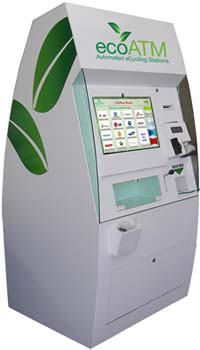
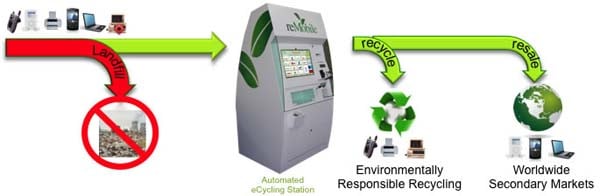
We all have old cell phones lying around collecting dust. Now, thanks to a new automated kiosk from ecoATM, you can recycle your old cell phone and get a reward for doing so. The self-serve eCycling station from ecoATM electronically inspects your phone, assigns it a real-time secondary market value, and then provides an in-store trade-up coupon or gift card (assuming the handset still has monetary worth). If your handset doesn't have any value, you can assign the device to the recycle bin where it will be recycled or refurbished.

ecoATM recently rolled out its first recycling kiosk at Nebraska Furniture Mart in Omaha, NE. The company plans to install additional eCycling Stations at several national retailers over the next quarter in San Diego, Boston, Dallas, and Seattle. A more massive rollout is set for the second quarter of next year.

"The ecoATM makes it easy and convenient for our customers to trade-in and recycle their used mobile phones," said Jay Buchanan, Electronics Division Director, Nebraska Furniture Mart, Inc., America's Largest Home Furnishings Store. "This benefits both our customers and the environment."

The machines use a camera-based system to detect signs of wear including cracked screens, missing keys, and scuff marks. The cameras also help to determine an approximate value for the phone. Even if your phone isn't worth anything, you may still get a free gift—at the Nebraska Furniture Mart kiosk, for instance, you'll get a waterproof phone case for your efforts and ecoATM will plant a tree on your behalf.

"We are extremely pleased with the initial results and consumers' delight with the system," said Mark Bowles, CEO, ecoATM Inc. "ecoATM's solution finally makes it easy for consumers to give their used phones a second life or to recycle them. Over 100 million used, but still valuable, phones are quietly retired to closets and drawers each year in the US where they decay into zero value and then enter our landfills years later. Our automated ecoATM provides consumers and retailers an easy, convenient, incentivized method to convert those devices into real money instead of toxic waste."


Right now, the ecoATM only accepts phones but in the future, the kiosks should be able to accept and recognize other gadgets such as MP3 players, digital cameras, notebooks, printers, and storage devices.


ecoATM kiosk at Nebraska Furniture Mart in Omaha, NE

For retailers, the ecoATM makes sense: the machines are installed for free and there are reward tie-ins and potential for increased foot traffic. "Consumer electronics retailers and their OEM partners are facing a complex and growing set of state and municipal eWaste laws. Consumer convenience is important to solving the eWaste problem in the U.S., and trade-in/trade-up incentive programs are proving to be quite effective in retail," said Leslie Hand, Research Director, IDC Retail Insights.


Sunday, March 8, 2009

Talk isn't cheap? For cellphone users, not talking is costly too

A study shows many customers pay for much more time than they use
David Lazarus

March 8, 2009

If you're like most cellphone users, you probably think you're paying less than 10 cents per minute for calls. Think again.

When you do the math, you find the average cellphone customer actually pays more than $3 per minute, according to a report being issued this week by the Utility Consumers' Action Network, a San Diego consumer advocacy group.

I got a sneak peek at the report the other day.

Researchers arrived at the average $3.02-per-minute charge by comparing the average number of minutes charged in more than 700 San Diego consumers' telecom bills and dividing by the average number of actual minutes used.

"We knew it was a myth that wireless costs were going down," said Michael Shames, UCAN's executive director. "But we were blown away by the actual costs."

That $3-per-minute figure is skewed by the relatively small percentage of people who pay for a lot of minutes but barely use any. But even when those folk are taken out of the mix, most wireless customers still pay between 50 cents and $1 per minute, the study found.

Shames said this wasn't a problem just for San Diego residents. He said the findings of the report were representative of cellphone use and bills nationwide.

That's something to keep in mind as an increasing number of people abandon traditional land lines and embrace a wireless-only lifestyle. More than ever, you have to make sure you're in a calling plan that fits your needs.

Among other findings in the report:

* Only about 8% of land line customers pay less than 10 cents per minute for long-distance calls. The majority pay well over 10 cents per minute, with 20% of people paying more than 50 cents per minute and 10% paying more than $1.

* The cost of additional phone services has soared. In AT&T's case, the cost of call waiting has risen 86% since 2004, the cost of an unlisted number is up 346% and the cost of directory assistance has skyrocketed 1,630%.

* The average cellphone customer uses only about a third of "any time minutes" allowed by most wireless plans. The rest are paid for but wasted.

Many of the findings -- particularly the average cost per minute of wireless service -- have been speculated about for years by telecom observers. The UCAN report represents one of the first attempts to quantify costs based on a relatively broad sample of customers.

Bottom line: Most telecom customers are buying more product than they use, and that's pure gravy for service providers.

"It's hard for customers to gauge how much of this product they're going to use," Shames said. "The phone companies basically force you to calculate in advance something that's very difficult to calculate."

The big dogs of the telecom industry -- AT&T Inc. and Verizon Communications Inc. -- insist that they're dedicated to making customers happy and ensuring that people have the best possible calling plans for their needs.

"We encourage people to look at their bill, question their bill, and call us if they see anything that's not right," said John Britton, an AT&T spokesman.

Ken Muche, a spokesman for Verizon Wireless, echoed this sentiment. "If you're not using the total amount of minutes in the bucket, we'll work with you to get you on the right plan," he said.

The trick, of course, is that consumers have to be proactive in tracking the number of minutes used each month and shopping around for the most suitable plan. Shames said the UCAN study found that most people don't take the time to look closely at their telecom bills.

For that matter, the study found that most bills were written and formatted so opaquely that even when customers tried to decipher their statements, they often couldn't make heads or tails out of what they were being charged for.

Shames said land line customers needed to be wary of long-distance plans that included monthly fees along with per-minute charges. He also said cellphone customers should explore pay-as-you-go plans that allow you to purchase minutes in advance, and to buy additional minutes in relatively small amounts so no money is wasted.

Be careful, though. AT&T, for example, offers pay-as-you-go plans that might seem penny wise at first but actually can cost some serious coin.

One plan charges cellphone customers 10 cents per minute plus $1 for every day you use the phone. Another skips the daily fee but costs 25 cents per minute.

The UCAN report recommends that federal regulators require a "cost-per-minute box" on all phone bills so that customers know exactly how much they're being charged, and standardize taxes so that customers can more easily compare one service with another.

Providers frequently list taxes and fees differently, making it tough for many people to understand exactly what they're paying for.

"We have millions of customers grossly overpaying for services," Shames said.

He said a copy of the UCAN study will be sent to the Federal Communications Commission. Maybe something will come of that.

But something tells me all we'll get is a busy signal.

David Lazarus' column runs Wednesdays and Sundays. Send your tips or feedback to david.lazarus@latimes.com.

Monday, January 12, 2009

NYPD Wants to Jam Cell Phones During Terror Attack

By Noah Shachtman Email

Amd_raykelly The New York Police Department wants to be able to shut down cell phones, in case of a terrorist attack.

During last month's massacre in Mumbai, terrorist handlers over micromanaged via mobile phone the assaults on the hotels, train stations, and Jewish center that killed more than 170 people.

In testimony today before the Senate Committee on Homeland Security and Governmental Affairs, New York Police Commissioner Ray Kelly (pictured) said he wanted to take out that "formidable capacity to adjust tactics while attacks are underway."

We also discussed the complications of media coverage that could disclose law enforcement tactics in real time. This phenomenon is not new. In the past, police were able to defeat any advantage it might give hostage takers by cutting off power to the location they were in. However, the proliferation of handheld devices would appear to trump that solution. When lives are at stake, law enforcement needs to find ways to disrupt cell phones and other communications in a pinpointed way against terrorists who are using them.

For now, Kelly said, the NYPD is taking a whole range of measures to stop another Mumbai-style spree -- from working with private businesses to interdicting boats to training recruits in heavy weapons to installing a spycam network across downtown Manhattan.

But Charles Allen, the Department of Homeland Security's top intelligence official, confessed to the Senate panel that "response to a similar terrorist attack in a major U.S. urban city would be complicated and difficult."

The chaos the attacks created magnified the difficulty of mounting an appropriate response. First responders, in order to deal with such a crisis, must first and foremost have adequate information on what is occurring as well as the capability to mount a rapid and effective response that minimizes the impact of the attack. In Mumbai it was not immediately clear to authorities whether there were multiple attack groups or a single group. The attackers were able to exploit the initial confusion because of the indiscriminate firings to move on to new targets. While preparedness training for this type of attack may not have prevented it, the effects likely could have been mitigated and reduced if authorities had been prepared and had exercised responses to terrorist attacks across all levels of government. Within the United States, our national exercises incorporate not only federal interagency participants, but also include regional, state, and local authorities, in order to identify potential gaps in our responses.

[Photo: NY Daily News]

Girl, 13, sends 14,528 texts in a month

SILVERADO CANYON, Calif., Jan. 11 (UPI) -- A California father says he discovered his 13-year-old daughter sent 484 text messages per day last month -- one message every 2 minutes of every waking hour.

Greg Hardesty of Silverado Canyon, Calif., told the New York Post his 440-page cell phone bill revealed his daughter Reina had sent an astonishing 14,528 text messages.

"First, I laughed. I thought, 'That's insane, that's impossible,'" said Hardesty, 45, a reporter for The Orange County Register. "And I immediately whipped out the calculator to see if it was humanly possible."

Hardesty said Reina had messaged a core of "four obsessive texters," all girls between the ages of 12 and 13. Luckily, he was on an unlimited text messaging plan or his bill would have been $2,905 at a rate of 20 cents per message, the Post reported.

Hardesty told the newspaper he and his ex-wife have placed restrictions on Reina's cellphone use, ruling she cannot text after dinner.

When it comes to texting, it appears Reina has much in common with a New Zealand teenager. It was reported last month that Hannah Brooke, 16, of Wellington frequently uses up the 6,000 messages she's allowed each month and borrows phones from friends to keep on texting.


© 2009 United Press International, Inc. All Rights Reserved.

Friday, January 9, 2009

AT&T moves closer to offering in-home cell base stations

By Glenn Fleishman

AT&T is contacting some of its customers asking if they'd like to test an in-home extension to its cellular networks powered by a subscriber's own broadband—a femtocell. Femtocells use frequencies licensed by the carrier for data and voice, while handling backhaul through a customer-provided service.

An Ars Technica reader forwarded a customer survey question he'd seen after being solicited by AT&T for his opinion: "AT&T's new product is a small, security-enabled cellular base station that easily connects to your home DSL or Cable Internet, providing a reliable wireless signal for any 3G phone in every room of your house. The device allows you to have unlimited, nationwide Anytime Minutes for incoming or outgoing calls."

Sprint Nextel has been offering femtocells since last year; the advantage to the carrier is providing fill-in service in the home without deploying more base stations in an area. (See "Sprint's new femtocells offer cell coverage, backhaul costs," July 30, 2008.) AT&T has apparently been testing femtocells with its own employees since last year as well.

Femtocells differ from T-Mobile's UMA (unlicensed mobile access) approach, which also puts a specialized device in the home. With UMA, specialized handsets must have both cell and WiFi radios, and the firmware to handle seamless handoffs between the two network types. With a femtocells, the radio side is effectively identical with only the backhaul varying. T-Mobile also offers WiFi routers that feature two increasingly common VoIP-oriented protocols (one for power conservation, the other for packet prioritization).

Carriers pay enormously less to transit and account for voice and data over a customer's own broadband, and thus can offer so-called unlimited voice plans (which have some very high monthly limits). T-Mobile's HotSpot@Home service costs $10 (1 or more lines) per month adding to a minimum $40-per-month voice plan; Sprint charges $15 to $25 per month for the same thing.

Femtocells have few disadvantages for home users because the dedicated frequencies means that any WiFi network they may already have in place isn't degraded by cellular use, and vice versa.

Motorola Renew is World’s First Carbon Neutral Mobile Phone

Motorola has announced plans to launch the world’s first completely carbon neutral mobile phone, at CES 2009 in Las Vegas.

The shell of the W233 Renew is made entirely of recycled water bottles, and will be available via T-Mobile within the next three months. The struggling cell phone manufacturer has also teamed up with CarbonFund.org to offset the energy used in the manufacture, distribution and operation of each phone throughout its lifetime.

As part of the alliance, Motorola will invest in renewable energy sources and global reforestation projects. The company also plans to print all of the phone’s documents on post-consumer recycled paper using vegetable-based inks.

According to Jeremy Dale, corporate vice president, global marketing, Motorola Mobile Devices, “Today, natural resources, energy and time are more precious than ever before. From the product’s design, to the packaging to our partnership with Carbonfund.org, we wanted to ensure that this device makes the right impact with consumers and the environment.”

There is no news yet on a price, but Motorola have announced that the phone will be “extremely affordable.”

Now, if they can make one model carbon neutral, how about rolling the approach out to the entire range…?

Image Credit - ModMyMoto.com