Zazzle Shop

Screen printing
Showing posts with label Antennas. Show all posts

Friday, July 16, 2010

Download iOS 4.0.1 Now: It "Improves" the iPhone's Bar Signal Display

Download iOS 4.0.1 Now: It  "Improves" the iPhone's Bar Signal Display

The iOS 4.0.1 update that "improves" the way the iPhone displays signal strength is out now. According to the release note, that's about all it does.

If you notice anything else—like maybe the iPhone 3G not running like total crap after the update—do let us know.

Send an email to matt buchanan, the author of this post, at matt@gizmodo.com.

Thursday, July 15, 2010

The iPhone 4 Redux: Analyzing Apple's iOS 4.0.1 Signal Fix & Antenna Issue

From: http://www.anandtech.com/

In case you haven’t noticed, the iPhone 4’s antenna design has come under considerable scrutiny. In our iPhone 4 review, we investigated the iPhone 4 antenna and came to two conclusions. First, that iOS 4 was displaying signal bars in an overly optimistic manner, compressing the dynamic range of possible signal bars users can see. Second, we identified a worst case signal drop of around 24 dBm when the iPhone 4 is cupped tightly in the left hand, covering the black strip and possibly detuning the antennas and adding additional attenuation from the presence of the hand.
Since those initial measurements, we’ve been working tirelessly to both characterize the problem, fully understand the mechanisms behind it, and report on a number of possible solutions.

The Bars Have Changed

On July 2, Apple released a letter noting that the formula used in iOS 4.0 to calculate how many bars are presented for each signal strength is “totally wrong.” This mirrored our conclusions that the effects of the signal drop were exacerbated in part by the way the iPhone visualizes signal strength - the dynamic range is compressed so much that the 24 dB drop from cupping the phone without a case could make all the bars go away.

They went on to promise that in a future software update they would make bars 1, 2, and 3 taller, and make the bars more “accurate” by displaying 2 bars fewer in certain circumstances.

iOS 4.1 beta rolled around yesterday, and we immediately dove in to find out just how much the bar to signal strength mapping has changed. Update: iOS 4.0.1 final just came out this afternoon and we finished preliminary testing. The signal strength mapping algorithms are identical to the 4.1 beta. The findings in this article apply to 4.0.1 as well as the 4.1 beta.
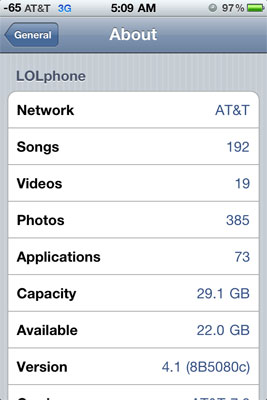
After updating our devices to the iOS 4.1 beta (and 4.0.1) and making sure our little trick to show signal strength in dBm instead of bars still worked, we set off. Remember last time how I said I drove around town all day with iOS 4.0, testing the phone, and recording signal strength and how many bars were being shown? You guessed it - another update, another evening of driving around. Anand and I did quite our fair share of moving around to get a complete picture of what the new cutoffs are.
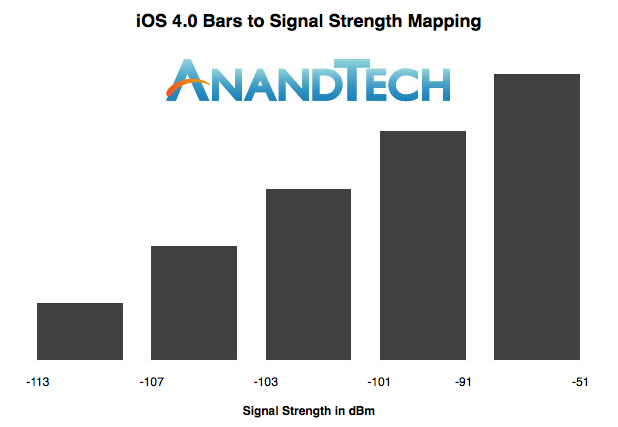

Old Bars
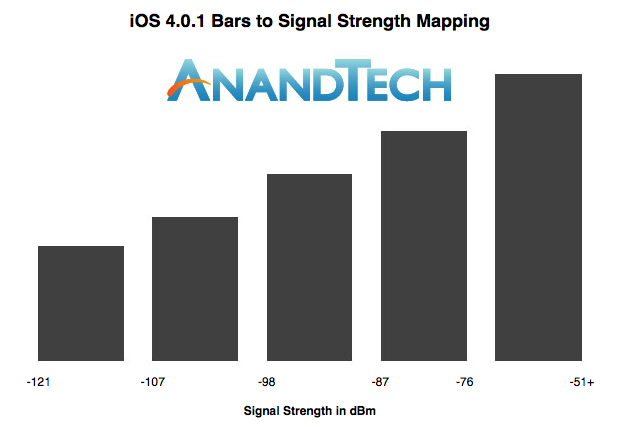

New Bars

The results are conclusive - Apple has dramatically changed the signal strength to signal bar mapping in iOS 4.0.1 and the iOS 4.1 beta, making the dynamic range not only much broader, but the range values for each bar much wider. The range of signals that correspond to bars three and four are the same width, and bar two is only slightly less.

The cutoff value for two bars to one bar remains the same, but every other value has increased. The result is that the worst case drop of 24 dBm no longer makes all the signal bars disappear, but rather two.

AnandTech reader Mike Escoffery, Director of Design and User Experience at Media Platforms, created his own diagram to help compare the old and new way of iOS signal strength reporting:
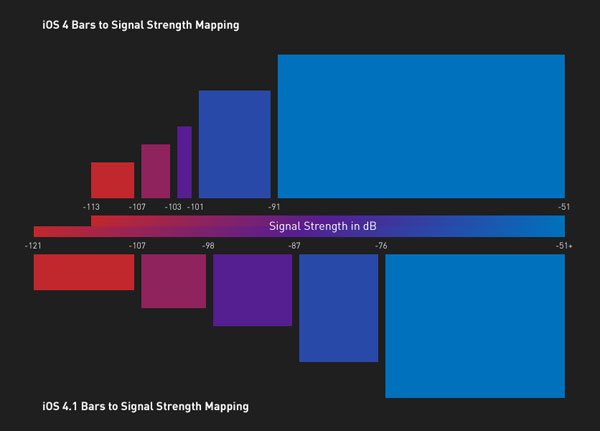
As you can see the old way (top) put far too much weight into the 5th bar of signal. Apple's new approach not only splits it up more reasonably between the 4th and 5th bar (still non-linearly keeping you in the 5th bar if possible) but also extends the range of the lower bars.

This change actually presented itself in our numeric signal strength reports - there’s more dynamic range in these numbers too. Previously, the absolute lowest value any iPhone would report was -113 dBm. With iOS 4.0.1/4.1, the value is now a shockingly low -121 dBm. In the iPhone 4 review, I talked a lot about how although the phone is prone to dropping signal from being held wrong, it was measurably more sensitive in weak signal areas. I was shocked that calls and data worked seemingly unfazed at -113 dBm. It seems as though this increased 8 dBm of range below -113 dBm was meant to show really how much more sensitive the radio stack is - it undeniably is more sensitive. Both Anand and I were able to hang onto calls all the way down at -121 dBm.

We’ve also included a comparison to how the latest version of Android displays signal bars from GSM or UMTS networks below. Thankfully, this didn’t require driving around town all day but rather inspecting the latest version of the Android source code from Google’s own repositories. Android uses an ASU value to compute signal strength, which isn’t anything more than a remapping of dBm to a sane value that’s a bit easier to interpret.
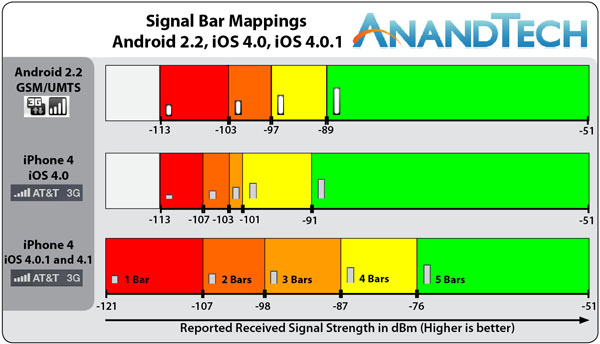
Apple’s mappings have gone from having probably the most compressed dynamic range among handset vendors to less compressed than Android.

While the software update obviously does not and cannot address the design of the antenna itself - or make the drop from holding the phone any less - it does change the way the issue is perceived among users. The result is that most iPhone users will see fewer bars disappear when they hold the iPhone 4 in a bare hand. The side effect is that the iPhone now displays fewer bars in most places, and users that haven’t been reporting signal in dBm will time see the - perhaps a bit shocking - reality of locations previously denoted as having excellent signal.

Interestingly enough, Apple has indeed changed the heights of bars 1, 2, and 3. They’re taller, and the result is that the relative heights are no longer linear, but rather a tad exponential looking. It’s a mind trick that Apple no doubt hopes will make the signal look better. If the bars are taller, they must denote stronger signal, right?
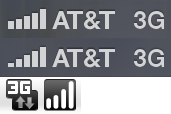

From top to bottom: iOS 4.1, iOS 4.0, Android 2.2

The reality is that Apple likely wants to deflect at least some of the initial backlash AT&T will face for reporting the signal bars without any concessions. Concessions that used to make coverage look better than it really is. Regardless of how tall the bars are, there are still going to be fewer of them virtually everywhere. Interestingly enough, while bars 1 and 2 are the most changed, their respective cutoffs are virtually unchanged.

While I was testing iOS 4.0.1, I told Anand that the signal reporting lie that started with the iPhone 3G had been removed entirely. That iOS 4.0.1 would potentially show the reality of AT&T’s coverage to iPhone users. With 4.0.1 users looking at signal bars will get a much more realistic view of how signal is changing.

We tested the iOS 4.1 beta on iPhone 3GSes as well, and found the mappings to be the same there as well.


Wednesday, June 30, 2010

Sign Here If You Think Apple Should Give Free Cases to Fix the iPhone 4's Problems

From: http://gizmodo.com/

Sign Here If You Think Apple Should Give  Free Cases to Fix the iPhone 4's Problems

Apple acknowledges the iPhone 4's reception problems. Their solution: Hold it differently or buy a case. But if this is an Apple design problem, they should fix it for real or give out cases for free.

We have evidence that proves that the iPhone 4 antenna problem was caused by an internal cultural problem at Apple, one that plagues more than just the iPhone 4, but the iPad and probably future Apple products as well.

A source in Apple's engineering team tells us that the kind of reception issues found in the iPhone 4 are a symptom of an internal issue that's been going on for a while—extremely inflexible mandates around the industrial design of products during their development. Jon Ive and his team of industrial designers can run "a little amok sometimes", they said, coming up with and steadfastly insisting on designs that, while aesthetically pleasing, cause the engineering team extreme difficulty in terms of implementation and maintaining the highest levels of functionality.

Apple engineers have evidently had a tough time trying to mitigate things, for example, like thermally-challenged designs and issues related to the fact that wireless signals don't go through metal. So perhaps this inordinate power wielded by the industrial design team at Apple is at least one factor contributing to a phone design that allows people's hands to interfere with the antenna.

Now, Apple is facing public backlash over the consequences of those design decisions.

It's a very real problem

On top of the many user submitted complaints the press received, many with video proof, we took an informal poll. The results: About 40 percent of iPhone 4 owners responded that they had seen the issue first hand. Other sites report similar percentages. Righmobilephone—a cellphone comparison site in the UK—took a pool among 836 iPhone 4 users, finding 93% affected by the problem (a theory here is that people in the US notice it less because they blame AT&T's traditionally lousy network). Of those, 63% were "particularly angered" about Steve Jobs' response, which suggested users should "avoid holding the phone in that way" to avoid loss of signal.

This is an unprecedented amount of user complaints. In our daily lives here in Gizmodo, we have experienced the problem many times, ruining an otherwise great experience. Some of us didn't run into the problem at first, but after a few days, we clearly noticed it. At this point, it seems to us that the question is not if people would experience the problem or not, but when would they experience it.

Apple's arguments and solutions

Apple argues that all cellphones' signal drops when you touch their antenna. That is true. But the difference here is that the rest of the phones don't have the antenna all around the phone itself, where the user is touching it at all times.

That's why Steve Jobs' "hold it in another way" suggestion is not a good solution. Users should be able to hold the iPhone in a natural way, whatever that way is for them. Otherwise, it's bad industrial design because it goes against the user's self-expression. It's a case of form not following function. If this were a case of the problem showing up in a few awkward, unnatural hand positions, that would be something. But the problem can be triggered by the way a right handed user generally holds the iPhone: in their left hand on the side and bottom, pecking at the screen with the other. In other words, the regular way most of us hold an iPhone when using it as a smartphone instead of a voice phone. Holding the phone any other way is unnatural, and in practical usage scenarios, unreasonable.

Apple's other solution is that people should get a case. They sell one. The bumper—barring some fix at the factory—is the only real Apple solution for this design problem.

The real solution

If Apple doesn't fix this design flaw or provides any technical fix, then they must give free bumpers to every iPhone 4 user. If they say the bumper fixes a problem that is caused by a faulty design, then it only makes sense that they should provide the bumper for free. End of the story.

Sign Here If You Think Apple Should Give  Free Cases to Fix the iPhone 4's Problems

The bumpers will negate the iPhone's beautiful design, one of its major selling points, but at least we won't have signals dropping. It may even help preventing their other design problem: The iPhone 4 is more fragile than the previous generations because of its glass backside. In addition to that, it also shatters on shock more easily because of the inner tension of the new glass material, which in addition is all oleophobic, making it more slippery.

Every product launch has its bugs. We've seen a lot this time. Many issues, like the yellow screens, will go away as manufacturing fine tunes and adjusts to solve the problems. But the antenna issue is a fundamental one, a design flaw, that won't go away as easily without adjusting the product in a deeper way.

If this was some junk phone, it wouldn't matter. But the iPhone 4 is perhaps the best cellphone there is thanks to its software and apps, its Retina display, and its camera. Some even say the reception is better than the old phone's under circumstances when the antennas aren't being shorted. So with all these great things, it's terrible that buyers should have this excellent phone ruined for them because of a single, but serious, design problem. And even worse that Apple should suggest users use their phones in unnatural ways or shell out $30—for what is essentially a double wide livestrong armband—to fix it.

Sign the petition

That's why we all should ask Apple to partially solve the phone's design problem by giving away free bumpers for every single iPhone 4 user out there. Together, we can get Apple fix their problem, whatever the solution may be, instead of dodging the issue.

It's all in your hands: If you agree with this petition, please sign it below, in the comments.

Pass this article around through Twitter, Facebook wall, your blog, or email. You can also join the Facebook petition group here:

The author of this post can be contacted at tips@gizmodo.com

Friday, January 9, 2009

AT&T moves closer to offering in-home cell base stations

By Glenn Fleishman

AT&T is contacting some of its customers asking if they'd like to test an in-home extension to its cellular networks powered by a subscriber's own broadband—a femtocell. Femtocells use frequencies licensed by the carrier for data and voice, while handling backhaul through a customer-provided service.

An Ars Technica reader forwarded a customer survey question he'd seen after being solicited by AT&T for his opinion: "AT&T's new product is a small, security-enabled cellular base station that easily connects to your home DSL or Cable Internet, providing a reliable wireless signal for any 3G phone in every room of your house. The device allows you to have unlimited, nationwide Anytime Minutes for incoming or outgoing calls."

Sprint Nextel has been offering femtocells since last year; the advantage to the carrier is providing fill-in service in the home without deploying more base stations in an area. (See "Sprint's new femtocells offer cell coverage, backhaul costs," July 30, 2008.) AT&T has apparently been testing femtocells with its own employees since last year as well.

Femtocells differ from T-Mobile's UMA (unlicensed mobile access) approach, which also puts a specialized device in the home. With UMA, specialized handsets must have both cell and WiFi radios, and the firmware to handle seamless handoffs between the two network types. With a femtocells, the radio side is effectively identical with only the backhaul varying. T-Mobile also offers WiFi routers that feature two increasingly common VoIP-oriented protocols (one for power conservation, the other for packet prioritization).

Carriers pay enormously less to transit and account for voice and data over a customer's own broadband, and thus can offer so-called unlimited voice plans (which have some very high monthly limits). T-Mobile's HotSpot@Home service costs $10 (1 or more lines) per month adding to a minimum $40-per-month voice plan; Sprint charges $15 to $25 per month for the same thing.

Femtocells have few disadvantages for home users because the dedicated frequencies means that any WiFi network they may already have in place isn't degraded by cellular use, and vice versa.