Zazzle Shop

Screen printing
Showing posts with label Cigarettes. Show all posts

Monday, June 14, 2010

Changes in cigarette pack colors called not so mild

From: http://www.usatoday.com/

"Lights" out: Faced by a ban on labels such as  "mild" and "light," cigarette makers have lightened  package colors. "Lights" out: Faced by a ban on labels such as "mild" and "light," cigarette makers have lightened package colors.

AP
Changes in cigarette pack colors called not so mild


In anticipation of a ban against using words such as "light" or "mild" on cigarette labels and ads, tobacco companies have lightened package colors to convey the same message, a move the American Lung Association and Rep. Henry Waxman, D-Calif., have attacked as disingenuous.

The ban, part of the Family Smoking Prevention and Tobacco Control Act signed a year ago by President Obama, takes effect June 22. The act gave the Food and Drug Administration authority to regulate tobacco products.

As an FDA guidance document notes, many smokers mistakenly believe that cigarettes labeled "light" or "mild" "cause fewer health problems" than others.

As for the color changes, "this is a transparent attempt by the tobacco industry to evade the law and mislead consumers," Waxman said Friday.

"The tobacco industry is masterful in its knowledge of consumer behavior and marketing," says Paul Billings, vice president for national policy at the lung association.

David Howard of R.J. Reynolds, maker of Salem and other brands, says the "smoking experience," not safety, is "light" cigarettes' appeal. Different-colored packages ensure smokers can still get the taste they desire, Howard says. All Salem packages used to be the same shade of green, but now packages previously called "lights" are a lighter green and white, and "ultra lights" are a pale gray and white. "The bottom line is there is no safe cigarette," Howard says, "and that is certainly well-known among adult cigarette consumers."

But, says research scientist Maansi Basal-Travers of the Roswell Park Cancer Institute in Buffalo, more than half of the more than 1,000 smokers she surveyed "believed that a high-tar or full-flavored cigarette is twice as likely to cause illness as a low-tar."

And, she says, studies show that the lighter the package, be it food or cigarettes, the more healthful it seems.

The FDA "should conduct a thorough science-based review and then ban any deceptive use of colors," Waxman said.

Bonnie Halpern-Felsher, a pediatrics professor at the University of California-San Francisco, says "it's plausible that just the packaging difference is enough" to make young smokers think certain cigarettes are safer.

FDA spokeswoman Kathleen Quinn said that though the ban covers "light," "low" and "mild" as of June 22, the FDA will evaluate other potential violations case by case.

Friday, April 9, 2010

Greenbutts cigarette filters sprout flowers when planted

By Jeff Salton
From http://www.gizmag.com/

Greenbutts cigarette filters sprout flowers when planted Technology demonstrator showing how the filters are designed and  what goes into them Greenbutts LLC has created natural cigarette filters that break  down in the environment to...


Let’s start by saying Gizmag doesn’t condone any form of smoking – they’re all bad for you. But we recognize that millions of people do, and it’s not just the extra cost on the community for smoking-related illnesses that irks most non-smokers, it’s also the trillions of cigarette butts that end up littering our sidewalks, roadways, parks, etc., many of which end up in our waterways. Greenbutts wants to tackle the problem with a 100 percent biodegradable cigarette filter... with extra benefits. The manufacturers say when a green butt is placed under a thin layer of soil it sprouts into green grass shoots or even blooming flowers.

Currently, cigarette filters are made from cellulose acetate and although technically they are biodegradable, this can take as along as 10-15 years in certain environmental conditions. Greenbutts says it is estimated that 4.5 trillion cigarette butts become litter every year and back in 2006, during the International Coastal Cleanup, cigarettes and cigarette butts constituted 24.7 percent of the total collected pieces of garbage, over twice as much as any other category. It’s not just the physical filters that are the problem because as they break down, the filtered cellulose acetate and carbon particles, suspected of causing harm in humans, can leach into our waterways and water supplies.

Greenbutts says its new filter is manufactured from 100 percent all-natural and compostable materials - organic cotton and natural de-gummed hemp. Wheat flour and pure water bind the filter elements as they are spun together. No chemicals or hidden additives are used.

The company encourages users to collect their green butts in a planter instead of an ashtray and watch them grow into green grass shoots or flowers... we're not quite sure exactly what sort of flowers. It also says that if you use its filters with additive-free tobacco you can have a true "all-natural cigarette".

Greenbutts is currently seeking investment and partnership opportunities so no word on availability or pricing yet.

But if you really want an all-natural feeling, we suggest steering clear of cigarettes and tobacco products altogether. Need help quitting?

Thursday, January 21, 2010

Proof lacking on e-cigarettes' safety, experts warn

By Michelle Roberts
Health reporter, BBC News

Electronic cigarette
'e-cigarettes' look real, but are battery-powered and typically made of stainless steel
There is a worrying lack of safety data on electronic cigarettes, despite their growing popularity with the public, two leading Greek researchers have warned.
In the British Medical Journal, they say that without more evidence it is impossible to know if such products actually do more harm than good.
Some studies have raised safety fears, but retailers argue e-cigarettes are a healthy alternative to the real thing.
Users can inhale nicotine without tar, tobacco or carbon monoxide.
The Department of Health suggested consumers "exercise caution".
The Department of Health is not aware of any evidence about the long-term safety of e-cigarettes and, as such, would suggest that consumers exercise caution
Government spokeswoman
The report authors said consumers should stop using the devices until ongoing safety studies reported back within the next year.
The World Health Organisation is among those to raise concerns about the safety of these new types of cigarette substitute, which deliver a nicotine hit in a fine vapour.
And in the past year, US regulators have detained and blocked numerous shipments of e-cigarettes at borders because the devices are not approved.
In the UK, it is illegal to sell e-cigarettes as a "quit smoking" aid.
But they are widely available to buy as a "cigarette alternative" over the internet and are sold in a number of places, including some bars and clubs.
Andreas Flouris and Dimitris Oikonomou, from the Institute of Human Performance and Rehabilitation in Greece, say there have been three main reports on e-cigarette safety - one by US regulators, one by a publicly-funded Greek research institute, and another by a private company in New Zealand.
Scant data
The US Food and Drug Administration report expressed concern after finding different brands of the battery operated device delivered markedly different amounts of nicotine vapour with each puff.
The FDA also detected traces of powerful cancer-causing chemicals.
The Greek institute Demokritos took a neutral stance on the products and did not find any evidence of chemical contamination.
Private enterprise Health New Zealand did find cancer-causing chemicals in products, but concluded that overall e-cigarettes should be recommended on the basis of the health risks associated with smoking normal cigarettes.
The researchers told the BMJ: "The scarce evidence indicates the existence of various toxic and carcinogenic compounds in e-cigarettes, albeit in possibly much smaller concentrations than in traditional cigarettes."
Smokers' views on e-cigarettes
Callum Reckless, director at Smart Smoker, a company that sells e-cigarettes, said: "I believe that electronic cigarettes are indeed a safer alternative to smoking real cigarettes."
He welcomed more research into the safety of the products.
A Department of Health spokeswoman said it had been working with regulators to test the products and that none of those tested so far complied with product safety regulations.
She said the government was working to ensure e-cigarettes were labelled and sold appropriately.
"The Department of Health is not aware of any evidence about the long-term safety of e-cigarettes and, as such, would suggest that consumers exercise caution.
"E-cigarettes are not promoted by, or available on, the NHS," she said.
Deborah Arnott, of the charity Action on Smoking and Health, said: "We do need better data on safety and appropriate regulation for e-cigarettes, although these products are certain to be significantly less hazardous than cigarettes, which lead to premature death in half all long-term users."
She said there was demand for the products from smokers - UK estimates suggest around one in ten has already tried them.

Tuesday, March 31, 2009

New 102% Increase in Tobacco Tax To Take Effect Wednesday


marlborovalerieeverett.jpg
Flickr: Valerie Everett
If you smoke, this post won't be news because you've noticed the price of cigarettes jump in the past two weeks. Tobacco companies are getting ready for the increased federal tobacco tax by raising their own prices. (Can someone explain how tobacco companies raising the price of a pack 80 cents will help consumers "adjust," as the companies have put it? It just seems a way to eek more profit.)

On Wednesday, the federal tax will go from 39 cents per pack to $1.01. All the extra tax money is supposed to help fund the State Children's Health Insurance Plan, or SCHIP. I've written about the new excise tax and SCHIP before and how it relates to cigars. On Wednesday the tax on individual cigars goes up as well, by 40 cents. It's steep but not as bad as the original version of the SCHIP law, which called for an outrageous $10 tax per cigar. Now, that will be the tax on a box of cigars rather than an individual cigar. That hasn't stopped the most popular cigar Web site from selling off inventory in what it's calling "SCHIP Busters."

The biggest losers in the new excise tax are the makers of roll-your-own tobacco.
Loose-leaf tobacco is a more fragmented industry with smaller producers than the monopolized cigarette industry. There are even a couple of family businesses still around, but most likely not for long. Wednesday happens to be April 1 and the new excise tax on roll-your-own tobacco looks an April Fool's joke but it isn't. The tax on RYO tobacco goes from $1.10 per pound to $24.78 per pound. That's more than 2,100 percent! Tuesday, a sack of RYO tobacco will cost $15; Wednesday it will be $40.

If there's a silver lining it's that the "loose-leaf" definition doesn't affect pipe smokers. Loose-leaf pipe tobacco increase more than 150 percent but nothing like RYO tobacco. The new tax goes up on it $1.75 to $2.83 per pound.

All of the above have created the tobacco panic of 2009 as smokers stock up. Others are promising the new taxes will make them quit.

Tuesday, February 10, 2009

Boston Bans Cigarette Sales In Drug Stores

CBS Evening News: Beantown Widens Its Effort To Get Its Residents To Kick The Habit; Now Taking Aim At Cigar Bars


Boston Toughens Smoking Ban


6 years after Boston, Mass. placed a citywide ban on smoking in workplaces, restaurants, and bars the city's public health commission has decided to outlaw all smoking bars. Randall Pinkston reports.


Answers.com

(CBS) Boston will become the nation’s second city to ban the sale of cigarettes by pharmacies on Monday, as new rules approved by the city’s public health commission take effect.

The regulations passed by the commission two months ago also ban colleges from selling tobacco products on campus and will force smoking bars to shut their doors within a decade, reports CBS News correspondent Randall Pinkston.

“In 10 years, all smoking bars in Boston should be gone,” Dr. Barbara Ferrer, the commission’s executive director, tells CBS News.

There are only 11 left, and the city vows not to license any more. Health officials are especially perturbed at the emergence of half a dozen of hookah bars, which cater to college students and young adults.

“Once you get started, quitting is very hard,” Hallet says. “We still have a half a million deaths a year in the country every year that are attributable to the use of tobacco.”

The direct financial impact on pharmacies is expected to be small, as cigarettes account for just one-to-three percent of sales.

At Sullivan's Pharmacy, a family-owned drug store in Boston, owner Gregory Laham worries about diminished foot traffic, but will remove cigarettes from the shelves without protest.

"We know the dangers of smoking, and I support the ban,” Laham, tells CBS News. "As a pharmacist, it's obvious; we shouldn't be selling cigarettes."

The largest number of pharmacies in Boston belong to CVS and Walgreens, and both chains say they will comply with the new rules and are working on new merchandise displays.

San Francisco last year imposed the first municpal ban on cigarette sales by pharmacies, and the Berkeley-based Americans for Non-Smokers Rights foundation hopes a trend is underway.

You shouldn’t be able to buy tobacco products from your health service provider.

Cynthia Hallet, Executive Director of Americans for Non-Smokers Rights
“We’re bound to see other cities follow suit, the foundation's executive director, Cynthia Hallet, tells CBS News.“You shouldn’t be able to buy tobacco products from your health service provider.”

More controversial is the limit on cigar bars.

“Our goal is one of promoting health and safety for workers and for residents,” says Ferrer. “What we are saying is that if you personally smoke, we should reduce the exposure your smoking habit may have on somebody else, in particular on workers.”

But cigar bars bristle at the notion that their employees object to second-hand smoke.

“There is second-hand smoke, but we have state of the art humidifiers and smoke eaters," George Gilio, the general manager of Cigar Masters in Boston, says. During our visit, we noticed one bartender there lighting up.

“We have ten years to prove them wrong, and I think we’ll do it,” Gilio says.

“All the people that come to work for me come to work for me because they embrace the lifestyle. They enjoy this business. They’re all smokers," Barry Macdonald, whose family took over Churcill's Lounge in the early 1970s says.

“My position is - it’s legal, if you’re an adult, you can make a rational decision about it,” Macdonald says.

Which echoes the feelings of the bars' clientele.

"It should be a choice," said a Swedish woman visiting Cigar Masters who would only give her first name, Nillo. "Do I want to eat a hamburger today or do I want to eat fish today? Do I want to have a cigarette or do I not want to have a cigarette? And as a human being, am I willing to work in a smoking environment or am I not willing to work in a smoking environment?”

“We’re adults. We have the right to choose. I choose to come into this place,” says Alan Dines, a regular at Cigar Masters. “These are legal products. These are not banned products, and they’re trying to regulate items that are not banned."

The original draft of Boston's new regulation would have withdrawn the cigar bar licenses within five years, but amidst the worsening receccsion, the owners prevailed for a longer reprieve.

“I think it will hurt a very fragile economy,” says Robert Shick, another Cigar Masters patron.

Still, smoke-free laws are becoming commonplace across the country. Already 27 states ban smoking in restaruants, while 22 do so in the workplace, according to Americans for NonSmokers' Rights. Hundreds of colleges have restricted smoking in housing and on campus.

“Smoke-free laws protect people from exposure to a known carcinogen, and this is a way to protect the public health,” sast Hallet.

The Boston health commission points to a study Massachusetts conducted with Harvard University which estimated there were 577 fewer than expected heart attack deaths every year since the state imposed its smoke-free workplace law four years ago.

“If I had my druthers, the tobacco industry would not be able to spend over a billion dollars every year advertising a lethal product,” commission head Ferrer says. “Tobacco kills more people every year than alcohol deaths and murder and suicide combined.”

But it's not that simple for the cigar bar owners facing extinction.

“This is my livelihood. This is what I do. You know, I have two children, a wife, a mortgage, like a lot of other people," Macdonald says. "It wouldn’t be good.”

Friday, January 9, 2009

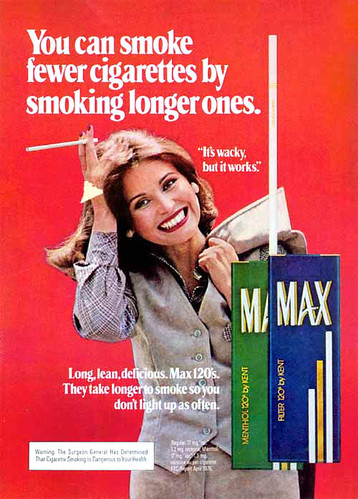
You can smoke fewer cigarettes by smoking longer ones

You can smoke fewer cigarettes by smoking longer ones by SA_Steve.


Also check out more vintage ads can be seen here
Also check out ads from the seventies, targeting African American Consumers

Uploaded on July 29, 2008
by SA_Steve