Zazzle Shop

Screen printing
Showing posts with label battery. Show all posts

Wednesday, March 2, 2011

New battery can recharge itself using sunlight

By Tuan C. Nguyen
From http://www.smartplanet.com/


A team of scientists are hoping to give those old school re-chargeable batteries a solar-powered makeover.
Mention solar technology to people and for many it still brings to mind big clunky panels housed at sprawling industrial facilities. But recent advances in solar cells has already allowed the technology to be miniaturized and integrated into a variety of everyday household products. Last year, the Japanese company Sanyo was honored with an IF Design award at the CeBIT technology conference for a developing a dual solar-powered light and USB charger. Now comes a battery prototype that can be recharged simply by being left out in the sun.
The researchers are calling their concept the Light Catcher, which is basically a photoelectronic battery comprised of tiny anti-reflective solar cells that soak up energy from the sun. A transparent encasing protects the battery while allowing sunlight to shine through. The batteries come in AA and AAA sizes and can be inserted into most portable electronics, anything from remote controls to toys. There’s also the option to power electronics using a 3.5mm jack.


The innovators behind the “Light Catcher” concept are Yung-Hsaing Chang, Ming-Shien Lin and Chang-Ting Lu. The team developed the batteries as an entry into this year’s iF Design awards, given out each year by the Hanover-based firm iF International Forum Design.

While miniaturized solar technology is still a ways from meeting the rigorous energy demands of many portable electronics like laptops and Smartphones, such advances are still quite promising. The amount of energy that can be tapped from sunlight is enormous considering that the current technology converts only a small percentage into use-able electricity.
Photo: Yanko Design

Thursday, June 10, 2010

7 Coolest Features of the iPhone 4

7 Coolest Features of the iPhone 4
Justin Sullivan/Getty Images


At Apple's developer conference in San Francisco, Steve Jobs unveiled his company's next generation smartphone, the iPhone 4. With over 100 new features, there's a lot to drool over. Here's what gadget geeks are most excited about:
  • Pricing and Color Schemes Michael Bettiol at Boy Genius Report writes: "The iPhone 4 will be available in both black and white. The 16GB model will be $199 and the 32GB model will be $299. Both of these prices reflect the 2-year contract price with AT&T. Pre-orders for the US, UK, Germany, France, and Japan will commence on the 15th of June. June 24th is the big day as far as actual availability goes."
  • It's Super-Thin, writes Agam Shah at PC World: "The iPhone 4 sports a new look and is the thinnest smartphone, [Jobs] said. At 9.3 millimeters (0.36 inches) thick, the new iPhone is 24 percent thinner than iPhone 3GS."
  • 'You Can Bing It,' praises Miguel Helft at The New York Times: "No black eye for Google, but a win for Microsoft. Mr. Jobs announces that in addition to Google, which remains the default search engine, and Yahoo, which was already an option on the iPhone, iOS 4 will give users the option to use Bing for their searches."
  • An Incredible Display Screen, notes Ed Oswald at Technologizer: "Another major feature is the 'Retina display,' Apple’s upgraded screen for the iPhone 4. The resolution comes in at 326dpi, which along with some software magic makes for clear, smooth fonts and more vivid images. Jobs said the resolution is actually higher than the human eye can see (exaggeration, perhaps?). Either way, Apple expects it to be 'years' before anybody matches this display."
  • Video Chat and Camera Overhaul, details Matt Brian at The Next Web: "Steve Jobs has just announced that the iPhone 4 has been given a complete overhaul in the camera department, upgrading the 3MP camera on the 3GS to a 5MP LED flash enabled camera that has 5x digital zoom. The handset has a backside illuminated sensor, integrated so the imaging sensor can “get more light, enabling iPhone users to take better quality low-light photos. Pixel sensors have been kept larger instead of blindly increasing megapixels to improve picture clarity and quality... The iPhone 4 will be able to record full 720p HD video at 30fps with tap to focus, one-click sharing and the LED flash will stay illuminated to allow the recording of video in low-light situations. Instead of cropping videos on the iPhone 3GS, iPhone 4 owners will be able to edit HD video using….wait for it…….iMovie for iPhone!" On top of that, there's also video chat: "You can use the front or rear camera, so people can see what you are seeing. Portrait or Landscape. The app is called FaceTime. 'Apple will ship 10s of millions of FaceTime devices this year, so there will be lots of people to talk to.'"
  • Chip and Battery Overhaul, writes MG Siegler at TechCrunch: "As expected, the iPhone 4 will use Apple’s A4 chip. The device also has a bigger battery than ever before. The combination of these two things allows for 40% better battery life in some situations, Jobs said."
  • The Gyroscope, writes Jesus Diaz at Gizmodo: "The new iPhone 4 has a gyroscope built-in. This means that it can track movement with a very high precision, much higher than the built-in accelerometers in the previous iPhones. It's 3-axis, so it's capable of detecting pitch, roll, and yaw. Couple with the accelerometer, you have 6-axis motion sensing."

Friday, January 8, 2010

"Eco-Friendly" Mobile Phone Runs on Coke

by Lloyd Alter, Toronto  
From: http://www.treehugger.com/

mobile phone runs on coke photo

Designer Daizi Zheng tells Rose at Dezeen that phone batteries are not very good- "it is expensive, consuming valuable resources on manufacturing, presenting a disposal problem and harmful to the environment."
So instead she designs a cell phone to run on Coke.
mobile phone runs on coke photo coke and phone
Now to be fair, fuel cells that run on sugar have been around for decades, and it can run on any sugary water, not just Coke. But if you are selling an idea as being environmentally friendly, why start with Coke?
mobile phone runs on coke photo phone in hand
The Designer writes:

The concept is using bio battery to replace the traditional battery to create a pollution free environment. Bio battery is an ecologically friendly energy generates electricity from carbohydrates (currently sugar) and utilizes enzymes as the catalyst. By using bio battery as the power source of the phone, it only needs a pack of sugary drink and it generates water and oxygen while the battery dies out.
mobile phone runs on coke photo phone rear
Bio battery has the potential to operate three to four times longer on a single charge than conventional lithium batteries and it could be fully biodegradable. Meanwhile, it brings a whole new perception to batteries and afternoon tea.
More at Dezeen. and from the Designer's website.

Wednesday, April 15, 2009

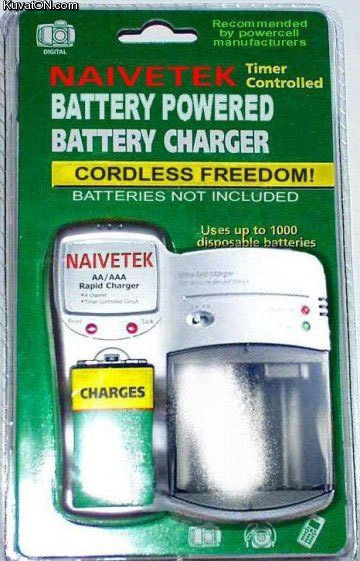
Battery Powered Battery Charger ----- WTF

Wednesday, April 8, 2009

It’s On! Portland and San Francisco Battle For Electric Car Domination

Author photo Written by Nick Chambers

Just a few weeks ago San Francisco’s visionary Mayor, Gavin Newsom, wrote a post for us describing his plan to make the Bay Area the electric car capital of the world by aggressively developing the charging infrastructure to support full-scale EV deployment. At the time he proclaimed:

“Electric vehicles have the possibility to transform our economy, revive our car industry, and improve our environment. To make sure electric vehicles succeed this time around we need to invest hundreds of millions of dollars in battery technology and [charging] infrastructure.”

Well, San Francisco, you have a challenger.

While I was at a press event yesterday hearing more about the major collaboration between Oregon, Portland General Electric and Nissan to develop a widespread EV charging network throughout Oregon, Portland’s Mayor, Sam Adams, threw down the gauntlet:

“We’re often ranked the most sustainable city in the nation. Our goal is to become the most sustainable city in the world. Today is a very important initiative that builds on where we have been but also puts us on the road, pardon the pun, to being an even greener city.”

“Working with the Governors office, Portland General Electric, and others, we will be announcing the most aggressive in-garage and on-street wired up charging station strategy that I think any city in the United States has sought to achieve. And that even means you Gavin Newsom, who’s trying hard to make the Bay Area the EV capital of the world. Uh, uh, uh, uh, uh… That’s gonna be Portland.”

I knew I had to go all the way to the top to get some answers, so I asked Mayor Newsom’s office for a response to this brewing West Coast EV turf war. Having just gotten off the phone with Mayor Newsom himself, he defended the Bay Area’s fight for the title of “EV king” saying:

“It gets me that Portland is always edging us out to win this or that sustainability competition and I thought I’d finally gotten a leg up on them with our aggressive EV development plan. Portland is a worthy competitor and it’s a fair game. It’s an enlightened competition. I don’t know the details of Portland’s plan yet, but mark my words, once we hear the details you can be sure we’ll be on top of it.”

Mayor Newsom’s Communication Director, Nathan Ballard, also added, “We welcome the healthy competiton. The more the merrier.”

Being the self-styled gushing Oregonian that I am, Mayor Adams elicited no small amount of pride from me, but I gotta give San Fran props for their wholehearted rallying cry.

All mock warring aside, I’m just happy to see the change coming so fast and furious right now. I want an electric car that can take me 100 miles a day on the freeway so bad it hurts

Now that I’m thinking about it, perhaps other cities want to get in on the EV war too? It sure beats the hell out of unwinnable wars like the war on terror or the war on drugs. Any takers?

Friday, March 13, 2009

Lithium breakthrough could charge batteries in 10 seconds

A new version of lithium battery technology can either provide a higher storage density than current batteries, or can charge and discharge as fast as a supercapacitor, emptying its entire charge in under 10 seconds.

By John Timmer
Lithium breakthrough could charge batteries in 10 seconds
Lithium-iron-phosphate particles.

It's getting difficult to overstate the importance of battery technology. Compact, high-capacity batteries are an essential part of portable electronics already, but improved batteries are likely to play a key role in the auto industry, and may eventually appear throughout the electric grid, smoothing over interruptions in renewable power sources. Unfortunately, battery technology often involves a series of tradeoffs among factors like capacity, charging time, and usable cycles. Today's issue of Nature reports on a new version of lithium battery technology that may just be a game-changer.

The new work involves well-understood technology, relying on lithium ions as charge carriers within the battery. But the lithium resides in a material that was designed specifically to allow it to move through the battery quickly, which means charges can be shifted in and out of storage much more rapidly than in traditional formulations of lithium batteries. The net result is a battery that, given the proper electrodes, can perform a complete discharge in under 10 seconds—the sort of performance previously confined to the realm of supercapacitors.

This appears to be one of those cases where applications badly lagged theory. Since lithium ions are the primary charge carriers in most batteries, the rates of charging and discharging the batteries wind up proportional to the speed at which lithium ions can move within the battery material. Real-world battery experience would suggest that lithium moves fairly slowly through most types of batteries, but theoretical calculations suggested that there was no real reason that should be the case—lithium should be able to move quite briskly.

A number of recent papers suggested that, in at least one lithium battery class (based on LiFePO4), the problem wasn't the speed at which lithium moved—instead, it could only enter and exit crystals of this salt at specific locations. This, in turn, indicated that figuring a way to speed up this process would increase the overall performance of the battery.

To accomplish this, the authors developed a process that created a disorganized lithium phosphate coating on the surfaces of LiFePO4 crystals. By tweaking the ratio of iron to phosphorous in the starting mix and heating the material to 600°C under argon for ten hours, the authors created a material that has a glass-like coating that's less than 5nm thick, which covers the surface of pellets that are approximately 50nm across. That outer coating has very high lithium mobility, which allows charge to rapidly move into and out of storage in the LiFePO4 of the core of these pellets. In short, because lithium can move quickly through this outer coating, it can rapidly locate and enter the appropriate space on the LiFePO4 crystals.

The results are pretty astonishing. At low discharge rates, a cell prepared from this material discharges completely to its theoretical limit (~166mAh/g). As the authors put it, "Capacity retention of the material is superior." Running it through 50 charge/discharge cycles revealed no significant change in the total capacity of the battery.

But the truly surprising features of the cell came when the authors tweaked the cathode to allow higher currents to be run into the cell. Increasing the rate by a factor of 100 dropped the total capacity down to about 110mAh/g, but increased the power rate by two orders of magnitude (that's a hundred-fold increase) compared to traditional lithium batteries. Amazingly, under these conditions, the charge capacity of the battery actually increased as it underwent more charge/discharge cycles. Doubling the charge transport from there cut the capacity in half, but again doubled the power rate. At this top rate, the entire battery would discharge in as little as nine seconds. That sort of performance had previously only been achieved using supercapacitors.

At this point, the authors calculate, the primary limiting factor is no longer storing lithium in the battery; instead, getting the lithium in contact with an electrode is what slows things down. The electrodes also become a problem because they need to occupy more of the volume of the battery in order to maintain this rate of charge, which lowers the charge density. That's a major contributor to the halving of the battery's capacity mentioned in the previous paragraph.

A more significant problem is that these batteries may wind up facing an electric grid that was never meant to deal with them. A 1Wh cell phone battery could charge in 10 seconds, but would pull a hefty 360W in the process. A battery that's sufficient to run an electric vehicle could be fully charged in five minutes—which would make electric vehicles incredibly practical—but doing so would pull 180kW, which is most certainly not practical.

Nature, 2009. DOI: 10.1038/nature07853

Thursday, January 8, 2009

Is The MacBook's New Super-Battery Actually Cutting Edge?

| posted by Chris Dannen

The best new feature in Apple's [AAPL] new MacBook Pro is the 8-hour, ultra-durable battery that Apple says it custom-designed. But is it really the advanced powerplant it claims to be?

Conventional notebook batteries, or lithium-ion batteries, are made up of tightly-packed cylindrical cells, almost like a bunch of little Duracell Cs in a case. Apple has chosen to use lithium-polymer batteries in the new MacBook Pro, which are widely regarded as more advanced than li-ion batteries; they're lighter, more physically robust, more energy-dense, cheaper to manufacture and don't have to be in the traditional block form-factor.

Macbook ProBecause li-poly batteries can be any shape, Apple smartly molded the new MacBook Pro's battery to the inside of its case, packing in a 40% "bigger" battery into the machine. That increase probably has as much to do with the physical size of the cells as the energy density of li-poly storage, which has helped Apple keep weight down. The MacBook Pro tips the scales at 6.6 pounds.

The new li-poly battery allows Apple to claim eight hours on a single charge, or seven with a beefier video card. Each battery should survive longer, too; Apple claims five years, or 200-300 full charges. That longevity owes itself to Apple's new "adaptive charging" system, which uses microchips inside the battery to determine the optimal level of current for each cell.

But put your ear to the ground in the battery community, and the buzz isn't about custom-shaped li-poly batteries, with or without "adaptive" charging. Companies like ZPower are already boasting huge improvements in silver-oxide batteries (also known as silver-zinc batteries), which have a much better energy-to-weight ratio than lithium-based batteries. You can see an animation of how silver-zinc batteries work here.

Not only are they 40% more energy-dense than lithium-based cells, silver-zinc batteries are 95% recyclable, and because they don't contain lithium, they're not prone to exploding and engulfing your precious notebook in flames. Apple's new li-poly battery, to its credit, is arsenic, BFR, mercury, and PVC free, and “highly recyclable,” according to the company -- but it's hard to beat silver for its green cred and safety.

The downside is that silver-based batteries are susceptible to the fluctuations of the price of silver, which has been on a rollercoaster ride since late 2005. [To see a graph of silver prices since 1992, courtesy of TheBullionDesk.com, click here.] That has rendered them useful only in small, if important, devices like the on-board computers inside self-guided weaponry.

But ZPower, for one, has said that it's gearing up to launch its batteries inside a "major notebook computer" this year, suggesting that some of the leakage problems that plagued early silver batteries has been solved. The company plans on using a trade-in recycling program to keep battery prices stable and manageable. California-based ZPower, whose backers include Intel [INTC], claims this will add two hours to the life of an average notebook battery, a jump from five hours to seven hours.

With its monster battery registering at welter-weight size, Apple is ahead of the pack for now. But should a competitor like Dell [DELL] or HP [HPQ] come out with a silver-ion battery in one of their 2009-2010 notebooks -- and should the price of silver fall -- all of Apple's custom in-house engineering might have been for naught.


Friday, December 12, 2008

HP laptops get new battery that charges quicker, lasts longer

SANTA BARBARA, CALIF. -- HP plans to offer as an optional upgrade for some consumer notebooks a new kind of lithium ion battery that charges faster than regular batteries and lasts three times longer.

The battery is made by Boston-Power, which announced iut as the Sonata battery. HP will re-brand the battery as the HP Enviro battery, and start offering them early next year.

Conventional batteries offer roughly 300 charge cycles before becoming useless. The Sonata, or Enviro, promises 1,000. HP will sell the Enviro with a three-year warranty.

The new battery should allow an 80-percent charge in thirty minutes, which is better performance compared with conventional lithium ion batteries.

HP has not announced pricing.

Wednesday, October 15, 2008

Texas Teen Builds His Own Electric Car on $10,000 Budget

This fall, Texas teenager Lucas Laborde will be driving to school in an electric car he built himself. The 17 year old spent last summer converting a conventional gas-powered car to run on batteries. Total cost? Around $10,000.

Luke’s EV is based on a kit car, known as a Bradley GT II, which his father bought on eBay for just $5000 splashing out a further $5700 on electric conversion parts and batteries. The rest was left up to Luke’s ingenuity and technical know-how.

After 150 hours of work, Luke had hooked up eight 80-pound lead-acid batteries in the space left after removing the fuel tank, as well as several other ‘creative locations.’ He finished up with an EV capable of travelling 40 miles between charges, a top speed of 45mph, (more than enough for the local school run), and heaps of low-end torque. As Luke told reporters, “it has a lot of power.”

The car isn’t without a few ‘quirks’ though; the weight of the batteries has caused the fiberglas body to twist slightly, meaning that the gull-wing doors don’t completely close. However, by using his own initiative, and making use of widely available existing components, Luke Laborde has put many global car companies to shame by creating a working, highway-ready EV, in far less time and on a much lower budget.

Image Credit - Steve Striharsky at bradleygt2.com