Zazzle Shop

Screen printing
Showing posts with label Coca-Cola. Show all posts

Friday, June 17, 2011

The Amazing World of Coca-Cola

Posted by Drew Hendricks
From: http://lymphedemacommunity.com/

  • Coca Cola History

Saturday, April 23, 2011

A Passover Toast to a Rabbi Known for Social Activism, and for Kosher Coca-Cola

By SAMUEL G. FREEDMAN

Rabbi Tuvia Geffen, of blessed memory, was born in Lithuania in 1870 and educated in the renowned Slobodka yeshiva. In the wake of a pogrom, he immigrated to New York in 1903, and seven years later he moved to Atlanta to become the rabbi of Shearith Israel, a tiny and struggling Orthodox congregation meeting in the battered remnant of a Methodist church.

During his early decades at Shearith Israel, Rabbi Geffen established Atlanta’s first Hebrew school and oversaw its ritual bath. He stood by Leo Frank, the Jewish man falsely accused of murdering a young Christian girl, and after Frank’s lynching in 1915, the rabbi urged his congregants not to flee the South in fear.

At Passover in 1925, he spoke eloquently and presciently against Congress for passing immigration restrictions that “have slammed shut the gates of the country before the wanderers, the strangers, and those who walk in darkness from place to place.” As early as 1933, he warned about the Nazi regime in Germany. Long before feminism, he advocated for Orthodox women who were being denied religious divorce decrees by vindictive husbands.

But all those achievements are not why we invoke the name and memory of Rabbi Geffen today, more than 40 years after his death. No, we come to honor his least likely yet most enduring contribution to the Jewish people and his adopted nation: kosher-for-Passover Coca-Cola.

Yes, observant Jews of today, searching supermarket counters for those bottles with the telltale yellow cap bearing the Orthodox Union’s certification, and yes, Coke die-hards of any or no religion who seek out those same bottles for the throwback flavor of cane-sugar Coke, you owe it all to Rabbi Tuvia Geffen.

He of the long beard and wire-rim glasses and Yiddish-inflected English, a man by all outward appearances belonging to the Old World, he was the person who by geographical coincidence and unexpected perspicacity adapted Coca-Cola’s secret formula to make the iconic soft drink kosher in one version for Passover and in another for the rest of the year. To this day, his 1935 rabbinical ruling, known in Hebrew as a teshuva, remains the standard.

That ruling, in turn, did much more than solve a dietary problem. A generation after Frank’s lynching, a decade after Congress barred the Golden Door, amid the early stages of Hitler’s genocide, kosher Coke formed a powerful symbol of American Jewry’s place in the mainstream.

“Rabbi Geffen really got the importance of it,” said Marcie Cohen Ferris, a professor of American studies at the University of North Carolina, who specializes in Jewish life in the South. “You couldn’t live in any better place than the South to get it. To not drink Coca-Cola was certainly to be considered un-American.”

Or look at the interplay of Jews and America from another angle. Rabbi Geffen’s solution to the Coke problem was not to forget the kosher rules and melt into the melting pot. But neither was it to decry the spiritual pollution of modernity in the form of a fizzy drink. A half-century before the era of cultural pluralism, his answer was to have the majority address the distinct needs of a minority.

As a contemporary Orthodox rabbi, Adam Mintz, has written in an essay on Geffen and Coke: “Struggling to find their place in a land that was often hostile to their religion, American Jews respected and appreciated rabbis who sought to include them within the Orthodox camp rather than simply condemn them as sinners. Of course his approach would not have been possible had he not felt confident in his powers of persuasion.”

We can safely say, however, that this issue chose Rabbi Geffen rather than the other way around. As early as 1925, as the Orthodox authority in Coke’s home city, he was receiving inquiries from other rabbis about the drink’s kosher status. A few other rabbis had already given certification, without knowing the secret formula. And multitudes of American Jews were drinking Coke regardless.

“Because it has become an insurmountable problem to induce the great majority of Jews to refrain from partaking of this drink,” Rabbi Geffen wrote in his teshuva, “I have tried earnestly to find a method of permitting its usage. With the help of God, I have been able to uncover a pragmatic solution.”

Putting aside God’s props for a moment, we should note that Rabbi Geffen had some significant earthly help in the person of Harold Hirsch, a Jewish Atlantan who was Coca-Cola’s corporate lawyer. Through Hirsch, Rabbi Geffen was permitted to enter that industry’s Holy of Holies and receive Coke’s secret formula.

With it, the rabbi was able to identify the elements that rendered Coke nonkosher during the bulk of the year (oil of glycerine derived from beef tallow) and specifically during Passover (a corn derivative). Hiding the exact ingredients behind Hebrew euphemisms in his teshuva, Rabbi Geffen explained the needed corrections. Glycerine could be replaced by coconut or cottonseed oils, and the corn derivative by cane or beet sugars.

Kosher-for-Passover Coke is now produced under rabbinic supervision at bottling plants serving Jewish population centers in New York, Florida, Southern California and Houston, among other areas. A number of other major brands have followed Coke into the Passover market: Dannon, Lipton, Pepsi and Tropicana. There are tequila and blintzes made without forbidden grains.

“It used to be that for Pesach you were limited to matza and hard-boiled eggs,” said Rabbi Menachem Genack, the head of the Orthodox Union’s kosher-certification program. “Now, I’ve got to tell you, I love those cheese blintzes.”

And, whether devout or debauched, Coke fans anticipate Passover for their own cultish reason: the usual sweetener, high-fructose corn syrup, is replaced by cane or beet sugar.

Moshe Feder, an editor of science-fiction and fantasy books, traveled to six supermarkets from his home in Queens before finding four two-liter bottles of Passover Coke. The subject of his quest happened to come up at a seder the other night. The host, a Jewish man, had never heard about the difference between Coke and Passover Coke. But two Roman Catholic guests, Mr. Feder reported, “knew all about it.”

Rabbi Geffen, of blessed memory, who’d have guessed you were so ecumenical?

E-mail: sgf1@columbia.edu

Wednesday, March 16, 2011

Pepsi Ups Ante on Plant-Based Bottles with 100% Non-Plastic Bottle

Pepsi Ups Ante on Plant-Based Bottles with 100% Non-Plastic Bottle
PURCHASE, NY — PepsiCo announced a response to Coca-Cola's PlantBottle, but unlike Coke's bottle, which is only 30 percent plant-based at the time, Pepsi says its will be completely derived from plants.
Pepsi will make its bottles out of switch grass, pine bark and corn husks, and like with Coke's PlantBottle, they're using natural materials to make PET plastic, so it can be recycled along with their current petroleum-based plastic bottles.

The beverage giant hopes to also use orange and potato peels, oat hulls and other agricultural byproducts from its Tropicana, Quaker and other operations in the future to make the bottles.
Pepsi will do a pilot run of the plant-based bottles in 2012, followed by commercialization based on the results of the test run.

While Coca-Cola beat Pepsi to putting out drinks in bottles made from plants first, Pepsi has the chance to put out the first recyclable bottle derived entirely from plants by a major company.
Coca-Cola's PlantBottles, which are also being used for Heinz ketchup and Odwalla juices, are still 70 percent petroleum-based. Scott Vitters, the company's global director of sustainable packaging, wrote in a GreenBiz.com post last year:
Our PlantBottle packaging is made by converting natural sugars found in plants into a key ingredient for making PET plastic. For those who want the technical specifics, we've innovated a way to develop plant-based MEG, a key component in PET plastic. PlantBottle is up to 30 percent plant-based because MEG is 30 percent of the total composition of PET plastic by weight. We still have more work to do to crack the code on a plant-based TA, which is the other 70 percent of PET plastic, but we know it is feasible.
Pepsi bottles - CC license by Clean Wal-Mart (Flickr)

Tuesday, March 15, 2011

Coming Soon: 7Up Retro

by Steve

As hinted at via our tweet on February 28, we've got confirmation that 7Up Retro will be arriving in May.
Real Sugar 7Up is coming!
(Source: Flickr, used via CC BY-NC 2.0 license)
 
The launch will be tied to a promotion done in conjunction with NBC's Celebrity Apprentice reality show. You may recall that last year, Dr Pepper Snapple Group, the parent of 7Up, used the same show to launch limited runs of Diet Snapple Trop-a-Rocka Tea and Snapple Compassionberry Tea. Apparently the folks at DPSG found that platform successful enough to continue with rollouts.

We've also heard that Snapple's sponsorship of one of BevReview's favorite reality shows, The Amazing Race, will be used to introduce new flavors Papaya Mango Tea and Diet Papaya Mango Tea later this month.

The introduction of a limited time lemon-lime product that uses "real sugar" should provide a nice comparison product to Pepsi's Sierra Mist Natural. While we like the sugar Sierra Mist, we do agree that something in the taste just seems a bit… off.

Dr Pepper Snapple Group experimented with the current limited release "real sugar" trend in soft drinks via Heritage Dr Pepper (bottled by Pepsi) and Dr Pepper with Real Sugar (bottled by Coke). Of course what got this whole thing started was the rollout of PepsiCo's Pepsi Throwback and Mountain Dew Throwback, which after 4 limited edition rereleases, are now permanent parts of the Pepsi lineup. With the recent reboot of 7Up's normal formula, we're looking forward to tasting this sugar-infused version.

We couldn't turn up any trademark filings or early packaging art on 7Up Retro, but keep your eyes open! Remember we're just an e-mail, tweet, or Facebook post away!

Tuesday, February 15, 2011

Coca Cola recipe 'discovered'

From: http://www.telegraph.co.uk/

A website claims to have uncovered Coca-Cola's top secret recipe.

Coca-cola bottles: Flat Coca-Cola 'should not be given to children with diarrhoea and vomiting'
Coca-Cola's top secret recipe has allegedly been revealed Photo: REUTERS
The ingredients of the drink, created by John Pemberton, a medicinal pharmacist in 1886, have always been a mystery.
However, Thisamericanlife.org claims to have discovered a list in a photograph in a newspaper article giving the ingredients and exact quantities to make the drink.
The Feb 8 1979 edition of the Atlanta Journal-Constitution has a photo of someone holding open a book with a recipe claimed to be an exact replica of Pemberton's.
The recipe reportedly contains the exact measures of all the different oils needed for Coca Cola's secret ingredient, Merchandise 7X.
Despite making up only one per cent of the drink's total formula, Merchandise 7X is thought to give the popular soft drink its unique taste.
The official recipe is said to be guarded 24-hours a day in a vault in Atlanta, Georgia.

The 'secret recipe'
Fluid extract of Coca 3 drams USP
Citric acid 3 oz
Caffeine 1oz
Sugar 30 (it is unclear from the markings what quantity is required)
Water 2.5 gal
Lime juice 2 pints 1 qrt
Vanilla 1oz
Caramel 1.5oz or more to colour
7X flavour (use 2oz of flavour to 5 gals syrup):
Alcohol 8oz
Orange oil 20 drops
Lemon oil 30 drops
Nutmeg oil 10 drops
Coriander 5 drops
Neroli 10 drops
Cinnamon 10 drops

Tuesday, June 15, 2010

Coke Greenlights Mello Yello Expansion With Retro Look

- Elaine Wong
from: http://www.brandweek.com/

Mello Yello, Coca-Cola’s longtime competitor to PepsiCo’s Mountain Dew, is channeling the spirit of 1979 in an attempt to break out of its perennial also-ran status.

The new Mello Yello cans, which began appearing on shelves over the last few weeks, hearken back to the brand’s introduction that year with a pair of green- and light-red L’s “strolling off the edge of the can,” as Coke describes it.

The somewhat retro look is part of Coca-Cola’s plan to expand the brand’s distribution beyond its current regional footprint. The new cans, for instance, will begin showing up in cities like Philadelphia as well as in the Northwest. The redesign, which replaces a look that was closer in style to the current Mountain Dew, is meant to appeal to teens and young adults—Mello Yello’s core target—but also older consumers who may remember the brand’s original packaging. Mello Yello’s repackaging is the first major marketing attention the brand has gotten in years. (Mello Yello had no appreciable spending last year, per the Nielsen Co., which doesn’t track online spending.)

Peter Clarke, CEO of Product Ventures, a brand strategy and design firm, said the relaunch is part of a trend in which consumers are gravitating to things that are comfortable and familiar. “People are retreating like Thoreau did to Walden Pond,” he said. Designs that tend to be simple, nostalgic or have a “retro flair” are comforting, whereas “things with an edge speak to fast pace, hectic and crazy. People are already overwhelmed quite a bit,” he added.

Coca-Cola is supporting the launch via out-of-home, radio and digital ads, the latter of which launch in August. One outdoor execution reads (with a nod to the British singer-songwriter Donovan): “They call me Mello Yello.” There’s also the accompanying tagline, “The original smooth,” which appears on the can.

The company tapped New York-based design agency Stag&Hare for the new look, and Mutt Industries in Portland, Ore., handled advertising duties. Sabrina Tandon, who goes by the title senior manager of smooth, is in charge of marketing Mello Yello.

Coke sold 27 million cases of Mello Yello last year versus 630 million for Mountain Dew, according to Beverage Digest. John Sicher, the publication’s editor, said that Mountain Dew has been marketed very well by PepsiCo and as a result completely dominates the citrus segment, though Coca-Cola’s Sprite is a big player in the clear lemon-lime category. “Mountain Dew is a very strong brand; it’s done very well,” he said. “Coke is smart to try to get [into] more of the citrus segment action.”

Gerry Khermouch, editor of Beverage Business Insights, an industry publication that covers the nonalcoholic beverages industry, said Mello Yello’s redesign is a good move. “We seem to be in a period where a new generation is discovering the 1960s/70s and flaunting peace symbols, psychedelic music styles, Afros and the like,” he wrote in an e-mail. Plus, flavored carbonated soft drinks have taken off in a downturn, and both Coca-Cola and Pepsi have focused their attention there. “The big checks they were willing to write to hang onto Crush is another indicator of that,” he said, referring to both companies’ decision to buy their main North American bottlers and continue distributing Dr Pepper Snapple Group brands, including the orange-flavored soda.

Friday, May 28, 2010

New Custom Coke Machine Will Let You Create Near Infinite Flavors

By Will Pollock
From: http://www.asylum.com/

Rest in peace, oh soda jerk: Coke Freestyle elevates individuals to instant mixologists by using a zesty touch-screen system to mix selections from over 100 choices into a custom beverage, all while delivering a geeky high-tech thrill.


It's been called "the fountain of the future," "the most advanced soda fountain ever" and (in a backhanded-compliment kind of way) a path "leading to social ruin." Even Warren Buffett is a fan. But can this thing really deliver?

Coke spokesperson Helen Tarleton certainly thinks so, calling it a "complete departure from a traditional fountain machine." (She even reports that a gal was caught on security camera fondly embracing and kissing the machine.)

Tarleton expects 500 new Freestyle machines to pop up soon in Southern California, Atlanta, Dallas and Salt Lake City

We decided to take Coke Freestyle for a test drive at a local McDonald's in Atlanta, where we came up with some crazy combinations using the machine's 100-plus flavor options.


2,145diggsdigg
While Freestyle's club soda can help cut the sweetness of some of the machine's more intense flavors, you are likely to go crazier with the combinations than you think -- and you're virtually guaranteed to forget whatever it is you put in your cup.

But we were able to document a few of our greatest hits for posterity:

"Doogie Fanta, M.D." (Combination: Dr. Pepper, Vault Peach, Cherry Fanta)

"The Red Wolf Blitzer" (Vault Red Blitz, vanilla Diet Coke)

"Barqing Berry" (Barq root beer, raspberry Dasani Sensation)

"Looney Tunes" (Minute Maid strawberry, vanilla Coke, grape Fanta, club soda)

"Lima-berry" (Grape Fanta, Lime Dasani Sensations, Club Soda)

"Customers love them," says Stephen Cordell, McDonald's on Cheshire Bridge's first assistant manager, who seems like a proud father reporting that his two Freestyle machines connect via Wi-Fi to the Coke mothership every morning at 2 a.m. for software updates.

Freestyle feedback was largely positive. "Wow, this is cool" and "How neat" were thrown around McDonald's by customers while we were testing it out.

So go forth, soda geeks, but make sure to keep track of your mix for next time -- and keep some Tums handy for the inevitable sugar-stomachache.


Tuesday, April 13, 2010

Coca-Cola Making Chairs Out of 3 Million Recycled Coke Bottles

By: by jerryjamesstone
From: http://greenopolis.com/

Coca-Cola is creating a new chair line from 3 million recycled Coke bottles.

The chair is a joint effort between Coke and leading furniture manufacturer Emeco (Electric Machine and Equipment Company). Emeco chairs have become a bit iconic after being featured on the hit TV show Sex and the City.

The company got an early start creating chairs for the U.S. Navy during World War II. In fact, the contract specified that the chair be able to withstand a torpedo blast to the side of a destroyer. That chair was made from 80-percent recycled aluminum with a painstaking 77-step process.

“The 111 Navy Chair is a reflection of our commitment to sustainability, constant innovation and originality in design,” said Kate Dwyer, Group Director, Worldwide Licensing, The Coca-Cola Company.

Each new chair uses at least 111 20-ounce recycled PET soda bottles diverted from Coke's recycling plant in Spartanburg, South Carolina. The plant happens to be the world's largest bottle-to-bottle recycling facility.

It's called the 111 Navy Chair which is a play on the chair's original name--106 Navy Chair--and the quantity of Coke bottles used. The chair will cost $230 and is available in six colors: Coca-Cola Red, Snow, Flint, Persimmon, Grass, and Charcoal. That price is about half of the original Navy Chair.

“When Coca-Cola approached me with this project I jumped on it,” said Gregg Buchbinder, Chairman of Emeco. “I was excited about the impact of reusing the PET from about three million plastic bottles a year. That’s a lot of bottles and a lot of chairs.”

Like this article? Follow me on Twitter or friend me on Facebook.

Source: MNN

Monday, February 8, 2010

Cola Powered Radio Control Car Fueled by a Sugar Rush


bio powered car, bio powered rc, cola powered car, cola powered rc, juice powered car, juice powered rc, sugar powered car, sugar powered rc, takara tomy car, tomy car
As a health conscious parent, you’re probably not seeking plausible reasons to introduce your kids to cola — but a radio controlled car powered by pop? How cool is that? Takara Tomy, a Japanese toy maker, has manufactured a prototype RC ‘ene Bio Engine’ car (looks more like a futuristic delivery truck) that runs on Sony’s sugar fueled Bio-Battery. See the car in action in the video after the jump!


The car, which may be powered by a variety of sugary liquids (ie: the residue in kids’ juice containers), is still in its prototype phase. Once on the market, parents will be able to use the toy to encourage less waste and introduce a bit of life science. “The passive-type bio battery system generates eco-friendly electricity by breaking down sugar using processes similar to those in living organisms.”


For those parents who find it a bit dubious that, as Gigazine explained, “The speed/running-time of the toy depends on what drink you use” (i.e. the more sugary the drink juicing the battery, the more power the car will receive) — it should be noted that although for commercial reasons Tomy has chosen to use colas to promote the car (Coca-Cola, Sprite, 7-Up), the most efficient fuel tested was grape juice. And whatever syrupy liquids are left may one day power… your cell phone.
Images and video via Gigazine


Wednesday, February 3, 2010

Madonna is Crazy for Coconut Water


Madonna is coming soon to your neighborhood bodega: The Material Girl has become a major investor in a company that sells coconut water in supermarkets.

Madonna's manager, Guy Oseary, told The New York Post that the singer invested about $1.5 million in Vita Coco, a New York-based company that sells the beverage in New York and Los Angeles and wants to take its product national. Oseary also told The Post he's convinced other celebrities, including actor Matthew McConaughey and singer Anthony Kiedis of the Red Hot Chili Peppers, to make smaller investments in the company.

Apparently, Madonna liked the juice of green coconuts so much, she's throwing marketing ideas to the Vita Coco management, and is talking about making a follow-up investment, according to The Post.

Coconut water has been gaining trendiness over the last couple of years, moving out of inner-city bodegas, where its main audience had been immigrants from the Caribbean and Latin America, and into the realm of hipster chic. With Madonna's seal of approval, it could go mainstream.

The market could be ripe for growth -- no pun intended. Several companies are already promoting coconut water as both a healthy substitute for sports drinks and a trendy mixer for cocktails. Vita Coco has reportedly turned down overtures from both Pepsico (PEP), which already owns two brands of coconut water in Brazil, and Coca-Cola Co. (KO). A rival coconut water brand, Zico, last year sold a minority stake to Coca-Cola, and another brand, O.N.E., signed a distribution agreement with Pepsi.

Lucky Stars? In High-Profile Investments, Not Always


But keep in mind, celebrity investors are not the same thing as investment celebrities. Madonna is nothing like Warren Buffett.

Any number of celebrities have put their money and fame behind various ventures -- U2 frontman Bono co-founded Elevation Partners, a Silicon Valley tech fund, and Bruce WIllis just signed up as an investor in distiller Belvedere SA -- but a having celebrities attached to your business is no guarantee of success. The company has to live and die by its own product.

Remember Planet Hollywood? The chain of restaurants was supposed to take on the Hard Rock Cafe, and it was a natural fit for movie stars like Willis, Arnold Schwarzenegger and Sylvester Stallone. For a while, it was flying high, and spawned imitators like the Fashion Cafe (models) and the All-Star Cafe (famous jocks). Then it overreached, opened too many restaurants and ended up with a trip to bankruptcy court, followed by a couple of sequels. Star power turned out to be no substitute for prudent management.

The investors apparently learned their lesson -- except perhaps for Arnold, who's trying to bail out California. Willis got a 3.3% stake in Belvedere in exchange for promoting its vodka, and his ex-wife Demi Moore -- another former Planet Hollywood investor -- made a smaller investment in Vita Coco than Madonna. Even stars sometimes have to start small.

Wednesday, January 27, 2010

Four Ways to Find Coke and Pepsi with Cane Sugar


Finding cane-sugar based sodas is becoming easier and easier these days. New, smaller soda makers are capitalizing on Coke and Pepsi’s insistence on using high fructose corn syrup (HFCS) in their drinks. Colas like Boylan’s Cane, Red Rock, and Afri-Cola have begun inching their way into mainstream stores, much to the chagrin of Coke and Pepsi.

For twenty-five years now the Coca Cola company has been using HFCS in its original formula drink. The switch from cane sugar happened during the roll out of New Coke and the company’s rebranding in 1985. Coca-Cola Classic was reintroduced a few years later, although this time with HFCS instead of sugar which became the norm across most Coke and Pepsi sodas.

Here are at least four options for finding Coke and Pepsi with cane sugar in the U.S.

Option #1: Kosher Coke & Option #2: Kosher Pepsi for Passover

Now with Passover fast approaching, Kosher Coke and Kosher Pepsi are starting to appear on the shelves. These versions of Coke and Pepsi are both made with cane sugar instead of HFCS, and most reviewers say they prefer the taste. In addition they avoid the purported negative effects of HFCS including increased obesity and insulin resistance.

The kosher versions are mostly available in many urban centers, but they can be special ordered at most stores through the local bottler. Both kosher Coke and Pepsi have flown off the shelves in recent years with increased awareness of HFCS . Even non-Jews have been purchasing the special versions and stocking up on them. (Image source: bevreview.com).

Option #3: That 70’s Cola

Last year, Pepsi introduced Pepsi Throwback, touted as a sentimental version of the original recipe and only sold for a limited time. It’s back again for 2010 with a new-old look and will be sold until February 22, 2010. Why the limited time frame? Who knows, but it’s a brilliant marketing move by Pepsi to position it as vintage, avoiding the HFCS argument. Mountain Dew Throwback is also available. Each of these versions add about ten calories to a twenty-ounce serving (260 vs. 250 calories).


Option #4: Destapa la Felicidad
Another way to find Cola-Cola with cane sugar is to seek out the Mexican formula, which is said to taste better than its American counterpart. It’s often difficult to find, but most Hispanic groceries and many restaurants are now selling it, along with some Costco and Kroger chain stores in areas with large Hispanic populations. Originally it was bootlegged in from across the border to keep local US bottlers from losing sales, but Coca-Cola now imports it into the US in small quantities.


Find this article at:
http://www.divinecaroline.com/22177/92010-four-ways-find-coke-pepsi

Friday, January 8, 2010

"Eco-Friendly" Mobile Phone Runs on Coke

by Lloyd Alter, Toronto  
From: http://www.treehugger.com/

mobile phone runs on coke photo

Designer Daizi Zheng tells Rose at Dezeen that phone batteries are not very good- "it is expensive, consuming valuable resources on manufacturing, presenting a disposal problem and harmful to the environment."
So instead she designs a cell phone to run on Coke.
mobile phone runs on coke photo coke and phone
Now to be fair, fuel cells that run on sugar have been around for decades, and it can run on any sugary water, not just Coke. But if you are selling an idea as being environmentally friendly, why start with Coke?
mobile phone runs on coke photo phone in hand
The Designer writes:

The concept is using bio battery to replace the traditional battery to create a pollution free environment. Bio battery is an ecologically friendly energy generates electricity from carbohydrates (currently sugar) and utilizes enzymes as the catalyst. By using bio battery as the power source of the phone, it only needs a pack of sugary drink and it generates water and oxygen while the battery dies out.
mobile phone runs on coke photo phone rear
Bio battery has the potential to operate three to four times longer on a single charge than conventional lithium batteries and it could be fully biodegradable. Meanwhile, it brings a whole new perception to batteries and afternoon tea.
More at Dezeen. and from the Designer's website.

Thursday, January 7, 2010

Coca-Cola Greens Lights and Power for Iconic SF Billboard


SAN FRANCISCO, CA — Coca-Cola's glittering billboard, a fixture in downtown San Francisco for more than 70 years, has been replaced with a state-of-the-art LED display that's 80 percent more energy efficient while retaining the classic look of the world-renown logo.

The company also is offsetting 100 percent of the electricity used by the billboard through purchase of Green-e certified Renewable Energy Certificates for wind energy from Sterling Planet.

Coca-Cola and the YESCO, the Salt Lake City, firm that engineered, manufactured and installed the retrofit, showed off their handiwork today.

Standing 112 feet above Bryant Street atop a three-story building in San Francisco's South of Market area, the billboard has been a landmark for drivers going to and from the Bay Bridge since 1937 -- the year after the bridge that connects San Francisco to Oakland opened.

The Spencerian script of the logo with its glowing background in a shade known as Coca-Cola Red was originally illuminated with neon. It alternately twinkled and shone for the better part of seven decades, but in recent years began showing its age.

Seventy-feet long and 30 feet high, the new sign is about the same size as its predecessor, but the look at night is crisper and the colors seem more vibrant.

That's largely due to advancements in lighting technology, according to the project partners.
The lumen output of the new sign is similar to that of the old one, said Jeff L. Krantz, an account executive at YESCO.
Krantz and Coca-Cola Energy Efficiency Manage Richard Crowther stressed that while the technology is new, the traditional design has been preserved.

That was the directive from the community as well as the company, they said.

"It was very important to everyone involved in the project to replicate that classic look and feel," said Krantz.

The work to remove the original lighting system and reface the billboard with 4,800 CFLs for the white lettering and strip LEDs for the background started November 30, and the new sign was in place and lit by Christmas Eve, said YESCO project manager Danny Hunsaker.


With eight - to 10-man crews working day and night on the installation project, the billboard was dark for only four days, Hunsaker added.

Ninety percent of the metals and wiring from the original sign were recycled, and disposal of neon and other materials that could not be recycled were handled according to regulatory guidelines, Coca-Cola said.

The company greened its giant sign in Times Square last year. The retrofitting of company signs is part of Coca-Cola's ongoing drive to embed its environmental stewardship credo in all its operations.

The global firm had a big presence at the climate conference in Copenhagen, where CEO Muhtar Kent spent time with GreenBiz.com Senior Contributor Marc Gunther to talk about the company's latest efforts.

Those include its development of the PlantBottle, a container made from recyclable PET plastic, 30 percent of which is sourced from Brazilian sugar cane and molasses, and the company's recently announced commitment to replace all its vending machines using hydrofluorocarbons with coolers that employ more environmentally friendly refrigerants by 2015.

There's also a major campaign to reduce energy use at facilities including those of Coke-product bottlers around the world, said Crowther.

In California, for example, Coca-Cola Enterprises -- the production, distribution and marketing firm that serves as the leading bottler of Coca-Cola products -- is slashing its electricity consumption by 5.6 million kilowatt-hours a year as a result of an energy efficiency overhaul of lighting systems at 24 facilities in the state.

The various initiatives all stem from Coca-Cola's ultimate goal of growing its business without increasing its carbon footprint, Crowther said.

More information on Coca-Cola's sustainability work is available at www.thecoca-colacompany.com/citizenship.

Images courtesy of the Coca-Cola Company.

Wednesday, November 18, 2009

History of the Coca-Cola Bottle

Tuesday, August 4, 2009

Why Does Coke From a Glass Bottle Taste Different?


The Usual Suspects: Various container materials might impart slight changes to Coke's flavor. Courtesy The Coca-Cola Company

It doesn’t. That’s what Coca-Cola’s spokespeople say, anyway. “The great taste of Coca-Cola is the same regardless of the package it comes in,” they insist. Rather, they say, “the particular way that people choose to enjoy their Coke can affect their perception of taste.” Sure, most people would agree that the cola is indeed delicious and refreshing, and pouring it into a glass or serving it over ice could influence the sensation of its flavor. But is it possible that the subtle variation in taste that some notice among aluminum cans, plastic bottles and glass bottles is more than just a psychological effect of their soda-consumption rituals?

Given that the formula is always the same, yes, according to Sara Risch, a food chemist and member of the Institute of Food Technologists. “While packaging and food companies work to prevent any interactions, they can occur,” she says. For example, the polymer that lines aluminum cans might absorb small amounts of soluble flavor from the soda. Conversely, acetaldehyde in plastic bottles might migrate into the soda. The FDA regulates this kind of potential chemical contact, but even minute, allowable amounts could alter flavor.

Your best bet for getting Coke’s pure, unaltered taste is to drink it from a glass bottle, the most inert material it’s served in. Even that’s not a sure bet, though. Coca-Cola maintains strict uniformity in processes in all of its worldwide bottling facilities, but it concedes that exposure to light and how long the product sits on store shelves may affect the taste. So yeah, the packaging might mess with Coke’s flavor, but we’ll still take it any day over New Coke.

Tuesday, July 28, 2009

It’s the new real thing from Coke – fizzy milk

COWS may not think it is the real thing but Coca-Cola is set to launch fizzy milk on the world.

The drink contains skimmed milk mixed with sparking water, flavoured with fruit and sweetened with cane sugar.

Scientists have developed the drink at the firm’s laboratories in Atlanta, Georgia, ensuring it will not curdle in its 8oz aluminium bottle.

Going under the name Vio, Coca-Cola has begun test-marketing the carbonated drink at natural food stores and delis in New York It sells for about £1.50 a bottle, no chilling required. One of Coke’s copywriters claims it tastes “like a birthday party for a polar bear”.

It comes in four “natural” flavours — peach mango, berry, citrus and tropical colada — and could even be marketed as a healthy nutritional drink. But it has 26g of sugar a bottle, on a par with other non-diet Coca-Cola products, and 1.5g of fat.

A flavour tester for BevNET.com, a drink industry research site, who tasted the citrus version, said: “It’s big on milk flavour and, as a result, has a somewhat creamy body. It didn’t seem sweet until you consumed almost a whole bottle.”

The drink is part of a wider Coke initiative called Project Life to develop milk-based products. If it is a success in the United States it could be launched globally.

Coca-Cola GB said there were no plans for a British version but added: “We are constantly listening to consumers.”

David Jago, director of insight and innovation at Mintel, the consumer research firm, said: “I suspect it is a bit of a novelty. British people will expect a milk drink to be chilled and will be suspicious if they see it on the shelves.”

Dairy farmers hope the drink could boost milk consumption.

David Cotton, vice-chairman of the Royal Association of British Dairy Farmers, said: “Anything that helps to sell milk is great. If Coca-Cola want to market fizzy milk and give us the odd shilling, we would be very happy.”

Wednesday, May 27, 2009

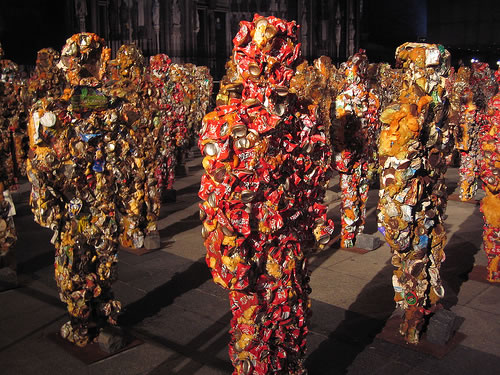
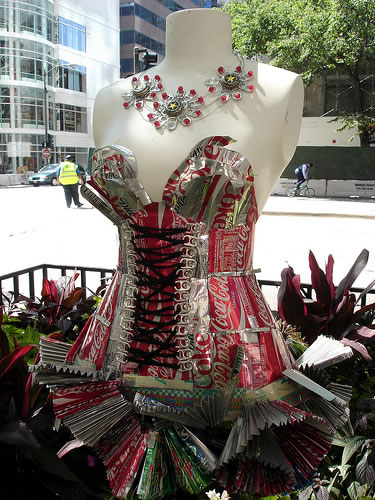
25 Original and Artistic Uses of Recycled Coca-Cola Cans

The possibilities of creating something with coca-cola cans seem endless, judging by these great images, who would have thought it. The planes are great, as are the elephant, scooter and the rhino…but I draw the line at the underpants, as for the tuxedo, thats one step too far, its simply wrong!
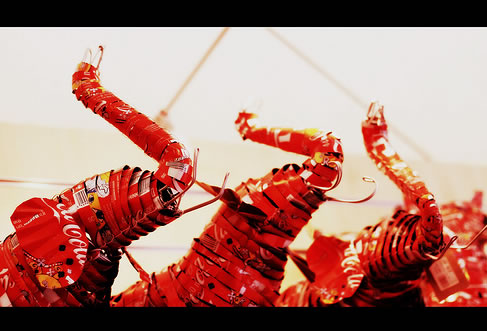
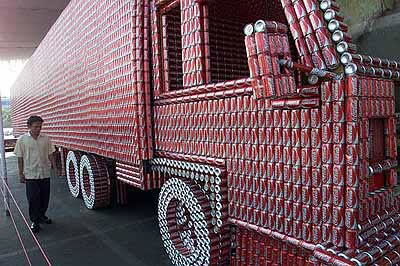
Heffalumps

Recycled Coke Can Art

Coke Truck

Recycled Coke Can Art

Coca Cola Man

Recycled Coke Can Art

Coke Can Art in Chicago

Recycled Coke Can Art

Click here for the Whole Gallery

Friday, May 15, 2009

Coke to launch bottle partly derived from plants


* Coke to test "plantbottle" in North America this year

* Says up to 30 pct of new bottle comes from plant material

NEW YORK (Reuters) - Coca-Cola Co said on Thursday it has developed a new plastic bottle that is partly made from sugar cane and molasses, raising the bar in the battle for the most environmentally friendly packaging.

Coke will test the new bottle in North America with Dasani bottled water and certain carbonated brands later this year. The test will expand to the vitaminwater brand in 2010.

Up to 30 percent of the new "plantbottle" will be made from a material derived from sugar cane and molasses, which is a by-product of sugar production, Coke said.

Plastic bottles are made from a non-renewable, petroleum-derived substance.

Many large food and drink makers are looking to make their packages smaller and more environmentally friendly, especially since retail giant Wal-Mart Stores Inc introduced a "packaging scorecard" to rate suppliers on their ability to cut waste and conserve resources by reducing packaging.

Rival beverage makers PepsiCo Inc and Nestle are also introducing lighter-weight bottles that use less plastic.

(Reporting by Martinne Geller; Editing by Gary Hill)

Friday, March 27, 2009

Coke Tests a Hybrid Truck in Europe

By James Kanter

TruckCoca-Cola Enterprises, Europe The beverage giant is testing a hybrid truck.

Beverage giant Coca-Cola has been delivering some of its products with hybrid electric trucks in North America for some time. Now the company says it will roll out the first hybrid vehicle of its kind to be used in a European city.

Coke says the hold-up in Europe was a special formula – not for the famously secret recipe for its cola but for manufacturing hybrid engines for delivery vehicles in urban areas, where frequent stops and starts are common.

“In Europe, we have lagged behind the U.S. in hybrid technology development with the majority of hybrid manufacturers being U.S.-based and having intellectual property exclusivity on their technology,” said Hubert Patricot, the president of Coca-Cola Enterprises Europe, who made the announcement at a business summit in Brussels on Thursday.

The pilot program, to run in Brussels until July, is part of Coke’s efforts at “developing a sustainable transport strategy across our European business,” Mr. Patricot said.

In the United States, Coke has worked with Eaton Corporation to develop hybrid components and with suppliers including as Kenworth and Cummings to configure the engines.

Coke’s partner in Europe is Iveco, a truck maker belonging to the Italian Fiat Group. Iveco already makes some hybrid vehicles, including city buses, and a medium-distance truck called the Eurocargo. Iveco developed the new system to be used in Brussels itself.

The new Coca-Cola truck, which weighs 12 tons, will serve a 20-kilometer route in the center of Brussels running both diesel and electric engines. A battery feeds the electric motor to start and accelerate up to 20 kilometers an hour. Then the diesel motor takes over when the vehicle normally consumes the least fuel, at speeds over 20 kilometers an hour.

Coke wants to see if the truck really can reduce fuel consumption by up to 30 percent and carbon dioxide emissions by 24 percent, as initial estimates suggest.

Wednesday, February 25, 2009

Pensioner drinks nothing but Coke for 40 years in promise to mother

A Croatian man claims he has drunk nothing but Coca-Cola for the past 40 years – because he promised his mother he would not touch alcohol.


Coca-cola - Pensioner drinks nothing but Coke for 40 years in promise to mother
'Coke is my drug now, and I'll drink it till I die,' Pero Ajtman said Photo: REUTERS

Pero Ajtman, 71, said he promised his mother he would stop drinking alcoholic beverages four decades ago.

"My mum didn't like me drinking when I was a young man as she was very religious," he explained to the Croatian tabloid 24 Sata.

"She made me promise never to drink again and Coca-Cola was the only thing that tasted as good as wine so I started drinking that.

"Now I have a glass in the morning, before and after lunch, with my dinner and then before I go to bed. I never drink anything else."

The pensioner, who lives in the village of Karanac, near the city of Osijek, in eastern Croatia, said he had no intention of abandoning his habit.

"My mother isn't here to tell me not to drink any more but I'm not even tempted to quit coke for alcohol.

"Coke is my drug now, and I'll drink it till I die," he said, adding that he had not experienced any major health problems.

There was no word on what Mr Ajtman's dentist thought of his sugary diet.