Zazzle Shop

Screen printing
Showing posts with label San Diego. Show all posts

Friday, August 20, 2010

A Surfboard Gets an Onboard Computer
By Daniel Kane

From: http://ucsdnews.ucsd.edu/

Photo of DrEricson
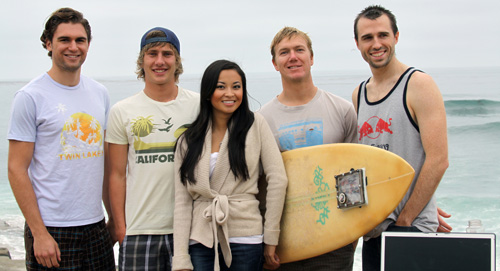
UC San Diego mechanical engineering undergraduates outfitted a surfboard with a computer and accompanying sensors -- one step toward a structural engineering Ph.D. student’s quest to develop the science of surfboards. Pictured: (L-R) Mechanical engineering undergraduates Victor Correa Schneider, Trevor Owen, Julia Tsai, Dan Ferguson; structural engineering PhD student Benjamin Thompson Photo credit: UC San Diego. Learn how the board works on YouTube: Watch Video

Computers are everywhere these days – even on surfboards. University of California, San Diego mechanical engineering undergraduates outfitted a surfboard with a computer and accompanying sensors -- one step toward a structural engineering Ph.D. student’s quest to develop the science of surfboards.

The UC San Diego mechanical engineering undergraduates installed a computer and sensors on a surfboard and recorded the speed of the water flowing beneath the board. While the students surfed, the onboard computer sent water velocity information to a laptop on shore in real time.

This is part of Benjamin Thompson’s quest to discover if surfboards have an optimal flexibility – a board stiffness that makes surfing as enjoyable as possible. Thompson is a UC San Diego structural engineering Ph.D. student studying the fluid-structure interaction between surfboards and waves. By outfitting a surfboard with sensors and electronics that shuttle data back to shore, the mechanical engineering undergraduates built some of the technological foundation for Thompson’s science-of-surfboards project.

Sensors on a Surfboard
Photo of DrEricson

Four undergraduates from the Department of Mechanical and Aerospace Engineering (MAE) at the UC San Diego Jacobs School of Engineering outfitted a surfboard with eight sensors and an onboard-computer or “microcontroller.” The students dug trenches into the board’s foam and ran wires connecting the sensors to the onboard computer. From this computer, the data travels via a wireless channel to a laptop on land – in this case, a beach in Del Mar, Calif.

The onboard computer also saves the data on a memory card.

“We were stoked to get good data and to be surfing for school,” said Dan Ferguson, one of the two mechanical engineering undergraduates who surfed while the onboard computer captured water velocity information and transmitted it back to land.

The four mechanical engineering majors built the wired surfboard for their senior design project, the culmination of the MAE 156 course sequence. Each project has a sponsor, and in this case, the sponsor was Benjamin Thompson, the structural engineering Ph.D. student from UC San Diego and founder of the surfboard Web site www.boardformula.com.

The onboard computer is in a watertight case the shape of a medium-sized box of chocolates. It sits at the front of the surfboard and glows blue. “What’s on your board? What is that?” fellow surfers asked Ferguson. “We’d have to tell them it’s a microprocessor connected to velocity sensors, and they would kind of nod and paddle away. It created a minor stir.”

Each of the eight sensors embedded into the bottom of the board is a “bend sensor.” The faster the water beneath the board moves, with respect to the board, the more the sensors bend, explained Trevor Owen, the other surfer on the four-person mechanical engineering team.

The data from the sensors runs through wires embedded in the board to the microcontroller. “You can see where we carved channels in the board,” said Owen.

Wireless Surfing

Photo of DrEricson

The most interesting part of the project for senior mechanical engineering major Victor Correa was using the microcontrollers and wireless transmitters to get the data to land.

Thompson, the project sponsor, is already working on a smaller version of the onboard computer. He hopes to shrink it down to the size of a cell phone and embed it flush with the top surface of the board.

Assembling, waterproofing and installing the microcontroller, connecting it to the sensors, and successfully transmitting the collected data to a computer on land required persistence and a lot of learning, explained senior mechanical engineering major Julia Tsai. “Everything hypothetically should take five minutes, but everything took at least three hours.”

Even though the team has finished their class project, Ferguson plans to keep working with Thompson. “This project is going to apply some science that most likely [board] shapers understand pretty well...it’s going to settle the debates. It’s going to be black and white hard data to let them know for sure which ideas work, which concepts work, and why they work.”

Surfboard Flex
Surfboard flex refers to the temporary shape changes that surfboards are thought to undergo. While many surfers say flex makes their boards feel springy in the water, it has not been scientifically measured. Thompson hopes to scientifically document surfboard flex. Then he wants to determine if there is an amount of flexibility that enhances the performance and feel of a surfboard, and if this optimal flexibility depends on other factors such as surfer experience or wave conditions.

Surfboards and Fluid-Structure Interactions

Photo of DrEricson
Mechanical engineering undergraduate Trevor Owen and the data-collecting surfboard. Watch the students surf the board on YouTube: Watch Video

The surfboard project falls within a hot area of engineering research: the study of fluid-structure interactions. According to UC San Diego structural engineering professor Qiang Zhu, the study of fluid-structure interaction is important due to the large number of applications in mechanical, civil, aerospace and biological engineering. “In my opinion, its popularity in recent years is partly attributed to advances in experimental and computational techniques which allow many important processes to be studied in detail,” said Zhu.

This is what the UC San Diego engineers are doing for surfboards: they are studying how surfboards change shape when people ride them – and how those shape changes are tied to the subjective experience of surfing.
At the public presentation of their research, team member Tsai said, “I thought the coolest part was being able to test our board, going out to the beach to test it, everyone else had to stay downstairs in the lab.”


Media Contacts:
dbkane@ucsd.edu, (858)534-3262 begin_of_the_skype_highlighting (858)534-3262 end_of_the_skype_highlighting


Monday, May 17, 2010

15 Years Ago - Stolen Tank Leads Police on a Wild Chase

youtube.com — May 17, 1995: San Diego, California - After stealing a military tank from the National Guard Armory in Kearny Mesa, a deranged man leads police on a destructive chase through San Diego, before finally getting caught on the miridian. It's a wonder how no one was hurt or killed after this man's rampage.

Wednesday, September 23, 2009

Chronic City: Darkness In San Diego -- Attack On Medical Marijuana Moving Northward

donnalambert.jpg
Courtesy Donna Lambert
San Diego medical marijuana patient Donna Lambert was arrested in Operation Green Rx as part of the "crackdown."
​
First, we heard from ambitious, headline-seeking San Diego District Attorney Bonnie Dumanis that there are "no such things" as legal medical marijuana dispensaries, despite state law. Now, even as a brutal crackdown on providers and patients is underway in San Diego County, officials from Los Angeles and other counties are being influenced by San Diego's anti-weed brigade to implement their hardline policies further north.

At a Long Beach City Council meeting yesterday, City Prosecutor Tom Reeves was still flushed with anti-ganja fervor as he told the council of attending a summit last week held by L.A. County DA Steve Cooley, where the message was that all dispensaries are illegal and will be prosecuted. What this means, he told the council, is that Long Beach can't or shouldn't try to regulate dispensaries.
blobfetch.asp.jpeg
longbeach.gov
Hardliner Long Beach prosecutor Tom Reeves: "You can't regulate illegal businesses."
​ "Over-the-counter sales are illegal," Reeves flatly stated. "So you're not helping us any," Councilwoman Tonia Reyes Uranga repied. "I'm helping you a great deal," Reeves snapped. "I just told you that you can't regulate illegal businesses."

So even as city governments in places like Long Beach honestly try to grapple with the real issues surrounding regulation and recognition of medical marijuana dispensaries -- including possibilities like taxation, on-site inspections and regulations similar to liquor stores or adult businesses -- their "legal experts" and law enforcement officials are giving them monumentally bad advice which seems to be in conflict with state law.

Not surprisingly, since those present couldn't agree on whether such a thing as a legal dispensary even exists, the Long Beach council didn't find a solution after two hours of discussion, and will continue wrestling with the issue at a future meeting.

San Diego: Bitter Intransigence and Stubborn Refusal

DA Bonnie M. Dumanis (sized).jpg
Office of Bonnie Dumanis
San Diego DA Bonnie Dumanis: arrest 'em all and let the courts sort it out
​
​San Diego County officials have simply refused to abide by the will of the voters and accept the state's medical marijuana law. For 13 years now, since the passage of Proposition 215 by voters in 1996, and even since the law was clarified and expanded by the Legislature with SB 420 in 2004, they've been fighting the practical implementation of legal medical marijuana.

The notoriously conservative San Diego County Board of Commissioners is well known for its irrational opposition to medical pot, even pursuing a quixotic and hopeless challenge to the law all the way to the U.S. Supreme Court, losing the case in every court that heard it, every step of the way.

Last week, the Board unanimously extended for 10 more months what had been a 45-day moratorium on new dispensaries in unincorporated areas of San Diego County. After its court challenge to the law was defeated, the Board began grudgingly issuing ID cards for medical marijuana users. But in the meantime, DA Dumanis has sent her raiders to shut down dispensaries and arrest their owners, creating a climate of fear and confusion among patients countywide.

The latest raids forced at least 14 dispensaries to close, and resulted in at least 33 arrests. Dumanis assembled strike forces of San Diego Police, San Diego County Sheriff's officers, DEA agents, and IRS agents to descend on the dispensaries, make arrests, seize cash and pot, and disrupt the local medical marijuana distribution system. Many patients who had come to depend on safe, legal access to the medicine recommended by their doctors were left in the lurch.

"I don't think Bonnie Dumanis has ever seen a 'legal dispensary' in 13 years," said Dion Markgraff, San Diego coordinator for Americans for Safe Access (ASA). "She can't follow the plain language of the law, but instead she holds some impossible standard that no one else knows about. The DA is sending in cops who lied to doctors to get valid recommendations, and then busting dispensaries that are operating according to the law."

"The question in court is, 'Can one medical marijuana patient help another and be exempt from sales charges?' " patient Donna Lambert, arrested back in February in the "Operation Green Rx" phase of Dumanis' crackdown, told the SF Weekly. "The answer is a clear yes, but San Diego has not yet accepted that. For a total of two quarter ounces of marijuana, they did a SWAT-style raid on my home, pointed assault rifles at me and tore my house apart," she said. Lambert is still fighting her case in court.

San Diego attorney Patrick Dudley has represented people accused of illegal use of medical marijuana. "Most people would say that the last battleground for medical marijuana is San Diego," Dudley told NPR.

Under state law, medical marijuana patients and primary caregivers may "associate within the State of California in order collectively or cooperatively to cultivate marijuana for medical purposes" (§ 11362.775). But according to Dudley, San Diego law enforcement has shown no inclination to help dispensaries understand how to follow the law. Their approach, he says, is to arrest first and ask questions later.


Tags: chronic city

Monday, August 10, 2009

Luxury San Diego resort offers $19 room _ minus bed, lights or toilet paper

Bedless resort


SAN DIEGO (AP) —A luxury resort in San Diego is offering rooms for $19 a night — if you don't mind sleeping in a tent.

The Rancho Bernardo Inn boasts three pools, a spa and golf course. It typically charges more than $200 a room.

But business is down. So from Aug. 16 to 31, guests can get a "Survivor Package" that charges them less for each amenity they give up.

For $19, guests give up breakfast, air conditioning, lights, sheets and even the bed. Staff will remove the mattress and headboard and leave a small tent instead.

Oh, and bring your own toilet paper.

General manager John Gates says the hotel hopes people who try the promotion will return at full price.

___

Information from: The San Diego Union-Tribune, http://www.signonsandiego.com

Wednesday, May 20, 2009

Medical Marijuana Is The Law — Any Questions?

By: Paul Armentano, NORML Deputy Director


How do you say: “Game, set, match” in southern California? Here’s how:

High court won’t hear county’s marijuana challenge
via SignOnSanDiego.com

The U.S. Supreme Court will not take up San Diego County’s challenge to state medical marijuana laws.

For more than three years the county has been fighting in court to overturn state laws that require counties to issue medical marijuana identification cards. The county contends federal law, which does not recognize medical marijuana usage, trumps the state law.

The county has lost that argument in state trial and appellate courts, and the state Supreme Court declined to take up the case, too. The county’s last, long-shot chance was to have the U.S. Supreme Court take up the case.

San Bernardino and Merced counties initially joined the suit, but Merced eventually dropped out. The high court also rejected San Bernardino’s petition to take up the case.

In other words, the oft-heard prohibitionist refrain that federal law trumps state medical marijuana laws has no legal merit.

None. Nada. Zero.

To anyone who has followed the unethical actions of the San Diego and San Bernardino Supervisors over the past three years, the Supreme Court’s refusal to hear their appeal shouldn’t come as a surprise. After all, the counties’ vapid arguments had previously been struck down — unanimously — by the Superior Court of the state of California the 4th District Court of Appeals.

In addition, the Legislative Counsel of California, the state Attorney General’s Office, and a majority of the California legislature had also previously determined that local politicians and law enforcement were obligated to uphold the provisions of California’s medical marijuana laws.

Finally, California’s constitution is also quite clear on this point — mandating that police have a sworn duty to uphold state law, not to enforce federal statutes.

Let’s be blunt: San Diego and San Bernardino’s protracted lawsuits — lawsuits that arguably cost county taxpayers hundreds of thousands of dollars and jeopardized the health and safety of thousands (if not tens of thousands) of citizens — were never about resolving legal ambiguity.

Rather, it was about the arrogance and recalcitrance of those who willfully chose to abuse their power and position to hamstring the will of the voters, the legislature, and the courts.

And while this particular legal battle is now over, our outrage shouldn’t be.

Tuesday, May 19, 2009

Supreme Court Hands Medical Marijuana Major Victory

Weed

The U.S. Supreme Court handed medical marijuana patients and advocates a resounding victory on Monday, refusing to hear a case brought by San Diego County, which has long chafed at implementing statewide medical marijuana laws.

The state of California, in an effort to systematize the 1996 voter-approved initiative, required localities to implement identification card programs for patients with doctor approval in 2004. Such ID cards are required to enter medical marijuana shops in California and can be shown to police officers who find patients in possession of marijuana.

San Diego County, however, argued that the federal ban on marijuana trumps the state law, meaning they are not required to follow the state law. The county filed suit in 2006. Both the San Diego Superior Court and the Fourth District Court of Appeals rejected the argument, which was followed by the California Supreme Court's refusal to review the case in 2008.

The San Diego Board of Supervisors voted to appeal to the Supreme Court.

"The courts have made clear that federal law does not preempt California's medical marijuana law and that local officials must comply with that law," said Joe Elford, chief counsel with Americans for Safe Access (ASA), a national medical marijuana advocacy group with a large presence in California. "No longer will local officials be able to hide behind federal law and resist upholding California's medical marijuana law."

It is not the job, in other words, of local cops or municipalities to enforce federal laws. In fact, the federal government has never made such an argument. The California counties acted on their own.

The Supreme Court ruling, following the Obama administration's decision not to raid medical marijuana clubs acting in accordance with state law, removes one of the last barriers to full implementation of the state law.

ASA has now given notice to 10 conservative holdout counties (Colusa, Madera, Mariposa, Modoc, Mono, San Bernardino, San Diego, Solano, Stanislaus, and Sutter) of their legal obligation to implement the ID card program. In January 2009, ASA, something of an industry trade group, filed a lawsuit in January against Solano County for its refusal to implement the state ID card program.

ASA was joined by the ACLU Drug Law Reform Project in assisting the California Attorney General in the case against San Diego. San Bernardino teamed with San Diego.

"The Supreme Court and the lower courts in California have blown away the myth that federal law somehow prevents states from legalizing medical marijuana," said Rob Kampia, executive director for the Marijuana Policy Project.

Thirteen states have laws that allow certain folks to use medical marijuana if their doctor recommends it. Illinois, Minnesota, New Hampshire, New Jersey and New York are currently considering medical marijuana bills in their state legislatures.

Ryan Grim is the author of the forthcoming book This Is Your Country On Drugs: The Secret History of Getting High in America