

A Surfboard Gets an Onboard Computer
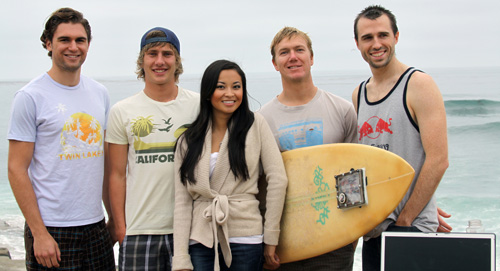 |
| UC San Diego mechanical engineering undergraduates outfitted a surfboard with a computer and accompanying sensors -- one step toward a structural engineering Ph.D. student’s quest to develop the science of surfboards. Pictured: (L-R) Mechanical engineering undergraduates Victor Correa Schneider, Trevor Owen, Julia Tsai, Dan Ferguson; structural engineering PhD student Benjamin Thompson Photo credit: UC San Diego. Learn how the board works on YouTube: Watch Video |
Computers are everywhere these days – even on surfboards. University of California, San Diego mechanical engineering undergraduates outfitted a surfboard with a computer and accompanying sensors -- one step toward a structural engineering Ph.D. student’s quest to develop the science of surfboards.
The UC San Diego mechanical engineering undergraduates installed a computer and sensors on a surfboard and recorded the speed of the water flowing beneath the board. While the students surfed, the onboard computer sent water velocity information to a laptop on shore in real time.
This is part of Benjamin Thompson’s quest to discover if surfboards have an optimal flexibility – a board stiffness that makes surfing as enjoyable as possible. Thompson is a UC San Diego structural engineering Ph.D. student studying the fluid-structure interaction between surfboards and waves. By outfitting a surfboard with sensors and electronics that shuttle data back to shore, the mechanical engineering undergraduates built some of the technological foundation for Thompson’s science-of-surfboards project.
Sensors on a Surfboard
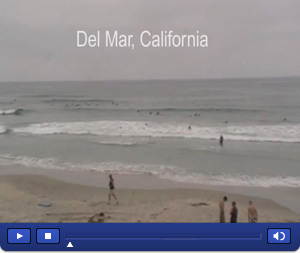 |
Four undergraduates from the Department of Mechanical and Aerospace Engineering (MAE) at the UC San Diego Jacobs School of Engineering outfitted a surfboard with eight sensors and an onboard-computer or “microcontroller.” The students dug trenches into the board’s foam and ran wires connecting the sensors to the onboard computer. From this computer, the data travels via a wireless channel to a laptop on land – in this case, a beach in Del Mar, Calif.
The onboard computer also saves the data on a memory card.
“We were stoked to get good data and to be surfing for school,” said Dan Ferguson, one of the two mechanical engineering undergraduates who surfed while the onboard computer captured water velocity information and transmitted it back to land.
The four mechanical engineering majors built the wired surfboard for their senior design project, the culmination of the MAE 156 course sequence. Each project has a sponsor, and in this case, the sponsor was Benjamin Thompson, the structural engineering Ph.D. student from UC San Diego and founder of the surfboard Web site www.boardformula.com.
The onboard computer is in a watertight case the shape of a medium-sized box of chocolates. It sits at the front of the surfboard and glows blue. “What’s on your board? What is that?” fellow surfers asked Ferguson. “We’d have to tell them it’s a microprocessor connected to velocity sensors, and they would kind of nod and paddle away. It created a minor stir.”
Each of the eight sensors embedded into the bottom of the board is a “bend sensor.” The faster the water beneath the board moves, with respect to the board, the more the sensors bend, explained Trevor Owen, the other surfer on the four-person mechanical engineering team.
The data from the sensors runs through wires embedded in the board to the microcontroller. “You can see where we carved channels in the board,” said Owen.
Wireless Surfing
 |
The most interesting part of the project for senior mechanical engineering major Victor Correa was using the microcontrollers and wireless transmitters to get the data to land.
Thompson, the project sponsor, is already working on a smaller version of the onboard computer. He hopes to shrink it down to the size of a cell phone and embed it flush with the top surface of the board.
Assembling, waterproofing and installing the microcontroller, connecting it to the sensors, and successfully transmitting the collected data to a computer on land required persistence and a lot of learning, explained senior mechanical engineering major Julia Tsai. “Everything hypothetically should take five minutes, but everything took at least three hours.”
Even though the team has finished their class project, Ferguson plans to keep working with Thompson. “This project is going to apply some science that most likely [board] shapers understand pretty well...it’s going to settle the debates. It’s going to be black and white hard data to let them know for sure which ideas work, which concepts work, and why they work.”
Surfboard Flex
Surfboard flex refers to the temporary shape changes that surfboards are thought to undergo. While many surfers say flex makes their boards feel springy in the water, it has not been scientifically measured. Thompson hopes to scientifically document surfboard flex. Then he wants to determine if there is an amount of flexibility that enhances the performance and feel of a surfboard, and if this optimal flexibility depends on other factors such as surfer experience or wave conditions.
Surfboards and Fluid-Structure Interactions
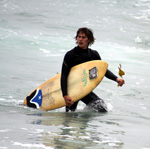 |
| Mechanical engineering undergraduate Trevor Owen and the data-collecting surfboard. Watch the students surf the board on YouTube: Watch Video |
The surfboard project falls within a hot area of engineering research: the study of fluid-structure interactions. According to UC San Diego structural engineering professor Qiang Zhu, the study of fluid-structure interaction is important due to the large number of applications in mechanical, civil, aerospace and biological engineering. “In my opinion, its popularity in recent years is partly attributed to advances in experimental and computational techniques which allow many important processes to be studied in detail,” said Zhu.
This is what the UC San Diego engineers are doing for surfboards: they are studying how surfboards change shape when people ride them – and how those shape changes are tied to the subjective experience of surfing.
At the public presentation of their research, team member Tsai said, “I thought the coolest part was being able to test our board, going out to the beach to test it, everyone else had to stay downstairs in the lab.”
Media Contacts:
dbkane@ucsd.edu, (858)534-3262 begin_of_the_skype_highlighting (858)534-3262 end_of_the_skype_highlighting


 .
.

 Posts
Posts

