Zazzle Shop

Screen printing
Showing posts with label Printing Human Organs. Show all posts

Wednesday, April 14, 2010

Skin Cell Spraying Bio Printer Can Heal Burn Victims in Three Weeks

skin cells, cell printer, cell sprayer, burn victims, wake forest,  winston salem, medicine, hospital, medical design, 3d printer

Recently we showcased a 3D printer that creates human body parts ready for transplant, and now our frankenstinean fascination with making body parts has unearthed another amazing device. This new bio-printer sprays skin cells on burn victim’s wounds, promoting healthy recovery. The printer is mounted onto a frame that is wheeled over a patient’s hospital bed. A laser reads the depth and shape of the wound, and with the help of a computer the device sprays a precise layer of skin cells that can heal infection-prone wounds in just three weeks.

The skin-spraying project is being developed by scientists and students at Wake Forest University in North Carolina. They are planning to team up with U.S. Armed Forces Institute of Regenerative Medicine to use the device to help wounded soldiers returning from overseas. The process starts as skin cells are separated and purified. They are then placed in a nutritious solution that helps the cells multiply. They are then loaded into the device, sprayed on the skin in layers and voila! Burns are healed. So far they’ve only tested the process on mice, and they were able to successfully heal burns after just three weeks.

Traditionally the only way to fix severe burn wounds is a skin graft. Skin grafts are highly painful and generally leave huge scars. With this new process scientists include some stem cells in the mix which allows hair follicles and sebaceous glands develop in the new layers of skin. It seems that when the cells are sprayed on the wound they know exactly what they are supposed to do, and they develop as naturally as a your own skin would. Eliminating the mass amount of medical rehabilitation involved in getting burn victims back on their feet by spraying on skin cells will eliminate much of the painful process and cut down on the chemical-based medicines used to help them heal.

Via Reuters

Wednesday, January 27, 2010

Anthony Atala on growing new organs

Tuesday, December 22, 2009

Kinko's for Kidneys: 3D Printing Your Own Body Parts

by Lloyd Alter, Toronto

3d printing bioprinter photo

3D printing to order is a regular subject on TreeHugger; we love the idea of making things when you need them, where you need them. And soon you will be able to order up body parts, at a sort of Ponoko for pancreas. Now people sit on waiting lists, hooked up to expensive equipment while they wait for donors and fly body parts all over the world; soon you will order them up fresh and hot. Perhaps, like Philip K. Dick did, we might even call them artif-orgs.


Printing kidneys

Organovo is trying to build "tissue on demand", building 3D printers that work with living cells.


"By marrying a knowledge of biophysics and cell biology with the precision of computer aided design and high precision deposition, we can recreate the microarchitecture of even the most complex human tissue. By precisely placing cells with an organ printer, and providing them with the proper natural developmental cues, the cells do exactly what they do in nature: they self assemble into fully formed, functional tissue."

They have just taken delivery of their first commercial printers from Australian manufacturer Invetech.

Ken Murphy, President of Organovo said in a press release:

"Scientists and engineers can use the 3D bio printers to enable placing cells of almost any type into a desired pattern in 3D," said Murphy. "Researchers can place liver cells on a preformed scaffold, support kidney cells with a co-printed scaffold, or form adjacent layers of epithelial and stromal soft tissue that grow into a mature tooth. Ultimately the idea would be for surgeons to have tissue on demand for various uses, and the best way to do that is get a number of bio-printers into the hands of researchers and give them the ability to make three dimensional tissues on demand."

So instead of having to find kidney or liver donors, doctors could grow new ones from a patient's own cells, solving the donor supply and rejection problems. Via Next Big Future

hpprinter.jpg
The future of 3D printing? from On Art and Science: Bioprinting & Pygmalion's Dream? Vladimir Mironov MD, PhD

Tuesday, December 15, 2009

Growing Body Parts: 60 Minutes


Watch CBS News Videos Online

Morley Safer reports on the emerging technology of growing body parts from human cells taken directly from patients, providing new hope for amputees and patients on organ-transplant lists.

Wednesday, June 10, 2009

Growing Organs in the Lab

Written on June 8, 2009 – 3:19 pm | by Drew Halley |

Why transplant an organ when you can grow yourself a new one?
lab-grown-bladder-atala

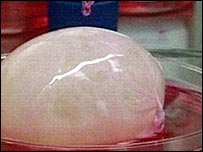
A homegrown bladder (Photo courtesy of BBC)

This research isn’t something that might happen in the distant future. It’s being used today to grow fresh organs, open up new ways to study disease and the immune system, and reduce the need for organ transplants. Organ-farming laboratories are popping up across the planet, and showing impressive results. Here we look at the state of the union of a rapidly advancing field called tissue engineering: what’s been accomplished so far, and what’s right around the corner.

Patients who undergo organ transplants require loads of toxic drugs to suppress their immune systems; otherwise their body might reject the organ. But tissue engineering could make organ transplants a thing of the past. By using a patient’s cells to grow new types of tissue in the lab, researchers are finding new ways to custom-engineer you new body parts by using your own cells.

At the cutting edge of organ engineering is Tengion, a clinical-stage biotech company based outside of Philadelphia. Their most successful research to date led to the creation of the Neo-Bladder. Tengion takes some of your cells and grows them in culture for five to seven weeks around a biodegradable scaffold. When the organ is ready, it can be transplanted without the need to suppress the patient’s immune system (because the organ was grown from the patient’s own cells, it carries no risk of rejection). Once the organ is in, the scaffold degrades and the bladder adapts to its new (old) home.

The Tengion Neo-Bladder is in Phase II testing, meaning that they have already implanted the organ into individuals and studied how the body adapts to it. After 5 years, the company was able to show that the homegrown organs are safe and effective, capable of treating the bladder effects of spina bifida (a neural tube defect that effects bladder function, among other things). After another round of Phase II trials, Tengion will move on to Phase III testing; after that, the Neo-Bladder should be approved and be made commercially available.

atala_organ_growing_regeneration

Atala wants to grow you an organ

Tengion’s Neo-bladder is nearing the completion of its clinical trials, but they weren’t the first to grow one. If anyone on Earth deserves the job title “Organ Farmer,” it’s Dr. Anthony Atala. He and his research team at Wake Forest University Medical Center pioneered the world’s first lab-grown bladder, and they remain at the forefront of the organ-growing field (Atala is also the chairman of Tengion’s scientific advisory board). Wake Forest is the world’s largest regenerative medicine research center, and their current research is growing 22 different types of tissue: heart valves, muscle cells, arteries, and even fingers.

So how many different types of human organs have been grown and transplanted? The lab-grown bladders are among the only transplants of an entire organ, but a wide variety of partial organ transplants have taken place. Skin cells are regularly grown in culture and grafted onto patients’ bodies. A graft was grown from a patient’s trachea cells and transplanted to replace part of her airway that had degraded due to disease. Cartilage has been grown and transplanted into a patient’s knee.

A number of technologies are under development but have yet to be transplanted into human bodies. Recently, Dr. Nicholas Kotov and his lab at the University of Michigan have engineered artificial bone marrow, a task that was previously doomed to failure. Kotov and his colleagues realized that in the body, stem cell differentiation relies on chemical signals in three dimensions (whereas in a petri dish, it takes place in two dimensions). This insight led to a new methodology that more closely replicated the natural environment of stem cell differentiation in bone marrow tissue. The resultant homegrown marrow grew and divided normally, even releasing antibodies in fight off an introduced influenza strain. It can be used to study the role of bone marrow in fighting disease within the body, as well as creating a “bioreactor”: harnessing the artificial marrow within a device to grow cells and tissues.

Tengion is pretty busy these days as well. Their new website lists a variety of new applications on the horizon, including a Neo-Kidney augment, artery replacements (including in the heart), and variations on their bladder technique to replace cancerous organs. Their company pipeline gives a general idea of the relative stages of each project.

A number of initiatives are under way to create an artificial pancreas, which would revolutionize the way we treat diabetes. By providing diabetics with a healthy pancreas, doctors could restore their natural control of blood glucose by giving them an endogenous source of insulin. Anyone with experience of diabetes knows the difficulty of manually monitoring and controlling your sugar levels, not to mention regularly injecting insulin. A lab-grown pancreas replacement would be an incredible benefit to the 23.6 million individuals in America alone who suffer from diabetes.
ratheart

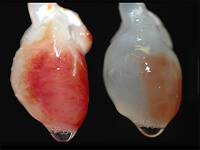
The Minnesota rat heart

As we previously reported, researchers at the University of Minnesota grew an entire rat heart in a laboratory last year. Their next goal is to grow a pig heart, a significant milestone towards growing a human heart due to their similar structure. Researchers hope to combine the scaffold of a pig heart with human cardiac tissue to grow a hybrid heart suitable for transplant.

Another exciting frontier is the field of printable tissue and organs, which is just what it sounds like. Inkjet cartidges are cleaned out and loaded with a mixture of live human cells and “smart gel.” Then, layer by layer, the cells are printed atop one another until a 3D organ is constructed. Just as a normal printer can deposit different colored ink, organ printing allows scientists to specify where to place different cell types. Organ printing has already created beating cardiac cells, and could soon produce organs that are viable for transplant. But unlike other 3D printers, I wouldn’t want this one in my living room.

The hottest areas in tissue growth are the types hardest to make: nerve, liver, kidney, heart and pancreas cells. But these are precisely where Alata and Tengion are heading, pushing the industry into fresh territory. Coupled with new regenerative treatments like Cook biotech’s foams and stem-cell organ patching, tissue engineering will be keeping our organs young and healthy in the years to come.

Merely a decade ago, tissue engineering was still a new field that struggled to find funding and support. Today, thousands of scientists worldwide are coordinating efforts to reach new breakthroughs, and the demonstrated potential of these methods has helped bring in investors. That should keep the organ growing field moving forward in the future months and years, and we’ll be covering new advances as they emerge.

Check out this Wired Science video that tours around Atala’s lab:

Friday, October 24, 2008

Need a new heart? Print one

The technology is the same as that of the simple inkjet printer found in homes and offices, but Japanese scientist Makoto Nakamura is on a mission to see if it can also produce human organs.

The idea is for the printer to jet out thousands of cells per second, rather than ink droplets, and to build them up into a three-dimensional organ.

"It would be like building a huge skyscraper on a micro level using different kinds of cells and other materials instead of steel beams, concrete and glass," he said.

"Ultimately I hope to make a heart," said Dr Nakamura, professor at the graduate school of science and technology for research at the state-run University of Toyama.

While Dr Nakamura says it would take him some 20 years to develop a heart, the feat could pave the way to mass produce "good hearts" for patients waiting for transplants.

A heart made of cells originating from the patient could eliminate fears that the body would reject it.

In the emerging field of organ printing, Dr Nakamura bills his work as the world's finest printed 3D structure with living cells.

The technology works a bit like dealing with sliced fruit: an organ is cut horizontally, allowing researchers to see an array of cells on the surface.

If a printer drops cells one by one into the right spots and repeats the process for many layers, it creates a 3D organ.

Much like a printer chooses different colours, the machine can position different types of cells to drop.

Dr Nakamura has succeeded in building a tube with living cells.

It measures one millimetre in diameter and has double walls with two different kinds of cells, similar to the three-layer structure in human blood vessels.

He has also made a smaller single-wall hydrogel tube that measures one-tenth of a millimetre, as narrow as human hair.

The tubes are made by a 3D inkjet bioprinter that Dr Nakamura's team developed in a three-year project completed earlier this year at Kanagawa Academy of Science and Technology, a foundation based south-west of Tokyo.

The printer can adjust where to drop cells in the order of one-thousandth of a millimetre and produce a tube at a speed of 3 centimetres per two minutes.

- AFP

This is from 2003. http://www.pbs.org/kcet/wiredscience/video/164-bod ... There is an awesome video demonstrating this and a doctor who has already transplanted multiple bladders with no rejection. The first part of the video is about successful limb regeneration.