Zazzle Shop

Screen printing
Showing posts with label New Zealand. Show all posts

Monday, August 15, 2011

Pay with The Force? Tiny Island Nation Mints 'Star Wars' Currency

By:
From: http://newsfeed.time.com/

New Zealand Mint

New Zealand Mint

Four words you'd never expect to hear: "Use the coin, Luke."

And you thought you were Star Wars die-hard. Apparently not as die-hard as the Pacific nation of Niue, a roughly 100-square-mile island located 1,500 miles northeast of New Zealand, sometimes called the "Rock of Polynesia," or just "The Rock" for short. These folks just opted to print coins adorned with color images of Luke Skywalker, Princess Leia, Darth Vader and other Star Wars fan favorites. We're not kidding: actual, usable, carry-in-your-coin-purse change.

The catch: the coins will be worth too much to justify spending. That, and you'll have to be one of Niue's 2,000 residents to actually use them, probably making this the world's most exclusive sci-fi-themed currency.

But still, honest-to-goodness, financially legitimate Star Wars coins? Who'd-'a-thunk.

Niue—whose name means "behold the coconut"—uses New Zealand's currency, the "Kiwi dollar," and the Star Wars coins are valued at NZ$2 each (or directly converted, about US$1.66). But their actual value, according to AAP New Zealand (via The Sydney Morning Herald), is upwards of AUD$100 (Australian dollars). The coins are apparently made of silver that's worth AUD$40 alone—the set includes eight one-ounce solid silver coins and 10 silver-plated base metal ones, and retails for about AUD$450, or about US$465 if you're looking to collect a set to ship stateside.

"You wouldn't want to go and spend them because they're only worth $2 [officially] but the value is much more than that," said New Zealand Mint Vice President of USA Operations Chris Kirkness (speaking to Fairfax New Zealand), quipping "No one is going to go buy an ice cream with them."

If you want a set, you'll have to be quick: They're only printing 50,000 of each coin, with some offered in special collectors' boxes (limited to 7,500). There's one modeled after Darth Vader (opening it triggers Vader's trademark mask-breathing sound) and another after the Millennium Falcon (opening it triggers a launch-engine sound).

Will the force be with your checkbook? You'll have to find out November 1st, when they're due to go on sale.

Thursday, March 24, 2011

The Hobbit Begins Filming, First Photo From The New Zealand Set!

Author: Josh Tyler

From: http://www.cinemablend.com/

It’s an exciting time to be a movie fan. Filming on the first of The Hobbit films began today in New Zealand. To celebrate the production has not only released a first look at director Peter Jackson climbing back into his Hobbit hole, but they’ve also launched an official Hobbit production blog.

The first three Lord of the Rings movies revolutionized the way fans connect with the movies they’re excited about with unprecedented, never before since duplicated access behind the scenes video, images, and access straight from the New Zealand set. Since then Hollywood has drifted away from letting us all in to the world behind the screen, but hopefully The Hobbit blog will bring it all back. To kick things off, here’s your first look at Peter Jackson on The Hobbit set!


Peter Jackson re-enters Bag End.
If those photos look at all familiar, it's probably because Peter Jackson took a very similar photo during the start of filming on Lord of the Rings, now more than a decade ago. Here's that photo of Peter Jackson in Bag End, striking a similar pose while filming Fellowship of the Ring:


For more on The Hobbit, including the movie's new official synopsis and complete cast list, visit its page in our Blend Film Database.

Tuesday, January 25, 2011

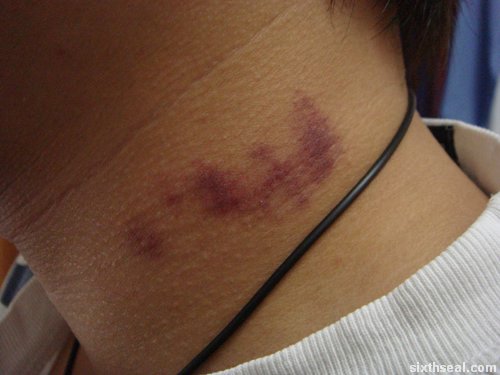
New Zealand Woman Partially Paralyzed by Hickey

From: http://www.foxnews.com/


A New Zealand woman was temporarily partially paralyzed by a hickey on her neck from her amorous partner, AFP reported Friday.

The 44-year-old woman went to the emergency department of Middlemore Hospital in Auckland last year after experiencing loss of movement in her left arm while watching television, doctors reported in the New Zealand Medical Journal.

Doctors concluded the woman had suffered a mild stroke but were puzzled about its cause until they found a small vertical bruise on her neck near a major artery, a hickey, she received a few days earlier.
"Because it was a love bite there would be a lot of suction," one of the doctors who treated her, Teddy Wu, told the Christchurch Press.

"Because of the physical trauma it had made a bit of bruising inside the vessel. There was a clot in the artery underneath where the hickey was."

Wu said the clot dislodged and traveled to the woman's heart, where it caused a minor stroke that led to the loss of movement.

"We looked around the medical literature and that example of having a love bite causing something like that hasn't been described before," he said.

The medic said the woman recovered after being treated with an anti-coagulant.


Wednesday, June 23, 2010

The Most Psychedelic Hot Spring on Earth

Geothermal Pools 2

Photo: Chmehl

The melted-highlighter hues of the Wai-O-Tapu hot springs in New Zealand make one wonder how nature can look so unnatural. Also known as the Champagne Pools, Sacred Waters, and Artist's Palette, the Wai-O-Tapu geothermal pools have attracted much attention for their psychedelic qualities.

Pools 7

Photo: macronix

The Wai-O-Tapu pools are the result of thousands of years of volcanic activity. Nine hundred years ago, a hydrothermal eruption solidified the presence of the pools. The eruption was triggered by the infiltration of rainwater into the ground, which returned to the surface significantly hotter and hydrostatically pressurized due to its passage through the earth.

Geothermal Pools 1

Photo: tokyoahead

The geothermal gradient beneath the pools is responsible for an outward heat flow from Earth's boiling interior. The heat flow from the Earth at these locations is so powerful that it generates 0.3% of the world's electricity.

Pools 4

Photo: anna t

The Champagne Pool is maintained at a temperature of 165 degrees Fahrenheit, but the deepest parts, which do not lose heat into the atmosphere, can hit 500 degrees. Due to the high heat, very little life can survive in the pools, which are more a geological phenomena than an ecosystem. However, at least three bacteria have been found to exist within the waters.

Pools 3

Photo: Leyo

The colorful pools are even more impressive due to their size. The craters are over 200ft in diameter and 200ft deep, and are filled with nearly 2 million cubic feet of geothermal fluid.

Pools 5

Photo: Tim Parkinson

The Champagne Pool is aptly named given the presence of surplus carbon dioxide, yielding bubbly fizz in the water, much like is found in a bottle of Dom Perignon. The colors are attributed to the variety of minerals and metalloid compounds including orpiment and stibnite.

Geothermal Pools 6

Photo: khirol

Although originally occupied by the Ngati Whaoa tribe, the Wai-O-Tapu geothermal wonderland complex is now a vibrant tourist attraction. The area includes geysers, which erupt daily, and bubbling mud pools, and has been protected as a scenic reserve since 1931.

Geothermal Pools 9

Photo: viahar24.com

geothermal pools 8

Photo: viahar24h.com

Sources: 1, 2, 3, 4

Monday, March 29, 2010

Kiwi Biker Wins Right to Bicycle Naked

by Christine Lepisto, Berlin
from http://www.treehugger.com/

Naked cyclist Nick Lowe wears a helmet photo
Image: Craig Simonox, Dominion Post and TVNZ

Nick Lowe, of Johnsonville, New Zealand, pulls on bike shorts and a t-shirt when he climbs on to pedal away through the city. But as soon as he hits the open road, a "change of clothes" is on the agenda. The t-shirt graces Lowe's handlebars. The bike shorts he carefully arranges on the saddle so that the chamois seat pad still performs as point of contact. "The majority of the public has no issues with it," Lowe told TV New Zealand.

But one person did take offense. And took Lowe to court. Lowe explains the philosophy behind his fight in a YouTube video. And we look at the verdict: does it mean a free-for-all for nudists in New Zealand?

Lowe first suspected trouble when a car driven by a woman on her cell phone passed him, slowly. She pulled over to let Lowe pass by. Then drove past him again, slowly. In all, the woman took advantage of the "offensive" scene fully five times. Curious about the strange behavior, Lowe assessed his new admirer. The look on her face convinced the fit 40-year old cyclist that she was not enjoying the view. Shortly thereafter, Lowe was pulled over by the police.

Lowe represented himself at the trial. He walked away with a NZ$200 (US$140) fine, and court costs, on his tab. The Johnsonviller decided to fight. On appeal, he took his lawyer. And walked away with a singular precedent.

Justice Clifford of the Wellington High Court ruled that Mr. Lowe's behavior did not meet the standard of "offensive." According to reports in Der Spiegel (German), the ruling determined that one person finding a behavior offensive is not sufficient to support a conviction for offensive behavior.

Now when Lowe takes to his bike, he applies his chafe cream liberally, and packs one additional item under the saddle: a copy of the verdict. But does his case clear the path for nudists of all stripes? Not so fast: analyses of the Justice's ruling point out that it is specific to the behavior in question in this particular case. Walking nude on a public path may be evaluated differently than a bicyclist on a country road.

So what about world naked bike day activities? Nude activism in organized demonstrations is judged by a different standard: if people are aware of a planned activity to which they might take offense, they have the right to stay away. Did it help Lowe's case? The Justice chuckled as he viewed photos of other activities on world naked bike day, which happens to be precisely the day on which one woman took offense at a naked cyclist on a rural route.

If you are interested, Lowe tells his story to Close-Up for TV New Zealand.

Tuesday, January 26, 2010

Air New Zealand to "revolutionize" transpacific travel with new cabins

by Grant Martin
from: http://www.gadling.com/

Tomorrow's announcement from Air New Zealand about their new cabin configurations is purported to be a doozy, a change to transpacific flight that could forever impact the way we think about airline travel.
A few small clues about the configurations have leaked through, including a recent interview with ANZ's CEO Rob Fyfe where he indicates that most of the changes would be in the economy and premium economy sections. A recent article from the New Zealand Herald also suggests that the airline may go as far as installing lie-flat seats throughout all of coach.
Here at Gadling we've got a couple of ideas for where the award-winning airline can go with their long-haul aircraft:
Like Delta has considered, ANZ could reconfigure their cabin with staggered seats, incorporating more room for passengers and creating even more space to pack in seats.
One of the wide-body options that Airbus has recently offered is for bunk beds in economy. Could Boeing and their 777 aircraft use the same thing?
The above interview with Rob Fyfe highlighted the importance that ANZ is placing on families in the future. Using cafe style (facing one another) seating in coach could help families coordinate, make extra space and softening the pain of long haul travel.
Either way, we've sent our own airline expert Kent Wien out to the Air New Zealand ranch in Auckland, New Zealand to scope out the new changes, snap some photos and get the skinny on what the big excitement is all about. We'll get you updated Monday afternoon after the official launch.

UPDATE: Read all about the new changes here.


Friday, December 11, 2009

No more 'business time' for 'Flight of the Conchords"

From: http://latimesblogs.latimes.com

Getprev-2

Let us bow our heads in silence. We have sad news to confirm.

"Flight of the Conchords" creators Jemaine Clement, Bret McKenzie and James Bobin announced on their official website today that the HBO comedy will not get a third season.

It's true: Bret and Jemaine will not be returning from New Zealand, destined to a life of sheepherding. But what about Murray? What's his destiny? We will never know. All we know is this: "We’ve noticed the less we say about the future of the show, the more people want to talk about it, so in an effort to reverse this trend we are today announcing that we won’t be returning for a 3rd season. We’re very proud of the two seasons we made and we like the way the show ended. We’d like to thank everyone who helped make the show and also everyone who watched it. While the characters Bret and Jemaine will no longer be around, the real Bret and Jemaine will continue to exist."

--Maria Elena Fernandez

Photo: Clement and McKenzie; Credit: Lawrence K. Ho / Los Angeles Times

Monday, October 5, 2009

I surfed the tsunami to safety: Briton tells of remarkable escape by riding OVER deadly Samoan wave

By Mail Foreign Service


Enlarge Tom Gogola, 22, who survived the Samoan tsunami by riding over the giant wave

Tom Gogola, 22, who survived the Samoan tsunami by riding over the giant wave

A British survivor survived the tsunami which devastated the by paddling towards the towering wave, he has claimed.

Tom Gogola, from Devon, was in Samoa for a three-week holiday when the island was hit by a 20-foot wall of water.

The 22-year-old was in the water surfing when he saw the wave racing towards the shore.

He did the only thing he could - and paddled as hard as possible straight for the wave.

Aiming the tip of his surfboard up to ensure its nose was not pushed under by the towering wall of water, he said he rode right up and over the top of the wave.

It is not clear how far out to sea Mr Gogola was at the time. The nearer tsunami wave comes to shore, the more quickly it will change height as the water becomes more and more shallow.

Mr Gogola's father Steve, 59, said: 'He said it was pretty unreal surfing when the tsunami happened. He and a friend decided to paddle out, rather than in, and they were picked up by a boat.

'Tom also said half of the people who were surfing got washed into the jungle.'

Mr Gogola, keeping in contact with his family on Facebook, said the tsunami has taken everything apart from a few clothes.

The college student wrote yesterday: 'I've lost everything but I've still got my life.'

His father said: 'When I saw the news I thought 'oh God, Tom is out there, I hope he is alright'.

Mr Gogola was not the only surfer to survive the giant wave by riding it out.

Surfed to safety: Chris Nel rode out the tsunami for an hour and a half, fearing that he would be smashed into the land at any second if he lost control

Surfed to safety: Chris Nel rode out the tsunami for an hour and a half, fearing that he would be smashed into the land at any second if he lost control

student Chris Nel was surfing on the south coast of Savai'i island in Western Samoa when the 8.3 magnitude quake struck on Wednesday morning.

He had been in the water with four other New Zealand surfers and an Australian when the tsunami appeared.

Mr Nel, a hospitality student, was forced to ride out the tsunami on his surfboard for more than half an hour, fearing he would be 'smashed into the jungle' by the surging water.

Now, back home on dry land, he is thanking his lucky stars that he lived to tell the tale.

Enlarge Riding the wave: The roof of a building is swept away by a tsunami wave in Apia, Samoa, on Tuesday

Riding the wave: The roof of a building is swept away by a tsunami wave in Apia, Samoa, on Tuesday

'All of a sudden the water went really weird, it kind of glassed off and got really lumpy, then we started moving really quick, getting sucked out to sea'

Mr Nel, from Wellington, was on holiday in Western Samoa when the massive undersea earthquake struck.

'I went out early morning for a surf, then I felt the tremor - you get them all the time in New Zealand, so I didn't really think too much of it. Then I went out in the water and caught a few waves.'

Mr Nel had been in the water with an Australian man and four other New Zealanders when the first signs of the coming tsunami appeared.

'All of a sudden the water went really weird, it kind of glassed off and got really lumpy, then we started moving really quick, getting sucked out to sea,' he said.

Enlarge The water is eerily glassy as the first of a series of tsunami waves approaches the shore outside the Ulimasao Marist Center, in Vailoa, in Samoa on Tuesday

Calm before the storm: The water is eerily glassy as the first of a series of tsunami waves approaches the shore outside the Ulimasao Marist Center, in Vailoa, in Samoa on Tuesday

'It was pretty scary looking back and seeing the reef completely dried up; it looked like a volcanic riverbed, it was just gone.'

Then he saw a giant spurt of water hit the shore.

'I was thinking, 'This is it, we're going to get washed away and smashed into the jungle'.

'We didn't know what was going on, we thought 'Why is no one coming out to help us?' but it turned out everyone had already been evacuated by that point.'

The surfers tried in vain to reach the shore as whole trees started floating past them. They lay on the surfboards as wave surges swept ashore, riding them out and trying not to get smashed.

'After about 35 or 45 minutes of floating around, we managed to time it between a surge to get to land through the reef channel.,' Mr Nel said.

When he made it to shore, he saw that the surf camp he had been staying at had been destroyed.

'A lot of my stuff got washed out to sea and I found one of my surfboards in the jungle,' Mr Nel told the Dominion Post newspaper.

See animation of the tsunami moving through the Pacific here

Initially he had stayed at the beach to help salvage a wrecked boat but left when he heard another tsunami warning.

'Everyone just got out of there. I managed to grab my passport and board shorts.'

The surfers headed to a village and waited for about five hours until the threat of a second surge had passed.

Days earlier, Mr Nel had been surfing off the south coast of Upolu, an area that was devastated by the tsunami.

Mr Nel left Samoa on Thursday, flying back to Wellington wearing the pair of jeans he had managed to find in the jungle.

'We were really, really lucky,' he said.

'If anyone had caught a wave closer to shore there would have definitely been people who would have died or been severely injured.'

Thursday, May 28, 2009

Mitsubishi offers free goat with Triton ute


Article from: The Courier-Mail

MITSUBISHI Motors in New Zealand is offering a free goat with every Triton ute sold before August in a novel effort at correcting the economy.

Mitsubishi Motors New Zealand general sales and marketing manager Peter Wilkins said the economy's recovery was in the hands of the rural sector, and goats, like Tritons, were "hardy, versatile units which will integrate directly into existing farm operations''.

Goats improved farm productivity by defending against weeds, were cheaper than toxic sprays, and there was no risk of goat flu affecting the tourism industry, he told NZPA.

"We are aware that three years of drought has severely depleted sheep and beef populations, so what better time to float the goat?''

If the purchaser already had enough goats, Mitsubishi would supply a no-goat package including a five-year/100,000km extended warranty, five free warrant of fitness inspections, 5000km road user charges, five years of roadside assistance and $500 of genuine or approved Triton accessories.

Monday, March 30, 2009

Drug Dealers Rent Houses To Import Drugs

By EMILY WATT - The Dominion Post

Relevant offers

Landlords are becoming unwitting pawns in the drug trade as dealers rent their properties and ship illegal imports to them.

The warning from Customs Minister Maurice Williamson came as he told of a huge increase in the seizure of cold medicine being imported to make P.

In one case, the medicine had been boiled down, painted black and formed into the shape of a heel on a pair of shoes. Another haul was found inside ordinary-looking chairs with wooden legs that had been hollowed out and tubes of drugs hidden in them.

Last year between January and October alone, customs intercepted 733 kilograms of pseudoephedrine enough to make nearly $83 million worth of methamphetamine. This is 1200 per cent more than five years ago.

"For me, the highest priority that I believe Customs now have is to try to stop the scourge of P which I think is tearing the very fabric of our society to pieces," Mr Williamson said yesterday.

"It's the most insidious drug out there, in my view."

Methamphetamine has been linked to some of New Zealand's most haunting crimes in recent years the murder and sword attack by Antonie Ronnie Dixon, the abduction and murder of Featherston schoolgirl Coral-Ellen Burrows by her mother's boyfriend, Steven Williams, and the RSA triple murders by William Bell.

Landlords are the latest group being called on to help fight the scourge.

Officials are worried by a new trend of dealers taking a short-term lease of a property as a false address to which to ship the precursors of drugs.

Mr Williamson said landlords should look out for people asking for a short-term lease, paying cash upfront, often with no identification, moving little furniture in, or sometimes not moving in at all, and for anyone asking numerous questions about mail delivery.

"Up until recently, landlords have had to be watching out for whether their flats were being used as a cookhouse for P.

"Well, just as serious now is is it a drop-off point for the ingredients?"

The cold medicine Contact NT can be bought in New Zealand under tightly controlled conditions, but is freely available in China. One kilogram of Contact NT can make 280 grams of P, with a street value of about $113,000.

Mr Williamson said drug smuggling could be very difficult to detect. "They're finding all sorts of incredibly inventive ways and we're just having to keep ahead of it all the time."

Wednesday, February 11, 2009

New Zealand town is in the dark _ and proud of it

By: RAY LILLEY

This little town is in the dark and proud of it.

Where other places greet the night by lighting up their streets and tourist attractions, this one goes the other way — low-energy sodium lamps are shielded from above, and household lights must face down, not up.

The purpose: to bring out the stars.

The town of 830 people on New Zealand's South Island is on a mission to protect the sight of the night sky, even as it disappears behind light and haze in many parts of the world.

The ultimate prize would be UNESCO's approval for the first "starlight reserve," and already the "astro tourists" are coming.

A group of 25 are huddled at midnight on a bare New Zealand hilltop, their faces numbed by an icy wind as they gaze up at the Milky Way.

"It's awesome, I mean it's like beyond words," says Simon Venvoort, 46, a management consultant from Amsterdam. "You see so much you aren't aware of."

"You know that two generations now are growing up not being aware that all this is out there because ... half of the world is light-polluted."

It's estimated that about one fifth of the world's population and more than two-thirds in the U.S. cannot see the Milky Way from their homes.

The "starlight reserve" idea germinated in UNESCO in 2005. Tekapo, in the McKenzie Basin of South Island, was already on its own track, seeking what locals were calling their "park in the sky." So Tekapo was suggested as a pilot site because of its haze-free sky and lighting controls already in place.

A UNESCO working party agreed last month to study what Graeme Murray, chairman of the Mackenzie Tourism and Development Board, calls "a heritage park in the sky."

"We helped make UNESCO world heritage look upward as well as around them in protecting the world's heritage," he says.

The U.N. body has extended world heritage status to 878 historic, cultural, ecological and natural sites around the planet, but none includes the sky.

The idea faces significant challenges — UNESCO's conventions do not mention the space above and around heritage sites, and there's still the question of how to define a piece of open sky for conservation purposes.

The darkening of Tekapo began in 1965 to serve the Mount John Observatory that opened on nearby Mount John. Town officials later turned necessity into a virtue by expanding controls on public and private lighting in a 19-mile ring around the town and observatory to keep the sky dark.

Three new housing developments have spent extra money for "sky-friendly" lighting. A skating rink even installed special lighting to prevent ultraviolet light reflecting off its ice surface into the night sky.

"We've got a dark sky and we've got to hang on to it," said Murray, who also runs a sky-watching ecotourism company.

Not that people here are bumping into each other or driving blind during the night hours. And anyway, there's plenty of starlight, as residents note.

"We're certainly not living in the dark," said Lorna Inch, a real estate agent. "We've got a beautiful sky that we all enjoy many nights of the year. There's a lot of natural light from the stars," plus those dimmed residential lights.

Some 150 years ago, unlit nights were the friend of a sheep rustling legend named James McKenzie and his faithful dog, Friday, as they stole through the landscape, driving flocks of stolen livestock deep into the basin that is now named after him.

Today a bronze statue of McKenzie's sheepdog stands — not floodlit — on Tekapo's lake front.

Resident Fraser Gunn, a night sky photographer, said people initially worried that with the light restrictions they wouldn't be able to develop the town. "But that isn't the case at all."

Regional economic development manager Phil Brownie said the lighting control ordinances "are not severe at all ... they do allow the community to develop and build ... and haven't imposed any difficulties."

Anna Sidorenko-Dulom, UNESCO coordinator of Astronomy and World Heritage, calls the sky park "an interesting proposal which needs to be evaluated," but adds that existing guidelines don't allow for protecting the sky.

"We cannot promote sky protection or sky recognition through the Convention on World Heritage. These are two completely different things," she said by telephone from Paris.

The chairwoman of New Zealand's National Commission of UNESCO, Margaret Austin, is more positive. She expects the park idea to be considered by UNESCO's general conference in October.

The former science minister says other countries interested in the idea are La Palma in the Canary Islands, Hawaii, Easter Island, the Galapagos Islands, Portugal, Canada, Romania and northern Chile.

Death Valley, Calif., is one of several U.S. national parks working to keep its lights low, the better to see the night sky. In Thailand, people living alongside the Mae Klong River say the fireflies are dwindling in number, chased away, they believe, by the ever-spreading glow of electric light.

"There's enough movement now among the principal players for it to gather momentum," said Austin. "The main sticking point is to get the criteria in the convention changed so it can include the sky above the land."

Atop Mount John, an astronomy guide's green laser stabs the night, picking out another stellar feature for the astro tourists.

For the guide, Chris Monson from Phoenix, Tekapo offers a chance to see something long lost to city-dwellers — "such pristine, dark skies."

Back in cities like Phoenix, grandparents may have seen starlit skies, but "now it's just something we hear about," he said. "We don't get to experience the stars and those constellations."


Friday, October 31, 2008

Rare dragon-like reptile found breeding in New Zealand for the first time in 200 years

By Daily Mail Reporter

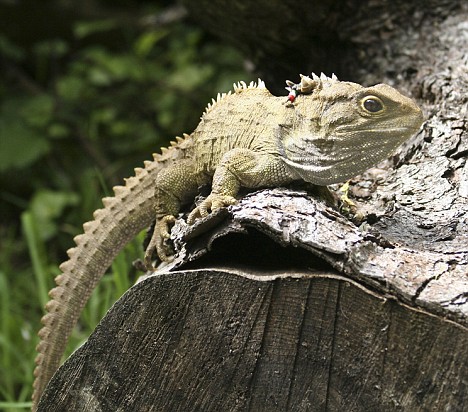
A rare dragon-like reptile with lineage dating back to the dinosaur age has been found nesting on the New Zealand mainland for the first time in about 200 years, officials said.

Four leathery, white eggs from an indigenous tuatara, which once roused fears of extinction, were discovered today by staff at the Karori Wildlife Sanctuary in Wellington, conservation manager Rouen Epson said.

'The nest was uncovered by accident and is the first concrete proof we have that our tuatara are breeding,' Epson said.

Tuatara

Rare: Tuatara are the last descendants of a species that walked the earth with the dinosaurs 225 million years ago


'It suggests that there may be other nests in the sanctuary we don't know of.'

Tuatara, dragon-like reptiles that grow to up to 32 inches (80 centimeters), are the last descendants of a species that walked the earth with the dinosaurs 225 million years ago, zoologists say.

They have unique characteristics, such as two rows of top teeth closing over one row at the bottom.

They also have a pronounced 'third eye' on the top of their skull. This white patch of light-sensitive skin - called its parietal eye - slowly disappears as they mature.

A native species to New Zealand, tuatara were nearly extinct on the country's three main islands by the late 1700s due to the introduction of predators such as rats.

Tuatara eggs

Hope: The discovery of the four rare eggs is 'concrete proof' that the tuatara are breeding and suggests there are more nests undiscovered in the sanctuary

They still live in the wild on 32 small offshore islands cleared of predators.

A population of 70 tuatara was established at the Karori Sanctuary in 2005. Another 130 were released in the sanctuary in 2007.

The sanctuary, a 620-acre (250-hectare) wilderness minutes from downtown Wellington, was established to breed native birds, insects and other creatures securely behind a predator-proof fence.

Empson said that the four eggs - the size of pingpong balls - are likely the first of a larger number because the average nest contains around ten eggs.

The eggs were immediately covered up again to avoid disturbing incubation.

If all goes well, juvenile tuatara could hatch any time between now and March, Empson said.