Zazzle Shop

Screen printing
Showing posts with label Reptiles. Show all posts

Wednesday, November 2, 2011

16-foot Python Swallows Entire Adult Deer

From: http://blogs.discovery.com/
python swallows deer whole

Eyes Clearly Not Bigger Than Stomach

A huge 16-foot Burmese python slithering through the Florida Everglades proved that her eyes weren't actually bigger than her stomach, by swallowing an intact 76-pound deer. The Everglades National Park wildlife biologists indicate that the python had a girth of 44.1 inches after devouring the adult female deer!

Screen shot 2011-11-01 at 7.51.08 PMAt 15.65 feet, the python isn't the largest on record, according to CNN, but the size of her prey both impresses and concerns state and federal wildlife scientists and land managers trying to control the non-native species.


As a large exotic animal that is not naturally from that area, experts assert that the python has the potential to wreak havoc on the natural Florida wildlife. Discovered by contractors who were spraying exotic vegetation on an island about 20 miles from Everglades National Park, the snake was dispatched with a single shotgun blast to the head, which is apparently protocol for non-native, predatory species.


Another Possible Example of Exotic Pets & Irresponsible Owners?
Officials indicate that they do see pythons on a regular basis and that they've dispatched hundreds of them in the past few years. While some of the snakes may have escaped enclosures after Hurricane Andrew's widespread destruction in 1992, experts assert a more likely cause for the problem is....
that some of these pythons were actually pets who grew bigger than the owner "planned" and they were released into the wild, which according to wildlife officials is the worst thing you can do.
Photo Source: South Florida Water Management District

Friday, October 22, 2010

12 Cutest Geckos on Earth

Written by Michele Collet
We all know the Geico gecko, who may be the cutest of all, but how much do we really know about the species and the real cuties in it? First a few general facts and then a countdown of the 12 cutest!
Geckos owe their wide-eyed look to having no eyelids; instead they have a transparent membrane that they lick clean. Many of them have a couple of defense systems like expelling a foul-smelling mixture of feces and other material, and many can also drop their tail when it is caught. Geckos come in a multitude of colors and patterns as well.
12. Mediterranean House GeckoHemidactylus turcicusPhoto: Hexasoft
The Mediterranean house gecko, also called the Turkish gecko, is a darling little fellow, the size of a finger. He is totally nocturnal and inhabits the hidden areas of a home, living inside walls and rafters. If you put him on a glass table and look underneath, you will see his tummy is almost transparent and of course, he has the special footpads all geckos are known for. He adores moths and roaches and will go outside to look for them.
11. Gold Dust Day Geckos
Two gold dust day geckos fighting on a banana plant in central Saint-Denis, Réunion.Photo: Thierry Cardo
These little creatures are having a bit of a territorial fight in the photo, but are beautiful even then. Endemic to Madagascar (as are most of the day geckos), their three bars identify them as does a blue rim around their eyes. They eat anything from nectar to other small lizards and are about 6-8 inches in length themselves.
10. Madagascariensis
MadagascariensisPhoto: Manuel Werner 
Madagascar day geckoPhoto: Tom Junek
Often found on the edges of forests and on trees, this is the largest of the living day geckos, growing up to 9 inches in length. He loves insects and also licking nectar and hard tart fruits. He is particularly striking with the pattern of colored dots on his back.
9. Dwarf Yellow-Headed Gecko
Dwarf Yellow headed geckoPhoto: Muhammad Mahdi Karim
These cuties live in small groups in parts of Africa such as Tanzania, preferring bamboo forests. They bask in the sun but if disturbed will use their flattened bodies to get into cracks of the bamboo. Their vocalizations sound more like frogs than any form of lizard, with squeaks, clicks and croaks. Member of this species are only 1 1/2 to 2 inches long.
8. Green Geckos
Naultinus elegans grayPhoto: wikimediacommons
A native of New Zealand, these geckos are strictly diurnal like the day geckos (the rest are mainly nocturnal) and while green on the surface have brightly colored mouths and tongues which can be orange, red, blue, black, pink or yellow. These geckos are arboreal in nature, living in trees and using their long tail as a fifth limb.
7. Teratoscincus or Wonder GeckoTeratosPhoto: andrew gardener
These beauties really are wonder geckos. They are found in the Middle East and desert areas, with very delicate skin (in fact, handling them can cause them to lose sections) and can take in oxygen through the skin as well. They are active in the darkest of nights, while digging and living in holes 32 inches below the desert surface. As you can tell by the picture, they also look like frogs and are called the frog-eyed geckos as well.
6. The Cat Gecko
Cat GeckoPhoto: LA Dawson
For a plain brown-and-white gecko, this little fellow is cute as a button. He gets his name from the habit of sleeping like a cat with his tail curled around him. Found in Thailand, Singapore, Indonesia and Cambodia, they are very close to the early fossils of geckos found and don't have the toe pads others do but instead live semi arboreally, using their claws and prehensile tail.
5. The House Gecko
House GeckoPhoto: W.A. Djatmiko
All house geckos are generally welcomed in their homes and become part
of the indoor menagerie because they eat mosquitoes and other pests. The photo above is of a tender skinned house gecko that shares with the Tokay gecko the ability to chirp like a cricket (which they also eat). The house gecko is found mostly in southeast Asia, and enjoys rocky areas as well as homes.
4. Blue-tailed Gecko
Blue-tailed day geckoPhoto: Jjargoud
This stunning gecko makes his home on the island of Mauritius and is diurnal but prefers night time. Only the males have the bright blue back with red dots; females are generally green and submissive males may be much lighter in color. Clearly, this boy above is a dominant and healthy male. Unlike most geckos, the Mauritian one is quite aggressive, both to its own members and to other gecko species, commonly wounding them.
3. Beaded Gecko
Diplodactylinae DiplodactylusPhoto: Anna Killjoy
One of the three cutest of all, this beaded gecko is a female. She is an extremely fast runner carrying very little fat on her. Many geckos, if not most, have some tail fat but she has almost none. Generally found in the dry interior of Australia, very little is known about this very private gecko.
2. Rhacodactylus
Rhacodactylus ciliatusPhoto: Anna Killjoy
Number two in the countdown, this adorable sweetheart is native to the New Caledonia Islands and is an arboreal nocturnal gecko. Stockier than many, it also has a prehensile tail for grasping trees and twigs. Also known as the crested gecko, it has a fringed crest that runs from over its eyes down to its back.
1. Tokay GeckoTokay1Photo: mm
The winner of the countdown is the cute Tokay Gecko. Its name comes from the vocalizations it makes, and it is an arboreal nocturnal species. It prefers living near cliffs and rocky heights and is an extremely stubborn animal, occasionally called the "pit bull" of geckos because it refuses to let go when it bites, for a few minutes and occasionally up to an hour.
The gecko is a fascinating animal with its specially adapted foot pads and the myriad of colors and patterns it has. It is of great use to humans with its enjoyment of insects we consider pests and is often kept as pets in homes where it has its habitat.
Sources 1, 2

Thursday, September 9, 2010

10 Most Beautiful Snakes on Earth

Green Tree Python

Photo: nasmac

Snakes. The word makes some shudder and others cringe while yet others think in wonder of the huge world of reptiles and their marvels. Whether you hate them or love them, one thing cannot be denied, which is their beauty. Count the top 10 down with me!

10. Honduran Milk Snake
Honduran Milksnake

Photo: Doug Mong

Lampropeltis triangulum hondurensis, is found in Honduras and Nicaragua. While at first glance not one of the most beautiful snakes, take a look at its scales above - they are bright (which is what the 'lampro' in the binomial name stands for) and a brilliant red and black. They are constrictors, but look a lot like coral snakes which herpetologists believe is an example of Batesian Mimicry - when a harmless animal takes on the appearance of a venomous one to protect themselves.

scales of Honduran milksnake(closeup)

Photo: Doug Mong

9. Leucistic Texas Rat Snake
leucistic Texas Ratsnake

Photo: Doug Mong

This Leucistic Texas Rat Snake is a lovely lady in white. She gets her coloring and the "leucistic" element of her name from a condition that results in a lack of all pigmentation, rather than just melanin which appears in albinism. This is why her eyes are of normal color. Texas Rat Snakes are (obviously) found in Texas as well as in Arizona and Louisiana. They are non venomous so a bite will give you little more than a sore leg.

8. Indigo Eastern Rat Snake
Eastern Indigo Snake

Photo: Ameng Wu

The Eastern Indigo snake is unofficially the longest in America, reaching lengths of 9.2ft. Carnivorous in habits, he has been known to beat his prey against other objects in a frenzied fashion to kill it. He will even eat other snakes such as the Texas Rattlesnake, and is immune to its venom. That aside, he deserves number 8 in our countdown for his brilliant black beauty that can look almost blue in the light.

7. The Emerald Tree Boa
Emerald Tree Boa

Photo: Derek Ramsey

One of the most vivid and unforgettable snakes is the Emerald Tree Boa, Corallus Caninus. These are found in South America and the Amazon. Even though it looks like it is closely related to the Green Tree Python and sleeps the same way, they are only distant relatives. One thing that the Emerald has, is very large front teeth. They way she catche her prey is to stay coiled on the branch, head down, ready to strike. She then catches small
mammals with her front teeth and pulls them in to their doom.

6. The Iridescent Shieldtail
Iridescent Shieldhead

Photo: Sandilya Theuerkauf

The only reason this lovely is not in the top 3 is that it is hard to see exactly how beautiful she is from this photograph, but she is actually even more gorgeous than she appears here. She has to be one of the most beautiful snakes in the world. The Iridescent Shieldtail, Melanophidium bilineatum , is not well known. Only three specimens are thought to have ever been caught and little is known of how it behaves in the wild. Recently some more have been seen but all that can be said for certain is that it's beautiful and rare.

5. Amelanistic Burmese Python
Burmese Pythons

Photo: Danleo

This head turner is an Amelanistic Burmese python - a species which retains their yellow, carotenoid-derived pigments. Mammals only produce pigments with melanins while birds and reptiles can also produce them by other means including carotenoids as we see here. Effectively though, she can be considered an albino snake in that amelanistic is classified under albinism

4. Brazilian Rainbow Boa
Brazilian Rainbow Boa

Photo: Doug Mong

This beauty is the Brazilian Rainbow Boa, Epicrates cenchria
named for the iridescent color of its scales. The underlying color is either brown, orange as we see here or a mix of the two. It is found in Central and South America and all the way through the Amazon basin. It is medium sized compared to other snakes and it likes the rivers and drainage areas, living for up to 20 years.

3. Eastern Coral Snake
Coral Snake

Photo: Norman Benton

Micrurus fulvius is one of the most beautiful of all snakes. Unfortunately it is also very venomous, as are all coral snakes. On the good side, there are only about 15 to 20 recorded bites a year but on the bad side they are deadly and soon there will be no more antivenin for it. Pfizer, has said that with such low demand, it is not worth the cost and research spent on it, and current stock is due to expire at the end of this year. The snakes are forest animals, living in leaf litter and brush. They flee before biting, but if you do get bitten it is imperative you go to a doctor. Respiratory failure occurs within hours.

2. Blue Racer Snake
Blue Racer

Photo: Jon Fife

This beauty is a pretty rare photograph of a Blue Racer snake. I say rare because its not often you get such a brilliant blue reflecting from the scales, as often they seem more gray in color. Its formal name is Coluber constrictor but despite this, they normally simply pin their prey to the ground and swallow them alive. They are known mostly east of the Rockies but have been seen as far south as Mexico.

Blue Racer

Photo: Jon Fife

1. Green Tree Python
Morelia-viridis

Photo: Micha L. Rieser

Morelia viridis, the Green Tree Python is a stunner that is found in New Guinea, Indonesia and parts of Australia. It, along with the Emerald Tree Boa, have a unique way of sleeping. They loop one or two coils along a branch, saddle style and place their head in the middle. Remember if it is in Indonesia, it is a python, if it is in South America, a boa. They are often mixed up because they are the only two that sleep this way.

Green Tree Python

Photo: Silvain de Munck

Sadly it is threatened due to the destruction of its habitat by logging, as well as by the pet trade. For her grace, her beauty and her threatened status, she easily deserves the number one spot in our countdown.

As I said earlier, whether you shudder at snakes or you like them, their beauty cannot be denied. There are others some feel more beautiful but I think this gives a good cross section of their amazing diversity in appearance. Several are threatened by loss of habitat, thereby threatening other species. However, hopefully we can remember that they are needed in this world to keep the food chain balanced. If for no reason but their beauty I hope you will think twice when you hear of new logging in the Amazon or other areas.

Sources: 1, 2, 3, 4. 5 , 6

Wednesday, August 4, 2010

Unsinkable Gecko

from:http://blogs.discovery.com/

Being small sometimes has its advantages. The Brazilian pygmy gecko, which is so tiny insects dwarf it, escapes the notice of many predators and can hide in the minutest of spaces. Not only is it unusually small, it has some other very odd and extremely cool adaptations.

To see these adaptations in action, check out this BBC video clip, narrated by Sir David Attenborough (and raise your hand if you want do be David Attenborough when you grow up).


Friday, October 16, 2009

Super Chameleon


The super chameleon shows his super camouflaging powers.

Music by YUKSEK - "Eat My Bear"

Become a fan of Never Hide Films:
http://www.facebook.com/rayban

Thursday, October 15, 2009

Lizard disguised as autumn leaf

A Satanic leaf-tailed gecko, a type of lizard that can camouflage itself to resemble a shrivelled autumn leaf, has been captured on camera in a stunning image.

A Satanic leaf-tailed gecko, a type of lizard that can camouflage itself to resemble a shrivelled autumn leaf, has been captured on camera in a stunning image.
The Satanic Leaf-Tailed Gecko Photo: ARDEA

The gecko, perched on a branch, has blended itself into its surroundings so well that its coil-shaped body is hard to spot amid the foliage.

Its body is twisted into a corkscrew shape, disguising its remarkable leaf-shaped tail against the decaying brown leaves.

The picture was taken at the Andasibe-Mantadia National Park in Madagascar, off the eastern coast of Africa.

Satanic leaf-tailed geckos (Uroplatus phantasticus) can be between 8cm and 30cm long and are found on the central eastern side of the island.

They are named because of their apparent 'horns' and some specimens have red eyes. The skin can appear a variety of colours including brown, yellow, green or orange.

Inactive during the day, they hunt for insects during the night and are almost impossible to see when at rest on a mossy or lichen covered branch. They can flatten themselves to the branch, creating a perfect match to their surroundings and avoiding any shadow being cast.

Modified scales form an irregular edge to the body that blends in nearly seamlessly with the bark.

When disturbed, larger members of the species stand up open mouthed and let out a large hiss.

The geckos are adapted to life in a rainforest and their disguises are so good that species and sub-species are still being discovered.

Friday, April 17, 2009

Snakes on a plane force Qantas to ground flight

Four baby pythons that disappeared from their container in the cargo hold of a Qantas plane have forced the airline to ground the aircraft after staff failed to find the missing reptiles.
Python
Python Photo: GETTY

In scenes reminiscent of the 2006 cult film Snakes on a Plane, four of 12 Stimson's pythons escaped during a two and a half hour flight from Alice Springs to Melbourne.

On the ground in Melbourne, staff were unable to find the escapees among the luggage in the hold and the aircraft was removed from service.

Joe Aston, Qantas spokesman, said the 12 juvenile pythons measured about six inches in length and were travelling in "an appropriate" container. He said it was not clear how the four had escaped.

"While (the container) was intact on departure (from Alice Springs), it was discovered on arrival that four of those animals had broken free," he told the Australian Associated Press.

Snake experts said the reptiles had probably slithered into the wamest parts of the plane, such as a motor or heater unti..

However, the company did not want to run the risk of the snakes reappearing mid-flight, so after establishing that the species was not threatened or endangered, the aircraft was fumigated to kill the four pythons.

The plane is now back in service.

Native to the arid and rocky parts of western and central Australia, the Stimson's python eats its prey whole — and this includes small mammals, birds, frogs and other reptiles.

The snake, which grows to between 20 and 40 inches, is not venomous.

They are common as pets and can live for more than 20 years.

Friday, October 31, 2008

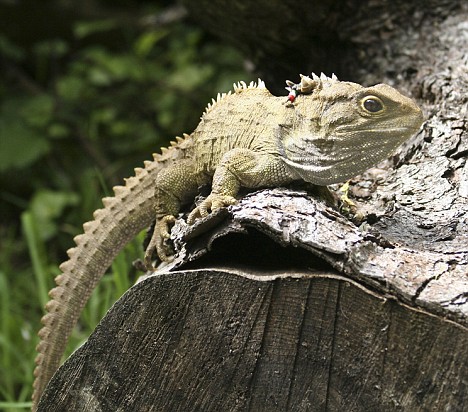
Rare dragon-like reptile found breeding in New Zealand for the first time in 200 years

By Daily Mail Reporter

A rare dragon-like reptile with lineage dating back to the dinosaur age has been found nesting on the New Zealand mainland for the first time in about 200 years, officials said.

Four leathery, white eggs from an indigenous tuatara, which once roused fears of extinction, were discovered today by staff at the Karori Wildlife Sanctuary in Wellington, conservation manager Rouen Epson said.

'The nest was uncovered by accident and is the first concrete proof we have that our tuatara are breeding,' Epson said.

Tuatara

Rare: Tuatara are the last descendants of a species that walked the earth with the dinosaurs 225 million years ago


'It suggests that there may be other nests in the sanctuary we don't know of.'

Tuatara, dragon-like reptiles that grow to up to 32 inches (80 centimeters), are the last descendants of a species that walked the earth with the dinosaurs 225 million years ago, zoologists say.

They have unique characteristics, such as two rows of top teeth closing over one row at the bottom.

They also have a pronounced 'third eye' on the top of their skull. This white patch of light-sensitive skin - called its parietal eye - slowly disappears as they mature.

A native species to New Zealand, tuatara were nearly extinct on the country's three main islands by the late 1700s due to the introduction of predators such as rats.

Tuatara eggs

Hope: The discovery of the four rare eggs is 'concrete proof' that the tuatara are breeding and suggests there are more nests undiscovered in the sanctuary

They still live in the wild on 32 small offshore islands cleared of predators.

A population of 70 tuatara was established at the Karori Sanctuary in 2005. Another 130 were released in the sanctuary in 2007.

The sanctuary, a 620-acre (250-hectare) wilderness minutes from downtown Wellington, was established to breed native birds, insects and other creatures securely behind a predator-proof fence.

Empson said that the four eggs - the size of pingpong balls - are likely the first of a larger number because the average nest contains around ten eggs.

The eggs were immediately covered up again to avoid disturbing incubation.

If all goes well, juvenile tuatara could hatch any time between now and March, Empson said.