Zazzle Shop

Screen printing
Showing posts with label Electric Motorcycles. Show all posts

Thursday, September 22, 2011

Electric Tron Lightcycle Is Street-Legal & Amazing

from: http://mashable.com/


There’s no denying it: every Tron fan pictured himself on one of those amazingly designed, super-fast bikes from the movie. Parker Brothers Choppers turned that dream into reality a year ago, when they created the first Tron Lightcycle, but now they’ve taken it a step further and turned the gas-guzzling beast into an electric bike.

The all-new Electric Tron Lightcycle is powered by a 96 volt electric motor and lithium ion batteries. Its top speed is in excess of 100 mph, and its range is 100 miles on a single range, with a mere 35-minute recharge time.

As for practicality, we’re not experts on motorcycles, but it does seem a bit hard to ride. We guess it’s a small price to pay for the looks you’ll be getting when riding this beauty — especially at night, when the bike lights up just like the one in the movie. .

Pricing and availability are unknown at this point, but as a reference, the old, gas-powered version costs close to $55,000. Check out a video of the Electric Tron Lightcycle in action below.

Monday, August 23, 2010

Ryno Motors creates one wheel electric scooter

From: http://gadgetsmarket.com/

ryno motors 9PJb1 69 Ryno Motors creates one wheel electric scooter

gadgetsmarket.com/wp-content/uploads/2010/08/ryno-motors_3_g649Q_691.jpg”>ryno motors 3 g649Q 691 Ryno Motors creates one wheel electric scooter

ryno motors 1 TezuW 69 Ryno Motors creates one wheel electric scooter

Ryno Motors one wheel electric scooter Ryno Motors creates one wheel electric scooter

Friday, June 11, 2010

The Motorcycle of the Future Has Arrived

This is the MotoCzysz E1PC. It is electric. It is almost certainly the most advanced motorcycle on the planet. And it is the future.

We told you moto-genius Michael Czysz — pronounced sizz — was building another contender for the TT Zero electric motorcycle race on the Isle of Man. But we caught up with him early in the build and he wasn’t providing details or pics. Now that the bike’s hit the track, Wes Siler of Hell For Leather has all the details on the MotoCzysz E1PC in a piece posted over at Popular Science.

This bike is bad-ass, no two ways about it. It has a custom-built 12.5-kilowatt-hour lithium polymer battery that can be swapped in seconds. The custom-built, oil-cooled motor generates 100 horsepower (continuous) and 250 pound-feet of torque. It all hangs from a custom frame. Of course, it’s got the usual top-shelf hardware. Ohlins. Brembo. You know the drill.

Czyzs and his crew in Portland, Oregon, were literally buttoning the bike up before the first practice session on the Isle of Man, having just gotten the body panels through customs. No one had tested the bike before, but rider Mark Miller smoked the field during practice, finishing more than three minutes ahead of the competition. The bike hit a top speed of 140 mph and lapped the 37.7-mile course at an average speed of 94.66 mph.

For all the high-tech componentry, the E1PC is designed first and foremost as a motorcycle, so it’s meant to be hammered. Many bikes racing in the TTXGP series suffer ground-clearance issues when leaning into a turn, but the E1PC has no such trouble. Siler says riders accustomed to a conventional sportbike will feel right at home on the E1PC.

Take a close look at the pics. You’re looking at the future of motorcycling.

Photos: Amadeus Photography. More after the jump and over at PopSci.

Monday, July 13, 2009

Human Hybrid Speed Machine - It is Eco-Friendly [Video] watch!

edition.cnn.com This Bicycle which is powered by an electric motor can go up to 50mph and it is eco-friendly. The faster you pedal, the faster it charges up the motor and the faster you go.

click here: Human Hybrid Speed Machine - It is Eco-Friendly [Video] watch!

Friday, July 10, 2009

Brazil’s First Network of Electric Charging Stations Will Be Solar-Powered

Motorcycle on road

The first of many roadside electric charging stations in Brazil is set to be installed in the Barra de Tijuca neighborhood in Rio de Janeiro, and it’ll be solar-powered.

The neighborhood was chosen because it has the highest number of electric motorcycles certainly in circulation. The battery charging point will serve a mainly symbolic purpose at first, “awakening environmental awareness by showing people that it is possible to use energy without harming the environment,” said spokesperson Edimar Machado.

Brazil has been a worldwide leader in reducing the impact of the transportation sector on the environment, with 90% of new cars sold in the country being flex-fuel– capable of running on ethanol or gasoline in any proportion. Now the hope is that they can also lead the world in infrastructure for electric vehicles. Once they become more financially viable, Machado hopes to have an electric charging station positioned every 30km across the country.

That could soon allow every electric motorcyclist the capability to travel the entire length of Brazil’s major roadways if they wanted, even if their battery length is only around 40km, like most of the bikes currently in circulation there. Machado also suggested that used batteries could be exchanged for already-charged ones at the stations for the same price as a full charge, in case roadsters can’t wait around for the standard 4 hours it takes to charge the batteries. That would make the time it takes to “fill up” your electric vehicle no longer than it would take to fill up a gas tank.

Even better, the charging stations will generate their electricity from solar energy. The charging point captures solar energy by means of an array of 28 photovoltaic panels that generate 184 volts of direct current, which is transformed into triphasic alternating current. Output is at 110 or 220 volts [1]. And on days when there isn’t much sunlight, or at night, the stations could still derive electricity from the grid system.

The Brazilian Electric Vehicle Association says the market for electric vehicles is already growing by about 50 percent a year, and with new charging stations located conveniently around town that number is expected to increase dramatically. They also project that electric vehicles will consume barely three to five percent of the country’s total energy in 2030, meaning as the system expands it shouldn’t be a significant strain on the country’s electricity. Meanwhile, car fuel consumption will be reduced by 10 percent.

Although that nationwide system of stations is still far from practical, the implementation of this first station is symbolic of what can be envisioned with the right political will and incentive.

Source: IPS News

Image Credit: Diego_3336 on Flickr under a Creative Commons License

Tuesday, May 26, 2009

Guy Builds Electric Motorcycle From Junk

Tony Parker Has Built An Electric Bike Made From Junk. He Also Made A Solar And Wind-Powered Charging Station For The Bike.

Tony Parker has built an electric motorbike completely from found junk.

Why? The laid-off worker found himself with a lot of time and just began tinkering around the house.

“Honda parts, washing machine parts, Yamaha parts,” Parker noted about occupying his time.

I’d probably just be eating Frittos and watching reruns of the A-team. Each to his own, I guess.

Of course, his friends and family though he was nuts to try it. But the Omaha-based DIYer not only built an electric bike, he also built a charging station for the bike.

The charging station consists of both solar and a small windmill. The wind generator can charge the bike at 250 watts per hour. Whereas the solar cell will only do 1.5 watts an hour.

Get Adobe Flash player

A lot of time and innovation was put into reusing materials. Like the bike seat was originally made from an old office chair! But what kept him going?

“If you can do this and keep yourself going, you can finish this thing and use it as at teaching tool to inspire other people,” Parker said.

The bike is powered by a 2.5KW 48V motor and gets up to 50 mph. He calls the bike the Electra Green and you can find more info on it here.

Source: Unconsumption


Tuesday, May 19, 2009

CNN: 60 MPH Highway Legal Electric Scooter

By Ayesha Tejpar
CNN

NEW BEDFORD, Massachusetts (CNN) -- When you think scooter, you might think of something a child would ride.
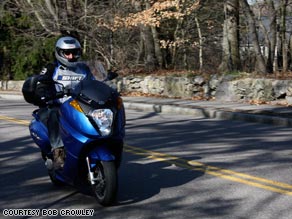
electric scooter

Steve Shapiro rides his VX-1 scooter on road in New Bedford, Massachusetts.


The Vectrix VX-1 maxi scooter, which weighs much more than a typical bike at 515 pounds, is anything but a kid's toy. It requires a motorcycle license to drive.

It's also electric, with a 180-pound battery that lets the rider forget about pumping gas. The Vectrix just needs an electrical outlet to get its fuel.

Steven Shapiro bought a scooter last year, when gas prices were surpassing $4 a gallon.

"I felt like I had an opportunity to sort of make a statement, just at the local level," Shapiro said.

That statement came with a price, though. His Vectrix VX-1 was $8,000.

"The cost of new technology is always higher than old technology," explains Mike Boyle, Vectrix's CEO. "You may win [people's] minds and hearts through the understanding of what an electric vehicle can bring to them. You then have to win their pocketbooks as well."

The Obama administration is helping do just that. Earlier this year, President Obama's stimulus plan proposed tax credits for those who buy plug-in electric vehicles. Depending on the size of the battery, the credit can reach up to $7,500.

Peter Hughes, Vectrix's chief technology officer, said the scooter was designed to suit the needs of a commuting executive.

"Think about the lawyer; think about the businessman, the banker, the engineer who doesn't want to take his car into the city. He has about a 20- to 40-mile round-trip commute."

The scooter can go about 50 to 60 miles when fully charged and it can reach speeds up to about 60 mph. It's billed as the only electric scooter on the market that's highway legal. Video Watch the Vectrix and Tesla take to the roads »

"We classify this as a zero emissions vehicle. ... When you're riding it and driving it, it is zero [greenhouse gas] emission," Hughes said of its environmental impact.

"But we do account for the fact that when you plug it in, that energy comes from somewhere. You're going to take four kilowatt hours to charge this vehicle. The VX-1 has a carbon footprint of 36 grams per kilometer. Now equate that to a car, which is typically 10 times that."

But it's still a tough sell in the U.S. market.

"In America, I would say, No. 1, we're a four-wheel society. We're in love with the car, right? In Europe, out of necessity, everybody grows up on a two-wheel vehicle," Hughes said.

The company has sold almost 2,000 bikes since 2007. Electric scooters aren't new to the market. Several other companies, such as ZAP and e-max, sell models that aren't highway legal.

John Anthony, a bartender in Rhode Island, was the third person in the United States to buy a Vectrix. He read about it when it was a still a prototype.

"I wrote a check, and I sent it to them. Sight unseen," he recalled.

The independence from gas intrigued him.

"I try to use less gas and oil than most people," he said. "I heat my home with a wood pellet stove and I heat my hot water with solar panels."

Of course, going electric has its limitations.

"I did get stuck," he said. "It was right after I got it, and I said, 'I'm not letting my neighbors see me push this home.' It's not like running out of gas in a car, where somebody can bring you a gas can. You can't do that, so it's something that you really have to be careful of."

For those wary of changing their ways completely, the Tesla Roadster might offer a solution. This sports car can travel up to 244 miles between charges. But it also costs more than 10 times more than a Vectrix scooter.

"If you look at any new technology that enters the marketplace, for instance plasma TVs ... five years ago, it was a $10,000 luxury item. Now I could walk into a store and pick up something higher quality for 10 percent of that, for a thousand bucks," said Jeremy Snyder, Tesla Motors' general manager.

According to Snyder, the company hopes to "change the preconceived notion of society that efficiency needs to be boring."

A sedan model is planned for 2011, and its base price is $49,900. There's already a waiting list of more than 700 people, Snyder said.

A more affordable electric car may be available as soon as this year. Th!nk city sells electric cars in Europe, and plans to sell U.S. models for under $25,000.

While there is still a long way to go before gas stations become extinct, electric vehicle owners are always on the lookout for electrical outlets. And Vectrix owner Shapiro has a few other ideas.

advertisement

"I had a dream when I bought it," Shapiro said. "I was going to go across country and make a documentary about going every 40 to 50 miles, and then knocking on people's door and saying, 'Do you mind if I sit on your couch for two hours while I plug in?'

"And it's still an idea I have in my head," he said. "Just waiting for a few offers from Hollywood."


Friday, February 6, 2009

Electric Motorcycle Promises 150 MPH

By Ben Mack Email

Missionsideshot_sized

A San Francisco startup led by a former Tesla Motors engineer is developing an electric motorcycle capable of 150 mph, a claim that, if true, would make it the fastest production electric vehicle in the world.

Mission Motors unveiled the bike, dubbed Mission One, at the TED conference and said it will begin selling them next year for $69,000 apiece. Although several electric motorcycles have been announced in recent weeks, Mission Motors sticks out because its 12 employees have worked for Tesla, Ducati North America and Intel, and the bike they're building could set a new benchmark for EVs of all kinds.

"As a motorcycle enthusiast and engineer, I knew I could combine my passion for motorcycles with my passion for innovation and create a motorcycle that truly sets a new standard in the perception of electric vehicles," company founder and CEO Forrest North said at the Mission One's launch.

The prototype, wearing bodywork designed by Yves Behar, is based on a Ducati 900 was designed entirely in-house by Mission Motors. Power comes from a 3-phase AC induction motor and a liquid-cooled lithium-ion battery the company claims delivers 150 miles and recharges in just two hours at 240 volts. That climbs to eight hours at 120 volts.

Top-shelf hardware includes Ohlins suspension at both ends, four-piston Brembo brakes and Marchesini forged wheels. The components - and the claimed 150 horsepower - put the bike on par with hardcore sportbikes like the Ducati 1198. That's exactly what North had in mind.

"With Mission One, we're writing the next chapter in motorcycle design, delivering a new riding experience without sacrificing performance or design in a zero emissions vehicle," he said in a statement.

Mission Motors was called Hum Cycles when North launched the company in 2007 after spending a year at Tesla, where he worked on the battery pack that powers the Roadster. Since then he's assembled an impressive team drawn from Silicon Valley and Ducati North America. Vice president of engineering Mason Cabot spent 10 years at Intel. VP of finance Dan Kaplan was CFO of Ducati North America and director of finance at Tesla. Product manager Jeremy Cleland is a motorcycle racer who also has worked for both Ducati and Tesla.

So far the company has raised $1.5 million from investors and capital venture firms like One Earth Capital. As Forbes notes, that won't last long, and Tesla's shown that building a high-dollar, high-performance EV is a tricky proposition. And in addition to going up against startups like Zero Motors and Brammo, Mission Motors will be competing with major manufacturers like Honda and KTM as they develop electric motorcycles.

North says production will begin next year and he's already sold five bikes. The first run is limited to 50 hand-built bikes, which will be followed by a bigger run of 250 before the company introduces a more affordable model.

The company plans to race the bike in the TTXGP, a zero-emissions motorcycle grand prix slated for the Isle of Man, on June 14th.

Missionfront_main_sized

Missionrear34_sized

Photos: Mission Motors

Thursday, February 5, 2009

Mission Motors: The Need for Electric Speed

The motorcycle maker will soon release a sport bike that will turn heads. Mass market to follow

Mission Motors is working on the next big status symbol: the electric motorcycle.
The company, formerly known as Hum Cycles, is concocting an expensive, fast and all-electric motorcycle for enthusiasts called the Mission One (see Hum Cycles Raises Angel Funding). The first 50 bikes, due in early 2010, will be limited editions, followed by 250 others that are similar, said CEO Forrest North in an interview.

The expected price is $68,999. Five have already been sold. North will show off a prototype this week at TED, the spring-break-for-bigwigs conference taking place this week in Long Beach, Calif. North will not be giving test rides. The bike is particularly fast and is the kind of thing that needs to be handled by more experienced riders. Having Bono stack it up on Highway 1 might bring a damper to the proceedings.

Like electric cars, electric motorcycles will beat out most of their gas-burning counterparts in acceleration. The bike, which will top out at 150 miles per hour and go 150 miles on a charge, will rank high on the zero to 100 miles per hour ratings, even compared to bikes with two to three times the horsepower. That's because electric motors inherently can access power rapidly from an engine.


Electric bikes will also provide a new, unusual and "aesthetic" driving experience, he said. Because they don't have gas motors, electric motorcycles are essentially silent. The loudest sound is the chain and the wind. (I test drove an all electric Zero Motorcycles and can confirm this). Electrics also don't jiggle and vibrate like gas burners.

"There's a connectedness to the road. You get into a zone. A [gas] motor sort of disconnects you," he said, adding, "it will be blazingly fast."

Unfortunately, lithium-ion batteries still cost quite a bit, so the company will start at the high end and try to trickle its technology down. It is a similar strategy to one employed by Tesla Motors.

"We didn't feel battery technology was cheap enough yet to make a mainstream commuter that would be palatable," North said.

Making electric motorcycles is, however, arguably easier than getting into the car business. For one thing, crash testing is far less rigorous, according to motorcycle executives. It is also less concentrated. The world's car market is dominated by a few big brands. By contrast, there are roughly 200 motorcycle makers in the U.S. alone, he said. (Many are custom builders.) Factories are far cheaper and motorcycles require smaller batteries, the big sticking point for electric vehicles.

High-end buyers also won't likely blanch at the price. Some custom sport bikes from high-end makers like Ducati can cost $70,000 or so, he said. Execs and engineers from the company, in fact, have worked at both Ducati and Tesla Motors.

Other companies, meanwhile, are taking an opposite tack. Zero (see hilarious video here), Vectrix and Brammo have all developed electric rides for the mass market. These bikes all cost more than gas equivalents. Zero has a dirt bike while Vectrix has a street scooter.

Will these be popular? Like electric cars, potential consumers are already intrigued. When North drives the prototype around, motorcyclists often come up and ask questions. That is, after it gets quiet enough to speak.

"The first thing they do is turn off their motorcycle to talk to me," he said.

Bullet Arrow February 4, 2009