The day Daniel Radcliffe met Rupert Grint (PIC)
latimesblogs.latimes.com — The young Harry Potter stars in 2000.


latimesblogs.latimes.com — The young Harry Potter stars in 2000.
| By Rory Cellan-Jones Technology correspondent, BBC News |

Rory Cellan-Jones meets the owner of Britain's oldest working TV
Britain's oldest working television has been tracked down in a house in London.
The 1936 Marconiphone is thought to have been made in the months that Britain's first "high-definition" television service began.
The set belongs to Jeffrey Borinsky, an electrical engineer and collector of antique television and radio sets.
He bought the set, which has a 12-inch (30cm) screen from another collector 10 years ago and is still working on restoring it to its original state.
The screen is mounted inside a wooden cabinet. The image from the cathode ray tube, mounted vertically inside the cabinet, is reflected onto a mirror.
The few controls include volume and vertical hold, but there is no channel changer, as there was only one channel when it was made: the BBC.
Modern in part
The set appears to be in good condition, but Mr Borinsky aims to replace a number of modern components with originals.
"The cabinet was beautifully restored by the previous owner," he explained,' but my aim is to gradually restore its electronics to its true 1936 magnificence," he said.
 Marconi also made the "Instantaneous Television Camera" shown in 1936 |
But the Marconiphone 702 still works as a modern television.
It has been hooked up to a Freeview box so that it can show digital channels, although Mr Borinsky has had to install a standards converter so that a modern television signal can be seen.
Mr Borinsky only keeps the set turned on up to two hours at a time, and he uses it to view films from the 1930s and 1940s.
He says he enjoys watching the kind of pictures that might have been seen by the original owners.
The National Media Museum in Bradford has a similar set, but does not use it to show television pictures for fear of damaging it.
Iain Logie Baird, the curator of television at the museum, said it is a thrill to see the Marconiphone working.
"It's very exciting to see the image the way people would have seen it in 1936, before television became ubiquitous as it is today," he said.
Mr Logie Baird, grandson of the television pioneer John Logie Baird, says this set would have been of huge local interest when it was first acquired at a cost of 60 guineas - the equivalent of £11,000 today.
"Television was a very exciting thing, it was something that the whole neighbourhood would come over to watch. People would crowd into the home of the owner."
The set was discovered as the result of a competition run by Digital UK, the body overseeing the switch to digital television. The aim was to publicise the message that just about any television, however old, can be used to show digital channels.
Dave Hill recently released a new website with a few extra pieces you may not seen, it also has a behind the scenes section where you can see the photo shots and clear out some doubts about how his work is done, it also has a blog and a display of his personal work.


Behind the Scenes Video


Arches National Park, UT


By Eliot Van Buskirk
Last week, Milanese authorities found Leonardo Notarbartolo, the man accused of masterminding the world’s biggest diamond heist, in possession of approximately 2.2 pounds of rough, uncut diamonds.
Many of the stolen diamonds were never recovered, and Notarbartolo was detained for driving around with hundreds of diamonds stashed in his BMW, just a few months after being released from prison for the crime.
Case closed? Not so fast.
Due to the slippery nature of rough diamonds — and of Leonardo Notarbartolo himself — the alleged criminal mastermind could walk away scot free, with the confiscated diamonds back in his possession.
Ever the charmer, Notarbartolo claims he purchased the diamonds legitimately for a mere 10,000 euros, as he told Wired’s Joshua Davis last week through an intermediary. (Davis wrote about the heist in March.) On Monday, the alleged jewel thief contacted Davis again to say that the confiscated diamonds are not precious jewels, but rather industrial-grade diamonds used to manufacture cutting tools, which is why he paid only 10,000 euros for the whole pile.
“Notarbartolo is saying, ‘These are my diamonds. I got them legitimately. Give them back.’ And he’s hired a lawyer, Basilio Foti, to advocate for the return of the diamonds,” explained Davis.
Notarbartolo’s defense will likely hinge on the fact that rough, uncut diamonds are nearly impossible to trace. Polished diamonds typically have certified identities that accompany them during transport, and often contain laser-etched logos or certification numbers that are invisible to the naked eye.
A rough diamond, on the other hand, is pretty much a rough diamond. Because they’re soon to be cut and polished, which changes their characteristics, they’re not certified by the industry. “To say with certainty that any rough diamond is the same rough diamond that was in a vault six years go is almost impossible,” explained Davis, who has reported extensively on the diamond trade.
Despite the fact that the vast majority of the diamonds stolen six years ago were in rough form — and that the guy proven to have organized the crime was just found with a big pile of rough diamonds — authorities probably lack sufficient evidence to put Notarbartolo back behind bars, due to the early-untraceable nature of unpolished stones. Most likely, they will be forced to return the jewels to the convicted jewel thief and send him on his merry way.
“I don’t understand the Italian legal system, of course,” explained Davis, “but speaking on purely logical grounds, if you can’t prove that the diamonds are stolen, then you would logically have to give them back.”
In other words, Leonardo Notarbartolo, who famously liberated $120 million in diamonds and cash from a bank so “secure” it didn’t even need live security guards, may finally have found a suitable second act: freeing himself after being caught red-handed, six years later, with hundreds of what could very well be the very same diamonds.
Written by Aaron Saenz |
If Disney’s Hall of Presidents upset you, if Chuck E. Cheese and his friends frighten you, if the TV show Dinosaurs gave you nightmares - don’t read this post! Hanson Robotics is in the business of creating life-like animatronic faces and they’ve gotten disturbingly real. Complex emotions play across the visages of these robotic replicants and if you’re not careful you’ll soon buy into their reality. Check out the videos of Hanson’s creations after the break.
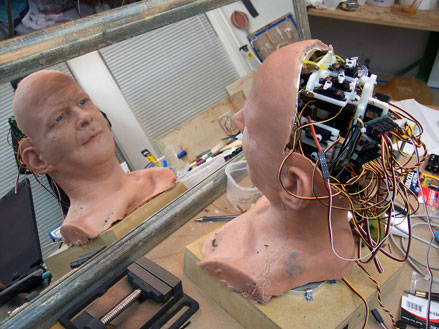
What makes a robot smile?
Dr. David Franklin Hanson, Jr , the founder of Hanson Robotics, owes much of his success to Frubber. Frubber is a revolutionary material with a porous structure that allows it to move similarly to human tissue. Previously used materials were too heavy and too stiff. Using Frubber, Hanson can create a wide range of realistic facial expressions while cutting the need for powerful actuators. Typical applications using Frubber consume more than 20 times less power than with traditional materials. A realistic face and neck can run for hours using just a few AA batteries.
…Believe It or Not
The engineers at Hanson Robotics appreciate good science fiction. That’s why in 2005 they built a realistic replicant of author Phillip K. Dick (Blade Runner, A Scanner Darkly and many others). Using information about the authors life, voice recordings, and an AI program, they were able to create an interactive experience. Here’s a great video from WIRED:
After Phillip Dick, other great science luminaries were sure to come. In 2006, Hanson teamed up with Hubo robotics in Korea to form a fully articulate android… of Albert Einstein. Whereas the Phillip animatronic just sat down, this new android could move around. Since it’s creation this android, and the detached robotic head, have been big crowd favorites. It recently appeared, along with other Hanson creations, at the 2009 TED conference. Check out the original Hubo/Hanson session in the video below:
Undoubtedly the success of these replicants is largely due to Frubber and fame. We perceive realistic facial expressions on celebrities and we overlook the shortcomings. It’s the same set of conditions that makes a wax museum successful. In addition, however, Hanson robots can also maintain eye contact. Using face tracking software, the replicants know where to look and how to move to keep their audience interested. Coupled with an interactive program that can learn from past conversations, these developments push the Hanson robots closer and closer to the Uncanny Valley.
The Uncanny Valley is that point where a simulated being becomes too realistic too enjoy. It’s a classic concept in robotics: develop something vaguely human and it will be cute. Create something too life- like and we will be disturbed by its imperfections. Hanson robotics doesn’t believe in the Uncanny Valley. Or rather, they think they have a solution: the Bride of Engaging Design.
In Hanson’s view, people will accept things in art that might disturb them in reality. Horror movies or sculpture by Ron Mueck, we appreciate these things even though they lie in the middle of the Uncanny Valley. The desire to understand and anthropomorphize can permit viewers to enjoy a work at all levels of realism. In that way, Hanson’s work is less disturbing than it is intriguing.
Bringing It Back to the Singularity
One of Hanson’s latest projects is called Zeno. Zeno is an anime style robot designed for entertainment and toy sales. He can walk, dance, and interact with others. His programming adopts the developments from previous Hanson projects: he adapts in conversation, maintains eye contact, and has limited learning. As part of his purpose as merchandise, he even comes with a great background story that could be included in literature, movies, or other media. You see, Zeno is the hero of the Singularity.
That’s right, in a meta-physical field day of fact and fiction, Zeno’s backstory details how he starts off as a toy in present day. By 2029 (Kurzweil fans will recognize the date), Zeno develops a greater intelligence and starts to question his existence. After the requisite government kidnapping and installation in a secret robot academy, Zeno meets new friends and helps save humanity and robots alike. Thus Zeno is the hero of both mankind and robokind. Well, it’s cute, but like so many things from Hanson Robotics, it’s a little weird. I mean you’re playing with a toy that claims it will one day develop from a toy into a sentient being. That has to make you a little cautious. “Sure Zeno, you can have some more batteries, just remember me when the revolution comes.”
Whether in toys, movies, or interactive displays, Hanson Robotics and its replicants are pushing the boundaries of what people will accept as human or human-like. Either with Frubber, or the next great material, engineers will keep improving the facial expressions, programmers will improve conversation software, and voice generation/recognition can only get better. While the animatronic faces and voices are imperfect (and in my opinion a little creepy), Hanson Robotics may be correct: in the end there may not really be an Uncanny Valley, just an audience that is hungry for new and innovative design. To those waiting for the next form of entertainment there’s likely no such thing as “too real.”
 |
| Photo: chron.ron |
| The color of money |


An aroma like bread dough permeates Raul Cano's lab. He has just removed the cover from a petri dish, and the odor wafts up from several gooey yellow clumps of microorganisms that have been feeding and reproducing in a dark cabinet for the past few days. Cano, a 63-year-old microbiologist at California Polytechnic State University, San Luis Obispo, inspects the smelly little mounds lovingly. "These are my babies," he says, beaming. "My yeasty beasties."
The dish contains a variant of Saccharomyces cerevisiae, known in culinary circles as baker's or brewer's yeast. But Cano didn't get this from Whole Foods. Back in 1995, he extracted it from a 45 million-year-old fossil. The microorganisms had lain dormant since the Eocene epoch, a time when Australia split off from Antarctica and modern mammals first appeared. Then Cano brought the yeast back to life.
This reanimation of an ancient life form was a breakthrough, a discovery so shocking that the scientific community initially refused to believe it. It changed our understanding of what microorganisms are capable of. It also gave the Cal Poly researcher a brief taste of fame. For a while, he thought it might make him rich. It didn't. Now, just when it seemed his babies would be forgotten, Cano has found a way to share them with the world.
Born and raised in pre-Castro Havana, Cano still has a noticeable Cuban accent. After the revolution, his parents were unable to escape the country, but they managed to secure him a visa and a plane ticket to Miami in early 1962. His parents would eventually follow him to the US, but for a few years Cano was on his own in a strange new country. "I was 16 at the time," he says. "I went from foster home to foster home."
His scientific aptitude was not immediately apparent. "I wasn't a remarkably good student," Cano says. "I went to community college." He eventually transferred to Eastern Washington University, and there he discovered his calling in a microbiology class. "It was taught by a fungal geneticist," he says. "He was terrific. He became my mentor." Cano got his master's and went on to earn a PhD in microbiology at the University of Montana.
In 1974, Cano went to work at Cal Poly, starting out as a fungus specialist. But by the early '90s, he was making a name for himself by examining the contents of fossilized prehistoric tree resin—more commonly known as amber.
Scientists have been cracking open the translucent caramel-colored rock for nearly two centuries in an attempt to unlock the history of the earth. All manner of flora and fauna got trapped in the dribbling sap, and once it solidified and fossilized, the contents were preserved for aeons. "It's a time capsule," Cano says. "Like a Kodak moment from when the amber was formed." The first study of the contents of amber, made public in 1856, yielded 163 species of ancient plant life.
More than a century later, amber became sexy again with the advent of gene sequencing and cloning. A 1982 paper by entomologist George Poinar explored the potential for extracting DNA from preserved creatures. The paper caused a stir in the scientific community and inspired Michael Crichton to write his best-selling dinosaur-cloning novel, Jurassic Park, which came out in 1990.
In 1993, Cano worked with Poinar and others to remove DNA from a 125 million-year-old Lebanese weevil entombed in amber. They were able to sequence segments of the bug's genome. But even if they had the full genome, science couldn't—and still can't—clone it back into existence. (Just as well—it's hard to imagine Steven Spielberg creating a blockbuster f/x extravaganza about reanimated weevils. Unless he made them 30 feet tall. With a taste for human blood.)
Two years later, however, Cano actually did manage to pull off an astonishing first—he brought back to life something that had been trapped in amber for more than 25 million years. It started with a chunk of fossilized resin from the Dominican Republic. Trapped inside was an extinct breed of stingless bee. It was dead, of course, but Cano theorized that microorganisms in the resin might simply be dormant. After all, he reasoned, some single-celled creatures are known to enter a hibernation-like state and survive for years with no air or food. Still, few believed that anything could survive after lying dormant for so long.
Cano wanted to find out. He took the contents of the ancient bee's stomach, suspended it in saline, and spread it on a growth medium. Amazingly, something woke up and began propagating in the petri dish. Cano identified it as a bacterial spore related to the modern Bacillus sphaericus, which is used to kill mosquito larvae.
Cano's discovery changed science's understanding of just how extraordinarily resilient microorganisms are. "They're the quintessential survivors," he says. "They started when the planet was born, they're going to stay around until the planet is dead, and then they'll just go somewhere else." After publishing the results of his experiment in Science, Cano found himself the center of national attention from scientists and eventually the media. This was the closest humanity had come to the discovery imagined in Jurassic Park.
Over the course of the next year, Cano would crack open several more pieces of amber and bring hundreds of strains of ancient bacteria back to life in his lab. In the process, he began to think there might be a practical use for these creatures. He launched a company, Ambergene, to explore potential biomedical applications. The premise for the venture was that ancient organisms might have antibiotic potential—they'd been out of the ecosystem for so long that nothing today would have a resistance to them. At the time, the approach—dubbed natural product discovery—was very much in vogue. Major players like Merck and Eli Lilly were making serious investments.
Creating a life-saving drug was appealing. Fabulous riches would be a nice side effect. "Altruism's great, but it's not that great," Cano says. He possessed the only known samples of these strains, and he patented his revivification process to further cement his control over them. As the cofounder, part-owner, and chief scientific officer of Ambergene, Cano stood to earn a hefty chunk of any windfall that might result.
To reassure potential investors, Ambergene's board of directors decided to confirm Cano's claims of reanimation. He wasn't the first to attempt to bring tiny beings back to life in this manner. But every previous reported success turned out to be a case of modern bacteria contaminating the amber during the extraction process.
How to Reanimate Prehistoric Microorganisms
Raul Cano proved that single-celled creatures like yeast and bacteria can be revived after lying dormant in amber—fossilized tree resin—for tens of millions of years. Here's how it's done.
 | |
| STEP 1 | STEP 2 |
 | |
| STEP 3 | STEP 4 |
Illustration: Noma Bar
"I was very skeptical," says Chip Lambert, a microbiologist tapped by Ambergene to try to duplicate Cano's results. The company provided him with amber and all of Cano's sterilization and extraction protocols. Lambert doubled all of the cleaning processes and added some of his own. He was still able to duplicate Cano's discovery.
Cano didn't mind the company checking his work if it helped Ambergene win financing. He ended up being impressed with Lambert's efforts. "We became friends," Cano says. "I enjoy his company. Besides working with him on some of his projects, we'd socialize, get dinner, maybe grab a beer." (Another team of researchers working with Cano has also been able to duplicate the results.)
In April 1995, during his amber-cracking spree, Cano made another important discovery. A piece of fossilized resin from Burma yielded something that looked very similar to Saccharomyces, brewer's or baker's yeast. This single-celled fungus feeds on sugars and reproduces frequently—if it has enough to eat, a culture can double in population in 90 minutes. "Yeasts are found in all kinds of vegetable matter—plants, fruits, stuff like that," Cano says. "It was fortunate for that yeast to be there at the time so it could become part of history."
Cano was fascinated by his find. Unfortunately, this ancient strain of yeast didn't have commercial applications that Ambergene could exploit. And none of Cano's other discoveries were yielding biomedical breakthroughs, either. "We did find two or three microorganisms that produced some new chemical compounds," Cano says. "But they were never pursued, because the company was broke. I was really disappointed."
Ambergene folded in 1997. Cano went back to his lab and pursued other research, like testing petroleum-degrading bacteria in sand dunes. That project scored enormous grants for Cal Poly, as did many of Cano's other research efforts. But he couldn't forget his brush with fame and fortune. "It was a scientific wild ride, like an E ticket at Disneyland," he says. "As you grow older, the thrill of the hunt becomes more and more acute, at least for me." Meanwhile, his ancient yeast—suspended in glycerol and nutrients—lay dormant in a deep freeze.
In March 2006, chip Lambert happened to meet a guy named Peter Hackett at a ski resort in Lake Tahoe, California. Hackett is a Northern California pub owner and brewer. Before long, the conversation turned to ancient yeast. "It started as a very casual, noncommittal, you-must-be-out-of-your-mind conversation," Hackett recalls. "He told me the story of how Cano revived the yeast, how it resembled brewer's yeast. And then he said, 'Wouldn't it be interesting if we could make beer with it?'"
Lambert and Cano had toyed with the idea for 12 years. Before Ambergene went under, the company made a batch on a lark. "We called it Jurassic Amber Ale or T-Rex Lager or something, and it was pretty good," Cano says. It was served at his daughter's wedding, and they even sent some to the Jurassic Park 2 cast party. That experiment had Cano and Lambert itching to release a beverage commercially. But they wanted it to be something respectable.
"Brewing beer is a biotechnological process," Cano says. "I know the essentials; I've taught it in classes. But the skills you need to actually make a quality beer? I had no clue." They needed a professional brewer to take their yeast for a serious test drive. But unable to interest one, they had put the idea on ice.
Hackett, 44, was a cocky upstart in the microbrew world, known for unique recipes like Bushwacker Wheat (made with tangerines, blackberries, and sun-dried mandarins). He hadn't really wanted to spend a cold, miserable afternoon discussing yeast from the Eocene. "But Chip is a very persistent man," Hackett says. "It was the only way I could get him to leave me alone." After some cajoling, the brewer agreed to try making a batch of beer with Cano's yeast.
But Hackett had his doubts about the 45 million-year-old Saccharomyces. Beer is the result of a chemical process that takes place when yeast gobbles up sugars and excretes carbon dioxide and alcohol. The flavor depends heavily on the type of Saccharomyces doing the eating, and very few strains perform well in the hostile anaerobic conditions inside a brewing tank. "It requires a robust cell," Hackett says. "My boss is a single-celled organism. If it's not happy, it will let me know."
Hackett combined the yeast with all the other ingredients that make up his popular Rat Bastard pale ale recipe, so he could easily taste its distinguishing characteristics. During the brewing, the ancient yeast's behavior was unusual, to say the least. "It ferments violently at the start," Hackett says, "then it falls out of suspension and the beer becomes almost clear." From a brewer's perspective, its behavior was schizophrenic: It began like a yeast used in ales, floating at the top. Then it began to act like yeast used in slow-fermenting lagers, settling to the bottom of the tank but not going dormant.
Normally, Hackett ends the primary fermentation process by "crashing the tank"—lowering the temperature to shock the yeast into dormancy. But that didn't work on Cano's yeast. "It was just sitting on the bottom and nibbling on the sugar like a couch potato," Hackett says. A strain that had survived 45 million years in suspended animation was not about to go quietly.
Hackett was prepared to pour the batch down the drain if it tasted awful. But he discovered that the flavor of the resulting ale was unique, and not in a bad way. It was light and crisp with a citrusy, gingery tang. It was definitely worth exploring further.
The brewer began experimenting with the ancient strain. He indulged its idiosyncratic behavior, letting it ferment for an extra month in a cold storage tank. He modified the hops, a plant that adds a characteristic bitterness to beer, to complement the flavor imparted by the yeast.
Cano's Saccharomyces coupled with Hackett's know-how to yield a very tasty libation, which is now made and distributed under the name Fossil Fuels Brewing Company. "We won the lottery," Hackett says. "It's such a random thing. A yeast cell, captured in amber, found by a mad scientist. For it to perform well, for it to perform uniquely ... I wouldn't have bet on it."
Fossil Fuels pale ale caused a stir among beer aficionados like William Brand, a former critic with The Oakland Tribune who raved about it on his blog. He noted its "light copper color and an intense clove aroma." He liked its sweetness and the "intriguing, very odd spicy note" in the finish.
Celebrator Beer News described the ale as having a "complex and well-developed taste profile" with "fruity flavor characteristics and just a touch of lemony sweetness. The fact that it is made with such old yeast is fascinating, and given how good the beer is, no mere novelty."
A 5-gallon glass jug containing hundreds of millions of Cano's yeast cells is sitting on the back porch of Hackett's brewpub in Guerneville, California, 70 miles north of San Francisco. Every half-hour or so, Hackett goes outside and shakes it up a bit. When the sun warms the contents of the jug to 70 degrees Fahrenheit, it'll be ready.
Hackett has been stirring malted barley into 150-degree water in an enormous stainless steel tub. The hot water will break down the starch in the grain, turning it into a sugary substance called wort, which is then diluted, boiled, and transferred to a fermentation tank. When the jar of yeast has warmed up sufficiently, Hackett dumps it into the tank, where it begins to gobble up the wort.
Normally, Hackett could reuse this yeast after separating it from the freshly brewed batch of beer. New characteristics may begin to present themselves as the tiny fungi go through tens of thousands of generations. "Over time, genetic drift can occur," Hackett says. "It mutates and evolves."
But for Fossil Fuels' brew, Cano prefers to create new colonies that are as close as possible to the original generation he reawakened from the chunk of amber. His yeasty beasties may not have made him a pharmaceutical millionaire, but he has finally discovered a use for them, and he wants to stay involved in the brewing process.
As Hackett finishes preparing his latest batch, Cano arrives. He has driven up from San Luis Obispo to get a pony keg of pale ale for his own personal use. And Lambert has come up from the East Bay. The scientists sit on stools as Hackett brings out pints of their beer, as well as fries, shrimp, and egg rolls hot from the brewpub's kitchen. They're soon ready for a second round of beer.
Fossil Fuels Brewing will start selling its beer in pubs and restaurants throughout California this fall. The company is creating beer-tap handles with hunks of amber embedded in the tip. A bigger brewery—one capable of bottling the beer when they're ready to put it on store shelves—has been enlisted to take on the commercial production duties.
Cano is delighted with the burgeoning success of Fossil Fuels ale. It'll earn him a little bit of money, and every pint or bottle sold could kick off a conversation about his momentous discovery 14 years ago. His only worry is that the unfiltered nature of this beer means that some of his yeast will invariably settle to the bottom of the glass or bottle, and an unscrupulous brewer could collect that and use it in another beer. The microbiologist has applied for a patent on his strains and has sequenced the genomes so he can tell if someone else has stolen it. "I am the keeper of the family jewels," Cano says. He isn't about to let them fall into the wrong hands.
Correspondent Erin Biba (twitter.com/erinbiba) wrote about GPS applications in issue 17.02.
Tuesday, July 21, 2009


(07-21) 04:26 PDT MIAMI (AP) --
This October, Kelly Hildebrandt will vow to share her life with a man who already shares her name.
This is no joke. Kelly Katrina Hildebrandt, 20, and Kelly Carl Hildebrandt, 24, expect just over 100 guests at a ceremony at the Lighthouse Point Yacht & Racquet Club in South Florida, where they will become husband and wife.
"He is just everything that I've ever looked for," she said in an interview. "There's always been certain qualities that a guy has to have. And he has all the ones I could think of — and more."
Their modern romance was a match made in cyberspace. She was curious and bored one night last year, so she plugged her name into the popular social networking Web site Facebook just to see if anyone shared it.
At the time, Kelly Hildebrandt, of Lubbock, Texas, was the only match.
So she sent him a message.
"She said 'Hi. We had the same name. Thought it was cool,'" Kelly Carl Hildebrandt said. "I thought she was pretty cute."
But there were also concerns.
"I thought, man, we've got to be related or something," he said.
For the next three months the two exchanged e-mails. Before he knew it, occasional phone calls turned into daily chats, sometimes lasting hours. He visited her in Florida after a few months and "fell head over heels."
"I thought it was fun," he said of that first online encounter. "I had no idea that it would lead to this."
Months after Kelly Hildebrandt sent her first e-mail, she found a diamond engagement ring hidden in treasure box on a beach in December.
"I totally think that it's all God's timing," Kelly Katrina Hildebrandt said. "He planned it out just perfect."
She's a student at a local community college. He works in financial services. They plan to make their home in South Florida.
It hasn't been all smooth sailing. A trip on a cruise ship almost got canceled when the travel agent deleted one ticket from the system, thinking someone had plugged in the same information twice.
There was also some uncertainty about how to phrase their wedding invitations, so they decided to include their middle names. But any confusion likely won't carry on past the husband and wife. Kelly Katrina Hildebrandt said there are no plans to pass along the name to future children.
"No," she said. "We're definitely not going to name our kids Kelly."
http://sfgate.com/cgi-bin/article.cgi?f=/n/a/2009/07/20/national/a120446D30.DTL


Something's Wrong with Esther. That's the tagline for the film Orphan opening wide this Friday. Either it's just me, or there's been something wrong with a lot of kids at the cinema as of lately.
It used to be we'd occasionally get an outstanding f*cked up youngster:

But now it seems there's a flock of mediocre mini sociopaths running amoke on the silver screen. Have the parents in these films never heard of a child psychologist? Or a good punch to the temple? Both are effective for different reasons, but I can guarantee you that either method will get your demented offspring, or unfortunate adoption, to quit lighting your pets, houses, and better behaved children on fire. That is unless head shrinking and corporal punishment really pisses them off. Then you might just have to put them down for good.
Let's take a look at some of the menacing kiddies who have recently been causing their on-screen mothers to wish they'd considered an "alternative option" to parenthood.
Aidan Keller in The Ring

Aiden's not a sociopath, he just sees pale dead girls with really long hair. But you don't have to look into those souless eyes for very long to know that this kid has some issues. Can't you draw your mother anything else but a stupid black ring?! Try a rainbow for once!
Young Sean in Birth

Cameron Bright's character is supposedly the reincarnation of his dead father and Nicole Kidman's character's husband. That's got to be a confusing situation to find yourself in. You want to bang your wife but your only ten years old and your balls haven't dropped yet. No wonder he's grabbing Kidman's face so intensely. He's a sexually frustrated man trapped inside a pubeless body.
Adam Duncan in Godsend

Here we go with Cameron Bright again. This kid was born to play the creepy son. In this film he's the perfect example as to why you don't clone your dead child. Sometimes dead is better, as we learned in Pet Semetary. If you really want to keep your deceased child around a few years longer find a really large Tupperware casket and squirt some lemon juice on him or her. My mom used to do it with my apple slices when I was younger and it worked splendidly.
Emily Callaway in Hide and Seek

Turn Dakota Fanning into a brunette and suddenly she's a psycho. Perhaps blonds do really have more fun... Or hair color is toxic. We won't go into the completely ridiculous turn of events in this film, but if you love Fight Club and you hate idea thievery then you probably won't like De Niro's predicament.
Damien Thorn in The Omen (2006)

One of the truly original creepy kids reimagined with glossier film stock and a Razer scooter. He also apparently enjoys staring contests because he won't stop looking at you. I get that it's supposed to be unsettling, but come on Damien, you're making me self-concious. I mean, do I have sauce from my Panda Express orange chicken on my face? If I give you my fortune cookie will you stop glaring at me from across the kitchy dining area? It's all for you, Damien!
Joshua Cairn in Joshua

I think there's a rule that at least once in these films the creepy kid has to appear in a darling suit or sportcoat. It just makes them look so grown up and normal when they're anything but. In Joshua we've got another case of a jealous sibling who takes things too far. Vera Farmiga plays Joshua's mother, a very similar role to her character in Orphan. How many crazy kids can one woman rear in her career's lifetime?
Tomas in The Orphanage

This is a truly entertaining and powerful horror film. You may think it's about some reject kid with a sack on his head and a whistle around his neck, but you'd be wrong. If you haven't seen it rent it right away. It carries the promise of a creepy kid in wide angle shots and some heartwarming scenes to boot. The lead protagonist ain't so bad either:

Cole Sear in The Sixth Sense

The original kid who sees dead people. Cole and Aidan from The Ring should get together and discuss their issues. No one can deny though that Haley Joel gave us a fantastic Oscar-nominated performance. He spent the whole movie with Bruce Willis and that little patch of fake hair they put on the front of his head, and Haley didn't laugh once.
-- IAN SOBEL

Art expert Howard Nowes (r.) examines artifacts found by Nick DiMola.

Rubbish Removal Company President Nick Dimola with objects he found in 2006 at the Manhattan apartment of Artist Clinton Hill.
One man's trash turned into Nick DiMola's treasure.
Five years after the Queens rubbish remover took home a mysterious barrel from a SoHo apartment, he opened it to find dozens of ancient Mexican artifacts.
The mix of bowls, figurines and jugs were made between 300 B.C. and 500 A.D., some by Mayans.
They're worth an estimated $16,500 - and DiMola said he's not at all surprised.
"There's always something in the garbage worth money," he said.
DiMola, 39, came to own the booty when his Ridgewood company was hired to clear the cluttered space of abstract artist Clinton Hill, who died in 2003.
Hill left his possessions to his longtime partner, Allen Tran, who died just months later, said John Koegel, a lawyer for their estates.
The couple's property fell to friends, who formed a nonprofit foundation to take the valuables from the studio.
Hill's estate paid DiMola about $4,500 in October 2004 to clean out the artist's Prince St. apartment, studio and basement storage.
The scuffed cardboard barrel was mistakenly considered trash and DiMola stuck it in a warehouse, where it collected dust for years.
He recently decided to peek inside just to see what treasure might await.
Even though no one intended to toss out the artifacts, Koegel said the foundation has no legal claim to recoup them from DiMola.
"If he is given a contract by the owner of property to remove and dispose of certain things, if the owner makes the mistake, that's the way it is," Koegel said.
Still, the attorney declined to congratulate DiMola on his find.
"I'm not happy for him," Koegel said. "I'm sorry that [barrel] slipped through the cracks."
The most valuable object that DiMola brought to upper East Side art dealer Howard Nowes for appraisal was a $1,000 stone ax god - perhaps intended as a sacrifice - from the Mezcala region of Mexico.
As for the pieces' future, DiMola said he first planned to pack them back into the barrel. He doesn't collect ancient art, so he said he was open to selling the pieces.
"I don't see the beauty in this, to be honest with you," he said. "I like things about history, but this pottery doesn't grab me."

telegraph.co.uk — Faces frozen in concentration at the FINA Diving World Championships. No matter how concentrated they are, It is extremely funny.
click here for the gallery: Faces of Divers at FINA Diving World Championships
There are millions of insect species known worldwide. Only 1500 or so are reported edible. This post reviews only 5 of those you could eat and how they are cooked throughout the world.
Entomophagy (a Greek word which means “insect eating”) is the practice of eating insects as food. While it is quite an ordinary thing in most Eastern cultures, it is considered a taboo in Europe and North America which may seem odd considering how plentiful and protein-packed insects are.
So unless you believe in the saying “You are what you eat“, you might probably consider adding a few insects in your daily menu:
The so-called ‘desert lobster has a poisonous stinger at the end of a jointed tail. Scorpions are often cooked impaled on a stick, then dunked in boiling oil – they are said to have crunchy texture, but taste like nothing, “like salted peanut shells”.
Useful? Due to its poisonous nature and unusual look, the scorpions are often believed to have plenty of healing properties: scorpion can eliminate the body’s inner heat, treat paralysis, rheumatism, convulsion twitches, tetanus, cancer and hepatitis B.


Deep-fried silkworms have a distinctive, yet difficult to describe odor and an after-taste similar to wet, decomposing leaves. The outer shell is tough and should not be eaten.
Useful? Silkworms are a high source of protein, iron, magnesium, calcium, sodium and Vitamins B1, B2, and B3. They are good for children who suffer from malnutrition and as a supplement for pregnant women.


Cicadas look much like crickets but are differentiated by their mating call. Like scorpions, cicadas taste like nothing and have cool crunchy texture. The inner part is soft like the white part of a boiled egg. Wings and legs can get stuck in your teeth.
Useful? Cicadas are said to be rich in protein and Vitamins B1, B2, and B3.


Centipedes are long and leggy, and look and taste not really good (based on other people’s words).
Useful? Centipedes are believed to heal weak kidneys, backache and impotence.


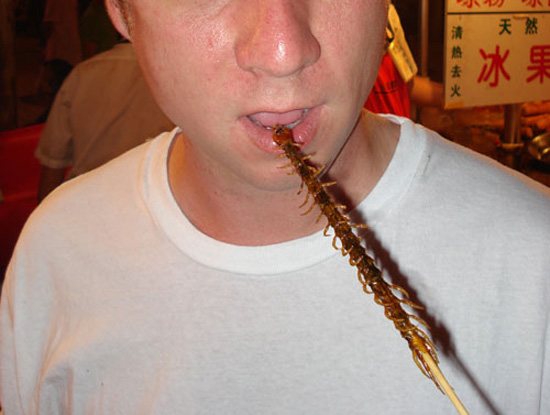
Before cooking or eating a bug, be sure to remove the hard wings on the back and “lightly squeeze the head between your thumb and index finger to push out the intestines” (tip).
Useful? Bugs are believed to be antidiuretic (i.e. limits the formation of urine) that can cure kids of bed-wetting and the elderly from making too many trips to the toilet.


 .
.

 Posts
All Comments
Posts
All Comments

