By Steve Elliott
Monday, Jul. 20 2009 @ 3:59PM
 |
| Photo: chron.ron |
| The color of money |
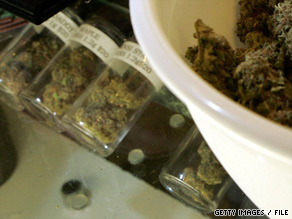
Mail-in voting closes Tuesday on Measure F, a new ordinance in Oakland which would impose a special tax on sales of medical marijuana in the city's dispensaries. The measure would make Oakland the first city in the United States to have a business tax category for marijuana merchants.
Dispensaries have already been paying a rate of $1.20 per $1,000 of gross receipts. Measure F would create a separate category for marijuana sellers, at a rate of $18 per $1,000 of sales. Sales taxes is already assessed on purchases.
Many activists see the proposed ordinance as an incremental step toward complete legalization. After all, once government bean counters associate the marijuana business with a positive revenue stream, they're likely going to think in much more favorable terms about the herb -- and be a lot less inclined to crack down on dispensaries.
The ordinance would create a new business tax category in Oakland for legal marijuana merchants (of which Oakland currently has only four), and would likely bring the cash-strapped city hundreds of thousands of dollars a year in additional revenue. Oakland City Auditor Courtney Ruby estimates initial revenues from the proposed ordinance at $294,000 annually.
Councilwoman Rebecca Kaplan said she believes the actual take could be closer to $1 million. The city's four dispensaries report that they took in $19.7 million in the last fiscal year.
"I don't think it's a turning point... but it starts the ball rolling," Oakland City Attorney John Russo told the
San Francisco Chronicle. "As cities start taxing pot and making money, other government entities are going to start asking: 'Why aren't we getting in on this revenue stream?'"
Local marijuana dispensaries (along with community groups and even local police) almost unanimously support the new tax, seeing it as a way to further legitimize their businesses. And it's not hard to understand their desire to be seen as legitimate, in a city that not so long ago was on the front lines of the war between federal and state marijuana laws. In 2001, the U.S. Supreme Court upheld the DEA's shutdown of an Oakland dispensary, finding no "medical necessity" exemptions in federal pot laws.
The issue of marijuana as an law enforcement concern for the Oakland Police Department was clarified by 2004's Measure Z, which instructed city cops to make marijuana laws their lowest priority.
Los Angeles Looking North
It's unlikely that anyone is watching the outcome of Tuesday's vote more closely than members of the Los Angeles City Council. Last week, Councilwoman Janice Hahn called for L.A. to get its share of money from the city's pot dispensaries.
Hahn suggested during last week's city council meeting that a city tax on medical marijuana could provide millions of dollars for Los Angeles, which, like Oakland, is in dire straits financially. Between 400 and 800 pot shops (according to whose estimate you believe) operate in Los Angeles; none are currently taxed. Hahn argues that marijuana should be taxed just like any other commodity.
Pundits believe a pot tax would be a slam-dunk politically, according to the
L.A. Weekly. "Although Californians, particularly Angelenos, have repeatedly shown their tolerance for individual marijuana use, I would bet most of us would view such a tariff as just another sin tax -- the kind voters almost routinely pass on cigarettes and liquor," writes Steven Mikulan.
Sacramento's Watching, Too...
You can believe that if Oakland -- and Los Angeles -- start raking in piles of cash from marijuana dispensaries, state legislators will be taking notes.
As reported in this space, Assemblyman Tom Ammiano (D-San Francisco) earlier this year proposed a measure that would legalize and regulate marijuana sales to adults in California.
Particularly in view of the state's economic woes, the proposal has attracted serious interest, especially since last week's report that indicates a marijuana tax could fatten state coffers by as much as $1.4 billion a year.
Opposing View: Unfairly Taxing Patients?
Occasionally lost in the excitement of the rapidly-changing situation on the ground is the fact that the proposed city taxes on marijuana might be seen as unfairly penalizing the sick and dying, since they'll be assessed solely on medical users of the herb.
"Ammiano's [state-wide] bill specifically exempts medical patients from the tax," medical marijuana patient/activist J. Craig Canada told the SF Weekly. "Oakland and Los Angeles, on the other hand, are proposing taking money the sick and dying spend for medicine and giving it to politicians, to balance the budget."
Canada, of Santa Cruz, says he's been a medical marijuana patient since 1995, when he became a member of the San Francisco Cannabis Buyers Club a year before Proposition 215 legalized medical marijuana statewide. In 2004, he became the first person in San Bernardino County to have felony cultivation of marijuana charges dismissed on medical grounds.
"It's a regressive tax," Canada said. "The people who use the most marijuana and need the highest potency are the sickest, and probably the poorest. Medicine should not be taxed."






 .
.

 Posts
Posts

