Zazzle Shop

Screen printing

Wednesday, November 5, 2008

In Death, Einstein Makes More Money than John Lennon

einsteinWho said going into science wasn’t a lucrative career move? In Forbes’ latest ranking of the highest earning dead celebrities, Albert Einstein beat out the likes of John Lennon, Andy Warhol and Marilyn Monroe to take the fourth spot behind Elvis Presley, Charles Schultz and Heath Ledger. Even though the father of relativity has been dead for 53 years, he remains one of the most recognizable faces in the world. He’s been a consistent appearance on Forbes’ list and raked in $18 million last year.

But where is all this money coming from? And who gets it?

As it turns out, Einstein doesn’t have any living heirs. He bequested all his personal papers, intellectual property rights and the right to use his image to the Hebrew University of Jerusalem. The university hires the company Greenlight to manage these rights and dole out permission for Einstein paraphernalia. (Greenlight also manages the rights to Steve McQueen and the Wright brothers.)

Greenlight says they receive 400 applications a year to use Einstein’s image, but they only approve about 40 of them. According to Martin Cribbs, director and brand strategy manager of Greenlight, to receive approval a company needs to prove that they are serious about the product, provide three years of sales predictions, and demonstrate a commitment to green issues. Cribbs says they reject proposals for cigarettes, sex toys, and anything of a scatological nature, like toilet paper.

Among products that have made the cut are Einstein calendars, mugs, jigsaw puzzles, action figures and a Japanese brand of coffee made by Nestle. The biggest source of revenue to the Einstein estate, however, comes from parents hoping to raise their very own geniuses. Disney’s line of Baby Einstein products, including educational DVD’s, books, and toys for babies, brings in millions every year. Most recently, Einstein has also been seen hawking Kobe Bryant’s new Nike ZKIII sneakers as part of its Genius campaign.

Earlier this year, Hebrew University asked an Israeli telephone company to retract its advertisements for its new Google-enabled mobile phones because they used the slogan “Everyone’s become an Einstein.” The company was told that it would cost NIS 400,000 (more than $100,000) to use the frizzy haired scientist-celeb for their ad campaign. Take that, Elvis.

18 Crazy Ways to Hang your Hat or Coat

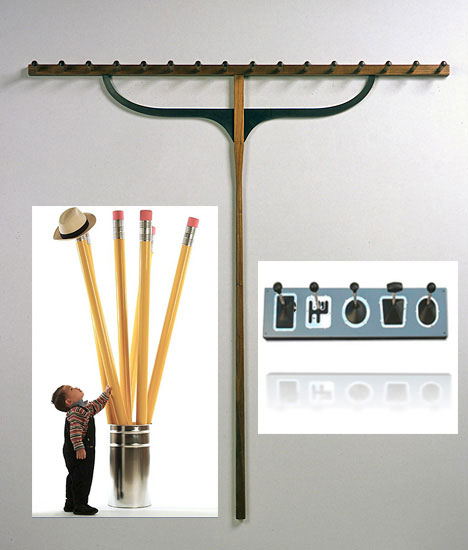
Crazy Coat Hooks and Racks

Wherever you hang your hat (or coat), that’s your home. No modern dream home is complete without a dazzling, eye-catching coat rack - and there is plenty of options to choose from. Here are 18 coat racks that are unafraid to hang up traditional designs and do something a little more creative and unexpected.

Knife Hooks + Dart Hooks

Images: tc studio and elsewheres.

It is not hard to see how the designers came up with the idea for these metal wall-mounted coat rack hooks. If you want your hallway to look like the aftermath of a Godfather-style disagreement, these Knife Hooks (which are screwed into the wall rather than stuck in) will be ideal. And for a slightly less intimidating take on the same theme, you could try these wall-mounted Dart Hooks, held firmly in place by their screw-head tips.

Die Electric & Shed Hooks

Images: Die Electric and Bouf.

Here is a hook with a message - namely, “Turn The Lights Off When You’re Done”. Keen to wean the modern world off its electricity supply, designer Scott Amron has created a range of fun way to encourage people to reach for the Off switch, including this fully-working Light Switch Hook. Similarly multi-purpose, the Shed Hook is designed to hold your keys, bags, mail and gloves as well as your coat.

Symbol Hooks

Image: Desu Design.

When not in use, the Symbol Coat Rack lines your wall like a colorful LED-dotted appliance, encouraging you to concoct some appalling fable about having computerised your whole house when visitors call by. If they want to hang their coat, your lie is found out: each of the colored strips cunningly slides out into a hook. Also available in monochrome aluminium, if metal is your thing.

Ivy & Hakeln Hooks

Images: Cooper Hewitt Museum and Design3000.

Maybe you feel coat racks are too regimented and get in the way of your creative urges. In which case, why not try building one? The Ivy and Häkeln racks come in modular form, and it is up to you to decide how and where they spread out over your hallway. Wind them around your existing furniture, paint pictures, spell out rude words - it is completely up to you.

Lasso Coat Rack

Image: Stolenwood.

Half Wild West and half Indian Rope Trick, the Catching The Wild coat rack is a startling sight. It’s constructed from steel and polyester rope formed into a remarkably convincing lasso. If you feel like all your coats are starting to get away from you, this is just the thing.

DismemberedBabyHooks

Image: Etsy.

But however startling a floating rope is, it is nothing compared to this. The gruesomely-named Dismembered Baby Doll Coat Rack doesn’t seem content to wait for your coat - it is reaching out to snatch it from your grasp. This is not a piece of furniture to accidentally put your hands on when the lights are off, unless you are of a highly serene disposition.

Gear Stick + Late Autumn + Pencil Coat Racks

Images: Artful Home and BanalExtra and TFTS.

It seems there’s a coat rack for every profession. For the gardener, the Late Autumn rack provides a reassuringly familiar sight (with no danger of accidentally stepping on the wrong end). Writers are bound to take note of this Oversized Pencils rack. And for those with a penchent for driving cars or spreading their inner workings out over the garage floor, the Gear Stick Coat Rack should elicit a grin of approval.

Range Coat Rack

Image: Vitamin D(esign).

At first glance, it looks like someone has taken an axe to this coat rack - but look closer. Beautifully carved from maple, the Coat Range is in fact a line of mountain peaks, the natural grain of the wood adding a subtle sense of perspective. Crafted from excess cut sheets of week, these Grand Teton inspired pieces of furniture provide a scenic view to hang your hat on.

Entwined Root + Twist Coat Rack

Images: VivaTerra and Design Within Reach.

The best designers know the value of imitating nature. With the Entwined Root Coat Stand, the intention is not to stray too far from the original material, leaving it up to the coat-owner to work out where the hooks are. The Twist coatrack is a much more regular and predictable double-helix arrangement, yet still highly evocative of intertwined branches (the prongs themselves are of beech, while the binding is steel and plastic).

Image: Unless.

Yet half the fun is finding wholly new designs - and it’s unlikely Nature will be coming up with something like the HangUp rack anytime soon. Fashioned from sustainably grown hoop pine plywood, this rack comes complete with recesses for hats, gloves or shoes - and a hint of traditional Japanese architecture.

Buss + Toda Coat Racks

Images: Garsnas and Notch Design.

And finally, two racks that are unashamedly modern. Notch Design’s Toda has a series of sinuous fold-out pegs complete with a central hole to thread your scarf through. And the gloriously minimalist Buss 4562 is a tiny-footprint (or the wall equivalent) coat rack in stained or lacquered birch studded with stainless steel hooks and knobs. You may want to label it for the benefit of guests!

Coating helps solar panels soak up more of the sun


A row of patented two axes solar tracking system at the Montesquieu solar plant in Martillac, southwestern France, in this October 2, 2008 file photo.

REUTERS/Regis Duvignau


By Julie Steenhuysen

CHICAGO (Reuters) - A new type of reflective coating can make solar panels far more efficient, soaking up nearly all available sunlight from nearly any angle, U.S. researchers said on Monday.

Current solar panels -- which convert energy from the sun into electricity -- absorb only about two-thirds of available sunlight.

But surfaces treated with a coating developed at Rensselaer Polytechnic Institute in Troy, New York, can harvest 96.2 percent of sunlight.

"That is a tremendous savings," Rensselaer's Shawn-Yu Lin, whose study appears in the journal Optics Letters, said in a telephone interview.

Lin said the technology addresses two main problems in current solar cells. It captures more colors of solar spectrum and it captures light from all angles.

"If you look at a solar panel, it looks a bit bluish," Lin said. That is "telling you not all of the blue color is being absorbed. It should look totally dark."

The other problem is that solar panels work best when sun shines directly on them. To solve this, large solar arrays mechanically shift position throughout the day -- much like sunbathers on a beach.

Lin and colleagues think they have found a better solution.

Their coating is made up of seven layers of porous material stacked in such a way that each enhances the antireflective properties of the layer below.

Together they act as a buffer zone, trapping light from all angles. "Your efficiency increases by 30 percent," Lin said.

He thinks the material could be applied to all types of solar cells.

"It's not going to require many added instruments too adopted this technology," he said.

(Reporting by Julie Steenhuysen, Editing by Anthony Boadle)

19 Year-Old Teen With World's Longest 'Super' Name


GLASTONBURY, England, Nov. 3 (UPI) -- A British 19-year-old has officially changed his name to "Captain Fantastic Faster Than Superman Spiderman Batman Wolverine Hulk And The Flash Combined."

The Glastonbury, England, teenager -- originally named George Garratt -- said his new name, which is thought to be the world's longest, has so outraged his grandmother that she is no longer speaking to him, The Telegraph reported Monday.

The teen said he used an online service to officially change his name for a $20 fee.

"I wanted to be unique," Captain Fantastic said of his name choice. "I decided upon a theme of superheroes."

Car Runs Mostly on Air

Quantcast

By Robert Roy Britt, LiveScience Managing Editor


Developer Zero Pollution Motors is working on a compressed air vehicle (CAV) that could run "all day on nothing but air and a splash of salad oil, alcohol or possibly a pint of gasoline." Cost: $20,000. Timing: 2011.

When using regular gasoline, the flexible-fuel-format (and tiny) car would average 106 mpg, more than double the industry-leading Toyota Prius. As auto sales dip, aiming for higher mpg is likely a smart business strategy. After all, it's what sells: "The Prius, the Yaris, the Matrix, and even our Scion brands. Anything that's going to give them the most miles for their buck," is what Missouri Toyota dealership sales manager Brian Cowles says of what's hot.

As far back as 2005, however, experimental vehicles were getting up to 250 mpg. Getting these sorts of vehicles into production requires serious industry and political willpower, not just hot air. Meantime, there are a slew of hybrid SUVs and trucks that get around 21 mpg ... progress?

[How Hybrids Work]

Massachusetts Bid to ban dog racing succeeds on 2nd try

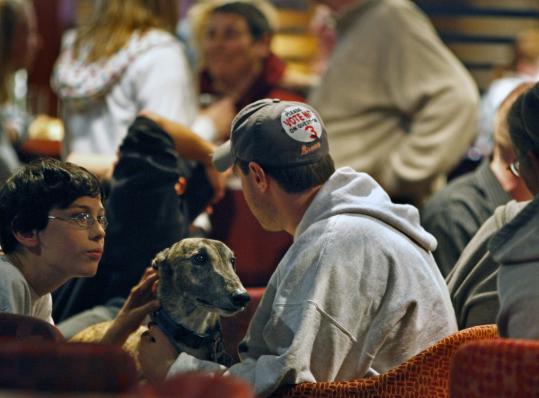
Jim Davis/Globe StaffAdam Johndrow (left) and Anthony Cutillo, track employees, petted Zane, Cutillo's pet, at Raynham-Taunton Greyhound Park.
Adam Johndrow (left) and Anthony Cutillo, track employees, petted Zane, Cutillo's pet, at Raynham-Taunton Greyhound Park. (Jim Davis/Globe Staff)

By Stephanie Ebbert Globe Staff / November 5, 2008

The contentious ballot question passed amid emotional ad campaigns by both sides. Proponents used images of sad-eyed greyhounds that they say are caged inhumanely and raced to injury, while opponents put the spotlight on the employees who would be out of work if the ballot passed. A similar ballot question was narrowly defeated in 2000.

The ban, which takes effect in 2010, passed by a vote of about 56 percent to 44 percent, with more than two-thirds of the precincts reporting.

"We did it. We did it for the dogs," a victorious Carey Thiel, executive director of Grey2K SA, said at a postelection party of some 60 supporters at Jillian's Billiards Club.

"For 75 years, greyhounds in our state have endured terrible confinement and suffered serious injuries," Thiel added. "We're better than that."

After the speeches, campaign supporters Jeff and Sandy Bigelow of Boylston embraced for a full minute, gripping the backs of one another's blue T-shirts that read, "Support the Greyhound Protection Act."

"It means everything. We've worked so hard for the dogs and they heard us," Sandy Bigelow, 40, said with tears streaming down her face. "It feels so good. Oh, God, it feels so good."

It was a far different mood at Raynham-Taunton Greyhound Park in Raynham, where track employees gathered to watch the results. George Carney, owner of the track, said voters had been misled by "bad information" from the proponents.

"It's not a very pleasant thing right now. Some of these people have been here 40 years," Carney said. "Here's a company that did nothing wrong, paid their federal taxes on time, paid the town on time. The town is going to be a severe loser, and a lot of people here dedicated their life to the company."

The Massachusetts Animal Interest Coalition - funded by the Raynham track - had argued that the ballot question would put the needs of dogs before the needs of people - among them, some 1,000 employees of the state's two dog tracks who would lose their jobs.

It said the dogs are treated well, that the injuries reported include minor ones, and that the dog tracks are following the regulations passed by the State Racing Commission after the last ballot question failed.

Those arguments resonated with many voters. Raynham defeated the question 79 percent to 21 percent, Fall River defeated the ballot question 56 percent to 44 percent, and the vote was divided almost precisely in Dedham, Dracut, and Danvers.

"I think that it's trying to regulate an industry that's already highly regulated," said Maria P. Marotta, 32, a Suffolk law student from Jamaica Plain who voted against the ban. "It's a deeper issue."

But the argument was not enough to stem the tide in other communities. Newton and Boxborough voted 2 to 1 for the ballot question, Concord 70 percent to 30 percent, and Dover 65 percent to 35 percent.

The Committee to Protect Dogs used data kept by the State Racing Commission since mid-2002 showing injuries to more than 800 greyhounds. Formed by Grey2K USA, the Humane Society of the United States, and the Massachusetts Society for the Prevention of Cruelty to Animals-Angell Medical Center, the committee spent nearly $500,000 through Oct. 15, campaign finance reports show, and received about $144,000 in in-kind contributions.

"This is a victory for everyone in Massachusetts who cares about dogs," said Christine Dorchak, cochairwoman of the Committee to Protect Dogs.

Stephanie Ebbert can be reached at ebbert@globe.com. Globe correspondents Matt Negrin and John M. Guilfoil contributed to this report.

Massachusetts Voters approve marijuana law change


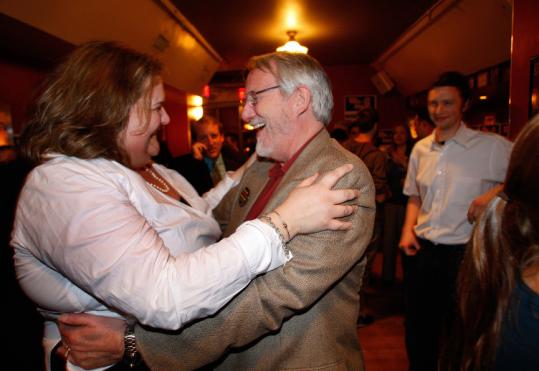
Whitney Taylor, Committee for Sensible Marijuana Policy chairwoman, and Jack A. Cole celebrated Question 2 passing.
Whitney Taylor, Committee for Sensible Marijuana Policy chairwoman, and Jack A. Cole celebrated Question 2 passing. (BARRY CHIN/GLOBE STAFF)


By David Abel Globe Staff / November 5, 2008

Voters yesterday overwhelmingly approved a ballot initiative to decriminalize possession of small amounts of marijuana, making getting caught with less than an ounce of pot punishable by a civil fine of $100. The change in the law means someone found carrying dozens of joints will no longer be reported to the state's criminal history board.


One ounce of Marijuana

With about 90 percent of the state's precincts reporting last night, voters favored the Question 2 proposition 65 percent to 35 percent.

"The people were ahead of the politicians on this issue; they recognize and want a more sensible approach to our marijuana policy," said Whitney Taylor, chairwoman of the Committee for Sensible Marijuana Policy, which campaigned for the ballot initiative. "They want to focus our limited law enforcement resources on serious and violent crimes. They recognize under the new law that the punishment will fit the offense."

The proposition will become law 30 days after it is reported to the Governor's Council, which usually meets in late November or early December. But the Legislature could amend or repeal the new law, as they have done with prior initiatives passed by the voters, said Emily LaGrassa, a spokeswoman for Attorney General Martha Coakley.

Opponents of the proposition said they are concerned about the potential consequences of the vote. "The administration is clear in its opposition to the decriminalization of marijuana, and we are concerned about the effects of ballot Question 2's passage," Kevin Burke, secretary of the state's Executive Office of Public Safety and Security, said in a statement.

He would not comment on whether the administration will try to repeal the law, which will require violators younger than 18 to complete a drug awareness program and community service. The fine would increase to as much as $1,000 for those who fail to complete the program.

Proponents of the initiative, who spent about $1 million promoting it, argued the change in the law would maintain the state's existing penalties for growing, trafficking, or driving under the influence of marijuana, while ensuring that those caught with less than an ounce of pot would avoid the taint of a criminal record.

The opponents, who include the governor, attorney general, and district attorneys around the state, argued that decriminalizing marijuana possession would promote drug use and benefit drug dealers at a time when they say marijuana has become more potent. They warned it would increase violence on the streets and safety hazards in the workplace, and cause the number of car crashes to rise as more youths drive under the influence.

In a statement, the Coalition for Safe Streets, which opposed the initiative, blamed the loss on being outspent by supporters of Question 2, which included the billionaire financier George Soros, who spent more than $400,000 in favor of decriminalizing marijuana.

"Now these pro-drug special interests will move on to another state as part of their plan to inflict a radical drug-legalization agenda on as many communities as possible," said the statement.

The Rev. Bruce Wall, pastor of Global Ministries Christian Church in Dorchester, was among several prominent black ministers in Boston who called on fellow clergy to oppose the initiative.

"I guess there are a lot of people smoking the stuff, and they don't see what we see," Wall said.

The initiative's success last night sparked loud cheers from supporters gathered at the Silvertone Bar & Grill in downtown.

"I think this points to how our Legislature is unwilling to represent their constituents on these issues," said Bill Downing, president of the Massachusetts Cannabis Reform Coalition.

Globe correspondent Matt Negrin contributed to this report.

Voters reject income tax repeal


On ballot questions, voters answer (Boston Globe) From income taxes to dog racing, issues spark a mix of reactions at the polls. Video by Wendy Maeda; produced by Leanne Burden Seidel/Globe Staff

By Eric Moskowitz Globe Staff / November 5, 2008

By a better than 2-to-1 margin, Massachusetts voters yesterday rejected an effort to repeal the state's income tax, following an aggressive campaign by unions and other opponents who warned that eliminating the tax would gut state government.


Although they were in no mood for change on taxes, voters yesterday did upend the status quo on two other issues. They chose by a wide margin to decriminalize small amounts of marijuana, and they also ended the state's seven-decade tradition of greyhound racing.

Six years ago, a similar tax-repeal question attracted little attention and no organized opposition but nearly passed. Stunned tax supporters took no chances this time, spending millions on an aggressive campaign warning that repealing the income tax would trigger drastic cuts to government programs, damage the economy, and prompt increases to other taxes and fees.

"We said the proposal was reckless, and we think voters saw it just as that," said Peter Meade, chairman of the Coalition for Our Communities, which led the opposition.

About 69 percent of voters opposed the repeal, with 80 percent of precincts reporting. In 2002, the repeal prevailed in about 100 communities. As of press time early this morning, it had not carried a single city or town.

The Coalition for Our Communities outspent the supporters of Question 1 by a 10-to-1 ratio through mid-October, a gap expected to widen on finance reports that will be filed after the election. That enabled the question’s opponents to pay for a flurry of television ads and a sophisticated effort to identify likely supporters and undecided voters.

Among other tactics, they sent full-color, personalized mailers that incorporated a voter’s name and community into the imagery and warned of specific local cuts.

Carla Howell, the former Libertarian gubernatorial candidate who led the effort to repeal the tax, blamed the defeat on the fund-raising gap.

"We knew that this was a David-versus-Goliath battle," said Howell, chairwoman of the Committee for Small Government, speaking to a crowd of about 20 supporters at Ken’s Steak House in Framingham last night. "All we needed was a bigger stone."

In an interview afterward, Howell also likened her limited-government bid to the Boston Tea Party, casting the campaign "in the long tradition of little guys trying to do what's right for working men and women."

But there was more than a monetary gap at play. The Coalition for Our Communities drew on a door-to-door network of activists worried about cuts to schools, health centers, public safety, and other programs. In Dorchester and Mattapan alone, more than 100 volunteers from several nonprofits offered rides to the polls yesterday and handed out thousands of palm cards with a thumbs-down icon and the words, "Times are hard enough. Let's not make them worse."

"We know how important Question 1 is to many services that are important to working families across the state," said Cortina Vann, a community organizer with the Dorchester-based Massachusetts Affordable Housing Alliance, where a classroom normally used for a low- and moderate-income home-buyer course had been converted into a war room, the walls covered with charts detailing precinct locations and volunteer schedules.

On the other side, the Committee for Small Government, invested a chunk of its limited resources, which totaled $431,000 through mid-October, early in the campaign, on the signature drive to get the question on the ballot.

After that, Question 1 advocates hoped that frustration with government waste as well as fatigue from strained family budgets would lead many of the state's 3.4 million workers to strike a blow against the 5.3 percent income tax.

"We’re getting taxed to death in Massachusetts," said Bernie Friesecke, a North Reading voter who contributed $85 to the Committee for Small Government.

"You get these television ads that tell you we're going to lose this, that, and the other thing," said Friesecke, a 78-year-old retired aeronautical engineer. "No one’s ever telling you that we've got corruption and spending on stuff we don’t need, in huge quantities."

The question called for cutting the income tax to 2.65 percent on or after Jan. 1 and for eliminating it entirely a year later. That would have returned an average of about $3,700 per worker but stripped the state of roughly $12.5 billion a year, or about 40 percent of funding for the current budget.

Opponents warned that the question would also harm the state’s credit rating and destabilize its economy, in addition to forcing cuts to the myriad services that rely on the tax. The coalition received heavy funding from public labor unions but also attracted outspoken allies in the state's leading business groups and from a wide range of government officials.

Some of those who voted for the question thought it had no chance of taking effect. Andrew Gray, a microbiology graduate student from Somerville, said he knew some supporters who just wanted to tweak government and send a message, thinking it would either lose or be immediately repealed by lawmakers if it passed.

"I don't want to play that sort of gambling game," said Gray, 29, who voted no.

Still, the question won some repeat supporters, such as George Bloom, a 47-year-old engineer from Lynnfield, a town that had widely supported the tax repeal in 2002.

"I agree with virtually nothing the Legislature does. I think they're the biggest bunch of hacks in the world," said Bloom, citing what he considered mismanagement of funds, outsized public-employee pensions, inefficient road projects, and an inhospitable business climate, among other things. "Tell me if I should stop. ... I'm just basically a disgruntled and beaten down voter."

But others in Lynnfield yesterday echoed the message of the Coalition for Our Communities.

"I just think it's kind of reckless," said Christine Noonan, 55, who works as a planner for GE. "And I really don't want to see my property taxes go up."

Globe correspondents John S. Forrester and Jillian Jorgensen contributed to this report.

McCain concedes, acknowledges historic achievement

By BETH FOUHY, Associated Press Writer Beth Fouhy, Associated Press Writer

McCain concedes, congratulates Obama Play Video AP – McCain concedes, congratulates Obama
Sen. John McCain Slideshow: Sen. John McCain

Sen. John McCain, R-Ariz., gestures as he addresses a rally with supporters on
AP – Sen. John McCain, R-Ariz., gestures as he addresses a rally with supporters on election night in Phoenix, …


PHOENIX – With a gracious nod to Barack Obama, John McCain acknowledged defeat and urged his supporters to move beyond partisan differences to put country first — an echo of his campaign theme.

"I wish godspeed to the man who was my former opponent and will be my president," McCain said as he conceded the presidency he has sought for a decade.

The four-term Arizona senator added: "These are difficult times for our country. And I pledge to him tonight to do all in my power to help him lead us through the many challenges we face."

Flanked by his wife Cindy and his running mate Sarah Palin, McCain stepped before supporters at the Biltmore Hotel on a balmy Tuesday evening shortly after telephoning Obama to offer his congratulations and concede the race. He implored his backers to fall in line behind Obama and put aside partisan bickering. And, he pushed back on a smattering of boos and shouts of "No-Bama! and "Reverend Wright," a reference to Obama's incendiary former pastor.

"Whatever our differences, we are fellow Americans," McCain said. "No association has ever meant more to me than that."

After an intensely negative campaign, McCain went to lengths to take the high road in his concession speech and acknowledged the historic nature of Obama's barrier-breaking accomplishment.

"His success alone commands my respect for his ability and perseverance," McCain said, adding that he "deeply admired" Obama for inspiring the hopes of people "who had once wrongly believed that they had little at stake or little influence" in electing a president.

"This is an historic election, and I recognize the special significance it has for African-Americans and for the special pride that must be theirs tonight," McCain said, adding that the U.S. had moved "a world away" from its racist past by electing the nation's first black president.

He allowed that disappointment was natural but said that starting Wednesday "we must move beyond it and work together to get our country moving again."

"We fought as hard as we could. And though we feel short, the failure is mine, not yours," McCain said.

Also, he praised Palin as "one of the best campaigners I have ever seen, and an impressive new voice in our party for reform."

By McCain's own admission, it was a disappointing end to a quest he began sketching 10 years ago before his first run for president in 2000. He was vanquished that time by George W. Bush in the Republican primaries, but won the affection and respect of many voters who admired his independent streak and dedication to honor and service as a former Naval officer and prisoner of war in Vietnam.

McCain entered this campaign as the perceived GOP front-runner but saw his effort nearly implode in July 2007 amid staff tension and vast overspending. He was able to rebuild his candidacy by grinding out key wins in the New Hampshire, South Carolina and Florida primaries.

He faced long odds from the start of the general election, running as the GOP successor to President Bush who had become deeply unpopular amid a troubled economy and two wars. But then McCain put the little-known Alaska governor on the GOP ticket and polling shortly after the Republican convention found McCain pulling slightly ahead of Obama.

Then the global financial crisis hit, and McCain's hopes were dashed. Voters usually punish the party in power when the economy tanks, and this year was no different.

In the campaign's final days, the GOP nominee maintained a grueling campaign schedule while being well aware of the odds against him. He stumped across Colorado and New Mexico after a 24-hour cross country journey across battleground states that ended after midnight Tuesday.

But McCain also acknowledged he'd made mistakes in his campaign and that he had let his supporters down.

"I don't know what more we could have done to try to win this election. I'll leave that to others to determine," he said.

Guitar Hero has never looked so good.

The Evolution of Al Pacino’s Yelling and Speaking Voice

from http://unrealitymag.com

Published by Nattyb

Pacino

I think we can all agree that Al Pacino has a reputation for being a yeller on film. But when did this reputation become so in tact? At what point were all the comedians imitating his on screen outbursts? When can we conclusively say that if you’re a director and you want to hire a guy who screams a lot that you call Al Pacino? In fact there’s even an article that teaches you how to yell like Pacino!

Granted Pacino yelled in his early days, I don’t think he really developed his signature “almost to be made fun of” yelling style until Scent of a Woman. However I think that Sea of Love and Glengarry Glen Ross really began this train of “automatic” outbursts on film. But then something really weird started happening to his “s” pronunciation as he got much older. And now he just sounds strange. It’s like he’s impersonating himself.

The proof is in Two for the Money and Ocean’s Thirteen and it’s very disturbing. There’s also hints of it in The Insider (where I think the “s” stuff originated). In any event, here is a compilation of videos that display how Pacino’s voice has developed over the years. It’s truly remarkable.

Al Pacino’s Trials for Godfather

A young, soft sounding Pacino. We sure as hell don’t notice that yelling nature this early in his career. Just a calm natured guy. No yelling. Boo.

Serpico

It’s high pitched but it just isn’t quite “hoo hah” now is it?

Godfather 2 Slap Scene

Here’s the crazy yelling baby! It might be just one line but man that’s a taste of the future right there.

Scarface

Pick a scene, any scene. Still though, the voice is kind of high. And here’s where we take the turn…

Sea of Love

1989 baby. This is when Pacino started to get a little older and that voice became even more dominant. And wait until we get to Scent of a Woman but not before….

Glengarry Glen Ross

Great outburst here.

Scent of a Woman

This is a weird version with sound effects but damnet if Pacino isn’t 100% Pacino right here.

Heat


This one’s just funny. Great ass!

The Devil’s Advocate

Pacino is just full blown yelling machine at this point in his career.

The Insider

His “s” is starting to change. The age is starting to show.

Any Give Sunday - Peace by Inches

One of the better sports movie speeches. But still, listen to that “s.” Even his “p’s” have something strange to them as compared to his early days.

Two for the Money

It’s almost as if he was Al Pacino impersonation Al Pacino at this point. This is pretty much embarrassing.

Ocean’s Thirteen

Come on Al! Just yell dude.

* I refuse to show anything from Righteous Kill


from http://unrealitymag.com

Philadelphia Phillies Sign Former Batboy as GM

PHILADELPHIA (AP)—With the enviable task of repeating as World Series champions ahead of them, the Phillies turned to a former bat boy to take over as their general manager.

Ruben Amaro Jr. signed a three-year contract Monday to become general manager of the Phillies a quarter-century after he was handing lumber to Hall of Famers Mike Schmidt and Steve Carlton as a starry-eyed teenager.

Amaro just completed his 10th season as assistant Phillies GM and replaces the retiring Pat Gillick, who will remain with the team as an adviser. The team announced the move five days after beating the Tampa Bay Rays its second title in franchise history.

“Pat, you’ve made it a little tough for me, a tough act to follow,” Amaro told Gillick at a news conference.

The 43-year-old Amaro, whose father Ruben Amaro Sr. was a Phillies shortstop from 1960-65 and first base coach for the club, recalled being around Schmidt, reliever Tug Mcgraw and shortstop Larry Bowa as a bat boy from 1980-83—in 1980 the Phillies won the only other championship in their 126-year history.

He later spent parts of eight seasons as a major league player, including a stint with the 1993 Phillies team that lost to Toronto in the World Series.

Amaro worked under former GM Ed Wade for seven seasons and the last three with Gillick. He was considered the front-runner for the job after Gillick said this would be his last season—despite pleas from ownership to get him to stay.

“Our goals will remain the same and that’s to bring championships here to Philadelphia,” Amaro said. “The biggest challenge is to repeat. That’s the biggest challenge in baseball.”

Amaro got the nod over Mike Arbuckle, another assistant GM who spent the last 15 years with the Phillies. Arbuckle, who led the team’s scouting efforts, will not be returning next year, team president Dave Montgomery said.

Arbuckle oversaw a farm system that produced much of the Phillies current core, including shortstop Jimmy Rollins, second baseman Chase Utley, first baseman Ryan Howard and pitcher Cole Hamels, the World Series MVP.

Montgomery said he had a “difficult” conversation with Arbuckle on Saturday, telling him that Amaro would be getting the job. Arbuckle said he wanted to be a general manager and would be pursuing other opportunities.

Under Gillick, the Phillies won two division titles before advancing to the World Series this year. The 71-year-old has a long track record as GM of Toronto (1978-94), Baltimore (1996-98), Seattle (2000-03) and Philadelphia. He won two titles with Toronto, including the 1993 win over the Phillies.

In Philadelphia, he traded for closer Brad Lidge last offseason and made a late move for Oakland starter Joe Blanton. Lidge was perfect in save situations in both the regular and postseason, while Blanton went 2-0 in three postseason starts.

But not all of Gillick’s trades worked so well, notably the acquisition of the very expensive pitcher Freddy Garcia, who won just one game before being shut down with a shoulder injury.

Amaro has many decisions to make as he gets ready to head to this week’s general managers’ meetings in Dana Point, Calif.

He will have to decide whether to bring back left fielder Pat Burrell and soon-to-be 46-year-old pitcher Jamie Moyer. He will also have to consider possible long-term contracts for Hamels and MVP candidate Ryan Howard.

Burrell, who hit .250 with 33 homers and 86 RBIs in the regular season, wants to return. So does Moyer, who had a team-best 16 wins.

The 32-year-old Burrell made $14 million this season, and will likely get a more lucrative free-agent offer from another team.

Amaro, a Stanford University graduate whose father wanted him to be a doctor or a soccer player, said he was still trying to soak it all in.

“It’s a little surreal,” he said. “For the life of me, I would have never thought I would have been in this position.”

Comcastic P4P trial shows 80% speed boost for P2P downloads

By Nate Anderson |

Comcast engineers have just released the first-ever real-world data on P4P technology—and it appears to be a massive success. While only a trial, the results do show that P4P's iTracker technology can increase P2P download speeds by 80 percent on ISP networks without materially increasing the network load.

P4P, which is being designed under the aegis of the Distributed Computing Industry Association, is meant to "localize" peer-to-peer transfers. P2P users generally grab data from all around the world, putting tremendous cost and bandwidth pressure on ISP peering and transit links with other networks. P4P uses an iTracker server to keep those transfers within an ISP's own network when possible, with the goal of boosting speeds for users and lowering peering-point loads for ISPs.

(Note that P4P has little to do with network neutrality, though companies sometimes suggest that it does. While it can decrease the financial hit ISPs take from sending traffic over transit links, P4P isn't designed to lower the total bandwidth on an ISP's network. In fact, by directing P2P users to "local" network sources, it might actually be expected to increase an ISP's local network traffic. More on that below.)

Comcast engineers have just filed the results of the first major P4P trial as an "Internet draft" with the IETF. The trial involved Pando, Yale, three (unnamed) ISPs, and Comcast, and it took place over the summer. It used a special, Pando-provided P2P client that is set up to check in with "iTracker" servers when searching for download locations in a BitTorrent swarm. The test used a 21MB video file (which was "licensed," in case you were worried), and measured the results of using the P2P client in order to see how the use of iTrackers affected uploads and downloads.


Data source: Comcast

Results were hugely positive. Compared to a random swarm, the use of any iTracker provided substantial speed boosts to Comcast network users, ranging from 57 to 85 percent above default behavior. For consumers, this would obviously be welcome news, but how does it affect Comcast?

Not too much, it turns out. "We did notice that download activity in our access network increased somewhat, from 56,030MB for Random to 59,765MB for P4P Generic Weight and 60,781MB for P4P Coarse Grained," wrote the Comcast engineers. That's a small increase, especially given that it reduced Comcast's "incoming Internet traffic by an average of 80 percent at peering points."

But uploads proved even more surprising. "It did not appear that P4P significantly increased upstream utilization in our access network," note the engineers. "In essence, uploading was already occurring no matter what and P4P in and of itself did not appear to materially increase uploading for this specific, licensed content."

Further good news came from a close examination of the various iTrackers. The fine-grained tracker provided detailed topology information about Comcast's network, and it took significant time to set up. "It was a detailed mapping of Comcast backbone-connected network Autonomous System Numbers (ASN) to IP Aggregates which were weighted based on priority and distance from each other," says the report. "Included in this design was a prioritization of all Peer and Internet transit connected ASNs to our backbone to ensure that P4P traffic would prefer settlement free and lower cost networks first, and then more expensive transit links."

Sounds like a lot of work. But Comcast found that it wasn't even necessary; simpler iTrackers provided even better results. The best results came from the coarse-grained iTracker, which featured 22 iTracker node identifiers and "resulted in a 1,461 line configuration file."

iTrackers can run on lightweight servers; for good results, every ISP should run one. While every network that deploys an iTracker will see good results, the system gets "dramatically" more impressive as more ISPs deploy it.

Comcast wants the iTracker mechanism made an IETF standard; more impressively, it recognizes that iTrackers should be "opt-in" mechanisms that each user can control. "The use of ISP-provided iTrackers should probably be an opt-in feature for P2P users, or at least a feature of which they are explicitly aware of and which has been enabled by default in a particular P2P client," say the engineers. "In this way, P2P users could choose to opt-in either explicitly or by their choice of P2P client in order to choose to use the iTracker to improve performance, which benefits both the user and the ISP at the same time."

Win/win scenarios haven't been common in the P2P wars, and it's important to note that this was only a preliminary test. But if P4P shows the same promise in larger trials and if P2P clients start to embed the technology into their software, faster downloads and lower-traffic peering points could be had simply by running some inexpensive servers.

First look at Tom Hanks in Da Vinci prequel Angels & Demons

By Lina Ritchie

It is set to break all box office records when it is released next year.

For now, however, we'll have to console ourselves with these exclusive pictures from Angels & Demons, the eagerly anticipated prequel to The Da Vinci Code.

Tom Hanks, who was reportedly paid £25m for the role, returns as Robert Langdon, the world-renowned Harvard symbologist, who this time is on a mission to prevent a terrorist act against the Vatican.

Scroll down to watch the trailer...

Angels and Demons

Angels & Demons: Robert Langdon (Tom Hanks) and Vittoria Vetra (Ayelet Zurer) work together to prevent a terrorist act against the Vatican

In this outing, directed once more by Ron Howard, Hanks is joined by Ewan McGregor, Stellan Skarsgard and newcomer Ayelet Zurer.

Angels & Demons, based on the third novel by Dan Brown, starts with Langdon being summoned to a Swiss research facility (CERN) to analyse a mysterious symbol seared into the chest of a murdered physicist, Leonardo Vetra.

Angels & Demons

Armin Mueller-Stahl and Ewan McGregor play Straus and Carlo Ventresca respectively in the eagerly anticipated prequel to The Da Vinci Code

While there, he discovers the rebirth of an ancient secret brotherhood known as the Illuminati, the most powerful underground organization ever to walk the earth.

Langdon and Vetra's daughter, Vittoria, played by Zurer, embark on a search for the secret brotherhood, as well as a new destructive weapon that could kill millions.

Angels and Demons

Langdon discovers the rebirth of an ancient secret brotherhood known as the Illuminati, the most powerful underground organization ever to walk the earth

The Da Vinci Code upset Catholic leaders throughout the world when it was released in 2006 for suggesting that Jesus was a married father when he died.

However the controversy didn't harm its takings - the film took over $200million at the US box office alone.

While filming Angels & Demons in Italy, Hanks and Howard attracted opposition again and were forbidden from filming in two Roman churches by Rome's diocese.

Enlarge Angels & Demons

While filming Angels & Demons, Hanks and Howard were forbidden from filming in two Roman churches by Rome's diocese

At the time a spokesman for the diocese said: 'It's a film that treats religious issues in a way that contrasts with common religious sentiment.

'We would be helping them create a work that might well be beautiful but that does not conform to our views.

Enlarge Angels & Demons

The film's makers once again met with religious opposition - just as they had done on The Da Vinci Code

Angels & Demons will be released in the UK on May 15, 2009.


Watch the trailer here for Angels & Demons...

Nine of the best candies of all time

Now that Halloween's over, it's time to empty out your goodie bag!Everyone’s got the candy of their generation, their neighborhood, and their tastes. What sugary delights sent young minds to greats heights when you were a kid? Well, let’s share. Here are some highlights from fourth grade:

Sizzles and pops

9. Lotsa Fizz. Also known by its more convenient nickname ‘Fizz’, these candies masqueraded as a regular ol’ hard candy, the kind you might find in a doctor’s office or a crystal dish in your grandma’s front foyer. Other than the snake-like packaging, linking individually-wrapped pieces together, there appeared to be nothing special about them. However, once you crunched into them, they released a tingly, carbonated bubble-liquid that sizzled and frothed on the tongue. A real advancement in the candy surprise effect. Good for a year or so

8. Massive, fist-sized Jawbreakers aka Dinosour Eggs. The big question here was who could fit these in all the way? Occasionally, a local big mouth would manage to squeeze it up in there, and then proceed to nearly suffocate while trying to simultaneously breathe and speed-suck the jawbreaker down to a smaller size with drool flying everywhere. It wasn’t pretty. You were actually watching them OD right in front of you. Of course, others would simply leave the giant jawbreaker on their night table and have a few licks before bedtime, spending a year or so patiently turning the smooth sphere it into a faded, rubbed-out rainbow of dried spit and sugar. Whatever you think about these things, they definitely came out on top of the Total Candy Minutes Per Dollar ranking.

7. Pez. Was it just me, or did Pez have a kind of weird taste? Don’t get me wrong — the dispenser alone was enough for some great memories, despite some questionable versions over the years.

Sour balls

6. Tear Jerkers aka Sour Balls. At the time, Tear Jerkers were a futuristic advancement in Artificial Souring Technology. They caused a massive sugar high epidemic at my grade school, with kids running over to the variety store at lunch to grab a new bag, daring each other to eat two or three at a time. The gum that remained after the sour powder was gone was always a wet, syrupy disappointment, and usually ended up in the trash to make more room in your mouth. But that sour powder packed a punch and it often left the insides of your cheeks all inflammed and torn up for the rest of the week. And of course, there was always the big question: who has the guts to eat the leftover patch of sour powder in the corner of the bag?

Don't break the stick!

5. Fun Dip aka Lik-M-Aid. Fun Dip was an entirely new way to eat your candy: Lick an edible candy stick and then use your own spit as glue to collect all the sugar-powder below. Well, it was a great long-lasting treat, as long as your stick didn’t come broken when you bought it. If that happened, you had to dive in with your wet finger instead. But you had to be careful, because it was that mark of the stained, purple finger that gave away why you weren’t hungry at dinner time. A lot of people would finish off by eating the actual stick itself for good measure which is sort of like eating your fork after finishing your pie.

4. Hot and Cold Nerds. Nerds was always a decent backup selection — it filled up the candy bag but was rarely the first pick. Sure, that little box of tiny, hard, asteroid-shaped candy offered two flavors in one box, but there was nothing too special about picking up Watermelon and Grape or Strawberry and Lemon. That is, until Nerds came out with the temperature-themed Hot and Cold Nerds box in the late 80s. Sure, maybe it was just bright, red cinnamon and bright, blue wintergreen, but it sure was fun alternatingly burning and freezing sensations in your mouth. Of course, there were always two kinds of Nerds kids — the slow, tantric, shake-it-in-your-hands-and-savor-it kids, and the minute men who instead preferred the all-in-one-go, head-tilt, box-shake manouver.

3. Bizarre Forms of Gum. Remember the glory days where gum came in so many different forms? There was baseball card gum, shattering and cutting the inside of your mouth like glass when you bit into it. There was Big League Chew, the shredded chewing tobacco gum. And of course there were Bubble Jugs, Bubble Tape, and even Bubble Gum Squeeze Tubes, which you pushed into your mouth like toothpaste, though with the exact opposite effect.

2. Pixy Stix. I always admired the straight-shooting style of Pixy Stix. Unlike the other candies, they didn’t dress up and pretend to be anything besides sugar. They were the real deal, straight up, just sugar in a straw. You want something gummy, sticky, sour, or chewy? Try the other guys. Now, if you want plain sugar, you’ve come to the right place. Available in regular size and occasionaly a Super Jumbo Straw version. Just be careful you don’t get dry-throat and gag on it when your brother pours a strawful down your throat.

Good luck kicking the habit

1. Popeye Cigarettes. These ones were the real deal, before they took off the red tip at the end and rebranded them as ‘Popeye’s Candy Sticks.’ Yes, after a dark, moody stint with the patch, Popeye managed to finally kick the habit. But good thing, or he probably wouldn’t be with us today.

Yes, finding and chowing down on some of the candies you grew up with is like sucking on sugary memories. Because how did it feel walking out of your local corner store with a wide smile pasted across your face, an empty wallet, and an armful full of candy?

I think we all know the answer to that.

AWESOME!

Gateway drug to shotgunning a beer

The 28 Most Ravishing TV Wives

28. Linda Evans

Linda Evans plays the new wife of Blake Carrington on soap opera from the 80’s, Dynasty. Family Guy spoof Linda Evans career with the following conversation between Stewie and Olivia at an acting school:
Stewie: Well, fine! Refuse my offer. Get booted out of this place (acting school) and wind up like Linda Evans.
(Flash to supermarket scene)
Intercom: Linda Evans, we have a spill in Aisle 9. Linda Evans, spill in Aisle 9.

27. Meredith Baxter
Meredith played the wife of Steve Keaton, Elyse on Who’s The Boss? After Family Ties, Baxter made apperances on Spin City, 7th Heaven,

26. Marcia Strassman
Strassman was the wife of Gabe Kotter on Welcome Back, Kotter. Marcia was one of the main characters on Honey, I Shrunk the Kids and Honey, I Blew Up The Kids.

25. Mary Tyler Moore
Mary played the wife of Rob Petrie on The Dick Van Dyke Show. Moore was on That 70’s Show for 3 episodes and appeared on Oprah earlier this year.

24. Lois Griffin
Lois is the wife of Peter Griffin on Family Guy. Alex Borstein plays her voice. Lois teaches the piano to help sustain the family’s income and raises 3 children throughout the show. Lois and Peter’s youngest child despises his mother to the point where he plots ways to get rid of her mostly throughout Season 1.

23. Joanna Kerns
Joanna plays Maggie Seaver on Growing Pains. Joanna also made apperances in Knocked Up, Girl, Interrupted, and The A-Team. Joanna directed a couple of Scrubs and ER episodes.

22. Elizabeth Montgomery
Elizabeth played the nose-twitching witch wife of Darrin Stephens between the 60’s and 70’s. In the 90’s before her passing, Montgomery appeared on The Dennis Miller Show, The Hollywood Squares, Entertainment Tonight, and many other TV shows.

21. Lucille Ball
Lucille is best known for playing Lucy Ricardo, wife of Ricky on I Love Lucy. There have been countless spin-offs from the original show such as Lucy Calls the President, Life with Lucy, The Lucy Show, Lucy in London, etc.

20. Patricia Richardson
Patricia is best known for playing the Tool Man’s wife on Home Improvement. Richardson also had a recurring role on The West Wing and Strong Medicine.

19. Eva Gabor
Eva played Lisa Douglas, wife of Eddie Albert on Green Acres. Eva is the younger sister of Zsa Zsa Gabor.

18. Edie Falco
In the Sopranos, Edie was the wife of Tony Soprano, Carmela. Edie has a recurring role on 30 Rock as Celeste Cunningham. Edie is one out of four actresses that received a Golden Globe, an Emmy, and an SAG award in the same year.

17. Kelly Rowan
Kelly played the role of Kirsten Cohen, wife of Seth Sandy on The O.C. Kelly also made appearances in Growing Pains, War of the Worlds, Hook, Three to Tango, and C.S.I.

16. Joely Fisher
Joely plays Joy Stark, wife of Eddie Stark on ‘Til Death. Joely is the half-sister of Carrie Fisher (Princess Leia on Star Wars). Joely had appearances on Ellen, Normal, Ohio, and Desparate Housewives. She also played the role of Dr. Brenda Bradford / RoboBrenda in the Inspector Gadget movie.

15. Cheryl Hines
Cheryl plays the wife of Larry David on Curb Your Enthusiasm. Cheryl was Rob Reiner’s personal assistant at one point and studied with Lisa Kudkrow at The Groundlings Theater.

14. Megyn Price
Megyn plays Claudia Finnerty, wife of Sean on Grounded For Life. Prior to this role, she also was a commentator on VH1’s I Love the 80s and I Love the 90s. Megyn also played the role of Audrey on Rules of Engagement.

13. Kellita Smith
Kellita was the wife of Bernie McCullough on The Bernie Mac Show. Kellita also made appearances in House Party 3, The Crossing Guard, Masquerade, Kingdom Come, Nash Bridges, Fair Game, Roll Bounce, and Feel The Noise.

12. Helen Hunt
Hunt played the role of Jamie Buchman, wife of Paul on Mad About You. Hunt also was in the films Twister, Cast Away, What Women Want, As Good As It Gets, and Pay It Forward.

11. Perry Reeves
Perry plays the wife of Ari Gold on Entourage. Prior to this role, she played Will Ferrell’s wife on Old School. Reeves also had apperances in Mr. and Mrs. Smith, American Dreamz, The X-Files, Kicking and Screaming, and Child’s Play 3.

10. Elise Neal
Elise played the wife of Darryl Hughley, Yvonne on The Hughleys. Elise also had roles in the movies Hustle & Flow, Mission to Mars, Scream 2, Money Talks, How to Be a Player, and Malcolm X.

9. Courtney Thorne-Smith
Courtney plays Jim’s wife on According to Jim. Courtney is also known for playing the role of Alison Parker on Melrose Place and Georgia Thomas on Ally McBeal.

8. Suzanne Somers
Suzanne played the wife of Frank Lambert, Carol on Step by Step. Currently Somers as her own products being sold on the Home Shopping Network. Somers has written two autobiographies, two self-help books, and four diet books. Somers also starred in Three’s Company.

7. Patricia Heaton
Patricia won two Emmys for playing the wife of Ray Barone on Everybody Loves Raymond. Heaton also made appearances in the shows Alien Nation, Matlock, Party of Five, The King of Queens, and Danny Phantom.

6. Jenna Elfman
Jenna plays the role of Dharma Montgomery, wife of Greg on the show Dharma & Greg. Elfman also made appearances in Grosse Pointe Blank, Can’t Hardly Wait, EDtv, and Clifford’s Really Big Movie.

5. Leah Remini
Leah plays the wife of Doug Heffernan on the CBS sitcom, The King of Queens. Leah is also known for playing the love interest of Zack Morris on Saved by the Bell when the gang was working at the Malibu Sands Beach Club. Leah also had appearances in Friends, Cheers, Who’s the Boss?, and Old School.

4. Ali Larter
Ali plays the role of Niki Sanders, an Internet stripper with super strength and is married to D.L. Hawkins in the hit show, Heroes. Before that show, Larter had roles in Dawson’s Creek, Varsity Blues, House on Haunted Hill, Final Destination, and Legally Blonde.

3. Lori Loughlin
Lori was best known acting as Rebecca Donaldson-Katsopolis, wife of Uncle Jesse on Full House. Since then Lori has been involved with the new version of 90210 and even played the voice of a character on Grand Theft Auto IV.

2. Eva Longoria Parker
Eva plays Gabrielle Solis, wife os Carlos on the show, Desparate Housewives. Longoria was FHM’s 14th “Sexiest Women 2008″ poll.

1. Jessica Simpson
Jessica was married to Nick Lachey at one point. They both had their own reality show called Newlyweds: Nick and Jessica. About 3 years after the first episode aired, the two filed for divorce.