Zazzle Shop

Screen printing
Showing posts with label Vatican. Show all posts

Tuesday, November 23, 2010

Pope Says Condoms Can Be Used In Some Cases

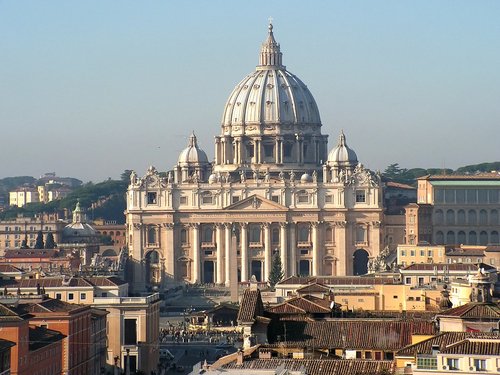
Pope Benedict XVI in St Peter's Basilica on Saturday.
Alberto Pizzoli/AFP/Images

Pope Benedict XVI leads a consistory in St Peter's Basilica at the Vatican on Saturday. In a new book, Benedict says condom use is acceptable "in certain cases," notably by male prostitutes to reduce the risk of infection with HIV.


Pope Benedict XVI says in a new book that condoms can be justified for male prostitutes seeking to stop HIV, a stunning turnaround for a church that has long opposed condoms and a pontiff who has blamed them for making the AIDS crisis worse.

The pontiff made the comments in a book-length interview with a German journalist, Light of the World: The Pope, the Church and the Signs of the Times, which is being released Tuesday. The Vatican newspaper ran excerpts on Saturday.

Church teaching has opposed condoms because they're a form of artificial contraception although it has never released an explicit policy about condoms and HIV. The Vatican has been harshly criticized in light of the AIDS crisis.

Benedict said that for male prostitutes — for whom contraception isn't the central issue — condoms are not a moral solution. But he said they could be justified "in the intention of reducing the risk of infection.''

He called it "a first step in a movement toward a different way, a more human way of living sexuality.''

Benedict drew the wrath of the United Nations, European governments and AIDS activisits when he told reporters en route to Africa in 2009 that the AIDS problem on the continent couldn't be resolved by distributing condoms.

"On the contrary, it increases the problem,'' he said then.

Journalist Peter Seewald, who interviewed Benedict over the course of six days this summer, revisited those comments and asked Benedict if it wasn't "madness'' for the Vatican to forbid a high-risk population to use condoms.

"There may be a basis in the case of some individuals, as perhaps when a male prostitute uses a condom, where this can be a first step in the direction of a moralization, a first assumption of responsibility,'' Benedict said.

But he stressed that it wasn't the way to deal with the evil of HIV, noting the church's position that abstinence and marital fidelity is the only sure way.

Christian Weisner, of the pro-reform group We Are Church in the pope's native Germany, said it was "surprising, and if that's the case one can be happy about the pope's ability to learn.

In other comments, Benedict said:

"If a pope is no longer physically, psychologically or spiritually capable of doing his job, then he has the "right, and under some circumstances, also an obligation to resign.''

On Islam, in Europe, he declined to endorse such moves as France's banning the burqa or Switzerland's citizen referendum to forbid topping mosques with minarets.

"Christians are tolerant, and in that respect they also allow others to have their self-image,'' Benedict replied when asked if Christians should be "glad'' about such initiatives. "As for the burqa, I can see no reason for a general ban.''

He was surprised by the scale of clerical sex abuse in his native Germany and acknowledged that the Vatican could have better communicated its response. "One can always wonder whether the pope should not speak more often.''

A man of deep personal faith, the former Cardinal Joseph Ratzinger has alienated some Roman Catholics with his zeal in enforcing church orthodoxy.

He grew up in the conservative Alpine foothills of Bavaria and at 78, he is the 265th pope of the Catholic Church and the first Germanic pope since the 11th century.

Many in Germany blamed Ratzinger for decrees from Rome barring Catholic priests from counseling pregnant teens on their options and blocking German Catholics from sharing communion with their Lutheran brethren at a joint gathering in 2003.

He also clashed with prominent liberal and moderate theologians.

In his autobiography, Ratzinger said he sensed he was out of step with his fellow Germans as early as the 1960s, when he was a young assistant at the Second Vatican Council in Rome.

Ratzinger wrote that he was enrolled in the Nazi youth movement against his will when he was 14 in 1941. He deserted the German army in April 1945, re-entered the seminary and was ordained, along with his brother, in 1951. He then spent several years teaching theology. In 1977, he was appointed bishop of Munich and elevated to cardinal three months later by Pope Paul VI.

John Paul II named him leader of the Congregation for the Doctrine of the Faith in 1981, where he was responsible for enforcing Catholic orthodoxy and was one of the key men in the drive to shore up the faith of the world's Roman Catholics.

Ratzinger who speaks Italian, English as well as his native language German, has been called a subtle thinker with a deep understanding of Catholic tradition and a personal touch he's not often given credit for.

Friday, June 25, 2010

Vatican Secret Archives hold tales fascinating ... and not

VATICAN CITY — The Swiss Guards wave you through St. Anne's Gate, the business entrance into the Holy See.

The bustle of tourists fades behind the high wall, replaced by the burbling of a fountain as your guide, dapper Belgian publisher Paul Van den Heuvel, leads you into a hidden courtyard behind the papal residence. On a far wall are metal doors carved with scenes celebrating Egyptian papyrus, medieval manuscripts and monks' scrolls. Through the doors, a plaque on the wall greets visitors to the VATICAVM TABVLARVM, Latin for Vatican records office.

"Welcome to the Vatican Secret Archives," says archivist Enrico Flaiani, head of conservators at the venerable institution. "I will be showing you many things," he adds with a quiet smile.

Founded in the 1600s by Pope Paul V, sacked by Napoleon, returned, moved and open only to scholars since the 1880s, the Vatican Secret Archives, the Archivum Secretum Apostolicum Vaticanum, serve as repository for the diplomatic records of pontiffs. Records stretch back to at least the 800s; the parchment Liber Diurnus, a circa-eighth-century codex containing legal language for consecrating monasteries and addressing dignitaries, is the oldest record in the archive. The most intriguing of its records are the subject of this year's The Vatican Secret Archives, which was published by Van den Huevel's VdH books and is the reason for the tour.

"The book presents some of the most fascinating of the documents in the archives," says Van den Heuvel. The volume holds lavish photos of the halls and artwork of the archives, forbidden to the throngs treading to the Vatican City each year. Only scholars are allowed in, and only to the reading room. The tour has been opened only to small groups of journalists in the past year to promote the book.

Van den Heuvel mischievously notes that even thriller writer Dan Brown, whose Angels & Demons likely has brought the archives the most fame, hasn't been given the tour.

Responding to demands for information

Between Angels & Demons and a long-running dispute over still-sealed World War II-era records, Vatican officials clearly felt some need to provide a glimpse of the archives, which are seen by church officials as a very serious center of historical research, says Matthew Bunson, author of The Encyclopedia of Catholic History.

"What we are seeing is a recognition on the part of the Vatican, or an ongoing discussion at the Vatican, on how to deal with the demands of the modern world for information," Bunson says. "The archives themselves are a fascinating reflection on the durability of the Holy See."

After leaving bags behind, visitors follow Flaiani to the staircased Tower of Winds, its white marble steps surrounding a wire-caged elevator and leading to the Leo XIII Study. There, visiting historians peruse the indices to the archive records in a balconied study lined with computers, which has a modern appearance except for its namesake's portrait, looking down from the back wall.

"Each index is a key to a part of the archives," Flaiani says, pulling down a binder listing 18th-century letters from papal nuncios, or representatives, from all over Europe. Every kingdom, city or state of note hosted these messengers for centuries, scribbling away at letters and communiqués, and receiving them in reply from the popes.

A medieval weather station

"I will show you something worth seeing," Flaiani says, unlocking and opening a wooden door and leading visitors into a room, walls 30 feet high, frescoed on all sides with scenes of St. Paul's shipwreck in Malta. On the ceiling is a star-hubbed pointer about 3 feet long, surrounded by two circles describing the wind's four directions. On the center of the floor is an eight-pointed rosette inscribed in marble, marked at one point by the spot where, on the spring equinox, a ray of sunlight falls at noon from a small hole in one wall of the windowless room.

Built by the "pontifical cosmographer" Ignazio Danti, the Meridian Room was intended to record the sun's position along the line dividing the room and for recording the wind's direction, making the Tower of Winds a sort of medieval weather station. From a balcony offering the second-highest vantage in Vatican City, astronomers made observations of the stars.

Despite the Catholic Church's history of persecuting the astronomical philosopher Giordano Bruno, who was burned at the stake in 1600, and Galileo, who was condemned by the Inquisition in 1633, the tower built from 1578 to 1580 originally served as an astronomical outpost needed for the reform of the Julian calendar in 1582. A summary of the case against Bruno and complete case against Galileo are held underneath the tower. The tower itself was once the seat of the Vatican Observatory, now at Castel Gandolfo outside Rome.

Even on a cloudy day, the view from the tower balcony is spectacular, offering a rarely seen display of Rome's seven hills on the other side of the Tiber river.

"Now, we will see the real archives," Flaiani says, tromping visitors down the tower stairs. The tower holds wooden cabinets once kept at Rome's Castel San Angelo, before Napoleon's removal of records in 1810. They contain volumes, some 11 inches thick, filled with the diplomatic correspondence of the Middle Ages. Each set of records resides in cabinets bearing the seal of their particular pope ("How else?" Flaiani asks).

A staff of 30 archivists under the archive prefect, Sergio Pagani, works to preserve and catalog the documents. Although most of the records represent mundane messages from the diplomats of the day and summaries of legal cases, a few reek of Dan Brown thrillers, including:

•Trial of the Knights of the Templars: parchments from 1308 to 1310 documenting a French king's persecution of the religious order.

•The "Bull" of 1493: a paper document splitting the New World, reached by Columbus the year before, between Spain and Portugal.

•Napoleon's coronation ceremony: a paper document outlining the ceremony to be used in Paris for the 1804 self-crowning of the upstart French emperor.

The bulk of the archives, about 50 miles of shelves, lies beneath more stairs in two basement levels, metal shelf after shelf of documents, thick with the smell of old paper and musty parchment. "The shelves look like any library, but then you see the dates — the 1500s, the 1600s," Van den Huevel says.

The basement shelves are closed to everyone but archivists, who bring requested records to scholars upstairs. At stops along the shelves, Flaiani displays famed documents — a papal bull excommunicating Martin Luther in 1521 — and amusing ones — the 1770 paper conferring the Order of the Golden Spur upon the 14-year-old musical prodigy Mozart.

Files relevant to World War II debate

The archives are akin to the U.S. National Archives, Flaiani says. They are more secretarial than truly "secret" and do not hold records related to sexual abuse scandals rocking the church.

But they are surrounded with their own controversy over what they might show about the Church's diplomatic conduct in World War II, and whether Pope Pius XII did too little to protest the Holocaust. Debate has been raging since an International Catholic-Jewish Historical Commission suspended its activities in 2000 after requests by panel members for unrestricted access to the archives were turned down.

The restricted records, those from the 1939 accession of Pope Pius XII forward, rest on fenced shelves at the back of one basement level. Flaiani says an index to those records will be completed by 2014, after which the current pope would have to decide to make them available. Popes generally make records available 70 years after the death of a predecessor, according to historian William Patch of Washington and Lee University in Lexington, Va., writing in the current edition of The Journal of Modern History.

The Vatican Secret Archives does display a 1934 letter from Pius XI to Hitler hoping for better relations between church and state. "The controversy over the political role of the Catholic Church in this era will, of course, not be resolved even when the Vatican archives become fully accessible," Patch writes. "Historical scholarship offers no method for resolving the debate between those who believe that Pius XII was cowardly not to have risked more to help the Jews and those who believe that he, as pope, would have been irresponsible to have done so."

Even Flaiani gets lost amid the endless basement shelves, taking his tour on a circular path before finding his way to the exit. He bids visitors farewell from within the metal doors of the archive.

"The archivists take what they do very seriously; they come at their work from a serious academic perspective. They won't be rushed by the outside world's demands for instant information," Bunson says.

"As history, the archives will always be fascinating. Here we have diplomatic records stretching from dealings with everyone from the Mongols to Hitler. It's interesting for what it says about Vatican culture that they have chosen this for display."

At the Vatican Secret Archives, "the shelves look like any  library," but, says Belgian publisher Paul Van den Heuvel,  "then you see the dates."
Handout
At the Vatican Secret Archives, "the shelves look like any library," but, says Belgian publisher Paul Van den Heuvel, "then you see the dates."
In the Tower of Winds the spot is marked where a ray of sunlight  falls at noon on the spring equinox through a hole in the fresco 'The  Calming of the Storm.'
EnlargeHandout
In the Tower of Winds the spot is marked where a ray of sunlight falls at noon on the spring equinox through a hole in the fresco 'The Calming of the Storm.'
Henry VIII's "Great Matter" and the letter of the Peers  of England to Clement VII found in the Vatican Secret Archives.
EnlargeHandout
Henry VIII's "Great Matter" and the letter of the Peers of England to Clement VII found in the Vatican Secret Archives.

Tuesday, April 27, 2010

Breathtaking 360º Virtual Image Tour of the Sistine Chapel


vatican.va — Michelangelo's masterpiece of the 12,000 square foot Sistene Chapel -- truly amazing virutal reality tour (Wait for it to load)

Click here for the: Breathtaking 360º Virtual Image Tour of the Sistine Chapel
 

Thursday, February 18, 2010

No Joke: Vatican Releases List of Top 10 Albums of All Time


chicagotribune.com — On February 15, the Vatican's newspaper, L' Osservatore Romano, published its semi-serious list of the top ten rock and pop albums of all time.

Click here to see the list and article: Vatican Releases List of Top 10 Albums of All Time

Monday, January 5, 2009

Pill link to infertile men, says Vatican


THE contraceptive pill is polluting the environment and is in part responsible for male infertility, a report in the Vatican newspaper L'Osservatore Romano said on Saturday.

The pill "has for some years had devastating effects on the environment by releasing tonnes of hormones into nature" through female urine, said Pedro Jose Maria Simon Castellvi, president of the International Federation of Catholic Medical Associations, in the report.

"We have sufficient evidence to state that a non-negligible cause of male infertility in the West is the environmental pollution caused by the pill," he said.

The article was promptly dismissed by several organisations.

"Once metabolised, the hormones contained in oral contraceptives no longer have any of the characteristic effects of feminine hormones," said Gianbenedetto Melis, vice-president of a contraceptive research association.

Hormones in the pill, such as oestrogen, "are present everywhere … in plastic, in disinfectants, in meat that we eat," said Flavia Franconi, of the Society of Italian Pharmacology.

In October, Pope Benedict XVI reaffirmed the Roman Catholic Church's condemnation of artificial birth control.

Contraception "means negating the intimate truth of conjugal love, with which the divine gift (of life) is communicated" the leader of the world's 1.1 billion Roman Catholics wrote on the 40th anniversary of a papal encyclical on the topic.

An encyclical is a letter usually treating some aspect of Catholic doctrine and issued occasionally by the pope.

The landmark document, with a translated title in English of On the Regulation of Birth, was published at a time when the development of the pill was giving new sexual freedom to women across the world.

Millions of Catholics distanced themselves from Rome as a result.

AFP