Zazzle Shop

Screen printing
Showing posts with label Switzerland. Show all posts

Tuesday, August 2, 2011

Half of European men share King Tut's DNA


By Alice Baghdjian
From  http://af.reuters.com/


LONDON Aug 1 (Reuters Life!) - Up to 70 percent of British men and half of all Western European men are related to the Egyptian Pharaoh Tutankhamun, geneticists in Switzerland said.

Scientists at Zurich-based DNA genealogy centre, iGENEA, reconstructed the DNA profile of the boy Pharaoh, who ascended the throne at the age of nine, his father Akhenaten and grandfather Amenhotep III, based on a film that was made for the Discovery Channel.

The results showed that King Tut belonged to a genetic profile group, known as haplogroup R1b1a2, to which more than 50 percent of all men in Western Europe belong, indicating that they share a common ancestor.

Among modern-day Egyptians this haplogroup contingent is below 1 percent, according to iGENEA.

"It was very interesting to discover that he belonged to a genetic group in Europe -- there were many possible groups in Egypt that the DNA could have belonged to," said Roman Scholz, director of the iGENEA Centre.
Around 70 percent of Spanish and 60 percent of French men also belong to the genetic group of the Pharaoh who ruled Egypt more than 3,000 years ago.

"We think the common ancestor lived in the Caucasus about 9,500 years ago," Scholz told Reuters.

It is estimated that the earliest migration of haplogroup R1b1a2 into Europe began with the spread of agriculture in 7,000 BC, according to iGENEA.

However, the geneticists were not sure how Tutankhamun's paternal lineage came to Egypt from its region of origin.


The centre is now using DNA testing to search for the closest living relatives of "King Tut".

"The offer has only been publicised for three days but we have already seen a lot of interest," Scholz told Reuters. (Edited by Paul Casciato)

Tuesday, March 15, 2011

10 best biking cities in Europe


While biking is becoming more popular in U.S. cities — L.A. is adding 1,600 bike lanes, Chicago has a new bike plan, and Portland has 17,000 daily commuters — Europe has some amazing biking cities of their own.
The Ecologist has come up with the 10 best biking cities in Europe (in no particular order):

-Lyon, France
  • “With its charming twisty lanes and dedicated bike routes, Lyon is a cyclists’ paradise.”
  • The city’s bike sharing program, Velo’v has over 300 stations throughout the city.
-Rome, Italy
  • “Cycling is by far the best bet for seeing the sights close to the Tiber, where a picturesque route runs from the Ponte Sublicio to the Ponte della Magliana.”
-Basel, Switzerland
  • “Featuring street lanes geared to cyclists and dedicated left hand turns to make crossing the road safer, Basel tops the list of cities to cycle in Switzerland.”
-Berlin, Germany
  • Thanks to the combined efforts of Allied air raids and the Communist predilection for destroying picturesque old buildings and replacing them with big, brash new ones, Berlin’s streets are wonderfully wide, which makes it easy to get around by bike.”
-Trondheim, Norway
  • “With its picturesque setting on the shores of the cerulean Trondheimsfjord, Norway’s fourth largest city has built a reputation for bicycling brilliance thanks to innovations such as the Trampe bicycle lift which takes the effort out of pedaling uphill.”
-Paris, France
  • While the many hazards of the Place de la Concorde aren’t the greatest advertisement for cycling in Paris, once you’re a safe distance from the city’s infamously crazy drivers – on the pavement in other words – then cycling in Paris can be a real pleasure.”
-Barcelona, Spain
  • “Surprisingly, given Spain’s reputation for endangering the lives and limbs of cyclists thanks to its motorists’ penchant for going everywhere at top speed, Barcelona has 50,000 regular cyclists and that figure is increasing daily.”
-Copenhagen, Denmark
  • 37 percent of all Copenhageners bike a total of 1.2 million kilometers each day.
  • “The Danish capital has been quietly turning itself into one of the best biking cities in the world; a fact revealed when the International Cycling Union gave it the first ‘Bike City’ award last year.”
-London, England
  • The city is working to build 12 biking “superhighways” — there are already two — and increase biking by 400 percent from 2000.
  • “Cycling in London used to be pretty dreadful thanks to an unfortunate combination of rain and aggressive drivers but since the first two Barclays Cycle Superhighways launched last summer, things have become a little easier.”
-Amsterdam, Netherlands
  • There are 600,000 bikes in a city of 750,000.
  • Thanks in part to the narrow streets in the medieval city center, cycling is by far the most efficient way to get around.”
Watch this inspiring video of Amsterdam’s biking community:

Wednesday, September 8, 2010

Drive-In ‘Sex-Boxes’ May Spread To Zurich

By David Chalk
From http://www.nileguide.com/

Zurich’s new police chief has received “thousands of complaints” from residents about the city’s thriving red light district. So he’s planning a police trip to Germany to check out a possible solution: ’sex-boxen’, or drive-in boxes where prostitutes can do their thing in relative privacy and safety. The boxes were first used in Holland, and Cologne became the first German city to implement them in 2002, after which they spread to other German cities like Essen.

Jessica Francis of the Swiss daily Blick (translated from German) stresses that the Zurich policemen who are going on this German study trip “do not go for pleasure,” instead they just want to study if something similar can be implemented in their city. In Cologne, the city fenced in an area about the size of a football field, provided a gate and privacy screen, and outlawed filming and photography. After the first three years, they declared the sex-boxen a success, with little violence perpetrated against prostitutes and improved health among sex workers.

Still, it’s hard to picture Richard Gere and Julia Roberts falling in love in one of these:

In an interesting twist, the Zurich police department’s spokesman is really named Reto Casanova. “We can’t get rid of prostitution,” Casanova says, “so have to learn how to control it.”

So far the police department doesn’t have a site in mind for Zurich’s version of the boxes, but they are preparing a report for the city council on their findings.

Thursday, April 15, 2010

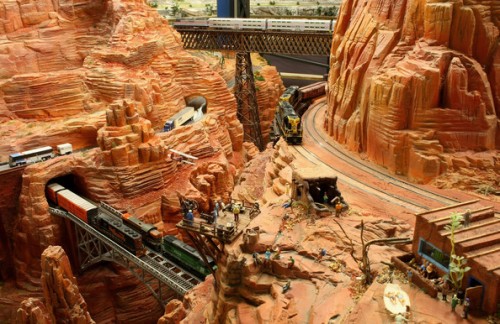
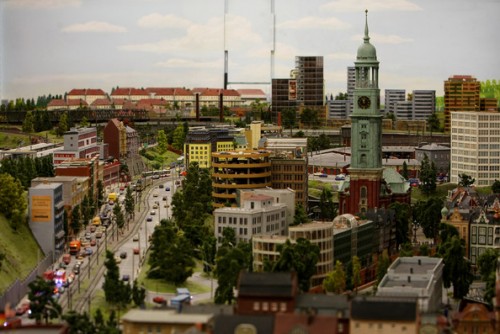
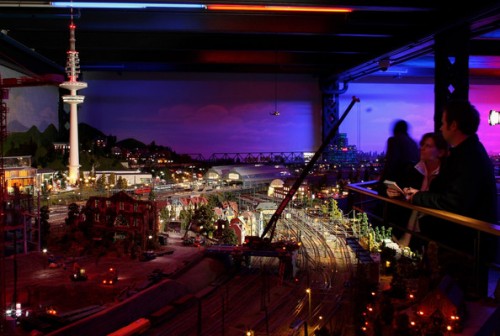
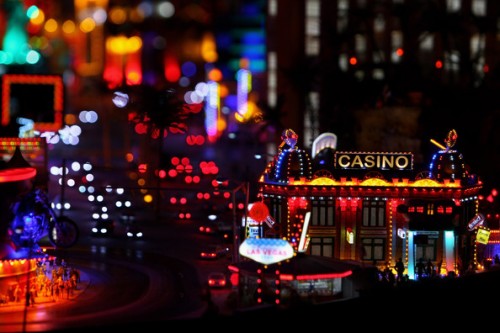
The Miniatur Wunderland Hamburg – The World’s Biggest Model Train Set

From: http://www.epidemicfun.com/

Model Train Set

Frederik Braun and his then-girlfriend and today’s wife were visiting the alpine city of Zurich in July 2000. Sauntering together through the alleys of Zurich’s center, they came across a railway model shop, which at once evoked childhood memories in Frederik.

Model Train Set

During the following hours, the idea of realizing the long forgotten childhood dream became more and more mature. On the very same day he called his twin brother Gerrit and surprised him with the following words: „We are going to build the largest model railway in the world“.

Model Train Set

Gerrit, who is more rational and sceptical by nature, doubted Frederik’s state of mind and didn’t take the idea too seriously. However, after having received about six more calls from Frederik enthusiastically presenting new ideas about this topic, Gerrit realized that his brother was very serious about it. So, he started thinking about the project from an economical and technical point of view.

Model Train Set

The result was that the project is technically demanding, the economic aspect is very risky and from an entrepreneurial view it is crazy – but, still possible. Gerrit had been infected by this idea as well. The two brothers passed the coming days intensely planning their dream despite many doubts and misgivings from their environment.

Model Train Set

Only a few days after Zurich’s enlightenment both of them were sure that they would engage in this adventure.

Model Train Set

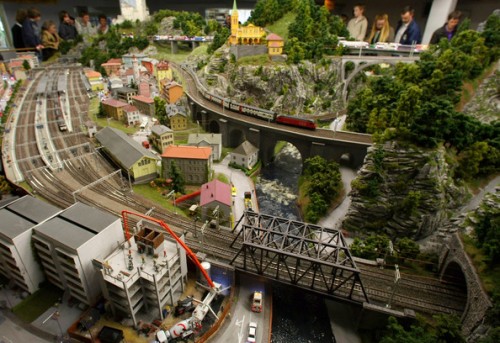
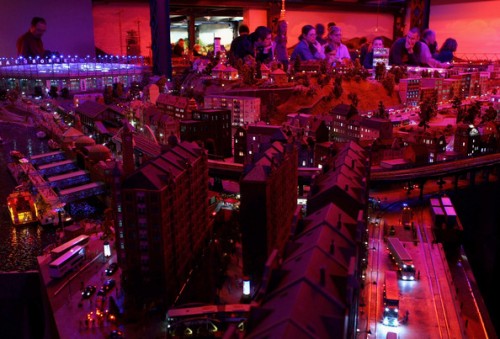
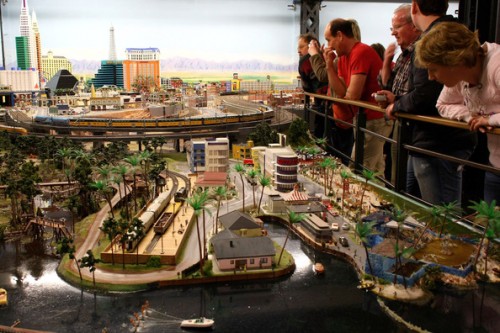
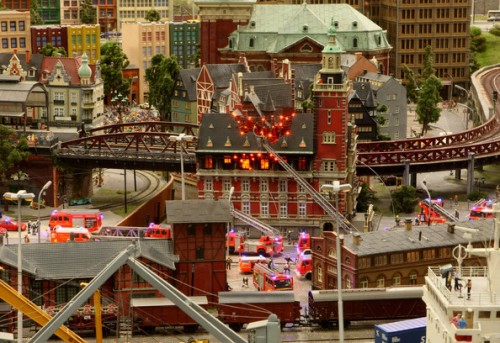
The world’s largest model railway and one of the most popular tourist attractions in Germany is located next to the Elbe in Hamburg’s Speicherstadt.

Model Train Set

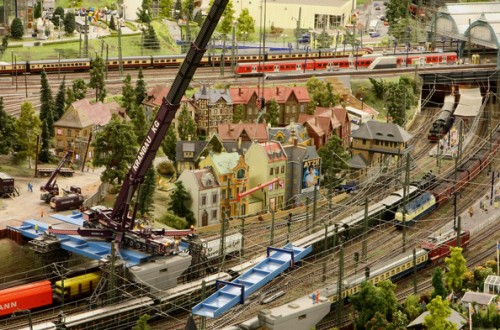
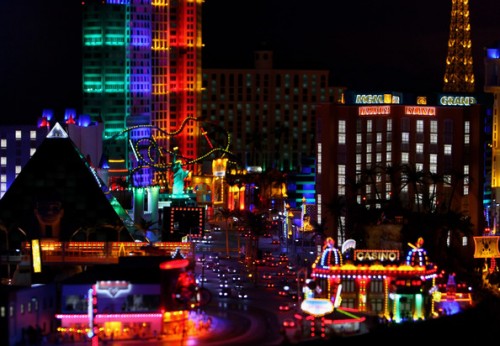
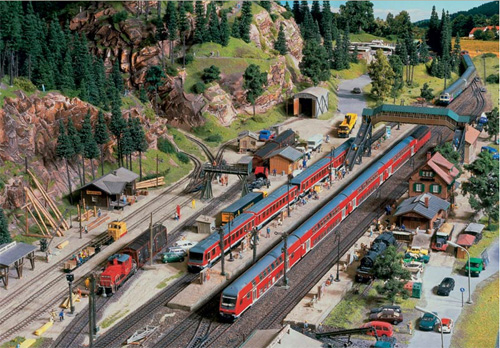
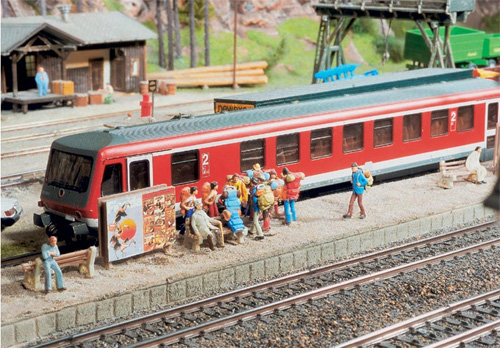
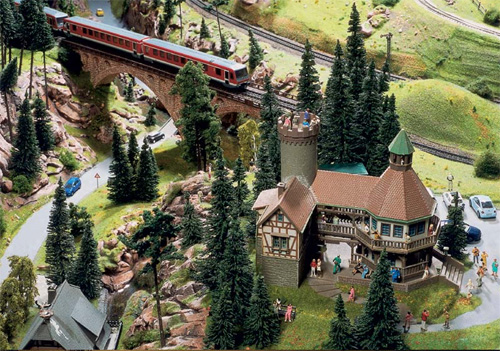
On more than 1,150 m² model area the Miniatur Wunderland ranges from Scandinavia to the USA, from the coast to the high mountains.

Model Train Set

After final construction phase in 2015 model area will have more than 2.300 m² in 12 Construction Areas.

Model Train Set

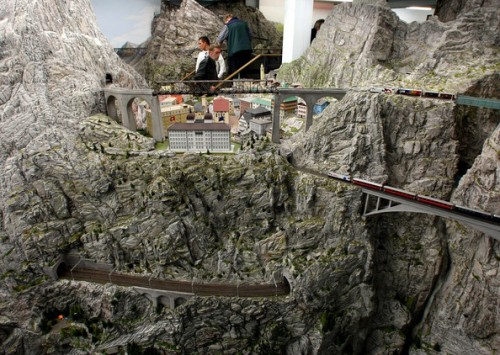
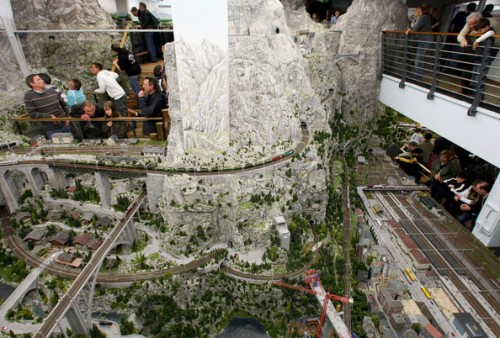
The Miniatur Wunderland has been constantly growing since the year 2001. Having started with two layout areas, Harz and Southern Germany, the Wunderland has openend the seventh area, Switzerland, in November 2007.

Model Train Set

More layout areas have already been planned until the year 2014.

Model Train Set

The Miniatur Wunderland have pursued the principle of open workshops since the beginning, which means that you can actually see his modellers and technicians working in the Wunderland and observe how landscapes emerge.

Model Train Set

Up till now approx. 500,000 working hours and 8.7 Million Euros(11.7M $) they have put into the Miniatur Wunderland.

Model Train Set

The Harz is one of the oldest landscapes in Miniatur Wunderland. It was built together with Austria and Knuffingen during the first construction phase (December 2000 – August 2001) and has become an important milestone in the renaissance of modelling.

Model Train Set

Model Train Set

Model Train Set

Click here for many more pics!!!

Friday, January 22, 2010

Incredible Underground Residence in Switzerland (pics)


underground home designs swiss mountain house 1 Incredible Underground Residence in Switzerland
underground home designs swiss mountain house 8 Incredible Underground Residence in Switzerland
underground home designs swiss mountain house 3 Incredible Underground Residence in Switzerland
underground home designs swiss mountain house 9 Incredible Underground Residence in Switzerland

freshome.com Have you ever thought how it would be like to live in a bunker or an underground tunnel? Well, today we bring you the upgraded version of that, which is an all-equipped underground home.


Click here to see this Gallery:  Incredible Underground Residence in Switzerland (pics)
 

Tuesday, August 18, 2009

The Swiss Menace: health care reform

nytimes.com The Democratic health care reform plan most resembles the system in Switzerland, despite comparisons to the approaches taken in Britain and Canada.

Published: August 16, 2009

It was the blooper heard round the world. In an editorial denouncing Democratic health reform plans, Investor’s Business Daily tried to frighten its readers by declaring that in Britain, where the government runs health care, the handicapped physicist Stephen Hawking “wouldn’t have a chance,” because the National Health Service would consider his life “essentially worthless.”


Fred R. Conrad/The New York Times

Paul Krugman

Professor Hawking, who was born in Britain, has lived there all his life, and has been well cared for by the National Health Service, was not amused.

Besides being vile and stupid, however, the editorial was beside the point. Investor’s Business Daily would like you to believe that Obamacare would turn America into Britain — or, rather, a dystopian fantasy version of Britain. The screamers on talk radio and Fox News would have you believe that the plan is to turn America into the Soviet Union. But the truth is that the plans on the table would, roughly speaking, turn America into Switzerland — which may be occupied by lederhosen-wearing holey-cheese eaters, but wasn’t a socialist hellhole the last time I looked.

Let’s talk about health care around the advanced world.

Every wealthy country other than the United States guarantees essential care to all its citizens. There are, however, wide variations in the specifics, with three main approaches taken.

In Britain, the government itself runs the hospitals and employs the doctors. We’ve all heard scare stories about how that works in practice; these stories are false. Like every system, the National Health Service has problems, but over all it appears to provide quite good care while spending only about 40 percent as much per person as we do. By the way, our own Veterans Health Administration, which is run somewhat like the British health service, also manages to combine quality care with low costs.

The second route to universal coverage leaves the actual delivery of health care in private hands, but the government pays most of the bills. That’s how Canada and, in a more complex fashion, France do it. It’s also a system familiar to most Americans, since even those of us not yet on Medicare have parents and relatives who are.

Again, you hear a lot of horror stories about such systems, most of them false. French health care is excellent. Canadians with chronic conditions are more satisfied with their system than their U.S. counterparts. And Medicare is highly popular, as evidenced by the tendency of town-hall protesters to demand that the government keep its hands off the program.

Finally, the third route to universal coverage relies on private insurance companies, using a combination of regulation and subsidies to ensure that everyone is covered. Switzerland offers the clearest example: everyone is required to buy insurance, insurers can’t discriminate based on medical history or pre-existing conditions, and lower-income citizens get government help in paying for their policies.

In this country, the Massachusetts health reform more or less follows the Swiss model; costs are running higher than expected, but the reform has greatly reduced the number of uninsured. And the most common form of health insurance in America, employment-based coverage, actually has some “Swiss” aspects: to avoid making benefits taxable, employers have to follow rules that effectively rule out discrimination based on medical history and subsidize care for lower-wage workers.

So where does Obamacare fit into all this? Basically, it’s a plan to Swissify America, using regulation and subsidies to ensure universal coverage.

If we were starting from scratch we probably wouldn’t have chosen this route. True “socialized medicine” would undoubtedly cost less, and a straightforward extension of Medicare-type coverage to all Americans would probably be cheaper than a Swiss-style system. That’s why I and others believe that a true public option competing with private insurers is extremely important: otherwise, rising costs could all too easily undermine the whole effort.

But a Swiss-style system of universal coverage would be a vast improvement on what we have now. And we already know that such systems work.

So we can do this. At this point, all that stands in the way of universal health care in America are the greed of the medical-industrial complex, the lies of the right-wing propaganda machine, and the gullibility of voters who believe those lies.

Correction: In Friday’s column I mistakenly asserted that Senator Johnny Isakson was responsible for a provision in a House bill that would allow Medicare to pay for end-of-life counseling. In fact, he is responsible for a provision in a Senate bill that would allow a different, newly created government program to pay for such counseling.


Roger Cohen is on vacation.

Monday, March 2, 2009

A Short History of Swiss Banks & Secrecy

Swiss banks' anonymity and confidentiality have attracted streams of illicit cash from around the world.
Erich Hartmann / Magnum

Along with Chocolate and Cheese, Switzerland is synonymous with secrecy: it's long been known as a place to put your money if you don't like taxes or you commit crimes for a living. Not an entirely fair characterization, to be sure, but it's a safe bet that the decision by Swiss bank UBS to turn over the names of some accused tax evaders has a few of the world's richest criminals a bit nervous. (See 25 people to blame for the financial crisis.)

Switzerland's tradition of financial discretion goes back at least to the 17th century. In the wake of World War I, as many European currencies became unstable, the consistent (not to mention neutral) Swiss franc attracted depositors. After France, incensed by the loss of revenue, raided a Swiss bank's office in Paris and revealed the names on its accounts, the Swiss passed a law in 1934 making such disclosures criminal. Years later, Swiss banks both sheltered the assets of German Jews and accepted looted Nazi gold (and later set up a $1.25 billion compensation fund for Holocaust victims). Corrupt leaders ranging from the Philippines' Ferdinand Marcos to Nigeria's Sani Abacha have used Swiss banks to hide ill-gotten gains. (See the top 10 financial collapses of 2008.)

Faced with criticism from foreign governments, Switzerland has changed some of its ways. It added laws to combat money-laundering and cracked down on numbered accounts in the 1990s. But that doesn't mean the banks open their vaults for just anyone. When the U.S., which loses an estimated $100 billion in tax revenues every year on assets stashed overseas, demanded that UBS release information on an additional 52,000 accounts, the bank refused, saying the move would violate Swiss law. Of course, with some 27,000 UBS employees working in U.S. offices, Switzerland might not be the jurisdiction it should worry about.

Monday, January 19, 2009

A DIY Test For Your Broadband Provider’s Net Neutrality

By Christopher Rhoads

Worried that your broadband provider is slowing down your Web traffic?

If so, you might want to download the aptly named “Switzerland” — a tool that tests whether your Internet provider is violating the principles of so-called “network neutrality.”

switzerland_E_20090116115338.jpg

Network neutrality, which prevents carriers from blocking traffic or manipulating the speeds of traffic from certain Web sites, became a hot-button issue several years ago when carriers suggested they should be allowed to charge content providers more for using faster lanes on their networks.

The issue resurfaced last summer when the FCC determined that Comcast had interfered with its subscribers’ use of a file-sharing technology, called BitTorrent, a free application used to distribute sometimes large software and media files. Comcast is contesting the ruling.

Net neutrality is likely to re-emerge in the coming months, as the incoming Congress considers expected legislation on the issue. At the moment, the FCC advocates only broad guidelines to “preserve and promote the open and interconneted nature of the public Internet.”

Meanwhile, the Electronic Frontier Foundation, a nonprofit in San Francisco that helped discover Comcast’s actions, decided it needed to help users detect similar violations.

“Congress may or may not decide to pass legislation on this,” said Peter Eckersley, a staff technologist with the EFF who designed Switzerland. “But we are going to need tools to know what’s going on and spot causes for concern on the network.”

EFF released Switzerland in August. The tool can be downloaded by users for free, and has been downloaded several thousands of times, according to Mr. Eckersley. It’s designed to detect when packets of Internet traffic have been modified or inserted into the network by service providers.

Still, in a hint of the debate to come, some contend such tools don’t detect anti-competitive practices that should also be included in any net neutrality legislation.

“It’s important to note that this tool tests for only ONE set of behaviors that are claimed by SOME people to be a violation of network neutrality,” wrote Brett Glass, a technology consultant, in a Web site comment on the EFF tool.