Zazzle Shop

Screen printing
Showing posts with label Spain. Show all posts

Monday, September 26, 2011

Spain's Catalonia bids farewell to bullfighting

By: AP
From: http://www.usatoday.com/


BARCELONA, Spain (AP) – Matadors drove the killing sword into bulls for the last time Sunday in Spain's powerful northeastern region of Catalonia in an emotive farewell fight before a polemical regional ban on the country's emblematic tradition takes effect.

Three of Spain's top bullfighters, including No. 1 Jose Tomas, starred in the sold-out show at Barcelona's 20,000-seat Monumental ring. Catalan bullfighter Serafin Marin closed the fight killing the last of six bulls to great applause.

Many fans then invaded the ring to grab handfuls of sand to keep as souvenirs.

The bullfighters were later carried shoulder high from the ring into the streets outside the bullring while the crowd chanted slogans in favor of freedom and against the prohibition. A brief bout of scuffling broke out as fans confronted about 20 animal welfare activists, but there were no reports of injuries or arrests.

The fight was also preceded by moments of tension as pro- and anti-bullfighting activists exchanged insults.

Catalonia's Parliament banned bullfighting in July 2010 following a signature-collection campaign by animal rights activists. The ban does not take effect until Jan. 1, but Sunday's fight was the last scheduled this season.

Critics say the prohibition is less about animal welfare and more a snub to Spain by independence-minded Catalans.

Bullfighting's popularity in Catalonia has plunged in recent decades and the Monumental was its last functioning ring, although the city once boasted three.

Hours before the fight, a small group of anti-bullfight activists gathered outside the arena, celebrating with sparkling wine.

"Obviously a lot of political parties have tried to politicize this, but we mustn't forget that this popular proposal sprouted from a pure pro-animal rights standpoint aimed at eradicating animal cruelty," campaigner Soraya Gaston said.

Others hoped the prohibition might only be temporary.

"It looks like this may be the last day (of bullfights in Catalonia). But the last word hasn't been said yet," fan Eduardo Edurna said. "I think we will have bullfighting back in Catalonia."

The prohibition caused a furor and triggered a nationwide debate over the centuries-old spectacle that inspired such artists and writers as Goya, Picasso and Hemingway.

"Banning bullfighting in Catalonia is nothing more than an attack on liberty," said Carlos Nunez, president of Spain's Mesa del Toro pro-bullfighting umbrella group. "It's the fruit of policies in Catalonia against bullfighting and all that is seen to represent Spain."

Although mostly symbolic — the Monumental staged only some 15 fights a year — the prohibition sent bullfighting supporters frantically looking for ways to overturn the decision or at least make sure it doesn't spread to other regions.

Bullfighter Enrique Ponce of Spain performs during the third bullfight of the 2011 season at the Monumental bullring on July 17 in Barcelona.

Spain's leading conservative opposition Popular Party— tipped to win general elections in November — has appealed the ban before the Constitutional Court, while its Catalan branch is battling for a delay in the implementation of the ban.

Meanwhile, the Mesa del Toro is seeking 500,000 signatures in the hope it can persuade the Madrid national parliament to grant bullfighting cultural heritage status.

Animal rights activists, meanwhile, are triumphant.

"It's like a crack has developed in the armor plating (of bullfighting). It's a small crack but the protective shield might crumble altogether," said Leonardo Anselmi, a key promoter of the Catalan prohibition.

Catalonia is the second of Spain's 17 regions to ban bullfighting. The Canary Islands outlawed the practice in 1991 although it had never been a popular tradition there.

For the moment, however, there are no signs any other Spanish region will follow suit.

The practice was once immensely popular in Barcelona and other Catalan towns but its decline began with the end of the dictatorship of Francisco Franco in 1978 and the subsequent rise in Catalan nationalism and a rejection of things deemed Spanish.

But critics say the hypocrisy of banning bullfighting in the name of animal rights was shown up when months after the ban, Catalonia passed other legislation protecting the "correbous," a typical Catalan town festival event in which flaming balls of wax or fireworks are attached to the horns of bulls which are then taunted and teased by rowdy crowds in bullrings or town squares.

Spain's ancient fascination with bulls, and with using the animals as a test of bravery, is still very much a part of the national identity. Bullfights and related events, such as the annual San Fermin Pamplona bull-runs, make up a multimillion-dollar industry and draw many tourists.

But modern times and the economic crisis have nevertheless hit the tradition hard and surveys consistently show most Spaniards have no interest in bullfighting.

In an article headlined "The Fiesta is Ending," leading newspaper El Pais highlighted that changing tastes and economic difficulties, particularly in small towns, have led to a 34 percent drop in the number of bull-related festival events from 2,622 to 1,724 between 2007 and 2010.

In January, Spain's leading broadcaster said it would no longer show live bullfights in order to protect children from viewing violence.

Wednesday, September 29, 2010

The 50 Hottest Women From Spain

The 50 Hottest Women From Spain

popcrunch.com — I don't think anyone would argue that some of the most beautiful women in the world hail from Spain.

Click here: http://www.popcrunch.com/the-50-hottest-women-from-spain/

Thursday, July 15, 2010

Sara Carbonero is Spains Hottest Sports Reporter

From: http://www.totalprosports.com/

You may remember Spain's hottie sportscaster Sara Carbonero from her interview with boyfriend and World Cup star Iker Casillas. The Spanish TV host talks sports for Telecinco. In July 2009, Sara Carbonero, was voted "The Sexiest Reporter in the World" by FHM. Take that, Erin Andrews.

The English press made a big deal about her being the cause of the Spain loss to the Swiss. But it was much ado about nothing. Casillas couldn't have been too distracted as he led Spain to their first-ever World Cup championship. Her mushy kiss with the Spanish goalie also raised some attention around the world. Sara Carbonero seemed a bit squeamish after Casillas planted a few smooches on her at the end of the interview, but it's not like she reports on the war or the heinous atrocity known as the BP oil spill. Who cares? Everyone knew about them anyway.

We thought you might enjoy a gallery of this beauty, so here are a slew of pics to check out.

Thursday, March 11, 2010

WTF? SNOW ON THE PALM TREES! Snow hits Mediterranean coast!


Blizzards have hit the French Mediterranean coast amid warnings of up to 20 inches of snow in Northern Spain on Tuesday.

Nimes and Perpignan were among the cities hit by the bad weather near the coast in France.

SEE ALSO

Friday, March 5, 2010

The 25 greatest cities in the world for drinking wine

Dreaming of sipping wine in a little Parisian cafe? Or picturing yourself in trendy Napa Valley, sampling new vintages straight from the barrel? While these well-known areas indeed spring to mind when thinking about the world's finest vintages, you may be surprised to know that excellent wine is being made and enjoyed just about everywhere.

As a wine judge and hobby winemaker, my favorite wine trips have always been to out-of-the-way places, away from tourists and kitsch. This is where you will find the best wines and the most interesting experiences. Here are dozens of not-to-miss wine experiences to plan into your next trip.

San Gimignano, Italy
San Gimignano is an ancient city in Tuscany whose medieval towers still fill the skyline today. While several grape varieties are grown in the area, the town is famous for its Vernaccia di San Gimignano, a dry white wine made in the region since the 13th century, and made famous by a reference in Dante's Inferno.

This unique wine is best paired with local fare such as wild boar or mushroom risotto which can be enjoyed in many local restaurants. One of the town's restaurants, Dorand, even serves authentic medieval food paired with local wines. A luxurious and decadent experience, it will not be soon forgotten.

Beamsville, Ontario, Canada
The Niagara Region of Canada has developed into a thriving wine region over the past thirty years. Its micro-climate is perfect for European-style grape growing and this area is known for award-winning Chardonnays, Rieslings, and Merlots.

The region's best product, however, is its Icewine. This naturally sweet dessert wine is made from white grapes that have been allowed to remain on the vine into the winter and are picked and pressed during the first hard freeze.

Forgo the touristy Niagara-on-the-Lake and stay in Beamsville to the west. Beamsville is surrounded by small craft wineries and vineyards producing a number of varietals. From Beamsville, wine tours are an easy day trip. Beamsville restaurants also carry many local wines, so you can sample to your heart's content while planning your trip through wine country.
Beaune, France
On your next trip to France, escape Paris and drive three hours south east to the city of Beaune. Even without wine, Beaune is a beautiful, historical city, with centuries-old cathedrals, ancient ramparts, and world-class cafs and restaurants.

The best place to sample wines in Beaune is the Marche aux Vins. The Marche, located in a 15th century Franciscan church, is a collective run by many of the region's wine merchants. For a mere 10.00 €, you can spend a morning or afternoon sampling a very large selection of Burgundies. You will be provided with a souvenir tasting cup and will make your way through the maze of wines. All of the wines are available to purchase. I most enjoy the heavier, older, and often more expensive vintages which are presented near the end of the tastings. Don't fill up on the cheap stuff first!

Temecula, California, USA
When one thinks California wineries, the exclusive and hip Napa Valley is the first area that comes to mind. While the Napa region produces some amazing wines, California harbors a wine secret farther to the south.

An hour from San Diego, Orange County, and Los Angeles, Temecula has been quietly gaining a name for itself in the wine industry. The hills to the north and west and the ocean breezes make for a perfect grape-growing climate.

If you enjoy gaming as well as wine, the Pechanga Casino and Resort just outside of town provides both. Or take a self-guided tour through Temecula's small boutique wineries and discover vintages that you will be unlikely to see on your supermarket's shelves.

Mainz, Germany
When you visit other cities, add a new wine to your repertoire. As years go by, when you taste that varietal, it can take you back to your trip.
Mainz sits perched on the banks of the Rhine as it has for almost two thousand years. The surrounding countryside is famous for its Rieslings, Sylvaners, and Muller-Thurgau. The cultivated vineyards encompass over 65,000 acres and, like many wine-growing regions along the Rhine, their soil imparts a unique character to these delicate white wines.

In Mainz, you can sample wines at many of the local vineyards, or take a boat ride down the Rhine with wine glass firmly in hand -- my favorite activity when I visit Germany. Stick with the Rieslings and forgo the more everyday Mullers. They want to be Rieslings when they grow up.

Valencia, Spain
The Mediterranean Sea keeps the vineyards around Valencia at just the right temperature. The Valencia area is famous for paella and its locally-produced wines; two treats that can easily be combined into one outing to one of the city's many Spanish restaurants.

The wineries in Valencia are some of the largest in Spain due to the city's large port and ability to ship large quantities of wine around the world. The area produces deep red Riojas, unique roses, and complex aged sherries.

There are several wine tours, both guided and self-guided that you can sign up for to see the wineries and sample a wider variety than what is available in restaurants.

Bellingham, Washington, USA
Washington is one of the great wine regions of the United States. Although just coming into its own in the past decade, Washington is now the second largest state producer of wine in the country.

While wine towns can be found in most areas of the state, Bellingham, near the Canadian border, is a fun experience and a short trip from the British Columbia wineries to the north.

Bellingham is known for its wine bars and local wine can be found in every one of them. The pace of life in Bellingham tends to be a little more laid back than you may be used to so sit back, enjoy the wine, and listen to live music. If visiting in the fall, include tours of local vineyards in your plans and watch the winemaking happen first hand.

Brisbane, Australia
Brisbane makes the list, not because of its own wine-growing identity, but because of its location. In Brisbane, you can sample the fruit wines produced to the north, on the Sunshine Coast, including pineapple, kiwi, or mango wines. You can also sample more traditional wines from farther south

Australia is known for its Shiraz, a red grape originally from Europe and there are many to choose from in Brisbane restaurants. My favorite way to enjoy wine in Brisbane is to find an outdoor table at one of the restaurants surrounding South Bank park and sip some of Australia's finest while watching kids play on the man-made beach.


Cape Town, South Africa
Cape Town is the center of South African wine-making and both reds and whites have been made here for almost 300 years. All of the great grapes of Europe can be found here including Chardonnay, Cabernet Sauvignon, Shiraz (called Petit Syrah in France), and Sauvignon Blanc.

Many of Cape Town's upscale hotels offer packages that include tours of the 130+ vineyards (or 'wine farms' as they are called in South Africa), wineries, food pairings and accommodation. This is the best way to see Cape Town's surrounding wine country and an opportunity not to be missed

Pelee Island, Ontario, Canada
Pelee Island is the southernmost tip of Canada and is, in fact, farther south than parts of California. This tiny island is inhabited by only about 500 full-time residents but boasts some of the best vineyards on the continent.

Pelee Island Winery grows all of its grapes on the island (over 500 acres). A weekend on Pelee Island is a great opportunity to get away for a romantic weekend, which I do as often as possible. There are several bed and breakfast inns on the island and the winery offers various wine tours, tastings and educational sessions. And when you tire of drinking wine (an unlikely occurrence), you can enjoy the nature preserve or take a bike ride around the entire island.

-- The above was written by
Angie Mohr, Seed contributor.


Walla Walla, Washington, USA
This small town is a four-and-a-half hour drive from Seattle, and it's a completely different world. Besides having a semi-arid climate and little-to-no traffic, Walla Walla is one of the world's hottest wine regions. Scattered throughout the countryside are vineyards and tasting rooms (highly recommended is Pepper Bridge Winery, one of many great producers in Walla Walla).

In the small but charming downtown there are enough tasting rooms to keep a wine tourist busy for days. Add in a few very high quality restaurants (Saffron and Brasserie Four, for example), and Walla Walla is one of the world's most inviting and laid-back wine towns.

Saint-Emilion, France
The wine-tourism capital of Bordeaux is an obvious pick for this list. The vineyards of Saint-Emilion surrounding the ancient town center (a World Heritage Site) produce some of the world's most sought-after wines. Chateau Cheval Blanc and Chateau Ausone are the only two Chateaux to receive Saint-Emilion's highest ranking, and great vintages of the wines frequently fetch over $1,000 per bottle. There are plenty of more economical choices though, and with nearly all of the 13,600 acres dedicated to wine production, there's plenty to go around.

Portland, Oregon, USA
The largest city in Oregon sits on the banks of the Willamette River and is a mere half-hour drive from many wineries in the Willamette Valley, one of the world's premium Pinot Noir growing areas. If touring the vineyards isn't on the agenda, there are numerous great wine bars and restaurants. Check out Alu Wine Bar, which claims a stellar wine list of both Oregon Pinot Noirs and intriguing imported selections.

Cochem, Germany
Cochem is one of dozens of small towns along Germany's Mosel River, and it is particularly charming. The Mosel is famous for producing some of the world's best -- as well as age-worthy -- Rieslings. The wide range of wine styles guarantees a hit with every palate. The town is surrounded by steep hillside vineyards, and a thousand-year-old castle on a hill overlooking the town square adds to the atmosphere.

San Francisco, California, USA
One of the most diverse cities in the United States also has plenty of choices when it comes to wine. Dozens of wine bars are scattered throughout the city center -- try Yield Wine Bar for an earth-friendly wine list or the aptly named WINE for a constantly rotating glass selection.

Bonus: Outside the bustling downtown, Napa Valley and Sonoma are easy day trips to sample some of the best U.S.-made wines.

Los Olivos, California, USA
Rather than fighting the crowds in Napa Valley try this quaint Victorian town just north of Santa Barbara. The area is now famous as the setting of Sideways. Don't let the Hollywood connection scare you away though: the region is stunningly beautiful and is one of the best Pinot Noir producing areas in the United States (alternatively, swing by Andrew Murray for some killer Syrahs). The historic downtown is home to over a dozen wine tasting rooms in a small area.


Chateauneuf-du-Pape, France
The town name is translated as "new castle of the Pope," from the days when the Pope ruled from nearby Avignon. The Pope no longer lives there, instead you'll find some of the best wines in the world in this on the rise region. The stellar 2007 vintage is getting a lot of attention around the world, so a visit is recommended before the crowds become unbearable, which seems almost inevitable for good reason.

Montalcino, Italy
It's hard to imagine any better place to be in the summer than in Tuscany. This old hilltop town has been booming since the 1970s when its now world-famous wine, Brunello di Montalcino, began to receive praise. It's now surrounded by the world's premier Sangiovese vineyards, and provides a stunning view of the Tuscan countryside.

Tampa, Florida, USA
While this city is not even close to a major wine region, it does have events and restaurants to make it one of the East Coast's best wine destinations. Possibly the biggest draw is Bern's Steak House, which has an absurdly huge wine list. There can't be many other restaurants in the world offering a 1970 Pauillac for $18 per glass. If that doesn't suit your style there are 150 other wines by the glass to choose from.

Pro tip: The Florida Wine Festival is held every April in nearby Sarasota.

New York, New York, USA
If money is no object, but drinking wine is, New York is hard to beat. There's a particularly high concentration of wine bars in the East Village and Midtown. If you're in Midtown, check out Clo WineBar above Columbus Circle for a high-tech, interactive wine experience. The wine list is displayed on a touch screen bar top, and the wines are dispensed automatically throughout the room.

-- The above was written by
Steven Washuta, Seed contributor.


Yountville, California, USA
Tucked into the vastness that is Northern California's famous wine country, is this 5-mile-long, cozy village. Wine country has many excellent dining opportunities to enjoy with their world class wines -- but Yountville beats them all with top restaurants (several are Michelin). It's hard to say which is better -- the wine or the food -- but wine pairing is what this area is all about. Stay at the Villagio Inn, and explore the town's antique shops and art galleries. And at night, get ready for Wine Pairing 101, taught by some of the world's best sommeliers.

Oetigheim, Germany
This quaint town is home to Germany's largest open-air theater, the Volksschauspiele. Nestled along the French border, this area also has it's own understated wine country: many of these vineyards grow the grapes that make German whites so infamous and versatile.

The tiniest restaurants here pride themselves on their schnitzel or other old world dishes. Pair a favorite with one of the regional, world class Rieslings -- some are produced in such small quantity, you may not find this nectar anywhere else in the world.

Steamboat Springs, Colorado, USA
When you visit other cities, add a new wine to your repertoire. As years go by, when you taste that varietal, it can take you right back to your special trip. While known for world class skiing, Steamboat is a summer haven -- to enjoy fresh mountain air, wine and music. A tiny specialty grocer, Market on the Mountain, can assist you in packing the perfect picnic basket with your favorite cheeses, crusty bread and a Pinot Grigio, so you may enjoy the majestic beauty of Mt. Werner and the Yampa Valley.

Pro tip: try to visit during "Strings on the Mountain" -- Steamboat's summer music festival (though Strings also runs a winter concert series, as well).

London, England
London has it all -- excellent wines from all over the world to pair with multiple cuisines, entertainment, and easy ways to get around without driving. Start out in one of Mayfair's excellent restaurants (we like the Greenhouse). Ask the sommelier for a brand new release -- or a warming Cabernet before taking the tube to the West End. SoHo's wine tasting and dancing venues top off the night, and grab a taxi back to your place. Wine, food, entertainment and transport are all integral to global scale, "good times" in the London scene.

Bethlehem, Pennsylvania, USA
Host to the nation's largest music festival (Musikfest), Bethlehem has an historic "Party Hearty" reputation. This may have originated with the 1741 settlers: Moravians (who were wine-makers) moving in alongside Germans (who, even today, remain devoted wine-drinkers).

Gaining recognition is the region's wine industry; Rieslings and Chambourcin are local favorites. Stay in the historic district in one of the B&B's (we like Morningstar Inn) and discover the town. Tour the wineries: Amore', Franklin Hill and Blue Mountain. This area's unique mix of history, music, and party provides lots of good times for Vino Explorers in search of new regional finds.

Pro tip for novice oenophiles: Where ever you live -- your town (and home) can become The Best Place for Wine Drinking. Take time to train your palate by starting with a single varietal, maybe a Merlot, and stick with it for a while. Then add another -- perhaps a Pinot -- and try that for a couple weeks. Soon, you'll be able to tell the difference in a blind taste test. When you're ready, try adding a Cabernet to the mix, but don't push this one. And, when you visit other cities, add a new wine to your wine repertoire. As years go by, when you taste that varietal, it can take you right back to your special trip.

--The above was written by
Kris Myers, Seed contributor.

Wednesday, October 21, 2009

Wheelchair user, 92, arrested for smuggling coke

By Al Goodman
CNN Madrid Bureau Chief

MADRID, Spain (CNN) -- A 92-year-old woman with cocaine strapped to her body flew all the way from Brazil to Spain before police arrested her, in a wheelchair, at Madrid's airport.

A Civil Guard spokeswoman says the 92-year old was apprehended at Madrid's Barajas Airport.

A Civil Guard spokeswoman says the 92-year old was apprehended at Madrid's Barajas Airport.

They found 4.3 kilos, or nearly 9.5 pounds, of cocaine packets strapped to her legs and torso, and also arrested a 44-year-old female companion, who tried to escape on another plane, a Civil Guard spokeswoman told CNN Tuesday.

The two women, both from Uruguay, were arrested Friday after arriving in Madrid on a flight from Sao Paolo, Brazil. But officials did not release details about the case until this week, after a judge had arraigned the two on drug trafficking charges. The judge ordered the younger woman to prison but sent the 92-year-old to a senior citizens' home in Madrid.

Due to her advanced age, "it's practically impossible" that she would be tried or face jail time, said the Civil Guard spokeswoman, who by custom is not identified. Police did not identify the two women.

Civil Guards became suspicious when the younger woman repeatedly told the older woman -- who had asked for an airport wheelchair in Madrid to traverse the terminal -- that if they rushed, they would make their connecting flight to Spain's Canary Islands.

The Civil Guards, who run customs controls at the airport, stopped the woman in the wheelchair.

The younger woman immediately fled, first trying to make the connecting flight, which by then had closed its doors, and then attempting to leave the airport terminal for the street.

But she was stuck in the "satellite," or second building, of Terminal 4, which is connected to the main building and the street by an underground train. Police caught up with her before she left the satellite terminal.

The two would-be smugglers probably expected a cash payment and return flight tickets to Brazil from their drug trafficking contacts, the Civil Guard spokeswoman said.

Tuesday, September 29, 2009

Spain's Goth First Daughters Embarrass, Embarrassed By Dad


Here's Barack and Michelle Obama with Spanish Prime Minister JosĂ© Luis RodrĂ­guez Zapatero and his family. The State Department uploaded it to Flickr. (What an unlikely sentence!) Whoops—no one in Spain has ever seen Zapatero's Goth daughters before!

According to Zapatero, Spanish law allows him to prevent the Spanish media from running any photographs of his 16 and 13-year-old daughters Laura and Alba. For their privacy, see. And because maybe it would be considered weird for the PM to have goth daughters, but it totally shouldn't be. It is a natural part of life, becoming a teenaged goth.

Click to enlarge this charming family portrait.

Friday, May 15, 2009

Spanish study shows cocaine in the air in 2 cities

MADRID (AP) — Air pollution has long been a fact of life in Spanish cities, but scientists now say it is not just smog that chokes people as they walk to work or stroll through the park. A new study has found the air in Madrid and Barcelona is also laced with at least five drugs — most prominently cocaine.

The Superior Council of Scientific Investigations, a government institute, said on its Web site Thursday that in addition to cocaine, they found trace amounts of amphetamines, opiates, cannabinoids and lysergic acid _a relative of LSD — in two air-quality control stations, one in each cities.

But it said there was no reason for alarm.

"Not even if we lived for a thousand years would we consume the equivalent of a dose of cocaine by breathing this air," scientist Miren Lopez de Alda said in a statement.

The scientific group stressed that "in no case should these levels be considered representative of the air in the two cities." It said the tests were done in areas where drugs were likely to be consumed.

In Madrid, the test site was close to a ruined building believed to be frequented by drug dealers. And in both Madrid and Barcelona, the studies were carried out close to universities.

The group said the study showed higher concentrations of the components on weekends, suggesting that drug consumption was up in these periods.

The research found cocaine in concentrations ranging between 29 and 850 picogram per cubic meter of air. A picogram is one-trillionth of a gram.

Mar Viana, another researcher who worked on the project, said the levels were far higher than those found in similar studies in Europe. She said one study in Rome and Taranto in 2007 revealed cocaine levels of 100 picograms per cubic meter.

According to the U.S. State Department, Spain is Europe's largest consumer of cocaine and hashish. It is also a major transit point for narcotics shipments from South and Central America as well as Africa.

The scientists detected the drug by placing quartz microfiber filters in the air-testing stations. They said the method was new and could help in measuring drug use in towns and cities in a fast and anonymous way.

The group said the findings would be published in the U.S. journal Analytical Chemistry.

Tuesday, March 24, 2009

Armstrong breaks collarbone in race crash


By Al Goodman
CNN Madrid Bureau Chief

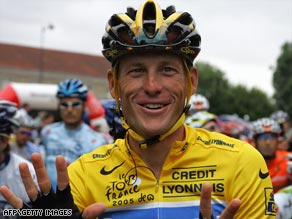
(CNN) -- American cyclist Lance Armstrong suffered a shattering blow in his comeback bid on Monday when he broke his right collarbone after falling on the first stage of a five-day race in northern Spain.

American Armstrong was competing in Spain to regain full race fitness after coming out of retirement.

American Armstrong was competing in Spain to regain full race fitness after coming out of retirement.

Emerging from a hospital with his arm in a sling, Armstrong said he will return to the United States, where doctors will determine whether he needs surgery.

"I'm miserable," said the record seven-time Tour de France champion. "I just need to relax a couple of days and then make a plan."

Astana rider Armstrong crashed about 16 kilometers (10 miles) from the end of the 168-km stage and later said it was the first time he had suffered such an injury in his 17 years as professional.

"It's pretty painful," he said. "Just wait and see how it heals."

The crash took down several riders but Armstrong appeared to be the only one injured.

"That's cycling," he said. "It's nobody's fault. Crashes happen all the time."

As they came within a few miles of the finish, Armstrong said, racers started picking up speed and jockeying for position. Video Watch more about the crash »

"It happens quick when it happens," he said. "It could have been worse."

Armstrong could be out for three to four weeks said Jacinto Vidarte, spokesman for the Vuelta Ciclista Castilla y Leon race.

The injury looks certain to end Armstrong's hopes of challenging for the Giro d'Italia from May 9-31 -- he admitted race plans are now "problematic" --and must cast doubts on his ambition of winning an eighth Tour crown from July 4-26 in France.

The 37-year-old Armstrong, who was taken to Clinico Universitario Hospital in Valladolid, was seen pointing to his collarbone as he sat by the roadside after the accident.

A group of 15 to 20 riders fell, according to Bartosz Huzarski, a cyclist racing for the Italian team ISD. Huzarski, who saw the fall, said he did not know what had caused it. Only Armstrong appeared to indicate he was hurt, the Polish cyclist said.

One of Armstrong's teammates told velonews.com that he did not see the crash but that the accident happened on a tough patch of road.

"I was in the front," Levi Leipheimer told Velonews, a journal of competitive cycling. "It was on really narrow, bumpy roads. It was a pretty bad road, super-rough and narrow. The edges were deteriorating, with cracks and parts missing, It was worse than typical [Spanish roads]."

Armstrong came out of retirement after more than three years to return to competitive cycling in January.

This was his first race alongside Alberto Contador, a Spaniard who won the Tour de France in 2007, two years after Armstrong's last event victory.

But Armstrong denied there was any friction with Contador, who is also riding for Astana.

"I have to respect the current results and he's the best there is right now. Until that changes, he's the leader," Armstrong told CNN before the accident.

Armstrong recently said Contador "still has a lot to learn," but the Spaniard shrugged it off.

"Anyone can say what they like during the race, but I'm not at all nervous," Contador said.

The fall took place a on a beautiful sunny day on a stretch of two-lane highway, Goodman said.

Armstrong's first comeback came in 1998, two years after he was diagnosed with advanced testicular cancer that had spread to his lungs and brain. Doctors gave him a less than 50 percent chance of survival.

He has become a highly visible cancer activist at the head of his Livestrong foundation.

Armstrong, whose Tour triumphs came between 1999-2005, announced in September last year that he would be returning to the saddle.

He launched his comeback in January when he raced in the Tour Down Under in Australia, finishing 29th.

Armstrong then played a key support role as Leipheimer won the Tour of California title in February before finishing 125th in last Saturday's Milan-San Remo in Italy.

He was riding in this week's Castilla and Leon race to continue his bid to reach peak form ahead of the Giro and then the Tour.

Armstrong returned to the sport not only to attempt to become the oldest Tour winner, but also to raise awareness about cancer.

"The most important issue is taking the global epidemic of cancer really to a much bigger stage," explained Armstrong, who previously fought a battle with testicular cancer.

"The best way to do that is to race the bike all over the world. So you race in Australia, South Africa, South America, Europe, America -- that is the first priority," added the Texan.

Saturday, March 21, 2009

42-piece dinner set made from cocaine


BARCELONA, Spain, March 20 (UPI) -- Authorities in Spain said they have seized a 42-piece dinner set made from 42 pounds of cocaine and arrested the intended recipient.

Police said a 35-year-old Spanish man, identified only as JVLL, was arrested and charged with an offense against public health after police seized the package in an international operation coordinated with Venezuela, where the package originated, The Times of London reported Friday.

Investigators said they believe the man was forced to become involved in the cocaine trade by drug traffickers in Venezuela.

Police said the cocaine had been destined for sale in Catalonia, Spain.