Zazzle Shop

Screen printing
Showing posts with label Medical. Show all posts

Wednesday, February 16, 2011

For Cold Virus, Zinc May Edge Out Even Chicken Soup

Scientists still haven’t discovered a cure for the common cold, but researchers now say zinc may be the next best thing.

A sweeping new review of the medical research on zinc shows that sniffing, sneezing, coughing and stuffy-headed cold sufferers finally have a better option than just tissue and chicken soup. When taken within 24 hours of the first runny nose or sore throat, zinc lozenges, tablets or syrups can cut colds short by an average of a day or more and sharply reduce the severity of symptoms, according to the Cochrane Database of Systematic Reviews, a respected medical clearinghouse.

In some of the cited studies, the benefits of zinc were significant. A March 2008 report in The Journal of Infectious Diseases, for example, found that zinc lozenges cut the duration of colds to four days from seven days, and reduced coughing to two days from five.

While the findings are certain to send droves of miserable cold sufferers to the drugstore in search of zinc treatments, the study authors offered no guidance on what type of zinc product to buy. The authors declined to make recommendations about the optimal dose, formulation or duration of zinc use, saying that more work was needed before they could make recommendations.

“Over all, it appears that zinc does have an effect in controlling the common cold,” said Dr. Meenu Singh, the review’s lead author and a professor in the department of pediatrics at the Postgraduate Institute of Medical Education and Research in Chandigarh, India. “But there still needs to be consensus about the dose.”
Zinc experts say that many over-the-counter zinc products may not be as effective as those studied by researchers because commercial lozenges and syrups often are made with different formulations of zinc and various flavors and binders that can alter the effectiveness of the treatment.

“A lot of preparations have added so many things that they aren’t releasing zinc properly,” said Dr. Ananda Prasad, professor in the department of oncology at Wayne State University School of Medicine in Detroit and an early pioneer of research into zinc as an essential mineral. Two of Dr. Prasad’s studies were included in the Cochrane report.

“The public is confused because people have used the wrong dose, they have used the wrong sort of zinc or they have not started the treatment within 24 hours of onset,” he said.

Even so, the new report gives credence to the long-debated theory that zinc can be an effective treatment for colds. While it’s not certain how the mineral curbs colds, it appears to have antiviral properties that prevent the cold virus from replicating or attaching to nasal membranes.

The first study to show that zinc might be a useful treatment for the common cold was published in 1984, but the research was criticized for its poor methods. Since that study, 18 more trials of zinc for colds have been conducted: 11 of them showed it to be a useful treatment, while seven of them showed no benefit, according to the review.

Although a majority of trials have shown some benefit from zinc, many of them have been criticized for failing to “mask” the treatment, meaning the participants most likely knew they were using zinc, which may have skewed the results. At the same time, many of the trials that showed no benefit from zinc have been criticized for using formulations that may have contained ingredients that blunted the effectiveness of zinc.

The Cochrane reviewers selected 15 studies that enrolled a combined 1,360 participants. The studies were all considered to have good methodological quality with a low risk of bias, but they were far from perfect. All the studies compared zinc use with a placebo, but in several studies the zinc users complained about the taste of lozenges, suggesting that some people may have known that they were using zinc rather than a placebo.
Even so, when the data was pooled, the effect shown was strong. The review found that not only did zinc reduce the duration and severity of common cold symptoms, but regular zinc use also worked to prevent colds, leading to fewer school absences and less antibiotic use in children. People who used zinc were also far less likely to have a cold that lasted more than seven days.

The studies used various forms and doses of zinc, including zinc gluconate or zinc acetate lozenges and zinc sulfate syrup, and the dose ranged from 30 to 160 milligrams a day. Several studies in the Cochrane review used zinc acetate lozenges from the Web site ColdCure.com, created by George Eby, the researcher who wrote the first zinc study in 1984.

Dr. Prasad said his studies have used zinc acetate lozenges from ColdCure.com that contained about 13 milligrams of zinc. Study participants took a lozenge every three to four hours during the day for four consecutive days, resulting in a daily dose of 50 to 65 milligrams a day, he said.
Some cold sufferers have been wary about using zinc since the Food and Drug Administration warned consumers to stop using Zicam nasal sprays and swabs, which contain zinc, after numerous reports that some users lost their sense of smell after using the product. The Cochrane report did not review any studies of nasal zinc products.

Monday, January 24, 2011

Food Freezing Technology Preserves Human Teeth. Organs Next?

by Constance J. Woodman

Japanese business man and chef
Chefs and scientists alike can use magnets to prevent the formation of ice crystals during freezing.

A technology used to freeze sushi is solving a dilemma for organ storage. By borrowing tech used to preserve high-end food delicacies, a Hiroshima University research group proved it possible to safely freeze whole teeth and their delicate attaching tissues. As long as the freezer stays cold, the folks at Hiroshima U. think your teeth could be stored for 40 years, no problem. But the sushi-storage system isn’t a one trick pony: internal organs could be next thanks to the magic of supercooling.  In typical cryo-storage, fast freezing of organs requires poisonous levels of anti-freeze, and let’s face it, no one wants a poisoned kidney transplanted into their body. But slower freezing causes cell popping ice crystals to form. So, what do you do to prevent ice crystals during slow freezing? Use magnets. ABI is the Japanese company producing the freezer system. ABI’s “Cells Alive System” (CAS) vibrates water with magnetic fields, preventing freezing, even at supercool temperatures of -10 degrees Celsius (According to the Patent.) When the field is turned off, the water in the food instantly freezes. No time for ice growth means no Freddy Krueger action on frozen organs. Watch some great demonstrations of the technology in the videos after the jump.

Interest in the CAS technology has spread all over the world. In the first video below, a bottle of water is super cooled below freezing in a CAS freezer. The bottle is slammed against the freezer door, inducing ice crystals to form. The bottle of water is instantly turned to solid ice. Supercooling water is a trick you can Try At Home but the CAS system is able to do more than supercool pure liquids. It can supercool, then freeze, meat and vegetables and anything else.  In the second video, CAS frozen flowers are dethawed and arranged in a vase.  The perfect preservation of the flowers is an enormous contrast to my painful childhood memories of sloppy, limp, dinnertime vegetables.  The frozen vegetables were train-wrecked by ice, while these flowers received much, much less damage during freezing.

The transition of this tech from food to longevity science is slowly evolving, but the steps forward are real. You can, right now, pay to store your teeth. Hiroshima University tested the cooling technology for teeth, and uses ABI CAS freezer tech at The Teeth Bank, the world’s first commercial tooth bank. Dr. Toshitsugu Kawata, a Hiroshima University professor who has done extensive research at the Teeth Bank, helped prove that CAS is a viable technology to preserve teeth. Spare teeth used to be worthless medical waste. Now, removed wisdom teeth aren’t garbage, they can be frozen and re-implanted at any point during your life. (The Teeth Bank’s re-implant success rate is 87% according to the Taipei Times. ) Thanks to scientific advances, surgeons can even alter your old teeth by sculpting them, transforming a molar into an incisor. To quote Dr. Kawata, “It’s like having a spare tire.”

In the journal Cryobiology in 2010, a research team including Dr. Kawata published the use of ABI’s CAS freezing technology on teeth. A very tricky part of tooth preservation is keeping tooth ligaments alive, or even some of the ligament cells.  Implanting ligaments is important.  We have ligaments attached to teeth because the force of chewing could grind our chompers out of our jaws.  When the research team tried slow freezing a whole fresh tooth without the CAS magnetic fields, the ligaments didn’t survive and were severely damaged. However, a CAS magnetically vibrated tooth’s ligaments survived. CAS frozen ligament cells grew as well as those from a fresh tooth, and showed only minor damage.

Frozen wasabi
See the intact cell walls? This wasabi suffered very little damage due to ice.

The founder of the ABI Corporation and its CAS freezer, Norio Owada (known internationally as “Mr. Freeze,”) is actively pursuing medical advances.  There’s a hodgepodge of reports out there about what’s being done.  According to various sources, Mr. Freeze is collaborating with 40 researchers to translate their work with teeth and sushi to hearts, nerves, and other organs. Transplant medicine could benefit tremendously. With further research, this technology could supercool, or even freeze internal organs, putting an end to the dangerously brief time frame for organ transplants. In a 2008 Forbes article, Mr. Freeze speculated on where his technology may lead. “If you could preserve a heart for three days, you could fly it anywhere.” On the late-night Japanese TV show, World Business Satellite, there was discussion of research towards using ABI’s CAS freezers to store ovaries during cancer treatment, allowing women to keep their fertility. On the ABI company webpage, photos of a rat heart transplant and undamaged cell walls of frozen wasabi are a reminder of the unusual coupling of frozen food and medicine.

Rat heart surgery
Rat heart transplant for ABI's research

Despite the very promising advances, and actual organ banking technology coming from ABI, information about the company hasn’t been too plentiful on the blog-o-sphere. One problem is that there have only been a couple English language scientific publishings that refer to ABI Corporation LTD or the CAS system. The next problem is that most of the TV and news media is in Japanese. And finally, since CAS freezers are sold internationally, videos and forum posts about people messing with the freezers aren’t always by English speakers. However, this technology could solve major problems associated with cryopreservation of body parts. Because as we’re learning to make organs, we need to learn how to store them.

Looking into the  future, imagine you have heart failure ten years from now. Rather than a frightening race against time to find a donor organ from a cadaver, a spare heart is thawed from a well stocked frozen organ bank.  Hell, you’ve got a CAS freezer full of replacement parts grown from your own cells. Humans are learning how to grow replacement organs through bio-scaffolds and printing (As reported in Singularity Hub.)  Combining organ printing and organ freezing may lead to growing and freezing our own spare parts, well beyond the extra teeth and perfectly preserved wasabi.

[Images, ABI incorporated, World Business Satellite]
[Sources: Journal of Cryobiology, Forbes Magazine, Journal of Biomedical Research]

Friday, August 6, 2010

Touch Bionics Gives an 18-Year-Old Amputee His Hand Back (Video)

by Drew Halley
from: http://singularityhub.com/


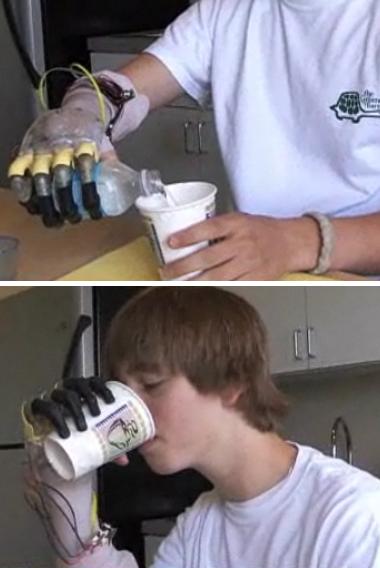
The Today Show recently ran a feature on an 18-year-old who was recently outfitted with ProDigits, the partial hand prosthesis developed by Touch Bionics. Michael Waldron was born with a congenital malformation that left him without four fingers on his right hand; through his life he has adapted to his disability, learning to perform in his high school orchestra and even play lacrosse without a fully functional right hand. But thanks to his new bionic hand, he was able to accept his diploma at graduation – and shake hands with the man who gave it to him. Tear-jerking video after the jump.

As we’ve mentioned earlier, ProDigits is a pretty exciting prosthetic – it shows off some of the leading artificial limb technology around, plus it’s already on the market. The hand can be custom tailored to each particular patient’s disability, as you’ll see in Michael’s case (his thumb fits into the device).

Myoelectric sensors along the forearm measure nerve impulses below the skin, which translates muscle flexing into finger movement. Each digit moves independently, they have pressure sensors to prevent crushing gripped objects, and the device is battery-powered. How much does all that cost? Roughly $70,000.

Check out the Today Show feature:

As you can see from the video, ProDigits does involve a learning curve. The prosthetic requires calibration to the individual user’s body, and it takes some practice to master. ProDigits can either be controlled via forearm muscle sensors (as seen in the video) or via remote pressure sensitive pads. Touch Bionics also markets the expensive but impressive i-Limb, one of a number of leading prosthetics that are integrated with the nervous system remotely.

Which is prosthetic?

Michael’s plight with social stigma is a common one, and one of the reasons that ProDigits can be outfitted with skin-like cosmetic sheaths (called LivingSkin). These “aesthetic restorations” are amazingly life-like, and frankly difficult to distinguish from a natural hand. You can even add artificial hair customized to your own, or add silicone tanning cream for the summer months. Outfitting your ProDigits with a cosmetic cover can help mitigate the unwanted attention that many amputees know too well.

At the Hub for a while we’ve been reporting on the prosthetics revolution, which has really taken off over the last few years. The competing RSPStreeper Bebionic Hand, which uses similar myoelectric sensors along the forearm, hit the market last month with a pricetag of $11,000. Some other prosthetics with more cutting-edge features are still in R&D. The Smart Hand, developed in Europe, is unique in that it sends electrical impulses back to the brain to restore the sensation of touch – but it isn’t yet available to the public.

DARPA is also involved in some cutting-edge prosthetic tech, including the Deka Luke Arm, which uses pads under the feet and shoulder sensors to control the artificial limb. Deka’s arm is not yet on the market, and will likely carry a hefty price tag (plus it’s in competition with the i-Limb, which is already available). Finally, we recently wrote up the most recent Johns Hopkins/DARPA project to actually hardwire a prosthetic directly into the brain, which is just beginning its first human trails and is probably years from marketability (and far beyond most folks’ budgets).

It’s cool to see ProDigits in action, and to get a better sense of how it impacts the lives of its users. While many of these cutting-edge prosthetics remain outside of the financial reach of many amputees (and outside of their insurance plans), they are exciting nonetheless. Time will hopefully bring pricetags down, and give these devices the opportunity to change more lives.

Wednesday, May 26, 2010

Doctor, 100, still working after delivering 18,000 babies

A doctor who has delivered 18,000 babies over a career spanning more than 60 years is still practising at 100 years old.
Doctor, 100, still working after delivering 18,000 babies: Dr  Walter Watson
Dr Walter Watson Photo: Barry Bland / Barcroft

Dr Walter Watson, nicknamed "Papa Doc", has been present at the births of generations spanning from grandparents down to grandchildren during his 63 years as an obstetrician.

The doctor from Augusta, Georgia, USA is thought to be the oldest practising medic in the world.

Among his patients is Sabra Allen, 77, who he has treated for 59 years. He has delivered 17 members of her family.

“He delivered all five of my kids and twelve of the grandkids,” said Mrs Allen, a retired hospital administrator.

“There ain’t no one like him, he’s the best.”

Dr. Watson, who still goes to work every day, said: “There is nothing quite as amazing at witnessing the miracle of life.

“Trouble is I remember the births with complications more vividly than the ones that went perfectly. Once you’ve done several thousand they start blending in together.”

Dr. Watson qualified at the brink of the Second World War but served in Korea until 1947.

When the war ended he returned to Georgia, his wife of 65 years Audrey and the practice of medicine.

Dr Watson turned 100 on February 25.

“I get up at 6.45, have my breakfast and get to the hospital by 8.30,” he said.

“I stopped delivering babies when my eyesight got bad but I do my rounds at the nursing stations and operating rooms just like I’ve always done.”

The women’s centre at University Hospital in Augusta, Georgia, bears Dr Watson's name and there is a bronze statue of him holding a newborn baby.

Dr Watson also delivered his colleague at the hospital, Dr Michel McDonough, who is young enough to be his grandson.

Dr. McDonough said: “His work ethic is unsurpassed by anybody.

“He was around before beepers – back then you were either at the hospital, at home or at church.”

Dr. Watson says he has no plans for retirement despite suffering from minor arthritis and diminished eyesight and hearing.

“I love medicine and I love having contact with people," he said.

“It gives me a reason to crawl out of bed in the mornings.”

According to records Dr Watson is the oldest practising doctor.

The previous record holder was Dr. Leila Denmark, also of Georgia, who practised until she turned 102 in 2000.

Wednesday, October 14, 2009

ImageVis3D Mobile – New iPhone apps allow for detailed analysis of human body in 3D

We’re getting used to hearing about new weird and wonderful apps for the iPhone, everything from cosmic ordering to your own personal voodoo doll app.

200px ImageVis3Mobile ImageVis3D Mobile   New iPhone apps allow for detailed analysis of human body in 3D

The biggest problem with iPhone apps these days is the sheer number of them, tens of thousands of them in fact, so you basically have to sort out the treasures from the trash.

We were fortunate the other day to stumble upon a trio of new apps that could prove pretty useful.

The apps, available in Apple’s iTunes store, were developed by University of Utah researchers, who say they could make life easier for medical professionals and students as well as patients.

So let’s take a look at them:

• ImageVis3D Mobile – This app allows the user to manipulate, display and rotate 3D images from CT (computerized tomography) and MRI (magnetic resonance imaging) scans, as well as other images. It is free to download and is based on software from Utah University’s Scientific and Computing and Imaging Institute (SCI).

• AnatomyLab – If you want to view a virtual dissection of a human body (unless you are a medical student then I can’t imagine why you would), activate the “view cadaver” button. The app, which costs $9.99, allows the user to view no fewer than 40 different stages of dissection of a real human body.

• MyBody – Basically a watered down version of AnatomyLab, developed with the general public in mind. It basically gives the viewer an idea of what the human body looks like inside and out, but not so detailed that it’s meant for medical students. It’s cheaper, too, just $1.99.

The researchers at SCI are developing another iPhone app: ViSUS, which already enables those with a laptop or desktop computer to view, edit and analyze massive image files.

Both ImageVis3D Mobile and ViSUS will “help people visualize and manipulate large amounts of image data,” said Chris Johnson, director of the SCI Institute.

Apparently many medical professionals are already buying AnatomyLab in order to show images to their patients to help explain a diagnosis or injury. Johnson said Image Vis3DMobile could be used for this as well, using the patient’s own scan image.

So don’t be too surprised next time you’re at the doctor’s and he whips out his iPhone to show you what’s wrong.

Welcome to life in the 21st century.

Friday, December 12, 2008

Report of Tom Brady's knee problems 'ridiculous'


Albert Breer
Sporting News

An internet report Thursday quoting unnamed sources portended an end to the career of New England Patriots QB Tom Brady, the reigning NFL MVP, because of complications linked to infections that followed his October knee reconstruction.

A source with intimate knowledge of Brady's condition told Sporting News on Thursday afternoon that "nothing could be further from the truth." The source said Brady is "right on track" to recover in time for the 2009 season, adding his rehab is going "perfectly."

Brady tore his ACL and MCL in the club's Sept. 7 opener against Kansas City and had the reconstructive surgery on his left knee Oct. 6. A post-surgery infection prompted doctors to perform three follow-up procedures on the knee to contain the infection.

Sporting News sources say the infection was successfully contained, and Brady was able to start the rehabilitation process like any other athlete with such an injury.

In October, Dr. James Gladstone, chief of medicine at Mount Sinai in New York, told Sporting News that, "If (the treatment for the infection) works like it's supposed to work, he's got every chance to do as well as anyone with his rehab."

The report of a major, career-threatening setback that surfaced Thursday morning quoted an unnamed orthopedic surgeon with knowledge of Brady's injury as saying, "(His career) is dead. It's over -- plain and simple."

Sporting News' source called that diagnosis "ridiculous."

Staff writer Albert Breer covers the NFL for Sporting News. E-mail him at abreer@sportingnews.com.

Friday, December 5, 2008

Sperm donor fathers 46 children


MAASTRICHT, Netherlands, Dec. 1 (UPI) -- A Dutchman known as Europe's most committed sperm donor says he's fathered 46 children and is willing to keep at it.

"I do it because I know how hard it is for people who desperately want a child," said Ed Houben, a tourism guide from Maastricht.

One of the reasons Houben is so popular, he said, is because many men stopped donating sperm three years ago when the United Kingdom said donors no longer could remain anonymous, The Sun reported Monday.

As a result, British women are going to other countries to find a sperm donor or having sperm samples sent to them, said Houben, noting women find out about him through the Internet and through word of mouth.

Houben, who said he's never had sex with any of his children's mothers, recently held a party at his home for his children and their families.

"The kids had the chance to play with their half-brothers and sisters, which was nice, said Houben.

Monday, November 10, 2008

Top 10 Useless Limbs (and Other Vestigial Organs)

livescience.com — In Charles Darwin's On the Origin of Species (1859) and in his later works, he referred to several "vestiges" in human anatomy that were left over from the course of evolution.


10) The Wings on Flightless Birds

The Cassowary, the sexier, but less-well-known flightless bird.

In 1798, sixty years before Charles Darwin?s first book was published, a French anatomist, É´ienne Geoffroy St. Hilaire, traveled to Egypt with Napoleon where he witnessed and wrote about a flightless bird whose wings appeared useless for soaring. The bird that Hilaire described was an ostrich, but he described it as a "cassowary", a term used back then to describe various birds of ostrich-like appearance. Ostriches and cassowaries are among several birds that have wings that are vestigial. Besides the cassowary, other flightless birds with vestigial wings are the kiwi, and the kakapo (the only known flightless and nocturnal parrot), among others. In general, wings of a bird are considered complex structures that are specifically adapted for flight and those belonging to these flightless birds are no different. They are, anatomically, rudimentary wings, but they could never give these bulky birds flight. The wings are not completely useless, as they are used for balance during running and in flagging down the honeys during courtship displays.

9) Hind Leg Bones in Whales

Whale skeleton showing pelvis and thigh bones (see inset).

Biologists believe that for 100 million years the only vertebrates on Earth were water-dwelling creatures, with no arms or legs. At some point these ?fish? began to develop hips and legs and eventually were able to walk out of the water, giving the earth its first land lovers. Once the land-dwelling creatures evolved, there were some mammals that moved back into the water. Biologists estimate that this happened about 50 million years ago, and that this mammal was the ancestor of the modern whale. Despite the apparent uselessness, evolution left traces of hind legs behind, and these vestigial limbs can still be seen in the modern whale. There are many cases where whales have been found with rudimentary hind limbs in the wild, and have been found in baleen whales, humpback whales, and in many specimens of sperm whales. Most of these examples are of whales that had only leg bones, but there were some that included feet with complete digits. It was reported recently that whales and hippos were distantly related.

8) Erector Pili and Body Hair

When a rabbit is scared, its hair stands on end. When a human is scared, he or she calls the police.

The erector pili are smooth muscle fibers that give humans ?goose bumps.? If the erector pili are activated, the hairs that come out of the nearby follicles stand up and give an animal a larger appearance that might scare off potential enemies and a coat that is thicker and warmer. Humans, though, don?t have thick furs like their ancestors did, and our strategy for several thousand years has been to take the fur off other warm looking animals to stay warm. It?s ironic actually that an animal, sensing danger is near, would puff up its coat to look scarier, but the human hunter would see the puffier coat as a warm prize, leaving the thinner haired weaker looking animals alone. Of course, some body hair is helpful to humans; eye brows can keep sweat out of the eyes and facial hair might influence a woman?s choice of sexual partner. All the rest of that hair, though, is essentially useless.

7) The Human Tailbone (Coccyx)

The human tailbone doesn't do much, but really hurts if you land on it.

These fused vertebrae are the only vestiges that are left of the tail that other mammals still use for balance, communication, and in some primates, as a prehensile limb. As our ancestors were learning to walk upright, their tail became useless, and it slowly disappeared. It has been suggested that the coccyx helps to anchor minor muscles and may support pelvic organs. However, there have been many well documented medical cases where the tailbone has been surgically removed with little or no adverse effects. There have been documented cases of infants born with tails, an extended version of the tailbone that is composed of extra vertebrae. There are no adverse health effects of such a tail, unless perhaps the child was born in the Dark Ages. In that case, the child and the mother, now considered witches, would?ve been killed instantly.

6) The Blind Fish Astyanax Mexicanus

Astyanax Mexicanus: growing up in the wrong neighborhood.

In an experiment designed by nature, the species of fish known as Astyanax mexicanus, dwelling in caves deep underground off the coast of Mexico, cannot see. The pale fish has eyes, but as it is developing in the egg, the eyes begin to degenerate, and the fish is born with a collapsed remnant of an eye covered by flap of skin. These vestigial eyes probably formed after hundreds or even thousands of years of living in total darkness. As for the experiment, a control is needed; and luckily for us, fish of the same species live right above, near the surface, where there is plenty of light, and these fish have fully functioning eyes. To test if the eyes of the blind mexicanus could function if given the right environment, scientists removed the lens from the eye of the surface-dwelling fish and implanted it into the eye of the blind fish. It was observed that within eight days an eye started to develop beneath the skin, and after two months the fish had developed a large functioning eye with a pupil, cornea, and iris. The fish were blind, but now they see.

5) Wisdom Teeth in Humans

They need regular brushing.

With all of the pain, time, and money that are put into dealing with wisdom teeth, humans have become just a little more than tired of these remnants from their large jawed ancestors. But regardless of how much they are despised, the wisdom teeth remain, and force their way into mouths regardless of the pain inflicted. There are two possible reasons why the wisdom teeth have become vestigial. The first is that the human jaw has become smaller than its ancestors? and the wisdom teeth are trying to grow into a jaw that is much too small. The second reason may have to do with dental hygiene. A few thousand years ago, it might be common for an 18 year old man to have lost several, probably most, of his teeth, and the incoming wisdom teeth would prove useful. Now that humans brush their teeth twice a day, it?s possible to keep one?s teeth for a lifetime. The drawback is that the wisdom teeth still want to come in, and when they do, they usually need to be extracted to prevent any serious pain.

4) The Sexual Organs of Dandelions

Send in the clones ...

Dandelions, like all flowers, have the proper organs (stamen and pistil) necessary for sexual reproduction, but do not use them. Dandelions reproduce without fertilization; they basically clone themselves, and they are quite successful at it. Look at any lawn for the proof. If dandelions were to revert to sexual reproduction, they might not retain whatever traits they have that allow them to be pests to gardeners everywhere. If flowers can begin reproducing in this manner, does that mean animals, even humans could too? Asexual reproduction can be a good strategy in an environment that is constant if a species is well suited to those conditions. It doesn?t take a scientist to figure out that humans wouldn?t last long if the condition set forth was no sexual contact with others. Therefore, the human sexual organs are probably in no danger of becoming vestigial.

3) Fake Sex in Virgin Whiptail Lizards (Vestigial Behavior)

Feminist lizards take the male out of the picture.

Only females exist in several species of the lizards of the genus Cnemidophorus, which might seem like a problem when it comes time to propagate the species. The females don?t need the males though, they reproduce by parthenogenesis, a form of reproduction in which an unfertilized egg develops into a new individual. So basically, the females don?t need the males; they just produce clones of themselves as a form of reproduction. Despite the fact that it is unnecessary and futile to attempt copulation with each other, the lizards still like to try, and occasionally one of the females will start to ?act like a male? by attempting to copulate with another female. The lizards evolved from a sexual species and the behavior to copulate like a male -- to engage in fake sex -- is a vestigial behavior; that is, a behavior present in a species, but is expressed in an imperfect form, which in this case, is useless.

2) Male Breast Tissue and Nipples

Oh yeah, really handy those ...

The subject of male nipples is a sensitive, and maybe confusing, topic to many. Those who wish to invalidate evolutionary theory might pose the question, ?Was man descended from woman?? The answer, of course, is no. Both men and women have nipples because in early stages of fetal development, an unborn child is effectively sexless. Nipples are present in both males and females; it is only in a later stage of fetal development that testosterone causes sex differentiation in a fetus. All mammals, male and female, have mammary glands. Male nipples are vestigial; they may perform a small role in sexual stimulation and a small number of men have been able to lactate. However, they are not fully functional and, because cancer can grow in male or female breast tissue, the tissue can be dangerous.

1) The Human Appendix

Leonardo da Vinci?s sketch of the intestines that included the appendix.

In plant-eating vertebrates, the appendix is much larger and its main function is to help digest a largely herbivorous diet. The human appendix is a small pouch attached to the large intestine where it joins the small intestine and does not directly assist digestion. Biologists believe it is a vestigial organ left behind from a plant-eating ancestor. Interestingly, it has been noted by paleontologist Alfred Sherwood Romer in his text The Vertebrate Body (1949) that the major importance of the appendix ?would appear to be financial support of the surgical profession,? referring to, of course, the large number of appendectomies performed annually. In 2000, in fact, there were nearly 300,000 appendectomies performed in the United States, and 371 deaths from appendicitis. Any secondary function that the appendix might perform certainly is not missed in those who had it removed before it might have ruptured.

Friday, November 7, 2008

Annoying Body Glitches: Can We Prevent Them?


By: Vicki Santillano

Last night, I was ripped from a peaceful slumber gasping and writhing in pain, clutching my calf in shocked agony as the muscle throbbed and burned mercilessly. Yes, it was the dreadful charley horse invading my night once again. I’ve been getting these terrible muscle spasms routinely since I was little, yet it’s only recently that I’ve begun to wonder why they even happen in the first place.

Our bodies are organized jumbles of parts and functions with specific purposes, but like any fine-tuned machine, there is room for internal error every now and then. We’ve all experienced some variation of these “issues”—hiccups, spasms, odd stomach noises, and so forth. Many are embarrassing or annoying, but so common that we don’t think much about their causes or potential solutions. However, there are reasons behind things as seemingly insignificant as hiccupping, and sometimes, there are ways to avoid them.

Charley Horses
Charley horses, which usually occur in the legs or feet, are very common and strike people of all ages and activity levels. What happens during these nighttime episodes is a muscle begins contracting and is unable to pick up cues to stop, causing discomfort and muscle fatigue. A variety of factors, including sore muscles, hormonal or mineral imbalances, and dehydration, can contribute to the onset of charley horses. Pregnancy, a lack of calcium or potassium, and improper stretching are frequently listed as catalysts.

Can they be avoided? There’s not a sure-fire method for permanently getting rid of charley horses, but by staying hydrated, stretching before and after exercise, and incorporating good sources of calcium and potassium into our diets, we can reduce the likelihood of getting them. To minimize the pain and length of a cramping episode, rub the muscle and lift the leg so that blood can flow beyond the affected area.

Pre-Sleep Body Jerks
Yet another thief of precious sleep time, body jerks—also called hypnic jerks—refer to the way our bodies sometimes “jerk” awake right before we’re about to fall asleep, usually accompanied by a panicked feeling of falling. There are different explanations given for why this happens, but the blame finger is usually directed at our brains, which sometimes get confused by our muscles easing into sleep and causes them to tense up, thinking that we’re falling. The misinterpretation could be a reaction to our brains not being ready for sleep, either due to stress, fatigue, or too much stimulation (exercise, caffeine consumption) before bed.

Can they be avoided? Since hypnic jerks have been linked to the sleep troublemakers listed above, avoiding them could lessen the prevalence of body jerks in our lives, but chances are we will experience them again at some point.

Eye Twitches
Eye twitches are very common and are usually caused by temporary faulty functioning of the part of the brain that controls muscle movement. They usually occur randomly and can be quite alarming—after all, are our eyes supposed to twitch like that? Most of the time, twitching eyes, though bothersome, are nothing to worry about, even though their technical name—blepharospasm—sounds kind of scary. With some people, it occurs after or during a bout of dry eye, and it can also be triggered by stress, lack of sleep, and eye strain.

Can they be avoided? To decrease twitching incidences, be mindful of sleep, stay calm, and regularly move your eyes away from the computer screen. However, we can sometimes inherit a higher likelihood of twitching, so they can’t always be avoided.

Hiccups
It seems like hiccups come at the worst possible times, like when I’m in a library or in the middle of a quiet office. Why do hiccups happen? Again, the culprit is routine body functions randomly misbehaving. The diaphragm helps the lungs get more air by contracting, but if something affects the diaphragm negatively (e.g. eating quickly), it contracts violently, causing us to breathe in quickly and make an annoying, loud sound.

Can they be avoided? By eliminating the actions that affect the diaphragm in this manner, such as eating or drinking too fast or too much, or eating something very hot, we can reduce our hiccup maladies. Everybody has a supposed foolproof method for getting rid of them (a spoonful of sugar, being scared, etc.), but the success of treatment depends on the person. Most suggested cures involve distracting the person from the hiccups or, in the case of sugar, hoping the sweet spoonful on the tongue will send a message to the diaphragm to halt contraction.


Stomach Growls
Loud, embarrassing stomach noises are another of those bodily functions that only occur when we really don’t want them to—and they’re not even limited to when we’re hungry! Borborygmi (its technical name) happens when our digestive system tries to digest food when there isn’t any food there. The sounds we hear are produced by stomach and intestinal juices mixing around without anything to work with. It can happen when we’re not even hungry because when the stomach is empty, messages are sent to your brain to signal the desire for food and restart the digestive process. Even if we ate just a couple of hours ago, our bodies want to make sure we know to replenish ourselves in the future.

Can they be avoided?
Other than constantly eating (which would probably cause a host of other digestion issues), the occasional stomach gurgles might just be a fact of life. Anything happening more frequently than that or any growls causing stomach pain should be checked out by a doctor.

Noisy Joints
Some of us purposefully pop our joints, and others can’t help but do it when we bend down or stretch. Either way, the odd sound can be caused by different things: air pockets being created and released by movement, arthritis, and tightened ligaments. Though the popping or cracking noises are a bit unnerving—and tend to make us feel older than we are—they usually aren’t cause for serious alarm.

Can they be avoided? There is no real way to avoid random gas bubbles between our joints popping every now and then, but one potential cause of them—too much strain on the joints—can be reduced by properly stretching and easing into exercise. Basically, don’t jump from walking to training for a marathon—let your body gradually make the transition to higher-intensity movements.

Ticklish Spots
Being ticklish can be annoying, especially when I’m getting a pedicure. I have to bite my lip to keep from laughing when they scrub the dead skin from my feet, yet the other patrons sit there calmly and actually enjoy the experience. Most people have certain sensitive spots, and their locations vary from person to person. Scientists postulate that this sensitivity is a defense mechanism to protect us from potentially harmful creatures like spiders crawling on us. Charles Darwin believed that there is a social link between giggling and tickling, that we laugh because we anticipate the sensitivity, but also because we trust the source of the tickles. In any event, it’s almost always a sure source of belly laughter.

Can they be avoided? Being ticklish can also be associated with anxiety—people who are more anxious or on-edge can have more extreme reactions to surprise tickle attacks because that’s how their bodies respond to potential threats. For example, if it was an actual bug crawling on the person, the uncontrollable laughs might be replaced with shrieks. Others remain unphased by tickling because they are better at keeping calm. If you want to avoid being ticklish, focus on staying cool.

Even with the suggested ways to avoid or decrease body oddities, sometimes there’s just no way around them. Stomachs will growl, joints will pop, and I’m sure there’s another charley horse in my future. As long as our bodies keep running smoothly the rest of the time, we can live through a few embarrassing or annoying kinks in the system here and there. And if your stomach talks really loudly like mine does, just feign ignorance … or blame the person next to you.

Image source: Laura Bell (cc)