Zazzle Shop

Screen printing
Showing posts with label Holographic TV. Show all posts

Thursday, November 4, 2010

Holographic communication flickers into life in Arizona

Long anticipated by science fiction, real-time holographic communication and 'telepresence' are finally within our grasp

  • From: guardian.co.uk,
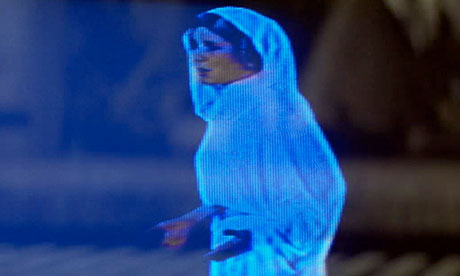
  • Hologram of Princess Leia in the first Episode of Star Wars
    Princess Leia's holographic SOS. Researchers report in Nature today the transmission of moving 3D holographic images in almost real time. Photograph: PR

    In Star Wars, Princess Leia records a 3D hologram of herself appealing for help from the Rebel Alliance in her epic battle against the Empire. The Emperor himself projects holographic messages to his henchman, Darth Vader. And, very soon, you too will be able to transmit messages in a similar way, whether or not you are involved in a galactic battle between good and evil.

    Thanks to scientists at the University of Arizona, real-world holograms have finally started to catch up with their fictional cousins. In a paper published today in Nature, they report the transmission of moving 3D images from one place to another in almost real time. This means it may eventually be possible to communicate with moving 3D images of friends or colleagues who are on the other side of the world. Surgeons will be able to use the technology to step into virtual operating theatres in other cities, and films will become ever more immersive.

    "Holographic telepresence means we can record a 3D image in one location and show it in another location, in real-time, anywhere in the world," said Nasser Peyghambarian, who led the team behind the new technology.

    Until now, scientists have been able to create holograms that display static 3D images, but creating video has not been easy. Two years ago, Peyghambarian's team demonstrated a device that was able to refresh a holographic image once every few minutes – it took around three minutes to produce a single-colour image, followed by a minute to erase that image before a new one could be written into its place.

    In his latest project, Peyghambarian's team reduced that image refresh time to two seconds. They also showed it was possible to use full colour and demonstrated parallax, whereby people looking at the image from different angles will see different views of the image, just as if they were looking at the original object.

    One of the first applications is likely to be in telepresence meeting systems. The most advanced modern telepresence systems use large, high-definition video screens to display standard 2D images. Holographic technology could be incorporated to make the people on the screen 3D.

    "Let's say I want to give a presentation in New York," said Peyghambarian. "All I need is an array of cameras here in my Tucson office and a fast internet connection. At the other end, in New York, there would be the 3D display using our laser system. Everything is fully automated and controlled by computer. As the image signals are transmitted, the lasers inscribe them into the screen and render them into a three-dimensional projection of me speaking."

    The holographic images are captured using feeds from an array of standard video cameras, each recording the subject from a different perspective every second. More cameras mean more perspectives can be recorded, so the resulting hologram can be more detailed. The visual information is encoded into short laser pulses that write individual holographic pixels, known as hogels, on to a screen.

    "If you go to a 3D film like Avatar, you'll see only two perspectives, one for one eye and one for the other eye. In our case, we've demonstrated 16 perspectives, but the technology has the potential to show hundreds of perspectives. It's very close to what humans can see in their surroundings," said Peyghambarian. "In surgery, for example, the cameras will be around where the surgery is done, so that different doctors from different parts of the world can participate and they can see things just as if they were there."

    Whereas the image of Princess Leia in Star Wars is projected in three-dimensional space, the new technology uses a 2D screen to create the illusion of 3D. At the heart of Peyghambarian's system is his team's invention of a new type of plastic known as a photorefractive polymer. The material, which is used to make the screen, allows the researchers to record and erase images quickly.

    The protoype described in Nature used a 10-inch screen, but the team have already improved on this with a 17-inch version.

    "In terms of size, if you look at that famous hologram of Princess Leia, we are about that size," said Peyghambarian. "It is actually very close to reality. It is no longer science fiction, it is something you can do today."

    Bringing the 3D holographic technology to market will involve reducing the size of the individual hogels to get a sharper image, and increasing the refresh rate of the image to around 30 times per second, so that it has the same smoothness as television. Even then, said Peyghambarian, the amount of data needed for a telepresence system could easily be carried by standard 2 or 3 gigabit per second internet cable of the kind already in use today.

Tuesday, July 20, 2010

Create a 3-D Hologram With Your iPad

By Julia Kaganskiy

From: http://thecreatorsproject.com/

N-3D DEMO from aircord on Vimeo.


Screw video conferencing. Toss out those 3-D glasses. We just got one step closer to making portable holographic videos a reality (something we’ve all been waiting for ever since the first Star Wars flick came out back in 1977). This new demo from Japan-based creative team Aircord labo uses nothing more than a glass prism (with “special film”), a projector, and an iPad to create a 3-D display that runs on OpenFrameworks and MaxMSP (you can download the program files here). Think that’s pretty badass? So do we. But wait, there’s more! With an installed application, the program can also respond to sound, making the 3-D holovid display interactive.

The simplicity and accessibility of this design is what makes it most exciting to us. We can’t wait to see what happens when the OpenFrameworks community takes hold of this thing and takes it for a joy ride. How long do you think it’ll be before holovids are on the iPhone? We give it 5 years.

[via CreativeApplications.net]

Friday, March 13, 2009

HoloTV Images Jump off the Screen, into Tomorrow's Homes (w/Video)

March 12th, 2009 By Lisa Zyga HoloTV Images Jump off the Screen, into Tomorrow's Homes

Enlarge

A holoTV image of a man walking appears in front of a transparent screen. Excerpt from video below. Credit: José J. Lunazzi, et al.

(PhysOrg.com) -- Unlike today’s biggest and most realistic LCD and plasma TVs, 3D TV screens can project images that seem to float in mid-air beyond the screen. That means, for instance, that viewers could watch basketball players dribble in front of, next to, or behind the TV screen as they go for a lay-up.

In a recent study, a team of researchers has developed a type of 3D called “holoTV,” which works a bit differently than a standard system. The holoTV system projects a or animation onto a white-light screen, creating an image that appears to float in front of the screen. Viewers don’t need to wear special to view the floating images, which have the appearance of , although the system is not volumetric. The scientists, from the University of Campinas in Sao Paulo, Brazil, and the High Polytechnic Institute José Antonio Echeverría in Havana, Cuba, have published their study in a recent issue of Optics Letters.

“3D TV is a general term, which can be applied to all systems where depth is perceived, but usually requires goggles,” lead author José Lunazzi, a professor at the University of Campinas, explained to PhysOrg.com. “Only holoTV and holography have continuous parallax, which means that when the observer moves his head, he can see different views without discontinuities.”

As Lunazzi explained, holography is academically defined as an object’s light wave interfering with a reference wave. One proposed technique for holographic TV involves using a laser to render the images, as in conventional holography, but registering electronically. However, this scheme requires the detection to have 10 times more resolution than is currently available, even to produce very small images, making holographic TV impractical for now.

In contrast, Lunazzi and his colleagues refer to their technique as holoTV, a term they adopted in 1990. Unlike holographic TV, holoTV doesn’t involve a reference wave. Instead, as in the researchers’ current holoTV system, holographic images are created from projection in a diffractive screen made by the splitting and subsequent interference of a light beam on a holographic film.

“3D images are impressive when they appear in front of a support, like ghosts which your hand goes through,” Lunazzi said. “These images are often named ‘floating images,’ which don’t require goggles. The support may be so transparent that it is not perceived. Other systems show images on transparent screens which are 2D, and to be more impressive they say ‘holographic images’ when they are actually ‘ghost images.’ These can be of large size, as seen in shows, but viewers who are close can notice the lack of depth.”

In the researchers’ set-up to make the screen, a laser emits a beam that is divided in two by a beam splitter. One of the beams is reflected by a mirror and then reaches a spatial filter, which causes the beam to diverge. The second beam travels through a cylindrical lens that causes that beam to diverge in only one direction, and then passes through a diffuser.

Then the two wide beams intersect at a 45° angle, and their interference is recorded on a holographic film, which becomes the 60cm x 30cm screen. When projecting on the screen, each wavelength of the white-light beam converges at a different position beyond the screen, so that a viewer’s left and right eyes receive light at different wavelengths (different colors), each composed of many beams converging toward the eyes. The projection makes each eye receive a different view to compose the scene as a natural one.

Using a diffraction grating, the researchers demonstrated how to project the image in front, behind, or next to the screen. The diffraction causes a blur on the screen, and the wider the blur, the greater the distance between the image and the diffraction grating - and the greater the depth of the image. One example the researchers demonstrated is an image of a man walking, which is projected 27cm in front of the screen. When sitting 140cm from the screen, a viewer would have a narrow field of view of 24cm (or 11°), enough to accommodate small head movements.

“Two or three persons can watch, in fact, if seated along a line,” Lunazzi said. “To achieve a larger angle, greater diffractive power is needed and could be obtained by larger interference angles on the recording of the screen. New materials should in fact be used to obtain higher diffraction efficiency to reduce the effect of the ambient light.” The researchers have already constructed improved screens, and plan to publish the results in upcoming papers.

Many other recent studies have been investigating 3D TV technology, which is already commercially available in Japan, although viewers must wear goggles. There is still limited viewing content, since only specially recorded shows can be viewed on 3D TVs: a scene must be filmed from many sides and then incorporated into a single image to be projected in 3D. Ideally, a holoTV would produce floating images that can be viewed at any angle, be updated quick enough to allow for smooth TV viewing, and be affordable. Whether hung flat on a wall or set like a checkerboard on a coffee table, holographic and holoTV displays could bring TV action into the living room.

Besides TV, other applications could include 3D advertisements in department store windows, as well as medical uses. For example, surgeons currently need to take multiple 2D scans to view organs from different angles, but 3D imaging could give them a fuller, more realistic view.

More information: José J. Lunazzi; Daniel S. F. Magalhães; Noemí I. R. Rivera; and Rolando L. Serra. “Holo-television system with a single plane.” February 15, 2009 / Vol. 34, No. 4 / Optics Letters.

Copyright 2009 PhysOrg.com.
All rights reserved. This material may not be published, broadcast, rewritten or redistributed in whole or part without the express written permission of PhysOrg.com.

Thursday, November 6, 2008

How the CNN Holographic Interview System Works

CNN's holographic election coverage is fancy pantsy, but how did they manage to send 3D 360 degree footage of virtual correspondent Jessica Yellin from Chicago all the way to the station's election center in NY? As Arthur C. Clarke says, Magic. A magic made possible from technology Vizrt and SportVu with the help of forty-four HD cameras and twenty computers. Here are the details.

On the subject's side:
• 35 HD cameras pointed at the subject in a ring
• Different cameras shoot at different angles (like the matrix), to transmit the entire body image
• The cameras are hooked up to the cameras in home base in NY, synchronizing the angles so perspective is right
• The system is set up in trailers outside Obama and McCain HQ
• Not only is it mechanical tracking via camera communication, there's infrared as well
• Correspondents see a 37-inch plasma where the return feed of the combined images are fed back to them. Useful for a misplaced hair or an unseemly boogar
• Twenty "computers" are crunching this data in order to make it usable

On the HQ side:
• Only used on two out of 40-something total camera feeds that CNN has
• Wolf Blitzer really loves it (or loves Jessica Yellin):

It's still Jessica Yellin and you look like Jessica Yellin and we know you are Jessica Yellin. I think a lot of people are nervous out there. All right, Jessica. You were a terrific hologram.

• The delay is either minimal, or we've gotten used to satellite delay that we don't even notice now
• An array of computers takes the crunched info feed from the subject's side in order to mesh it with the video from Wolf's side.
• Unfortunately, it doesn't look like the images are actually "projected" onto the floor of the CNN studio so that Wolf can actually talk to the person, you know, in a face to face. So it's not quite Star Wars just yet. Only after computers merge the video feeds together do you get a coherent hologram + person scenario

CNN Hologram TV First


During the American election Jessica Yellin was recorded as a hologram and beamed into the studio