Zazzle Shop

Screen printing
Showing posts with label Foreign Culture. Show all posts

Friday, January 21, 2011

The World's 10 Happiest Countries


Christopher Helman

Think about it for a minute: What does happiness mean to you?

For most, being happy starts with having enough money to do what you want and buy what you want. A nice home, food, clothes, car, leisure. All within reason.

But happiness is much more than money. It's being healthy, free from pain, being able to take care of yourself. It's having good times with friends and family.

In Pictures: The World's Happiest Countries

Furthermore, happiness means being able to speak what's on your mind without fear, to worship the God of your choosing, and to feel safe and secure in your own home.

Happiness means having opportunity--to get an education, to be an entrepreneur. What's more satisfying than having a big idea and turning it into a thriving business, knowing all the way that the harder you work, the more reward you can expect?

With this in mind, five years ago researchers at the Legatum Institute, a London-based nonpartisan think tank, set out to rank the happiest countries in the world. But because "happy" carries too much of a touchy-feely connotation, they call it "prosperity."

Legatum recently completed its 2010 Prosperity Index, which ranks 110 countries, covering 90% of the world's population.

To build its index Legatum gathers data from 12 sources the Gallup polling group, the Heritage Foundation and the World Economic Forum. Each country is ranked on 89 variables sorted into eight subsections: economy, entrepreneurship, governance, education, health, safety, personal freedom and social capital.
The core conceit: Prosperity is complex; achieving it relies on a confluence of factors that build on each other in a virtuous circle.

"To use economic measurements alone to gauge the success of a nation would be equivalent to assessing the entire condition of a man simply by looking at his bank balance," writes Peter Mandelson, former U.K. economic minister.

To that end, the inputs used to create the index are both objective and subjective: that's because it's not enough to know hard data like a country's unemployment or inflation rates. It also matters how hard people think it is to find jobs, how convinced they are that hard work can bring success.

This can get complicated. In Nepal, for example, inflation is 11%, unemployment 46%. Yet a surprisingly high 50% of the people say they are satisfied with their standard of living and 81% have confidence in their banks. Could be they're scared of voicing their true opinion in a shaky democracy, or maybe the Nepalese are just endemically happier people. Legatum adjusts for this, adding a variable called "ability to express political opinion without fear."

What's the most prosperous country in the world? Norway. What's it got that the rest of the world doesn't? The biggest bump comes from having the world's highest per capita GDP of $53,000 a year. Norwegians have the second-highest level of satisfaction with their standards of living: 95% say they are satisfied with the freedom to choose the direction of their lives; an unparalleled 74% say other people can be trusted.

Cynics (particularly those leaving comments on Legatum's excellent website) say Norway's ranking is a fluke, that it's a boring, godless (just 13% go to church) homogeneous place to live with a massive welfare state bankrolled by high taxes. Without massive offshore reserves of oil and gas that it exports to the world through state-controlled Statoil, Norway's GDP would be far smaller.

And yet joining Norway in the top 10 prosperous countries are its Scandinavian sisters Denmark, Finland and Sweden, with equally small and civilized Switzerland and the Netherlands also in the club. None of these countries are blessed with great hoards of oil and gas.

So what gives? What do these prosperous European nations have in common that can somehow explain their prosperity? Being an electoral democracy is almost a given--of the top 25 most prosperous countries, only Singapore and Hong Kong aren't.

Being small helps too. Big countries have so many disparate groups (ethnic, geographic, civic) vying against each other that it's hard for true social cohesion and trust to emerge, and harder to maintain high levels of safety. Among countries with populations of more than 150 million, the United States ranks highest, at No. 10.

What else? They are all borderline socialist states, with generous welfare benefits and lots of redistribution of wealth. Yet they don't let that socialism cross the line into autocracy. Civil liberties are abundant (consider decriminalized drugs and prostitution in the Netherlands). There are few restrictions on the flow of capital or of labor. Legatum's scholars point out that Denmark, for example, has little job protection, but generous unemployment benefits. So business owners can keep the right number of workers, while workers can have a safety net while they muck around looking for that fulfilling job.

Of perhaps utmost importance, nearly all the nations in the top 10 are adept at fostering entrepreneurship and opportunity. Legatum's researchers concluded that a country's ranking in this area is the clearest proxy of its overall ranking in the index.

This means low business startup costs, lots of cellphones, plenty of secure Internet servers, a history of high R&D spending and the perception that working hard gets you ahead.

That last bit--the perception that working hard pays off--is especially vital. Consider that Denmark and Sweden rank first and second in entrepreneurship and opportunity, but only 77% of Swedes and 84% of Danes think that working hard will get them ahead. Compare that with the U.S., the No. 3 country for entrepreneurship and opportunity. Fully 9 of 10 Americans think that hard work will pay off.

Perception matters. Alan McCormick, a managing director at Legatum, points out that the U.S. remains the envy of the world when it comes to entrepreneurialism, pointing out that during the recession year of 2009, Americans created 558,000 new businesses each month. That's 27,000 more per month than in 2008 and 60,000 more per month than in 2007.

For countries that want to move up in the prosperity rankings, that care about improving the happiness of their people, one of the best ways may be to cultivate an entrepreneurial culture.

"Over the last three decades, new startups have accounted for nearly all of the increased employment in the American private sector," says McCormick. "Entrepreneurial societies raise levels of expectation and produce a culture in which human potential is released, healthy risk-taking is encouraged, and where the fledgling business ideas of today become the global-selling products of tomorrow."

Entrepreneurialism also gives a society a mechanism by which it can address and improve other aspects of the prosperity ecosystem. Want better education, health care or safety? Someone's ready to sell it to you.
So what else does the U.S. have going for it? High levels of governance, education and freedom. But most surprising, Legatum gives the U.S. the top ranking in the world when it comes to health.

Huh? Didn't we spend last year decrying the sorry state of an American health care system that had left 40 million uninsured? This doesn't mean the U.S. has the best health care system, says McCormick, but $5,500 a year in per-capita health spending has resulted in excellent vaccination rates, water quality and sanitation.

Lacking: the U.S. scored just 62nd in feeling "well rested." Compare that with China, which ranked 12th in being well rested.

That takes us back to our original question: What does happiness mean to you? Does being well rested fit into the equation? Maybe. But not if all that shuteye is because you don't have a job to go to. Or if you have no choice but to rest because you don't have access to real medical care. China ranks 66th in health, spending just $350 per capita per year.

Overall China is the 58th most prosperous nation in the world. Despite scoring well in economic measures, it's dragged down by a rank of 92nd in safety and security and 102nd in personal freedom (just edging out Saudi Arabia and Zimbabwe).

And the worst? Zimbabwe is the least prosperous country on Earth, followed by Pakistan, according to the study, with most of the rest of sub-Saharan Africa not much better. To be fair, some countries, like North Korea, are so far off the deep end that they don't publish any data or let in pollsters to quiz their people.
How to improve their plight? Economic growth at all costs. Roger Bate, a fellow at the American Enterprise Institute, points out that if you live in one of the poorest nations, a doubling of income from $3,000 to $6,000 per year will generate a lot more additional happiness than would a pay raise of the same amount, from $33,000 to $36,000, for a citizen of a prosperous country.

Ultimately how happy you are depends on how happy you've been. If you're already rich, like Scandinavia, then more freedom, security and health would add the most to happiness. For the likes of China and India (ranked 88th), it's more a case of "show me the money." What they want most of all? The opportunity to prove to themselves that money doesn't buy happiness.
In Pictures: The World's Happiest Countries

Friday, March 12, 2010

Bhang Your Head! Hindu Holi Festival Celebrated With Marijuana Milk Shakes

By Steve Elliott
From: http://www.tokeofthetown.com/
Monday, Mar. 8 2010 @ 12:14PM
h01_18257809.jpeg
Photo: AP/Gemunu Amarasinghe
"Dude... I am soooo high." (Or the local equivalent.) Men smear colored powder on each other's faces during celebrations of Holi, the Hindu spring festival of colo

They're getting that old time religion in northern India, as the annual Holi festival, an extravagant Hindu spring celebration of colors, is observed with potent marijuana milk shakes.

The festival, celebrated in March each year (the exact date depends on the lunar calendar), is an occasion during which men, women and children play wildly with water guns and colored powder, according to The Observers. And the fact that "bhang thandai," an almond-flavored milk shake blended with cannabis, is a prominent part of the celebration doesn't hurt the festive atmosphere one bit.

Bhang Shop.jpeg
Photo: Fractal Enlightenment
While technically "illegal," bhang is still sold in government-authorized shops in India.
​The marijuana milk shakes are widely served, from exclusive private gatherings to street parties. On this particular day, using bhang is considered completely acceptable for all adults, youths to grandparents.

Cannabis is technically illegal in India, since the nation is a signatory to Harry Anslinger's 1961 Single Convention narcotics treaty. But the substance has been a part of the country's cultural heritage for thousands of years, and a law that's been around less than half a century hasn't made much of an impact. Bhang is sold for consumption through government licensed outlets.

According to popular legend, bhang drinks were offered to the gods and were particularly loved by Lord Shiva. If that's a close enough connection for the revelers to get stoned, then it works for me, too. Praise Shiva and pass the bhang, homies!

holi1 imovies4you.com.jpeg
Photo: iMovies4you.com
​"At places, the revelry becomes rowdy and violent," said Percy Fernandez, a New Delhi-based consultant. "Not just bhang, Holi is also associated with heightened guzzling of alcohol. Marijuana is not legal in India, but the tradition of having bhang during Holi is that it has a religioius association."

"I know of shops selling bhang served with thandai (a combination of milk, almonds, and cardamom) and sweets among other eatables," Fernandez said. "Cannabis is traditionally smoked with tobacco or eaten in the form of pakkoras or even sweets."

"For me, Holi is all about being a kid again, shedding your inhibitions, getting colors all on you, generally having a good time," said Rahul Verghese, a Gurgaon-based entrepreneur.

h03_18271171.jpeg
Photo: Reuters/K.K. Arora
Women tear off the clothes of men as they play huranga, a game played between men and women a day after the Holi festival during which men drench women with liquid colors and women tear the men's clothes off.
​"In our little colony... we have a little celebration with food, drinks and bhang," Verghese said. "It tastes smooth, and doesn't hit you initially, but a little later you're knocked out."

The fun's not over on the day after the Holi festival. Huranga, a game played between men and women on the day after Holi, involves men drenching women with liquid colors and women tearing off the men's clothes. [Craig Ferguson voice] "I knooooow!"

Factor in that practically everybody involved is high as a freakin' kite, and got-DANG if that doesn't sound exactly like my kind of party.

Here's a bhang-up recipe, courtesy of Fractal Enlightenment:

2413-Bhang.jpeg
Photo: Cannabis Culture
Bhang

2 cups water
1 ounce marijuana (fresh leaves and flowers of a female plant preferred)
4 cups warm milk
2 tablespoons blanched and chopped almonds
1/8 teaspoon 'garam masala' (a mixture of cloves, cinnamon, and cardamon)
1/4 teaspoon powdered ginger
1/2 to 1 teaspoon rosewater
3/4 to 1 cup sugar

Bring the water to a rapid boil and pour into a clean teapot. Remove any seeds or twigs from the marijuana, add it to the teapot and cover. Let this brew for about 7 minutes.
Now strain the water and marijuana through a piece of muslin cloth, collect the water and save.

Take the leaves and flowers and squeeze between your hands to extract any liquid that remains. Add this to the water. Place the leaves and flowers in a mortar and add 2 teaspoons warm milk. Slowly but firmly grind the milk and leaves together. Gather up the marijuana and squeeze out as much milk as you can.

Repeat this process until you have used about 1/2 cup of milk (about 4 to 5 times). Collect all the milk that has been extracted and place in a bowl. By this time the marijuana will have turned into a pulpy mass.

Add the chopped almonds and some more warm milk. Grind this in the mortar until a fine paste is formed. Squeeze this paste and collect the extract as before. Repeat a few more times until all that is left are some fibers and nut meal. Discard the residue.

Combine all the liquids that have been collected, including the water the marijuana was brewed in. Add to this the garam masala, dried ginger and rosewater. Add the sugar and remaining milk.

Chill, serve and enjoy.


Friday, October 30, 2009

Male orders artificial hymen

When a Chinese company made artificial hymens available to the Middle East it caused uproar in Egypt. I just had to buy one

By: Mohamed Al Rahhal
From: guardian.co.uk

hymen
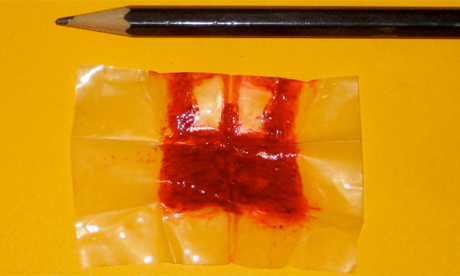
A picture of the artificial hymen Photograph: Mohamed Al Rahhal

As a member of the XY tribe, evolution has spared me of one anatomically useless little membrane; and of course, my virginity, as a male, is of little interest to society. For women, however, it is frequently a very different matter.

Recently, news of a $15 Chinese-made artificial hymen sent ripples across the Egyptian media and blogosphere. China has been manufacturing this very same product for years, but it was an advertisement for a Chinese company offering shipping into the Middle East that started the discussion here in Cairo.

Conservative MPs took the debate into parliament, requesting a ban on imports of the product – and incidentally meteorically boosted its public exposure. There was, however, no information available whether the product was already available in Egypt, or whether there were individual orders coming locally. Of course, I had to provide an answer. I just had to order one.

Gigimo (NSFW) mainly sells sex-toys, and offers a "discreet packaging" option – removing the original packaging and any user manuals. I made sure to select that. One secured online payment and two weeks later – instead of the "three to four" suggested on the website – the product had arrived in Cairo.

As I went to retrieve my package at the post office, it had been opened by various puzzled customs and postal employees who, at a loss, defined the product in writing as "containing an unknown red liquid" – and awaited my description.

Though yet to be officially banned, an honest description would have almost guaranteed confiscation. I was inspired to describe the item as "cinematographic make-up". Not much of a stretch really – with the website suggesting adding "a few moans and groans", to make the performance convincing.

After much paperwork, various stamps, signatures and duties – and a total of 12 pairs of hands processing the package and its paperwork – I left with my, well, hymen.

Such is the "hymen": a 5x7cm folded piece of plastic – of albumin, the notice promptly corrects me – covered on one side by dark red ink. Placed in the vagina before sex, the plastic hardens slightly, and rips upon intercourse. A few drops of "blood" will stain the sheets, preserving the woman's, her family's, or society's "honour".

Whether it does actually work or not I cannot answer. The complete absence of medical information on the product, as well as online accusations that this product can cause infections, made me unwilling to give it to a volunteer to test.

We must remember, however, that the "Chinese hymen" – as it has come to be called in the media – only exists because of demand. Virginity "restoration" – or the illusion thereof – has been around ever since some societies decided that every bride's virginity was her most prized attribute.

A vial of chicken or pigeon blood – why poultry seems thus privileged I have no idea – kept under the bed and spilled on the sheets appears to be the oldest version of the trick. More recently, hymen reconstruction surgery is said to have become fairly widespread. Despite its price – often going into the several hundred dollars – and the fact that the operation is usually performed in unsanitary backstreet clinics, it is unlikely to go out of fashion.

The introduction of the artificial hymen on the Egyptian market has been forewarned by alarmists as the demise of all morality, providing women with a free-for-all opportunity for sexual promiscuity.

Yet the opposite is truer. Instead, this product allows society to bury its head in the sand and continue to engage in the hypocritical game of the "three drops of blood". It can only perpetuate the national illusion of our sexless perfection.

Lest I am so accused, I have nothing against a religious-based idea of pre-marital chastity per se, nor am I encouraging a sexual revolution of sorts. And I genuinely empathise with the women who feel compelled to recourse to those methods – sometimes at the peril of their lives – to uphold their reputation in the fact of a merciless society.

I do, however, strongly condemn the hypocrisy that allows us to discriminate against 50% of the society while giving a free pass to the other half. I am against forcing women to go such lengths, sometimes endangering their health, to allow us to delay a long-awaited national moratorium on gender relations.

Morality is worst interpreted by anatomy. And if we're waiting upon a small piece of plastic to define morality, then we've already failed – and ought to find a better definition.

Friday, October 9, 2009

7 Drinking Games From Around the World

Written by Admin
http://regretfulmorning.com/

drinkmontage
When it comes to drinking games, anything goes. In the U.S., the Quarter Bounce, Bullshit, Shotgun, Moose, Fuck the Dealer, and Presidents and Assholes have all been favorites of many, but are now eclipsed by the popularity of younger rivals, like Beer Pong and Flip Cup. Some of us the States have become more than a little bored with Beer Pong, so we decided to look into the drinking games that people in other countries play. Maybe these games can even lead to some inspiration for our own party ideas — it’s worth a look.

Russia


russia

Source

We’ve all heard of Russian Roulette, the highest stakes drinking game in the world, but not all Russian drinking games are quite as intense. There are at least a couple that allow the drinkers to get their kicks, and get out alive.

Tiger has come or Enter the Dragon is a Russian drinking game that requires a lot of vodka, a table and cash. The weakest drinker starts out as the game leader, and he drinks only every other round, and holds his position until he passes out. A shot-glass of vodka is poured for each player as each antes up before the rounds hit the table. The game leader announces “tiger has come” or “dragon has entered,” at which point the players down their shots, then duck under the table and hide until the game leader says that the offending tiger or dragon is gone. As the game progresses, players who lose their balance coming out from under the table are eliminated. Winner takes all. Don’t think the winner too lucky a fellow, since he then hosts the next night of drinking — and provides the alcohol.

Bear Paw is also a popular drinking game in Russia, and it’s a bit cheaper. However, this game has no winners. An enormous beer mug is filled with beer and passed around, and wait for it — after each person drinks, the mug is topped off with vodka. This hilarious nonsense continues until everyone is passed out or the mug is full of pure vodka, at which point nobody would be left standing anyhow. If, by some miracle of alcoholism, the mug is full of vodka and players are still conscious, the mug continues to be passed around, this time topped-off with beer after every sip. This ridiculousness goes on until nobody is left awake.

Finger Guessing in China

china-snakewine

Source

Drinking is frowned upon in China, even more so than it seems to be in Amish country, so thirsty Chinese get together for parties as an excuse to play drinking games and get smashed. Sound familiar? One of the most popular drinking games in China is the finger-guessing game.

This one’s surprisingly simple: Players slyly make a shape with their fingers to represent a number between 1 and 20. Each player then tries to guess the total sum of all other players’ fingers. The closest guess is the winner, and the losers, of course, drink.

The alcohol of choice for Chinese drinking games is usually baijiu, a grain-based spirit with an alcohol content anywhere between 20 and 60 percent. Another favorite is Cantonese snake-wine, a potent, green concoction made by pickling snakes in a bottle of alcohol. A similar snake-wine is also popular in Vietnam.

Peer Pressure Ceremony in China

longi
Source

In Longi, China, guests at the Longi Rice Terraces are invited to rice wine ceremonies, hosted by the minority tribal villages of the Huang and Yao people. The local women sing before ambushing the guests and forcing them to knock back cup after cup of wine, in something similar to village-sized frat shots. The peer pressure is intense and the ladies constantly watch the glasses and refill them as soon as they are empty while ensuring the guests keep drinking. The ceremonies are as much a game for the hosts as for the guests, since the object is to get their chosen guests as drunk as possible, as quickly as possible. With this game, there’s fun to be had for all.

Rum and Jenga in Cuba

jenga
Source

Many adults in Cuba play Dominos and card games while they gamble and drink, but Jenga and rum often come together at parties to form a drinking game. Discounting some regional variation, the participating Cubans basically play Jenga normally, except the consequences for mistakes are downing more rum. This goes on and on until the players are unable to even set up the pieces anymore, and a winner is declared.

Mexico

dreidel
Source

A drinking game called Pon/Toma is played in Mexico with a six-sided dreidel. The sides of the dreidel are labeled with pon uno, pon dos, pon todo, tom uno, tom dos, tom todo. These translate to “give one, give two, give all, drink one, drink two, drink all,” respectively. Players start with a full glass of liquor, and an empty glass is placed in the center of the table. Each player spins the dreidel. If it lands on pon uno, the player puts a shot of their own drink into the glass. Toma uno, on the other hand, means the player has to drink a shot from the glass. When a player lands on a todos, they have to either fill the glass, or drink what’s in it.

The UK

withnail

Source

One notorious drinking game known throughout the UK has never been successfully played through to finish, as far as anyone knows. Drinkers watch the film Withnail & I and attempt to match the characters drink for drink. Pints of beer are downed at ludicrous-speed until the players are either comatose or can simply drink no more. Technically, the end of the game is the end of the movie. Nobody knows what happens at the end of the movie.

The Official Drinking Games Forum Thread

Tuesday, August 18, 2009

10 Asian Liquors Most Likely To Give You The Creeps

10 Asian Liquors Most Likely To Give You The Creeps

As most of you already know, we like to cover other alcohol and industry information every once in a while besides cognac. Today is one of those days. Cognac is one of the finest drinks in the world, there certainly is no doubt about that. But it certainly doesn’t have that weird element to it and we are glad it doesn’t. While we were browsing the web to find some unusual drinks we came across a site and we were pretty shocked to see these drinks. We have included some of the images of these drinks below and trust us, you will find these quite shocking.

All these drinks are made in Asia and are said to have health benefits. Pretty much all the descriptions were similar as the content inside the bottles were farm raised and are believed to have many different health benefits. If you would like to purchase one of these drinks please check out the source link at the bottom. Once again, be prepared cause when we say “it likely will give you the creeps,” we aren’t joking ;-) .

1. Real Cobra Snake Whiskey

snake whisky2. Giant Centipede Whiskey

centipedewhiskey3. Thai Spider Whiskey

b204. Real Seahorse Whiskey From Vietnam

seahorsewhiskey5. Herbal Snake Whiskey

snakewhiskey16. Common Cobra & Vine Snake Wine

vinesnakewine7. Banana Flavored Scorpion Liquor

b248. Gecko Lizard Whiskey

b259. Real Cobra Snake & Scorpion whiskey

snakescorpionwhisky10. Real Scorpion Vodka

scorpionvodka

So what do you think? Are you willing to try any of these drinks? If so, which one would you prefer?

source

Foreign Talent Loads the Bases in Minor Leagues

More Visas Spur Deals From Haiti to India; Korean Teen Scores Big


BOISE, Idaho -- Like many teenagers spending this summer abroad, Hak-Ju Lee is immersing himself in a foreign culture, making friends and tasting exotic food like moose stew. Unlike most teens, however, he's getting paid three-quarters of a million dollars to do it.

Mr. Lee, 18 years old, is a shortstop, and the culture he is experiencing is American minor-league baseball, where major-league teams develop their talent in small towns across the country.

For decades, minor-league rosters seemed the essence of America's heartland. But thanks to growing numbers of foreign players like Mr. Lee, the minors are fast turning into a veritable United Nations.

The Boise Hawks' Imported Talent

Sean Flanigan for the Wall Street Journal

Hak-Ju Lee is one of 18 international players on the Boise baseball roster.

The gangly infielder is one of three South Koreans playing this summer for the Boise Hawks, an affiliate of the Chicago Cubs. The Hawks' opening-day roster boasted 18 of 25 players from abroad -- mostly Venezuela and the Dominican Republic -- making it one of the most "imported" of all minor-league teams.

Recent changes in U.S. immigration law and growing competition in baseball for raw talent have allowed the minor-league farm system to flourish with imported players. It has been a home run for globalization, but bad news for U.S.-born players, who suddenly have much more competition. Across the minor and major leagues, the total number of foreign-born players is growing fast, to almost 3,500 of the 8,532 players under contract this summer, from 2,964 three years ago.

Boise Hawks' hitting instructor, Ricardo Medina, a native of Panama who translates at team meetings in what has become almost a bilingual program, notes that Mr. Lee and his Korean teammates are getting something else from their summer in Idaho. "I think they may be learning more Spanish than English," he jokes.

The three South Koreans on the Hawks' roster matches the total number playing at the major-league level. Today, 19 Koreans play in the minor leagues, compared with just seven five years ago.

This summer's crop of foreign players in the minors includes baseball's first-ever pros from India, two of them on the Pittsburgh Pirates' Gulf Coast league team. That league's rosters include players from Honduras, Haiti, Russia and the Czech Republic.

Minor League Baseball Becomes Melting Pot

2:33

As a result of unlimited work visas, minor league baseball is seeing a new influx of international players. Joel Millman reports from Boise, Idaho.

Eight teams have minor leaguers from Brazil, including Fábio Murakami, an outfielder for the Philadelphia Phillies' Williamsport, Pa., minor-league team, the Crosscutters. Mr. Murakami is one of several South Americans of Japanese descent in the minors, a list that includes Claudio Fukunaga and Lucas Nakandakare, both from Argentina and under contract to Tampa Bay.

One Red Sox farm team boasts an even more exotic tandem: the brothers Crew Tipene Moanaroa, called "Boss," and Hohua Moanaroa, called "Moko." Born in New South Wales, Australia, the Moanaroas are believed to be the first members of New Zealand's Maori tribe to play baseball professionally in the U.S. "Boss" is a first baseman. "Moko" plays outfield.

New Zealand's representative in the minors is Scott Campbell. He plays third base for the Blue Jays' Eastern League affiliate, the New Hampshire Fisher Cats.

The surge of young foreign players into the U.S. minor leagues began in 2007, a few months after then-president and former major-league team owner George W. Bush signed the Creating Opportunities for Minor League Professionals, Entertainers and Teams Act, known as the Compete Act. It freed the farm systems of major-league teams from having to compete with all U.S. employers seeking H2B work visas for foreign employees, the supply of which usually was exhausted each year by February. Now, teams can import as many prospects as they want.

"There is no longer a limit on work visas," explains Oneri Fleita, the Florida-born director of minor-league development for the Cubs. "So, yeah, you might see more foreign players getting an opportunity."

The Cubs, who signed Korea's Hak-Ju Lee right out of high school, have become one of the most aggressive signers of foreign players. In 2006, 86 players in the Cubs' major and minor-league system were foreign-born. This year, 142 Cubs are imports.

The changes pose a challenge to American teens hoping to make the big leagues. Instead of signing hundreds of U.S. amateurs out of high school -- the traditional business model for stocking minor-league rosters -- teams are drafting fewer U.S. kids and signing more so-called nondraft free agents, the vast majority of them teenagers from Latin America.

This summer, major-league teams spent over $70 million signing nondraft free agents from outside the country. That is up from $54 million last year, and just under $30 million in 2006, the last year before the Compete Act.

Economics plays a huge role. U.S.-born players drafted out of high school rarely sign a contract to turn pro without a cash bonus, most in excess of $100,000. This summer, the Cubs have forked out more than $6 million in signing bonuses to 26 U.S. prospects, an average of nearly a quarter million apiece.

While some foreign players like Mr. Lee got hefty signing bonuses, the majority do not. Latin players in particular can be had for a lot less -- just $10,000 in the case of Venezuelan pitcher Eduardo Figueroa, one of Mr. Lee's teammates. Third baseman George Matheus, another Hawk from Venezuela, received $15,000 for signing.

Lifting visa limits creates an opportunity for players like Eric Gonzalez, a 22-year-old Spaniard in the San Diego Padres' farm system. Mr. Gonzalez was the last player drafted by the Atlanta Braves in 2005, when he was a 17-year-old high-schooler in the Canary Islands. But under the work-visa cap then prevailing in baseball, the Braves would have had to release another foreign prospect to sign him, Mr. Gonzalez explains, "or else send me somewhere overseas to play, probably Australia."

So Mr. Gonzalez didn't get a shot, and instead polished his skills at the University of South Alabama. Signed by the Padres after graduating last year, he has already whipped through one level of minor-league competition, winning a promotion from the Fort Wayne TinCaps to the Lake Elsinore Storm in July. But the cash rewards will have to wait. "I signed for $1,000, before taxes," laughs Mr. Gonzalez, one of two Spaniards in the minors this year. "Basically, I signed in exchange for a plane ticket and a work visa."

In the past, visa restrictions meant many foreign prospects were sent to play for sister teams in places like the Dominican Republic and Australia, where they tried to get enough visibility to fill a coveted visa spot. Nowadays, teams figure they can train foreign talent personally, and give youngsters a chance to learn English and assimilate with U.S.-born teammates.

On both counts, South Korea's Mr. Lee is an enthusiastic student. "Stolen base! Slider! Fastball! Right down the middle!" the teenager recently shouted with a smile, demonstrating the English terms he's mastered since arriving in Idaho.

Much like in an exchange-student program, local families host foreign ballplayers, getting season tickets in return. Mr. Lee lives in a suburban home festooned with heads of antelope and deer and other hunting trophies. He has learned to play Rock Band with his 17-year-old host-family "brother," a ballplayer who is entering his senior year in high school.

His typical teenage observation about life in America: lack of sleep. "Bus ride after game from Vancouver?" he groans, feigning fatigue. "Thirteen hours! Oh, my God. Tired!"

Write to Joel Millman at joel.millman@