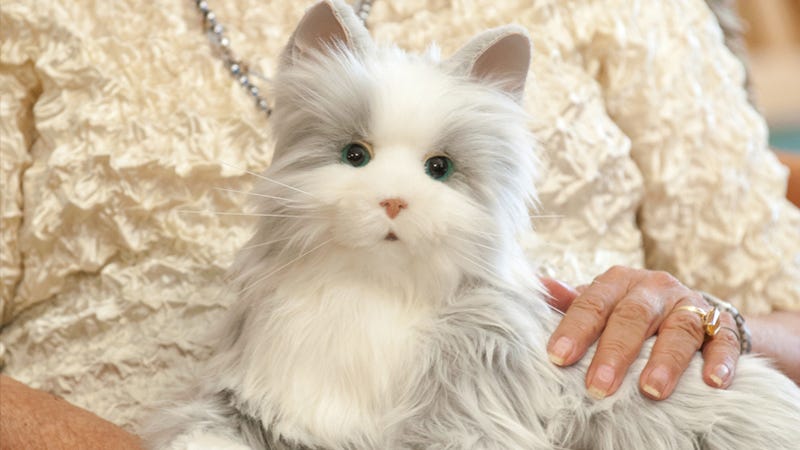
After already conquering demographics including kids, teenagers, and those technically considred adults, Hasbro is reaching out to that last frontier of consumers: seniors, with a new toy line featuring lifelike robotic companion pets that only need affection, not feeding or bathroom breaks.
The company’s new Joy For All line might sound a little depressing, almost like a robotic substitute for visiting your grandparents. But you grew up with Tamagotchis, Pokemon, and other virtual pets that never needed much maintenance; why shouldn’t your aging loved ones also be able to enjoy some virtual companionship too?
The first animal in the Joy For All line, the $99 Companion Pet Cat, is now available and comes packed with motion and light sensors so that it can realistically respond to being petted, held, and hugged. Hasbro hasn’t gone into too much detail about how it works, but the cat apparently has new vibration technology that allows it generate responsive purrs that both sound and feel incredibly realistic.
But it doesn’t just purr. Pet the companion cat on the head and it will automatically move it towards your hand, demanding more attention—or at least appearing to. And if you continuously pet its back, eventually it will roll over so you can give it a belly rub.
There’s no word on how long the cat will, well, live, on its included set of four C-sized batteries. But if left alone for a few minutes it will automatically close its eyes and fall asleep to help extend battery life for as long as possible.
Other companion animals are soon to follow in the Joy For All line, but Hasbro will have an even bigger hit on its hands as soon as it perfects a Companion Pet Grandchild with chubby cheeks perpetually in need of cleaning, a messy mop of hair that always needs straightening, and a genuine appreciation of hard candies. [Joy For All]
In the 70s, that swinging decade of key parties and shag carpets, waterbeds were the epitome of sexy. They were coveted by free-love hippies, randy bachelors and senior citizens alike. Playboy founder Hugh Hefner reportedly had two waterbeds, one clothed in green velvet, another in Tasmanian possum fur.
Kids today don’t remember them firsthand, but they’ve seen them featured in movies and even lampooned on SNL:
When waterbeds went mainstream in the 1980s, children pleaded for them:
And grandparents looked to them to cushion arthritic joints and relieve back pain:
Not really. As it turns out, Hef’s marsupial mattress cover wasn’t far off from the first waterbeds. More than 3,000 years ago, ancient Persians filled goatskins with water and warmed them in the sun. No one is exactly sure about their earliest purpose, but speculation ranges from luxurious rest for royalty to comfort for the sick and elderly.
By 1871, when Mark Twain wrote an article for The New York Times about plans for Park Church in Elmira, NY, under the supervision of pastor Thomas Kennicott Beecher (brother to famous abolitionist and author Harriet Beecher Stowe), waterbeds had made their way to the United States. Twain reported that the church’s infirmary would have two “water-beds [for invalids whose pains will not allow them to lie on a less yielding substance]” and that the current waterbeds were “always in demand, and never out of service.”
When Sir James Paget introduced Arnott’s waterbed to St. Bartholomew Hospital in London in 1873, waterbeds were able to ride a wave of good PR. A decade later, Dr. William Hooper of Portsmouth, England, patented his version of the waterbed to treat arthritis and rheumatism patients.
Yet, because they didn’t offer a way to regulate the water temperature, they eventually fell out of fashion.
Who solved the temperature problem?
In 1968, a San Francisco State University student named Charles Hall created a mattress filled with water for his senior thesis project. More importantly, he found a practical way to heat it. Hall’s intention was to create comfortable furniture that would use heat to relieve muscle pain and the water flotation to reduce pressure points. But, as he told the New York Times, when he invited his classmates over to his Haight-Ashbury apartment for a demo, they ended up “frolicking” on his creation. And voila, man, a sex symbol was born.
In a Washington Post article, Hall shared his memories of a “typical early waterbed dealer” — a seedy fellow who also sold something called “orgy butter.” An early waterbed model advertised in Playboy called the Pleasure Pit, and it was “surrounded by leather and covered in furs.” The tagline of a 1970 waterbed ad read: “Two things are better on a waterbed. One of them is sleep.”
Hippies, figures. What about the east coast?
New York City was actually the worst market for waterbeds. One bedding retailer told the New York Timesin 1986 that New Yorkers were too “urbane” and “sophisticated” for the trend. But manufacturers blamed something else — restrictions by landlords and the impracticality of moving heavy, unwieldly bags of water into small apartments. That being said, while it was on display at Bloomingdale’s in Manhattan, the waterbed was, according to a 1971 Time article, reportedly a hot meeting place for hopeful singles.
Slow sales figures notwithstanding, waterbeds permeated popular culture from every side, from sitcoms toart installations. In a Whitney Museum of American Art catalog published in the mid-80s, architecture critic Martin Filler wrote that the waterbed was one of the “most evocative furniture types of the time.”
Someone who was less impressed with waterbeds? Pope John Paul II. On a 1987 visit to Miami, the pontiff declined to sleep on an archbishop’s waterbed, opting instead to rest his holy head on a traditional mattress.
So what happened?
As waterbeds went mainstream, they naturally became less hip. The selling points shifted from sex appeal totherapeutic purposes as doctors recommended them for older patients, and they were sometimes spotted in nursing homes.
At any rate, these behemoths had their shortcomings. Waterbed installation was a real pain in the ass. They are very heavy, their parts require maintenance; oftentimes they were left behind after a move since it was such a pain in the ass to drain the mattress. Occasionally, apartment renters were required to purchase waterbed insurance in case of leaks or damage.
Ultimately, the waterbed lost its appeal even as a therapeutic solution as new, lower-maintenance bedsdesigned for comfort became available.
Does anyone still buy them?
In recent years, waterbeds have accounted for less than five percent of the bed market. While many retailers no longer carry the beds or components, there are still plenty of waterbed specialty stores. And, of course, they’re available online.
At the very least, there are still enough out there for this cat-meets-waterbed video compilation:
Overstock is best known for selling discount merchandise online, but the company has another trick up its sleeve: It has hoarded food, cash, and digital currencies in preparation for a disaster scenario that could cripple lesser online retailers.
“I want a system that can survive a three-month freeze,” CEO Patrick Byrne told BuzzFeed News. “If the whole thing collapses I want our system to continue paying people, we want to be able to survive a shutdown of the banking system.”
The Utah-based company has made headlines in the past for its drawn out fight with hedge funds it accused of manipulating the company’s stock, and its CEO’s interest in digital currencies. Byrne said the company maintains a 30-day supply of food, and has a distribution system to pay and feed employees in case the banking and payments systems collapse.
“In the 1930s there was a two-week freeze on the banking system; in 2008 we came perilously close to banks not knowing who could accept counterparty risk,” Byrne said. “I think we’re living in the final days of the theory that the Keynesian magic money tree can deliver actual wealth and growth.”
In a call with anlaysts in early 2013, Byrne said the company is “determined to make Overstock robust in the face of that fragility and that includes owning some precious metals and maybe some Bitcoin.”
Hoarding precious metals can come with risks of its own. The company said in a recent regulatory filing that the value of its metals has been hit by the global decline in commodities prices — they’ve gone down to $10.2 million from $10.9 million at the end of last year.
“We’re not rubbing our hands together gleefully waiting for it to happen,” Byrne said. “We think of it as an insurance company with a 5% chance of paying off.”
While the precious metal store — $6 million of gold and $4.3 million of silver — has been noted in financial disclosures, the uncommon risk mitigation measure got renewed attention when the company’s former President Jonathan Johnson, who is running for governor of Utah, mentioned it in a speech to the United Precious Metals Association earlier this month. “I don’t know if it will be two days or two weeks or two months. But we have $10 million in gold and silver in denominations small enough … for payroll,” Johnson said.
The hoarding of coins and food may seem inconsistent with the company’s investment in financial instruments based on digital currency, but both come from Byrne’s doubts about the current way the world is run. “In a deep sense, I do not trust the central banks and I don’t trust major institutions.”
When asked exactly where the gold was — the company says it’s in an “off-site secure facility” — Byrne told BuzzFeed News, “It’s in a safe space in Utah. Utah has a lot of safe places.”
Matthew Zeitlin is a business reporter for BuzzFeed News and is based in New York. Zeitlin reports on Wall Street and big banks.
Mark Rober sorted out an easy way to almost-always win a game no one really plays anymore. It unclear if it still works if your opponent is also using this strategy.
It's finished and its amazing, the ultimate man cave and survival cell rolled into one sub garden room. There are more things to add such as air filtration and different power source but it's a great space,
To see the build throughout its stages here are the previous 4 video's
Go Retro, Get Nostalgic. Play Modern Games with This Classic Controller.
$29.95 $35 14% off
Free Shipping
Refer a friend, get $10!
DESCRIPTION
Remember the glory days of playing Super Nintendo on that classic gray controller with its signature purple push buttons? 8Bitdo is bringing it back again with the SNES30, a 1:1 original design that supports both Bluetooth and USB connections. Connect with your favorite device or computer to play any modern game with arguably the greatest controller of all time.
Play all the latest games w/ an old school controller
Connect via Bluetooth or the included USB cable
Use w/ your PC, Mac, iPad, Android & more
Play multiplayer games using the dual-keyboard code system for iOS
Play w/ up to four players on Wii w/ Wiimote emulation support
Carry it in your back pocket thanks to its slim, portable size
Game for up to 20 hours without taking a break to recharge the battery
Play touchscreen-only games w/ touchscreen simulation
Recharge the battery 1000+ times
COMPATIBILITY
SPECS
SHIPPING
TERMS
Questions
We'd love to help! Email or chat M-F, 9am-5pm PST:
We take pride in curating the latest and greatest creative technology products around the globe. We personally research and hand-pick each product to ensure it meets our st
Wow. You thought you were done with new Star Wars trailers after therecent, amazing one we just had? Think again. Disney has released an international cut of the trailer—one that is packed with new shots and dialogue.
The trailer, which you can see below, follows a similar thematic path as the recent teaser, but we get to hear more from Rey and how she’s waiting for her family. We get to see Kylo Ren’s controversial new lightsaber in action. There’s a glimpse of Leia and C-3PO, of gorgeous vistas and alien suns—and then Lupita Nyong’o’s Maz Kanata ends the trailer by saying “Hope is not lost today... it is found.” See for yourself!
There is a surprising amount of extra stuff in here, especially considering J.J. Abrams was very insistent on the previous trailer being the last new footage we’d see before the movie released. Naturally, we’ve broken down some of that new content for you into glorious gifs!
Rey checks out the wreckage of a ship on Jakku.
And enquires as to where BB-8—who is owned by Poe Dameron—came from, and teasingly mentions that she knows what it’s like to wait for her family. The question is... who’s the family? Han and Leia, like everyone thinks it is?
The shot of Rey speeding across Jakku is very Luke-and-the-binary-sunset-y, and we love it.
A busy Jakku market, and BB-8 dashes off as it spots something that gets the attention of Rey... and Finn, who’s joined her now! Presumably, BB-8’s seen the First Order making their arrival, as we’ve seen images of Finn and Rey being chased through a similar environment by Stormtroopers.
Speaking of gorgeous shots of alien suns, this one is also spectacular. TIEs at sunset!
Finn and Rey introduce themselves to each other on the Falcon. Wait, they go through all that without knowing each other’s names first?
It’s the Resistance Base! There’s Poe in the background, a brief shot of C-3PO, and PRINCESS GODDAMN LEIA. They look pretty concerned by something.
Leia’s not the only old face we get to see in the trailer. Chewbacca is here, and he’s here to BLOW SHIT UP. Presumably the exploding First Order bridge, which was in the last trailer, is just cut here for effect rather than being Chewie’s actual handiwork, but still.
On a forest world we’ve seen only glimpses of, Rey gets a close encounter with Kylo Ren’s flickering, spitting lightsaber. Careful Kylo, you’ll have someone’s eye out with that thing! There’s a few shots of his lightsaber in this trailer, and we have to say, this crossguard thing has grown on us. It looks menacing and awesome.
.
All you art collectors out there. Here is a chance to get a Giclee copy of some of Ian M Sherwin work. Ian is planning on doing a whole series of Marblehead, Massachusetts paintings. His work is amazing.



















 .
.

 Posts
Posts


