Overstock.com Has $10 Million In Gold And Silver Hidden Somewhere In Utah
from: http://consumerist.com/
The online retailer is hoarding gold and food to keep its employees paid and fed if the financial system collapses.

Adding Value To The World, one Post At A Time
from: http://consumerist.com/
The online retailer is hoarding gold and food to keep its employees paid and fed if the financial system collapses.


Posted by gjblass at 12:01 PM 1 comments
Labels: Gold, Lost Treasures, Treasure Hunters
Posted by gjblass at 12:46 PM 1 comments
Labels: German, Lost Treasures, ship, Treasure Hunters, United Kingdom
It's like a scene from Indiana Jones and the Temple of Doom. Even before the unlocking of the last of six secret vaults at Kerala's largest temple, the centuries-old treasure in gold, silver and precious stones discovered in its cellars is already estimated to be worth around £12.6bn.
"Though we knew that offerings made to the temple by devotees for the last 500 years were lying in these secret cellars, the scale of the treasure has definitely surprised us," temple official Hari Kumar told the Guardian. "All of Kerala is celebrating this extraordinary find." Its discovery has made the Hindu temple of Padmanabha Swamy in the state capital Thiruvanthapuram the richest in India.
During the past week, a team of experts appointed by India's supreme court has opened five vaults dedicated to the deity Lord Vishnu to uncover an enormous hoard of gold idols, jewellery studded with diamonds, emeralds and other precious stones, antique silver, and even two golden coconut shells studded with rubies and emeralds.
The shrine dates back to the 10th century, but the present massive granite structure was built only in the 18th century after King Marthanda Varma expanded and consolidated the Travancore kingdom. It has historically been a royal temple, but offerings to the Lord Vishnu, in the form of gold and jewellery, have come not just from Travancore kings and other Kerala royalty but millions of ordinary devotees.
The vaults containing the offerings have remained locked at least since the 1930s, when the last inventory was reportedly carried out by Travancore's then rulers. India's supreme court ordered a fresh inventory of the treasure after a face-off between the current head of the former Travancore royal family and a lawyer who challenged them about the management of the temple wealth, claiming there was inadequate security.
"There are six vaults, from A to F, and only Vault B has still to be opened," says Kumar. "This vault has special locks, and we don't want to break them. So we're getting experts to examine them, and we should be able to open them on Friday."
The entire operation is going on under heavy police security, but nothing is being filmed or photographed. "Taking photos within the sacred space of the temple is strictly prohibited," says Kumar.
Kerala's chief minister Oommen Chandy has rejected the demand that the treasure should be used for public benefit. "It belongs to the Padmanabha Swamy temple and will be preserved there," he said.
Posted by gjblass at 3:51 PM 0 comments
Labels: Gold, Lost Treasures, Treasure Hunters
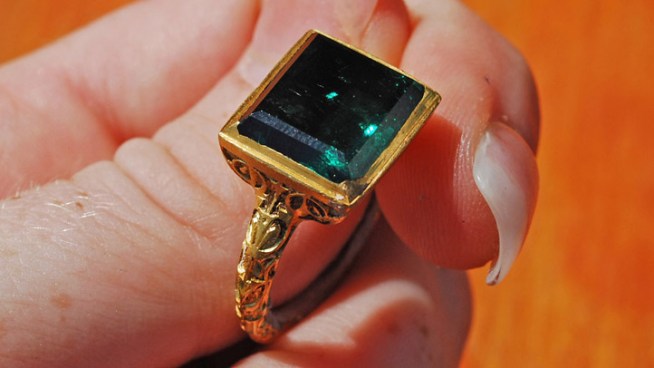
Sharon Wiley/ Mel Fisher Treasures via the Florida Keys News Bureau /HO
An ancient gold ring with a rectangular cut emerald found Thursday is believed to have come from the Nuestra Señora de Atocha.
The famed Atocha shipwreck site in the Florida Keys coughed up another treasure Thursday when salvagers said they discovered a 10-karat emerald ring initially valued at $500,000.
A crew with historic salvagers Mel Fisher's Treasures found the ornately carved gold ring while searching for the long-lost sterncastle of the Spanish galleon Nuestra Senora de Atocha, which sank off the Keys during a hurricane in 1622.
The ring was found with two silver spoons and two other silver-encrusted artifacts about 35 miles west of Key West, within 300 feet of where a gold rosary and gold bar were found in April.
"It is exciting because we are moving into virgin territory, an area of the Atocha Trail that has never been worked," said vessel captain Andy Matroci in a statement.
Fisher's Treasures has been working the Atocha site since 1969, hauling up approximately $450 million in silver, gold, and emeralds after the wreck and its "mother lode" was first discovered in 1985.
An infamous eight-year legal battle over the treasure with the government ensued before the Supreme Court ultimately ruled in Fisher's favor.
The sterncastle of the Atocha has yet to be found, most likely having been scatered by a second hurricane that hit the area shortly after the ship was driven into a reef in the Dry Tortugas, according to Fisher's website.
The crew of Mel Fisher's Treasures believe that a second major treasure cache is hidden within the missing sterncastle, probably having been stored in the captain's quarters of the ship for safekeeping.
A spokeswoman has said the company will have the ring appraised by an independent party.
Posted by gjblass at 3:18 PM 0 comments
Labels: Diving, Florida, Free Diving, Lost Treasures, ship, Treasure Hunters, Wrecked Exotics
ScienceDaily (Aug. 14, 2009) — London's oldest timber structure has been unearthed by archaeologists from Archaeology South-East (part of the Institute of Archaeology at University College London). It was found during the excavation of a prehistoric peat bog adjacent to Belmarsh Prison in Plumstead, Greenwich, in advance of the construction of a new prison building. Radiocarbon dating has shown the structure to be nearly 6,000 years old and it predates Stonehenge by more than 500 years.
Jacobs Engineering UK Ltd acted as the managing consultants, on behalf of the Ministry of Justice, and the work was facilitated by Interserve Project Services Ltd.
The structure consisted of a timber platform or trackway found at a depth of 4.7m (about the height of a double decker bus) beneath two metres of peat adjacent to an ancient river channel (image available). Previously, the oldest timber structure in Greater London was the timber trackway in Silvertown, which has been dated to 3340-2910 BC, c. 700 years younger.
Wetlands adjacent to rivers such as the Thames were an important source of food for prehistoric people, and timber trackways and platforms made it easier to cross the boggy terrain. The structure discovered at Plumstead is an early example of people adapting the natural landscape to meet human needs. The peat bogs which developed at Plumstead provided ideal conditions to preserve organic materials, which in other environments would have rotted away. The peat not only preserved wood, but also other plant matter - down to microscopic pollen grains - which can inform us about the contemporary landscape.
English Heritage, the government's advisor on the historic environment, provides planning advice in respect of archaeology within Greater London and was involved in the discovery at the Plumstead site.
Mark Stevenson, Archaeological Advisor at English Heritage said: "The discovery of the earliest timber structure in London is incredibly important. The timber structure is slightly earlier in date than the earliest trackways excavated in the Somerset Levels, including the famous 'Sweet Track' to Glastonbury, which provide some of the earliest physical evidence for woodworking in England.
"This large area of development has been the subject of extensive building recording of the old Royal Arsenal (East) site as well as detailed work to map the buried ancient landscape."
Archaeology South-East Senior Archaeologist Diccon Hart, who directed the excavation, commented: "The discovery of the earliest timber structure yet found in the London Basin is an incredibly exciting find. It is testament to the hard work and determination of those who toiled under very difficult conditions to unearth a rare and fascinating structure almost 6,000 years after it was constructed."
Other notable finds from the archaeological excavation include an Early Bronze Age alder log with unusually well-preserved tool marks made by a metal axe. This item has been laser scanned at UCL's Department of Civil, Environmental and Geometric Engineering and is currently undergoing conservation treatment prior to its display in Greenwich Heritage Centre, Woolwich (image available).
The study of the samples will continue for the next couple of years as the archaeological team learns more about this intriguing structure and the environment in which it was built.
Posted by gjblass at 10:41 AM 0 comments
Labels: Ancient Civilizations, Archaeological field survey, Archaeology, Early Humans, Excavation, Fossils, London, Lost Treasures, ruins, ScienceDaily, Stone tool, Stonehenge