Zazzle Shop

Screen printing
Showing posts with label Treasure Hunters. Show all posts

Wednesday, November 18, 2015

Overstock.com Has $10 Million In Gold And Silver Hidden Somewhere In Utah

from: http://consumerist.com/

The online retailer is hoarding gold and food to keep its employees paid and fed if the financial system collapses.

Ross D. Franklin / AP
Overstock is best known for selling discount merchandise online, but the company has another trick up its sleeve: It has hoarded food, cash, and digital currencies in preparation for a disaster scenario that could cripple lesser online retailers.
“I want a system that can survive a three-month freeze,” CEO Patrick Byrne told BuzzFeed News. “If the whole thing collapses I want our system to continue paying people, we want to be able to survive a shutdown of the banking system.”
The Utah-based company has made headlines in the past for its drawn out fight with hedge funds it accused of manipulating the company’s stock, and its CEO’s interest in digital currencies. Byrne said the company maintains a 30-day supply of food, and has a distribution system to pay and feed employees in case the banking and payments systems collapse.
“In the 1930s there was a two-week freeze on the banking system; in 2008 we came perilously close to banks not knowing who could accept counterparty risk,” Byrne said. “I think we’re living in the final days of the theory that the Keynesian magic money tree can deliver actual wealth and growth.”
In a call with anlaysts in early 2013, Byrne said the company is “determined to make Overstock robust in the face of that fragility and that includes owning some precious metals and maybe some Bitcoin.”
Hoarding precious metals can come with risks of its own. The company said in a recent regulatory filing that the value of its metals has been hit by the global decline in commodities prices — they’ve gone down to $10.2 million from $10.9 million at the end of last year.
“We’re not rubbing our hands together gleefully waiting for it to happen,” Byrne said. “We think of it as an insurance company with a 5% chance of paying off.”
While the precious metal store — $6 million of gold and $4.3 million of silver — has been noted in financial disclosures, the uncommon risk mitigation measure got renewed attention when the company’s former President Jonathan Johnson, who is running for governor of Utah, mentioned it in a speech to the United Precious Metals Association earlier this month. “I don’t know if it will be two days or two weeks or two months. But we have $10 million in gold and silver in denominations small enough … for payroll,” Johnson said.
The hoarding of coins and food may seem inconsistent with the company’s investment in financial instruments based on digital currency, but both come from Byrne’s doubts about the current way the world is run. “In a deep sense, I do not trust the central banks and I don’t trust major institutions.”
When asked exactly where the gold was — the company says it’s in an “off-site secure facility” — Byrne told BuzzFeed News, “It’s in a safe space in Utah. Utah has a lot of safe places.”
Matthew Zeitlin is a business reporter for BuzzFeed News and is based in New York. Zeitlin reports on Wall Street and big banks.
Contact Matthew Zeitlin at matt.zeitlin@buzzfeed.com.

Tuesday, September 27, 2011

British shipwreck with a fortune in silver on board discovered in Atlantic


The wreck of a British cargo ship containing silver worth £155 million, sunk by a German U-boat during the Second World War, has been discovered on the Atlantic sea bed.

Expert underwater archaeologists will attempt to salvage the treasure, handing
20 per cent of its value to the British Government.

The SS Gairsoppa set sail from India in December 1940 carrying a consignment
of 240 tonnes of silver, iron and tea.

It was headed for Liverpool but was forced to break away from its military
convoy off the coast of Ireland as weather conditions deteriorated and it
began to run out of fuel.

As the merchant steamship tried to make it to Galway it was attacked by the
German submarine U101, 300 miles southwest of the Irish harbour.

On February 17, 1941, a single torpedo sank the ill-fated vessel, killing all
85 crewmen except one.

Of 32 survivors who managed to clamber onto lifeboats, Second Officer Richard
Ayres was the only one who, 13 days later, made it to the Cornish coast
alive. He was awarded an MBE for his attempts to rescue his fellow sailors
and lived until 1992.


The wreck of the 412ft-long Gairsoppa, owned by the British Indian Steam
Navigation Company, was discovered by Odyssey Marine Exploration, an
American underwater archaeology and salvage firm, this month.


The Department of Transport had awarded the Florida-based treasure hunters a
contract to conduct the search, allowing the company to retain 80 per cent
of the profits of any silver salvaged.


Greg Stemm, chief executive of Odyssey, said: "We were fortunate to find
the shipwreck sitting upright, with the holds open and easily accessible.


"This should enable to us to unload cargo through the hatches, as would
happen with a ship alongside a cargo terminal."


Odyssey's tethered robot took three and a half hours to descend 2.9 miles to
the seabed. There, it found a gaping hole where the torpedo had struck 70
years ago.


The company said it had confirmed the shipwreck's identity from evidence
including the number of holds, the anchor type, the scupper locations and
red-and-black hull colours.


Although none of the precious metal has yet been found, the shiny tin linings
of the tea chests were initially mistaken for silver bars, according to the
New York Times.


The Odyssey team is expected to begin the "recovery" stage of the
operation when the weather improves in spring.


Mr Stemm said: "While some people might wonder about the potential
complexity of salvage at this depth, we have already conducted a thorough


analysis of the best tools and techniques to conduct this operation and are
confident that the salvage will be conducted efficiently and on a timely
basis.


"Hundreds of modern cargo ships like this have been salvaged since the
mid-20th century, some at depths of thousands of metres.


"We were fortunate to find the shipwreck sitting upright, with the holds
open and easily accessible. This should enable us to unload cargo through

the hatches as would happen with a floating ship alongside a cargo terminal."

Neil Cunningham Dobson, Odyssey's principal marine archaeologist, added: "By
analysing the known configuration and research about the Gairsoppa and her
final voyage and painstakingly exploring the shipwreck site to record each
element and item, our team of experts was able to positively identify the
site as the Gairsoppa.


"Even though records indicate that the lifeboats were launched before the
ship sank, sadly most of her crew did not survive the long journey to shore.

By finding this shipwreck, and telling the story of its loss, we pay tribute
to the brave merchant sailors who lost their lives."


The precise value of the ship's treasure is unclear because the wartime
government did not disclose the true nature of its transportation records.

But Odyssey discovered that it had paid out an insurance claim on silver
amounting to around 120 tons owned by private parties and it believes the
government's hidden share would be about the same.


The Government will be hoping that the search does not prove controversial.

A federal appeals court in Florida this month upheld a ruling that Odyssey
must hand over an estimated £250 million worth of gold and silver coins to
the Spanish Government after a four-year legal battle in which it was
accused of plundering Spain's national heritage.


The coins had been recovered from a Spanish frigate laden with bullion from
the Americas that was sunk by the British off the coast of Portugal in
October 1804.

Wednesday, July 6, 2011

£12bn and counting: the treasure uncovered at Kerala temple

One vault is still left to open as scale of the offerings made to shrine in the past 500 years comes to light
     Padmanabha Swamy temple
    The Padmanabha Swamy temple. Photograph: Reuters

    It's like a scene from Indiana Jones and the Temple of Doom. Even before the unlocking of the last of six secret vaults at Kerala's largest temple, the centuries-old treasure in gold, silver and precious stones discovered in its cellars is already estimated to be worth around £12.6bn.

    "Though we knew that offerings made to the temple by devotees for the last 500 years were lying in these secret cellars, the scale of the treasure has definitely surprised us," temple official Hari Kumar told the Guardian. "All of Kerala is celebrating this extraordinary find." Its discovery has made the Hindu temple of Padmanabha Swamy in the state capital Thiruvanthapuram the richest in India.

    During the past week, a team of experts appointed by India's supreme court has opened five vaults dedicated to the deity Lord Vishnu to uncover an enormous hoard of gold idols, jewellery studded with diamonds, emeralds and other precious stones, antique silver, and even two golden coconut shells studded with rubies and emeralds.

    The shrine dates back to the 10th century, but the present massive granite structure was built only in the 18th century after King Marthanda Varma expanded and consolidated the Travancore kingdom. It has historically been a royal temple, but offerings to the Lord Vishnu, in the form of gold and jewellery, have come not just from Travancore kings and other Kerala royalty but millions of ordinary devotees.

    The vaults containing the offerings have remained locked at least since the 1930s, when the last inventory was reportedly carried out by Travancore's then rulers. India's supreme court ordered a fresh inventory of the treasure after a face-off between the current head of the former Travancore royal family and a lawyer who challenged them about the management of the temple wealth, claiming there was inadequate security.

    "There are six vaults, from A to F, and only Vault B has still to be opened," says Kumar. "This vault has special locks, and we don't want to break them. So we're getting experts to examine them, and we should be able to open them on Friday."

    The entire operation is going on under heavy police security, but nothing is being filmed or photographed. "Taking photos within the sacred space of the temple is strictly prohibited," says Kumar.

    Kerala's chief minister Oommen Chandy has rejected the demand that the treasure should be used for public benefit. "It belongs to the Padmanabha Swamy temple and will be preserved there," he said.

Monday, June 27, 2011

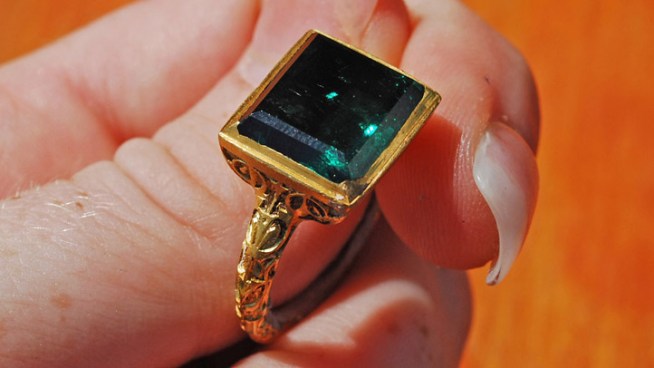
Treasure Hunters Find $500k Ring at Atocha Wreck

A crew from Mel Fisher's Treasures found the 10-karat emerald piece on Thursday

By Janie Campbell
from: http://www.nbcmiami.com/


Treasure Hunters Find $500k Ring at Wreck

Sharon Wiley/ Mel Fisher Treasures via the Florida Keys News Bureau /HO

An ancient gold ring with a rectangular cut emerald found Thursday is believed to have come from the Nuestra Señora de Atocha.

advertisement

The famed Atocha shipwreck site in the Florida Keys coughed up another treasure Thursday when salvagers said they discovered a 10-karat emerald ring initially valued at $500,000.

A crew with historic salvagers Mel Fisher's Treasures found the ornately carved gold ring while searching for the long-lost sterncastle of the Spanish galleon Nuestra Senora de Atocha, which sank off the Keys during a hurricane in 1622.

The ring was found with two silver spoons and two other silver-encrusted artifacts about 35 miles west of Key West, within 300 feet of where a gold rosary and gold bar were found in April.

"It is exciting because we are moving into virgin territory, an area of the Atocha Trail that has never been worked," said vessel captain Andy Matroci in a statement.

Fisher's Treasures has been working the Atocha site since 1969, hauling up approximately $450 million in silver, gold, and emeralds after the wreck and its "mother lode" was first discovered in 1985.

An infamous eight-year legal battle over the treasure with the government ensued before the Supreme Court ultimately ruled in Fisher's favor.

The sterncastle of the Atocha has yet to be found, most likely having been scatered by a second hurricane that hit the area shortly after the ship was driven into a reef in the Dry Tortugas, according to Fisher's website.

The crew of Mel Fisher's Treasures believe that a second major treasure cache is hidden within the missing sterncastle, probably having been stored in the captain's quarters of the ship for safekeeping.

A spokeswoman has said the company will have the ring appraised by an independent party.

Monday, January 5, 2009

Treasure Hunter Claims Google Maps Treasure Find

A 39-year-old musician and filmmaker from Los Angeles has been fighting representatives of an estate in Refugio County, Texas, for the right to excavate.


A treasure hunter testified in a Texas courtroom Tuesday that he used Google Maps to locate a shipwreck.

Houston Chronicle writer Mary Flood reported that Nathan Smith, a 39-year-old musician and filmmaker from Los Angeles, has been fighting representatives of an estate in Refugio County, Texas, for the right to excavate his claimed find.

Smith seeks to prove that the wreck lies in navigable waters rather than on privately owned land.

The case, Nathan Smith v. The Abandoned Vessel, was filed in March 2007. The significant documents, including the initial complaint, are under seal to hide the location of the supposed shipwreck.

In the publicly accessible depositions, much of the questioning has to do with the area in and around Melon Creek and Melon Lake, near the Mission River.

On Monday, according to the Houston Chronicle, Smith described the circumstances in 1822 by which the ship allegedly ran aground and sank in the mud near the Mission River while trying to avoid a hurricane. He claimed that half the crew died during the voyage and the remaining crew was killed by a local cannibal tribe.

Describing a seemingly implausible sequence of events, Smith testified that Comanche Indians found the ship's gold and buried some of it after encountering the cannibals and fleeing, the Chronicle reported.

The plaintiff's exhibit list mentions "Google (NSDQ: GOOG) Aerial photographs taken in 2007." Google has traditionally licensed its satellite imagery from companies like DigitalGlobe, GeoEye, and TerraMetrics.

The court exhibit list also includes Lost Treasures Of American History by W.C. Jameson. Presumably, the book has some relevance to the claimed shipwreck. The exhibit list also mentions a 1958 family manuscript, Nicholas Fagan: Texas Patriot, by Mrs. Tom O'Connor Sr.