Zazzle Shop

Screen printing

Thursday, February 5, 2009

Chrysler Gets 3 Offers for Viper Business

Chrysler: Three Offers for Viper Business

Chrysler announced that it was selling its Viper sports car operation last summer, proving just how painful its financial woes had become. Since then, it has remained mum about receiving possible offers for the highly-regarded program. Yesterday, Chrysler co-President Jim Press shed a little light on the Viper sale process.

According to Press, Chrysler has had three offers to buy the Viper business. "We're doing due diligence," he said in a conference call. Chrysler must submit a restructuring plan to the U.S. government by March 31 in order to keep a $4 billion federal loan it received last year. When asked if a sale was possible before the deadline, Press said Chrysler didn't expect it to be done by then.

The Viper factory in Detroit employs about 110 people. Last year, Chrysler sold 1,172 Vipers in the U.S. In January, sales rose 74 percent from a year earlier, to 127 units.

Source: Automotive News

Use the Product? Buy the Stock!

Legendary investor Peter Lynch used to talk about buying stock in the companies whose products you use. In some ways, this makes a lot of sense. Back in 2001, I put together a portfolio of companies whose products I use all the time, with an emphasis on vice, habit and hobby-related products.

Related Quotes

SymbolPriceChange
AMZN61.54+0.48
Chart for Amazon.com, Inc.
BKS15.75+0.07
Chart for BARNES & NOBLE
DIS18.24-0.76
Chart for WALT DISNEY-DISNEY C
PM36.57-0.21
Chart for PHILIP MORRIS INTL

The original list was composed of steakhouses such as Outback, Mondavi wine company, tobacco stocks, book publishers and retailers, as well as companies that owned sports franchises. The portfolio did amazingly well over the years, with several of the companies being taken over along the way. With the market clearly in the doldrums and far off the highs, this might be an interesting way to look for cheap stocks.

My biggest hobby or vice, depending who you are talking to, is reading. I consume books at a rapid rate. Now that I no longer have an office right across from a mall, I order most of my books from Amazon. I love the company and use it constantly. As you know, the company recently issued a great earnings report.

Amazon is literally changing the face of retail. For stock purposes, however, the stock has done a little too well. I am just psychologically incapable of paying 40 times earnings for a stock.

When I do go to a bookstore, it is usually a Barnes & Noble. With that stock trading at less than tangible book and yielding north of 5%, I can add it to my lifestyle portfolio. The company may struggle in the consumer recession, but the balance sheet is solid, with a debt-to-equity ratio of less than 0.15.

I'm probably the world's last unabashed, unapologetic smoker as well. My brand of choice is manufactured by Reynolds American. The stock is cheap at 8 times earnings and sports a dividend of over 8%. Ordinarily, I might just buy this stock for the long term. However, the tobacco industry has some challenges in the near future. It is almost certain that there will be a federal tobacco excise tax passed. Over 40 states are also said to be raising the tobacco tax. In addition, it is now highly likely that tobacco will come under the purview of the Food and Drug Administration. All of this will keep pressure on the shares.

I believe Philip Morris International is a better buy at these levels. The company pays a dividend of more than 5% and does not face the regulatory pressure in its key overseas markets that the domestic companies do. Because it is a large-cap company, I believe the market has further downside, so I would wait until we get a somewhat steeper decline.

There are not any direct publicly owned sport franchises anymore that I can find. In years past, I took great delight in owning shares in franchises such as the Boston Celtics and Cleveland Indians. Unfortunately, there just are not any right now. Even the Tribune has finally reached a deal to sell the Chicago Cubs.

To represent my sports fixation, I'll go with the owner of the television channel that is on once the market closes. I have watched ESPN since the network first came on years ago. With the college basketball season in full swing, it is a staple in the evening. There is nothing better than spending a winter evening reading, with ESPN on the TV.

Not only that, shares in the network owner, Walt Disney, are cheap. Disney is at its lowest level in five years. Investors with a long-term time horizon who are willing to accept the risk of market declines would do well to buy Mickey and friends. This is a world-class franchise that will survive the recession and thrive in the recovery.

I have been known to enjoy a distilled adult beverage or two. The brands I enjoy are primarily distributed and imported by Diageo. The U.K.-based company is one of the world's largest liquor distributors, and it has a wide range of brands across all price levels. The liquor industry is somewhat recession-resistant, and sales have held up so far. Revenue was actually up slightly in 2008. This is another of those "buy a little and forget it for a few years" stocks. Diageo is an industry leader, and the dividend yield pays you well while you wait for the recovery.

I ruled out Fortune Brands. for inclusion. The company has exposure to the home and leisure markets, and its latest earnings report was horrible

Looking at the stocks of companies whose products you use is a valuable exercise. In a selloff like we have experienced, you may find that the shares have become cheap enough to include in a long-term portfolio. In tumultuous times, it is far easier to hold shares in companies you know and use. No matter what your hobbies and habits are, you are spending your money on the things you enjoy. Odds are you are sending that money to the coffers of a public company. A bear market gives you a chance to buy some of these companies at prices that even a value investor can love.

Fight Off Your Financial Demons

Anyone with children knows about night terrors, the common sleep disorder in which a child bolts upright, not quite awake, screaming, sweating, and crying inconsolably. I've been lucky; none of my three kids experienced night terrors. The problem is -- their mom is having them.

They're not officially night terrors because I'm wide awake. And there's no crying -- it's more a panicky undercurrent, a repetitive rumination of mistakes, regrets, and to-do lists. Tasks that are commonplace in the light of day -- working, making the lunches, doing laundry, saving for college and retirement -- loom impossibly large at 2 a.m. I might as well be coordinating the air assault and amphibious landings at Normandy.

I ponder the ETF I shouldn't have bought; the endless domino of job losses in the media; the friend who died of skin cancer, a protracted tragedy that started with a small mole found between two toes. In the dark of night, I ask, what if...?

Critical Rumination

Given the upheaval in financial markets, there's a lot of critical rumination going on. Even Harry Markopolos, the investor who repeatedly warned the Securities and Exchange Commission that Bernard Madoff was a fraud, is having trouble sleeping, according to a 'Wall Street Journal' article. He wishes he could have persuaded Thierry Magon de La Villehuchet, the French money manager who committed suicide in December, to avoid Madoff's Ponzi scheme.

Researchers have found that there are two kinds of rumination -- analytical and experiential. The former can actually be constructive, says Sonja Lyubomirsky, psychology professor at University of California, Riverside, and author of 'The How of Happiness'.

"Rumination can help you find out what's important," she notes. "When your goals are not being met, or not progressing as fast as you expect, that leads to self-focus -- you ask why so you can address it. You dwell on things that aren't going well in your job; maybe a colleague makes more money and it's unfair. But it might lead you to do something about it, like ask for a raise or change something you're doing at work."

Unhealthy Effects

The other kind, experiential rumination, can exacerbate depression, impair problem-solving, and erode social support, as friends and family grow weary of constant negativity. It's most common in people who are already depressed.

"What we've found is, if we induce people to ruminate and they're already a little distressed, it makes them feel even more overwhelmed and pessimistic," Lyubomirsky explains. "[Experiential] rumination is the opposite of problem solving -- instead of taking it step by step and going from A to B to C, it's like going in circles."

These ruminators are more self-critical, more likely to blame themselves for their current problems and express reduced self-confidence and optimism in overcoming those issues, researchers found. When presented with hypothetical negative life events, they choose gloomier and more distorted interpretations, minimizing their successes and over-generalizing from their failures.

Compounding the Problem

Moreover, ruminating leads to procrastination, which can compound the initial problem. For example, Lyubomirsky and several co-researchers found female ruminators with breast cancer symptoms experienced greater distress, so they delayed seeking a diagnosis -- waiting more than two months longer than non-ruminators to report warning signs to a physician.

Financial planners say they perceive more rumination among clients these days, and urge them to take action.

"What makes the markets tough is that there is nothing you can do as an investor to escape the overall economic environment," explains Charles Farrell, a Denver financial planner and attorney. "So you must either accept the volatility and uncertainty or opt out of the game. I think it is best to confront the issue and force the investor to make a decision to stay in or get out. Worrying about it won't change anything and is harmful to their overall mental and physical health."

The stock market, Farrell wrote in an email, is "like an elevator; each day it stops at a different floor and gives you the chance to get off. I think J.P. Morgan said, 'Sell down to the sleeping point.' That is good advice. Get the allocation to risky assets [generally stocks] down to a level you can live with. Box it into a corner, and then go about living your life."

Avoid "Money Porn"

Kevin McKinley, a Wisconsin financial planner, author, and host of the public radio program 'On Your Money', advises clients to tune out the market play-by-play, as well as news stories about layoffs or the economy.

"Do not watch the ‘money porn' television channels," he wrote in an email. "Nobody knows for sure how this is going to turn out, or what's going to happen next. Understand that many of the people who are telling you that the end is near are the same ones who in 2007 were telling us that good times would never end."

Lyubomirsky and other researchers have found that diverting attention can break a cycle of rumination and lead to clearer decisions. "If you're dysphoric, pay direct attention to something neutral or something positive," then focus on reappraisals and revised goals, Lyubomirsky says.

Create New Goals

For example, California recently instituted unpaid furloughs two days a month for state employees. "Losing that money might mean a significant dent in life," Lyubomirsky says. "Rather than dwelling on it, create new, meaningful goals for those two days -- retrain for a different job, spend time with the kids."

Other distractions can be as simple as reading, playing sports, meditating, or spending time with friends. "Just be careful that you don't have a friend who ruminates along with you," Lyubomirsky adds.

Once you've cleared your head, project your own financial scenario using worst-case scenarios, such as lower rates of return, higher taxes, lower salaries, and more personal responsibility for expenses, McKinley advises. "Can you still ‘make' it?" he asks. "If not, take the action necessary to improve your odds -- increase saving, cut spending, lower your taxes."

Practice Gratitude

Another proven strategy to curb rumination is practicing gratitude. McKinley recommends clients write down all of their financial and other worries, ranking them from the most frightful to the most benign. Then note all of the things in your life for which you are thankful, such as your health, family, or job, according to what you value most.

"Start at the top of your 'thankful' list, and ask yourself if you'd give up anything on the thankful list to make something on your ‘worry' list go away," McKinley wrote in an email. "Chances are, the answer will be ‘no' and you will realize how fortunate you are."

by Laura Rowley


Largest Snake Ever Uncovered!

Holy reticulated snake spine! A fossil reveals a 2,500 pound prehistoric python (along with some surprising facts about global temperature)

Sliding Easy: An artists conception of the snake in its natural habitat, 60 million years ago. Jason Bourque/University of Florida

Any character in a B-list film would yelp "Snake? Snaaaake!" upon spotting a specimen stretching longer than a school bus – and now scientists have uncovered the remains of such a beast.

A research team found the vertebrae of the 43-foot long snake down the Cerrejon Coal Mine in northern Colombia. Their report appears in Nature this week, and gives a conservative estimate that the snake weighed 2,500 pounds when it lived 60 million years ago.

Big Changes: A comparison of the fossil vertebra (Titanoboa, left) and a similarly placed vertebra from the spine of a 10-foot-long boa constrictor (right). Jason Head, Univ. of Toronto.
"At its greatest width, the snake would have come up to about your hips," said David Polly, a geologist at Indiana University-Bloomington. "The size is pretty amazing. But our team went a step further and asked, how warm would the Earth have to be to support a body of this size?"

"Titanoboa" would have needed an average annual temperature of 86 to 93 degrees F to survive, according to Jonathan Bloch, a paleontologist at the Florida Museum of natural History. The average annual temperature of the Colombian city Cartagena is just above 82 degrees F.

"Tropical ecosystems of South America were surprisingly different 60 million years ago," Bloch said. "It was a rainforest, like today, but it was even hotter and the cold-blooded reptiles were all substantially larger."

The new find represents an ancient relative of non-venomous constrictors, which wrap themselves around prey to suffocate them before swallowing whole. That contrasts with the approach taken by smaller, poisonous snakes.

Scientists also found skeletons of giant turtles and crocodilian relatives near the "Titanoboa" remains – possibly examples of the prehistoric monster's prey. That seems to fit with a general evolutionary drift toward "bigger is better," even if smaller has its advantages under other circumstances.

"Truly enormous snakes really spark people's imagination, but reality has exceeded the fantasies of Hollywood," Block noted. "The snake that tried to eat Jennifer Lopez in the movie Anaconda is not as big as the one we found."
Yep. That's one solid snake.

NASA and Google Setup University for Future Leaders


Ever wonder what would happen if the world’s top minds came together to establish a university? It’s time to find out. NASA and Google have teamed up with leading science and technology entrepreneurs to open Singular University (SU), a school devoted to fostering collaboration and innovation “in order to address humanity’s grand challenges.”

Housed on the NASA Ames campus in Silicon Valley, the university will open in June 2009 and offer a nine-week graduate level program along with several executive level programs aimed at helping current leaders adapt their businesses to up-and-coming technologies. SU’s founders include Pete Worden, the director of NASA Ames, Dr. Ray Kurzweil, distinguished author and futurist and Dr. Peter Diamandis, chairman of the X Prize Foundation.

Besides its cool name, (which scientifically refers to the ultra-compressed center of a black hole, but in this case, a period of rapid technological progress) what makes SU different from other top institutions? Instead of seeking to become the forerunner of a single discipline, the university is looking to compliment existing programs in a variety of subjects including biotechnology, AI, robotics, law, ethics and finance. The main goal is to gather “the next generation of CEOs, University Deans/Presidents and Government leaders” to begin networking and collaborating. It’s like putting all the future power holders in one room and giving them a jump-start on solving the world’s problems.

So, looking to become the leader of the world’s next multibillion-dollar company? You might want to enroll. Better hurry though; class sizes are limited to 30 students for the first year. And if you don't make the cut, never fear. The University's body of materials is going to be available through a Creative Commons License. Now hit the books Web!

New A6 3.0T Bridges the Gap Between old 3.2 and 4.2


Two issues came up enough in our time with the new 2009 A6 3.0T that we just have to address them both right up front. The first is likely a no-brainer for our community, but the letter "T" doesn't necessarily stand for "turbocharger." Decades of tradition may have you believing otherwise but, well, deal with it. Or walk away shaking your head in confusion, just as we've seen a number of people do in the past week. In Audi-speak, "T" is now simply an indicator of any forced induction--in this case that means a supercharger. Our second note: people hear the word "supercharger" and expect that the next step after buckling up is to secure their eyeballs to ensure they don't slide out through their ears under full acceleration. The 'charger's intent in the A6 is to bridge the gap between V6 economy and a V8 powerband, not to disfigure passengers. With that established, we can move on.

audi_a6_3T_1.jpg

The changes for the '09 A6 aren't limited to the engine compartment or the addition of the new 3.0T model. The car also receives a number of subtle visual updates that keep Audi's segment leader modern and competitive. Like the A8, the A6 now wears a grille that isn't divided in half by an unattractive bumper bar, but instead uses one taller piece that pays homage to the legendary Auto Union Le Mans racers. We're told this generation of A6 was already close to being finalized when the move toward the single shield was adopted, so that's why it didn't happen until this mid-cycle refresh. It gives the front end an even more cohesive look, and the rest of the bumper too has been refined to give an aggressive, flowing appearance. That look is topped off by Audi's signature strips of LED driving lights, with six diodes residing in each headlight lens. They aren't as elegant as the shapelier units of the A5/S5 or R8, but they are distinctive.

audi_a6_3T_wrap2_08.png

The detail-oriented among you will notice our car's naked front fenders, while auto show cars (and Jason Statham's ride in the new Super Bowl commercial) wear a silver "supercharged" badge that looks a bit like the ones on current S-line package cars. The rest of the world will get badge-less cars like ours here, but from April moving forward, American A6 3.0Ts will broadcast what's under the hood.

Audi has done away with the chrome strip that stretched across the trunk, connecting the top edge of the taillights, of the outgoing car. It isn't gone completely, but has been moved to the top edge of the bumper, below the trunk lid, where it's less noticeable and a bit more elegant. The trunk itself has also been restyled and now has a small lip at its top edge for a more dynamic look. Joined by wider, squinting LED taillights, a wider license plate cutout, and a new diffuser, those changes equate to a rear end that's less anonymous than the 2005-2008 A6.

Our favorite addition, though, is the fantastic set of shoes that came on our test car as part of the premium plus package, which also includes the LED running lights, bi-xenon headlamps with a self-leveling feature, a memory seat, auto-dimming mirrors, and aluminum window trim. These new 18-inch wheels, wrapped in Continental ContiProContact rubber, look bold enough to be part of an S-line package. Chicago's wintery weather helped us learn they're also easy to clean, while the Windy City's sharp-edged potholes taught us they're not too heavy when you have to change one out (though that's also a good thing all around.)

Inside the cabin, not much has changed other than a few trim pieces, a higher-resolution instrument panel, and new color options. The big news will be a switch to the latest generation of MMI, but that won't be happening until the fall of this year.

All 2009 A6 models also get a suspension update that, in Audi's words, "optimizes comfort and dynamic handling." Most of the attention was paid to the front of the car, where a number of parts were swapped. New springs have sharper, quicker response and the dampers feature a larger diameter (35 mm tubes versus 32 mm) and a new, optimized valve system. On 18-inch wheels, the car feels a bit harsher than we were expecting. Small road irregularities transmit themselves to the cabin while bigger bumps border on jarring. On the plus side, steering response feels a bit more direct, the A6 stays planted in corners better than ever, and the ride is confident and serene on smooth asphalt. A Quattro shift from a 50/50 torque split to a 60 percent rear-bias also aids the new car's dynamics. The 40/60 split can vary to deliver as much as 85 percent to the rear in aggressive driving or as much as 65 percent to the front when conditions call for that split.

The A6 3.0T's new grille isn't the only thing about this car that's suggestive of Audi heritage. Turbochargers may own the pages of the last few chapters in history books, but the Auto Union racers of the '30s used kompressors to make championship-delivering power. Still, rearward thinking can't be credited for this latest powerplant. Both bi-turbo and supercharged versions of this new V6 were subject to rigorous testing over the past few years and the latter came out on top in a number of ways. Starting performance, responsiveness, and packaging were among the supercharged unit's better assets, and any owner of a high-mileage 2.7-liter bi-turbo will likely agree with that last bit. How many, do you think, wish those two turbos were right up at the top of the engine compartment?

audi_a6_3T_3.jpg

audi_a6_3T_4.gif Eaton was sourced for the Roots-style blower that sits atop the 3.0 TFSI engine. Its compact design allows it to sit between the cylinder banks, while direct-injection allows it to be piped in behind the throttle valve for better efficiency. Its pair of four-vane rotors spin as fast as 23,000 rpm and are capable of blowing a ton of air (literally, 2204 pounds per hour) into the cylinders.

During the first few seconds of acceleration, the engine characteristics feel similar to those of the naturally aspirated 3.2-liter-a touch coarse, but eager to rev. The difference comes as the tachometer slides beyond 2000 rpm, where the engine gains full steam and never seems to back down from its 300 hp and 310 lb-ft peak figures. An official 0-60 mph time of 5.9 seconds-just one-tenth behind the A6 4.2-supports our impressions of this newfound gusto. The best way to experience the new 3.0T is on the highway, though. Like BMW's 3.0-liter twin-turbo, this engine makes 10-mph speed increment changes feel effortless, as if a firm breeze, not the engine, were responsible. That's what Audi's supercharged V6 feels like, too. The blower does miraculous things in terms of refinement; gone is the bit of vibration that happens when you tip into the 3.2-liter's throttle. Pull a passing maneuver with the 3.0T and you'll be wondering why anyone might need two more cylinders. Other than the sweet, sweet noises of the 4.2, there's no real reason to make the step up.

There are numerous reasons to make the step down, however. The 3.0T delivers V8 smoothness and torque without the 4.2's low 16/23 mpg economy numbers. The EPA rates the car at 18 mpg city, 26 mpg highway, and our time mixing between those two environments delivered an indicated 24.5 mpg, just a big above the official combined number. Those figures are also higher than a 2008 A6 3.2's 17/25 mpg, which might explain why that engine enters 2009 mated only with a front-drive, continuously variable transmission powertrain. That model equals the 3.0T's city number but squeaks out one more mile for every highway gallon.

Of course, the real hot topic among supercharged Audis this year will be the 333-hp S4 sedan, which we drove in November. With more power, less weight, and a price similar to the $52,425 our A6 3.0T Premium cost, that car will be the go-to choice for performance-oriented Audiphiles. But for drivers looking for a great combination of space, power, and efficiency, the 3.0T might just be the best A6 ever offered. It may pick up a few buyers who see the tuning potential wrapped in a discreet and luxurious package, but more importantly, it should keep Audi at the top of the highly-competitive mid-size luxury segment where, while many cars are topping 300 hp, few have torque figures just as high. Truth in Engineering, indeed.

words: Stu Fowle

The 5 Most Improved Commutes in the Country

In these areas, getting to and from work has become less of a hassle.

Boston may have bad weather, bad drivers and a bad accent, but it's one of the only places in America where "commuting" isn't a four-letter word. Boston is one of the only cities to improve both its rail and road commutes since 2000.

Granted, this came at a cost. Boston's Big Dig--which put the city's highways underground and extended rail service--cost a dizzying $22 billion. But Bostonians got what they paid for (even if the project sprung leaks, took 20 years and won't be paid off until 2038), as the Big Dig increased road capacity at the seventh-best mark in the country and the number of Bostonians using public transit rose to 11.2% from 9% in 2000, the fourth-biggest jump in the nation.

"Of course, if every city put their freeway underground, they'd probably go bankrupt," says Wendell Cox, principal of Demographia, a St. Louis-based demographics and transit research firm. "It'd make the $700 billion TARP program look like a piker."

In other words, improving commuters' lives doesn't always require drastic measures. Right behind Boston--and for much less money--are Milwaukee, Cleveland, San Francisco and Seattle, where investments in roads and transit have eased commuting.

While these cities might not qualify as the best American commutes, improvements to infrastructure have each one moving in the right direction. Los Angeles, for example, ranks sixth, not because it's easy to drive in L.A., but because improvements to train routes and road construction have been more quickly implemented than in other cities.

Behind the Numbers

To establish our list of most improved commutes, Forbes rated the 60 largest U.S. metropolitan areas by two measures. First, we looked at how many lane miles of roads have been added to metropolitan areas since 2000 relative to the increase in traffic flow. This data, from Demographia, the U.S. Federal Highway Administration and the Texas Transportation Institute, illustrate where road construction outpaces demand.

Second, we assessed improvements to public transportation systems using ridership data from the U.S. Census and American Community Survey. The more people who use public transit, the better that system meets individuals' commuting needs.

However, most cities developed one option over the other. Atlanta, for example, ranked fourth in highway improvement, but 30th in improving public-transportation usage, putting the city well off our top 10. Since the goal of improving a commute is less congestion on the roadway, our list favored those cities that expanded highway lanes and encouraged commuters to use public transit through improvements in service or reach.

In St. Louis, which ranks seventh on our list, the Page Avenue extension added 10 lanes to one of the metro's busiest commuting corridors. Along with other construction, it improved lane miles, relative to traffic flow, by 12% since 2000--the biggest improvement in the nation. Public transportation ridership stayed even over that time.

Falling Behind?

Other cities have introduced considerable developments, such as Houston's Katy Freeway, which added between four and six lanes over a 23-mile stretch, or Dallas' Area Rapid Transit extensions throughout metro Dallas. But neither of those cities made our list since those projects have only recently been completed and the change to the system hasn't yet appeared in statistics.

What's more, usually during construction projects of such scale, the systems become more clogged, worsening commutes before they improve.

"Traffic patterns change due to construction and it means having to adjust the traffic signals or freeway operations also," says Tim Lomax, a research engineer at the Texas Transportation Institute. "It might be that you see no effect when you are in the middle of a bigger construction program."

But these projects are not solely designed to make commuting less stressful; the true motivation is increased productivity. There's a productivity loss when it takes workers longer to get to work, and the problem is more pronounced for low-income workers, who often commute over longer distances.

Research from the Brookings Institution, a centrist think tank in Washington D.C.; the Progressive Policy Institute, a Washington, D.C., research firm affiliated with the Democratic Leadership Council; and the National Science Foundation has concluded that productivity increases and poverty decreases when commuting speed improves, as it makes more opportunities accessible. Put simply, wider roads and better infrastructure for mass transit result in thicker wallets.

Given the current state of the economy, that's good news for the cities on our list.

America's 5 Most Improved Commutes

1. Boston, Mass.

boston_commute.jpg
© Darren McCollester/Getty Images

• Improvement in road construction versus traffic since 2000: 4% (7th best)

• Commuters using public transit in 2000: 9% of metro residents

• Commuters using public transit in 2007: 11.2% (4th best increase)

• Traffic delays, per commuter, per year, due to congestion: 46 hours

2. Milwaukee, Wis.

milwaukee_commute.jpg
© Corey Hengen/iStockphoto

• Improvement in road construction versus traffic since 2000: 7.7% (3rd best)

• Commuters using public transit in 2000: 4% of metro residents

• Commuters using public transit in 2007: 4.27% (13th best increase)

• Traffic delays, per commuter, per year, due to congestion: 19 hours

3. Cleveland, Ohio

cleveland_commute.jpg
© AP Photo/Mark Duncan

• Improvement in road construction versus traffic since 2000: 3.6% (8th best)

• Commuters using public transit in 2000: 3.4% of metro residents

• Commuters using public transit in 2007: 3.9% (10th best increase)

• Traffic delays, per commuter, per year, due to congestion: 13 hours

4. San Francisco, Calif.

san_francisco_commutes.jpg
© Shutterstock

• Improvement in road construction versus traffic since 2000: -0.7% (17th best)

• Commuters using public transit in 2000: 9.4% of metro residents

• Commuters using public transit in 2007: 13.6% (3rd best increase)

• Traffic delays, per commuter, per year, due to congestion: 60 hours

5. Seattle, Wash.

seattle_commute.jpg
© AP Photo/Elaine Thompson

• Improvement in road construction versus traffic since 2000: 1.6% (13th best)

• Commuters using public transit in 2000: 6.7% of metro residents

• Commuters using public transit in 2007: 7.45% (7th best increase)

• Traffic delays, per commuter, per year, due to congestion: 45 hours

5 Ways to Fix Up a Beaten Down 401(k)

In the midst of a market meltdown and economic crisis, many Americans' 401(k) retirement plans are looking a bit bedraggled. But some tender loving care from plan participants, employers and policy makers can help spruce up these accounts.

Market upheaval has underscored a litany of woes in 401(k) plans. Many people don't save enough, make poor investment choices, pay high fees that eat into returns, and raid their retirement accounts to pay credit-card bills or fight foreclosure. Meanwhile, hard-hit employers are suspending 401(k) matching contributions.

More from WSJ.com:

• Retiree Hell Isn't as Bad as You Might Think It Is

• Time to Convert an IRA to a Roth?

• Details on the New IRA Rule

And a market crash on the eve of retirement can crush the 401(k)s of even the most diligent savers. In the 12 months following the market's peak in October 2007, more than $1 trillion worth of stock value was shaved off 401(k) and other defined-contribution plan accounts, according to Boston College's Center for Retirement Research.

Those losses are particularly painful because the 401(k) has become the primary retirement savings vehicle for many Americans. Roughly 50 million people have 401(k)s, and these accounts now have about $2.5 trillion in assets, estimates the Employee Benefit Research Institute in Washington.

Lawmakers and employers already are looking at ways to improve the 401(k). At hearings in October, the House Education and Labor Committee heard a variety of proposals for overhauling these plans. And many companies have been automatically enrolling workers in 401(k)s and directing their contributions into broadly diversified funds. But you don't have to wait for change to come.

You, your boss and Congress can start fixing up 401(k) plans today. Here's how:

1. Save Till It Hurts…

Undersaving has always been a big issue in 401(k) plans, and the economic doldrums are only making matters worse. A recent survey commissioned by AARP, an advocacy group for older people, found that about 20% of workers age 45 or older had stopped contributing to a 401(k), IRA or other retirement accounts in the past year.

Think you can't save any more? Ask your payroll manager to calculate what your paycheck would look like if you boosted your 401(k) contribution, suggests Christine Benz, director of personal finance at investment research firm Morningstar.

"The percentages might seem daunting, but if you look at it in dollar-and-cents terms, you might find it's something you could easily implement," says Ms. Benz.

2. … Even With No Match

Employers' matching contributions are a big incentive for many workers to contribute to 401(k) plans. But major employers like General Motors and FedEx are suspending these contributions, and cuts are on the way at other companies. One out of 10 employers already has reduced or plans to reduce the match, according to a December survey by consulting firm Watson Wyatt Worldwide, up from 6% just two months earlier.

If your employer has suspended the match, you should boost your own contributions to make up for it. Together, the employee and employer should contribute at least 10% to 15% of the worker's salary to build a healthy nest egg, retirement experts say.

The maximum amount most workers can contribute to a 401(k) this year is $16,500. Workers age 50 or older can contribute an additional $5,500.

3. Set It and Forget It

Sharp market swings can lead 401(k) savers to make some poor investment decisions, like fleeing stock funds simply because they've taken a dive. Investors who dump stocks at depressed levels lock in losses that could take a big bite out of their savings.

People who leave the asset-allocation decisions in the hands of a professional don't have to worry about making emotional investment decisions in rocky markets. One solution: So-called target-date funds hold a broadly diversified blend of stocks, bonds and other investments and gradually shift toward a more conservative mix as investors near retirement.

savings_slowdown.gif

But be aware that these funds can still fall hard and fast. The average target-date fund dropped 32% last year, while the Standard & Poor's 500-stock index fell 38.5%. Even 2010 funds for investors about to hit retirement fell 25%.

4. Pay Attention to Fees

Hefty fees can put a lot of cracks in your nest egg. Yet many employers haven't even tried to calculate the total costs of their plans. You should be able to see the total dollar amount you're paying in plan fees so you can compare the 401(k) and other savings vehicles such as an IRA, Ms. Benz says.

Some of the simplest, cheapest investment options -- indextracking funds -- aren't even offered in many plans. Rep. George Miller, a California Democrat who is chairman of the House Education and Labor Committee, wants to pass legislation encouraging all plans to offer at least one index fund.

5. Get More Workers Saving

Many companies don't offer 401(k)s, and many workers who do have the opportunity to invest often simply don't.

More and more employers are automatically enrolling workers. But many of these efforts focus only on new hires. They should also include existing employees. What's more, many workers don't have access to a 401(k). The costs and administrative burdens can be daunting for small businesses.

One solution might be for the government to make it easier for small employers to band together to offer workers 401(k)s, says Paul Stevens, president and CEO of the mutual-fund industry trade group the Investment Company Institute.

Names of some Madoff Clients Revealed

NEW YORK (AP) -- Hall of Fame pitcher Sandy Koufax. Actor Kevin Bacon. World Trade Center developer Larry Silverstein.

All three have at least one thing in common: Their names appear on a list of several thousand clients who lost money investing with Bernard Madoff. The list has been made public in a court filing in U.S. Bankruptcy Court in Manhattan.

The list emerged late Wednesday, shortly after a whistleblower in the case, Harry Markopolos, told House lawmakers at a hearing that he had discovered that additional funds had relayed investments to Madoff in Europe -- and that the managers of these "feeder" funds may have ignored signs of the massive fraud scheme.

He plans to present his findings to the Securities and Exchange Commission's inspector general Thursday. If proven, they would substantiate the assertions of many analysts that the alleged fraud was far too large for Madoff to have conducted alone.

House lawmakers on Wednesday also sparred with SEC officials, accusing them of impeding their probe into how the agency failed to uncover the alleged fraud.

Prosecutors say Madoff admits he lost more than $50 billion belonging to investors. Defense lawyers say he has cooperated with authorities to help identify assets.

The list of client names, including those of Madoff's relatives, numerous celebrities, dead people and charitable institutions, are listed on a 162-page document. Each page carries 84 single-spaced lines. Some customers are listed multiple times, presumably because they had multiple accounts.

The customers include prominent people and institutions that already had been publicly revealed, such as the Wilpon family, owner of the New York Mets.

Also listed were more than two dozen accounts involving the Mets and companies affiliated with their owners were listed, many with addresses at Shea Stadium.

The amount each person or institution invested with Madoff isn't listed.

One client is Ira Sorkin, the attorney who's defending Madoff against charges he perpetrated the biggest financial fraud in history. Others include Madoff's wife, sons, brother and other relatives.

The list was compiled by AlixPartners LLP, a Dallas company hired as claims agent by the trustee overseeing the liquidation of Bernard L. Madoff Investment Securities LLC.

Madoff hasn't been indicted. He's being held under house arrest at his multimillion-dollar penthouse.

Buffett's Berkshire bets on Swiss Re

ZURICH -(Dow Jones)- Swiss Re (RUKN.VX) said Thursday it expects to report a net loss for the full year 2008 of approximately CHF1 billion, and said it will get a capital injection of CHF3 billion from Warren Buffett's Berkshire Hathaway Inc (BRKA).

Shareholders' equity at 31 December 2008 is estimated to be between CHF19 billion and CHF20 billion. The Group is taking significant measures to reinforce its capital strength. In addition to ongoing de-risking in its investment portfolio, the Group is raising CHF3 billion of capital from Berkshire Hathaway Inc., subject to shareholder approval, and will consider further equity raising of up to CHF2 billion, subject to market conditions.

"We are disappointed with our overall results in 2008, but our core business - Property & Casualty and Life & Health - is performing well," said Jacques Aigrain, Swiss Re's Chief Executive Officer. "We have taken steps to protect our capital strength to ensure the continued trust of our clients, and we continue to manage our business in a disciplined, conservative manner. Warren Buffett's agreement to invest in Swiss Re is a testament to the strength of our franchise."

Based on preliminary and unaudited figures, Swiss Re expects to report a net loss for the full year of approximately CHF1 billion. The Group's strong underwriting performance was offset by negative investment results primarily due to mark-tomarket losses recognised in income and impairments on its investment portfolio. These losses were partly counterbalanced by the Group's hedging programme.

Shareholders' equity is expected to be between CHF19 billion and CHF20 billion. The reduction in shareholders' equity in the fourth quarter is primarily due to unrealised losses on investments and the impact of exchange rate fluctuations.

Swiss Re announces preliminary and unaudited 2008 results Warren Buffett to invest CHF3 billion in Swiss Re via Berkshire Hathaway Inc.

Underlying operating performance is excellent due to strong client solution focus and disciplined underwriting Swiss Re's focus on underwriting quality provides a strong base from which to serve increased client demand for reinsurance solutions.

Swiss Re continued to deliver strong Property & Casualty results, with an expected full year combined ratio of 97.4% (95.6% excluding unwind of discount).

The underlying Life & Health business remains strong with a benefit ratio for the full year of approximately 85.5%.

Increased client demand for reinsurance solutions Demand for reinsurance has increased, as many clients seek protection to offset the erosion of their capital. The Group expects to report an increase in rates of around 2%, leading to a volume increase of around 6%, at constant foreign exchange rates. As the reinsurance premium cycle continues to harden, Swiss Re is well positioned to provide clients with effective solutions.

Financial Markets activities disbanded with refocus on asset management As part of an overall de-risking, financial markets activities have been disbanded, and the remaining activities have been reorganized into two distinct units. The Asset Management unit is responsible for managing the assets generated through the (re)insurance activities, and is linked with Products Underwriting and Client Markets to provide insurance-related solutions to clients. The US GAAP return on Asset Management investments for the full year is estimated to be around 5%, while the total return is a small positive.

The Legacy unit manages products no longer offered by the Group. These include the structured Credit Default Swaps (SCDS), the portfolio Credit Default Swaps, Financial Guarantee Re and the former trading businesses of Financial Markets.

These businesses produced a mark-to-market loss for the full year of approximately CHF6 billion, including mark-to-market losses of CHF2 billion for SCDS.

Capital actions reinforce Swiss Re's balance sheet Actions to strengthen its capital position, including the CHF3 billion investment from Berkshire Hathaway, give the Group the financial flexibility to capitalize on client opportunities.

The Group has surplus regulatory capital, but it estimates that at 31 December 2008 it was between CHF1.5 and CHF2.0 billion below the level required to maintain its current "AA" rating. The Board of Directors has concluded that it is in the best interest of the Group to seek to re-establish a strong level of capital. Based on current estimates, the total amount of capital to be raised is likely to be up to CHF5 billion. As part of this effort, the Group and Berkshire Hathaway have agreed in principle that Berkshire Hathaway will invest CHF3 billion in Swiss Re. The final closing of the investment is subject to shareholder approval. The investment is expected to be in the form of a convertible perpetual capital instrument issued by Swiss Re with a 12% coupon. At Berkshire Hathaway's option, it will be convertible after three years into Swiss Re shares, with a price of CHF25 per share (subject to anti-dilution adjustments).

Warren Buffett commented, "We are delighted to have this opportunity to increase our investment in Swiss Re. I am very impressed by Jacques Aigrain and his management team."

Consistent with the focus of maintaining a strong capital position for client opportunities and shareholders, Swiss Re intends to ask the General Assembly for authorisation for a rights offering to existing shareholders of up to CHF2 billion, subject to market conditions.

Additionally, the Board proposes to reduce the dividend for 2008 to a nominal amount.

The Group has also agreed, subject to regulatory approval, to enter into an adverse development cover with Berkshire Hathaway on the Group's total Property & Casualty reserves.

The contract will provide total coverage of CHF5 billion.

Well-positioned to take advantage of client opportunities Swiss Re's (re) insurance business is strong, and the Group's actions today will better enable it to further support its client base. The combination of capital actions, including the investment from Berkshire Hathaway, the additional rights offering, and a reduction in dividend, coupled with significant de-risking of the investment portfolio, will further position the Group to deliver high- quality client solutions and benefit from the improvement in (re)insurance markets.

The information provided in this release is preliminary and all figures mentioned are based on preliminary and unaudited data.

Final results may change. Swiss Re will report its full year 2008 results on 19 February 2009.

Company Web Site: http://www.swissre.com

-Zurich Bureau, Dow Jones Newswires; +41 43 443 8040; zurichdjnews@ dowjones.com

New Jobless Claims top 600,000

WASHINGTON (AP) -- The government says new claims for unemployment benefits jumped to their highest level in more than 26 years.

The Labor Department says the number of laid-off workers seeking jobless benefits rose last week to a seasonally adjusted 626,000, from the previous week's upwardly revised figure of 591,000. The latest total is far more than analysts' expectations of 583,000.

The number of people that remained on the unemployment compensation rolls increased slightly to nearly 4.8 million, the most since records began in 1967, though the work force is now much larger.

Wednesday, February 4, 2009

Kid's reaction after being drugged up at the dentist office


This is my 7 year old son who had an extra tooth removed last summer, 2008. I had the camera because he was so nervous before I wanted him to see before and after.

He was so out of it after, I had to carry him out of the office. The staff was laughing and I had tears it was so funny.

He is doing fine now and the teeth are great.

Best of all he is the best kid as his brother William. I couldnt have asked for two better sons!

2/3 Update: Video camera is a flip video. not bad for $150 bucks!

Iraqi woman had 80 women raped then recruited as suicide bombers

Agence France-Presse


Woman used rape to recruit bombers
An Iraqi woman has confessed to organising the rape of 80 women so she could recruit them as suicide...


A WOMAN suspected of recruiting more than 80 female suicide bombers has confessed to organising their rapes so she could later convince them that martyrdom was the only way to escape the shame.

Samira Jassam, 51, was arrested by Iraqi police and confessed to recruiting the women and orchestrating dozens of attacks.

In a video confession, she explained how she had mentally prepared the women for martyrdom operations, passed them on to terrorists who provided explosives, and then took the bombers to their targets.

"We arrested Samira Jassim, known as 'Um al-Mumenin', the mother of the believers, who was responsible for recruiting 80 women'', Major General Qassim Atta said.

"She confessed her responsibility for these actions, and she confirmed that 28 attempts had been made in one of the terrorists' strongholds,'' he said.

Samira Jassim was arrested on January 21. She is allegedly linked to the Ansar al-Sunnah insurgent group.

Two of the attacks for which Samira Jassim admitted responsibility in the video confession took place in Diyala province, in central Iraq, which is considered one of the most dangerous areas of the country.

The Associated Press reports US military figures indicate at least 36 female suicide bombers attempted or carried out 32 attacks last year. Women are often allowed through military checkpoints without being searched, making it easier for them to hide explosives under their traditional robes.

University of Utah Announces Mac OS X Classes!

Posted by Matt Asay

In a sign that Apple's Mac OS X operating system has gone truly mainstream, computer science programs like that at the University of Utah have formally announced classes like "Mac OS X Deployment v10.5" focused on administering Mac OS X.

While a quick scan of computer science courses at Harvard and Stanford doesn't reveal any Mac OS X-centric courses, and a quick Google search doesn't reveal much more, it's possible that the University of Utah, which has several OS X classes, is the vanguard for OS X's classroom uptake and a clear signal of enterprise adoption.

The description of its newest class hints at bigger and broader OS X enterprise rollouts:

On February 9th to the 11th, we will be offering Mac OS X Deployment v10.5, which covers deploying your Macintosh systems initially, deploying the OS systems for various uses, and providing updates and maintenance for the Macintosh system. For any of you who manage large Mac labs or businesses that are migrating to or integrating Macs, this would be a great class for you attend.

Universities, for all their attempts to be counterculture, tend to follow general industry trends. They have to, if they want to serve their customers. If the University of Utah is offering OS X administration courses, it's because there's a market for the classes being fed by increasing enterprise adoption of the Mac.


How Apple succeeds by limiting consumer choice

It was reported today that Microsoft will be releasing 6 versions of Windows 7, and while the majority of consumers will realistically only be choosing between two of them, it helps highlight the difference between Apple’s approach to business, and that of other tech companies. Contrary to what they teach in business school, Apple has succeeded by limiting consumer choice, and Apple’s small product line-up has been a key factor in that success.

While other companies release an inordinate number of products in an attempt to satisfy every potential customer, Apple has kept its product line-up relatively streamlined in comparison. Not only does this make things less confusing for consumers, but it also helps consumers understand what they’re actually paying for. Everyone knew what the iPhone had to offer almost immediately upon its release. Now, imagine if Apple had released an iPhone, an iPhone Nano, an iPhone Mini, and an iPhone Pro. Consumers would have no idea where to even start, and they’d actually have to study up on all the different models before they made their purchase. Most people don’t have the time to do that, and to be honest, most probably don’t care to either.

When Steve Jobs returned to Apple in 1997, he himself found Apple’s product lineup to be convoluted and ultimately too confusing. He even quipped that if he couldn’t figure out the difference between a multitude of hardware models, how could Apple expect consumers to do so? Naturally, one of his first orders of business was putting the squeeze on Apple’s product lineup and focusing instead on only a few products that were to be marketed at either consumers or professionals. A large number of products were axed in the process, including the Newton. As a result, Apple’s product lineup shrunk down to just four offerings - laptops for either consumers or professionals, and desktops for either consumers or professionals.

Even today, Apple’s product lineup is relatively sparse compared to the product offerings of other companies. For example, if you want an Apple laptop, you can choose between a MacBook, a MacBook Air, and MacBook Pro. Three models to choose from, and that’s it. Even the names Apple chooses lend themselves to making it easier for consumers to differentiate between the different models available. By way of comparison, there are a multitude of Sony Vaio laptops out on market, and if you want to figure out how they differ, you have to study the specs. How else can you figure out the difference between a Sony Vaio VGN-Z550N and a Sony Vaio VGN-CS215J/R. In contrast, the use of the words “Air” and “Pro” give potential consumers, right from the start, an idea of what the machine is, and who it’s geared for.

Apple’s simplified approach to selling computers helped re-energize the company as it forced Apple to focus on doing a few things extremely well, while not letting its talent and resources drift off in a number of different directions and projects. That narrow focus eventually led to the development of the iMac, the iPod, and the iPhone - three products that together have helped Apple achieve record breaking financial and critical success. Apple understands that consumer choice is great, but too much choice can easily lead to customer confusion and frustration. It’s also worth pointing out that its easier for companies to provide quality technical support when there aren’t 15 models of a product that technicians need to be familiar with.

When it comes to product offerings, Apple’s approach to business is a lot like that of a Basketball coach. Would you rather have a smaller team comprised of only 7 All-Stars, or a full 12 man roster with 1 All-Star, 2 above average players, 3 mediocre players, and 6 benchwarmers. The Dream Team wins every time, baby.

Sheriff investigates whether Michael Phelps smoked pot

(CNN) -- A South Carolina sheriff's office is investigating whether Olympic gold medalist Michael Phelps smoked marijuana on the University of South Carolina campus.

Michael Phelps is facing a criminal investigation into whether he smoked marijuana on a college campus.

Michael Phelps is facing a criminal investigation into whether he smoked marijuana on a college campus.

Authorities will file criminal charges if the investigation determines that they are warranted, a spokesman said Tuesday.

"If someone breaks the law in Richland County, we have an obligation as law enforcement to investigate and to bring charges," Sheriff Leon Lott said in a statement.

"The Richland County Sheriff's Department is making an effort to determine if Mr. Phelps broke the law. If he did, he will be charged in the same manner as anyone else. The sheriff has a responsibility to be fair, to enforce the law and to not turn a blind eye because someone is a celebrity."

Phelps admitted "regrettable behavior" on Sunday after a British newspaper published a photograph of him smoking through a bong. The tabloid News of the World showed Phelps using the bong during what it said was a November party at the University of South Carolina, in Richland County.

Both university police and Columbia, South Carolina, police have said they would not pursue charges, according to The State newspaper in Columbia. It was unclear where the party took place, the paper said, or whether it was on the USC campus.

"I engaged in behavior which was regrettable and demonstrated bad judgment," said Phelps, who won a record eight gold medals at the 2008 Olympic Games in Beijing, China, in a statement Sunday. See the photo on the cover of Star magazine »


"I'm 23 years old, and despite the successes I have had in the pool, I acted in a youthful and inappropriate way, not in a manner that people have come to expect from me," he said. "For this, I am sorry. I promise my fans and the public -- it will not happen again."

The U.S. Olympic Committee also issued a statement that said in part, "Michael has acknowledged that he made a mistake and apologized for his actions. We are confident that, going forward, Michael will consistently set the kind of example we all expect from a great Olympic champion."

In 2004, Phelps was arrested on charges of driving under the influence in Salisbury, Maryland. He pleaded guilty and was sentenced to 18 months probation. He also issued an apology after that incident.

Phelps is one of 12 Olympic athletes who have signed on to "My Victory," an initiative launched last year by the U.S. Anti-Doping Agency aimed at keeping competitive sports clean.

Spray-on solar panels developed

Cosmos Online
Solar cell

Image shows the preparation of a conventional solar panel. A new type of spray-on solar panel will make the cells cheaper and production more efficient.

Credit: Centre for Sustainable Energy Systems

SYDNEY: Taking a leaf from the beauty industry, scientists have devised a way to make solar panels cheaper and more efficient - by spraying them on.

Researchers from the Australian National University (ANU), in Canberra, solar company Spark Solar Australia, and Finnish materials company Braggone Oy are collaborating on a three-year project that could transform the production of solar cells.

"I think it has a big chance of success," said Keith McIntosh, lead researcher from the ANU, "It's an exciting possibility."

Simpler process

Solar cells are typically made of silicon coated with a thin layer of silicon nitrate - which is used as an anti-reflective agent to increase cell efficiency. However, these types of cells are costly to produce because they are made in a vacuum.

The plasma form of hydrogen, another expensive material used in solar cell production, is used to capture the energy from the Sun's rays.

The new method developed by Braggone Oy uses a spray-on hydrogen film and spray-on anti-reflective film. Instead of the need for plasma and a vacuum, the cells simply travel along a conveyor belt where the films are sprayed on.

"The cells will be the same quality, but much cheaper," McIntosh said.

Much cheaper

Testing of the process is now taking place at the ANU, and the technology should be available toward the end of 2011.

"About A$5 million will be saved per medium-sized factory," McIntosh said. "These savings should be passed down to the consumer in a couple of years when demand for solar panels increases."

Besides the price advantage, the project aims to increase cell efficiency too. Presently, solar cells on the market range from 5 to 24 per cent efficiency.

Most of the cells energy is lost at its surface where the material is roughened. This is to increase the surface area that can absorb solar energy.

However, roughening the material also disrupts the cell's crystalline structure in the process.

"We want to roughen the surface in several different ways to study the different properties of each. Then we can find the best and most efficient surface," said Klaus Weber, also from the ANU.

Once an optimal surface is found, the cost of the cells would remain the same, but their efficiency and power would be greater, he said.

"What we are trying to get out of it is new ideas and processes to improve the efficiency of solar power," he added.

"If you can get the same efficiency as vacuums with this spray-on technology that's great; it will make the process a lot cheaper," said engineer Alistair Sproul from the University of New South Wales in Sydney, Australia. "All of this is a good step in the right direction."

Buffett's Metric Says It's Time to Buy

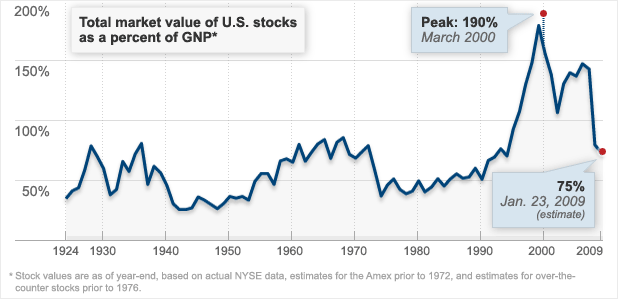
According to investing guru Warren Buffett, U.S. stocks are a logical investment when their total market value equals 70% to 80% of Gross National Product.

buffet chart
By Carol J. Loomis and Doris Burke
February 4, 2009: 9:49 AM ET


(Fortune Magazine) -- Is it time to buy U.S. stocks?

According to both this 85-year chart and famed investor Warren Buffett, it just might be. The point of the chart is that there should be a rational relationship between the total market value of U.S. stocks and the output of the U.S. economy - its GNP.

Fortune first ran a version of this chart in late 2001 (see "Warren Buffett on the stock market"). Stocks had by that time retreated sharply from the manic levels of the Internet bubble. But they were still very high, with stock values at 133% of GNP. That level certainly did not suggest to Buffett that it was time to buy stocks.

But he visualized a moment when purchases might make sense, saying, "If the percentage relationship falls to the 70% to 80% area, buying stocks is likely to work very well for you."

Well, that's where stocks were in late January, when the ratio was 75%. Nothing about that reversion to sanity surprises Buffett, who told Fortune that the shift in the ratio reminds him of investor Ben Graham's statement about the stock market: "In the short run it's a voting machine, but in the long run it's a weighing machine."

Not just liking the chart's message in theory, Buffett also put himself on record in an Oct. 17 New York Times op-ed piece, saying that he was personally buying U.S. stocks after a long period of owning nothing (outside of Berkshire Hathaway (BRKB) stock) but U.S. government bonds.

He said that if prices kept falling, he expected to soon have 100% of his net worth in U.S. equities. Prices did keep falling - the Dow Jones industrials have dropped by about 10% since Oct. 17 - so presumably Buffett kept buying. Alas for all curious investors, he isn't saying what he bought. To top of page

Aston Martin V12 Vantage Production Coupe

2010 Aston Martin V12 Vantage Production Coupe

After showing a concept V12 Vantage at the grand opening of its new design studio, Aston Martin has turned out a production version of the car an astoundingly-quick 13 months later. That is, unless you factor in the time between its unveil today and the actual on-sale date, which will be some time in the third quarter of 2009. Considering the development periods of some other companies, that's still impressive.

The AM V12 Vantage is the result of engineers combining the smaller, lighter Vantage platform with the bigger, meaner V12 engine of the DB9 and DBS, here making 510 hp and 420 lb-ft of torque. That's enough stupid power to get the car to 62 mph in 4.2 seconds on its way to a 190-mph top speed. The new model also benefits from added carbon fiber pieces and a few interior touches. See the photos through the gallery link below or read the release after the jump.


PRESS RELEASE

-Fastest and most agile Vantage ever; ultimate performance interpretation of the Vantage range
-Purposeful, striking and functional styling signalling performance capabilities
-Everyday usability associated with a modern Aston Martin
-Race-derived technology used throughout

Gaydon, Warwickshire, Wednesday 4 February 2009. Aston Martin will present the most potent production sports car in the marque's 95-year history at the Geneva motor show on 3 March. Based on the hugely successful V8 Vantage, the V12 Vantage will feature a 6.0-litre V12 engine producing 510 bhp (380 kW / 517 PS), and 570 Nm (420 lb ft) of torque with a top speed of 190 mph (305 km/h) and 0-62 mph (0-100 kp/h) time of 4.2 seconds.

The latest incarnation of the Vantage family has been designed to provide a unique character, appealing to different driver tastes and complementing the other models in the current Aston Martin line-up.

The original V12 Vantage concept was unveiled to guests at the opening of the Aston Martin Design Studio in December 2007. Continuing the marque's impressive record of bringing concepts through to production, Aston Martin engineers have brought the V12 Vantage to market in an incredible 12 months.

Aston Martin Chief Executive Officer, Dr Ulrich Bez said: "This is the ultimate performance interpretation of the Vantage range, combining our most agile model with our most powerful engine. It represents the definitive driving package; providing spectacular performance to ensure a dynamically thrilling and everyday useable driving experience.

"The V12 Vantage has a unique character, one unlike our other cars. This will appeal to different people with different tastes, allowing more people to enjoy the Aston Martin experience.

"This also illustrates one of Aston Martin’s key strengths - the ability to act quickly and turn concepts and ideas into reality."

Designed for the focused driver, every component of the V12 Vantage has been honed with pure driving enjoyment in mind. Benefitting from race-developed materials and components, and featuring lightweight carbon fibre; performance and agility have been tuned to perfection.

Visually enticing, the V12 Vantage expresses its performance potential through its purposeful stance created by enhanced aerodynamic and cooling aids optically widening the car, while retaining traditional understated Aston Martin design. Equally inviting, the cosseting interior permits the driver to extract maximum performance ability from the car while also enjoying customary levels of Aston Martin comfort on longer journeys. High levels of power and torque are available at all engine speeds making the V12 Vantage responsive and tractable in any driving situation.

The V12 Vantage will be built at Aston Martin's global headquarters in Gaydon, Warwickshire joining the DBS, DB9 and V8 Vantage model lines which are built in the state-of-the-art production facility combining hi-tech manufacturing processes with traditional hand-craftsmanship. Production will be limited up to 1,000 examples over the life span of the car, making the V12 Vantage a truly exclusive driver's car.

Deliveries of the V12 Vantage are expected to commence during quarter three 2009 with prices to be confirmed at the Geneva motor show

Kathleen Parker: Phelps May Be Involuntary Hero For Liberty

By Kathleen Parker

Wednesday, February 4, 2009; 12:00 AM

It's hell being a celebrity, especially if you're young and find yourself at a party, where marijuana and cameras should never mix.

And it's not exactly heaven being sheriff of a county with escalating drug crimes and pressure to treat all offenders equally.

Thus it is that Olympian swimmer Michael Phelps and Sheriff Leon Lott of South Carolina's Richland County are being forced to treat seriously a crime that shouldn't be one.

As everyone knows by now, Phelps was photographed smoking from an Olympic-sized bong during a University of South Carolina party last November. As all fallen heroes must -- by writ of the Pitchforks & Contrition Act -- Phelps has apologized for behavior that was "regrettable and demonstrated bad judgment," and has promised never to be a lesser role model again.

Check.

Lott, meanwhile, is threatening action against Phelps because ... he has to. Widely respected and admired as a "good guy" who came up through the ranks, Lott is in a jam. Not one to sweat the small stuff, he nevertheless has said that he'll charge Phelps with a crime if he determines that the 14-time gold-medal winner did, in fact, smoke pot in his county.

The sheriff's job will be made both easier and tougher by evidence that includes a photograph of Phelps with his face buried in a smoke-filled tube and what Lott has called a "partial confession." Phelps has said that the photo is legit. The only missing link, apparently, is the exact location of the party.

What's tough is that Lott probably doesn't want to press charges because it's a waste of time and resources. He's got much bigger fish to fry, but several recent drug-related crimes -- including at least two high-profile murders -- have captured community attention.

And the law is the law. Therein lies the problem.

Our marijuana laws have been ludicrous for as long as we've been alive. Almost half of us (42 percent) have tried marijuana at least once, according to a report published last year in PLoS Medicine, a journal of the Public Library of Science.

The U.S., in fact, boasts the highest percentage of pot smokers among 17 nations surveyed, including The Netherlands, where cannabis clouds waft from coffeehouse windows. Among them are no small number of high-ranking South Carolina leaders (we knew us when), who surely cringe every time a young person gets fingered for a "crime" they themselves have committed.

Other better-known former tokers include our current president and a couple of previous ones, as well as a Supreme Court justice, to name just a few. A complete list would require the slaughter of several mature forests.

This we know: Were Phelps to run for public office someday and admit to having smoked pot in his youth, he would be forgiven. Yet, in the present, we impose monstrous expectations on our heroes. Several hand-wringing commentaries have surfaced the past few days, lamenting the tragic loss for disappointed moms, dads and, yes, The Children.

Understandably, parents worry that their kids will emulate their idol, but the problem isn't Phelps, who is, in fact, an adult. The problem is our laws -- and our lies.

Obviously, children shouldn't smoke anything, legal or otherwise. Nor should they drink alcoholic beverages, even though their parents might.

There are good reasons for substance restrictions for children that need not apply to adults.

That's the real drug message that should inform our children and our laws, rather than the nonsense that currently passes for drug information.

Today's anti-drug campaigns are slightly wonkier than yesterday's "Reefer Madness," but equally likely to become party hits rather than drug deterrents. One recent ad produced by the White House Office of National Drug Control Policy says: "Hey, not trying to be your mom, but there aren't many jobs out there for potheads." Whoa, dude, except maybe, like, president of the United States.

Once a kid realizes that pot doesn't make him insane -- or likely to become a burrito taster, as the ad further asserts -- he might figure other drug information is equally false. That's how marijuana becomes a gateway drug.

Phelps may be an involuntary hero to this charge, but his name and face bring necessary attention to a farce in which nearly half the nation are actors. It's time to recognize that all drugs are not equal -- and change the laws accordingly.

kparker@kparker.com