Zazzle Shop

Screen printing

Friday, August 29, 2008

Bloomberg Accidentally Publishes Steve Jobs Obituary


The Bloomberg financial newswire decided to update its 17-page Steve Jobs obituary today -- and inadvertently published it in the process. Some investors were undoubtedly rattled to see, as our tipster did late this afternoon, the Apple CEO's obit cross the wire and then suddenly disappear. Jobs's battle with pancreatic cancer, and speculation over his health, jarred Wall Street earlier this year and continues to be the subject of speculation. The Times weighed in on the matter as recently as last month, when columnist Joe Nocera spoke with the secretive tech executive. But news organizations routinely prepare obituaries in advance, even for the healthy. And if Bloomberg readers had seen the internal story slug, "testjobs," their jitters might have abated. The obit, which we've obtained and reprinted after the jump, is a bit macabre to read but should not scare you out of your Apple shares.

Read the whole story here.

Sarah Palin is McCain's VP pick

BREAKING NEWS
Alaska Gov. Palin is McCain's VP pick


Sen. John McCain has chosen Alaska Gov. Sarah Palin to be his vice-presidential candidate on the Republican ticket for the White House, CNN has learned. The 44-year-old Palin, now in her first term as governor, is a pioneering figure in Alaska, the first woman and the youngest person to hold the state's top political job. developing story

Weight Loss Drinking Beer

Comcast to limit customers' broadband usage

By Yinka Adegoke

SAN FRANCISCO (Reuters) - Comcast Corp, the largest U.S. cable operator, said on Thursday it will cap customers' Internet usage starting October 1, in a bid to ensure the best service for the vast majority of its subscribers.

Comcast said it was setting a monthly data usage threshold of 250 gigabytes per account for all residential high-speed Internet customers, or the equivalent of 50 million e-mails or 124 standard-definition movies.

"If a customer exceeds more than 250 GB and is one of the heaviest data users who consume the most data on our high-speed Internet service, he or she may receive a call from Comcast's Customer Security Assurance (CSA) group to notify them of excessive use," according to the company's updated Frequently Asked Questions on Excessive Use.

Customers who top 250 GB in a month twice in a six-month timeframe could have service terminated for a year.

Comcast said up to 99 percent of its 14 million Internet subscribers would not be affected by the new threshold, which it said would help ensure the quality of Internet delivery is not degraded by a minority of heavy users.

U.S. Internet subscribers are typically not aware of any limit on their Internet usage once they sign up to pay a flat monthly fee to their service provider.

As Web usage has rocketed, driven by the popularity of watching online video, photo-sharing and music downloading services, cable and phone companies have been considering various techniques to limit or manage heavy usage.

But Comcast has come under fire from a variety of sources for its network management techniques.

The U.S. Federal Communications Commission investigated complaints by consumer groups that it was blocking peer-to-peer applications like BitTorrent, and earlier this month ordered Comcast to modify its network management.

Comcast has said that by the end of the year it will change its network management practices to ensure all Web traffic is treated essentially the same, but has also been exploring other ways to prevent degradation of its Internet service delivery.

One consumer group said while Comcast's new 250 GB limit was "relatively high," it could eventually ensnare customers as technology progresses.

"If Comcast has oversold their network to the point of creating congestion problems, then well-disclosed caps for Internet use are a better short-term solution than Comcast's current practice of illegally blocking Internet traffic," said S Derek Turner of Free Press, a Washington, D.C.-based consumer advocacy group that filed a complaint about Comcast's network management practices earlier this year.

The Philadelphia-based company is not alone in trying to come up with ways to limit heavy Internet usage.

Time Warner Cable Inc, the second-largest U.S. cable operator, said in January it would run a trial of billing Internet subscribers based on usage rather than a flat fee.

Comcast spokesman Charlie Douglas said Comcast was also considering so-called consumption-based billing, but no decisions had been made.

(Editing by Braden Reddall

Great Day for a Guiness!

Tiny Drug Transporters


Cell signals: Researchers performed two tests to measure the efficacy of anticancer drugs delivered using carbon nanotubes. They found few proliferating cells (pink, top) and a much higher percentage of cell death (pink, bottom) compared with tumors that received other treatments. The researchers attribute this to the nanotube’s ability to leak into a tumors from blood vessels.
Credit: Hongjie Dai

An ideal cancer treatment would deliver a high dose of drugs to tumor sites while minimizing side effects. Unfortunately, as anticancer drugs are quickly cleared from the bloodstream, large doses are usually needed to ensure that enough drugs reach the tumor. And since these drugs can be absorbed by normal cells, high doses cause unpleasant side effects. Now research from Stanford University has shown that carbon nanotubes loaded with anticancer drugs can target tumor cells while steering clear of healthy tissue.

"Carbon nanotubes are one-dimensional, which sets them apart from other drug-delivery systems," says Hongjie Dai, a chemistry professor at Stanford, who led the research. The nanotubes--on average 100 nanometers long and a few nanometers wide--pass easily through the leaky walls of tumor blood vessels but do not get into healthy blood vessels. So the researchers realized that drugs attached to the nanotubes could be carried inside tumors without harming normal tissue.

To make working nano-drug transporters, the researchers coated the nanotubes with a molecule called polyethylene glycol (PEG), which has three branches on one end, then attached molecules of the anticancer drug paclitaxel to each branch. Each of the 100-nanometer-long nanotubes carried about 150 drug molecules in total. "Think of a carbon nanotube as a boat," says Steve Lippard, a chemistry professor at MIT, who was not involved in the research. "The advantage of the branched PEG is that you can have multiple passengers at each seat." Dai adds that the branched PEG is stable in the bloodstream for a relatively long time, giving the nanotubes more time to find and treat a tumor before leaving the body.

The drug-delivery technique was tested in mice that had been injected with breast cancer cells. Once the tumors grew to a specific size, the researchers administered a dose of the drug-laden nanotubes every six days. They gave another group of mice similar doses of different forms of paclitaxel, including the clinical drug Taxol, and left some untreated. After 22 days, they found that the tumors treated by nanotube delivery were less than half the size of the tumors treated by the second most effective treatment, Taxol.

The tumors treated with nanotube-delivered paclitaxel had a higher percentage of cell death and a smaller percentage of proliferating cells. The researchers estimate that drug uptake within a tumor was 10 times higher for nanotube delivery than for Taxol. This uptake means that smaller doses could be used to achieve the same effects as other treatments, reducing side effects.

However, despite such a dramatic improvement, lingering concern over the potential toxicity of carbon nanotubes means that they may be a long way from clinical use as a drug-delivery mechanism.

Dai's research suggests that carbon nanotubes accumulate in the liver and spleen and are cleared from the body through feces within a few months without causing lasting damage to organs. But "unlike nanoparticles that have been used for some time, such as gold, the safety of carbon nanotubes is not yet clearly established," says Bruce Weisman, a chemistry professor at Rice University. He adds that safety concerns will probably delay the approval of carbon nanotubes for medical purposes.

"Carbon nanotubes offer an interesting alternative [for drug delivery], if the toxicity does prove to be negligible," adds Lippard.

Nonetheless, the Stanford group plans to further investigate how the size of nanotubes affects drug circulation in the blood, penetration into both tumor and healthy cells, and the overall efficiency of drug delivery. Since there are relatively few anticancer drug carriers approved for clinical use, "there is a lot of room to develop this new drug-delivery method," says Dai.

Neutralizing Fluorocarbons


Broken Apart: Researchers at Brandeis University used a silyium-carborane catalyst to break carbon-fluorine bonds at room temperature. This promises to make it easier and more effective to dispose of pollutants.
Credit: Oleg Ozerov

Fluorocarbons--common chemicals in which carbon is bound to fluorine--are potent greenhouse gases, and some form toxic compounds that can accumulate in the environment. But neutralizing fluorocarbons has required a process whose high temperature drives up its cost, limiting its adoption. Researchers at Brandeis University report in Science today that they have found a catalyst that breaks the carbon-fluorine bond at room temperature, promising easier and more effective disposal of pesky pollutants.

The strength of the fluorine-carbon bond makes fluorocarbons valuable in chemically resistant and durable materials such as stain repellants, nonstick cookware, and coolants. But it also explains why they are so difficult to dispose of. One type of fluorocarbon, the ozone-destroying chlorofluorocarbons (CFCs), has now been widely banned under the Montreal Protocol, but the two other main types also present environmental problems.

One of them is now used instead of CFCs as a coolant in refrigerators and air-conditioning units. Where such refrigerants leak into the environment, they function as greenhouse gases that are a thousand times more potent than carbon dioxide.

Another type of fluorocarbon is used in many medical applications, including artificial blood. It, too, is a potent greenhouse gas and gets into the atmosphere as a by-product of the aluminum industry. But some species of it are also toxic and accumulate in the food chain, possibly increasing risk of cancer, birth defects, and other health problems.

Brandeis's Oleg Ozerov, lead researcher of the current Science study, found a way to crack the carbon-fluorine bond by using a silicon-based catalyst that recycles itself, so it can spark the breakdown reaction over and over again.

"The basic idea is that we use three things: the fluorocarbon, a silicon-based hydrogen source, and a catalyst which mediates between the two to replace the fluorine in the fluorocarbon with hydrogen," says Ozerov. "The active part of the catalyst is a positively charged silicon compound that kicks off the reaction by ripping the fluorine out of the fluorocarbon bond."

Having a fluorine ripped out, explains Ozerov, causes the former fluorocarbon to pull a hydrogen molecule out of the silicon-based material. Losing a hydrogen, in turn, transforms the silicon-based material into another instance of the catalyst, so the reaction can continue.

To get the initial catalyst to work, Ozerov and his colleague Christos Douvris had to stabilize it by partnering it with a very nonreactive, negatively charged ion that would interfere as little as possible with the target reaction.

Surgery by the numbers

Lymph Imaging: Photo by John V. Frangioni, M.D., Ph.D. Beth Israel Deaconess Medical Center, Boston

The problem with cancer surgery, or so we hear, is that it's difficult for surgeons to know if they've removed all of a tumor, especially in late-stage cancers when the edges get indistinct. But a new imaging technology developed at Beth Israel Deaconess Medical Center's Center for Imaging Technology and Molecular Diagnostics in Boston is giving cutters visual cues on just where to aim their scalpels.

The portable FLARE (Fluorescence-Assisted Resection and Exploration) system uses near-infrared light to highlight cancer cells, giving surgeons a "paint-by-numbers" guide that shows the full extent of a tumor. Before surgery, patients are injected with special dyes called NIR fluorophores that target certain cell or tumor types and glow when they are exposed to near-infrared light. (Don't worry, your prostate won't glow orange -- this process is invisible to the naked eye). A detector relays the information to a video monitor, where the glowing cancer cells are overlaid on real-time images of the patient's body. A footswitch allows the surgeon to magnify or change viewing angles during the operation. More advanced versions may allow the surgeon to simultaneously view other systems, like nerves and blood vessels.

So far, FLARE has been used on mice and pigs, but is going into human trials soon. But advancing the technology and using it on various cancers now depends on developing more sophisticated dyes. "The future of the technology now is really in the chemistry," says project director John Frangioni. "We have to develop agents for specific tumors, nerves, or blood vessels we're trying to visualize."

[Via Eurekalert]

Automobile's take on the big six sedans

REVIEWS:

Nissan Maxima, Toyota Avalon, Hyundai Genesis, Pontiac G8 V-6 Comparison - Big Six Sedans

By Joe Lorio

">
">

">

American F1 champion Phil Hill dies at 81


MONTEREY, California — Phil Hill, the first American to win the Formula 1 world driving championship, has died at age 81, but he'll be remembered for far more than his driving exploits. Hill popularized sports car racing in the U.S. during the 1950s and '60s, was instrumental in the rise of vintage car restorations in America, and had been an influential part of American car culture for more than 50 years.

Hill passed away on Thursday morning in Monterey, where he had been hospitalized following the Pebble Beach weekend August 16-17. He had been suffering from Parkinson's disease for some years, but had insisted on attending Monterey this year because his long-time racing friend Dan Gurney was being honored at The Quail. He enjoyed a long and storied career — culminating in the Formula 1 World Driving Championship in 1961 — during the most dangerous era of motorsports without suffering a single serious injury. He was 81.

Phil Hill was the first American to win a Formula 1 race, the first American to conquer the 24 Hours of Le Mans and one of only two Americans — Mario Andretti being the other — to be crowned F1 champion. Yet this glittering record was hardly the measure of the man. Hill also co-founded one of the country's most reputable restoration shops for vintage cars, regularly contributed stories to Road & Track and served perennially as a judge at the Pebble Beach Concours d'Elegance. He was both a legitimate player and an influential observer, and from his singular vantage point, he was uniquely able to instill in successive generations of Americans an appreciation for racing and the historic cars that were his lifelong passion.

Those who met him late in his life would find it hard to believe how handsome and powerful he'd been in his heyday, and the nervous agitation he customarily exhibited belied the courage required to brave the perils of the Carrera Panamericana, the Nürburgring Nordschleife, and the banking at Monza. In an age when Formula 1 is everything in the road racing world, Hill's three Grand Prix triumphs may seem paltry. But he also won three times at Le Mans. And don't forget the victories at Sebring and Daytona, in Can-Am and on the original Pebble Beach road course, not to mention the land speed records he set at Bonneville. And how many drivers can say they won their first race (in a supercharged MG TC on a half-mile oval) and their last race (at Brands Hatch in the Chaparral 2F)?

Raised in Santa Monica, Hill was one of the young, speed-happy Californians who discovered imported sports cars after World War II. But to Hill, a racecar was more than a mere mechanical contrivance. As a boy, he'd learned to love the majestic American classics of the prewar epoch, and he never lost his appreciation for how they worked and what they represented.

A few years after Hill retired from racing, he teamed up with Ken Vaughn to create what was then the nation's most prestigious restoration firm. During the next decade, Hill & Vaughn established the template — and set the standard — for the shops that proliferate to this day. Two of Hill's own cars won Best of Show honors at Pebble Beach. It's no coincidence that Hill served as a judge at this, the country's premier concours, no fewer than 40 times.

Hill also collaborated with his great friend John Lamm to write scores of articles for Road & Track about the most memorable cars of the past century. Like Hill, these stories were honest without ever becoming accusatory, erudite without ever seeming pedantic. And as often as not, the cars he wrote about were analogues for Hill himself — rare classics never to be made again, but never to be forgotten.

What this means to you: One of the most respected and well-liked drivers of the classic era, Phil Hill had much to do with the American car culture we know today. — Preston Lerner, Correspondent

Paul "Fitzy" Fitzgerald: Friars Club Roast of George Takei

OK, so I know alot of you voted for me and helped me get that sweet spot opening for Dave Attell last weekend at Showcase Live in Foxboro. And I thank you very much 'cuz it was all kinds of awesome (and if you didn't vote for me that's fine to - just pretend you did whenever we meet in person). BUT, I could use one more vote from you. I hate to ask, but hey - that's what MySpace friends are for, right Dionne Warwick? I know, I'll stop...

So, I took part in this roasting competition at The Friars Club in New York, and a couple of us comic types got the chance to perform an original roast of George "Mr. Sulu" Takei. And it was a friggin' blast.


If you get a coupla laughs (clip is very Fitzy, thus very NSFW) and don't mind logging a view and a vote then that would be dynamite. You sign up for nothing, enroll in nothing and will receive no texts, spam or junk mail at home. And that's a GFY promise! Just filthy jokes, inappropriateness galore and lotsa fun at a successful person's expense.


Cheers and cold Star Trek beers,

Fitzy
www. townienews. com

PS - Have you checked out the redesigned site yet? Pretty sweet, right?

Van Damme Friday: WaterSports!!

Thursday, August 28, 2008

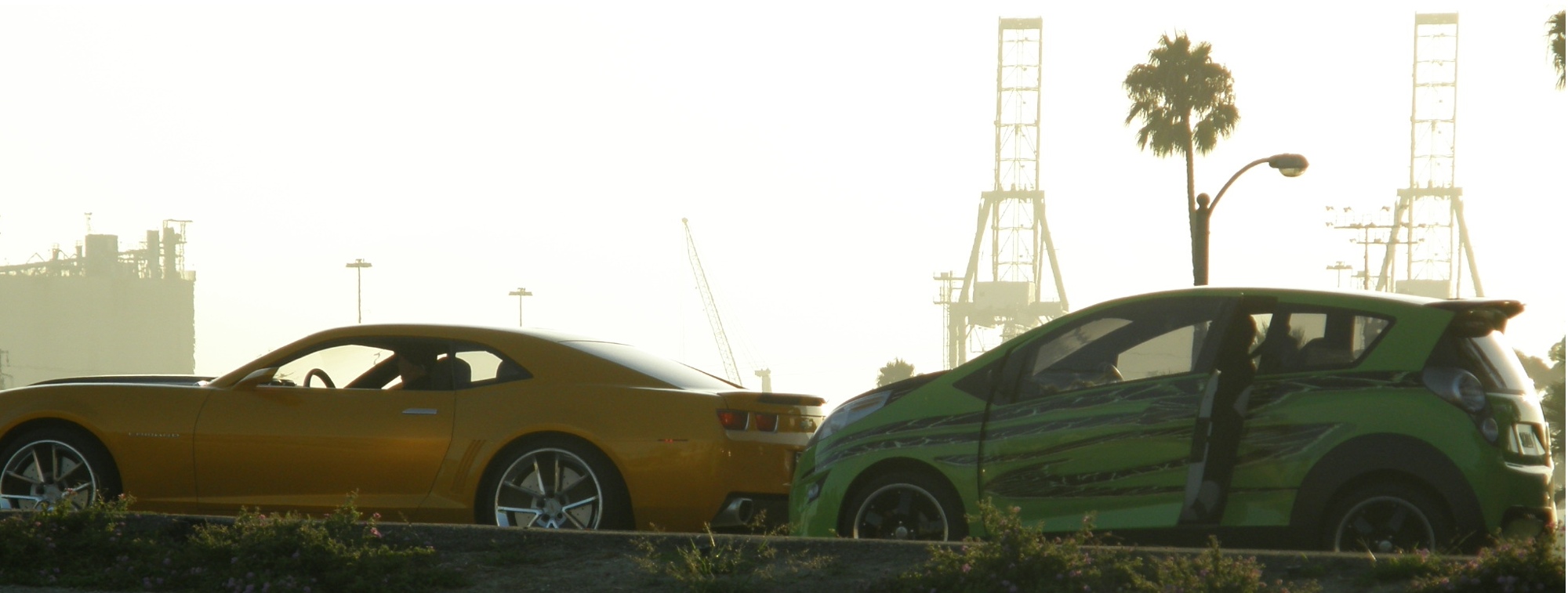
More Transformers 2 Long Beach Set Photos

/Film reader Ricky C snapped some photos of the Transformers: Revenge of the Fallen shoot in Long Beach today:

Hey guys! I got some really great pictures from the Transformers 2 set in Long Beach. I tried to get more pictures of that grey car but it sped away before i could snap some good pictures. I was literally ten feet away from all of these. It was intense! Later on guys!

Green Gym Uses Human-Powered Energy

Written by Ariel Schwartz

bikes
The opening of Portland’s The Green Microgym this week seems like a perfect complement to the announcement of M2E’s kinetic charger, which can generate energy from motion. Adam Boesel, The Green Microgym’s owner, doctored up spin bikes with weed whacker motors and truck alternators so that patrons can create energy to help power the 2,800 foot space.

According to DailyTech, the Team Dynamo and Spin Bikes at the gym can each generate up to 75 watts. Next on Boesel’s list is generating power from elliptical trainers.

At first, patrons will probably generate about 25 percent of the gym’s power. But Boesel hopes that eventually they will be to generate all of it.

The Green Microgym follows in the footsteps of Hong Kong’s California Fitness gym, which uses gym-goers’ energy to power light fixtures.

Lego Batman Coming To iPhone?

The latest installment in the LEGO Thing franchise — LEGO Batman — could be heading to the iPhone, reports Pocket Gamer.

There have been earlier Java midlet versions of LEGO games - notably Star Wars II: The Original Trilogy, but it would be nice to think that theiPhone would get a proper conversion..

The possibilities for manipulating LEGO bricks using multi-touch gestures could make for an interesting twist on the LEGO gameplay. Even if it is just a port of the DS version, though, it should be worth checking out providing the thorny issue of lack of D-Pad is resolved.

Pocketgamer don't mention a source for the news — hence the rumor tag — but as soon as we get more details, you shall be the first to know.

Ford Tests Improve Gas Mileage 24% with EcoDriving

by Benjamin Jones

Ford is really throwing down the guantlet by showing how dedicated it is to the new EcoDriving initiative we talked about the other day. I really liked it because it validates a lot of what we’re trying to do on the forums in terms of improving fuel economy on an individual level, but also showed that automakers were willing to commit (at least in name) to supporting fuel efficient driving. However, it seems Ford has really stepped up to the plate by offering ecodriving lessons over the course of several days to see how effective it really is.

Ford takes on ecodriving

Recently, Ford and a group called Pro Formance decided to take on ecodriving in the form of a 4-day long seminar with 48 different drivers taking part. Using the ecodriving tips taught by Pro Formance, the participants increased their fuel economy between 6-50%, with and average increase of 24%.

With the gas crunch hitting people hard, it’s good to see a company like Ford stepping up and showing consumers that there’s more than just air up your tires and cleaning out the trunk. Here’s their take on ecodriving:

“By working with Pro Formance to conduct validation testing, Ford is proving that eco-driving techniques are teachable and work across a broad spectrum of vehicles and drivers,” said Drew DeGrassi, president and CEO of Pro Formance Group. “It’s a great initiative for Ford to lead in this country. It’s not the end-all solution for America to obtain energy independence, but it is an important part of it.”

I would love to see what the training program is like, but for the rest of us Ford give us 10 ecodriving tips. Sure, they pale in comparison to EcoModder’s ecodriving tips list, but most drivers aren’t interested in getting really involved, and Ford’s hands-on approach is a good way to get results without asking too much of people.

Evidently they have been doing this since the 1990s in Germany, where gas mileage has been an issue for longer than it has in the US. Hopefully, this will encourage other manufacturers to bring their most efficient vehicles and programs to a ready-and-willing US market.

Spielberg Digs Up Clues

by

Steven Spielberg is having a Clues encounter of the 39 kind.

The Oscar-winning filmmaker is pumping up his already crowded slate with another would-be blockbuster. DreamWorks has acquired the big-screen rights to The 39 Clues, a multiplatform adventure series hitting stores in September from Scholastic Media—a publisher that knows a thing or two about launching mega-franchises, having foisted a little something called Harry Potter on us Yanks.

As first reported in Variety, Spielberg will produce the film and could also direct should one of several other projects he's been developing fail to get off the ground. A search is already under way for a screenwriter to adapt the franchise.

Scholastic will roll out Clues over a period of two years, beginning with the first installment, The Maze of Bones. Nine other literary adventures are expected to follow, accompanied by a set of collectible cards and an online game that will run for two years and give Netizens the chance to solve a mystery and win a $10,000 grand prize.

"The 39 Clues takes creative leaps to expand the story experience from the pages of the books to multiple stages of discovery and imagination," Spielberg said in a statement.

The franchise centers around the most powerful family in the world, the Cahills, whose relatives include Napoleon and Houdini. In the first book, Cahill matriarch Grace alters her will at the last minute to give her descendants a choice: Either accept $1 million or receive one of 39 clues hidden around the globe that will reveal the source of the family's power.

Based on Maze of Bones author Rick Riordan's outline for the 10-book series, there would be enough material for as many as three or four movies.

After reviving Indiana Jones last month to the delight of moviegoers and his accountant (the sequel has grossed nearly $400 million worldwide and counting), Spielberg has plenty in the pipeline.

The pending projects include The Trial of the Chicago 7, chronicling the 1968 protests at the Democratic National Convention in Chicago and the high-profile conspiracy trial that followed; Lincoln, a presidential biopic starring Liam Neeson; and two Tintin adventures he's developing with Peter Jackson.

Spielberg Still Taking First Tintin Shift

Peter Jackson, Tin-Tin, Steven Spielberg Axel/ZUMA Press;Hergé;Lisa O'Connor/ZUMAPress.com

by


The Tintin tag-teaming has begun.

Steven Spielberg is still slated to direct the first of three planned films about the mystery-solving Belgian reporter and his trusty fox terrier Snowy, despite recent word from the Brussels studio that owns the rights to the characters that Peter Jackson would be doing the honors for Tintin's first outing.

Reps for both filmmakers say that Jackson—who will serve as a producer on the Spielberg-directed installment—is still onboard to helm the next film in the would-be franchise, based on the classic European comic strip by George Remi, who published his creations under the pen name Hergé.

A rep for Hergé Studios had said earlier Tuesday that Jackson would be the first to step behind the camera and Spielberg would be indirectly involved in the filming, according to the Hollywood Reporter.

Either way, the first movie will be adapted from two books in the Adventures of Tintin series—The Secret of the Unicorn and Red Rackham's Treasure, written between 1942 and 1944. Dr. Who scribe Stephen Moffat penned the script.

And now Tintin's signature carrot top will reach new heights: The originally 2-D traveler is being brought to the big screen with Polar Express-style motion-capture animation technology.

British teen Thomas Sangster (Liam Neeson's lovestruck son in Love Actually) will wield Tintin's heavily stamped passport and motion-capture veteran Andy Serkis, of Gollum fame, is stepping into the role of his crusty sailor pal, Captain Haddock.

Before it's Jackson's turn to fashion a Tintin adventure, he will finish postproduction on The Lovely Bones and cowrite The Hobbit with Guillermo del Toro, who was tapped to direct the Lord of the Rings prequel after Jackson dropped out.

Viper owners and fans react to news that Viper could be on the block


AUBURN HILLS, Michigan — As owner's clubs and fan sites buzzed Wednesday with news that Chrysler may sell the Dodge Viper brand, fans of the brawny halo car expressed concern for what the car might become, rather than who owns it.

On the Viper Club of America forum, members were generally appreciative that Chrysler is looking at a future for the V10-powered car, rather than killing it off. Chrysler Chairman and CEO Bob Nardelli announced on Wednesday that the company was exploring "strategic options for the Dodge Viper business" and had been approached by companies interested in the Viper nameplate.

"I have only one hope, whoever buys it, keep it a Viper," wrote a Viper Club of America member going by the name V10SpeedLuvr. "I don't want a backseat or a V8. I'd rather see it die completely than become a mass produced, babyseat hold-down having, family version of the Corvette."

Many owners and enthusiasts were speculating on potential buyers — and voicing dreams of an even more powerful Viper produced by a niche manufacturer like Pininfarina, Roush or Saleen. Still, some fans worried that eliminating the halo car from the lineup would harm the entire Dodge brand. On Red Letter Dodge, a Web site devoted to the entire company lineup, the news drew just two comments, but both posters expressed disappointment.

"Having a high-end car in the lineup gives Dodge the credibility that they are a high-performance, quality manufacturer that will always be a few notches above the competition because they can build exotic cars," wrote user TexasMopar.

What this means to you: Viper fans don't seem too concerned with what logo is on the hood, as long as the car stays true to its performance pedigree. — Eric Tingwall, Correspondent

Is College Still worth the Price?


Costs are soaring twice as fast as inflation, even as salaries for graduates are falling. Time to examine the old belief that college is worth whatever you can pay.


(Money Magazine) -- In May, more than 20,000 spectators gathered under blue skies at Wesleyan University in Middletown, Conn. to hear Democratic presidential candidate Barack Obama deliver the commencement address.

After recalling his days as a low-paid community organizer, Obama urged the graduates to consider careers in public service. "I ask you to seek these opportunities when you leave here," Obama declared. "The future of this country - your future - depends on it." His message was received with enthusiastic applause.

Calls to "give back" always seem to resonate at elite schools like Wesleyan, a picture postcard of academic abundance on its 360-acre wooded campus, complete with state-of-the-art film center, 7,500-square-foot fitness facility, skating rink, 11-building arts complex and a new $47 million student center offering everything from Mongolian grill entrées to organically grown coffee.

As for actually entering a career in public service, Graduate, good luck with that. Given the steep price tag for a Wesleyan degree ($200,000 for four years) and the substantial amount you may have borrowed to pay those bills ($21,500 for the average student, with some families carrying loans of $50,000 or more), choosing a profession that often pays less than $30,000 a year might be, well, let's just say a bit of a financial challenge.

For more than two decades, colleges and universities across the country have been jacking up tuition at a faster rate than costs have risen on any other major product or service - four times faster than the overall inflation rate and faster even than increases in the price of gasoline or health care (see the chart to the right). The result: After adjusting for financial aid, the amount families pay for college has skyrocketed 439% since 1982.

Granted, the fact that college costs are spiraling wildly out of control is not exactly a news flash. The real eye-opener is why.

College finance experts point to a record number of applicants in recent years as the baby boomlet comes of age (many of the more selective schools reported double-digit increases for 2008); that trend, coupled with growing demand for degrees (undergraduate enrollment has jumped more than 20% over the past decade), puts heavy upward pressure on prices. Dwindling support for higher education from cash-strapped federal and state governments doesn't help the situation.

Normal supply and demand can't begin to explain cost increases of this magnitude, though. If the usual rules applied, tuition would eventually stop rising because families would cut back enrollment, especially at the most expensive private schools, just as they curtailed consumption of gas once prices hit $4 a gallon.

Colleges would then be forced to cut costs or entrepreneurs would flood the market with lower-cost alternatives. But for the most part - all those invitations you see to get your degree online notwithstanding - that hasn't happened.

Instead, prices for college have begun to follow their own peculiar logic. In the absence of any objective measure of the value of an education, price becomes the default yardstick. The more expensive a college is, the better the education it presumably provides. (After all, if other families were willing to pay this much to send their kids here, it must be worth it.)

And the better the education is presumed to be, the higher the price the college can charge. In that respect, it's like home values during the housing boom or dotcom stocks during the late-'90s tech frenzy: Prices go up on sheer momentum.

But families don't shell out money for college in the belief that their investment will someday bring them riches, as they did with real estate and tech stocks. Rather, the perceived payoff is that going to a brand-name school will one day make their children richer.

Even if the financial value of a degree is hard to measure, however, one thing's for sure: It's not infinite. Already a backlash is brewing in Congress about the spending and pricing policies of the wealthiest schools, and some parents may soon join in.

Says Charles Miller, who chaired the U.S. Department of Education's Commission on the Future of Higher Education: "If college costs continue to escalate at this rate, you may reach a point where the investment simply isn't worth it."

The critical question for you to ask: When it comes to college, will you and your child get what you think you're paying for? Here are the facts. You decide

If colleges were spending most of their money on initiatives that improve the quality of education for students, you might regard price hikes running at two to four times the rate of inflation as a necessary evil. But spending on palatial dorms, state-of-the-art fitness centers and a panoply of gourmet dining options? Maybe not.

Yet that's precisely what many schools are doing to attract students - engaging in a luxury arms race, fueled by the wealth of such elite institutions as Harvard and Yale.

Sure, they're also putting funds into cutting class sizes and hiring top professors. But they're spending even more on building Hogwarts-style dorms with mahogany casement windows of leaded glass (Princeton's newest $136 million student residence); installing 35-foot climbing walls and hot tubs big enough for 15 people (Boston University); providing multiple eateries with varied cuisines and massive fitness and recreation centers (too many schools to name).

"There's a lot of competition from other colleges," says Steven Knapp, president of George Washington University. "In today's consumer culture, parents and students expect a certain level of comfort - and they compare the amenities."

The goal of all this collegiate bling is to entice more people to apply. Not just because the school gets a bigger pool of qualified students to choose from but also because the more students who apply, the more it can ultimately reject. That lowers its acceptance rate and makes it appear more selective in the critical U.S. News & World Report college ranking system.

"The rankings are a measure of wealth, exclusivity and fame, not quality," says Kevin Carey, research manager at the nonprofit Education Sector. "Still, they've become a de facto standard for parents, students and the colleges themselves."

The rankings generate a lot of criticism, and nearly 70 colleges refuse to participate. Many more try to work the system to their advantage by spending in ways that will boost their standing - say, offering more merit aid to attract top students.

Here's the rub: More merit aid means less money for need-based aid - which means many families end up paying more, unless their child is one of the lucky few to earn a scholarship.

The appearance of misguided spending by colleges has prompted some lawmakers to question whether wealthy schools still deserve their tax-exempt status. After all, they argue, the colleges are spending only a small fraction of their endowments on the public good - often less than 5%, which is the mandatory payout for private foundations.

The implied threat caused a minor panic attack in academe and prompted many wealthy colleges to announce plans to raise their spending on financial aid. Harvard, the nation's richest university with a $35 billion endowment, now guarantees that families earning up to $60,000 will pay nothing and those earning $180,000 or less will pay no more than 10% of their income.

Yale ($23 billion) promises that families earning $120,000 or less will pay no more than 10% of their income. Many other highly selective colleges, including Wesleyan, have followed the Ivy League leaders. Says Sen. Chuck Grassley (R-Iowa), a leading voice on the issue of college affordability: "The quick response by the schools is admitting that something's not right."

The improved aid for the fortunate few, however - less than 1% of students attend Ivy League schools - may result in higher costs for everyone else. Public colleges and less wealthy private ones are now under intense pressure to compete, yet few can afford to match the largesse of the rich schools.

At the University of California-Berkeley, for example, a family earning more than $90,000 would get little or no aid, so they'd have to pay the total cost of nearly $25,000. At Harvard they'd now pay less than $9,000.

"That puts middle-class families at a huge disadvantage in our system," says Berkeley chancellor Robert Birgeneau. "Many colleges may have to raise fees to funnel more money into financial aid or risk losing many of the best middle-class students."

The high sticker price is actually part of many colleges' marketing strategy. For as counterintuitive as it seems, schools have often found that raising tuition attracts more applicants because families tend to equate high price with quality. Marketers call it the Chivas Regal effect.

In 2000, for example, Ursinus College in Collegeville, Pa. boosted tuition and fees by 17.6%. The following year the school received nearly 200 more applications than the year before, and within eight years the freshman class had grown 56%.

Hendrix College in Conway, Ark. had a similar experience in 2005 when it hiked its tuition rate by 29% to $22,000. The college in effect gave back much of the increase as financial aid or merit scholarships to 99% of the students; still, it seemed that tuition was as high as at places like the University of Richmond. Since then the number of incoming freshmen has increased by nearly 40%.

Says Hendrix College president Timothy Cloyd: "We are competing with schools that charge more, so it was hard to convince people that we were as good as our rivals when we charged so much less."

The outlet for students who can't play this game has always been public colleges, which 80% of undergraduates attend. But as states struggle to meet the growing cost of Medicaid and federal requirements for elementary and high school education, less money is available for colleges.

Twenty years ago, nearly 75% of state university general funds came from state appropriations vs. 63% today. And in the current economic downturn, which is reducing tax revenue in many states, college officials worry, rightly, about additional cutbacks.

Public colleges have been making up the shortfall by raising tuition at an even faster clip than private schools -31% compared with 14% over the past five years. Last year alone, Illinois public colleges raised rates 12%, while in Colorado costs jumped 16%.

And prices at some flagship public universities are starting to look more like what you'd pay at a private institution. At the University of Michigan, for instance, in-state freshmen now pay nearly $20,000, and out-of-state first-year students pay almost $42,000 - $10,000 more than the $32,000 cost of the average private institution, although still less than the $50,000 or so charged by top private schools.

Colleges could help ease the pressure by adopting cost-containment practices that are standard in private business. But most schools are nonprofits. And without the pressure to produce earnings, they have little incentive to slash expenses or improve productivity.

Says Ron Ehrenberg, an economics professor at Cornell University and author of "Tuition Rising": "For nonprofits the goal is to raise all the money you can, then spend it."

Then too, teaching is an inherently labor-intensive process that isn't conducive to economies of scale. "It's not like automating a factory - one professor can only grade so many papers and teach so many classes," says Vassar College president Catharine Hill. "If you were to double the class size, the quality would go down."

Classroom instruction is just one part of a college's budget, however, and not even the biggest part. In a study of spending at nearly 2,000 public and private schools over 18 years, researchers for the Delta Cost Project found that the percentage of operating expenses going to classroom instruction (mainly professor salaries and benefits) accounted for 34% to 44% of spending - and those percentages actually fell over the period reviewed.

By contrast, an increasing amount was being spent on such items as faculty research and recruiting. "We see indications that institutions are spending more money in areas that may not fit in with the public priority of preparing more graduates," says Jane Wellman, the project's executive director.

That ought to leave plenty of room to cut costs without sacrificing quality. Brit Kirwan, chancellor of the University System of Maryland, has kept tuition level for three years with moves such as centralizing purchasing and increasing faculty teaching hours. Meanwhile, 20 private colleges and universities in Wisconsin have banded together to consolidate administrative functions, saving $16 million over the past three years.

These schools are largely the exception, though. Most colleges don't approach cost-cutting in a systematic way. The American Association of State Colleges and Universities has found that more than three-quarters of schools fail to devote significant resources to identifying and carrying out cost-containment measures and 60% do not regularly quantify results.

Runaway college costs are a matter of growing concern in Washington. In addition to pushing wealthy schools to spend more of their endowments, Congress recently passed legislation that requires greater disclosure about pricing and encourages states to maintain steady funding for public colleges by promising to withhold federal grants if they don't.

But in the end, no matter what lawmakers do, college costs will continue to defy gravity as long as we parents are willing to pay ever-higher prices to give our kids a head start in life. We assume that an expensive college will provide a superior education (there's that "high price equals better quality" bias) and an inside track to a high-paying job after graduation.

After all, at a brand-name school, your child will hang out with the scions of senators, hedge fund managers and captains of industry, and those connections can only help, right?

Well, maybe not. Says Ohio University economics professor Richard Vedder, author of "Going Broke by Degree": "There's virtually no data that allow families to evaluate the quality of [an elite college's] educational offerings or the outcomes of its graduates."

In theory you could quantify the added value you get from going to a highly selective school - which, in turn, would help determine what a reasonable tuition premium would be - by comparing the salaries earned by its graduates with those of workers who attended less selective schools.

Colleges, however, don't hand out that information. And some independent studies suggest the value is less than people think. Take a well-known 1999 paper by Princeton economist Alan Krueger and researcher Stacy Berg Dale at the Andrew W. Mellon Foundation.

The study compared the salaries of graduates who earned degrees from top-tier colleges with those of graduates who were accepted by these schools but chose to attend less selective institutions.

The research found that the two groups of students ended up with similar incomes. It appears that bright students excel no matter where they get their degree. The one exception: Low-income students did benefit from attending the most selective colleges - in their case, the impact of social networking seemed to pay off.

In today's fast-changing economy, however, the value of those old-boy networks may be eroding. According to a 2004 University of Pennsylvania study, prestigious degrees aren't as valuable at major corporations as they were a generation ago.

The study looked at the top executives at Fortune 100 companies in 1980 and 2001. During that time the percentage of top guns with Ivy League undergraduate degrees dropped by nearly a third, from 14% to 10%, while the percentage who attended other highly ranked schools, such as Williams or Notre Dame, fell from 54% to 42%.

Meanwhile, public university graduates soared to nearly 50% from 32%. Meritocracy in corporate America is a good thing, but it doesn't support the notion that whatever you pay for an elite education is worth it.

Given the steep price tag on the Ivies and similar schools and the uncertainty of the payoff, families need to do a harder-nosed evaluation when determining which college is right for their child. When you compare the best private and public undergraduate programs, says Vedder, you'll find that private schools rarely confer an unbeatable advantage.

If a student is considering engineering, for example, Cooper Union (where tuition is free to all) and the University of California at Berkeley have top-ranked programs. For economics, the University of Texas-Austin, the University of Wisconsin-Madison and UCLA are highly regarded.

There are, of course, situations where the expensive degree may trump the less costly alternative. Maybe Deluxe U. offers the most comprehensive courses in astrophysics or Korean literature. Perhaps a dream employer routinely recruits there and not at other schools. Or perhaps your child simply falls in love with the storied tree-lined campus and fieldstone halls.

Then you'll face some tough decisions. Just keep this in mind if opting for Deluxe U. will force your family to borrow heavily: After decades of steady increases, the median salary for workers with a bachelor's degree fell 4.6% from 2001 to 2006. (College grads still earn far more than workers with only a high school diploma, though, as the chart on page 1 shows.)

Meanwhile, salaries rose 4.3% for workers with professional degrees and shot up 9.4% for those with doctorates. So you don't want the debt from getting that B.A. to make grad school unaffordable.

Mind you, some borrowing can actually be a good thing, giving students a built-in investment in their education. But today many kids leave school with unprecedented amounts of debt - $20,000 on average, up from $9,000 a decade ago - and one in 10 private college students borrows over $40,000.

Moreover, that figure doesn't include parent loans, home-equity loans and credit-card debt. "It remains to be seen whether this kind of borrowing is economically sound or just a form of faith-based financing," says Barmak Nassirian, associate executive director of the American Association of Collegiate Registrars and Admissions Officers.

One chilling sign: Among students who graduate from four-year schools with more than $15,000 in debt, the default rate is nearly 20%.

As a rule of thumb, financial advisers recommend that student-loan payments not exceed 10% of a young adult's starting salary. At New York University, for example, about 60% of last year's graduates had loans, which averaged a hefty $34,000.

If they took out the maximum in federal loans and made up the difference with private loans, the typical borrower would owe about $460 a month, which is considered affordable if you earn at least $55,000.

That may be no problem for chemical engineers, with an average starting salary of $63,000, according to the National Association of Colleges and Employers. But the typical liberal arts major earns just $33,000, which would make those payments a real challenge.

Of course, for most families, choosing a college is not simply a financial decision; it's a highly personal one as well. Yes, you have to think about what kind of career that degree will lead to.

College, though, is also about forging lifelong friendships, being challenged by professors and students and sharing traditions - all of which are impossible to quantify. Still, there's no reason to overpay for the experience. From a purely economic point of view, the best advice might be this: Save your money; you'll need it for graduate school.


Making a killing by exporting tiny buildings to China and the Middle East


(Fortune Small Business) -- Edward Leftwich loves to show visitors around the Mohammed Bin Rashid Gardens. It's a massive 4,000-building mixed-use project that he just finished constructing for a client in Dubai, complete with hundreds of waterways, roads, and parks. But you don't have to fly to Dubai to see it - the miniature city fits inside Leftwich's office in Atlanta.

Leftwich, 51, is the CEO of Real Model, a company that creates scale replicas of projects for real estate developers. The replicas can fetch several hundred thousand dollars.

Rather than rely on the troubled U.S. real estate market, Real Model expanded its operations to Dubai, financial capital of the Gulf region. Since opening an office there two years ago, Real Model has seen annual revenues shoot up from $200,000 to nearly $2 million.

Founded in 1985, the company won lucrative contracts during the 1990s housing boom. It built replicas of the Augusta National Golf Course, the Trump (TRMP) Towers in New Orleans, and Atlanta's Olympic facilities. But Leftwich was always wary of a slump.

"One market isn't a feasible business model," he says. "You have to be ready when it stops performing."

In 2006, just as the U.S. building boom started grinding down, Leftwich took a trip to Dubai. The large-scale projects he saw convinced him that the future of real estate lay in the Gulf. Real Model promptly opened a second office in Dubai, hiring 18 local employees. (He still has a staff of eight in Atlanta.)

The bet paid off: Real Model's Middle Eastern sales have soared, while the company's U.S. business has stagnated. The company recently landed deals with major firms such as Emaar, Nakheel, and Dubai Properties.

"In many cases architectural modeling is being replaced with sophisticated computer programs," says Ian Rusk, executive vice president at Zweig White, a construction research firm in Boston. "But replicas are still widely used for high-profile projects, which are concentrated in Dubai."

Real Model's replicas are filled with meticulously crafted touches such as layers of laser-cut Plexiglas, each less than a thousandth of an inch thick, and tiny pedestrians with hand-painted faces. Customers can control hundreds of LED lights via a touchscreen remote. Such attention to detail is how Leftwich aims to compete with his rivals in Dubai, who increasingly outsource their models to China.

"The Chinese prices are lower," admits Reza Khalili, founder of Dubai-based model maker I-CAM. "But the quality isn't as good."

Leftwich hopes to open another office next year in Abu Dhabi - the next hot spot for tiny buildings. To top of page

Flying in the Hawker 4000 Chismillionaire style


Fortune's Sue Zesiger Callaway hops a ride on the Hawker 4000, a $21 million aircraft that boasts cutting-edge avionics. Plus: Jet etiquette.

By Sue Zesiger Callaway

(Fortune Magazine) -- When it comes to business jets, the holy grail has long been a reasonably priced jet with enough range to zip you across the Atlantic. (After all, what mogul wants to refuel in Greenland en route to London?)

Which is why I was particularly curious to take a joy ride in July on the brand-new Hawker 4000, the first plane to offer big-jet safety and technology features at a midsized-jet price.

Okay, so it's still $21 million. But consider: It's $2 million cheaper than a Gulfstream G200 and $7 million less than a Falcon DX, and it has a range of 3,280 nautical miles - that's coast to coast or New York to London nonstop.

The 4000 boasts cutting-edge avionics, auto throttle, and multiple duplicate systems (for safety) unavailable in comparable-size jets - only on the big boys.

A body like no other

Hawker Beechcraft is also the first manufacturer to certify a composite-body jet with the FAA. "It was six steps back to do composite," says chairman and CEO Jim Schuster of the 20-year, $1 billion development process. But the resulting body is 70% stronger than aluminum, doesn't corrode, is easier to repair, and has no life limit.

Amazingly, the fuselage is composed of three enormous pieces - vs. more than 10,000 on a traditional competitor. It's also three times thinner, meaning there's noticeably more room inside the standup, flat-floor ten passenger Hawker.

Tucked into its fine leather - HBC offers limitless leathers, woods, and exotic materials - I felt the obvious power during takeoff. The next thing I noticed was the relative peace: The 4000 has the quietest cabin in its class.

There's already a two and a half year wait list, in part thanks to orders from fractional-jet companies like NetJets and BJETS, so even those who won't be buying a 4000 may still be able to hop aboard one soon.

Private jet etiquette

So you have friends in high places, and they've offered to bring you along. Follow these rules if you want to be invited back.

  • Ask in advance how much luggage you may bring.
  • Don't take your seat until after the owners find theirs.
  • Never tip the staff. That's entirely up to the owner.
  • Nix bringing your own meal. But offering to feed everyone - preferably by air caterer - is a nice gesture.
  • Skip the red wine. You don't want your hosts to remember you every time they see the stain on the carpet.
  • Arrange for transportation when you land. Asking for a lift is an inconvenience.
  • Show your thanks. One owner gives a gift equal to a first-class commercial ticket when she flies with other owners. You may not need to go so far, but don't skimp either. -- Diane Tegmeyer

Gasoline Prices Tumble further

NEW YORK (CNNMoney.com) -- Gas prices continued their slide, falling 11% from highs reached in July, according to a national survey of gas station credit card swipes released Thursday.

Gas was selling at $3.660 a gallon, a decrease of seven tenths of a cent from the previous day's price of $3.667, according to motorist group AAA and the Oil Price Information Service. Thursday's decline is the fifth consecutive day that retail gas prices have fallen.

Prices have fallen more than 45.4 cents since hitting a record of $4.114 on July 17, AAA reported.

The average price of a gallon of gas has been falling as crude oil prices have come sharply off their recent highs. Crude futures hit a record high of $147.27 on July 11 but have since fallen more than 18% as global demand slackened in reaction to the high energy costs.

While gas prices have fallen off their recent highs, however, prices at the pump are still 33% above the same time last year, when a gallon of gas cost $2.758.

State prices: Gas prices change from one state to the next due to differences in state and local gasoline taxes. In addition, gas prices vary by state according to how far the state is from oil and gas facilities in the Gulf of Mexico.

Gasoline remains above $4 a gallon in only two states, according to the survey. Alaska had the highest prices at $4.529 a gallon, down slightly from the previous day's price of $4.546. Hawaii was second at $4.386, down from $4.393 yesterday.

Missouri had the cheapest gas, with prices falling to $3.424 a gallon. South Carolina had the second least expensive gas, with a gallon costing $3.442.

Diesel: The average price for diesel fuel, which is used in most trucks and commercial vehicles, fell to $4.275 a gallon from $4.283 the previous day, according to AAA.

The price of diesel has risen almost 46% in the last year, when a gallon of diesel cost $2.930. Because it is used in transporting goods, the rise in the price of diesel fuel has pushed up the prices of products and services.

Ethanol: Many Americans have turned "flex-fuel" vehicles powered in part by ethanol as the price of petroleum-based fuels climbed to record levels in the past year.

The price of E85, an 85% ethanol blend, fell to $3.009 a gallon on average from $3.030 in the previous day, AAA reported.

Ethanol, made out of corn, is cheaper than regular gas, which is made from pricey crude oil. However, ethanol is only readily available in the Midwest, where much of the nation's corn is produced,and it's not even sold in some states.

Ethanol contains less energy than petroleum-based gasoline and burns less efficiently. Drivers of vehicles capable of running on ethanol or gasoline would pay about $3.959 a gallon to get the same mileage from ethanol as from regular gas, according to AAA's estimates

Medical-pot limit needs to be larger, some say

More than 100 weigh in on proposal at Health Department forum

By Adam Wilson | The Olympian • Published August 26, 2008

What sounds like a lot of marijuana for pleasure isn't enough for medication, more than 100 people at the state Department of Health headquarters said Monday.

How much is enough?

• The state of Washington considered allowing a patient to keep 35 ounces of marijuana and 100 square feet of growing space for plants.

• Gov. Chris Gregoire supports a new plan that would allow 24 ounces, up to six mature plants and up to 18 immature plants.

• Medical marijuana supporters are suggesting a limit of 71 ounces and 99 plants.


The agency was directed by the state Legislature to define how much medical marijuana a patient is allowed to have, something that hasn't been settled since Washington residents voted to allow the product in 1998.

Thomas McCoy of Vancouver, Wash., said he had a stroke more than three years ago and decided to use marijuana to control his pain.

"I called the cops and said what I'm doing," McCoy said, explaining that he raised 75 plants at his home.

Later, the police suspected he had too much, took his plants and destroyed his equipment, he said.

"They told us, 'Oh, we don't target medical patients.' That's bull," McCoy told a Department of Health panel. "Please give me some answers."

There were no answers Monday, however. Instead, supporters of medical marijuana who have cancer, multiple sclerosis, AIDS and other ailments lined up for 21/2 hours, explaining why the department's proposal would be too restrictive.

At one time, the agency considered a rule allowing a patient to keep 35 ounces of marijuana and 100 square feet of growing space for plants. But Gov. Chris Gregoire pushed for reconsideration, and the new plan would allow 24 ounces, up to six mature plants and up to 18 immature plants.

Over and over again, people at the hearing said such a small supply would not produce enough marijuana to relieve major pain. They also opposed the definition of a mature plant as being more than a foot tall, saying many plants are several feet tall and produce none of the flowers actually used.

Without an adequate garden at home, patients will turn to illegal purchases on the street, several people said. Many wore "71/99" buttons, suggesting a limit of 71 ounces and 99 plants.

Although many of the people who spoke said scientific evidence supports giving patients more marijuana than the agency has proposed, Karen Ann Jensen, assistant secretary of Health Systems Quality Assurance, said she was skeptical.

"There are many, many studies. Our staff has looked at the studies," she said. "The problem is we don't have the kind of definitive science we do with other types of medication."

The state's proposed limits come from Oregon regulations, which seem to be working, Jensen added.

Dr. Francis Podrebarac said he flew in from California because he helped write Initiative 692, which legalized medical marijuana in 1998. The definition of a 60-day supply was deliberately vague because marijuana affects people differently and can be ingested in many forms, he said.

The department's proposal "lacks sincere compassion and understanding of patients," he said.

Sue Watson of Seattle said she stopped taking most of her prescription drugs and instead smokes a quarter of an ounce of marijuana a day, as well as eating it in capsules and rubbing it on her skin.

And Dr. William Robertson, former director of the Washington Poison Center, said few people complain of having too much marijuana.

The testimony, as well as written comments on the proposal, will be summarized and given to Health Secretary Mary Selecky before she makes a final decision.

"At this point, it's really too early to say whether there will be a change in our proposal," Jensen said.

How MythBusters Will Shut Up Moon Conspiracy Theorists 2nite


On the eve of one of their biggest busts yet, Jamie Hyneman and Adam Savage take us behind the scenes to explain how they made their own fake photos, built a moon set in an hour—and even went weightless themselves. No, they didn't build a rocket ship and actually go ... yet.

read more | digg story

Muppet Show to return to TV after 27 years

Kermit the frog and friends could return in the first new Muppet Show TV series for 27 years.
Muppet Show to return to TV after 27 years
The Muppet Show, which ran from 1976 to 1981, won an Emmy in 1978 for Outstanding Variety, Music or Comedy Series Photo: REUTERS

The Jim Henson-created characters may be on their way back thanks to a new Disney Film.

In the movie, written by Forgetting Sarah Marshall star and writer Jason Segel, the Muppets reunite to save their studio with one last variety show.

Should the film go well, it opens up the possibility of a television programme, also written by 28-year-old Segel.

A source said: "Jason is a massive Muppets fan and is seen as the man to finally bring The Muppet Show back to TV.

"It will obviously have all its old fans but Jason's comedy is hugely popular with youngsters so it will open it up to a whole new audience."

The source added: "If the movie script is popular Jason will write the TV series too. He is already coming up with ideas for it."

Although there have been a number of spin-offs, including Muppets Tonight in 1996, The Muppet Show originally ran from 1976 to 1981, and made famous characters such as Miss Piggy, Fozzie Bear and Gonzo - the show won an Emmy in 1978 for Outstanding Variety, Music or Comedy Series.

In the original series, Kermit, arguably the world's most famous frog, was the show's stage manager, attempting to keep order amidst the chaos, while being pursued by Miss Piggy.

The Muppet characters went on to star in a number of movies including The Muppets Take Manhatten, The Muppet Christmas Carol and Muppets from Space.

More Proof That Dolphins are Bad Ass

PHOTOGRAPHED BY RICK RICKMAN/LES WALKER/MARIAH TAUGER
Joe Jansen (left) and Brian Simpson with Endris's destroyed surfboard, at the spot where they pulled him onshore.


When a two-ton shark caught surfer Todd Endris in its jaws, an unlikely group of swimmers came to his rescue.

read more | digg story

Two-headed boy born in Bangladesh

A baby boy born with two heads in Bangladesh has been placed under police protection because of the curiosity his birth has caused among thousands of locals.

The boy, named Kiron, was born by Cesarean section on August 25, weighing 5.5 kilogrammes
The boy was born by Cesarean section on August 25, weighing 12 lbs 1 oz Photo: AFP

The boy, named Kiron and weighing 12 lbs 1 oz, was born by Cesarean section on Monday at a clinic in Keshobpur, 85 miles from the capital, Dhaka.

But an estimated 150,000 people from the region descended on the clinic to try to catch sight of the boy so he was moved to a larger hospital. Police are now mounting a round-the-clock operation to protect him and his family from intrusion.

Dr Mohamad Abdul Bari, his mother's gynaecologist, said: "He has one stomach and he is eating normally with his two mouths. He has one genital organ and a full set of limbs.

"He was born from one embryo but there was a developmental anomaly."

The clinic had been unable to determine whether the baby had one or two sets of vital organs, Dr Bari said.

Kiron's life was not in immediate danger but he and his 22-year-old mother were moved to the hospital in the nearby city of Jessore city because of the large crowds that had gathered at the clinic, the doctor said.

"Around 150,000 people gathered yesterday from different areas. It became tough for us to care for the baby.

"We called police to tackle the situation and they are guarding the hospital in Jessore as well," he said.

The Samakal newspaper said that many well-wishers had left money for the baby's family.